A contract renewal risk score answers an important question:
Which contracts are most likely to create problems if we do not act?
But risk is only one dimension of priority.
Consider two contracts.
Contract A:
- €800,000 annual value;
- auto-renewing;
- notice deadline in 20 days;
- renewal decision still outstanding.
Contract B:
- €2 million annual value;
- notice deadline in 150 days;
- supplier proposes a 15% increase;
- license utilization is only 55%;
- several business units buy related services separately.
Contract A has:
higher immediate risk.
Contract B may have:
greater commercial opportunity.
If a renewal platform sorts only by risk, Contract B may appear much lower on the list even though starting work on it now could produce hundreds of thousands of euros in savings.
This is why mature contract renewal management should distinguish between:
Renewal Risk Score
and:
Renewal Priority Score.
Risk asks:
What might go wrong?
Priority asks:
Where should we spend our limited attention next?
That second question is what turns a contract renewal portfolio into a practical next-best-action queue.
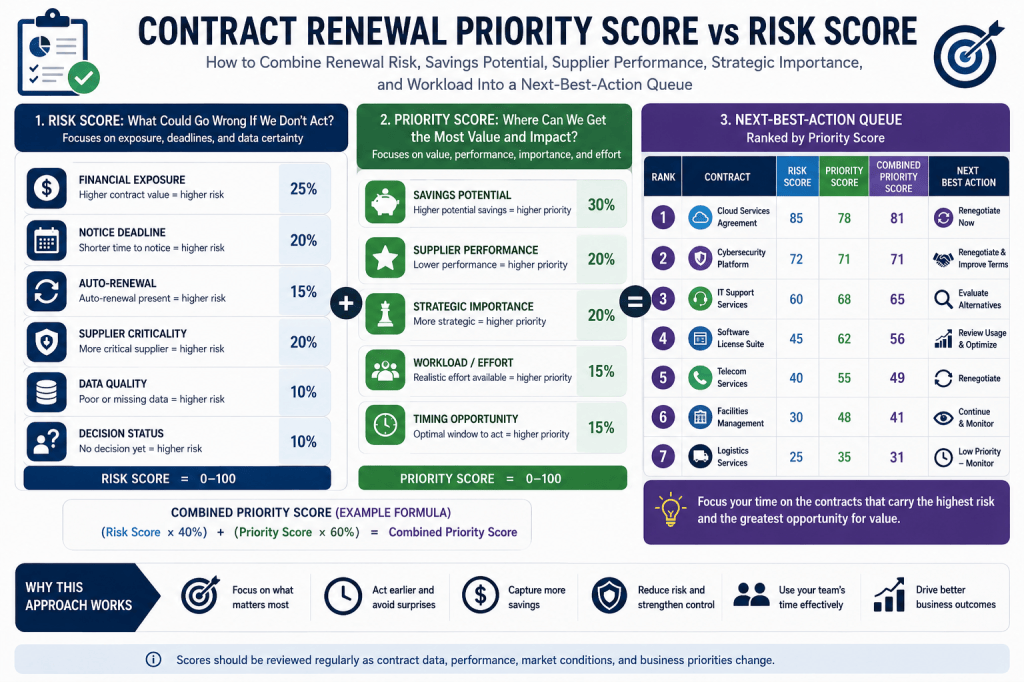
What Is a Contract Renewal Priority Score?
A Contract Renewal Priority Score is a numeric measure used to rank contracts according to the overall importance of taking action.
It can consider:
- renewal risk;
- financial exposure;
- savings opportunity;
- supplier performance;
- strategic importance;
- workload;
- decision readiness;
- transition complexity.
A typical scale could be:
0–24 — Routine
25–49 — Monitor
50–74 — Priority
75–100 — Immediate Attention
The score should answer:
Given everything we know about this contract, how important is it that somebody works on it now?
Risk Score and Priority Score Are Not the Same
The distinction is fundamental.
Risk Score
Measures:
potential renewal failure.
Examples:
- missed notice deadline;
- unwanted auto-renewal;
- missing owner;
- incomplete contract data;
- overdue approval.
Priority Score
Measures:
how valuable or necessary intervention is.
Examples:
- high savings potential;
- strategic supplier negotiation;
- poor supplier performance;
- consolidation opportunity;
- major replacement decision.
Risk is therefore:
one input into priority.
Not:
the entire priority model.
Why You Need Both Scores
Imagine a portfolio of:
1,000 contracts.
A risk model identifies:
45 High or Critical renewals.
Useful.
But Procurement may also need to work on:
20 lower-risk agreements
because:
they represent:
€8 million of potential commercial opportunity.
A combined priority model can surface:
both.
That allows the organization to protect:
against failure
while also pursuing:
value.
The Simplest Model
Think of renewal priority as:
Risk + Opportunity + Strategic Importance − Work Already Completed
Conceptually:
Priority Score =Renewal Risk+ Commercial Opportunity+ Strategic Importance+ Timing− Readiness / Completion
That can then be normalized to:
0–100.
The objective is not mathematical perfection.
It is:
consistent prioritization.
Start with Two Separate Scores
Before creating one combined priority score, calculate:
Renewal Risk Score
0–100.
Renewal Opportunity Score
0–100.
This separation is useful because:
users can understand why something is important.
Risk Score Recap
A renewal risk score might consider:
- notice deadline;
- annual value;
- auto-renewal;
- business criticality;
- decision status;
- data quality;
- ownership.
For example:
Contract A:
Risk Score:
82 — Critical
Contract B:
Risk Score:
38 — Moderate
That tells us:
Contract A needs control attention.
Opportunity Score
Now calculate:
commercial opportunity.
Possible factors:
- Financial Value
- Supplier Price Increase
- Utilization / Demand Reduction
- Supplier Performance
- Consolidation Potential
- Benchmark Gap
- Strategic Negotiation Opportunity
Maximum:
Suggested Opportunity Weighting
| Opportunity Factor | Maximum Points |
|---|---|
| Financial Value | 20 |
| Proposed Price Increase | 15 |
| Utilization / Demand Reduction | 20 |
| Supplier Performance | 10 |
| Consolidation Opportunity | 15 |
| Benchmark Gap | 10 |
| Strategic Negotiation Potential | 10 |
| Total | 100 |
This is only a starting model.
Opportunity Factor 1 — Financial Value: 20 Points
Larger contracts generally provide:
greater absolute optimization potential.
Example scoring:
<€10K
€10K–€50K
€50K–€100K
€100K–€250K
€250K–€500K
€500K–€1M
>€1M
This mirrors the financial factor in:
risk scoring.
That is acceptable because financial scale matters to:
both risk and opportunity.
Opportunity Factor 2 — Supplier Price Increase: 15 Points
A supplier proposing:
0%
increase
may create less negotiation urgency than:
20%.
A possible model:
No Increase / Reduction
0–3%
3–5%
5–10%
10–15%
>15%
This gives Procurement:
a clear commercial signal.
Example
Current annual cost:
€500K.
Supplier proposal:
€575K.
Increase:
15%.
Opportunity points:
12–15.
That renewal deserves:
commercial attention.
Opportunity Factor 3 — Utilization or Demand Reduction: 20 Points
This is particularly important for:
SaaS,
cloud,
telecom,
fleet,
facilities,
and:
service contracts.
Possible scoring:
Utilization >90%
80–90%
70–80%
60–70%
50–60%
<50%
Low utilization creates:
potential quantity reduction.
Example
Purchased licenses:
1,000.
Active:
Utilization:
52%.
Opportunity:
very high.
This may be more valuable than:
negotiating the unit price.
Demand Reduction Outside SaaS
The same concept applies to:
cleaning frequency.
Fleet size.
Telecom lines.
Office space.
Maintenance assets.
Renewal should reflect:
current demand.
Opportunity Factor 4 — Supplier Performance: 10 Points
Poor supplier performance can create:
negotiating leverage
or:
replacement opportunity.
Possible scoring:
Excellent
Good
Acceptable
Poor
Critical Performance Issues
High opportunity does not necessarily mean:
terminate.
It means:
the renewal deserves active commercial review.
Opportunity Factor 5 — Consolidation Potential: 15 Points
A contract may become more valuable when:
other contracts can be combined with it.
Possible scoring:
No Overlap
Small Overlap
Several Related Contracts
Major Cross-Entity / Cross-Business Consolidation
This is especially relevant for:
multi-entity organizations,
M&A,
and:
private equity portfolios.
Example
Supplier:
ExampleCloud.
Contracts:
Entities:
Combined spend:
€2.5M.
Renewals:
within 12 months.
Consolidation score:
This is a strong commercial opportunity.
Opportunity Factor 6 — Benchmark Gap: 10 Points
Suppose:
current price:
€50/user.
Internal benchmark:
€38.
That indicates:
pricing inefficiency.
A possible model:
<3% Gap
3–5%
5–10%
10–20%
>20%
This creates:
data-driven negotiation targets.
Opportunity Factor 7 — Strategic Negotiation Potential: 10 Points
Some agreements deserve strategic attention even when:
pricing looks reasonable.
Examples:
- supplier concentration;
- long-term commitment;
- important contract-term improvements;
- portfolio leverage.
Possible:
Low:
Medium:
High:
Strategic:
This allows:
expert judgment.
Example Opportunity Score
Contract:
€1.2M SaaS agreement.
Supplier increase:
12%.
Utilization:
58%.
Supplier performance:
Acceptable.
Consolidation:
Several related agreements.
Benchmark gap:
15%.
Strategic:
High.
Scores:
Financial:
Price Increase:
Utilization:
Performance:
Consolidation:
Benchmark:
Strategic:
Total:
76/100
Opportunity:
Very High.
Even if deadline risk is only moderate:
Procurement should begin early.
Combining Risk and Opportunity
Now we can create:
a Priority Score.
One simple model:
Priority Score =(60% × Risk Score)+(40% × Opportunity Score)
Why weight risk higher?
Because:
missing a contractual deadline can eliminate:
the opportunity entirely.
Control comes first.
Example A
Risk:
Opportunity:
Priority:
82 × 0.60 = 49.2.
35 × 0.40 = 14.
Total:
63.2
Priority:
High.
Example B
Risk:
Opportunity:
Priority:
22.8 + 30.4
=
53.2
Priority:
High.
Interesting.
Both contracts appear:
important,
but for:
different reasons.
That Is Exactly the Point
Contract A needs attention because:
it could fail.
Contract B needs attention because:
it could create large value.
A priority engine should surface:
both.
Add Strategic Importance
For some organizations, risk and opportunity alone may not be enough.
A contract could be:
critical to the business.
You may therefore use:
Priority Score =50% Risk+35% Opportunity+15% Strategic Importance
This can work well for:
enterprise portfolios.
Strategic Importance Score
Possible:
Low
Medium
High
Critical
Then normalize:
through the weighting.
This keeps:
the underlying score simple.
Example
Risk:
Opportunity:
Strategic Importance:
Priority:
22.5 + 14 + 15
=
51.5.
This contract becomes:
Priority.
Even though:
neither risk nor savings alone is extreme.
That is sensible for:
mission-critical suppliers.
Priority Score Should Also Consider Timing
A huge opportunity in:
18 months
may not need:
today’s attention.
Therefore:
priority should account for:
actionability.
A simple way:
multiply opportunity by:
a timing factor.
Timing Factor
For example:
>365 Days
0.25.
181–365 Days
0.50.
121–180 Days
0.75.
<=120 Days
1.0.
This prevents:
distant opportunities
from dominating:
today’s work queue.
Example
Opportunity Score:
Notice deadline:
300 days.
Timing-adjusted opportunity:
80 × 0.50
=
Now the opportunity remains:
visible,
but not:
urgent.
Transition Lead Time Can Override This
There is one important exception.
Suppose:
notice deadline:
300 days.
Replacement lead time:
12 months.
The contract may actually need:
immediate action.
Therefore:
actionability must consider:
both notice deadline
and:
required lead time.
Actionability Gap
Calculate:
Days Until Notice Deadline − Required Preparation Days
Example:
Notice deadline:
300 days.
Required replacement lead time:
365 days.
Actionability Gap:
−65.
Meaning:
you are already:
65 days late
relative to ideal preparation.
That should increase priority substantially.
This Is a Powerful Metric
For replacement decisions, a simple deadline does not tell:
the whole story.
The real question is:
How much time remains compared with how much time the action requires?
This is:
renewal readiness risk.
Preparation Lead Time
Possible values:
Routine Renewal
30 days.
Standard Negotiation
Retender
Technology Replacement
Strategic Transformation
365+.
Then compare with:
remaining window.
Workload Should Affect Priority Too
A portfolio may identify:
50 high-priority renewals.
But Procurement has:
limited capacity.
This introduces:
another dimension:
Effort.
A useful next-best-action model considers:
value
relative to:
work required.
Effort Score
Possible:
Very Low
Low
Medium
High
Very High
Examples:
Cancel unused subscription:
Low.
Replace ERP:
Very High.
This helps identify:
quick wins.
Priority vs Effort Matrix
Another useful portfolio view:
| Low Effort | High Effort | |
|---|---|---|
| High Priority | Do Now | Plan Now |
| Low Priority | Automate | Defer |
This becomes:
very practical.
High Priority + Low Effort
These are:
quick wins.
Example:
Unused €50K SaaS subscription.
Notice deadline:
60 days.
Decision:
Terminate.
Low migration dependency.
Action:
do it now.
High Priority + High Effort
These require:
program management.
Example:
€5M ERP renewal.
Replacement project:
12 months.
Action:
start now.
Not:
rush later.
Low Priority + Low Effort
Automate.
Example:
routine €1K subscription.
No material change.
Low Priority + High Effort
Usually:
defer.
Unless:
strategic considerations justify it.
This helps protect:
team capacity.
Building a Next-Best-Action Queue
The ultimate purpose of priority scoring is:
not the number itself.
It is:
to generate a work queue.
For example:
1. ExampleCloud — Priority 92
Action:
Begin negotiation and license reduction review.
2. SecurityCo — Priority 89
Action:
Resolve termination decision before notice deadline.
3. TelecomCo — Priority 82
Action:
Consolidate regional contracts.
4. AnalyticsCo — Priority 76
Action:
Verify owner and usage.
Now the user knows:
what to do next.
Priority Without an Action Is Incomplete
A dashboard saying:
Priority = 87
still forces:
the user to interpret.
Better:
Priority 87 — Begin negotiation this week.
This is where:
Next-Best-Action
becomes powerful.
Next-Best-Action Rules
Start with:
deterministic rules.
For example:
IF risk_score >= 75AND decision = UNDECIDEDTHEN action = "Complete Renewal Decision"
Another:
IF utilization < 70%AND notice_deadline <= 120 daysTHEN action = "Review License Quantity"
Another:
IF supplier_price_increase >= 10%AND annual_value >= 100000THEN action = "Begin Commercial Negotiation"
These rules are:
explainable
and:
auditable.
Additional Next-Best-Action Examples
Missing Owner
Assign Contract Owner
Missing Notice Period
Verify Renewal Clause
Auto-Renewal + No Decision
Complete Renewal Review
Supplier Increase >10%
Start Negotiation
Low Utilization
Review Quantity
Poor Performance
Review Supplier Alternatives
Decision = Terminate
Verify and Execute Notice
Decision = Replace
Start Transition Plan
These actions are easy for:
users to understand.
Priority Can Be Role-Specific
The same contract may have:
different priority
for:
different teams.
This is important.
Procurement Priority
Emphasize:
- spend;
- savings opportunity;
- price increase;
- supplier performance.
Legal Priority
Emphasize:
- notice deadline;
- conflicting clauses;
- termination;
- approval status.
Finance Priority
Emphasize:
- financial exposure;
- budget variance;
- commitment value;
- forecast uncertainty.
IT Priority
Emphasize:
- usage;
- technical criticality;
- replacement lead time;
- architecture fit.
This suggests a future capability:
role-specific priority queues.
Example Contract
Cloud Platform.
Annual Value:
€2M.
Notice deadline:
120 days.
Supplier proposes:
+12%.
Usage:
85%.
Replacement complexity:
Critical.
Procurement Priority
High.
IT Priority
Critical.
Legal Priority
Moderate.
Finance Priority
High.
Same contract.
Different perspective.
This is much more realistic than:
one universal queue.
But Start with One Company-Wide Priority Score
For MVP:
do not build:
five separate models.
Use:
one explainable priority score.
Then:
add filters
and:
role-specific views later.
This keeps:
the product usable.
Hard Priority Overrides
As with risk scoring:
some situations should always rise to the top.
Examples:
- Notice deadline passed.
- Critical contract with no decision.
- Termination notice not executed.
- Major contract with unknown notice period.
- Replacement project already behind required lead time.
These should become:
Immediate Attention
regardless of:
the calculated score.
Example Override
IF notice_deadline <= 7 daysAND action_complete = falseTHEN priority = IMMEDIATE
This protects:
against model quirks.
Priority Score Should Decrease as Work Completes
Suppose:
Priority:
Then:
owner assigned.
Decision approved.
Negotiation started.
The priority might fall to:
Then:
final agreement signed.
Priority:
This creates:
a dynamic work queue.
Do Not Let Completed Contracts Stay at the Top
This sounds obvious.
But a static scoring model based mainly on:
contract value and date
can do exactly that.
Workflow state must reduce:
priority.
Priority Trend
Display:
Priority 84 ↑
or:
Priority 51 ↓
This tells the user:
whether the situation is:
getting better
or:
worse.
Example
July 1:
August 1:
August 15:
Why?
Notice deadline approaching.
Decision still missing.
That should trigger:
attention.
Priority Aging
How long has:
a contract remained in:
Immediate Attention?
For example:
12 days.
This becomes:
a management KPI.
High-Priority Aging
A renewal that remains:
high priority
for:
weeks
indicates:
workflow failure.
This can trigger:
escalation.
Workload Balancing
Once priorities exist:
Contract Renewal Tracker could show:
the workload assigned to:
each owner.
Example:
Sarah:
8 high-priority renewals.
Mark:
This can help:
reassign work.
Workload-Adjusted Priority
A more advanced model could consider:
owner capacity.
But be careful.
A critical contract should not become:
less important
because:
the owner is busy.
Instead:
workload should influence:
assignment,
not:
underlying priority.
This distinction matters.
Better Model
Contract Priority
determines:
importance.
Owner Capacity
determines:
who should handle it.
Keep:
the concepts separate.
Portfolio-Level Next-Best-Action Queue
A central dashboard could show:
Immediate Attention
6 contracts.
High Priority
Commercial Opportunities
Data Quality Actions
Routine Renewals
This is much easier to manage than:
128 rows sorted by expiration date.
Executive View
Executives may not need:
contract-level details.
Instead:
Immediate Attention
€4.8M exposure.
High-Priority Opportunities
€7.2M spend.
Estimated Optimization Opportunity
€650K.
Critical Decisions Outstanding
This creates:
management relevance.
Procurement View
Negotiations to Start
License Reviews
Consolidation Opportunities
Supplier Performance Reviews
Now priority becomes:
a work agenda.
Legal View
Notice Clauses to Verify
Terminations to Execute
Contract Conflicts
This reduces:
noise.
Finance View
Approvals Required
Above-Budget Renewals
Low-Confidence Forecasts
Again:
role-specific value.
IT View
Low-Utilization SaaS Renewals
Technology Replacements Behind Schedule
Critical Vendor Dependencies
This becomes:
practical.
Priority Score and Savings Forecast
Suppose:
20 high-opportunity renewals.
Potential opportunity:
€1.4M.
Validated:
€800K.
The priority queue can help:
allocate Procurement effort toward:
the highest expected value.
Expected Value per Hour
A very advanced model could estimate:
commercial opportunity
relative to:
expected effort.
For example:
Contract A
€100K opportunity.
20 hours.
€5K/hour.
Contract B
€200K opportunity.
200 hours.
€1K/hour.
Contract A may be:
the better short-term priority.
This is essentially:
procurement resource optimization.
Do Not Over-Financialize Strategic Decisions
A cybersecurity replacement may have:
low expected savings
but:
high strategic necessity.
So:
expected value per hour
should never become:
the sole prioritization model.
Strategic importance must remain:
visible.
Priority Score Should Be Explainable
When a user clicks:
Priority 88
show:
Renewal Risk
Contribution:
41 points.
Opportunity
Contribution:
27 points.
Strategic Importance
Contribution:
15 points.
Workflow Completion Adjustment
−5.
Total:
Or whatever model is used.
The exact arithmetic should be:
transparent.
Explainable Priority Summary
Even better:
High priority because the contract auto-renews in 28 days, represents €900K annual spend, supplier pricing increased 14%, and usage is only 61%.
That is easier to understand than:
a formula.
AI Can Write the Explanation
The underlying score should remain:
rule-based.
AI can translate:
the factors
into:
natural language.
This creates:
the best of both worlds.
AI Next-Best-Action
A future assistant could say:
Recommended next action: review license quantity before entering supplier negotiation.
Reason: utilization is 61%, the supplier proposes a 14% increase, and 95 days remain before the notice deadline.
This is strong decision support.
AI Can Prioritize Work Across the Portfolio
A user could ask:
What should Procurement focus on this week?
The assistant might answer:
Start with five renewals representing €3.4M of annual spend. Two require immediate deadline action, while three offer substantial license or pricing optimization.
That is a much more useful interaction than:
searching dashboards manually.
AI Should Not Create Hidden Prioritization Logic
The assistant should explain:
which deterministic factors
drive:
the recommendation.
Avoid:
mysterious AI ordering.
Trust requires:
visible reasoning.
AI Can Add Contextual Signals Later
Future signals might include:
- supplier sentiment;
- historic negotiation behavior;
- repeated late proposals;
- prior savings;
- replacement history.
These could improve:
priority.
But they should remain:
secondary to:
reliable core data.
Historical Renewal Memory
Suppose Supplier X:
increased pricing 12%
during each of:
three renewal cycles.
That historical memory may justify:
starting negotiation earlier.
This is exactly where:
longitudinal renewal intelligence
becomes valuable.
Historical Owner Behavior
Suppose one business unit consistently:
submits decisions:
two weeks late.
The system could:
start its workflow earlier.
That is:
adaptive workflow.
Adaptive Lead Times
Instead of:
one 90-day policy,
the system learns:
certain contract types need:
more time.
For example:
Standard SaaS:
90 days.
Supplier X:
120 days because of:
slow negotiation history.
ERP:
365 days because:
replacement complexity is high.
This becomes:
intelligent renewal operations.
But Begin Deterministically
The roadmap should be:
Static Rules
↓
Risk Score
↓
Opportunity Score
↓
Priority Score
↓
Next-Best-Action
↓
Historical Adaptation
↓
Predictive AI
This is a strong product sequence.
Priority Model Calibration
Once real users interact with:
the queue,
track:
whether they agree.
Ask:
Was this contract correctly prioritized?
Then:
compare score
with:
actual intervention.
This helps refine:
weights.
Measure Priority Precision
Of the top:
20 contracts,
how many genuinely required:
significant action?
If only:
5,
the score is too noisy.
Measure Opportunity Conversion
Of high-opportunity contracts:
how many generated:
validated value?
This tests:
commercial usefulness.
Measure Risk Resolution
Of high-risk contracts:
how quickly did:
priority fall
after intervention?
This tests:
workflow effectiveness.
User Trust
The most important metric may be:
Do users actually use the ranked queue?
If they ignore it
and build:
their own spreadsheet,
the prioritization model is not helping.
Avoid Score Inflation
If:
80% of contracts
are High Priority,
the score is useless.
The system must create:
meaningful separation.
A Healthy Queue
For example:
Immediate:
3%.
High:
12%.
Monitor:
30%.
Routine:
55%.
This gives:
real prioritization.
Actual distributions will vary.
Do Not Force a Bell Curve
If an acquisition produces:
100 genuinely urgent contracts,
the system should show:
100 urgent contracts.
Accuracy comes before:
aesthetic distribution.
Priority Score as a Core Product Feature
This could become one of the strongest differentiators for Contract Renewal Tracker.
Most systems can show:
upcoming renewals.
A more intelligent platform can say:
Here are the five renewals where your team should act first—and why.
That is substantially more valuable.
Potential Dashboard Design
For each contract:
Priority
Risk
Opportunity
Next Action
Example:
| Contract | Priority | Risk | Opportunity | Next Action |
|---|---|---|---|---|
| Cloud Platform | 91 | 78 | 92 | Start negotiation |
| CRM | 88 | 95 | 60 | Complete decision |
| Design Software | 76 | 45 | 90 | Review licenses |
| Security MSP | 72 | 80 | 45 | Verify replacement |
This tells:
a complete story.
Priority Score as a Filter
Users could filter:
Priority >75
or:
Opportunity >80
or:
Risk >80
This gives:
different work modes.
“Protect” Mode
Show:
highest risk.
Useful for:
Renewal Operations.
“Save” Mode
Show:
highest opportunity.
Useful for:
Procurement.
“Strategic” Mode
Show:
highest criticality.
Useful for:
leadership.
This could become:
an elegant product interface.
Daily Priority Brief
A daily digest might say:
Today’s Renewal Priorities
3 immediate actions.
2 commercial opportunities.
1 termination deadline.
€2.7M of contracts represented.
This is highly actionable.
Weekly Procurement Brief
This Week’s Renewal Opportunities
€5.4M in upcoming negotiations.
€420K estimated optimization potential.
Three contracts require quantity review before supplier engagement.
Again:
very useful.
Contract Renewal Tracker Beta
The initial beta does not need:
a sophisticated Priority Score.
A simple first version can rank by:
- Days to notice deadline.
- Annual value.
- Auto-renewal.
- Decision missing.
This creates:
an initial priority queue.
Beta Priority Formula
For example:
Deadline
40 points.
Annual Value
Auto-Renewal
Decision Status
Total:
This is simple enough:
to explain and test.
Beta Example
€500K.
Notice deadline:
18 days.
Auto-renewal:
Yes.
Decision:
Undecided.
Deadline:
Value:
Auto:
Decision:
Priority:
Immediate Attention.
That works.
Post-Beta Phase 1
Separate:
Risk Score
and:
Priority Score.
Phase 2
Add:
Opportunity Score.
Phase 3
Add:
Next-Best-Action rules.
Phase 4
Add:
role-specific queues.
Phase 5
Add:
historical learning.
Phase 6
Add:
AI-assisted predictive prioritization.
This creates:
a strong roadmap.
Product Positioning
A strong message:
Know What to Work on Next.
Very simple.
Another
Turn Your Renewal Portfolio Into a Prioritized Action Queue.
Strong for:
operations.
Another
Prioritize Contract Renewals by Risk and Value—not Just Expiration Date.
Excellent SEO/product messaging.
Another
Find the Renewals That Can Hurt You—and the Ones That Can Save You Money.
Very strong commercial message.
Another
From Renewal Risk to Next Best Action.
Excellent strategic positioning.
Lead Magnet Opportunity
This article is ideal for:
Contract Renewal Priority Scoring Calculator
Users enter:
- risk score;
- annual value;
- supplier increase;
- utilization;
- performance;
- strategic importance;
- deadline.
Then receive:
Priority Score: 87/100 — Immediate Attention
and:
Recommended Next Action: Begin Negotiation and Quantity Review
This would connect:
SEO,
lead generation,
and:
the future SaaS product.
Downloadable Priority Template
Another asset:
Contract Renewal Priority Score Excel Template
Columns:
- Risk Score;
- Opportunity Score;
- Strategic Score;
- Priority Score;
- Next Action;
- Owner.
This could become:
a useful prospect tool.
Suggested CTA
Download the Contract Renewal Priority Scoring Template
Rank upcoming contracts using renewal risk, financial exposure, savings potential, supplier performance, strategic importance, and required action so your team can focus on the renewals that matter most.
Download the Free Priority Score Template →
Interactive Next-Best-Action Tool
Eventually:
visitor enters:
contract details.
Result:
Priority Score: 91 — Immediate Attention
Risk: Critical.
Opportunity: High.
Recommended actions:
- Complete renewal decision.
- Review license quantity.
- Begin supplier negotiation.
Then:
Manage Your Entire Portfolio in Contract Renewal Tracker →
This could be an excellent product-led SEO funnel.
Contract Renewal Tracker Beta Launch — September 21, 2026
Contract Renewal Tracker is launching its first SaaS beta on September 21, 2026. The beta focuses on the fundamentals needed to create a reliable renewal priority view: contract values, notice periods, owners, auto-renewal status, deadlines, and explicit renewal decisions. As the platform develops, these structured signals can support separate risk and opportunity scores, explainable priority ranking, and next-best-action queues that help teams focus on the contracts where intervention creates the greatest protection or commercial value. [Notify Me When the Beta Launches →] (One launch notification only — no newsletter or ongoing marketing emails.)
Why This Could Become a Core Differentiator
A traditional contract tracker answers:
What is renewing?
A risk engine answers:
What could go wrong?
An opportunity engine answers:
Where could we create value?
A priority engine answers:
What should we work on next?
And a next-best-action engine answers:
What should we actually do?
That progression is significant.
The Product Intelligence Stack
Conceptually:
Contract Data
↓
Deadline Intelligence
↓
Risk Score
↓
Opportunity Score
↓
Priority Score
↓
Next-Best-Action
↓
Workflow
↓
Outcome
That could become the central intelligence architecture for Contract Renewal Tracker.
Final Thoughts
Contract renewal prioritization is fundamentally about:
allocating scarce attention.
No Procurement, Finance, Legal, IT, or Operations team has unlimited time.
Therefore the objective should not be:
Treat every contract equally.
It should be:
Apply the right level of attention to the contracts where timing, risk, financial value, commercial opportunity, and strategic importance justify it.
That requires separating:
Risk
from:
Opportunity
and then combining them into:
Priority.
The most powerful end state is not:
a score.
It is:
a ranked list of actions.
Instead of:
Contract A — 90
Contract B — 82
Contract C — 77
the system should say:
1. Complete the €800K auto-renewal decision today.
2. Begin license reduction and negotiation on the €1.2M SaaS agreement.
3. Start replacement planning for the critical MSP contract.
That is where Contract Renewal Tracker begins to move beyond:
contract administration
and toward:
decision orchestration.
The product is no longer merely storing:
renewal information.
It is helping the organization decide:
where to focus, why it matters, and what to do next.
Next Article in the Contract Renewal Tracker Series
The next article can move from priority ranking into the actual recommendation engine and define how Contract Renewal Tracker should generate actions such as Renew, Renegotiate, Reduce, Replace, Escalate, Verify Clause, Start Negotiation, Review Licenses, Request Approval, or Send Termination Notice while keeping recommendations explainable, permission-aware, and safely separated from autonomous execution.

