A contract renewal portfolio can contain hundreds or thousands of agreements.
The problem is not only knowing:
which contracts are renewing.
It is knowing:
Which renewals deserve attention first?
A €2,000 software subscription with 20 days remaining is not necessarily more important than a €2 million outsourcing agreement with 75 days remaining.
Likewise, a contract with a distant expiration date may still be urgent if:
- the notice deadline is close;
- the agreement auto-renews;
- the owner is missing;
- the supplier is business-critical;
- renewal terms are unverified;
- no decision has been made.
This is why a mature renewal-management process benefits from a structured Contract Renewal Risk Score.
A risk score combines several signals into one explainable priority indicator, helping teams focus limited time on the contracts where delay, poor data, or weak governance could create the greatest financial or operational impact.
This article explains how to build a practical 0–100 Contract Renewal Risk Score, how to weight the factors, how to avoid misleading scores, and how the model could eventually become a core intelligence feature inside Contract Renewal Tracker.
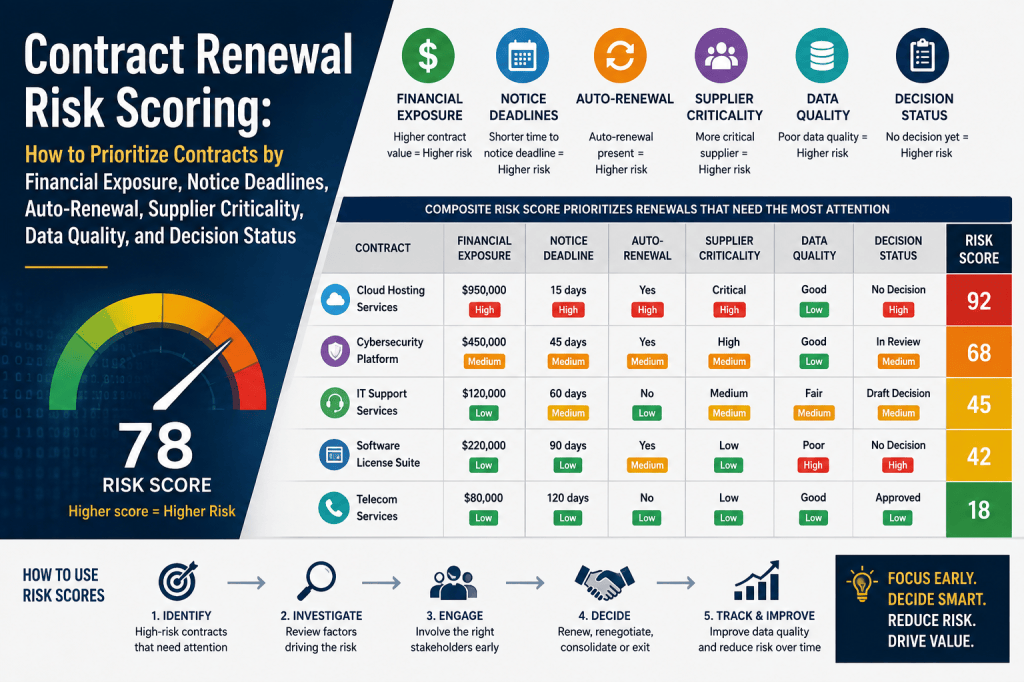
What Is a Contract Renewal Risk Score?
A Contract Renewal Risk Score is a numeric measure that estimates how urgently a contract requires renewal attention.
For example:
0–24 — Low
25–49 — Moderate
50–74 — High
75–100 — Critical
The score should not try to predict:
whether the supplier is good or bad.
It should answer:
How much renewal-management attention does this contract require right now?
That is a narrower and more useful objective.
Why Risk Scoring Matters
Without prioritization, a renewal dashboard may simply show:
83 Contracts Renewing Soon
That creates another problem:
where do you start?
A risk-scored dashboard could instead show:
Critical
High
Medium
Low
Now the team can focus first on:
the seven critical renewals.
Risk Is Not the Same as Contract Value
A large contract is not automatically:
high renewal risk.
Suppose:
Contract A:
€5M.
Decision approved.
Supplier negotiations complete.
Notice deadline:
180 days away.
Risk:
probably moderate or low.
Contract B:
€150K.
Auto-renews.
No owner.
Notice deadline:
12 days away.
Risk:
critical.
That distinction is exactly why multiple factors are needed.
What Should a Contract Renewal Risk Score Consider?
A practical model can include seven dimensions:
- Notice Deadline Proximity
- Financial Exposure
- Auto-Renewal
- Business Criticality
- Decision Status
- Data Quality
- Ownership and Workflow Status
These factors capture both:
impact
and:
likelihood of renewal failure.
Suggested Weighting
A simple 100-point model could be:
| Risk Factor | Maximum Points |
|---|---|
| Notice Deadline Proximity | 30 |
| Financial Exposure | 20 |
| Auto-Renewal | 10 |
| Business Criticality | 15 |
| Decision Status | 10 |
| Data Quality | 10 |
| Ownership / Workflow | 5 |
| Total | 100 |
This is a practical starting point.
The precise weights should eventually be tested against:
real customer behavior and outcomes.
Factor 1 — Notice Deadline Proximity: 30 Points
Time is usually the most important renewal-risk variable.
The closer the organization gets to:
the contractual notice deadline,
the fewer options remain.
A possible scoring model:
More Than 180 Days
0 points.
121–180 Days
5 points.
91–120 Days
10 points.
61–90 Days
15 points.
31–60 Days
20 points.
15–30 Days
25 points.
0–14 Days
30 points.
This creates an intuitive urgency curve.
Why Use Notice Deadline Instead of Contract End Date?
Because the notice deadline often determines:
when the organization loses flexibility.
Example:
Contract end:
December 31.
Notice deadline:
September 30.
Today:
September 20.
Days to contract end:
Days to notice deadline:
Expiration-based scoring says:
not urgent.
Notice-based scoring says:
Critical.
The second is operationally correct.
What If There Is No Notice Period?
That should not mean:
zero risk.
Missing notice information creates:
uncertainty.
You can address that through:
the Data Quality factor.
For high-value contracts, you may also apply:
a minimum risk floor.
More on that later.
Factor 2 — Financial Exposure: 20 Points
Financial value determines:
the scale of potential impact.
A possible model:
<€10K
2 points.
€10K–€50K
€50K–€100K
€100K–€250K
€250K–€500K
€500K–€1M
>€1M
This is simple and understandable.
Do Not Use Value Alone
A €10M agreement with:
a completed renewal
should not stay:
Critical
just because it is large.
Value should influence:
priority.
It should not determine it alone.
Use Annual Value or Total Commitment?
That depends on the objective.
For day-to-day renewal prioritization:
Annual Contract Value
is often useful.
For approval or commitment risk:
Total Contract Value
may matter more.
Contract Renewal Tracker could eventually support:
both.
Multi-Year Example
Annual Value:
€500K.
Term:
5 years.
TCV:
€2.5M.
Risk scoring:
financial points based on ACV.
Approval routing:
based on TCV.
This keeps:
risk and governance logic separate.
Factor 3 — Auto-Renewal: 10 Points
Automatic renewal increases risk because:
inaction itself can become a financial commitment.
A simple score:
No Auto-Renewal
Unknown
Yes
This intentionally treats:
Unknown
as risk.
Missing information should not be equivalent to:
No.
Auto-Renewal + Near Deadline
A contract that:
auto-renews
and:
has 14 days remaining
should become:
highly prioritized.
This is where factor combination works well.
Example
Notice Proximity:
30 points.
Auto-Renewal:
Financial Exposure:
Already:
54 points.
Before considering:
criticality,
ownership,
decision status.
This may easily become:
Critical.
Factor 4 — Business Criticality: 15 Points
A contract can have:
modest financial value
but:
high operational impact.
Examples:
- cybersecurity;
- payroll;
- identity management;
- production maintenance;
- telecom.
Therefore:
criticality deserves its own factor.
Criticality Scoring
Low
0 points.
Medium
High
Critical
This value should ideally be:
assigned by the business owner
or:
risk function.
Example
Fire alarm maintenance:
€20K.
Value score:
Business Criticality:
This prevents the contract from appearing:
low risk
simply because:
the spend is small.
Criticality Should Not Be Automatically Derived from Spend
A €2M marketing agreement can be:
commercially large
but:
operationally replaceable.
A €30K specialist security tool may be:
mission-critical.
Keep the dimensions:
separate.
Factor 5 — Decision Status: 10 Points
A renewal with a final approved decision is:
less risky
than:
one that remains undecided.
A possible model:
Executed / Completed
Approved Decision
Decision Proposed
Under Review
Not Started
Overdue / Undecided
This converts:
decision readiness
into risk.
Why Decision Status Matters
Suppose:
notice deadline:
30 days.
But decision:
Terminate.
Legal notice:
already sent.
The contract should not remain:
Critical.
Its deadline may be close,
but:
the critical action is complete.
Risk scoring must incorporate:
workflow progress.
Completed Actions Should Reduce Risk
This is an important design principle.
A static date-only score remains high:
even after the problem is solved.
A workflow-aware score should fall as:
controls are completed.
This makes the score:
operationally meaningful.
Factor 6 — Data Quality: 10 Points
Poor contract data creates:
hidden risk.
Consider:
- missing notice period;
- unknown auto-renewal;
- missing end date;
- unverified clause;
- conflicting terms.
A contract with unreliable metadata should score:
higher.
Example Data Quality Model
All Critical Fields Verified
Minor Missing Information
One Critical Field Unverified
Several Critical Fields Missing
Governing Terms Conflicting / Unusable
This creates:
data-quality risk.
Critical Fields
For renewal management, critical fields could include:
- end date;
- notice period;
- auto-renewal;
- owner;
- annual value.
But not all fields carry:
equal importance.
Notice period uncertainty should usually weigh more heavily than:
missing category.
Source Verification
A useful future status could be:
Verified
Unverified
AI Extracted
Conflicting
This lets Contract Renewal Tracker distinguish:
confidence.
Factor 7 — Ownership and Workflow Status: 5 Points
A contract with:
no accountable owner
is inherently more dangerous.
Possible model:
Active Owner + Workflow On Track
Owner Assigned but Task Overdue
Owner Inactive / Reassignment Needed
No Owner
Simple.
But valuable.
Why Owner Risk Is Lower Weight
Ownership is important.
But once:
deadline,
value,
criticality,
and:
decision status
are already included,
a 5-point weight may be sufficient.
This avoids:
double-counting.
Full Risk Score Formula
Conceptually:
Renewal Risk Score =Deadline Risk+ Financial Risk+ Auto-Renewal Risk+ Criticality Risk+ Decision Risk+ Data Quality Risk+ Ownership Risk
Maximum:
This is easy to explain.
Explainability is:
important.
Example 1 — Critical Auto-Renewal
Annual Value:
€800K.
Notice Deadline:
12 days.
Auto-Renewal:
Yes.
Criticality:
High.
Decision:
Undecided.
Data:
Complete.
Owner:
Assigned.
Scores:
Deadline:
Value:
Auto-Renewal:
Criticality:
Decision:
Data:
Ownership:
Total:
77/100
Classification:
Critical.
That feels reasonable.
Example 2 — Large but Controlled Contract
Annual Value:
€3M.
Notice Deadline:
120 days.
Auto-Renewal:
Yes.
Criticality:
Critical.
Decision:
Approved Renew.
Data:
Verified.
Owner:
Assigned.
Scores:
Deadline:
Value:
Auto-Renewal:
Criticality:
Decision:
Data:
Owner:
Total:
57/100
Classification:
High.
But perhaps:
too high.
This reveals an important issue:
the scoring model may need:
risk-reduction modifiers.
Risk Reduction Modifiers
If:
decision approved
and:
execution tasks are on track,
reduce:
the score.
For example:
Approved + Workflow On Track
−10.
Contract Executed
−30.
This can make:
the score more realistic.
Revised Example
Original:
Approved and on track:
−10.
Final:
Classification:
Moderate.
That is probably:
more appropriate.
Example 3 — Low-Value but Uncontrolled
Annual Value:
€8K.
Notice Deadline:
5 days.
Auto-Renewal:
Yes.
Criticality:
Low.
Decision:
Not Started.
Data:
Notice verified.
Owner:
Missing.
Scores:
30 + 2 + 10 + 0 + 8 + 0 + 5
=
55
High Risk.
That also makes sense.
The spend is small,
but:
the process is clearly failing.
Example 4 — High-Value Contract with Bad Data
Annual Value:
€1.5M.
End Date:
known.
Notice Period:
unknown.
Auto-Renewal:
unknown.
Criticality:
High.
Decision:
Not Started.
Owner:
assigned.
Suppose:
deadline cannot be calculated.
Scores:
Financial:
Auto-Renewal Unknown:
Criticality:
Decision:
Data Quality:
Ownership:
Total before deadline:
Even without a deadline score:
High Risk.
This is useful.
Poor data should itself:
surface the contract.
What If Deadline Cannot Be Calculated?
Do not assign:
That implies:
safe.
Use one of three approaches:
Option 1 — Risk Floor
Minimum:
Option 2 — Missing Deadline Penalty
Add:
Option 3 — Separate Unknown Risk Status
Label:
Critical Data Missing
I prefer:
Option 3 plus a numeric penalty.
This preserves:
explainability.
Hard Rules Can Override the Score
Pure scoring is not always enough.
Some conditions should automatically trigger:
Critical.
For example:
IF notice_deadline <= 7 daysAND decision = UNDECIDEDTHEN risk = CRITICAL
Or:
IF annual_value >= 1,000,000AND notice_period = UNKNOWNTHEN risk = CRITICAL
These are:
override rules.
Why Override Rules Matter
Suppose:
weighted score = 68.
But:
termination notice must be sent tomorrow.
You do not want the system saying:
High.
You want:
Critical.
Deterministic safeguards should override:
the general scoring model.
Recommended Critical Overrides
Consider rules such as:
- Notice deadline passed and action incomplete.
- Notice deadline <=7 days and no decision.
- Termination selected but notice not sent.
- High-value contract with missing notice period.
- Owner missing inside critical window.
- Auto-renewing contract with no decision inside 14 days.
These are strong operational controls.
Risk Score vs Priority Score
It may eventually be useful to distinguish:
Risk Score
from:
Opportunity Score.
They answer:
different questions.
Risk Score
Where might something go wrong?
Factors:
deadline,
criticality,
missing data,
no decision.
Opportunity Score
Where could we create commercial value?
Factors:
spend,
price increase,
low utilization,
poor supplier performance,
supplier overlap.
This distinction can become:
a powerful Contract Renewal Tracker feature.
Example
Contract A:
High Risk.
Low Opportunity.
Why?
Critical service,
near deadline,
but:
good pricing.
Contract B:
Low Risk.
High Opportunity.
Why?
Renewal in 150 days,
but:
large underutilized SaaS estate.
These deserve:
different actions.
Dual Matrix
A useful dashboard could show:
| Low Opportunity | High Opportunity | |
|---|---|---|
| High Risk | Protect | Act Now |
| Low Risk | Monitor | Optimize |
This gives teams:
a much more strategic view.
Quadrant 1 — High Risk / High Opportunity
Top priority.
Example:
€1M software contract.
Low utilization.
Supplier asks +15%.
Notice deadline in 30 days.
Action:
immediate review.
Quadrant 2 — High Risk / Low Opportunity
Focus on:
control.
Example:
critical maintenance contract
with:
near deadline.
Goal:
avoid disruption.
Quadrant 3 — Low Risk / High Opportunity
Plan:
commercial optimization.
Example:
large SaaS contract
renewing in:
six months.
Lots of unused licenses.
Good time to:
prepare.
Quadrant 4 — Low Risk / Low Opportunity
Routine.
Automate:
as much as possible.
This supports:
exception-based renewal management.
Renewal Risk Should Change Over Time
A good score is:
dynamic.
Day 120:
Day 60:
Decision recorded:
Approval complete:
Renewal executed:
This tells:
the operational story.
Risk Trend Is Valuable
Instead of only:
current risk,
show:
trend.
For example:
Risk: 76 ↑
Meaning:
worsening.
or:
Risk: 42 ↓
Meaning:
improving.
This could be highly useful.
Why Risk Increased
The system should explain:
Risk increased from 54 to 76 because the notice deadline is now within 30 days and the business decision remains overdue.
This is:
explainable scoring.
Why Risk Decreased
Risk decreased because the renewal decision was approved and the supplier notice was successfully delivered.
Again:
transparent.
Never Use a Black-Box Score
A user should be able to click:
Risk = 82
and see:
Deadline
30 / 30.
Financial Exposure
17 / 20.
Auto-Renewal
10 / 10.
Criticality
10 / 15.
Decision
10 / 10.
Data Quality
5 / 10.
Ownership
0 / 5.
This builds:
trust.
Explainability Is Especially Important for AI
If AI later modifies:
risk or priority,
users need to understand:
why.
Do not show:
AI Risk = 92.
without:
drivers.
This creates:
unnecessary opacity.
Rule-Based First, AI Later
For the first version:
use deterministic scoring.
Why?
It is:
- testable;
- explainable;
- configurable;
- auditable.
AI can later:
add context.
This is the safer product architecture.
AI Could Add Qualitative Risk
For example:
AI identifies:
supplier performance deterioration.
Or:
conflicting notice language.
These could become:
additional signals.
But the core score should remain:
transparent.
AI-Assisted Risk Explanation
A future assistant might say:
This contract is Critical because it auto-renews in 18 days, represents €720K annual spend, and still has no approved renewal decision.
That is useful.
AI-Assisted Prioritization
Instead of:
40 high-risk contracts,
the assistant could say:
These five require attention first because they combine financial exposure, near-term notice deadlines, and unresolved decisions.
This helps:
workload prioritization.
AI Should Not Reduce Deterministic Risk Without Evidence
Suppose:
rule engine says:
Critical.
AI should not independently decide:
it looks safe.
Hard controls must remain:
authoritative.
AI can:
augment,
not override.
Category-Specific Risk Models
Eventually, different contract categories may require:
slightly different weights.
SaaS Risk Model
Emphasize:
- auto-renewal;
- utilization;
- price increase.
Facilities Risk Model
Emphasize:
- criticality;
- transition lead time;
- service continuity.
Legal Risk Model
Emphasize:
- notice verification;
- conflicting terms;
- termination execution.
Strategic Supplier Model
Emphasize:
- spend;
- criticality;
- switching complexity.
This creates:
more accurate prioritization.
But Avoid Too Many Models Initially
For MVP:
one general model
is better than:
15 complicated variations.
Start simple.
Then learn from:
real users.
User-Configurable Weights
Eventually, customers may want:
their own weighting.
For example:
financial-services company:
higher risk weighting.
Small SaaS company:
higher auto-renewal weighting.
A settings screen could allow:
configuration.
Example Configuration
Notice Deadline:
30%.
Financial Exposure:
15%.
Auto-Renewal:
15%.
Criticality:
20%.
Decision:
10%.
Data Quality:
5%.
Ownership:
5%.
Total:
100%.
This creates:
flexibility.
Guardrails for Weight Configuration
Do not allow:
Deadline Weight = 0
for every organization.
Certain controls may need:
minimum weights.
Otherwise:
customers could accidentally destroy:
risk logic.
Use:
reasonable guardrails.
Risk Threshold Configuration
Customers may also want:
custom thresholds.
Default:
0–24 Low.
25–49 Moderate.
50–74 High.
75–100 Critical.
But some organizations may want:
Critical at 70.
This could be:
configurable later.
Risk Score and Notifications
Risk can directly drive:
notifications.
For example:
Low
No urgent alerts.
Moderate
Standard reminder.
High
Owner + manager.
Critical
Immediate escalation.
This makes the score:
operational.
Risk Score and Dashboard Sorting
Default dashboard should probably sort:
highest risk first.
Not:
alphabetically.
This helps:
users focus.
Risk Score and Work Queues
Examples:
Critical Renewals
High-Risk Renewals
Data Quality Risk
Unowned Contracts
This creates:
clear work queues.
Risk Score and Management Reporting
Executives can see:
Critical Exposure
€3.4M.
High-Risk Exposure
€9.1M.
This is more meaningful than:
contract counts alone.
Financial Risk Exposure
One useful metric:
Risk-Weighted Contract Value
For example:
Contract Value × Risk Score / 100.
Contract:
€1M.
Risk:
Risk-Weighted Exposure:
€800K.
This can help:
portfolio prioritization.
Use Risk-Weighted Exposure Carefully
It is not:
expected financial loss.
Do not present:
€800K
as:
money expected to be lost.
It is simply:
a prioritization metric.
Naming matters.
Use:
Risk-Weighted Renewal Exposure
not:
Expected Loss.
Portfolio Example
Contract A:
€1M × 80%
=
€800K.
Contract B:
€2M × 30%
=
€600K.
Contract A ranks:
higher.
This can be useful.
Risk Distribution by Supplier
Example:
Supplier X:
four contracts.
Average risk:
Supplier Y:
six contracts.
Average risk:
This can identify:
supplier-related concentration.
Risk Distribution by Department
IT:
72 average.
Finance:
Operations:
This might reveal:
governance gaps.
Risk Distribution by Entity
Germany:
Netherlands:
France:
This supports:
multi-entity management.
Risk Distribution for Private Equity Portfolios
Portfolio Company A:
B:
C:
Operating team can focus:
support.
This connects directly to:
the broader product architecture.
Risk Score as a Health Metric
At contract level:
Risk = bad when high.
At portfolio level:
you could calculate:
Renewal Health Score = 100 − Average Weighted Risk
Example:
Average risk:
Portfolio Health:
This may be:
easier for executives to understand.
Avoid Oversimplifying Portfolio Health
Averages can hide:
critical contracts.
Example:
999 low-risk contracts.
1 critical €20M agreement.
Average looks:
excellent.
Therefore:
always show:
critical exceptions
alongside:
portfolio score.
Recommended Portfolio Dashboard
Renewal Health
82/100.
Critical Contracts
Critical Value
€6.2M.
High Risk
Missing Notice Data
This provides:
balanced reporting.
Risk Score and Audit
The risk model can also support:
audit sampling.
Internal Audit can select:
- highest-risk contracts;
- random contracts.
This creates:
risk-based assurance.
Risk Score and Governance
Governance rules can use:
risk.
For example:
IF risk_score >= 75THEN require_management_review = true
This creates:
dynamic governance.
Risk Score and Approval
Potential rule:
IF risk_score >= 80AND annual_value >= 250000THEN require_CFO_visibility = true
This helps:
material exception management.
Risk Score and Legal Review
For example:
IF data_quality_risk >= 8AND notice_deadline <= 60_daysTHEN require_legal_review = true
This is more targeted than:
Legal reviews everything.
Risk Score and Procurement
Example:
IF financial_exposure >= 14AND decision = RENEGOTIATETHEN procurement_priority = HIGH
This turns:
risk intelligence
into workflow.
Risk Score and AI Assistant
A user could ask:
Why is this contract Critical?
Assistant:
Three main factors drive the score: 14 days remain before the notice deadline, the €850K contract auto-renews for another year, and the business decision is still overdue.
This is exactly:
the kind of explainable AI
users can trust.
Contract Renewal Tracker Beta
For the first beta:
you do not need:
the complete seven-factor risk engine.
A simpler initial score might use:
just three inputs:
Deadline
50%.
Value
25%.
Auto-Renewal / Decision
25%.
This can provide:
useful prioritization
without excessive complexity.
Beta Risk Model
For example:
Deadline Risk
0–50.
Financial Risk
0–25.
Control Risk
0–25.
Total:
That may be enough for:
initial testing.
Beta Risk Example
Contract:
€300K.
Notice deadline:
20 days.
Auto-renewal:
Yes.
Decision:
Undecided.
Deadline:
Financial:
Control:
Total:
Critical.
This is easy to understand.
Post-Beta Phase 1
Add:
Business Criticality.
Phase 2
Add:
Data Quality.
Phase 3
Add:
Owner and Workflow.
Phase 4
Add:
Supplier Performance and Opportunity Score.
This creates:
progressive sophistication.
Risk Model Calibration
Once real users generate:
data,
analyze:
which high-risk contracts actually:
- escalated;
- missed deadlines;
- required urgent intervention.
Then adjust:
weights.
This is:
model calibration.
Do Not Optimize Against Synthetic Scenarios Alone
The initial model will be:
an informed design.
The better model comes from:
real customer outcomes.
That is another reason:
to introduce scoring gradually.
Risk Model Evaluation Metrics
You could measure:
Precision
How many Critical contracts genuinely needed urgent action?
Recall
How many urgent contracts were correctly marked Critical?
Stability
Does the score change sensibly over time?
Explainability
Do users understand the score?
These are strong product metrics.
User Trust Metric
Ask:
Did the risk ranking match your own judgment?
Score:
1–5.
If users consistently disagree:
the model needs adjustment.
False Positive Problem
If every contract becomes:
High or Critical,
users will ignore:
the score.
This is the same problem as:
alert fatigue.
The distribution should be:
useful.
Desired Distribution
For a healthy portfolio, perhaps:
Low:
40–60%.
Moderate:
20–30%.
High:
10–20%.
Critical:
small minority.
Actual distribution will vary.
But:
Critical should remain:
meaningful.
False Negative Problem
More dangerous:
a genuinely urgent contract appears:
Low.
Hard override rules help:
prevent this.
This is why:
deterministic critical controls
matter.
Risk Score Lead Magnet
This article is ideal for:
Contract Renewal Risk Scoring Calculator
Visitors could enter:
- annual value;
- days to notice deadline;
- auto-renewal;
- criticality;
- decision status;
- data quality;
- owner status.
Then receive:
Risk Score: 82/100 — Critical
This could be a strong interactive SEO and lead-generation tool.
Suggested Result
Your Contract Renewal Risk Score: 82/100 — Critical
Primary drivers:
Notice deadline within 14 days.
Auto-renewal enabled.
Renewal decision still outstanding.
Recommended action: assign an accountable owner and complete the renewal decision immediately.
Then:
Track All Renewal Risks in Contract Renewal Tracker →
This creates:
direct product relevance.
Downloadable Lead Magnet
Also offer:
Contract Renewal Risk Scoring Excel Template
with:
- formulas;
- weights;
- thresholds;
- examples.
This would be particularly useful for:
Procurement and Finance teams.
Download the Contract Renewal Risk Scoring Template
Prioritize your contract portfolio using a practical 0–100 scoring model based on notice deadlines, annual value, auto-renewal exposure, business criticality, decision status, data quality, and ownership.
Download the Free Risk Scoring Template →
Contract Renewal Tracker Beta Launch — September 21, 2026
Contract Renewal Tracker is launching its first SaaS beta on September 21, 2026. The beta focuses on giving businesses a centralized view of contract dates, notice periods, owners, values, auto-renewals, and upcoming actions so important renewals can be identified before deadlines become urgent. As the platform develops, those structured signals can support explainable renewal-risk scoring that helps teams distinguish routine contracts from the small number requiring immediate management attention. [Notify Me When the Beta Launches →] (One launch notification only — no newsletter or ongoing marketing emails.)
Strong Product Positioning Opportunity
Risk scoring could become one of Contract Renewal Tracker’s most visible differentiators.
Instead of showing:
47 contracts renewing soon
show:
3 Critical renewals require action today.
That is far more valuable.
Homepage Message
A strong future message:
Know Which Contract Renewals Matter Most.
Subheading:
Contract Renewal Tracker prioritizes upcoming agreements by deadline risk, financial exposure, auto-renewal, ownership, and decision status so your team knows where to act first.
This is:
clear and differentiated.
Another Positioning Option
From Renewal Calendar to Renewal Priority Engine.
Strong for:
mid-market buyers.
Another
Stop Treating Every Contract Renewal as Equally Urgent.
Excellent pain-point message.
Another
Prioritize Renewal Risk Before It Becomes Renewal Cost.
Strong commercial positioning.
Risk Score as Product Navigation
The home dashboard could default to:
Critical
then:
High.
This means the product itself is:
organized around priority
rather than:
a database table.
That is a better user experience.
Risk Score and Daily Digest
Example:
Your Renewal Risk Brief
3 Critical renewals.
€1.8M critical exposure.
5 contracts moved to High Risk.
2 risks resolved yesterday.
This could be:
very useful.
Risk Score and Weekly Management Report
Example:
Critical Contracts
4 → 2.
Critical Exposure
€3.2M → €1.1M.
New High-Risk Contracts
Resolved
This shows:
progress.
Risk Aging
Track:
how long a contract remains:
Critical.
Example:
Critical for:
12 days.
This can reveal:
governance failures.
Critical Aging KPI
Target:
short.
If critical renewals remain:
unresolved for weeks,
the process is not working.
Risk Resolution Rate
How many High/Critical renewals move to:
lower risk
within:
target time?
This could become:
another KPI.
Risk Velocity
How quickly is risk:
increasing?
Example:
Score:
40 → 70
in:
two weeks.
This may warrant:
attention.
This could eventually become:
a sophisticated analytics feature.
Historical Risk Timeline
A contract record could show:
June 1:
July 1:
August 1:
August 5:
Decision Approved.
August 5:
August 20:
Negotiation Complete.
Risk:
This is:
excellent operational history.
Risk Score and Renewal Memory
Over multiple cycles:
the system can learn:
this supplier routinely:
delays proposals.
Or:
this business unit often responds late.
That creates:
longitudinal intelligence.
This connects directly to:
your existing renewal-memory architecture.
Future Supplier Risk Pattern
For example:
Supplier X has reached Critical renewal status during three consecutive renewal cycles due to late pricing proposals.
This could inform:
earlier future engagement.
Future Owner Pattern
Business Unit Y completes renewal reviews an average of 14 days later than organizational target.
This can improve:
workflow policy.
AI-Assisted Predictive Risk
Eventually, AI could predict:
which contracts are likely to:
become Critical
before they do.
For example:
This renewal is currently Moderate but is likely to become High because similar replacement projects require 120 days and only 95 days remain.
This is:
predictive renewal intelligence.
But Prediction Comes Later
The roadmap should be:
Deterministic Risk
↓
Explainable Scoring
↓
Historical Trends
↓
Predictive Intelligence
This keeps:
trust high.
Final Thoughts
Contract renewal risk is not determined by:
one variable.
It emerges from:
Time
Financial Exposure
Contractual Structure
Business Criticality
Decision Readiness
Data Quality
Ownership
A good risk score transforms those signals into:
a single priority indicator
without hiding:
the underlying reasons.
The purpose is not to replace:
human judgment.
It is to make the portfolio:
manageable.
Instead of asking:
Which of these 500 contracts should we look at first?
the system can say:
These six renewals represent the greatest combination of deadline risk, financial exposure, and unresolved action. Start here.
That is a major evolution for Contract Renewal Tracker.
The product begins as:
a place to see renewal dates.
It grows into:
a place to manage renewal decisions.
And with risk scoring, it can become:
a renewal priority engine that continuously tells the organization where its attention is needed most.
That is a strong differentiator because businesses do not merely need:
more contract data.
They need:
better decisions about where to act first.
Next Article in the Contract Renewal Tracker Series
The next article can take this one step further by separating risk from business priority. A contract may be low risk but have enormous savings potential, while another may be high risk but commercially routine. Article 105 can define an explainable Priority Score that combines both dimensions and turns the portfolio into a ranked next-best-action queue for Procurement, Finance, Legal, IT, and business owners.

