Contract renewal management is often assumed to be working because:
contracts are being renewed.
That does not necessarily mean:
the process is controlled.
A company may successfully renew hundreds of contracts while still having significant weaknesses:
- missing notice periods;
- inaccurate renewal dates;
- contracts without owners;
- uncontrolled auto-renewals;
- approvals performed after commitments are made;
- termination notices without delivery evidence;
- supplier price increases that nobody challenges;
- savings that cannot be substantiated;
- contract changes without audit history.
The real test is not simply:
“Did the contract get renewed?”
It is:
“Can we demonstrate that the renewal was identified early, reviewed by the right people, approved correctly, executed on time, financially understood, and supported by reliable evidence?”
That is the purpose of a contract renewal management audit.
This article provides a practical 75-control Contract Renewal Management Audit Checklist that Procurement, Finance, Legal, Internal Audit, IT, Operations, and contract-management teams can use to assess the effectiveness of their renewal process.
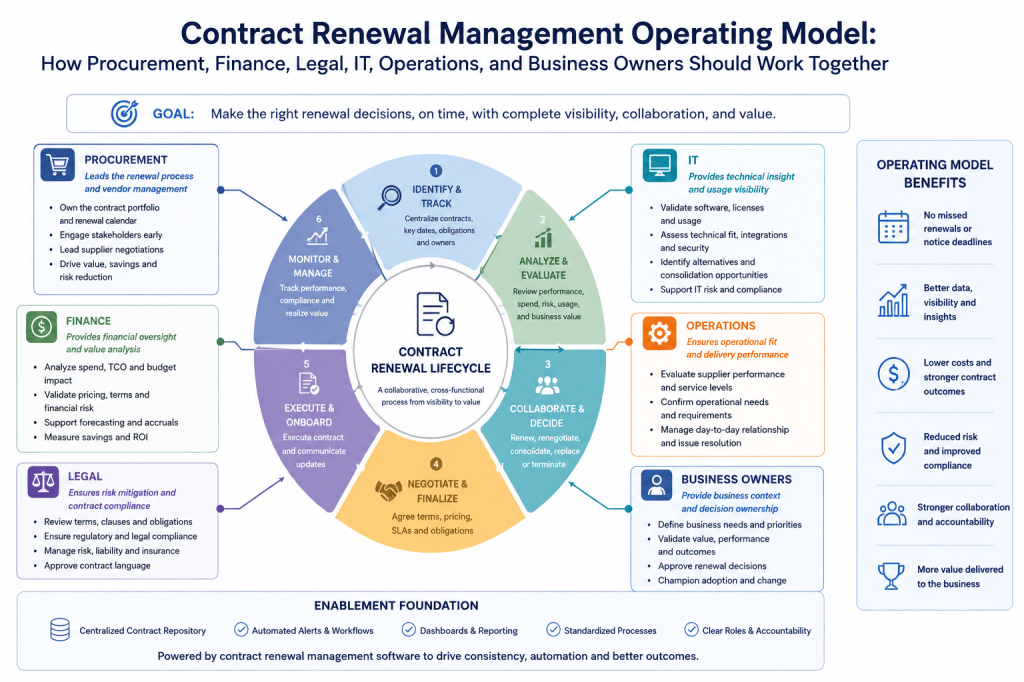
What Is a Contract Renewal Management Audit?
A contract renewal management audit examines whether an organization’s processes and controls provide reasonable assurance that contract renewals are:
Complete
Accurate
Timely
Authorized
Commercially Reviewed
Properly Executed
Auditable
The audit does not need to examine every contract.
For larger portfolios, organizations can use:
risk-based sampling.
For example:
review all critical contracts,
plus:
a representative sample of lower-value agreements.
Why Audit Contract Renewals?
Contract renewals can create significant financial exposure.
A missed notice deadline might commit the organization to:
another year of service.
An incorrect contract value might distort:
financial forecasts.
An unauthorized renewal might create:
governance problems.
An incomplete termination record might make it difficult to prove:
notice was delivered correctly.
An audit helps determine whether these risks are being:
systematically controlled.
The 10 Audit Areas
The 75 controls in this checklist are organized into ten areas:
- Contract Inventory and Coverage
- Contract Data Quality
- Ownership and Accountability
- Notice Period and Deadline Controls
- Auto-Renewal Controls
- Renewal Decision and Workflow Controls
- Approval and Financial Controls
- Termination and Execution Controls
- Supplier and Commercial Controls
- Audit Evidence, Reporting, and Governance
Together they provide:
a broad assessment of renewal-management maturity.
How to Score the Audit
For each control, assign:
2 — Effective
Control exists and operates consistently.
1 — Partially Effective
Control exists but has gaps.
0 — Ineffective
Control is absent or materially unreliable.
With 75 controls:
Maximum score = 150.
You can then calculate:
Audit Score = Points Achieved ÷ 150 × 100
Suggested Audit Rating
90–100%
Strong
Renewal controls are well established.
75–89%
Controlled
Generally effective, with improvement opportunities.
60–74%
Developing
Important controls exist, but material gaps remain.
40–59%
Weak
Significant renewal-control weaknesses exist.
Below 40%
High Risk
Renewal management is largely reactive or uncontrolled.
These thresholds are a practical framework rather than a formal accounting or auditing standard.
Area 1 — Contract Inventory and Coverage
The first question is:
Do we actually know which contracts should be managed?
A sophisticated reminder system cannot protect contracts that:
never entered the system.
Control 1 — Central Contract Register
Does the organization maintain:
a centralized register
of material active contracts?
Score: 0 / 1 / 2
Control 2 — Defined Contract Scope
Has management defined:
which contracts must be included?
For example:
all supplier contracts above €10,000.
Score: 0 / 1 / 2
Control 3 — Active Contract Coverage
Is there reasonable assurance that:
all material active contracts
are represented?
Score: 0 / 1 / 2
Control 4 — New Contract Onboarding
Is there a process ensuring:
newly signed contracts
enter the renewal system?
Score: 0 / 1 / 2
Control 5 — Amendment Capture
Are amendments:
linked to the underlying contract?
Score: 0 / 1 / 2
Control 6 — Entity Assignment
Is each contract assigned to:
the correct legal entity?
Score: 0 / 1 / 2
Control 7 — Contract Status
Does each record have:
a reliable status?
Examples:
Active.
Terminated.
Expired.
Superseded.
Score: 0 / 1 / 2
Control 8 — Duplicate Detection
Is there a process to identify:
duplicate contract records?
Score: 0 / 1 / 2
Area 1 Maximum Score
16 points
A low score here is especially important because:
all downstream controls depend on portfolio completeness.
Area 2 — Contract Data Quality
Once contracts are captured:
is the data reliable?
Control 9 — Supplier Name
Is the contractual counterparty:
accurately recorded?
Score: 0 / 1 / 2
Control 10 — Contract Start Date
Is the effective/start date:
recorded?
Score: 0 / 1 / 2
Control 11 — Contract End Date
Is the current contractual end date:
accurate?
Score: 0 / 1 / 2
Control 12 — Annual Contract Value
Is the annual financial commitment:
reasonably accurate?
Score: 0 / 1 / 2
Control 13 — Currency
Is contract value associated with:
the correct currency?
Score: 0 / 1 / 2
Control 14 — Contract Document
Can users access:
the governing contract document?
Score: 0 / 1 / 2
Control 15 — Amendment Hierarchy
Can users identify:
which amendments modify the original agreement?
Score: 0 / 1 / 2
Control 16 — Critical Field Validation
Are material fields reviewed for:
accuracy and completeness?
Score: 0 / 1 / 2
Area 2 Maximum Score
16 points
Area 3 — Ownership and Accountability
A renewal cannot be effectively managed if:
nobody owns it.
Control 17 — Named Business Owner
Does every material contract have:
an accountable business owner?
Score: 0 / 1 / 2
Control 18 — Active Owner Validation
Does the system identify:
owners who have left the organization?
Score: 0 / 1 / 2
Control 19 — Owner Reassignment
Is there a process for:
reassigning orphaned contracts?
Score: 0 / 1 / 2
Control 20 — Renewal Administration Owner
Is responsibility for:
monitoring the renewal process
clearly defined?
Score: 0 / 1 / 2
Control 21 — Procurement Ownership
Are material negotiations assigned to:
an appropriate Procurement owner?
Score: 0 / 1 / 2
Control 22 — Escalation Ownership
Is it clear who receives:
overdue renewal escalations?
Score: 0 / 1 / 2
Area 3 Maximum Score
12 points
Area 4 — Notice Period and Deadline Controls
This is one of the most important audit areas.
An expiration date tells you:
when a contract ends.
A notice deadline tells you:
when you may lose the ability to prevent renewal.
Control 23 — Notice Period Recorded
Is the notice period recorded for:
material contracts?
Score: 0 / 1 / 2
Control 24 — Notice Deadline Calculated
Is the actionable deadline:
calculated separately from the expiration date?
Score: 0 / 1 / 2
Control 25 — Source Evidence
Can the recorded notice period be traced to:
the governing clause?
Score: 0 / 1 / 2
Control 26 — Amendment Impact
Are amendments checked for:
changes to notice requirements?
Score: 0 / 1 / 2
Control 27 — Conflicting Terms
Are conflicting renewal clauses:
identified and escalated?
Score: 0 / 1 / 2
Control 28 — Internal Decision Deadline
Does the organization establish:
an internal deadline before the contractual deadline?
Score: 0 / 1 / 2
Control 29 — Automated Deadline Monitoring
Are upcoming notice deadlines:
automatically monitored?
Score: 0 / 1 / 2
Control 30 — Critical Deadline Escalation
Are unresolved decisions escalated as:
the notice deadline approaches?
Score: 0 / 1 / 2
Area 4 Maximum Score
16 points
A poor score in this area represents:
significant renewal risk.
Area 5 — Auto-Renewal Controls
Auto-renewal deserves its own audit category because:
inaction can become a financial commitment.
Control 31 — Auto-Renewal Identification
Are auto-renewing contracts:
clearly identified?
Score: 0 / 1 / 2
Control 32 — Renewal Term
Is the automatic renewal period recorded?
Example:
12 months.
Score: 0 / 1 / 2
Control 33 — Explicit Decision Requirement
Does every material auto-renewal require:
an explicit decision?
Score: 0 / 1 / 2
Control 34 — No Response Control
Does failure to respond trigger:
escalation
rather than:
automatic internal approval?
Score: 0 / 1 / 2
Control 35 — Auto-Renewal Exposure Reporting
Can management see:
the financial value of upcoming auto-renewals?
Score: 0 / 1 / 2
Control 36 — Critical Auto-Renewal Escalation
Are high-value unresolved auto-renewals:
escalated appropriately?
Score: 0 / 1 / 2
Area 5 Maximum Score
12 points
Area 6 — Renewal Decision and Workflow Controls
A deadline is useful only if:
a decision happens.
Control 37 — Standard Decision Options
Does the organization use:
consistent renewal decisions?
For example:
Renew.
Renegotiate.
Reduce.
Replace.
Extend.
Terminate.
Score: 0 / 1 / 2
Control 38 — Decision Owner
Is responsibility for:
the business decision
explicit?
Score: 0 / 1 / 2
Control 39 — Decision Due Date
Does each material renewal have:
an internal decision deadline?
Score: 0 / 1 / 2
Control 40 — Decision Evidence
Is the reason for:
material renewal decisions
documented?
Score: 0 / 1 / 2
Control 41 — Workflow Routing
Does the selected decision trigger:
appropriate downstream actions?
Example:
Terminate → Legal.
Score: 0 / 1 / 2
Control 42 — Overdue Task Escalation
Are overdue renewal tasks:
escalated?
Score: 0 / 1 / 2
Control 43 — Replacement Planning
Do replacement decisions trigger:
transition planning?
Score: 0 / 1 / 2
Control 44 — Completion Confirmation
Is there evidence that:
the approved renewal decision
was actually executed?
Score: 0 / 1 / 2
Area 6 Maximum Score
16 points
Area 7 — Approval and Financial Controls
The next question is:
Are financial commitments properly authorized?
Control 45 — Approval Matrix
Does the organization maintain:
documented approval thresholds?
Score: 0 / 1 / 2
Control 46 — Approval Based on Materiality
Do higher-value commitments require:
appropriate approval?
Score: 0 / 1 / 2
Control 47 — Total Commitment Considered
Does approval consider:
multi-year total contract value
where appropriate?
Score: 0 / 1 / 2
Control 48 — Approval Before Commitment
Is approval obtained:
before contractual commitment?
Score: 0 / 1 / 2
Control 49 — Budget Validation
Are material renewals checked against:
available budget?
Score: 0 / 1 / 2
Control 50 — Price Increase Review
Are significant supplier increases:
identified and reviewed?
Score: 0 / 1 / 2
Control 51 — Segregation of Duties
For material contracts, are:
request,
approval,
and execution
appropriately separated?
Score: 0 / 1 / 2
Control 52 — Approval Evidence
Can approval be demonstrated:
after the event?
Score: 0 / 1 / 2
Area 7 Maximum Score
16 points
Area 8 — Termination and Execution Controls
A termination decision is not:
a termination.
The notice must actually be:
executed correctly.
Control 53 — Legal Verification
Are material termination decisions checked against:
contractual requirements?
Score: 0 / 1 / 2
Control 54 — Authorized Notice
Is termination notice:
approved by an authorized person?
Score: 0 / 1 / 2
Control 55 — Correct Notice Method
Does the organization verify:
the required delivery method?
For example:
registered mail,
specified email address,
or:
contractual notice address.
Score: 0 / 1 / 2
Control 56 — Notice Sent Before Deadline
Can the organization demonstrate:
timely dispatch?
Score: 0 / 1 / 2
Control 57 — Delivery Evidence
Is proof of delivery:
retained where relevant?
Score: 0 / 1 / 2
Control 58 — Supplier Acknowledgment
Is supplier acknowledgment:
captured when available?
Score: 0 / 1 / 2
Control 59 — System Status Updated
After termination, is:
contract status
updated?
Score: 0 / 1 / 2
Control 60 — Downstream Offboarding
Where appropriate, does termination trigger:
access removal,
license cancellation,
asset return,
data handling,
or:
other offboarding activities?
Score: 0 / 1 / 2
Area 8 Maximum Score
16 points
Area 9 — Supplier and Commercial Controls
Renewal management should not only prevent:
missed deadlines.
It should also help determine:
whether the organization is obtaining reasonable commercial outcomes.
Control 61 — Current Spend Available
Is current supplier spend available:
before negotiation?
Score: 0 / 1 / 2
Control 62 — Supplier Proposal Captured
Is the supplier’s renewal proposal:
documented?
Score: 0 / 1 / 2
Control 63 — Price Change Calculated
Is the percentage change from:
current pricing
clearly visible?
Score: 0 / 1 / 2
Control 64 — Usage Reviewed
For usage-based or licensed services:
is actual demand considered?
Score: 0 / 1 / 2
Control 65 — Supplier Performance Reviewed
For material contracts:
does performance influence:
renewal decisions?
Score: 0 / 1 / 2
Control 66 — Duplicate Supplier Analysis
Does the organization identify:
multiple contracts with the same supplier?
Score: 0 / 1 / 2
Control 67 — Consolidation Opportunities
Are overlapping supplier agreements considered for:
consolidation?
Score: 0 / 1 / 2
Control 68 — Savings Validation
Are reported savings:
defined and validated consistently?
Score: 0 / 1 / 2
Area 9 Maximum Score
16 points
Area 10 — Audit Evidence, Reporting, and Governance
The final section asks:
Can management demonstrate that the renewal process is operating effectively?
Control 69 — Audit Trail
Does the system retain:
critical changes,
users,
and:
timestamps?
Score: 0 / 1 / 2
Control 70 — Renewal History
Can previous renewal decisions:
be reconstructed?
Score: 0 / 1 / 2
Control 71 — Evidence Retention
Are important renewal documents:
retained?
Examples:
proposal,
approval,
notice,
executed amendment.
Score: 0 / 1 / 2
Control 72 — Exception Reporting
Can management identify:
control exceptions?
For example:
missing owners,
overdue decisions,
unverified notice periods.
Score: 0 / 1 / 2
Control 73 — Management Reporting
Does management receive:
regular renewal-risk reporting?
Score: 0 / 1 / 2
Control 74 — Governance Review
Are renewal policies and controls:
periodically reviewed?
Score: 0 / 1 / 2
Control 75 — Remediation Tracking
Are identified audit findings assigned:
an owner,
deadline,
and:
resolution status?
Score: 0 / 1 / 2
Area 10 Maximum Score
14 points
Complete Audit Score
The scoring structure is:
| Audit Area | Maximum |
|---|---|
| Contract Inventory & Coverage | 16 |
| Contract Data Quality | 16 |
| Ownership & Accountability | 12 |
| Notice Period & Deadlines | 16 |
| Auto-Renewal Controls | 12 |
| Renewal Decision & Workflow | 16 |
| Approval & Financial Controls | 16 |
| Termination & Execution | 16 |
| Supplier & Commercial Controls | 16 |
| Audit Evidence & Governance | 14 |
| Total | 150 |
Now calculate:
Points Achieved ÷ 150 × 100
Example Contract Renewal Audit
Suppose a company scores:
Contract Inventory:
12/16.
Data Quality:
11/16.
Ownership:
10/12.
Deadlines:
8/16.
Auto-Renewals:
4/12.
Workflow:
9/16.
Financial Controls:
12/16.
Termination:
8/16.
Commercial:
7/16.
Governance:
9/14.
Total:
90/150.
Audit score:
60%.
Classification:
Developing.
What the Score Actually Tells You
The total score is useful.
But:
the category scores are more important.
The example company may have:
good Finance controls
but:
poor auto-renewal controls.
Therefore:
the remediation priority is not:
“improve everything.”
It is:
fix the highest-risk weaknesses first.
Build a Renewal Control Heatmap
A simple heatmap might show:
Contract Coverage
Green.
Ownership
Green.
Notice Deadlines
Amber.
Auto-Renewals
Red.
Workflow
Amber.
Approvals
Green.
Terminations
Amber.
Commercial Optimization
Red.
Audit Evidence
Amber.
This gives management:
a much clearer picture.
Critical Controls vs Optimization Controls
Not all 75 controls carry:
equal risk.
For example:
missing a legal notice deadline
can be more consequential than:
failing to perform supplier consolidation analysis.
Therefore divide findings into:
Critical Controls
and:
Optimization Controls.
Critical Renewal Controls
I would prioritize:
- contract coverage;
- business owner;
- end date;
- notice period;
- notice deadline;
- auto-renewal;
- explicit decision;
- approval;
- termination execution;
- audit evidence.
These protect:
the organization.
Optimization Controls
Then improve:
- supplier benchmarking;
- consolidation;
- utilization;
- savings;
- forecasting.
These create:
additional value.
This sequencing is important.
Audit Sampling Strategy
For a large organization with:
20,000 contracts,
auditing every renewal may not be practical.
Use:
risk-based sampling.
Sample 1 — Critical Contracts
Review:
100%.
For example:
Tier 1 strategic contracts.
Sample 2 — High-Value Auto-Renewals
Review:
all contracts above:
a defined threshold.
Sample 3 — Terminated Contracts
Sample:
recent termination cases.
Why?
Because termination is:
high risk.
Sample 4 — Random Standard Contracts
Select:
a representative sample.
This helps identify:
systemic weaknesses.
Sample 5 — Problem Cases
Include:
contracts with:
- missed deadlines;
- emergency extensions;
- approval overrides;
- disputed termination.
These often reveal:
control weaknesses.
Audit Evidence Request List
Before the audit begins, request:
- contract register;
- renewal policy;
- approval matrix;
- renewal calendar;
- user/owner list;
- audit logs;
- termination notices;
- supplier proposals;
- approval records;
- savings reports.
This reduces:
audit friction.
Testing a Contract Record
For each sampled contract:
start with:
the system record.
Then compare against:
the source agreement.
Ask:
Does the system match:
the contract?
This tests:
data integrity.
Testing the Notice Deadline
Suppose the system says:
June 30.
Auditor should inspect:
the clause.
Then:
recalculate.
If clause says:
90 days before September 30,
verify:
June 30.
This is a critical control test.
Testing Auto-Renewal
Check:
whether:
the system correctly identifies it.
Then:
was an explicit decision recorded?
If not:
control failure.
Testing Approval
Take:
final commitment.
Compare against:
approval matrix.
Then verify:
correct approver.
This is straightforward.
Testing Termination
Take:
a terminated contract.
Check:
- Decision approved.
- Notice requirement verified.
- Notice prepared.
- Notice sent correctly.
- Delivery evidence retained.
- Contract status updated.
This tests:
the full chain.
Testing Savings
Suppose Procurement reports:
€100K savings.
Ask:
Compared with what?
Original price?
Supplier proposal?
Budget?
Prior-year spend?
Savings methodology should be:
consistent.
Otherwise:
portfolio savings become unreliable.
Audit Findings Should Be Actionable
Avoid findings such as:
Contract management should be improved.
Too vague.
Instead:
11 of 30 sampled auto-renewing contracts did not have an explicit renewal decision before the contractual notice deadline.
That is:
specific.
Audit Finding Structure
Use:
Condition
What happened?
Criteria
What should happen?
Risk
Why does it matter?
Root Cause
Why did it happen?
Action
What should change?
Owner
Who fixes it?
Due Date
When?
This creates:
useful remediation.
Example Audit Finding
Condition
8 of 25 sampled contracts had:
no documented notice period.
Risk
The organization may lose:
termination or renegotiation leverage.
Root Cause
Notice period is:
optional in the spreadsheet.
Recommendation
Make notice period:
mandatory
or:
create a formal exception when unknown.
Owner
Contract Operations.
Target
30 days.
This is actionable.
Audit Finding Severity
Classify:
Critical
Immediate material exposure.
High
Significant control weakness.
Medium
Important but not urgent.
Low
Process improvement.
This helps prioritize:
remediation.
Root Cause Categories
Many findings will fall into:
People
Process
Data
Technology
Governance
Understanding root cause prevents:
superficial fixes.
Example
Problem:
missed deadline.
Superficial solution:
send more reminders.
Root cause:
contract had:
no owner.
Correct solution:
ownership governance.
This distinction matters.
Contract Renewal Audit Dashboard
A future Contract Renewal Tracker dashboard could show:
Overall Control Score
84%.
Critical Findings
High Findings
Open Remediation Actions
Overdue Actions
This creates:
continuous assurance.
From Periodic Audit to Continuous Control Monitoring
Traditional audit asks:
Did controls operate last quarter?
Software can increasingly ask:
Are controls operating right now?
This is a significant opportunity.
Example Continuous Control
Rule:
Every material contract must have:
an owner.
The platform continuously checks:
the entire portfolio.
Result:
14 exceptions.
No sampling required.
Another Continuous Control
Rule:
Every auto-renewing contract above €100K must have:
a decision
60 days before notice deadline.
The platform monitors:
continuously.
This is much stronger than:
annual audit alone.
Continuous Renewal Assurance
This creates a future product layer:
Contract Tracking
↓
Renewal Workflow
↓
Governance
↓
Continuous Control Monitoring
↓
Assurance
That is an important evolution.
AI-Assisted Audit
AI could eventually help:
review contracts against:
system metadata.
For example:
system says:
Notice Period = 60 days.
AI reads:
contract.
Finds:
90 days.
Result:
Potential Control Exception: Recorded notice period may not match governing contract.
Human verifies.
This is useful AI.
AI Amendment Review
AI could compare:
MSA
with:
amendments.
Then flag:
Amendment 3 appears to modify the renewal term.
Again:
human review remains appropriate for:
material contractual decisions.
AI Audit Evidence
AI could assemble:
a renewal evidence summary:
Business decision approved May 4. Finance approval May 8. Supplier proposal received May 11. Final amendment signed June 2.
This dramatically reduces:
audit preparation time.
AI Exception Prioritization
Instead of showing:
500 missing fields,
AI could prioritize:
These 12 missing notice periods represent €8.4M of auto-renewing exposure within the next 120 days.
That transforms:
data-quality work
into:
risk prioritization.
Audit Permissions
Internal Audit may need:
read-only access
across:
multiple departments.
That suggests a future:
Auditor Role
inside Contract Renewal Tracker.
Auditor Role
Possible permissions:
View contracts.
View audit history.
View approvals.
View evidence.
View workflow.
Cannot:
modify operational data.
This is useful:
enterprise functionality.
Evidence Export
Auditors may need:
an exportable evidence pack.
For example:
Contract Renewal Audit Package
containing:
contract metadata,
decision history,
approvals,
timeline,
documents,
audit trail.
This could become:
a valuable product feature.
Contract Renewal Tracker Beta and Auditability
The first beta does not need:
enterprise audit functionality.
But auditability should influence:
the architecture early.
For example:
avoid silently overwriting:
critical information.
Track:
timestamps.
Track:
users.
Maintain:
history where practical.
This makes future governance:
much easier.
Beta Audit Controls
The initial version can already support:
- Contract exists.
- Owner assigned.
- End date recorded.
- Notice deadline recorded.
- Renewal status visible.
- Reminder generated.
- Decision recorded.
Those seven controls are:
a strong foundation.
Post-Beta Audit Roadmap
Phase 1
Basic history.
Phase 2
Workflow audit log.
Phase 3
Approval evidence.
Phase 4
Termination evidence.
Phase 5
Continuous control monitoring.
Phase 6
AI-assisted audit.
This fits naturally with:
the existing product roadmap.
Contract Renewal Tracker Beta Launch — September 21, 2026
Contract Renewal Tracker is launching its first SaaS beta on September 21, 2026. The beta focuses on establishing the core renewal controls businesses need first: centralized contract records, notice periods, renewal dates, owners, values, reminders, and explicit renewal actions. That structured foundation can later support stronger audit capabilities including approval evidence, termination records, control testing, exception monitoring, audit trails, governance dashboards, and AI-assisted contract verification. [Notify Me When the Beta Launches →] (One launch notification only — no newsletter or ongoing marketing emails.)
Downloadable Audit Checklist Opportunity
This article should absolutely become:
a downloadable asset.
Contract Renewal Management Audit Checklist — 75 Controls
Create:
a spreadsheet containing columns for:
Control ID
Control Area
Control Description
Score
Evidence
Finding
Risk Rating
Action
Owner
Due Date
That turns the article into:
a practical tool.
Suggested CTA
Download the 75-Point Contract Renewal Audit Checklist
Assess your contract inventory, notice deadlines, auto-renewals, ownership, approvals, termination controls, supplier spend, commercial processes, audit evidence, and governance using a structured renewal-control assessment.
Download the Free Audit Checklist →
Interactive Audit Opportunity
Eventually:
turn the 75 questions into:
an online assessment.
User completes:
the audit.
Contract Renewal Tracker calculates:
Overall Score
72%.
Contract Data
88%.
Notice Controls
62%.
Auto-Renewal
44%.
Approvals
91%.
Commercial Optimization
55%.
Then provide:
a remediation roadmap.
This could become:
a very strong acquisition tool.
In-Product Audit
Even more interesting:
Contract Renewal Tracker could automatically answer:
some of the 75 questions.
For example:
Owner Coverage
System calculates:
94%.
Notice Deadline Coverage
87%.
Auto-Renewal Decision Coverage
76%.
Overdue Actions
The audit becomes:
partially automated.
Renewal Control Score
Eventually each organization could receive:
a live:
Contract Renewal Control Score
For example:
86/100
Updated continuously.
This creates:
a measurable operational outcome.
Contract-Level Control Score
You could even score:
individual contracts.
For example:
Supplier X
Contract Value:
€750K.
Owner:
✓
Notice Verified:
✓
Decision:
✕
Approval:
—
Evidence:
—
Risk:
High
This creates:
contract-level governance visibility.
Portfolio Risk Ranking
Then rank:
all contracts
by:
control weakness × financial exposure × deadline proximity.
For example:
- Supplier A — Critical.
- Supplier B — Critical.
- Supplier C — High.
This becomes:
a powerful operational queue.
Why This Matters for the Product
This article reveals an important strategic possibility.
Contract Renewal Tracker does not have to stop at:
“Here are your upcoming renewals.”
It could eventually say:
“Here are the renewals where your controls are failing.”
That is much more valuable.
And eventually:
“Here are the €12.4M of contracts where control weakness and renewal timing create the highest financial exposure.”
Now the product becomes:
risk intelligence.
From Reminder Software to Renewal Assurance
The product evolution becomes:
Reminder
↓
Tracker
↓
Workflow
↓
Governance
↓
Audit
↓
Continuous Assurance
↓
AI-Assisted Renewal Intelligence
That is a substantial SaaS roadmap.
Final Thoughts
A good contract renewal audit should answer five fundamental questions.
1. Completeness
Do we know:
which contracts exist?
2. Accuracy
Do we know:
the correct renewal and notice terms?
3. Accountability
Does somebody:
own the decision?
4. Authorization
Was the renewal:
properly approved and executed?
5. Evidence
Can we:
prove what happened?
If the answer to all five is:
yes,
the organization has a strong foundation.
If not:
the 75 controls in this checklist help identify:
where the weaknesses are.
The objective is not:
perfect paperwork.
It is to prevent:
avoidable commitments,
missed opportunities,
unauthorized expenditure,
failed terminations,
and:
uncontrolled renewals.
For Contract Renewal Tracker, this opens another important product direction.
The early product helps customers:
remember renewals.
The mature product can help them:
control renewals.
And an advanced platform can help them:
continuously prove that their renewal process is operating effectively.
That progression moves Contract Renewal Tracker considerably beyond a simple renewal calendar.
It positions the platform around something much more valuable:
continuous visibility, control, and assurance over recurring contractual commitments.
Next Article in the Contract Renewal Tracker Series
This is a particularly important next article because it can define a practical 0–100 Contract Renewal Risk Score that can later be implemented directly inside the SaaS. It would connect deadline proximity, annual contract value, auto-renewal exposure, missing data, supplier criticality, owner status, and decision readiness into a single explainable priority score—potentially becoming one of Contract Renewal Tracker’s core differentiating features.

