Private equity firms often face a recurring operational challenge after acquiring or assembling a portfolio of companies:
the businesses may share many of the same supplier categories, but they manage contracts independently.
One portfolio company may use one CRM.
Another uses a different CRM.
Three companies may buy Microsoft separately.
Several may have overlapping cybersecurity tools, cloud contracts, telecom providers, insurance brokers, professional-services firms, or software subscriptions.
The result is usually:
fragmented recurring spend
and:
limited visibility into upcoming renewal windows.
This matters because contract renewals are often the easiest time to renegotiate pricing, consolidate vendors, reduce licenses, standardize terms, or eliminate unnecessary services.
For private equity operating teams, the question becomes:
How do we systematically identify renewal opportunities across multiple portfolio companies without forcing every business onto one procurement system?
That is where a dedicated Contract Renewal Tracker can become particularly valuable.
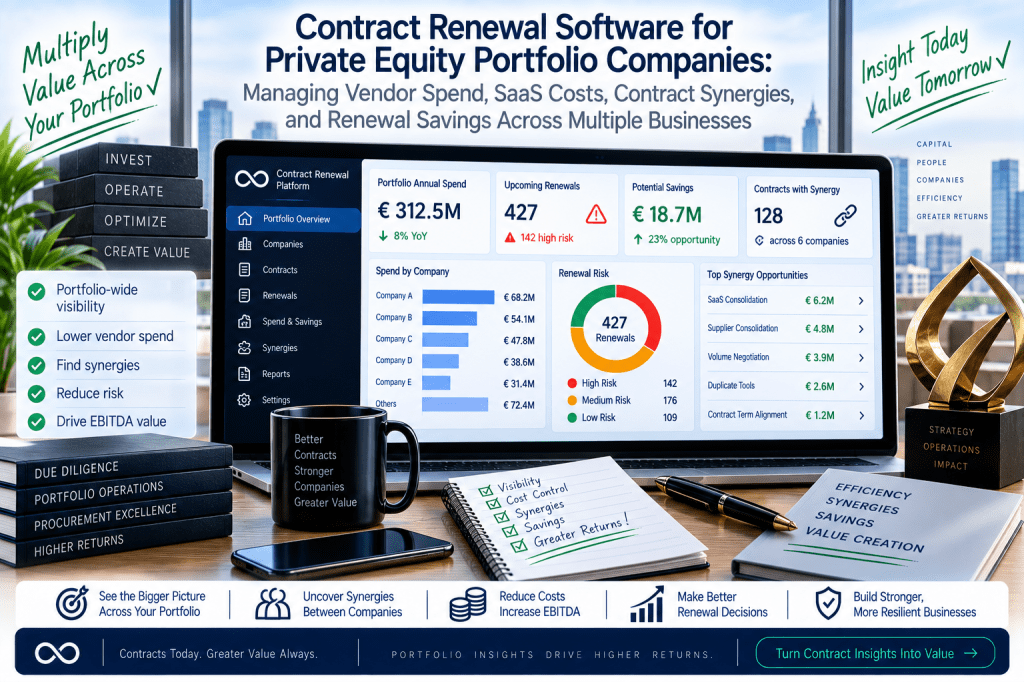
What Is Contract Renewal Software for Private Equity?
Contract renewal software for private equity helps operating teams and portfolio companies track recurring contractual commitments across multiple independently managed businesses.
It can provide visibility into:
- upcoming supplier renewals;
- notice deadlines;
- annual contract values;
- software and SaaS spend;
- duplicate suppliers;
- portfolio-wide supplier concentration;
- cost-reduction opportunities;
- renewal savings;
- post-acquisition integration opportunities.
The objective is not necessarily to centralize all purchasing decisions.
Instead, the platform can provide:
portfolio-wide renewal intelligence while allowing each company to retain operational ownership.
Why Private Equity Has a Unique Renewal Opportunity
Most individual portfolio companies negotiate based on:
their own spend.
A private equity group can potentially see:
the combined purchasing power of the entire portfolio.
For example:
Portfolio Company A spends:
€250K with Supplier X.
Company B:
€400K.
Company C:
€180K.
Company D:
€320K.
Combined:
€1.15M.
If those businesses negotiate separately, the supplier sees:
four customers.
If the operating team can coordinate renewal timing and commercial strategy, it may discover:
a much larger procurement opportunity.
Managing Renewals Across Portfolio Companies?
You do not necessarily need to centralize every supplier decision.
But you do need visibility.
Contract Renewal Tracker can provide a portfolio-level view of upcoming renewals while preserving company-level ownership, helping operating teams identify common suppliers, SaaS overlap, commercial opportunities, and recurring cost exposure before renewal windows close.
Turn portfolio contracts into renewal intelligence →
The Private Equity Contract Model
A practical hierarchy might be:
Private Equity Portfolio
↓
Portfolio Company
↓
Legal Entity
↓
Contract
This allows the operating team to see:
the portfolio
while each company sees:
its own agreements.
Example
Portfolio:
Northstar Capital.
Portfolio Companies:
AlphaTech.
Beta Services.
GammaCloud.
Delta Consulting.
Each company has:
its own users,
contracts,
suppliers,
and:
renewal workflow.
The portfolio layer provides:
aggregated intelligence.
Private Equity Feature 1: Portfolio Company Separation
Each portfolio company should remain:
logically separated.
Users at:
Company A
should not automatically see:
Company B’s confidential contracts.
This is fundamental.
Private Equity Feature 2: Portfolio-Level Visibility
Authorized operating-team users should be able to see:
aggregated information across:
all portfolio companies.
For example:
Total Supplier Contracts:
4,800.
Annual Contract Value:
€180M.
Renewing Next 12 Months:
€115M.
This creates:
portfolio-scale visibility.
Private Equity Feature 3: Supplier Normalization
This is essential.
Company A may record:
Microsoft.
Company B:
Microsoft Ireland.
Company C:
MSFT.
The portfolio layer should normalize these into:
Supplier Group: Microsoft
while preserving:
the legal counterparty.
Without this:
cross-company analysis becomes unreliable.
Private Equity Feature 4: Portfolio-Wide Supplier Spend
Once suppliers are normalized:
the operating team can ask:
How much do all portfolio companies spend with Supplier X?
For example:
Microsoft:
€8.4M.
AWS:
€5.2M.
Salesforce:
€4.1M.
Adobe:
€2.3M.
This changes:
commercial leverage.
Private Equity Feature 5: Renewal Calendar by Supplier
Spend alone is not enough.
The key is:
when the contracts become actionable.
For example:
Microsoft-related renewals:
Company A:
October.
Company B:
December.
Company C:
January.
Company D:
March.
This creates:
a potential coordinated negotiation window.
Private Equity Feature 6: Common Supplier Detection
The system should identify:
suppliers used by:
multiple portfolio companies.
For example:
Supplier X used by:
8 companies.
Combined annual spend:
€4.6M.
Renewals within:
12 months:
This is a high-value insight.
Private Equity Feature 7: Common Category Detection
Sometimes the companies use:
different suppliers
for:
the same category.
Examples:
CRM.
Cybersecurity.
Payroll.
Cloud.
Telecom.
Professional services.
That may create:
standardization or sourcing opportunities.
Example
Portfolio CRM landscape:
Company A:
Salesforce.
Company B:
HubSpot.
Company C:
Dynamics.
Company D:
Salesforce.
Combined CRM spend:
€2.2M.
This gives the operating team:
a strategic view.
Private Equity Feature 8: SaaS Stack Overlap
SaaS is one of the easiest categories for portfolio analysis.
Why?
Because it is:
- recurring;
- measurable;
- often standardized;
- frequently auto-renewing.
Examples:
- CRM;
- collaboration;
- security;
- developer tools;
- HR;
- finance.
This makes SaaS renewals a natural starting point.
Portfolio SaaS Dashboard
For example:
SaaS Contracts
1,450.
Annual SaaS Spend
€22M.
Auto-Renewing
€15M.
Renewing Next 90 Days
€4.2M.
Duplicate Supplier Categories
This creates:
immediate operational intelligence.
Private Equity Feature 9: License Utilization
If portfolio companies share:
usage data,
the platform can identify:
underutilized software.
Example:
Company A:
1,000 licenses.
Active:
Company B:
500 licenses.
Active:
Combined waste may be:
substantial.
Private Equity Feature 10: Benchmark Pricing Across Portfolio Companies
This is a particularly powerful use case.
Suppose:
Company A pays:
€42/user/month.
Company B:
€51.
Company C:
€39.
Same supplier.
Same product.
That creates:
internal benchmark data.
Internal Benchmarking Advantage
Instead of relying only on external market benchmarks, the private equity group has:
real negotiated prices
from:
its own companies.
This can create:
very strong leverage.
Example
Supplier:
ExampleHR.
Company A:
€32/user.
Company B:
€45.
Company C:
€37.
Next Company B renewal:
target:
move pricing closer to:
€32–€37.
This is concrete.
Private Equity Feature 11: Contract-Term Benchmarking
Price is not the only difference.
Compare:
- notice periods;
- renewal caps;
- payment terms;
- discounts;
- contract duration.
One portfolio company may have:
better commercial terms.
Those can become:
negotiation targets elsewhere.
Example
Company A:
3% price cap.
Company B:
8%.
Company C:
uncapped.
Portfolio opportunity:
standardize future renewals toward:
3%.
This can create:
long-term value.
Private Equity Feature 12: Payment-Term Benchmarking
Suppose:
Company A has Net 60.
Company B:
Net 30.
Same supplier.
This may create:
working-capital opportunity.
Renewal is:
a natural time to improve terms.
Private Equity Feature 13: Renewal Strategy by Company
Each portfolio company should record:
Renew
Renegotiate
Reduce
Replace
Consolidate
Terminate
This allows:
portfolio-level strategy visibility.
Example
Supplier X:
Company A:
Renew.
Company B:
Renegotiate.
Company C:
Terminate.
Company D:
Consolidate.
Now the operating team can decide:
whether coordination makes sense.
Private Equity Feature 14: Local Autonomy
Not every supplier should be:
centrally negotiated.
This is important.
Portfolio companies often need:
operational independence.
The best model may be:
central intelligence
with:
local execution.
Federated Procurement Model
Portfolio team:
identifies:
- common suppliers;
- benchmarks;
- opportunities.
Portfolio company:
retains:
final commercial decision.
This is less disruptive than:
forcing centralized procurement across the group.
Private Equity Feature 15: Portfolio Procurement Opportunities
The system can classify:
opportunities such as:
Volume Consolidation
Price Benchmark
License Reduction
Supplier Rationalization
Term Improvement
Payment-Term Improvement
This creates:
a structured savings pipeline.
Private Equity Feature 16: Opportunity Value
Each opportunity should include:
potential value.
For example:
Microsoft consolidation:
€350K.
SaaS license reduction:
€180K.
Telecom consolidation:
€220K.
Now the portfolio team can prioritize:
effort.
Potential vs Validated Value
Do not report:
every theoretical opportunity
as:
savings.
Use:
Potential
↓
Validated
↓
Negotiated
↓
Realized
This keeps reporting credible.
Private Equity Feature 17: Savings Ownership
Assign:
who owns each initiative.
For example:
Company CFO.
Portfolio Procurement.
IT Director.
Operating Partner.
Without ownership:
synergies remain theoretical.
Private Equity Feature 18: Savings Realization Date
Renewal savings often become effective:
later.
For example:
Opportunity identified:
September.
Contract renews:
January.
Savings effective:
February.
This timing matters for:
EBITDA planning.
Private Equity Feature 19: EBITDA Impact
Private equity teams often care about:
recurring cost reductions
because they directly affect:
EBITDA.
Example:
Annual recurring supplier savings:
€500K.
Assuming no offsetting costs:
EBITDA improvement:
€500K.
That makes contract renewal optimization strategically important.
Private Equity Feature 20: Exit Value Implications
Recurring EBITDA improvement can theoretically contribute to:
higher enterprise value.
However, the actual valuation effect depends on:
many factors.
Contract Renewal Tracker should measure:
realized operational savings,
not claim:
a guaranteed valuation multiple.
This distinction is important.
Private Equity Feature 21: Cost Synergy Tracking
After acquisitions:
track:
supplier synergies.
For example:
Identified
€2M.
Validated
€1.5M.
Contracted
€1.1M.
Realized
€900K.
This creates:
transparent integration reporting.
Private Equity Feature 22: Post-Acquisition Contract Review
For a newly acquired portfolio company:
import:
the supplier portfolio.
Then immediately identify:
- near-term renewals;
- high-value contracts;
- auto-renewing contracts;
- duplicate suppliers.
This could become:
a standard 100-day plan activity.
First 30 Days
Focus on:
critical deadlines.
Days 30–60
Identify:
supplier overlap.
Days 60–100
Build:
renewal savings pipeline.
This creates a repeatable integration model.
Private Equity Feature 23: 100-Day Contract Plan
A dashboard might show:
Immediate Risk
12 contracts.
Quick Wins
€400K potential.
Supplier Consolidation
€1.2M potential.
Long-Term Rationalization
€2.5M potential.
This fits:
private equity operating models well.
Private Equity Feature 24: Cross-Portfolio Renewal Calendar
Operating teams should see:
which periods contain:
large renewal volumes.
Example:
Q1:
€25M.
Q2:
€18M.
Q3:
€32M.
Q4:
€40M.
This helps plan:
procurement resources.
Private Equity Feature 25: Renewal Opportunity Calendar
Even more useful:
show only:
commercial opportunities.
For example:
November:
€5M renegotiation opportunities.
December:
€3M consolidation opportunities.
January:
€2M software rationalization.
This becomes:
an operating agenda.
Private Equity Feature 26: Portfolio Company Benchmarking
Compare:
companies.
For example:
| Company | SaaS Spend / Employee | Auto-Renewal Exposure | Owner Coverage |
|---|---|---|---|
| Alpha | €4,200 | 70% | 98% |
| Beta | €7,100 | 85% | 80% |
| Gamma | €4,800 | 60% | 95% |
This can identify:
companies needing attention.
SaaS Spend per Employee
This metric should not be used:
blindly.
Different businesses require:
different software.
But it can be:
a useful diagnostic.
Private Equity Feature 27: Renewal Management Maturity
Score portfolio companies on:
- contract coverage;
- owner coverage;
- notice periods;
- decision timeliness;
- savings tracking.
This helps identify:
operational maturity.
Example
Company A:
92/100.
Company B:
Company C:
Portfolio Operations can focus:
support
where it is needed most.
Private Equity Feature 28: Standard Renewal Playbook
The portfolio may establish:
common practices.
For example:
- all auto-renewals reviewed;
- all contracts >€100K start 180 days early;
- supplier proposal captured;
- savings categorized consistently.
This creates:
repeatability across companies.
Private Equity Feature 29: Standard Savings Methodology
Different companies may calculate:
savings differently.
That makes portfolio reporting unreliable.
Create:
standard definitions for:
- hard savings;
- cost avoidance;
- demand reduction.
This improves:
portfolio-level financial reporting.
Private Equity Feature 30: Finance Validation
Portfolio companies can submit:
savings.
Finance validates:
before inclusion in:
portfolio reporting.
This builds trust.
Private Equity Feature 31: Procurement Playbook Library
The platform could eventually provide:
templates for:
- SaaS renewals;
- telecom;
- cloud;
- insurance;
- professional services.
This gives smaller portfolio companies:
access to better procurement practices.
Private Equity Feature 32: Smaller Company Enablement
This is an important advantage.
A portfolio company with:
100 employees
may not justify:
a dedicated procurement team.
But it can still benefit from:
portfolio-level tools and benchmarks.
Contract Renewal Tracker can effectively provide:
some shared procurement infrastructure.
Private Equity Feature 33: Shared Negotiation Intelligence
If Company A negotiated:
Supplier X
last month,
Company B can learn:
- latest pricing;
- concessions;
- supplier behavior.
This reduces:
duplicated effort.
Example
Company A negotiated:
12% initial supplier increase
down to:
3%.
Company B renewal:
next quarter.
That history is:
extremely valuable.
Private Equity Feature 34: Supplier Negotiation History
Track:
previous portfolio interactions with:
major suppliers.
This could become:
a strategic knowledge base.
Private Equity Feature 35: Preferred Supplier Strategy
If several portfolio companies use:
different suppliers,
the group may choose:
preferred vendors.
Renewal windows become:
migration opportunities.
Private Equity Feature 36: Procurement Leverage Without Forced Standardization
This is a key positioning point.
You do not need:
every company
to use:
the same systems.
The portfolio layer can provide:
leverage
without:
operational uniformity.
This makes the model more practical.
Private Equity Feature 37: Cloud Spend
Cloud contracts can represent:
major cost.
Portfolio companies may have:
AWS,
Azure,
or:
Google Cloud.
Track:
commitments
and:
renewal timing.
This can create:
significant opportunities.
Private Equity Feature 38: Insurance
Insurance may also benefit from:
portfolio purchasing strategies.
Track:
renewal windows.
Again:
central intelligence
can create leverage.
Private Equity Feature 39: Telecom and Connectivity
Multiple companies may have:
separate telecom contracts.
These categories can sometimes be:
consolidated.
Renewal timing matters.
Private Equity Feature 40: Professional Services Suppliers
Common suppliers may include:
- consulting firms;
- legal services;
- recruitment agencies;
- marketing agencies.
Portfolio-wide visibility can reveal:
significant aggregate spend.
Private Equity Dashboard
A portfolio-level dashboard could show:
Portfolio Companies
Active Supplier Contracts
6,800.
Annual Contract Value
€240M.
Renewing Next 12 Months
€160M.
Common Suppliers
Validated Renewal Opportunities
€8.2M.
Realized Savings YTD
€4.1M.
This is a very strong executive view.
Operating Partner Dashboard
A more focused view:
Top 10 Renewal Opportunities
Companies with Highest Auto-Renewal Exposure
Largest Supplier Consolidation Opportunities
Savings Behind Target
This provides:
action-oriented visibility.
Portfolio CFO Dashboard
Focus on:
- renewal spend;
- validated savings;
- realized savings;
- forecast impact.
This supports:
financial oversight.
Portfolio Procurement Dashboard
Focus on:
- common suppliers;
- upcoming negotiations;
- pricing benchmarks;
- consolidation.
Different role:
different view.
Portfolio IT Dashboard
Focus on:
- SaaS overlap;
- cloud commitments;
- security tools;
- application rationalization.
Again:
same platform,
different lens.
Private Equity KPI 1: Portfolio Renewal Spend
Value entering renewal.
KPI 2: Common Supplier Spend
Spend with suppliers used by:
multiple companies.
KPI 3: Auto-Renewal Exposure
Especially:
unreviewed commitments.
KPI 4: Identified Savings
Potential opportunity.
KPI 5: Validated Savings
Finance-approved potential.
KPI 6: Realized Savings
Actual value captured.
KPI 7: Procurement Opportunity Conversion
Validated opportunities converted into:
results.
KPI 8: Portfolio Contract Coverage
Percentage of:
material supplier contracts
inside the system.
KPI 9: Renewal Decision Coverage
Contracts with:
confirmed direction before deadline.
KPI 10: Company Maturity Score
Renewal-management maturity by:
portfolio company.
These metrics create:
a repeatable operating model.
Private Equity Use Case: SaaS Consolidation
Suppose:
10 companies.
Combined SaaS spend:
€15M.
Analysis identifies:
€2M of duplicate or underutilized products.
Validated opportunity:
€900K.
Realized:
€650K.
That is:
meaningful recurring value.
Use Case: Major Supplier Negotiation
Five companies use:
Supplier X.
Combined spend:
€6M.
Previously negotiated:
separately.
Next renewal cycle:
coordinated.
Even a:
3% improvement
equals:
€180K annually.
This illustrates the leverage.
Use Case: Payment Terms
Suppose group negotiations move:
€20M of spend
from:
Net 30
to:
Net 60.
This may create:
working-capital benefit.
Again:
renewal periods can become:
commercial improvement windows.
Use Case: Price Caps
If the portfolio negotiates:
lower annual escalators
across:
large contracts,
the benefit compounds over:
several years.
This can be highly material.
Private Equity vs Traditional Procurement Software
A procurement platform may help:
source and buy.
Contract Renewal Tracker can focus on:
when existing supplier commitments become renegotiable.
That is a more specific operating signal.
Private Equity vs CLM
CLM may manage:
documents
inside:
each portfolio company.
Contract Renewal Tracker could provide:
portfolio renewal intelligence
without forcing:
one common CLM.
That may be a major advantage.
Why a Portfolio-Level CLM Can Be Difficult
Each company may already have:
different legal processes.
Forcing:
one contract authoring system
may be unnecessary.
But sharing:
renewal dates and supplier intelligence
is much easier.
That makes:
renewal management
a good candidate for:
portfolio standardization.
Private Equity Product Architecture
Conceptually:
Portfolio
↓
Portfolio Company / Tenant
↓
Entity
↓
Contracts
The portfolio layer sees:
authorized aggregates.
Each company retains:
its own operational workspace.
This is more complex than standard multi-tenancy but potentially:
very valuable.
Privacy and Confidentiality
This architecture requires:
careful permissions.
Company A should not automatically see:
Company B’s confidential supplier pricing.
Portfolio operating teams may have:
broader rights.
This must be:
explicitly controlled.
Aggregate Benchmarking
An interesting possibility:
share:
anonymized benchmarks
without exposing:
specific company details.
For example:
Portfolio median unit price for Product X: €42.
This could provide:
negotiating intelligence
while respecting:
access boundaries.
AI for Private Equity: Supplier Overlap
A future assistant could answer:
Which suppliers are used by at least five portfolio companies?
Then rank:
by spend.
This is highly useful.
AI for Private Equity: Pricing Benchmarking
For example:
Company B pays 24% more per seat than the portfolio median for the same product.
This can trigger:
renewal review.
AI for Private Equity: Renewal Opportunities
The next 180 days contain €3.2M of high-confidence savings opportunities across seven portfolio companies, primarily in SaaS, telecom, and professional services.
This is a compelling operating view.
AI for Private Equity: Company Benchmarking
Company C has the highest auto-renewal exposure and lowest notice-period coverage in the portfolio.
This can focus:
operating-team attention.
AI for Private Equity: 100-Day Plan
After an acquisition:
Prioritize these 12 supplier contracts during the first 100 days because they combine near-term notice deadlines, duplicate suppliers, and material spend.
This could become a very strong differentiator.
AI Must Respect Company Boundaries
This is crucial.
If a user belongs only to:
Portfolio Company A,
the assistant must not reveal:
Company B’s contract data.
Permission-aware retrieval must remain:
foundational.
Contract Renewal Tracker Beta and Private Equity
The first SaaS beta does not need:
portfolio-company architecture.
But the current work on:
tenant isolation,
entities,
suppliers,
auditability,
and:
structured renewal data
can provide the foundation for it later.
This represents:
an enterprise expansion path,
not:
an MVP requirement.
Private Equity Product Roadmap
Stage 1
Individual portfolio-company deployment.
Stage 2
Multi-entity within company.
Stage 3
Portfolio-level reporting.
Stage 4
Supplier normalization across portfolio.
Stage 5
Pricing benchmarks and savings intelligence.
Stage 6
AI portfolio renewal intelligence.
This is a coherent progression.
Initial Go-to-Market Approach
Rather than selling immediately to:
the private equity fund,
you could first win:
individual portfolio companies.
Then demonstrate:
cross-company opportunity.
This may reduce:
enterprise sales complexity.
Example Expansion
Start:
Company A.
Then:
Company B.
Then:
three portfolio companies.
Now ask:
Would the operating team benefit from a consolidated renewal dashboard?
This creates:
natural expansion.
Bottom-Up Enterprise Motion
This could become:
Portfolio Company
↓
Multiple Portfolio Companies
↓
Portfolio License
That is a strong SaaS land-and-expand model.
Private Equity Positioning
A strong headline:
Turn Portfolio-Wide Contract Renewals Into Recurring Cost Savings.
Excellent.
Another
See Every Portfolio Company’s Supplier Renewals Before the Negotiation Window Closes.
Very strong.
Another
Find Common Suppliers, Benchmark Pricing, and Capture Renewal Savings Across the Portfolio.
Clear value.
Another
One Renewal Intelligence Layer Across Your Portfolio Companies.
Excellent enterprise positioning.
Another
Make Contract Renewal Optimization Part of the 100-Day Plan.
This is particularly strong for:
operating teams.
Lead Magnet Opportunity
This article is an excellent candidate for a:
Private Equity Vendor Spend & Renewal Synergy Template
Columns:
- portfolio company;
- supplier;
- category;
- annual spend;
- notice deadline;
- auto-renewal;
- unit pricing;
- portfolio overlap;
- opportunity type;
- potential savings;
- validated savings;
- realization date.
This could attract:
private equity operating professionals.
Suggested CTA
Download the Private Equity Contract Renewal Synergy Template
Compare supplier spend, renewal dates, pricing, auto-renewals, and consolidation opportunities across portfolio companies using one structured framework.
Download the Free Portfolio Template →
Second Lead Magnet
Another strong asset:
100-Day Contract Optimization Checklist
Include:
Days 1–30
Contract inventory.
Days 31–60
Supplier overlap and urgent renewals.
Days 61–100
Savings pipeline and negotiation strategy.
This is highly aligned with:
private equity search intent.
Commercial CTA
Looking for Repeatable Procurement Savings Across Portfolio Companies?
Contract Renewal Tracker can give individual businesses control over their own supplier renewals while creating the foundation for portfolio-level visibility into common suppliers, recurring spend, renewal timing, and contract savings opportunities.
Join the Contract Renewal Tracker Beta →
Contract Renewal Tracker Beta Launch — September 21, 2026
Contract Renewal Tracker is launching its first SaaS beta on September 21, 2026. The initial beta focuses on helping individual businesses centralize recurring supplier contracts, notice periods, owners, annual values, and upcoming renewal actions instead of relying on fragmented spreadsheets and calendar reminders. That foundation can later support larger operating models such as multi-entity groups and private equity portfolios that want to compare suppliers, identify renewal synergies, benchmark commercial terms, and track realized savings across multiple companies. [Notify Me When the Beta Launches →] (One launch notification only — no newsletter or ongoing marketing emails.)
The Strategic Opportunity
The interesting part of this market is:
not simply:
contract reminders.
Private equity creates:
a much larger information advantage.
Once enough portfolio companies contribute:
structured supplier and renewal data,
the system can begin answering:
Which suppliers appear across the portfolio?
Which company has the best price?
Which contracts renew soon enough to coordinate negotiations?
Where is recurring spend unnecessarily duplicated?
Which savings opportunities have actually been realized?
That is:
portfolio procurement intelligence.
Data Network Effect
There is potentially a significant product advantage here.
More portfolio companies using:
the platform
creates:
better:
- benchmarks;
- supplier intelligence;
- renewal visibility.
This should only operate within:
appropriate permissions and privacy boundaries.
But conceptually:
the product becomes more valuable as:
portfolio coverage increases.
From Renewal Tracker to Operating Platform
The product evolution could therefore be:
Contract Renewal Tracker
↓
Supplier Spend Intelligence
↓
Portfolio Benchmarking
↓
Renewal Optimization
↓
Synergy Realization
That is a much bigger commercial opportunity than:
a simple reminder application.
Final Thoughts
Private equity firms often pursue value creation through:
- revenue growth;
- operational improvement;
- margin expansion;
- procurement savings.
Supplier contract renewals sit directly inside:
the procurement and margin-expansion opportunity.
The process becomes:
Portfolio Contract Visibility
↓
Supplier Normalization
↓
Cross-Company Benchmarking
↓
Upcoming Renewal Window
↓
Negotiation / Consolidation
↓
Validated Savings
↓
Realized EBITDA Improvement
The renewal deadline is what makes:
the opportunity actionable.
Without the deadline:
you know that Company A and Company B use the same supplier.
With the deadline:
you know:
when you can do something about it.
That is where Contract Renewal Tracker could eventually become particularly powerful for private equity operating teams.
The long-term value proposition is no longer merely:
“Don’t miss contract renewals.”
It becomes:
“Turn recurring supplier commitments across your portfolio into a repeatable source of procurement intelligence and measurable value creation.”
That is a compelling enterprise direction.
Next Article in the Contract Renewal Tracker Series
Article 100 is a good opportunity to make the milestone article a major pillar page. It can define Levels 1–6 of renewal-management maturity, show where different organizations sit today, provide a self-assessment score, explain what capabilities to implement at each stage, and position Contract Renewal Tracker as the platform that grows from simple deadline tracking toward full renewal intelligence.

