Most organizations do not begin with a sophisticated contract renewal process.
They begin with:
a spreadsheet.
Then someone adds:
calendar reminders.
Later, responsibilities are distributed across departments.
Procurement becomes involved.
Finance asks for forecasts.
Legal wants better control over notice periods.
Executives want dashboards.
Eventually, the organization realizes that contract renewal management has become its own operational discipline.
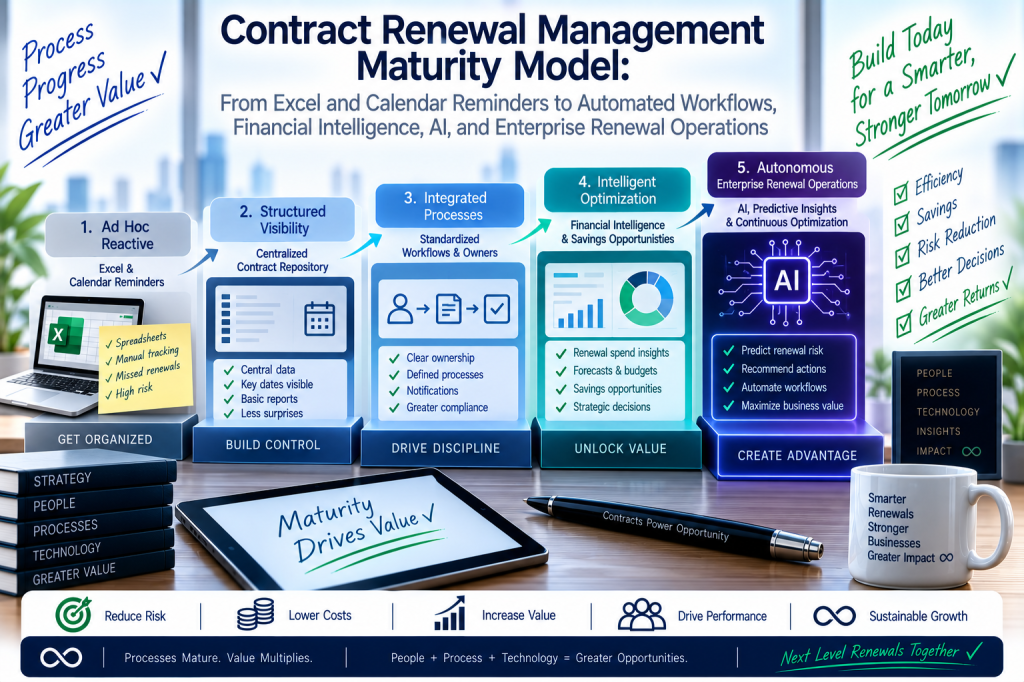
This maturity model provides a practical way to understand that evolution.
It defines six levels:
Level 1 — Reactive Tracking
Level 2 — Structured Renewal Visibility
Level 3 — Automated Renewal Control
Level 4 — Cross-Functional Renewal Operations
Level 5 — Financial and Supplier Intelligence
Level 6 — AI-Assisted Enterprise Renewal Management
The purpose is not to suggest that every company needs Level 6.
A small business may operate perfectly well at Level 2 or 3.
A large enterprise managing hundreds of millions in recurring commitments may need something much more advanced.
The important question is:
What level of renewal-management maturity matches the complexity, value, and risk of your contract portfolio?
What Is a Contract Renewal Management Maturity Model?
A maturity model describes how an organization’s renewal-management capabilities evolve over time.
It looks beyond software.
It considers:
- data quality;
- ownership;
- deadlines;
- workflows;
- governance;
- financial measurement;
- supplier intelligence;
- automation;
- AI;
- organizational adoption.
Two companies can use the same software and still have very different maturity levels.
Technology is only one part of the operating model.
Why Renewal Management Maturity Matters
A company with 25 low-value supplier contracts probably does not need:
complex workflow orchestration.
A multinational company with:
10,000 agreements
and:
€500M of recurring supplier commitments
probably should not depend on:
personal Outlook reminders.
The process should be proportional to:
Scale
Financial Exposure
Contract Complexity
Organizational Complexity
Risk
The maturity model helps establish where additional control starts creating real value.
Where Is Your Organization Today?
You can think of renewal-management maturity as a progression:
Memory
↓
Spreadsheet
↓
Automated Reminders
↓
Workflow
↓
Financial Intelligence
↓
AI-Assisted Renewal Operations
Contract Renewal Tracker is designed around that same progression: start with reliable renewal visibility and add more sophisticated control as the organization needs it.
Level 1 — Reactive Contract Renewal Tracking
At Level 1, contract renewals are managed primarily through:
- memory;
- email;
- local files;
- personal calendars;
- ad hoc spreadsheets.
There is no consistent organizational process.
Typical Level 1 Environment
A manager receives:
a supplier email.
Your subscription renews next month.
They forward it to:
Finance.
Finance asks:
Do we still need this?
Someone replies:
Probably.
The company renews.
This is reactive renewal management.
Level 1 Characteristics
Contract Register
Incomplete or nonexistent.
Notice Periods
Often unknown.
Ownership
Informal.
Reminders
Personal.
Renewal Decisions
Mostly reactive.
Reporting
None or manual.
Financial Measurement
Little or none.
Level 1 Risk
The main risk is:
surprise.
Examples:
- unexpected auto-renewal;
- late supplier negotiation;
- forgotten subscriptions;
- unclear contract owner.
The organization often discovers renewals because:
the supplier contacts it.
That gives the supplier:
the informational advantage.
Level 1 Question
Ask:
Do suppliers often know our renewal dates better than we do?
If yes:
you may still be at Level 1.
Level 1 Appropriate For
This can still be acceptable for:
very small organizations
with:
few contracts
and:
low financial exposure.
Do not overengineer.
Moving from Level 1 to Level 2
The first improvement is simple:
create:
one contract renewal register.
At minimum:
- supplier;
- contract;
- owner;
- end date;
- notice period;
- value.
This creates:
visibility.
Level 2 — Structured Renewal Visibility
At Level 2, the organization has:
a centralized contract renewal spreadsheet or simple database.
Contracts are no longer dependent entirely on:
individual memory.
This is a major improvement.
Typical Level 2 Tools
Excel.
Google Sheets.
SharePoint list.
Simple contract tracker.
Basic database.
The technology matters less than:
the structure.
Level 2 Characteristics
Contract Register
Centralized.
End Dates
Tracked.
Notice Periods
Partially tracked.
Owners
Usually identified.
Reminders
Manual or calendar-based.
Decisions
Tracked inconsistently.
Reporting
Basic.
Level 2 Dashboard
A spreadsheet can show:
Contracts Expiring Next 90 Days
Annual Value
€420K.
Missing Owners
This is already:
useful.
Level 2 Strength
The biggest improvement is:
visibility.
The organization can finally answer:
What is renewing?
That is foundational.
Level 2 Weakness
The system still depends heavily on:
humans checking it.
A spreadsheet can show:
a critical renewal.
It does not necessarily:
ensure that anybody acts.
That becomes:
the transition to Level 3.
Level 2 Question
Ask:
If nobody opens our renewal spreadsheet for two weeks, could an important contract deadline be missed?
If yes:
you are probably Level 2.
Level 2 Appropriate For
Often suitable for:
- small businesses;
- 20–100 contracts;
- centralized ownership;
- straightforward renewals.
It can be perfectly adequate.
Level 2 Key KPI
Contract Coverage
Percentage of active contracts:
inside the register.
Target:
high.
Level 2 Second KPI
Notice Deadline Coverage
Percentage with:
known notice period or deadline.
This is more important than:
simply having expiration dates.
Moving from Level 2 to Level 3
The next step is:
automation.
The system should no longer depend on:
somebody remembering to open the file.
Add:
- automated reminders;
- ownership;
- deadline calculations;
- escalation.
Level 3 — Automated Renewal Control
At Level 3, contract renewal management becomes:
proactive.
The system monitors deadlines and tells:
the organization
what needs attention.
This is where dedicated renewal software begins to provide substantial value.
Level 3 Characteristics
Contract Register
Centralized.
Notice Deadlines
Structured.
Owners
Named.
Reminders
Automated.
Escalation
Basic.
Decisions
Structured.
Reporting
Operational dashboard.
Level 3 Core Process
Contract
↓
Notice Deadline
↓
Owner Reminder
↓
Renewal Review
↓
Decision
This is the core Contract Renewal Tracker model.
Level 3 Difference
At Level 2:
the user checks:
the system.
At Level 3:
the system tells:
the user.
That is a major change.
Level 3 Reminder Example
Contract Renewal Required
Supplier: ExampleCloud
Annual Value: €85K
Notice Deadline: September 30
Decision Due: September 15
Now action becomes:
explicit.
Level 3 Escalation
If the owner does not respond:
notify:
manager
or:
contract administrator.
This begins:
closed-loop renewal management.
Level 3 Decision Model
Use:
Renew
Renegotiate
Reduce
Replace
Extend
Terminate
This gives management:
better visibility than:
Renew = Yes/No.
Level 3 Dashboard
For example:
Renewals Next 90 Days
Critical
Undecided
Awaiting Owner
This is an operational work queue.
Level 3 Risk Reduction
The main value becomes:
fewer preventable missed deadlines.
This is usually the first strong SaaS business case.
Level 3 KPI 1
Reminder Coverage
Percentage of material contracts:
with automated reminder policy.
Level 3 KPI 2
Owner Response Rate
Percentage of assigned reviews:
completed on time.
Level 3 KPI 3
Critical Missed Deadlines
Target:
zero.
Level 3 KPI 4
Decision Coverage
Percentage of near-term renewals:
with confirmed decision.
Contract Renewal Tracker Beta and Level 3
This is where the first Contract Renewal Tracker SaaS beta fits particularly well.
The initial product does not need to become:
enterprise CLM.
It needs to help organizations move from:
Level 1 / 2
toward:
Level 3.
That alone creates:
clear value.
The Beta’s Core Promise
The beta should help users answer:
What is renewing?
When do we actually need to act?
Who owns it?
What still needs a decision?
If it does these things reliably:
the beta has proved its foundation.
Level 4 — Cross-Functional Renewal Operations
At Level 4, renewal management is no longer:
just a reminder process.
Several functions participate.
Typical stakeholders:
- business owners;
- Procurement;
- Finance;
- Legal;
- IT;
- Operations.
The renewal becomes:
a workflow.
Level 4 Characteristics
Workflow
Structured.
Approvals
Automated.
Escalation
Role-based.
Legal Review
Integrated where needed.
Procurement
Commercial workflow.
Finance
Budget and approval.
Termination
Controlled.
This is a major maturity jump.
Level 4 Renewal Workflow
Business Review
↓
Renewal Decision
↓
Procurement
↓
Legal
↓
Finance Approval
↓
Execution
↓
Completion
Different contracts may use:
different paths.
Low-Value Contract
Business Owner
↓
Renew
↓
Complete.
Very simple.
Strategic Contract
Business Review
↓
Procurement Strategy
↓
Negotiation
↓
Legal Review
↓
Finance Approval
↓
Executive Approval
↓
Execution.
The system becomes:
policy-driven.
Level 4 Feature: Approval Thresholds
Example:
<€50K:
Business Owner.
€50K–€500K:
Finance.
€500K:
CFO.
€2M:
Executive.
This reduces:
manual routing.
Level 4 Feature: Termination Workflow
A decision:
Terminate
triggers:
Legal Verification
↓
Notice Preparation
↓
Approval
↓
Delivery
↓
Evidence
This provides much stronger control.
Level 4 Feature: Replacement Workflow
A decision:
Replace
triggers:
- sourcing;
- migration;
- transition;
- bridge management.
This moves the product beyond:
calendar alerts.
Level 4 Dashboard
Management can see:
Awaiting Business Review
Procurement Negotiation
Legal Review
Finance Approval
Termination in Progress
The platform becomes:
an operational system.
Level 4 KPI 1: Workflow Completion
Percentage completed:
on time.
Level 4 KPI 2: Approval Cycle Time
How long:
approval takes.
Level 4 KPI 3: Legal Review Cycle Time
How quickly:
exceptions are resolved.
Level 4 KPI 4: Termination Compliance
Percentage of non-renewals:
executed correctly before deadline.
Level 4 Question
Ask:
Can we reconstruct the entire renewal journey from initial review through final approval and execution?
If yes:
you are approaching Level 4.
Moving from Level 4 to Level 5
Once process control is strong:
the organization can focus on:
economic optimization.
The question moves from:
Did we renew correctly?
to:
Did we renew intelligently?
Level 5 — Financial and Supplier Intelligence
At Level 5, renewal management becomes:
a value-creation discipline.
The organization combines:
contract data
with:
financial,
supplier,
and:
usage information.
Level 5 Characteristics
Current Spend
Known.
Supplier Proposal
Captured.
Expected Outcome
Forecast.
Final Spend
Captured.
Savings
Validated.
Supplier Performance
Integrated.
Usage
Available where relevant.
This creates:
renewal intelligence.
Level 5 Core Question
What should we do with this renewal to optimize cost, risk, performance, and flexibility?
That is very different from:
Is the deadline approaching?
Level 5 Procurement Example
Current cost:
€500K.
Supplier proposal:
€575K.
Benchmark:
€520K.
Final:
€525K.
The system shows:
Cost Avoidance:
€50K.
Increase vs current:
€25K.
Now the result is:
financially transparent.
Level 5 IT Example
SaaS licenses:
1,000.
Active:
Renewal quantity:
Annual reduction:
€120K.
This connects:
usage
with:
contract renewal.
Level 5 Supplier Performance Example
Supplier score:
64%.
Proposed price increase:
10%.
Renewal:
in 120 days.
Recommendation:
Commercial review / possible retender.
This is:
decision intelligence.
Level 5 Feature: Supplier Aggregation
Multiple contracts with:
same supplier
are viewed together.
This creates:
consolidation opportunities.
Level 5 Feature: Portfolio-Level Savings
Track:
Hard Savings
€600K.
Cost Avoidance
€1.1M.
Demand Reduction
€750K.
Terminated Spend
€400K.
Now renewal management has:
measurable financial impact.
Level 5 Feature: Forecasting
Finance can see:
expected renewal spend.
For example:
Next 12 months:
€48M.
Expected renewed spend:
€46.5M.
Validated reductions:
€1.5M.
This supports:
budgeting.
Level 5 Feature: Forecast Confidence
Not every number is equally certain.
Classify:
High.
Medium.
Low.
This improves:
financial credibility.
Level 5 Feature: Internal Benchmarking
If several business units buy:
the same product,
compare:
unit pricing.
This creates:
commercial leverage.
Level 5 Feature: Supplier Consolidation
The system identifies:
several contracts with:
one supplier
renewing within:
a common timeframe.
Now Procurement can:
coordinate.
Level 5 KPI 1: Hard Savings
Finance validated.
Level 5 KPI 2: Cost Avoidance
Reported separately.
Level 5 KPI 3: Demand Reduction
Especially:
SaaS and service volumes.
Level 5 KPI 4: Forecast Accuracy
Expected renewal spend vs:
final.
Level 5 KPI 5: Negotiation Lead Time
How early:
Procurement enters.
Level 5 KPI 6: Supplier Consolidation Value
Savings through:
combined negotiation.
Level 5 Question
Ask:
Can we demonstrate the financial value generated through our renewal process?
If yes:
you may be at Level 5.
Level 6 — AI-Assisted Enterprise Renewal Operations
At Level 6, the organization combines:
structured renewal data,
workflow,
financial intelligence,
and:
AI.
The important distinction is:
AI sits on top of a reliable operational foundation.
It does not replace:
that foundation.
Level 6 Characteristics
AI Extraction
Contract terms extracted automatically.
AI Retrieval
Natural-language contract questions.
AI Briefings
Renewal summaries.
AI Recommendations
Explainable next-best action.
Portfolio Intelligence
Cross-contract analysis.
Automation
Guardrailed.
Human Control
Preserved for high-impact decisions.
This is advanced renewal management.
AI Capability 1: Contract Term Extraction
Upload:
PDF.
AI identifies:
- contract end date;
- notice period;
- auto-renewal term.
The user verifies:
critical data.
This reduces:
manual entry.
AI Capability 2: Clause Evidence
AI says:
Notice period is 120 days.
Then shows:
source clause.
This is essential.
AI Capability 3: Conflict Detection
MSA:
90 days.
Amendment:
120 days.
AI says:
Conflicting renewal terms detected. Legal review required.
This is much better than:
guessing.
AI Capability 4: Renewal Brief
Example:
Supplier spend is €450K. Supplier requests +9%. Utilization has fallen 18%. Performance score is 74%. Notice deadline is in 85 days.
Then:
Suggested action: Review demand and commercial terms before renewal.
This saves:
preparation time.
AI Capability 5: Portfolio Q&A
Procurement asks:
Which auto-renewing contracts above €250K have no decision?
The system answers:
immediately.
This makes the portfolio:
much more accessible.
AI Capability 6: Executive Briefing
CFO asks:
What changed in next-quarter renewal exposure?
AI explains:
- new price increases;
- terminations;
- savings;
- forecast uncertainty.
This becomes:
management intelligence.
AI Capability 7: Supplier Consolidation Detection
AI identifies:
multiple related contracts.
For example:
Seven agreements with Supplier X renew within nine months. Combined annual value is €2.4M.
This can trigger:
a commercial strategy.
AI Capability 8: Multi-Entity Intelligence
AI can analyze:
subsidiaries,
regions,
portfolio companies.
For example:
Germany has the highest unverified notice-period exposure in the group.
This is powerful enterprise functionality.
AI Capability 9: M&A Intelligence
After acquisition:
24 suppliers overlap with the existing group portfolio, representing €3.1M of combined annual spend.
This supports:
synergy analysis.
AI Capability 10: Next-Best-Action
The system may recommend:
Reduce
because:
- utilization is 62%;
- price increase is 12%;
- notice deadline is 90 days away.
The user still decides.
This is:
decision support,
not:
autonomous procurement.
Level 6 Guardrails
AI should not autonomously:
- approve major expenditure;
- send termination notices;
- commit the organization;
- reveal unauthorized contract information.
High-impact actions require:
authorization.
This is essential.
Level 6 KPI 1: AI Extraction Accuracy
Measured against:
verified contract data.
Level 6 KPI 2: Human Review Rate
How often:
AI requires correction.
Level 6 KPI 3: AI Recommendation Adoption
How often recommendations:
prove useful.
Level 6 KPI 4: Time Saved
Reduction in:
contract review
and:
renewal preparation.
Level 6 KPI 5: Explainability Coverage
Percentage of AI recommendations:
with evidence.
Level 6 Question
Ask:
Can users ask complex renewal questions conversationally and receive evidence-backed answers without bypassing permissions or governance?
If yes:
you are approaching Level 6.
The Six Levels at a Glance
| Level | Primary Goal | Typical Capability |
|---|---|---|
| 1 | Remember | Email / personal calendars |
| 2 | See | Spreadsheet / central register |
| 3 | Control | Automated reminders and ownership |
| 4 | Orchestrate | Workflow, approvals, termination |
| 5 | Optimize | Spend, supplier, savings intelligence |
| 6 | Augment | AI-assisted enterprise renewal operations |
This provides a simple maturity framework.
Renewal Management Is Not an All-or-Nothing Journey
An organization may be:
Level 4
for:
technology contracts
but:
Level 1
for:
facilities contracts.
That is common.
Maturity can differ by:
category,
entity,
department,
or:
region.
Example
IT:
Level 4.
Procurement:
Level 5.
Facilities:
Level 2.
Marketing:
Level 1.
The objective might be:
bring all material contracts to:
at least Level 3.
This is more realistic than:
forcing every category to Level 6.
The Minimum Good-Control Level
For a growing company, I would generally view:
Level 3
as a strong practical target.
Why?
Because Level 3 establishes:
- centralized records;
- actionable deadlines;
- named ownership;
- automated reminders;
- structured decisions.
That solves:
the core renewal-control problem.
Level 4 Is the Organizational Scale Point
Once multiple functions participate:
Level 4 becomes:
valuable.
This is common for:
mid-market and enterprise organizations.
Level 5 Is the Procurement/Finance Value Point
At this stage:
renewal management begins creating:
measurable economic value.
This is where:
Procurement and CFO sponsorship
often becomes stronger.
Level 6 Should Not Be Rushed
AI is attractive.
But AI on top of:
poor contract data
creates:
faster confusion.
The sequence should be:
Reliable Data
↓
Reliable Workflow
↓
Reliable Financial Definitions
↓
AI
This is critical.
Do Not Skip Levels Because AI Looks Exciting
An organization with:
50% missing notice periods
does not primarily need:
an AI procurement agent.
It needs:
reliable renewal data.
AI can help:
fill the gap.
But the operating foundation still matters.
Contract Renewal Maturity Self-Assessment
Score each statement:
0
No.
1
Partly.
2
Yes.
Use the following 20 questions.
1. We Have a Central Register of Active Contracts
0 / 1 / 2.
2. Material Contracts Have Known End Dates
0 / 1 / 2.
3. Material Contracts Have Known Notice Periods
0 / 1 / 2.
4. Notice Deadlines Are Tracked Separately from Expiration Dates
0 / 1 / 2.
5. Every Material Contract Has a Named Owner
0 / 1 / 2.
6. Renewal Reminders Are Automated
0 / 1 / 2.
7. Overdue Renewal Actions Escalate
0 / 1 / 2.
8. Renewal Decisions Are Recorded Consistently
0 / 1 / 2.
9. Approval Workflows Are Defined
0 / 1 / 2.
10. Termination Actions Are Controlled
0 / 1 / 2.
11. Renewal History Is Auditable
0 / 1 / 2.
12. Current Annual Contract Values Are Available
0 / 1 / 2.
13. Supplier Proposals Are Captured
0 / 1 / 2.
14. Final Renewal Values Are Captured
0 / 1 / 2.
15. Savings Are Defined Consistently
0 / 1 / 2.
16. Supplier Performance Influences Renewal Decisions
0 / 1 / 2.
17. Usage or Demand Is Reviewed Where Relevant
0 / 1 / 2.
18. Management Can See Renewal Exposure Across the Portfolio
0 / 1 / 2.
19. AI Outputs Can Be Traced to Supporting Evidence
0 / 1 / 2.
20. AI Respects the Same Permissions as the Underlying System
0 / 1 / 2.
Maximum score:
40.
Suggested Score Interpretation
0–8
Level 1.
Reactive.
9–15
Level 2.
Structured visibility.
16–23
Level 3.
Automated control.
24–30
Level 4.
Cross-functional operations.
31–36
Level 5.
Financial intelligence.
37–40
Level 6.
Advanced / AI-assisted.
This is not a formal industry standard.
It is a practical self-assessment framework.
Do Not Chase the Highest Score Automatically
Higher maturity means:
more process.
More process creates:
administrative cost.
The objective is:
appropriate maturity.
Not:
maximum complexity.
Example: Small Business
30 contracts.
€200K spend.
One owner.
Appropriate target:
Level 2–3.
Example: 500-Person Technology Company
600 supplier contracts.
€20M spend.
Distributed owners.
Appropriate target:
Level 4–5.
Example: Multinational Enterprise
10,000 contracts.
€500M recurring supplier spend.
Multiple entities.
Appropriate target:
Level 5–6.
This illustrates proportionality.
The Maturity Gap
A useful question is:
What level are we today, and what level does our risk profile require?
The difference is:
the maturity gap.
Example
Current:
Level 2.
Required:
Level 4.
Gap:
- automated reminders;
- escalation;
- structured decisions;
- approvals;
- termination workflow.
Now the roadmap becomes:
clear.
12-Month Maturity Roadmap
For example:
Q1
Centralize contract data.
Q2
Automate reminders and ownership.
Q3
Add workflow and approvals.
Q4
Add financial outcome tracking.
This is manageable.
Do Not Launch Everything at Once
A common transformation mistake is:
trying to implement:
all workflows,
all contracts,
all integrations,
all AI capabilities
simultaneously.
Better:
progressive maturity.
Phase 1: Visibility
Get:
contracts
and:
deadlines
under control.
Phase 2: Accountability
Add:
owners
and:
reminders.
Phase 3: Workflow
Add:
decisions,
approvals,
termination.
Phase 4: Intelligence
Add:
spend,
supplier performance,
forecasting.
Phase 5: AI
Add:
extraction,
retrieval,
recommendations.
This is a much safer sequence.
Maturity by Contract Tier
Another useful strategy:
apply advanced controls only to:
important contracts.
For example:
Tier 1
Level 5 controls.
Tier 2
Level 4.
Tier 3
Level 3.
Tier 4
Level 2.
This keeps administration:
proportional to risk.
Example
€5M outsourcing contract:
full workflow.
€3K SaaS subscription:
simple reminder.
Same platform.
Different control intensity.
This is how enterprise renewal management should scale.
Contract Renewal Tracker and the Maturity Model
This maturity framework provides a useful product roadmap for Contract Renewal Tracker itself.
The product can map capabilities directly to maturity levels.
Contract Renewal Tracker Level 2 Capabilities
- contract register;
- end dates;
- notice periods;
- owners;
- portfolio views.
This is the foundation.
Contract Renewal Tracker Level 3 Capabilities
- automated reminders;
- deadline engine;
- renewal decisions;
- escalation.
This is likely the most important early product layer.
Contract Renewal Tracker Level 4 Capabilities
- workflow;
- approvals;
- legal review;
- termination execution;
- audit history.
This makes the product:
mid-market capable.
Contract Renewal Tracker Level 5 Capabilities
- spend forecasting;
- savings;
- supplier performance;
- consolidation;
- usage intelligence.
This builds:
strategic value.
Contract Renewal Tracker Level 6 Capabilities
- AI extraction;
- RAG;
- conversational renewal intelligence;
- explainable recommendations;
- AI-assisted workflow.
This is the long-term intelligence layer.
This Creates a Clean Product Story
Instead of saying:
We have 150 features.
say:
Contract Renewal Tracker grows with your renewal-management maturity.
Start with:
visibility.
Then add:
control.
Then:
workflow.
Then:
intelligence.
This is much easier for buyers to understand.
Product Packaging Could Follow Maturity
Conceptually:
Starter
Level 2–3.
Professional
Level 3–4.
Business
Level 4–5.
Enterprise
Level 5–6.
This creates:
a logical pricing architecture.
Do Not Artificially Lock Core Safety Features
Notice deadline tracking,
ownership,
and:
basic reminders
should remain:
core.
These define:
the product’s fundamental promise.
Higher tiers should unlock:
complexity
and:
scale,
not:
basic renewal safety.
The Beta Is the Level 2 → Level 3 Product
This is the clearest way to define the September 21 beta.
The beta does not need to prove:
Level 6.
It needs to prove:
Can Contract Renewal Tracker move a customer from spreadsheet visibility to proactive renewal control?
That is a strong and achievable product milestone.
Beta Success Metrics
For example:
Contract Import Rate
How many beta users import:
real contracts?
Notice Deadline Coverage
How much renewal data becomes:
actionable?
Owner Coverage
Are contracts assigned?
First Reminder
Does automation happen?
First Decision
Does the platform become:
part of the actual process?
These are stronger than:
account signups.
Beta Activation Funnel
Signup
↓
First Contract
↓
5 Contracts
↓
First Notice Deadline
↓
First Reminder
↓
First Renewal Decision
↓
Return Visit
This should be closely monitored.
Beta Product-Market Fit Question
Ask:
Would you be disappointed if Contract Renewal Tracker disappeared tomorrow?
And:
Why?
The answer can reveal:
what users actually value.
Maturity Assessment as a Lead Magnet
This article creates an excellent downloadable resource:
Contract Renewal Management Maturity Assessment
It could include:
the 20 questions,
score,
maturity level,
recommended next steps.
This is a strong lead-generation tool.
Suggested CTA
Take the Contract Renewal Management Maturity Assessment
Score your current process across contract data, notice deadlines, ownership, reminders, workflow, approvals, financial intelligence, and AI to identify your current maturity level and the next capabilities worth implementing.
Calculate Your Renewal Maturity Score →
This is stronger than a generic PDF download because:
it provides personalized value.
Better: Interactive Assessment
Eventually, make it:
an online calculator.
User answers:
20 questions.
System returns:
Your Renewal Maturity: Level 2 — Structured Visibility
Then:
recommendation:
Automate reminders and assign named owners.
That creates:
a highly relevant SaaS CTA.
Example Result
Score: 14/40
Level 2 — Structured Renewal Visibility
Strengths:
- central spreadsheet;
- contract end dates.
Gaps:
- notice deadlines;
- owner escalation;
- decisions.
Recommendation:
Move toward:
Level 3.
Then:
Try Contract Renewal Tracker →
This is an excellent acquisition funnel.
The Maturity Assessment Can Qualify Leads
A prospect scoring:
5/40
may need:
education.
A prospect scoring:
22/40
may be ready for:
Professional.
A prospect scoring:
34/40
may need:
Enterprise capabilities.
This can help:
lead qualification.
Maturity Score as In-Product Feature
Once a customer imports contracts:
Contract Renewal Tracker could calculate:
a live:
Renewal Management Health Score.
For example:
Data Quality
88%.
Owner Coverage
94%.
Deadline Coverage
82%.
Decision Coverage
76%.
Overall
85/100.
This makes maturity:
measurable.
Company Improvement Over Time
Month 1:
Month 3:
Month 6:
This proves:
operational improvement.
That can help with:
customer retention.
Benchmarking
Eventually:
customers could compare:
their maturity
against:
anonymized peer benchmarks.
For example:
Your notice deadline coverage is 92%, compared with 81% for similar-sized organizations.
This could create:
strong product value.
Such benchmarking would require sufficient customer data and careful privacy handling.
Maturity-Based Customer Success
Customer Success could review:
the maturity score quarterly.
Then recommend:
next capabilities.
This turns:
upselling
into:
process improvement.
Example
Customer is:
strong Level 3.
Recommendation:
implement:
approval workflows.
This naturally supports:
Professional → Business expansion.
Executive Renewal Maturity Dashboard
For enterprise:
compare:
business units.
For example:
| Business Unit | Level |
|---|---|
| IT | 5 |
| Procurement | 5 |
| Facilities | 2 |
| Marketing | 3 |
| HR | 2 |
Now leadership can see:
where risk is concentrated.
Entity Benchmarking
For multi-entity businesses:
Netherlands:
Level 4.
Germany:
Level 3.
France:
Level 2.
This creates:
a practical improvement agenda.
Private Equity Portfolio Benchmarking
For PE:
Portfolio Company A:
Level 4.
B:
Level 2.
C:
Level 3.
This becomes:
an operating-team diagnostic.
It connects directly with:
the previous article.
M&A Maturity
After acquisition:
acquired company may be:
Level 1.
Parent:
Level 5.
Integration plan:
raise acquired company to:
Level 3
within:
100 days.
This is a very practical use of the model.
The Ultimate Level Is Not Full Automation
It is tempting to define:
Level 7
as:
completely autonomous AI.
I would not.
High-quality renewal management still involves:
human judgment.
Especially for:
- strategic suppliers;
- legal termination;
- major financial commitments;
- technology replacements.
The goal is:
better decisions,
not:
removing humans.
Mature Renewal Operations Should Be Exception-Driven
The ideal enterprise future is:
routine renewals flow automatically.
Humans focus on:
- material risk;
- savings;
- exceptions;
- strategic choices.
This is a better vision than:
full autonomy.
Example Future Operating Model
1,000 annual renewals.
700 routine.
Handled through:
standard workflow.
200 require:
business review.
80 require:
Procurement.
20 require:
executive attention.
This is:
scalable.
AI’s Role
AI helps identify:
which 20 matter.
That is where:
real enterprise value lies.
Contract Renewal Tracker Beta Launch — September 21, 2026
Contract Renewal Tracker is launching its first SaaS beta on September 21, 2026. The beta is designed to help organizations move from basic spreadsheet visibility toward proactive renewal control by centralizing contract dates, notice periods, owners, values, and upcoming actions in one dedicated workspace. This establishes the foundation for later capabilities such as automated escalation, cross-functional workflows, financial intelligence, supplier optimization, and AI-assisted renewal management. [Notify Me When the Beta Launches →] (One launch notification only — no newsletter or ongoing marketing emails.)
Strong Homepage Use for This Model
This maturity model could also become:
a section on the homepage.
For example:
Where Are You Today?
Excel
↓
Reminders
↓
Workflow
↓
Intelligence
Then:
Contract Renewal Tracker helps you move to the next level.
This simplifies:
the product story.
Product Roadmap Page
You could even organize:
the public roadmap
around:
maturity levels.
For example:
Available in Beta
Level 2–3.
Coming Next
Level 4.
Future
Level 5–6.
That makes:
product evolution
easy to understand.
Customer Education Strategy
Your article library can also map onto:
the maturity model.
Level 1–2 Content
Excel templates.
Reminder guides.
Level 3 Content
Automation.
Escalation.
Level 4
Approvals.
Termination.
Workflow.
Level 5
Savings.
Supplier performance.
Forecasting.
Level 6
AI.
RAG.
Agents.
This gives the entire content strategy:
a coherent architecture.
SEO Architecture
A pillar page:
Contract Renewal Management Maturity Model
can internally link to:
- Contract Renewal Excel Template;
- Contract Renewal Reminder Software;
- Contract Renewal Workflow;
- Contract Renewal KPI Dashboard;
- Contract Renewal AI.
This strengthens:
topic clustering.
Commercial Architecture
The same journey becomes:
Visitor Uses Excel
↓
Reads Reminder Article
↓
Joins Beta
↓
Uses Workflow
↓
Upgrades for Analytics
↓
Enterprise Expansion
That is an excellent SaaS growth model.
Final Thoughts
Contract renewal management maturity is ultimately about moving from:
reaction
to:
control
to:
optimization.
The progression is:
Level 1
We discover renewals.
Level 2
We can see renewals.
Level 3
We control renewals.
Level 4
We orchestrate renewals.
Level 5
We optimize renewals.
Level 6
We augment renewal decisions with AI.
Each stage builds on:
the previous one.
The foundation remains:
correct contract data
and:
clear accountability.
Without those:
advanced automation will not fix the process.
For Contract Renewal Tracker, this maturity model also provides a clear long-term product philosophy:
Start simple enough to replace a spreadsheet. Grow powerful enough to become the renewal intelligence layer for an enterprise.
That is a compelling direction because it allows the product to serve:
small businesses today
without restricting what it can become tomorrow.
Next Article in the Contract Renewal Tracker Series
Article 101 — “Contract Renewal Management Operating Model: How Procurement, Finance, Legal, IT, Operations, and Business Owners Should Work Together”
The next article can build directly on this maturity model and define the people and governance side of renewal management: who owns contract data, who owns the business decision, who verifies notice clauses, who negotiates, who approves spend, how escalation works, what the RACI should look like, and how a Renewal Operations function can coordinate the entire process.

