SaaS companies live on recurring contracts.
That makes renewal management unusually important.
On one side, the business has its own supplier commitments:
- cloud infrastructure;
- software subscriptions;
- cybersecurity tools;
- data platforms;
- developer tools;
- outsourced services;
- telecom and support agreements.
On the other side, it has customer contracts that determine:
- recurring revenue;
- renewal dates;
- expansion opportunities;
- churn risk;
- notice periods;
- commercial commitments.
That means a SaaS company is often managing two renewal portfolios at the same time:
the contracts it pays for and the contracts it earns revenue from.
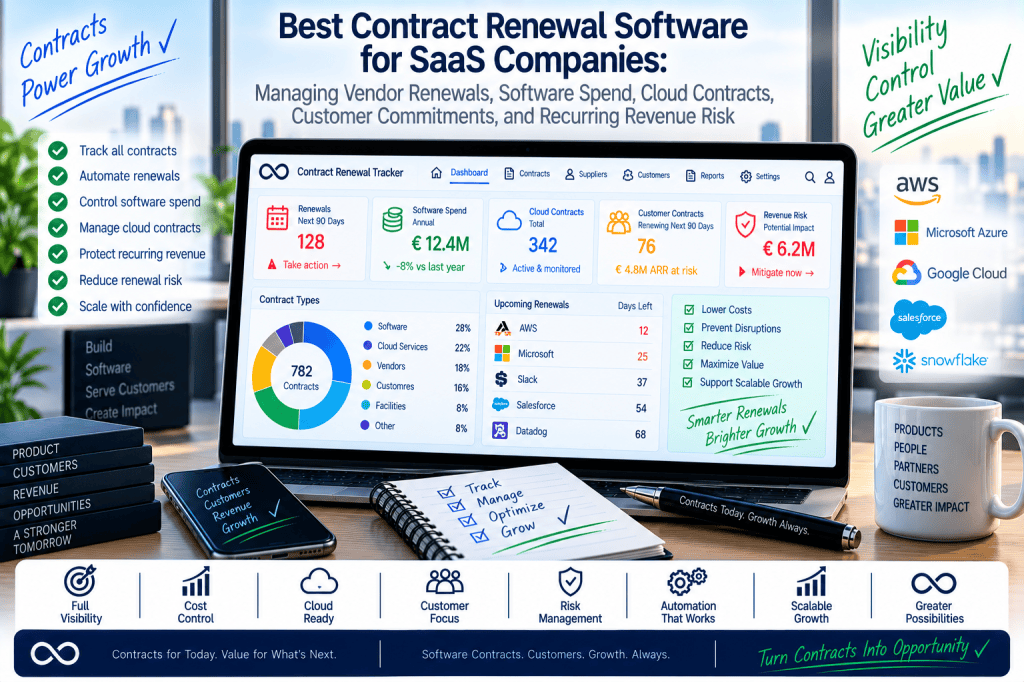
The best contract renewal software for SaaS companies should therefore help the business understand both sides of that equation.
It should help answer:
Which supplier contracts are about to recommit cost?
and:
Which customer contracts are about to recommit—or put at risk—revenue?
That creates a much broader renewal-management opportunity.
Why SaaS Companies Have a Unique Renewal Problem
A SaaS business can grow quickly.
Contracts accumulate just as quickly.
At 20 employees, the company might use:
30 software tools.
At 100 employees:
100 or more.
At 500 employees:
hundreds of technology and service contracts.
At the same time, the company may have:
hundreds or thousands of customer subscriptions.
This creates renewal complexity on both:
cost
and:
revenue.
The Two-Sided SaaS Renewal Model
A useful way to think about it is:
Vendor Renewals
Money going out.
Examples:
AWS.
Azure.
Adobe.
GitHub.
Salesforce.
Security vendors.
Consultants.
Customer Renewals
Money coming in.
Examples:
annual SaaS contracts.
enterprise subscriptions.
multi-year agreements.
The same underlying discipline applies:
know the deadline, owner, value, and required action before the renewal window closes.
Contract Renewal Tracker for SaaS Companies
A SaaS-oriented Contract Renewal Tracker can eventually provide:
Vendor Renewal Management
Customer Renewal Visibility
while keeping those workflows appropriately separate.
That creates a potentially powerful product position:
Manage recurring contractual commitments on both sides of the SaaS business.
Looking for Better Control Over SaaS Renewals?
SaaS companies often manage significant recurring supplier costs while also depending on predictable customer renewals for revenue.
Contract Renewal Tracker can provide a centralized renewal layer for contract dates, notice periods, values, owners, and upcoming decisions so teams can identify cost and revenue exposure earlier.
Bring recurring contract commitments into one renewal view →
Vendor Side: SaaS Spend Is Highly Recurring
Many SaaS businesses rely heavily on other SaaS products.
This creates:
SaaS buying SaaS.
Typical categories include:
- CRM;
- analytics;
- product management;
- design;
- development;
- support;
- finance;
- HR;
- security.
These agreements often renew:
annually
and:
automatically.
That creates a recurring optimization opportunity.
Vendor Renewal Feature 1: Supplier Contract Register
Track:
- software/service;
- supplier;
- owner;
- end date;
- notice period;
- annual value.
This becomes the vendor renewal portfolio.
Vendor Renewal Feature 2: SaaS License Tracking
For seat-based contracts:
track:
Purchased.
Assigned.
Active.
This helps identify:
waste.
Example
Purchased:
300 seats.
Active:
Annual price:
€500/seat.
Potential excess:
110 × €500
=
€55,000.
That can be a material saving for a growing SaaS company.
Vendor Renewal Feature 3: Cloud Commitments
Cloud contracts can be even larger.
Suppose:
Annual AWS commitment:
€2M.
Expected consumption:
€1.6M.
Renewing at the same level can create:
€400K of underutilization risk.
That deserves early review.
Vendor Renewal Feature 4: Developer Tooling
Engineering organizations often accumulate:
- source control;
- observability;
- CI/CD;
- testing;
- AI coding tools.
These categories can expand rapidly.
Renewal becomes a good moment to ask:
Is the tool still standardized and sufficiently used?
Vendor Renewal Feature 5: Security Stack
SaaS companies often invest heavily in:
- identity;
- endpoint;
- SIEM;
- vulnerability tools;
- monitoring.
There may be overlap.
Renewal management can help identify:
consolidation opportunities.
Vendor Renewal Feature 6: Renewal Price Increases
Fast-growing technology vendors often increase:
prices
or:
minimum commitments.
Track:
Current Value.
Supplier Proposal.
Expected Value.
Final Value.
This improves forecasting.
Vendor Renewal Feature 7: Auto-Renewal Exposure
A useful SaaS CFO metric:
How much vendor spend could recommit automatically?
For example:
Vendor ARR-like recurring spend:
€5M.
Auto-renewing:
€3.2M.
Undecided within next 90 days:
€600K.
That is highly relevant.
Vendor Renewal Feature 8: Owner Mapping
Different tools are owned by:
Engineering.
Marketing.
Finance.
Sales.
HR.
Assign:
a named business owner
so renewals do not fall into:
central IT by default.
Vendor Renewal Feature 9: Duplicate SaaS Detection
A growing company may discover:
several teams buying similar tools.
Examples:
- three survey products;
- two project management tools;
- several AI assistants.
Renewal creates:
the right moment to rationalize.
Customer Side: Renewal Is Revenue Risk
Customer renewals require a different perspective.
The question is not:
Can we reduce spend?
It is:
How much recurring revenue is approaching renewal, and which customers require intervention?
This is especially important for:
annual enterprise contracts.
Customer Renewal Feature 1: Customer Contract End Date
Track:
when the current term ends.
This provides:
revenue renewal visibility.
Customer Renewal Feature 2: Customer Notice Period
Some enterprise customers may have:
non-renewal notice requirements.
Track:
both parties’ rights
where appropriate.
This helps commercial teams understand:
renewal timing.
Customer Renewal Feature 3: Annual Recurring Revenue
For customer contracts:
the equivalent of annual contract value is often:
ARR
or:
annualized contract revenue.
This should be visible.
Example
Customer:
ExampleCorp.
ARR:
€180K.
Renewal:
November 30.
Health:
Moderate.
Account Owner:
Sarah.
Now the renewal has:
financial context.
Customer Renewal Feature 4: Renewal Owner
Typical owner:
Customer Success Manager.
Account Executive.
Renewals Manager.
This should be explicit.
Customer Renewal Feature 5: Renewal Status
Possible stages:
Upcoming
Health Review
Renewal Discussion
Proposal Sent
Negotiating
Committed
Renewed
Churned
This creates:
a recurring-revenue pipeline.
Customer Renewal Feature 6: Renewal Probability
A SaaS company may want:
forecast probability.
For example:
Customer ARR:
€250K.
Renewal Probability:
80%.
Expected Renewal Revenue:
€200K.
This can support:
forecasting.
Do Not Treat Probability as Contractual Fact
This is a:
commercial forecast,
not:
legal commitment.
Keep:
contract data
and:
forecast data
separate.
Customer Renewal Feature 7: Customer Health
Renewal risk can be informed by:
- product adoption;
- support issues;
- NPS;
- payment history;
- executive engagement.
This is more like:
customer success intelligence.
Customer Renewal Feature 8: Usage
For SaaS sellers, low usage can indicate:
churn risk.
Example:
Purchased seats:
Active users:
Renewal:
in 90 days.
This deserves:
customer-success intervention.
Customer Renewal Feature 9: Expansion Potential
Renewal is also an opportunity for:
upsell.
Example:
Current ARR:
€150K.
Usage exceeds:
licensed capacity.
Potential renewal:
€190K.
That represents:
expansion.
Customer Renewal Feature 10: Downsell Risk
The opposite can happen.
Current:
€200K.
Expected:
€150K.
Potential contraction:
€50K.
This should be visible before:
forecast closes.
Customer Renewal Feature 11: Churn Risk
If the customer is likely to terminate:
Finance and leadership should know:
early.
For example:
At-Risk ARR:
€1.2M.
This is a major SaaS KPI.
Customer Renewal Feature 12: Renewal Forecast
A CFO or CRO may want:
Renewal ARR Next Quarter
€5M.
High Confidence
€3.6M.
At Risk
€900K.
Expansion Potential
€400K.
This creates:
forward revenue visibility.
Customer Renewal Feature 13: Renewal Rate
Basic formula:
Renewed ARR ÷ Eligible ARR.
This is related to:
gross retention.
Gross Revenue Retention
For SaaS companies, GRR is generally driven by:
renewals minus churn and contraction.
Contract renewal data can contribute to:
this view.
Net Revenue Retention
NRR additionally includes:
expansion.
A renewal platform could eventually connect:
renewal contract outcomes
to:
retention metrics.
Important Product Boundary
Contract Renewal Tracker should not necessarily become:
a full Customer Success Platform
or:
CRM.
That would create massive scope.
A better role is:
contract-driven renewal control.
For customer renewals:
CRM may provide:
health and sales data.
Contract Renewal Tracker provides:
contract dates, notice windows, commitments, and final renewal outcome.
This is a cleaner architecture.
CRM + Contract Renewal Tracker
Example:
CRM:
Customer relationship.
Opportunities.
Account activity.
Contract Renewal Tracker:
Signed contract.
Renewal deadline.
Notice terms.
Renewal decision.
New contract value.
This division is sensible.
Vendor and Customer Renewals Should Not Be Mixed Carelessly
This is important.
Supplier renewal:
goal may be:
reduce spend.
Customer renewal:
goal may be:
retain and grow revenue.
Those workflows are very different.
The product should keep them:
logically distinct.
Potential SaaS Product Model
A future workspace could contain:
Vendor Renewals
Outgoing commitments.
Customer Renewals
Incoming commitments.
Same core deadline engine.
Different:
workflow,
roles,
metrics.
This is architecturally interesting.
SaaS CFO View: Cost + Revenue Renewals
Imagine a dashboard:
Vendor Renewals Next 90 Days
€1.8M cost.
Customer Renewals Next 90 Days
€4.6M ARR.
Net Renewal Exposure
Visible side by side.
This gives leadership:
a powerful recurring-commitment view.
Example
September:
Customer ARR renewing:
€1.2M.
Vendor commitments renewing:
€500K.
October:
Customer ARR:
€2M.
Vendor:
€900K.
Now Finance can see:
two-sided contractual exposure.
SaaS Runway Implications
Vendor renewals affect:
cash burn.
Customer renewals affect:
revenue.
Together they affect:
runway.
This can become strategically important.
Example
Expected customer churn:
−€300K ARR.
Vendor savings:
€150K.
Net economic impact:
still negative.
This provides:
better planning context.
SaaS Renewal Feature 14: Multi-Year Customer Contracts
Track:
term.
A customer may renew for:
36 months.
That changes:
revenue visibility.
SaaS Renewal Feature 15: Multi-Year Vendor Commitments
Likewise:
supplier contracts may commit:
future operating expense.
Both sides matter.
Contracted Revenue vs Contracted Cost
A SaaS company could eventually view:
Contracted Future Revenue
versus:
Contracted Future Supplier Cost
This would be a very interesting advanced financial capability.
SaaS Renewal Feature 16: Price Escalation
Vendor side:
price increases hurt margin.
Customer side:
contractual increases may improve revenue.
Both should be visible.
Example
Vendor software inflation:
+8%.
Customer price increase:
+4%.
If vendor inflation exceeds:
customer pricing power,
gross margin may be pressured.
This is a powerful financial insight.
Margin Impact of Renewal Cycles
Suppose:
Vendor recurring cost:
€4M.
Inflation:
+8% = +€320K.
Customer ARR:
€20M.
Renewal pricing uplift:
+2% = +€400K.
Net:
+€80K before other effects.
This illustrates how renewal data can contribute to:
margin forecasting.
SaaS Renewal Feature 17: Cloud Gross Margin
Cloud is often one of the largest SaaS costs.
If cloud commitment increases faster than revenue:
gross margin suffers.
Cloud contract renewal management can therefore be:
strategic.
SaaS Renewal Feature 18: Customer Discount Expiry
Some customer contracts include:
introductory discounts.
At renewal:
pricing may reset.
Track:
discount expiry
and:
expected new ARR.
SaaS Renewal Feature 19: Vendor Discount Expiry
Likewise:
supplier discounts may expire.
A renewal can therefore produce:
a sudden cost increase.
This should appear:
before budgeting.
SaaS Renewal Feature 20: Commitment Minimums
Both customer and vendor contracts may contain:
minimum commitments.
Track them.
Examples:
- minimum seats;
- minimum usage;
- cloud commit;
- annual minimum fee.
This affects:
economics.
SaaS Renewal Feature 21: Contract Amendments
Fast-growing SaaS companies often amend:
customer contracts
and:
supplier agreements.
The renewal record should reflect:
the latest terms.
SaaS Renewal Feature 22: Renewal Clause Verification
For material agreements:
know:
whether terms auto-renew.
Know:
notice period.
Know:
which document governs.
This remains foundational.
SaaS Renewal Feature 23: Legal Review
Enterprise customer contracts may have:
custom renewal terms.
Legal may need to verify:
- notice;
- liability;
- data processing;
- pricing clauses.
This can be part of:
the renewal workflow.
SaaS Renewal Feature 24: Revenue Risk Escalation
Customer renewal at risk:
€500K ARR.
Notice deadline:
45 days.
This should trigger:
commercial escalation.
Potential recipients:
CSM.
Account Executive.
VP Customer Success.
CRO.
Again:
risk-based.
SaaS Renewal Feature 25: Vendor Cost Risk Escalation
Supplier renewal:
€600K.
Auto-renewing.
No decision.
30 days remaining.
Escalate:
IT.
Procurement.
Finance.
This mirrors:
the other side of the business.
SaaS Renewal Dashboard: Vendor Side
Vendor Contracts
Annual Recurring Cost
€4.8M.
Renewing Next 90 Days
€1.2M.
Auto-Renewing
€3.1M.
Potential Reduction
€240K.
This supports:
cost management.
SaaS Renewal Dashboard: Customer Side
Customer Contracts
ARR
€18M.
ARR Renewing Next 90 Days
€4.5M.
At-Risk ARR
€700K.
Expansion Opportunity
€500K.
This supports:
revenue management.
Executive Combined Dashboard
Customer ARR Renewal Exposure
€4.5M.
Vendor Cost Renewal Exposure
€1.2M.
At-Risk Revenue
€700K.
At-Risk Auto-Renewal Cost
€300K.
Potential Expansion
€500K.
Potential Cost Reduction
€240K.
This is an interesting executive view.
SaaS KPI 1: Vendor Renewal Savings
Annual supplier cost reduced.
SaaS KPI 2: Vendor Auto-Renewal Exposure
Uncontrolled recurring cost.
SaaS KPI 3: Vendor License Utilization
SaaS cost efficiency.
SaaS KPI 4: Customer Renewal ARR
Revenue entering renewal.
SaaS KPI 5: Renewal Rate
Contracts or ARR renewed.
SaaS KPI 6: Churned ARR
Lost recurring revenue.
SaaS KPI 7: Expansion ARR
Additional revenue generated at renewal.
SaaS KPI 8: Contraction ARR
Revenue reduced at renewal.
SaaS KPI 9: Forecast Accuracy
Predicted renewal outcome:
versus:
actual.
SaaS KPI 10: Renewal Lead Time
How early:
cost and revenue renewals
enter active management.
These ten KPIs create:
a strong SaaS renewal framework.
Why SaaS Companies Are a Promising Segment
SaaS organizations often have:
- high recurring supplier spend;
- many software vendors;
- measurable usage;
- recurring customer revenue;
- strong familiarity with SaaS tools.
This reduces:
customer education.
The problem is already familiar.
Growth Makes the Problem Worse
As a SaaS company scales:
more:
employees
means more:
vendor subscriptions.
More:
customers
means more:
renewal contracts.
Both portfolios grow.
That creates:
increasing renewal complexity.
SaaS Companies Also Understand Subscription Economics
They understand:
- ARR;
- churn;
- expansion;
- auto-renewal;
- subscription pricing.
This can make the Contract Renewal Tracker value proposition:
easy to communicate.
But Be Careful About Product Scope
The temptation could be:
build vendor renewal management
plus:
full customer success
plus:
CRM
plus:
revenue forecasting.
Do not do that initially.
Own:
the contract renewal layer.
Integrate with:
the systems that already handle:
other workflows.
This keeps the product coherent.
Recommended Initial SaaS Positioning
For now:
Manage Vendor and Software Renewals Before They Become Automatic Costs.
That is closer to the initial product.
Customer-renewal management can become:
a later adjacent market.
Why Vendor Renewals Should Come First
The current Contract Renewal Tracker product is already built around:
- supplier contracts;
- notice periods;
- owner reminders;
- spend.
That aligns directly with:
vendor renewal management.
Customer renewal workflows would require:
additional concepts such as:
- ARR;
- churn;
- expansion;
- customer health.
Those should not complicate:
the first launch.
Product Expansion Path
Phase 1
Vendor renewals.
Phase 2
Spend optimization.
Phase 3
SaaS usage intelligence.
Phase 4
Customer contract renewal module.
This is much more manageable.
SaaS Beta Experience
For the beta:
focus on:
the vendor side.
A SaaS company imports:
- software contracts;
- cloud contracts;
- services.
Then sees:
renewal exposure.
This is a strong initial use case.
SaaS Beta Aha Moment 1
€320K of software and cloud contracts enter their notice window within the next 90 days.
Useful.
SaaS Beta Aha Moment 2
€140K of that spend auto-renews and still has no recorded decision.
Financially relevant.
SaaS Beta Aha Moment 3
Five contracts have no named owner.
Governance.
Post-Beta SaaS Feature 1
Add:
license counts.
This creates:
optimization.
Post-Beta SaaS Feature 2
Add:
active usage.
Then calculate:
utilization.
Post-Beta SaaS Feature 3
Add:
cloud commitment fields.
This broadens:
technology spend management.
Post-Beta SaaS Feature 4
Add:
supplier proposal / final value.
This supports:
forecasting.
Post-Beta SaaS Feature 5
Add:
customer renewal module only after:
clear demand.
This prevents:
premature complexity.
AI for SaaS Vendor Renewals
A powerful future assistant could say:
Five vendor contracts worth €480K renew in the next 90 days. Two show low utilization, one has a 14% proposed price increase, and one has no owner.
That is actionable.
AI for Cloud Renewal
For example:
Current annual cloud commitment is €1.5M, but projected usage is €1.1M. Review the renewal commitment before negotiation.
This can create:
major savings.
AI for SaaS Rationalization
For example:
Three collaboration tools overlap in functionality and renew within six months. Combined annual cost is €110K.
This is a strong optimization use case.
AI for Customer Renewals—Later
Eventually:
€800K ARR is at elevated renewal risk next quarter, primarily from four low-adoption accounts.
This would be useful.
But it belongs:
later.
Contract Renewal Tracker Beta Launch — September 21, 2026
Contract Renewal Tracker is launching its first SaaS beta on September 21, 2026. The beta is designed to help SaaS companies centralize recurring vendor commitments such as software subscriptions, cloud agreements, cybersecurity tools, developer platforms, and outsourced services by bringing contract values, notice periods, owners, and upcoming renewal actions into one workspace. For SaaS businesses managing a growing stack of recurring supplier costs, the beta provides a practical way to identify renewal exposure before subscriptions and commitments roll into another term. [Notify Me When the Beta Launches →] (One launch notification only — no newsletter or ongoing marketing emails.)
Lead Magnet Opportunity
This article is ideal for a:
SaaS Vendor Renewal Audit Template
Fields:
- software;
- supplier;
- annual cost;
- licenses;
- utilization;
- cloud commitment;
- end date;
- notice period;
- auto-renewal;
- decision.
This should attract:
SaaS operators,
Finance,
and:
IT leaders.
Suggested CTA
Download the SaaS Vendor Renewal Audit Template
Review recurring software, cloud, security, developer-tool, and service commitments using one spreadsheet with contract values, notice periods, usage, owners, and renewal decisions.
Download the Free SaaS Renewal Template →
Future Customer-Renewal Lead Magnet
Later, if you add the customer side:
SaaS Customer Renewal Forecast Template
Fields:
- customer;
- ARR;
- renewal date;
- notice period;
- owner;
- health;
- probability;
- expansion;
- churn risk.
This could support a separate SEO cluster.
Commercial CTA
Managing a Growing Stack of Recurring Vendor Contracts?
Contract Renewal Tracker gives SaaS teams one place to see upcoming supplier renewals, contract values, notice periods, owners, and renewal decisions before recurring costs automatically roll into another term.
Strong SaaS Positioning
For the current product, I would use:
Manage the Renewals Behind Your SaaS Business.
Short.
Broad.
Another
Control the SaaS You Buy Before It Renews.
Very strong for vendor-side acquisition.
Another
Turn Recurring Software Spend into a Managed Renewal Pipeline.
Strong for Finance/IT.
Longer-Term Positioning
If customer renewals are eventually added:
One Renewal Intelligence Layer for Recurring Cost and Recurring Revenue.
That could become a distinctive enterprise proposition.
But it is:
a later-stage vision.
Final Thoughts
SaaS companies operate inside:
a recurring economic model.
That applies not only to:
the subscriptions they sell,
but also to:
the technology and services they buy.
The vendor-side process is:
Recurring Cost
↓
Notice Deadline
↓
Usage Review
↓
Renewal Decision
↓
Negotiation
↓
New Commitment
The customer-side process is:
Recurring Revenue
↓
Renewal Date
↓
Customer Health
↓
Renewal Discussion
↓
Expansion / Renewal / Churn
Both are:
renewal problems.
But they should not be treated:
identically.
For Contract Renewal Tracker, the immediate opportunity is clear:
help SaaS companies gain control over the growing stack of recurring supplier contracts that quietly accumulate as the business scales.
Longer term, the same renewal architecture could potentially expand into:
customer-contract renewal intelligence.
That creates an intriguing broader vision:
a platform that helps SaaS companies understand what recurring commitments are about to change—on both the cost side and the revenue side of the business.
Next Article in the Contract Renewal Tracker Series
This next article can target consultancies, agencies, accounting firms, legal practices, engineering firms, and other professional-services organizations where contract administration is usually distributed across partners, Finance, IT, Operations, and project teams rather than managed by a dedicated procurement organization.

