Professional services firms often have a deceptively complex contract portfolio.
A consultancy, agency, accounting firm, engineering company, legal practice, or advisory business may not think of itself as heavily contract-driven.
But recurring commitments accumulate quickly.
Typical examples include:
- software subscriptions;
- cloud services;
- professional indemnity insurance;
- subcontractor agreements;
- office leases;
- telecom services;
- managed IT support;
- data and research subscriptions;
- marketing platforms;
- training and certification services;
- outsourced finance or HR services.
At the same time, the firm may also have recurring client agreements that determine revenue continuity.
This creates an operational challenge:
The business may depend on dozens or hundreds of recurring agreements without having a dedicated procurement or contract-management team responsible for monitoring them.
For professional services firms, the best contract renewal software should therefore be simple enough for a lean organization while still giving Finance, Operations, IT, partners, and business owners reliable visibility into upcoming commitments.
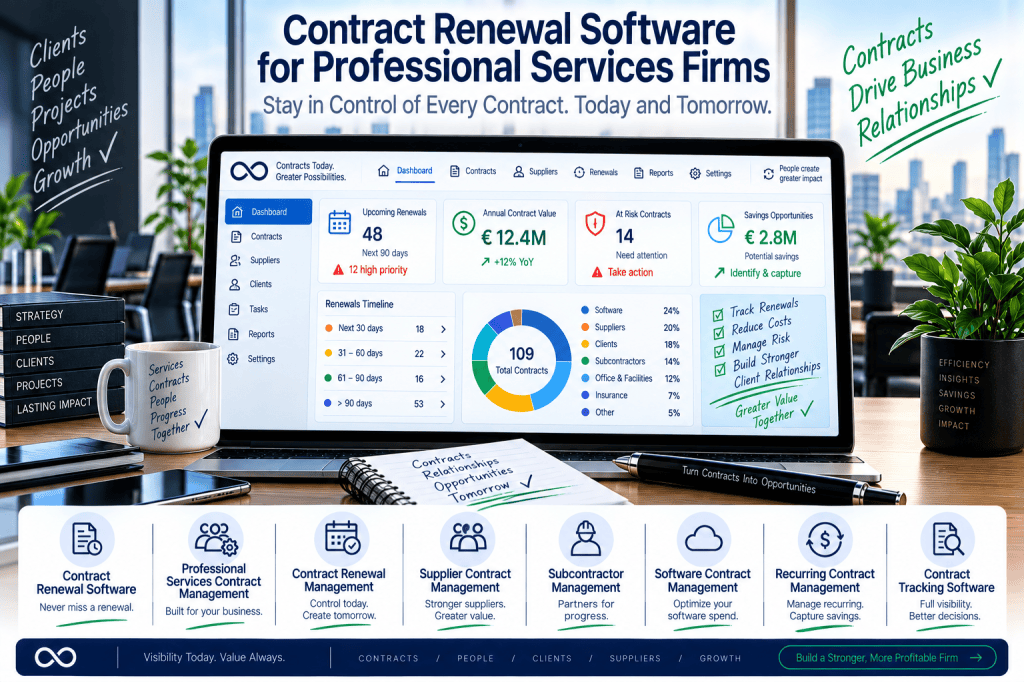
What Is Contract Renewal Software for Professional Services Firms?
Contract renewal software helps professional services businesses track recurring agreements and manage what needs to happen before those agreements renew, expire, or terminate.
At minimum, it should track:
- contract;
- supplier;
- responsible owner;
- end date;
- notice period;
- notice deadline;
- annual value;
- auto-renewal;
- renewal decision.
A more mature platform can also support:
- reminders;
- escalation;
- approvals;
- spend forecasting;
- subcontractor reviews;
- insurance renewals;
- supplier consolidation;
- client contract visibility.
The key objective is:
Keep recurring commitments visible without creating enterprise-level administrative overhead.
Why Professional Services Firms Are Particularly Exposed
Professional services firms are usually people-intensive rather than procurement-intensive.
That means contract administration often sits with:
- Finance;
- Operations;
- IT;
- office management;
- individual partners.
There may be no dedicated contract operations team.
This makes spreadsheets and personal reminders common.
They work—until ownership becomes fragmented.
Still Tracking Renewals Across Spreadsheets and Calendars?
A growing professional services firm may have software, office, insurance, subcontractor, and service agreements managed by completely different people.
Contract Renewal Tracker is designed to bring those commitments into one workspace so the firm can see which contracts require attention, what they cost, who owns them, and when action is required.
Centralize recurring contract renewals without enterprise CLM complexity →
The Professional Services Renewal Portfolio
A typical firm may have contracts in six major groups:
1. Technology
Software, cloud, IT support.
2. People and Delivery
Subcontractors and specialist providers.
3. Offices and Operations
Lease, cleaning, telecom, utilities.
4. Insurance and Compliance
Professional indemnity, cyber, liability.
5. Knowledge and Data
Research subscriptions, databases, training.
6. Client Agreements
Retainers, support agreements, recurring engagements.
Each category has different renewal risks.
Category 1: Software Contracts
Professional services firms often rely heavily on SaaS.
Examples:
- Microsoft 365;
- Adobe;
- CRM;
- accounting software;
- project management;
- time tracking;
- document management;
- collaboration;
- cybersecurity.
These subscriptions often renew automatically.
Software Renewal Risk
A 75-person consultancy might have:
60 SaaS products.
Even modest contracts can create:
significant recurring spend.
Suppose average:
€4,000/year.
60 tools:
€240,000 annually.
That deserves structured management.
Software Feature 1: Contract Owner
Track:
who actually uses and owns the application.
For example:
CRM:
Sales Director.
Design software:
Creative Director.
Accounting:
Finance Manager.
This prevents IT or Finance from making business-use decisions alone.
Software Feature 2: License Count
Track:
purchased licenses.
Then compare with:
active users
where possible.
This creates renewal optimization opportunities.
Example
Professional design software:
Purchased:
50 seats.
Active:
Annual cost:
€36,000.
Potential quantity reduction:
16 seats.
That can create immediate savings.
Software Feature 3: Auto-Renewal
Mark:
Yes / No / Unknown.
Professional services firms can accumulate many auto-renewing subscriptions precisely because they are easy to buy.
The renewal system should make them visible.
Category 2: Subcontractor Agreements
Consultancies and agencies frequently use:
- freelancers;
- specialist contractors;
- delivery partners;
- technical subcontractors.
These agreements can also require renewal or extension.
Subcontractor Renewal Questions
Before extending:
ask:
- Is the specialist still required?
- Is pricing still competitive?
- Is performance acceptable?
- Are client requirements changing?
- Does the subcontractor still meet compliance requirements?
This is more than simply extending:
the contract date.
Subcontractor Feature 1: Assignment / Service Scope
Track:
what the subcontractor provides.
For example:
Cloud architect.
Design support.
Cybersecurity testing.
This improves visibility.
Subcontractor Feature 2: Engagement Owner
Who is responsible?
Usually:
Project Director.
Practice Lead.
Operations.
A named owner is essential.
Subcontractor Feature 3: Rate
Track:
day rate
or:
monthly value.
This supports:
commercial review.
Example
Current:
€1,000/day.
Supplier requests:
€1,150/day.
Renewal becomes:
a negotiation.
Not simply:
an administrative extension.
Subcontractor Feature 4: Performance
Capture simple evidence:
- delivery quality;
- responsiveness;
- client feedback;
- reliability.
This helps determine:
whether extension is justified.
Subcontractor Feature 5: Compliance
Depending on the engagement, the firm may need:
- insurance;
- certifications;
- security documentation.
Renewal can trigger:
reverification.
Category 3: Office and Facilities Contracts
Professional services firms often maintain:
- leases;
- cleaning;
- security;
- telecom;
- printing;
- utilities;
- office equipment.
These agreements may have:
long notice periods.
Office Lease Example
Lease ends:
June 30.
Break or non-renewal notice:
9 months.
The real decision deadline may therefore be:
the previous September.
That is far earlier than:
many managers expect.
This is exactly why notice-period tracking matters.
Facilities Feature 1: Location
Track:
which office
the agreement relates to.
This becomes increasingly important for:
multi-office firms.
Facilities Feature 2: Occupancy or Demand
Suppose:
office occupancy drops by 40%.
Cleaning,
printing,
telecom,
or:
space requirements
may need to change.
Renewal should reflect:
current operating reality.
Hybrid Work Changes Renewal Economics
Professional services firms have often changed:
office utilization
and:
technology needs.
That means contracts negotiated years earlier may no longer match:
current working patterns.
Renewal is a natural reassessment point.
Category 4: Insurance Contracts
This is a particularly important category for professional services firms.
Examples:
- professional indemnity;
- cyber insurance;
- general liability;
- directors and officers insurance.
These should not be treated like:
ordinary software subscriptions.
Insurance Renewal Feature 1: Coverage Period
Track:
policy start/end.
Insurance Renewal Feature 2: Renewal Preparation Deadline
Insurance renewal may require:
information gathering
well before:
policy expiry.
The internal workflow should therefore begin early.
Insurance Renewal Feature 3: Broker / Owner
Assign:
Finance Director.
Risk Manager.
Partner.
Someone must own:
the process.
Insurance Renewal Feature 4: Premium
Track:
current annual premium
and:
renewal proposal.
This gives Finance:
cost visibility.
Insurance Renewal Feature 5: Coverage Changes
Renewal may change:
- limits;
- deductibles;
- exclusions.
These require:
management review.
Contract Renewal Tracker can coordinate:
the process
without trying to become:
an insurance platform.
Category 5: Data, Research, and Professional Subscriptions
Professional firms often buy:
- market data;
- legal databases;
- research tools;
- analyst services;
- industry memberships;
- training platforms.
These can become:
significant recurring costs.
Usage Review Matters
A €20,000 research subscription may be used by:
three people
or:
Before renewal, ask:
Who is actually using it?
This can reveal:
easy savings.
Duplicate Subscription Risk
Different practice groups may independently purchase:
similar information sources.
Central renewal visibility can reveal:
overlap.
Category 6: Client Agreements
Professional services firms may also have recurring client arrangements such as:
- retainers;
- managed services;
- advisory subscriptions;
- support agreements;
- framework agreements.
These create:
revenue-side renewal exposure.
Client Contracts Are a Different Workflow
As with SaaS companies:
supplier renewals
and:
client renewals
should not be mixed carelessly.
Supplier renewal:
cost-side decision.
Client renewal:
revenue-side decision.
But both rely on:
contract dates and notice terms.
Client Renewal Feature 1: Revenue Value
Track:
annual or recurring contract revenue.
Client Renewal Feature 2: Client Owner
Usually:
Partner.
Account Director.
Engagement Manager.
Client Renewal Feature 3: Renewal Preparation
Before renewal, the firm may review:
- profitability;
- client satisfaction;
- scope;
- pricing;
- resource requirements.
This is especially useful for:
retainers.
Example
Current client retainer:
€180K/year.
Hours delivered:
significantly above plan.
Margin:
too low.
Renewal decision:
Renegotiate Scope / Price.
That is commercially important.
Client Renewal Feature 4: Notice Period
Some clients can:
terminate
or:
non-renew
with specified notice.
The firm should understand:
revenue risk.
Client Renewal Feature 5: Renewal Probability
For commercial forecasting:
the firm may want:
expected renewal.
Again:
forecast
should remain distinct from:
contractual fact.
Key Requirement 1: Simplicity
Professional services firms usually do not have:
a full-time CLM administrator.
That means the system must be:
easy to use.
This is arguably the most important product requirement.
Simple Contract Record
For an initial workflow:
Contract
Supplier
Owner
End Date
Notice Period
Value
Auto-Renewal
That may be enough.
Key Requirement 2: Excel Import
Many firms already have:
a contract spreadsheet.
Migration should be:
straightforward.
Do not require:
a consulting project.
Key Requirement 3: Named Ownership
This is especially important because:
responsibility is distributed.
Partners.
IT.
Finance.
Operations.
Assign:
a person.
Key Requirement 4: Automated Reminders
Manual reminders become problematic because:
partners and managers are busy.
The system should:
notify them
before:
the decision window becomes urgent.
Key Requirement 5: Escalation
If a partner ignores:
the reminder,
someone must know.
For example:
Owner.
↓
Operations.
↓
Finance Director.
This creates:
control.
Key Requirement 6: Contract Value
Small contracts can add up.
Track:
annual value
so management can focus on:
material commitments.
Key Requirement 7: Category
Useful categories:
- Software;
- Subcontractor;
- Office;
- Insurance;
- Marketing;
- Professional Services;
- Client;
- Other.
This makes reporting:
simple.
Key Requirement 8: Renewal Decision
Use:
Renew
Renegotiate
Reduce
Replace
Extend
Terminate
This works across many professional services contracts.
Example: Software
Reduce.
Example: Subcontractor
Extend.
Example: Insurance
Renegotiate.
Example: Office
Terminate / Replace.
One common decision framework can therefore work:
across categories.
Key Requirement 9: Dashboard
A professional services leadership dashboard should stay simple.
For example:
Contracts Renewing Next 90 Days
Annual Value
€420K.
Auto-Renewing
€230K.
Undecided
€95K.
Missing Owners
That may be enough.
Key Requirement 10: Financial Forecast
Finance should know:
what supplier spend is renewing.
For example:
September:
€80K.
October:
€120K.
November:
€250K.
This helps:
cash and budget planning.
Key Requirement 11: Multi-Office Support
A growing firm may have:
Amsterdam.
London.
Berlin.
Each with:
different local suppliers.
Track:
location
without creating:
separate spreadsheets.
Example
London:
10 contracts.
Amsterdam:
Berlin:
Central Finance:
sees all.
Local Operations:
sees relevant ones.
That is a useful SaaS model.
Key Requirement 12: Permission Control
Partner compensation,
client agreements,
insurance,
or:
sensitive supplier terms
may not be appropriate for:
every user.
Role-based access matters.
Key Requirement 13: Document Attachments
Users should be able to attach:
the agreement.
This reduces:
searching through email.
Key Requirement 14: Search
Type:
Insurance.
Find:
all relevant policies.
Type:
Adobe.
Find:
all Adobe agreements.
Simple search creates:
significant usability value.
Key Requirement 15: Audit Trail
As more people participate:
track important changes.
Especially:
- dates;
- values;
- owners;
- decisions.
Professional Services Renewal Workflow
A practical workflow can be:
120 Days Before Deadline
Owner review.
↓
90 Days
Decision.
↓
60 Days
Commercial/legal review.
↓
30 Days
Approval.
↓
Before Notice Deadline
Execute.
For low-value contracts:
compress this.
Low-Value Renewal Workflow
Example:
€2,000 SaaS subscription.
60 days:
review.
30 days:
decision.
No complex approval.
This keeps administration:
proportional.
High-Value Renewal Workflow
Example:
€500K subcontracting agreement.
180 days:
business review.
120 days:
performance and alternatives.
90 days:
negotiation.
60 days:
approval.
This deserves:
more scrutiny.
Contract Tiering
A simple model:
Tier 1
€250K or strategic.
Tier 2
€50K–€250K.
Tier 3
<€50K.
Then apply:
different workflow intensity.
This keeps the system manageable.
Renewal Risk Score for Professional Services Firms
Possible factors:
Notice Deadline
30%.
Contract Value
25%.
Auto-Renewal
15%.
Business Criticality
15%.
Owner Status
15%.
This can help prioritize:
the portfolio.
Example
Small design subscription:
€3K.
30 days remaining.
Easy to replace.
Risk:
Medium.
Professional indemnity insurance:
€80K.
Critical.
20 days remaining.
Risk:
Critical.
These deserve:
very different treatment.
Spend Optimization Opportunities
Professional services firms can often find savings in:
- unused software;
- duplicate tools;
- excessive subcontractor rates;
- underused office services;
- unnecessary data subscriptions.
Renewal management creates:
the trigger for review.
Software Optimization Example
Annual software spend:
€300K.
10% reducible through:
license cleanup.
Potential:
€30K.
That alone may justify:
the renewal platform.
Data Subscription Example
Four market-data services:
€60K combined.
Two have:
low usage.
Potential reduction:
€20K.
Again:
easy renewal value.
Office Services Example
Cleaning frequency reduced.
Annual reduction:
€15K.
Telecom lines removed:
€5K.
Recurring savings:
€20K.
These small improvements can add up.
Subcontractor Optimization Example
10 recurring specialists.
Rate benchmarking identifies:
€40K opportunity.
This can be another:
commercial benefit.
Insurance Visibility Benefit
Insurance may not provide:
cost optimization every year.
But missed renewal would be:
high risk.
That makes contract renewal software valuable for:
control,
not only savings.
Different Contract Categories Create Different Value
Software
Optimization.
Insurance
Risk protection.
Subcontractors
Commercial control.
Office
Cost and continuity.
Client Agreements
Revenue protection.
One platform can support:
different outcomes.
Professional Services Dashboard by Category
For example:
| Category | Contracts | Annual Value |
|---|---|---|
| Software | 65 | €280K |
| Subcontractors | 30 | €1.2M |
| Offices/Facilities | 18 | €500K |
| Insurance | 6 | €150K |
| Data/Research | 22 | €120K |
This immediately shows:
where money is concentrated.
Partner Dashboard
Partners should not see:
every supplier contract.
They need:
their contracts and actions.
For example:
Your Contracts
Decisions Due
Client Renewals
This reduces:
noise.
Operations Dashboard
Operations may need:
all:
office,
service,
supplier renewals.
This is a broader portfolio view.
Finance Dashboard
Finance needs:
- value;
- forecast;
- budget.
Again:
role-specific views.
Managing Client and Supplier Contracts in the Same Platform
This can work if:
record type is explicit.
For example:
Supplier Contract
vs:
Client Contract
Then:
different workflows.
This prevents confusion.
Record Type: Supplier
Financial value means:
cost.
Record Type: Client
Financial value means:
revenue.
That distinction must be:
very clear.
Should Contract Renewal Tracker Support Client Renewals?
Potentially:
later.
But the first product should remain:
supplier-focused.
Why?
Because adding client-renewal concepts introduces:
- revenue forecasting;
- churn;
- expansion;
- CRM integration.
That expands:
scope significantly.
Better Product Strategy
Start with:
professional services firms’ supplier contracts.
Then observe:
whether users repeatedly ask:
Can I also track my client agreements?
If demand is strong:
build the module.
This is much safer than:
assuming demand.
Contract Renewal Tracker Beta Use Case
Professional services firms can be ideal early beta users because:
their portfolios are often:
large enough to need help
but:
not so complex that enterprise CLM is necessary.
This fits:
the product’s likely starting point.
Beta Example
Consultancy:
80 employees.
Contracts:
Annual recurring supplier spend:
€1.4M.
Current process:
Excel.
This is a strong beta profile.
Beta Aha Moment 1
14 contracts require action within 90 days.
Immediate visibility.
Beta Aha Moment 2
€220K of those agreements auto-renew.
Financial context.
Beta Aha Moment 3
Five contracts have no named owner.
Governance.
Beta Aha Moment 4
Three software contracts may have redundant licenses.
Later:
optimization.
This creates a strong value progression.
Product Positioning for Professional Services
A strong message:
Contract Renewal Management for Firms That Don’t Need Enterprise CLM.
Very aligned.
Another
Keep Software, Supplier, Office, Insurance, and Service Renewals in One Place.
Very practical.
Another
Stop Letting Recurring Contracts Live in Different People’s Spreadsheets.
Strong pain-point positioning.
Another
A Simple Renewal Calendar for the Contracts Behind Your Firm.
Good small-business messaging.
Consultant-Specific Positioning
Spend More Time on Clients, Less Time Chasing Contract Renewal Dates.
This can work well.
Agency Positioning
Track the SaaS, Freelancers, Suppliers, and Service Contracts Behind Your Agency.
Very relevant.
Accounting-Firm Positioning
One Renewal View for Software, Insurance, Offices, Data Services, and Supplier Agreements.
Again:
clear.
Engineering-Firm Positioning
Manage Professional Software, Subcontractors, Facilities, and Supplier Renewals Before They Become Operational Risks.
Strong vertical variation.
Professional Services KPI 1: Renewal Coverage
Percentage of material agreements:
inside the system.
KPI 2: Owner Coverage
Target:
close to 100%.
KPI 3: Notice Deadline Coverage
How many contracts have:
a reliable action deadline?
KPI 4: Auto-Renewal Exposure
Total spend:
subject to automatic rollover.
KPI 5: Undecided Spend
Contracts nearing renewal without:
a decision.
KPI 6: Software Utilization
For technology subscriptions.
KPI 7: Cost Reduction
Recurring spend reduced.
KPI 8: Renewal Lead Time
How early:
important contracts
enter review.
KPI 9: Late Renewals
Target:
declining.
KPI 10: Critical Missed Deadlines
Target:
zero.
These metrics are simple enough for:
a smaller firm.
Excel vs Contract Renewal Tracker
Excel remains a strong starting point.
For:
20 contracts,
it may be enough.
As the organization grows:
the problem becomes:
distributed ownership.
Then:
automated reminders,
workflow,
and:
dashboards
become increasingly valuable.
Enterprise CLM vs Contract Renewal Tracker
Professional services firms may not need:
full contract authoring transformation.
If the primary problem is:
renewal control,
a focused platform can be:
much easier to adopt.
That is an important market position.
CRM vs Contract Renewal Tracker
CRM manages:
clients.
Pipeline.
Relationships.
Contract Renewal Tracker manages:
contractual renewal obligations.
If customer renewals are added later:
integrate rather than:
replace CRM.
Accounting Software vs Contract Renewal Tracker
Accounting systems show:
what was paid.
Contract Renewal Tracker shows:
what contractual commitment is approaching next.
This creates:
forward visibility.
Contract Renewal Tracker as Lightweight Contract Operations
Professional services firms may not need:
Contract Operations staff.
The software can provide:
some of the process structure
that such a team would otherwise create manually.
This is a compelling concept.
AI Opportunity: Contract Extraction
A firm could upload:
insurance policy.
Software agreement.
Subcontractor agreement.
AI extracts:
- end date;
- notice period;
- auto-renewal.
That reduces:
administration.
AI Opportunity: Renewal Summary
For example:
Your professional indemnity policy renews in 85 days. Current annual premium is €42K. No owner is assigned and the renewal information has not yet been verified.
Useful.
AI Opportunity: Spend Review
For example:
Four research subscriptions worth €38K renew within six months. Two appear to have overlapping categories.
This surfaces:
optimization opportunities.
AI Opportunity: Partner Digest
A partner could receive:
Two contract decisions require your attention this week: a €75K subcontractor extension and a €40K client data subscription.
This is much more digestible than:
a contract database.
AI Should Not Overcomplicate the Product
For smaller firms:
simple automation
will likely create more value initially than:
advanced AI.
The order should be:
Reliable Dates
↓
Reminders
↓
Ownership
↓
Decisions
↓
AI
This keeps the product grounded.
Contract Renewal Tracker Beta Launch — September 21, 2026
Contract Renewal Tracker is launching its first SaaS beta on September 21, 2026. The beta is designed for growing firms that need a simpler way to manage recurring software, supplier, office, insurance, subcontractor, and service agreements without adopting a heavyweight enterprise CLM platform. By bringing contract dates, notice periods, owners, annual values, and upcoming actions into one workspace, the beta can help Finance and Operations identify renewal risk before commitments roll into another term. [Notify Me When the Beta Launches →] (One launch notification only — no newsletter or ongoing marketing emails.)
Lead Magnet Opportunity
This article is ideal for:
Professional Services Contract Renewal Template
Categories:
- Software;
- Subcontractors;
- Insurance;
- Office;
- Data;
- Client.
Columns:
- owner;
- annual value;
- end date;
- notice period;
- auto-renewal;
- decision.
This would be:
highly practical.
Suggested CTA
Download the Professional Services Contract Renewal Template
Track software, subcontractor, office, insurance, data, and recurring supplier contracts using one structured spreadsheet with owners, values, notice periods, and renewal decisions.
Download the Free Renewal Template →
Second Lead Magnet
Another useful resource:
Annual Contract Review Checklist for Professional Services Firms
Include:
- software;
- insurance;
- subcontractors;
- offices;
- subscriptions.
This could become:
a recurring annual lead-generation asset.
Commercial CTA
Still Managing Contract Renewals Across Different Spreadsheets?
Contract Renewal Tracker gives professional services firms one place to track recurring supplier commitments, contract values, notice periods, owners, and upcoming actions—without the complexity of an enterprise CLM implementation.
Final Thoughts
Professional services firms need:
contract discipline
without:
contract bureaucracy.
That is the central opportunity.
Their renewal portfolio may span:
Software
Subcontractors
Insurance
Offices
Data
Services
Each category is different.
But the fundamental renewal process is the same:
Contract
↓
Notice Deadline
↓
Owner
↓
Review
↓
Decision
↓
Renew / Reduce / Replace / Terminate
A focused renewal platform can standardize that process without forcing every partner or manager to become:
a contract-management specialist.
For Contract Renewal Tracker, this makes professional services a promising target market:
businesses with enough recurring contractual complexity to outgrow spreadsheets, but not enough appetite for a heavyweight CLM transformation.
That position fits the product exceptionally well.
Next Article in the Contract Renewal Tracker Series
Article 97 — “Best Contract Renewal Software for Multi-Location and Multi-Entity Businesses: Managing Contracts Across Offices, Countries, Subsidiaries, and Business Units”
The next article can address companies that have outgrown a single-company spreadsheet and need visibility across multiple sites, subsidiaries, legal entities, currencies, owners, suppliers, and regional notice requirements.
That should create another strong commercial page between the small-business use case and the eventual enterprise positioning of Contract Renewal Tracker.

