Procurement teams should rarely treat a contract renewal as an administrative event.
A supplier renewal is a commercial decision.
It is an opportunity to ask:
Do we still need this supplier?
Are we buying the right quantity?
Is the supplier performing?
Is the pricing still competitive?
Should we renegotiate?
Could we consolidate spend?
Should we switch suppliers?
And, critically:
How long do we have before the contract removes some of those options?
That final question is why contract renewal software can be particularly valuable for procurement.
The important date is often not the contract expiration date. It is the notice deadline—the point after which an auto-renewal or contractual provision may significantly reduce the buyer’s options.
Procurement renewal management therefore needs to combine deadlines, supplier performance, spend, negotiation preparation, ownership, approvals, and renewal outcomes in one repeatable process. Current procurement guidance similarly emphasizes beginning renewal work before the notice window closes so there is time to evaluate performance, alternatives, pricing, risk, and internal approvals. (clauseminds.com)
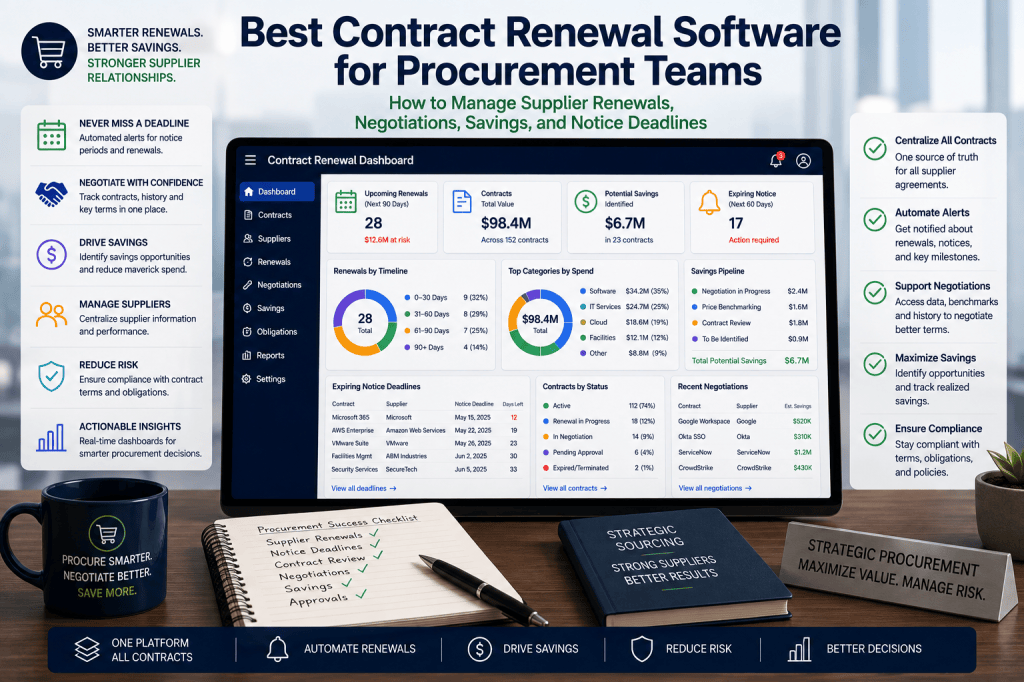
What Is Contract Renewal Software for Procurement?
Contract renewal software for procurement helps teams identify upcoming supplier renewals and manage the activities required to reach a commercially sound decision.
A basic platform might track:
- supplier;
- contract;
- end date;
- notice period;
- renewal date;
- owner.
A procurement-oriented platform should go further and support:
- supplier spend;
- renewal strategy;
- supplier performance;
- pricing history;
- negotiation;
- savings;
- approvals;
- termination or replacement.
The objective is not simply:
Don’t miss the renewal.
It is:
Give Procurement enough time and information to achieve the best practical renewal outcome.
The Procurement Renewal Problem
Procurement frequently becomes involved:
too late.
The business owner receives a supplier renewal proposal.
They forward it to Procurement.
The supplier wants an answer:
next week.
Procurement discovers:
the contract auto-renews shortly afterward.
There is no time to:
benchmark competitors,
run an RFP,
challenge quantities,
review supplier performance,
or develop a credible alternative.
The result becomes:
Renew now. Negotiate better next year.
Then next year:
the same thing happens.
Renewal Timing Creates Negotiating Leverage
Time is one of Procurement’s most important renewal assets.
If the supplier knows:
you cannot realistically replace them,
the buyer’s negotiating position weakens.
If Procurement has:
six months,
the situation is different.
The team can investigate:
- alternatives;
- competitive pricing;
- consumption;
- supplier performance;
- consolidation opportunities;
- switching costs.
Negotiation guidance for supplier renewals similarly recommends building a fact base around usage, spend history, benchmarks, performance, switching costs, and alternatives before entering the commercial discussion. (Negotiations.AI)
Procurement Should Work Backward from the Notice Deadline
Suppose:
Contract End:
December 31
Notice Period:
90 days
The procurement timeline should not start:
December 1.
It should work backward from approximately:
early October.
For example:
180 Days Before Notice Deadline
Business requirement review.
150 Days
Supplier performance assessment.
120 Days
Market benchmark.
90 Days
Negotiation begins.
60 Days
Commercial recommendation.
30 Days
Final approval.
Notice Deadline
Renew / renegotiate / terminate decision executed.
The exact schedule should depend on:
contract complexity and materiality.
Why Expiration Tracking Alone Is Insufficient
Imagine a dashboard saying:
Contract expires in 130 days.
That sounds comfortable.
But suppose:
Notice deadline is in 10 days.
Procurement does not have:
130 days.
It effectively has:
That is why procurement-oriented renewal systems should clearly distinguish:
Expiration Date
from:
Notice Deadline.
Tracking the governing renewal clause, amendments, owner, and required lead time is especially important because amendments or order forms can change the operative renewal terms. (clauseminds.com)
What Should Procurement Contract Renewal Software Track?
At minimum:
| Data | Why Procurement Needs It |
|---|---|
| Supplier | Counterparty |
| Contract | Agreement being renewed |
| Business Owner | Internal stakeholder |
| Procurement Owner | Commercial owner |
| End Date | Contract lifecycle |
| Notice Period | Required advance action |
| Notice Deadline | Commercial deadline |
| Auto-Renewal | Lock-in risk |
| Current Value | Spend baseline |
| Proposed Value | Supplier position |
| Renewal Decision | Intended outcome |
| Negotiation Status | Commercial progress |
| Final Value | Renewal outcome |
| Savings / Avoidance | Procurement result |
This transforms:
a contract database
into:
a procurement renewal pipeline.
Think of Renewals as a Pipeline
Procurement teams are accustomed to:
sourcing pipelines.
Renewals can be managed similarly.
For example:
Upcoming
↓
Business Review
↓
Procurement Review
↓
Market Assessment
↓
Negotiation
↓
Approval
↓
Execution
↓
Completed
Now Procurement can answer:
Where is every material renewal?
Procurement Renewal Dashboard
A useful dashboard might show:
Renewals Next 180 Days
48
Contract Value
€7.8M
Undecided
€1.9M
In Negotiation
€3.2M
Critical
€650K
Expected Savings
€280K
That is much more useful than:
48 contracts expire soon.
Feature 1: Supplier Renewal Calendar
Procurement needs a forward-looking calendar.
Not:
30 days.
Ideally:
12–18 months.
This allows teams to plan:
resources
and:
negotiation capacity.
12-Month Renewal Forecast
For example:
| Month | Renewals | Value |
|---|---|---|
| September | 14 | €850K |
| October | 21 | €1.4M |
| November | 8 | €720K |
| December | 35 | €3.8M |
Now the Procurement Director can see:
December is overloaded.
Work can begin earlier.
Feature 2: Notice Deadline Management
This should be:
fundamental.
The platform should store:
Notice Period
and calculate:
Notice Deadline.
Then alerts should work backward from:
that date.
Not merely:
expiration.
Feature 3: Auto-Renewal Identification
Procurement should be able to filter:
Auto-Renewal = Yes
Then ask:
How much spend could roll forward automatically?
For example:
Total Supplier Spend:
€15M.
Auto-Renewing:
€6.2M.
Undecided Auto-Renewing:
€1.1M.
That final number deserves attention.
Feature 4: Supplier Performance
Renewal decisions should incorporate:
how the supplier actually performed.
Possible metrics:
- SLA compliance;
- service availability;
- delivery performance;
- incident frequency;
- support quality;
- stakeholder satisfaction;
- implementation performance.
Structured supplier-performance evidence can strengthen the renewal negotiation rather than relying on recollection or anecdote. (Dilitrust)
Supplier Renewal Scorecard
A simple scorecard might include:
| Category | Score |
|---|---|
| Service Quality | 82% |
| SLA Performance | 91% |
| Commercial Competitiveness | 68% |
| Support | 74% |
| Innovation | 65% |
| Relationship | 88% |
Overall:
78%
Now Procurement has evidence for the conversation.
Poor Performance Creates Negotiating Evidence
Suppose:
SLA target:
99.9%.
Actual:
99.3%.
Seven major incidents.
Average support resolution:
outside contractual target.
Supplier proposes:
8% increase.
Procurement now has a stronger fact base for challenging that increase.
Feature 5: Spend History
The system should ideally show:
Year 1:
€300K.
Year 2:
€330K.
Year 3:
€365K.
Supplier Proposal:
€410K.
Now Procurement immediately sees:
the commercial trajectory.
Renewal Price Increase
Calculate:
Supplier Proposal − Current Value
For example:
Current:
€365K.
Proposal:
€410K.
Increase:
€45K.
Percentage:
12.3%.
That should be visible.
Feature 6: Price Benchmarking
Procurement may want to compare:
current pricing
against:
market benchmarks.
The software does not necessarily need to provide:
the benchmark itself.
But it should allow the team to record:
Benchmark Price
or:
Target Price.
Example
Supplier Proposal:
€410K.
Benchmark:
€350K.
Procurement Target:
€360K.
Now the negotiation has:
a structured objective.
Feature 7: Usage and Demand Data
This is particularly important for:
SaaS.
Suppose:
1,000 licenses.
Average active users:
Supplier proposes renewal for:
1,000.
Procurement should challenge:
quantity
before negotiating:
unit price.
Quantity Optimization Often Comes Before Price Negotiation
Current:
1,000 × €500
=
€500K.
Actual need:
Even with the same unit price:
700 × €500
=
€350K.
Potential reduction:
€150K.
That can be more important than negotiating:
5% off.
Procurement Should Ask Two Different Questions
Price Question
Are we paying too much per unit?
Demand Question
Are we buying too many units?
Both matter.
Feature 8: Renewal Strategy
Each contract should have:
a procurement strategy.
Possible values:
Renew As-Is
Renegotiate
Reduce
Consolidate
Replace
Retender
Terminate
This creates portfolio visibility.
Example
Upcoming €10M portfolio:
Renew:
€3M.
Renegotiate:
€4M.
Reduce:
€800K.
Retender:
€1.5M.
Terminate:
€300K.
Undecided:
€400K.
That is actionable procurement intelligence.
Feature 9: BATNA
For material negotiations, Procurement should understand its:
Best Alternative to a Negotiated Agreement.
For example:
Current supplier:
Supplier A.
Alternative:
Supplier B.
Switching cost:
€100K.
Implementation:
4 months.
Estimated alternative annual cost:
€650K.
This changes:
negotiating leverage.
The Supplier Also Understands Your BATNA
If:
switching requires 12 months
and:
you start negotiating 30 days before renewal,
the supplier knows:
your alternative is weak.
This is another reason:
early renewal visibility matters.
Feature 10: Negotiation Tracker
For important renewals, track:
Initial Supplier Proposal
Procurement Target
Current Offer
Final Offer
This creates transparency.
Example
Initial:
€575K.
Target:
€500K.
Second Offer:
€550K.
Third Offer:
€525K.
Final:
€515K.
Now Procurement can analyze:
the negotiation outcome.
Feature 11: Savings Tracking
Procurement will naturally want to measure:
value created.
But savings terminology must be:
consistent.
Savings vs Cost Avoidance
These are not necessarily the same thing.
Suppose:
Current:
€500K.
Supplier proposes:
€575K.
Final:
€525K.
Compared with supplier proposal:
€50K avoided.
Compared with current spend:
cost increased:
€25K.
Calling:
€50K
pure savings could be misleading.
Use Separate Metrics
Track:
Hard Savings
Reduction versus baseline.
Cost Avoidance
Reduction versus proposed or forecast increase.
Demand Reduction
Spend removed through reduced quantity.
Consolidation Savings
Spend removed through supplier consolidation.
This makes reporting more credible.
Example
Current:
€500K.
Supplier Proposal:
€575K.
Final:
€475K.
Hard Savings:
€25K.
Avoided Increase:
€100K relative to supplier proposal.
These tell:
different stories.
Feature 12: Negotiation Notes
Capture:
important commercial developments.
For example:
Supplier offered 5% reduction in exchange for three-year commitment.
This creates organizational memory.
Feature 13: Concession Tracking
Price is not:
the only negotiating variable.
Track concessions such as:
- payment terms;
- renewal caps;
- termination rights;
- service credits;
- SLA improvements;
- implementation support;
- training;
- volume flexibility.
Renewal negotiations are often strongest when Procurement trades across several commercial dimensions rather than treating price as the only variable. (Negotiations.AI)
Example
Supplier:
5% price reduction.
Customer:
three-year term.
Supplier:
price increase capped at 3%.
Customer:
minimum volume commitment.
Now the commercial package can be evaluated:
as a whole.
Feature 14: Price Escalation Clauses
Procurement should track:
future price increases.
For example:
CPI + 2%
or:
Maximum 5% annually
These clauses can materially affect:
total contract cost.
Contract optimization systems increasingly analyze renewal caps and price-escalation clauses specifically because small annual increases can compound into substantial future spend. (ServiceNow)
Example
Initial value:
€500K.
Annual increase:
5%.
Year 2:
€525K.
Year 3:
€551,250.
Three-year total:
€1,576,250.
A small-looking escalation can become:
material.
Feature 15: Payment Terms
Renewal is also an opportunity to renegotiate:
payment terms.
For example:
Net 30
→
Net 60.
This may create:
working-capital value.
Feature 16: Contract Term
Supplier offers:
5% discount
for:
three-year commitment.
Is that good?
Maybe.
Procurement must evaluate:
Price Benefit
against:
Loss of Flexibility.
The system should capture:
term length.
Feature 17: Supplier Consolidation
Suppose the company has:
five contracts
with:
the same supplier.
Different departments negotiated:
independently.
Total spend:
€1.8M.
That may create:
a consolidation opportunity.
Supplier-Level Renewal View
Instead of seeing:
five contracts,
Procurement should be able to see:
Supplier: ExampleCloud
Contracts:
Annual Spend:
€1.8M.
Upcoming Renewals:
This creates:
negotiating leverage.
Feature 18: Parent Supplier Relationships
This becomes useful when:
different legal entities belong to:
the same supplier group.
For example:
Supplier Group.
↓
Legal Entities.
↓
Contracts.
↓
Spend.
This gives Procurement:
a more accurate supplier view.
Feature 19: Business Owner Workflow
Procurement cannot decide:
business need
alone.
The business owner must answer:
Do we still need this?
The system should therefore start:
business review
before:
commercial negotiation.
Example Business Review
Need next term?
Yes.
Expected volume?
700 licenses.
Performance acceptable?
Partially.
Strategic importance?
High.
Preferred action?
Renegotiate.
Now Procurement has:
a clear mandate.
Feature 20: Procurement Owner
The business owner
and:
Procurement owner
are different roles.
Business:
owns requirement.
Procurement:
owns commercial process.
The software should distinguish:
both.
Feature 21: Legal Involvement
Legal may need to verify:
- renewal clauses;
- amendments;
- termination mechanics;
- liability changes;
- data-processing terms.
Procurement should be able to:
route review.
Feature 22: Finance Approval
If final renewal value exceeds:
budget
or:
approval threshold,
Finance may need to approve.
Example:
Budget:
€500K.
Final Proposal:
€540K.
Variance:
+€40K.
Approval:
required.
Feature 23: Executive Approval
For strategic contracts:
executive approval may be required.
For example:
Three-year €5M cloud infrastructure commitment.
The system should make:
decision context
easy to review.
Executive Renewal Brief
A useful summary might include:
Supplier
ExampleCloud.
Current Annual Spend
€1.4M.
Supplier Proposal
€1.6M.
Negotiated
€1.45M.
Term
3 years.
Performance
82%.
Alternatives
Reviewed.
Recommendation
Renew.
This makes approval faster.
Feature 24: Termination Management
Procurement may negotiate:
the exit,
but contractual termination needs:
proper execution.
The platform should track:
Decision
↓
Legal Verification
↓
Notice Preparation
↓
Approval
↓
Delivery
↓
Evidence
This reduces:
termination risk.
Feature 25: Supplier Replacement
If the decision is:
Replace,
the renewal workflow becomes:
a transition workflow.
Track:
- replacement supplier;
- sourcing status;
- implementation;
- incumbent exit;
- transition date.
This prevents:
service gaps.
Procurement Risk Score
A useful procurement renewal score could combine:
Deadline
30%.
Contract Value
25%.
Auto-Renewal
15%.
Supplier Performance
15%.
Replacement Complexity
15%.
Then:
contracts can be prioritized.
Example
Contract A:
€20K.
15 days.
Low switching complexity.
Risk:
Contract B:
€2M.
45 days.
Poor performance.
Auto-renewing.
High switching complexity.
Risk:
Contract B should probably receive:
greater attention.
Not Every Renewal Deserves the Same Effort
Procurement capacity is:
limited.
Tier contracts.
For example:
Tier 1 — Strategic
Full review.
Tier 2 — Material
Commercial review.
Tier 3 — Standard
Simplified review.
Tier 4 — Low Value
Automated renewal review.
This keeps the process:
proportional.
Strategic Renewal Workflow
180 Days
Business review.
150 Days
Performance review.
120 Days
Market assessment.
90 Days
Negotiation.
60 Days
Recommendation.
30 Days
Approval.
This is much more rigorous.
Low-Value Renewal Workflow
60 Days
Owner review.
30 Days
Decision.
If:
Renew,
process automatically.
This reduces:
administrative burden.
Exception-Based Procurement
The ultimate goal should not be:
Procurement manually touches every contract.
It should be:
Procurement focuses on:
exceptions and opportunities.
Example
1,000 contracts.
Software automatically identifies:
750 routine.
150 need owner decisions.
70 commercial opportunities.
30 critical.
Procurement focuses on:
the 100 that matter most.
That is scalable renewal management.
Procurement Work Queue
A useful interface could show:
Critical
Negotiation Required
Awaiting Business Owner
Awaiting Supplier
Approval Required
This is better than:
a giant contract table.
Category Manager View
A category manager may want:
only:
IT suppliers.
Another:
Marketing.
Another:
Facilities.
Filters should support:
procurement categories.
Category Renewal Forecast
For example:
IT
€5.2M.
Marketing
€1.8M.
Facilities
€3.1M.
Professional Services
€2.7M.
Now category managers can plan:
their workload.
Supplier Performance + Spend + Renewal
These three data sets are particularly powerful together.
Performance
Spend
Renewal Timing
=
Negotiation Priority
That could eventually become:
a core Contract Renewal Tracker capability.
Example
Supplier A:
Spend:
€1.5M.
Performance:
62%.
Renewal:
75 days.
This should immediately become:
a high-priority procurement opportunity.
Renewal Opportunity Score
Eventually, Contract Renewal Tracker could calculate:
Savings Potential
Performance Problem
Deadline
Contract Value
=
Renewal Opportunity Score
This moves the product beyond:
deadline tracking.
Procurement Savings Dashboard
For example:
Hard Savings
€185K.
Cost Avoidance
€420K.
Demand Reduction
€95K.
Total Negotiated Value
€6.4M.
This turns renewal management into:
measurable procurement performance.
Do Not Inflate Savings
Procurement credibility depends on:
consistent methodology.
Define:
baseline.
Define:
period.
Define:
calculation.
Preserve:
evidence.
Otherwise:
savings numbers become questionable.
Renewal Savings Record
Store:
Baseline:
€500K.
Supplier Proposal:
€575K.
Final:
€520K.
Savings Type:
Cost Avoidance.
Value:
€55K.
Approved By:
Finance.
Now the metric is:
defensible.
Procurement KPI 1: Renewal Coverage
Percentage of material contracts entering renewal workflow:
before:
the internal target date.
Example:
96%.
Procurement KPI 2: Decision Before Notice Deadline
Percentage with confirmed decision:
before contractual notice deadline.
Target:
as close to 100% as practical.
Procurement KPI 3: Negotiation Lead Time
Average:
days from negotiation start
to:
notice deadline.
Longer lead times generally give Procurement more options.
Procurement KPI 4: Auto-Renewal Exposure
Total value of:
auto-renewing contracts
without:
confirmed decision.
This should be monitored closely.
Procurement KPI 5: Savings
Track by:
category,
buyer,
supplier,
and:
renewal.
Procurement KPI 6: Supplier Increase Avoidance
How much proposed supplier inflation was:
negotiated away?
This is particularly relevant during:
price-increase cycles.
Procurement KPI 7: Demand Reduction
How much spend was removed through:
usage optimization?
Particularly valuable for:
SaaS.
Procurement KPI 8: Renewal Cycle Time
From:
business review start
to:
completed renewal.
This helps identify:
process bottlenecks.
Procurement KPI 9: Late Renewal Rate
Percentage entering:
Critical
before:
decision.
This should decline over time.
Procurement KPI 10: Supplier Consolidation
Track:
contracts consolidated
and:
spend consolidated.
This demonstrates:
strategic procurement value.
Excel vs Contract Renewal Software for Procurement
Excel can absolutely track:
supplier renewals.
But Procurement eventually needs:
more than rows.
It needs:
- reminders;
- ownership;
- escalation;
- negotiation status;
- financial outcomes.
At that point:
a dedicated platform becomes increasingly useful.
ERP vs Contract Renewal Software
ERP systems are excellent for:
purchase orders,
invoices,
and:
financial transactions.
But they may not provide the renewal workflow needed to connect:
notice deadlines,
business decisions,
supplier performance,
and:
negotiation strategy.
Integration can therefore be:
valuable.
CLM vs Specialized Renewal Software
Enterprise CLM may already provide:
much of this functionality.
If your organization has a mature CLM deployment:
use it.
A specialized renewal platform becomes attractive when:
the existing process remains:
too complex,
poorly adopted,
or:
renewals are still managed outside the system.
Contract Renewal Tracker for Procurement
This represents an important expansion opportunity for Contract Renewal Tracker.
The product can begin with:
Renewal Visibility
Then progress toward:
Procurement Intelligence.
Product Evolution
Stage 1
Dates + reminders.
Stage 2
Owners + decisions.
Stage 3
Supplier + spend.
Stage 4
Negotiation + savings.
Stage 5
Supplier performance.
Stage 6
AI renewal intelligence.
This creates a coherent roadmap.
Beta Should Not Try to Build Everything
For the first beta:
focus on:
Contract
Supplier
Value
End Date
Notice Period
Owner
Reminder
Decision
These fields already create:
procurement value.
Procurement Beta Feedback
Ask Procurement users:
What information did you need outside Contract Renewal Tracker to make the renewal decision?
Their answers will reveal:
what to build next.
For example:
pricing history.
Supplier performance.
Usage.
Benchmark.
Those signals should drive:
the roadmap.
Procurement Import Template
A procurement-specific import could include:
Supplier
Contract
Category
Annual Spend
End Date
Notice Period
Auto Renewal
Business Owner
Procurement Owner
This could make onboarding:
extremely simple.
Procurement-Specific Dashboard
Eventually:
Renewal Pipeline
Spend at Renewal
Critical Renewals
Negotiation Pipeline
Savings
This could become:
a dedicated Procurement workspace.
AI Opportunity: Renewal Brief
Imagine opening a contract and seeing:
Renewal Brief
Supplier spend: €850K
Supplier proposes +8%.
Performance score declined from 88% to 74%.
Two SLA breaches occurred during the current term.
Usage decreased 12%.
Notice deadline is in 94 days.Suggested action: Commercial review recommended.
This is a compelling future capability.
AI Opportunity: Negotiation Preparation
The system could summarize:
- pricing history;
- supplier performance;
- contract clauses;
- usage;
- previous negotiation outcomes.
Then generate:
a negotiation briefing.
That could save Procurement:
significant preparation time.
AI Opportunity: Portfolio Prioritization
Instead of:
86 renewals approaching.
tell Procurement:
These 12 renewals represent the strongest combination of financial opportunity, supplier-performance concerns, and deadline risk.
That is much more valuable.
AI Should Support, Not Make the Decision
The system can recommend:
Renegotiate.
But Procurement should decide:
what to do.
Particularly for:
material supplier relationships.
Contract Renewal Tracker Beta Launch — September 21, 2026
Contract Renewal Tracker is launching its first SaaS beta on September 21, 2026. The beta is designed to give procurement teams earlier visibility into supplier renewals by bringing contract dates, notice periods, auto-renewals, responsible owners, and upcoming decisions into one dedicated workspace. That foundation can help teams move away from reactive renewals and create more time for supplier reviews, negotiation preparation, approvals, and commercial decisions. [Notify Me When the Beta Launches →] (One launch notification only — no newsletter or ongoing marketing emails.)
Lead Magnet Opportunity
This article should have a procurement-specific downloadable resource:
Free Supplier Renewal Negotiation Checklist
Include:
- contract review;
- notice deadline;
- supplier performance;
- usage;
- spend history;
- benchmark;
- BATNA;
- target price;
- concessions;
- approval;
- termination option.
This has:
excellent commercial intent.
Suggested CTA
Download the Supplier Renewal Negotiation Checklist
Prepare every major supplier renewal using a structured checklist covering contract terms, notice deadlines, performance, spend, usage, benchmarks, negotiation targets, alternatives, approvals, and savings.
Download the Free Procurement Checklist →
Second Lead Magnet
You could also eventually offer:
Supplier Renewal Scorecard Template
with:
Performance.
Cost.
Risk.
Service.
Relationship.
Renewal History.
This connects directly with your existing Contract Renewal Tracker content.
Commercial CTA
Still Managing Supplier Renewals in Excel?
Contract Renewal Tracker brings upcoming supplier renewals, notice deadlines, contract values, owners, and renewal decisions into one dedicated workspace—giving Procurement more time to prepare before negotiating leverage disappears.
Strong Procurement Positioning
For this audience, I would position the product as:
Turn Supplier Renewals into Negotiation Opportunities
rather than simply:
Never miss a renewal.
The first is:
strategic.
The second is:
administrative.
Both are useful, but Procurement responds more strongly to:
commercial value.
Another Strong Message
Know What’s Renewing Before the Supplier Calls You
That is an excellent procurement-focused message.
It immediately communicates:
control.
Another
Start Renewal Negotiations with Time on Your Side
This captures:
the central benefit.
Final Thoughts
For Procurement, contract renewal management should not be:
a calendar exercise.
It should be:
a commercial discipline.
The process should connect:
Notice Deadline
↓
Business Requirement
↓
Supplier Performance
↓
Spend
↓
Market Alternatives
↓
Negotiation
↓
Approval
↓
Commercial Outcome
The earlier Procurement enters that process:
the more options remain available.
That is ultimately what good contract renewal software should provide:
not simply:
a reminder that something is renewing,
but:
enough visibility, context, and time for Procurement to do something valuable about it.
For Contract Renewal Tracker, this creates an important expansion beyond:
deadline management.
The product can start by preventing:
late renewals.
Then evolve toward helping Procurement:
reduce unnecessary spend, negotiate stronger commercial terms, improve supplier accountability, and systematically capture renewal value.
That is a much larger product opportunity.
Next Article in the Contract Renewal Tracker Series
This should be the next persona-specific commercial page.
The central message will shift from Procurement’s:
“Give me negotiating leverage.”
to Finance’s:
“Show me what money is contractually committed, what is renewing, what is likely to change, and where we can reduce future spend.”
After Finance/CFO, I would continue the cluster with IT Departments → Legal Teams → Operations Teams → SaaS Companies → Professional Services Firms.

