Finance teams often see contract renewals after the commercial decision has already been made.
A supplier agreement approaches renewal.
The business wants to continue.
Procurement negotiates.
Legal reviews the terms.
Then Finance receives the final number.
That sequence is workable, but it limits one of Finance’s most important responsibilities:
understanding future commitments before they become fixed.
For CFOs and finance teams, contract renewal software is valuable when it improves visibility into:
- upcoming supplier commitments;
- auto-renewing spend;
- undecided renewals;
- expected price increases;
- savings opportunities;
- budget variance;
- forecast confidence.
The key question is not only:
Which contracts renew next?
It is:
How will those renewals affect future cash flow, operating expenses, budgets, and long-term commitments?
That is where Contract Renewal Tracker can evolve from a renewal reminder tool into a useful financial planning and control platform.
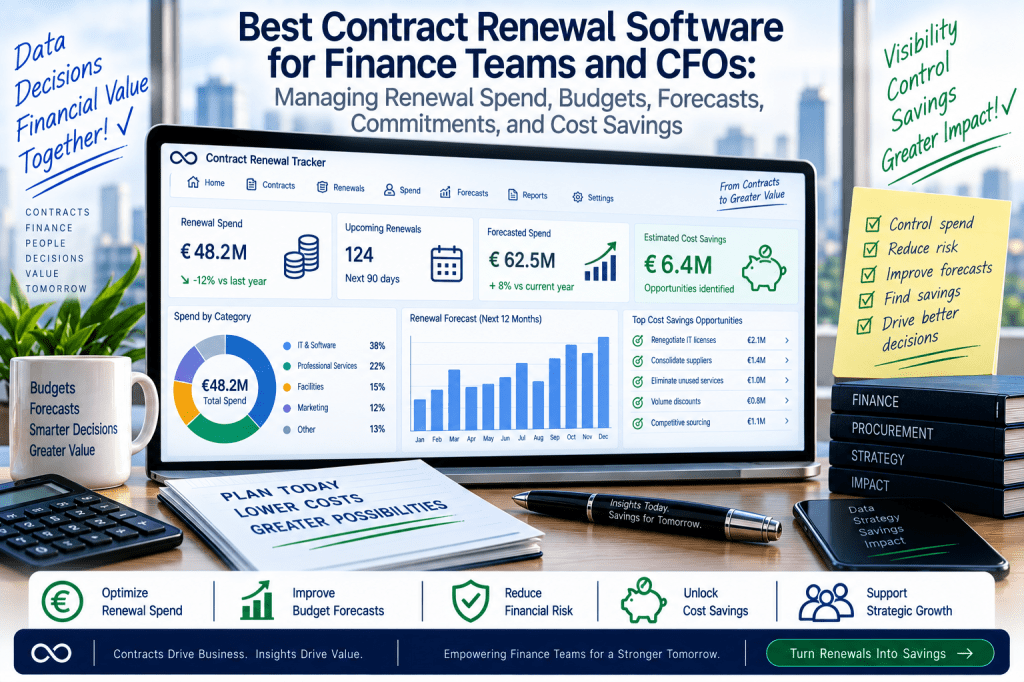
What Is Contract Renewal Software for Finance Teams?
Contract renewal software for Finance connects upcoming contractual decisions with their expected financial consequences.
At minimum, the system should help answer:
- what contracts are renewing;
- when;
- at what current value;
- whether they auto-renew;
- whether the business plans to continue them.
A more mature system can also show:
- supplier proposals;
- expected renewal values;
- budget variance;
- hard savings;
- cost avoidance;
- multi-year commitments;
- forecast confidence.
This creates a forward-looking view of recurring supplier spend.
Why Finance Often Has a Renewal Visibility Problem
Finance may know:
what the company spent last month.
It may know:
what purchase orders exist.
It may know:
what invoices have been paid.
But future renewal exposure can remain less visible.
For example:
a SaaS contract worth €400K may renew in four months.
The current ERP may show the historical spend.
It may not show:
- notice deadline;
- business renewal decision;
- supplier’s proposed increase;
- expected final outcome.
That gap matters.
Contract Renewals Are Future Financial Commitments
A renewal is not simply:
an administrative contract event.
It may create:
another:
12 months,
24 months,
or:
36 months
of future spend.
Finance therefore needs visibility before:
the new commitment is signed.
Example
Current annual spend:
€500K.
Supplier proposal:
€575K.
Requested term:
3 years.
Potential future commitment:
€1.725M.
That deserves more attention than:
“€75K increase next year.”
The multi-year commitment matters.
Finance Should See Both Annual Value and Total Commitment
For example:
Annual Contract Value
€500K.
Proposed Annual Value
€550K.
Proposed Term
36 months.
Total Contract Value
€1.65M.
This gives the CFO a much clearer picture.
Contract Renewal Tracker for Finance
A finance-oriented Contract Renewal Tracker should connect:
Contract
↓
Renewal Date
↓
Business Decision
↓
Supplier Proposal
↓
Expected Outcome
↓
Budget
↓
Final Commitment
This creates an integrated renewal-spend pipeline.
Looking for Better Visibility into Upcoming Supplier Commitments?
Finance should not discover major recurring commitments only when the invoice arrives or the contract is ready for signature.
Contract Renewal Tracker is designed to make upcoming renewals, values, owners, decisions, and expected financial outcomes visible earlier in the process.
Turn renewal data into forward-looking financial visibility →
Finance Feature 1: Renewal Spend Calendar
Finance should be able to see:
what value is entering renewal by:
month,
quarter,
or:
year.
For example:
| Quarter | Renewal Value |
|---|---|
| Q1 | €4.2M |
| Q2 | €6.8M |
| Q3 | €3.7M |
| Q4 | €9.1M |
This creates a contract-driven spending horizon.
Finance Feature 2: Notice Deadline Calendar
End dates alone are insufficient.
Finance may need to know:
when the organization effectively loses flexibility.
Example:
Contract end:
December 31.
Notice deadline:
September 30.
If the business does not act by September:
the financial commitment may already become harder to change.
That deadline therefore has financial relevance.
Finance Feature 3: Auto-Renewal Exposure
One of the most useful CFO metrics is:
How much annual spend can renew automatically without a new purchasing decision?
For example:
Total annual supplier spend:
€30M.
Auto-renewing:
€12M.
Undecided auto-renewing spend:
€2.3M.
This is valuable governance information.
Auto-Renewal Spend by Horizon
For example:
Notice Deadline <30 Days
€350K.
31–60 Days
€800K.
61–90 Days
€1.15M.
Now Finance can see:
where commitments are approaching.
Finance Feature 4: Renewal Decision Coverage
Finance should know:
what percentage of upcoming spend already has a confirmed direction.
For example:
Next 180-day renewal exposure:
€12M.
Confirmed decisions:
€9M.
Undecided:
€3M.
Decision coverage:
75%.
The €3M undecided portion is:
forecast uncertainty.
Finance Feature 5: Expected Renewal Value
Current contract value is not necessarily:
future spend.
The system should therefore distinguish:
Current Value
and:
Expected Renewal Value.
Example:
Current:
€1M.
Expected:
€1.08M.
This creates better budgeting.
Finance Feature 6: Supplier Proposal
The supplier’s proposed amount should be stored separately.
For example:
Current:
€1M.
Supplier asks:
€1.15M.
Expected internally:
€1.06M.
Now Finance can model:
range and uncertainty.
Finance Feature 7: Final Renewal Value
Once agreed:
capture:
the final amount.
Then compare against:
- current spend;
- supplier proposal;
- forecast;
- budget.
This produces valuable learning.
Renewal Financial Lifecycle
A strong model is:
Current Baseline
↓
Supplier Proposal
↓
Internal Forecast
↓
Approved Amount
↓
Final Contract
↓
Actual Spend
Each stage answers a different financial question.
Finance Feature 8: Budget Comparison
Finance needs:
expected renewal value
versus:
budget.
For example:
Budget:
€900K.
Expected renewal:
€960K.
Variance:
+€60K.
That should be visible before approval.
Budget Variance Dashboard
For example:
Renewals Within Budget
€7.2M.
Above Budget
€1.4M.
Below Budget
€600K.
Undecided / No Forecast
€800K.
This helps Finance focus attention.
Finance Feature 9: Forecast Confidence
Not every renewal forecast has equal certainty.
For example:
High Confidence
Final supplier terms agreed.
Medium Confidence
Negotiation underway.
Low Confidence
Business decision not yet made.
This is more useful than presenting:
one false-precision forecast.
Example
Expected renewal spend:
€12.5M.
But:
€3M remains low confidence.
The CFO should know that.
Forecast Range
A mature platform could show:
Expected:
€12.5M.
Low:
€11.9M.
High:
€13.4M.
This makes uncertainty explicit.
Finance Feature 10: Forecast Accuracy
After renewal completes:
compare:
forecast
with:
actual final outcome.
For example:
Forecast:
€1.1M.
Actual:
€1.08M.
Variance:
−1.8%.
Over time, Finance can measure:
renewal forecast quality.
Forecast Accuracy by Horizon
For example:
90 Days Before Renewal
96%.
180 Days
91%.
365 Days
82%.
This tells Finance how early forecasts become reliable.
Finance Feature 11: Forecast Bias
Accuracy alone is not enough.
Suppose forecasts are usually:
3% too low.
That means the organization systematically:
underestimates renewal spend.
The system should detect:
bias.
Example
Average forecast error:
+3.2%.
Interpretation:
Actual spend tends to exceed forecast.
This may indicate:
supplier inflation is underestimated
or:
savings assumptions are too optimistic.
Finance Feature 12: Hard Savings
Finance should clearly distinguish:
real reductions in comparable spend.
Example:
Current:
€500K.
Final:
€470K.
Hard savings:
€30K.
This is relatively straightforward.
Finance Feature 13: Cost Avoidance
Example:
Supplier proposal:
€600K.
Final:
€530K.
Current:
€500K.
Cost avoidance:
€70K.
But:
spend still increased:
€30K.
Finance should see both.
Avoid One Giant Savings Number
Do not combine:
Hard Savings.
Cost Avoidance.
Demand Reduction.
Productivity Value.
into:
“Total Savings”
without distinction.
That weakens financial credibility.
Better Reporting
Hard Savings
€250K.
Cost Avoidance
€480K.
Demand Reduction
€320K.
Productivity Value
€40K.
This gives Finance:
a much clearer picture.
Finance Feature 14: Demand Reduction
This is particularly important for:
software subscriptions.
Suppose:
Current licenses:
1,000.
Renewed:
Unit price unchanged.
Annual spend falls:
€150K.
That is a real financial outcome.
Finance Feature 15: Spend Avoided Through Termination
If a contract is no longer needed:
termination can eliminate:
future spend.
Example:
Analytics platform:
€80K/year.
Decision:
Terminate.
Annual avoided recurring spend:
€80K.
This should be tracked separately.
Finance Feature 16: Multi-Year Commitment Reporting
CFOs need to understand:
future contractual lock-in.
For example:
New 3-year SaaS agreement:
€1M/year.
Total commitment:
€3M.
This is strategically different from:
a 12-month commitment.
Commitment Maturity Profile
A dashboard might show:
<12 Months
€8M.
12–24 Months
€12M.
24–36 Months
€18M.
>36 Months
€25M.
This helps Finance understand:
flexibility.
Finance Feature 17: Contract Term Tradeoff
Suppliers may offer:
discounts
in exchange for:
longer commitments.
Finance should see both sides.
Example:
1-Year
€1M.
3-Year
€900K/year.
Savings:
€300K over three years.
But commitment:
€2.7M.
The cheaper annual price creates:
more lock-in.
That tradeoff deserves visibility.
Finance Feature 18: Price Escalation
Future price increases can materially affect:
multi-year cost.
Example:
Base:
€1M.
Escalation:
5% annually.
Year 2:
€1.05M.
Year 3:
€1.1025M.
Three-year total:
€3.1525M.
Finance should not evaluate:
Year 1 price only.
Finance Feature 19: Inflation Exposure
Across the portfolio:
Supplier proposed increases:
8%.
Budget assumption:
4%.
That creates:
potential overspend.
For example:
Renewing spend:
€20M.
4 percentage-point gap:
potentially:
€800K.
This is meaningful for forecasting.
Inflation Dashboard
Software
+9%.
Cloud
+7%.
Professional Services
+4%.
Telecom
+2%.
This can help Finance understand:
where inflation pressure originates.
Finance Feature 20: Renewal Budget Bridge
A useful CFO view is:
Budget
↓
Supplier Inflation
↓
Growth
↓
Savings
↓
Terminations
↓
Expected Spend
For example:
Budget:
€10M.
Inflation:
+€500K.
Growth:
+€300K.
Savings:
−€400K.
Terminations:
−€200K.
Expected:
€10.2M.
This provides a concise financial narrative.
Finance Feature 21: Committed vs Uncommitted Spend
Separate:
Committed
already signed.
from:
Forecast
likely.
from:
Undecided
uncertain.
For example:
Committed:
€8M.
Forecast:
€3M.
Undecided:
€1M.
This improves planning.
Finance Feature 22: Cash Flow Timing
Not every renewal is:
annual prepaid.
Contracts may be:
monthly;
quarterly;
annual.
The platform could eventually help model:
payment timing.
This creates:
cash-flow visibility.
Example
Annual contract:
€1.2M.
Payment:
annual upfront.
Renewal month:
January.
Cash effect:
€1.2M in Q1.
That differs materially from:
€100K/month.
Finance Feature 23: Payment Terms
Renewal negotiations may change:
Net 30
to:
Net 60.
That has working-capital implications.
Contract Renewal Tracker can eventually track:
payment-term improvements.
Finance Feature 24: Supplier Concentration
Finance should understand:
how much spend is concentrated with:
a few suppliers.
For example:
Top 10 suppliers:
52% of renewal spend.
This can represent:
financial and operational dependency.
Supplier Concentration + Renewal Timing
Suppose:
Supplier A represents:
15% of technology spend
and:
most contracts renew next quarter.
That creates:
a significant financial decision point.
Finance Feature 25: Strategic Supplier Exposure
For strategic suppliers:
show:
Annual Spend.
TCV.
Renewal Date.
Risk.
Expected Increase.
This helps CFO oversight.
Example
Supplier:
CloudCo.
Annual Spend:
€4M.
Renewal:
November.
Supplier Proposal:
+12%.
Expected:
+5%.
Financial Risk:
Medium.
This is board-ready information.
Finance Feature 26: Renewal Scenario Analysis
A major renewal may have several options.
Example:
Option A — Renew 3 Years
€900K/year.
Option B — Renew 1 Year
€1M.
Option C — Replace
€700K/year + €500K migration.
Finance needs:
total economics.
Three-Year Cost Comparison
Option A:
€2.7M.
Option B:
€3M.
Option C:
€2.6M.
But:
Option C has:
higher transition risk.
This is where financial analysis meets business strategy.
Finance Feature 27: NPV / TCO for Large Renewals
For significant commitments:
finance may calculate:
- total cost of ownership;
- NPV;
- payback.
Contract Renewal Tracker does not necessarily need to become:
a full financial-modeling platform.
But it can provide:
the structured inputs.
Finance Feature 28: Approval Thresholds
Finance approval should follow:
authority policy.
For example:
<€25K:
budget owner.
€25K–€250K:
Finance.
€250K–€1M:
Finance Director.
€1M:
CFO.
This should be automated where appropriate.
Finance Feature 29: Budget Owner
The contract owner
may differ from:
budget owner.
Track both.
This improves:
financial accountability.
Finance Feature 30: Cost Center
Contracts should ideally map to:
cost center
or:
department.
Then Finance can see:
renewal exposure by budget owner.
Example
IT
€6M.
Marketing
€2M.
Operations
€4M.
Finance
€700K.
This supports:
departmental planning.
Finance Feature 31: Legal Entity
For multi-entity companies:
contracts may be committed by:
different entities.
That matters for:
budgeting,
cash flow,
and:
reporting.
Finance Feature 32: Currency
International supplier agreements may be denominated in:
EUR.
USD.
GBP.
Finance needs:
original value
and potentially:
reporting currency.
Currency Exposure
Example:
USD-denominated renewals:
$5M.
If home currency is:
EUR,
exchange rates can affect:
budget.
This is another future finance capability.
Finance Feature 33: Actual Spend Integration
Contract value
and:
actual spend
can differ.
ERP integration can help compare:
contract baseline
with:
actual invoices.
Example
Contract annual value:
€500K.
Actual spend:
€620K.
Why?
Possible:
- overage;
- additional services;
- billing issue.
The renewal review should investigate.
Finance Feature 34: Invoice Validation
If final renewed value is:
€480K
but invoices continue at:
€500K,
the organization is leaking:
€20K.
Contract Renewal Tracker could eventually flag:
variance.
Finance Feature 35: Realized Savings
Negotiated savings are not the same as:
realized savings.
Example:
Contracted saving:
€50K.
Actual invoice reduction:
€35K.
Realized:
70%.
Finance should care about:
realization.
Savings Realization Funnel
Identified
↓
Validated
↓
Contracted
↓
Realized
This should be visible.
Finance Feature 36: Renewal ROI
Finance may ask:
Does the software itself create enough value?
A simple measure:
Validated Renewal Value ÷ Platform Cost
Example:
Hard savings:
€40K.
Avoided spend:
€30K.
Subscription:
€4K.
Value-to-cost:
17.5×.
This is useful for product renewal and expansion.
Finance Feature 37: Platform Break-Even
Suppose:
Contract Renewal Tracker:
€3,990/year.
Managed renewal spend:
€20M.
Break-even improvement:
€3,990 ÷ €20M
=
0.01995%
Approximately:
0.02%.
This is a strong CFO business-case metric.
Finance Feature 38: Material Renewal Exceptions
Finance does not need every operational issue.
It needs:
material exceptions.
For example:
€1.4M renewal remains undecided 30 days before notice deadline.
That deserves CFO visibility.
Finance Feature 39: Executive Decision Queue
A useful CFO dashboard might show:
Approval Required
Total Commitment
€8.2M.
Above Budget
High Risk
This makes executive attention:
focused.
Finance Feature 40: Monthly Renewal Forecast
The platform can eventually generate:
a monthly summary.
For example:
Next-quarter renewal forecast is €7.8M, €300K above budget. Software inflation remains the primary pressure, partly offset by €180K of confirmed license reductions.
This is useful management reporting.
AI for Finance: “What Is Renewing Next Quarter?”
A CFO could ask:
What major commitments renew next quarter?
The assistant could return:
top contracts
by:
value
and:
risk.
This makes the renewal portfolio:
more accessible.
AI for Finance: “Why Is the Forecast Above Budget?”
For example:
Q4 forecast is €420K above budget. The main contributors are a €250K cloud increase, €120K in software inflation, and a delayed termination worth €50K.
This is highly useful.
AI for Finance: “What Is Still Uncertain?”
For example:
€2.1M of the next-quarter forecast remains Medium or Low confidence because five material renewals are still under negotiation.
This improves transparency.
AI for Finance: “Where Are We Saving Money?”
For example:
€320K of validated renewal-related value has been recorded this year: €150K demand reduction, €90K hard savings, and €80K avoided unwanted renewals.
This provides a concise financial explanation.
AI Should Preserve Financial Definitions
If Finance asks:
How much did we save?
AI should not mix:
- hard savings;
- cost avoidance;
- productivity.
It should preserve:
the organization’s defined methodology.
This is essential for trust.
AI Should Explain Its Numbers
For example:
€90K hard savings consists of three contracts: Supplier A €40K, Supplier B €30K, Supplier C €20K.
This provides:
traceability.
Finance Dashboard: One-Page Version
A CFO may need only:
Renewal Exposure Next 12 Months
€42M.
Next 90 Days
€9.2M.
Auto-Renewal Exposure
€13M.
Undecided
€3.4M.
Above-Budget Forecast
€1.1M.
Hard Savings YTD
€600K.
Cost Avoidance
€900K.
Material Decisions Required
That is powerful.
Finance Dashboard vs Procurement Dashboard
Procurement may focus on:
- supplier;
- negotiation;
- savings.
Finance focuses on:
- commitment;
- budget;
- forecast;
- realized value.
Same data.
Different lens.
This is why:
role-specific dashboards matter.
Finance KPI 1: Renewal Spend Exposure
Total value entering renewal over:
90 / 180 / 365 days.
Finance KPI 2: Undecided Spend
Value with:
no confirmed renewal decision.
This represents:
forecast uncertainty.
Finance KPI 3: Auto-Renewal Exposure
Total value that may renew:
without new explicit commitment.
Finance KPI 4: Forecast Accuracy
Compare:
forecast
with:
final outcome.
Finance KPI 5: Budget Variance
Expected spend minus:
budget.
Finance KPI 6: Supplier Inflation
Proposed and final increases.
Finance KPI 7: Hard Savings
Finance-validated.
Finance KPI 8: Cost Avoidance
Reported separately.
Finance KPI 9: Savings Realization
Actual value captured versus:
contracted.
Finance KPI 10: Multi-Year Commitment
Total value of:
new commitments.
These ten metrics provide a strong CFO scorecard.
Finance Does Not Need to Own the Renewal Process
This is important.
Procurement,
business owners,
legal,
and:
contract operations
may manage the operational steps.
Finance should receive:
timely financial visibility.
The platform should support collaboration without making Finance responsible for:
every workflow.
CFO Escalation Should Be Materiality-Based
Do not send CFO:
every renewal.
Escalate when:
- value exceeds threshold;
- budget variance is material;
- risk is Critical;
- approval is required.
This prevents alert fatigue.
Example
€2,000 subscription:
no CFO.
€5M three-year commitment:
CFO.
This is common sense.
Finance and Procurement Should Share One Financial Model
A common problem is:
Procurement’s savings spreadsheet
and:
Finance’s budget model
show different numbers.
Contract Renewal Tracker can help establish:
shared baseline fields.
For example:
Current Value
Supplier Proposal
Final Value
Savings Type
Finance Validation
This improves consistency.
Finance Validation Workflow
Procurement records:
Hard Savings:
€50K.
Finance reviews.
Status:
Validated.
Now executive reporting includes:
the number.
This increases trust.
Finance Should Be Able to Challenge the Baseline
For example:
Procurement says baseline:
€600K.
Finance knows:
budget only included:
€550K.
The platform should preserve:
discussion and final accepted methodology.
Contract Renewal Tracker for Finance
The product progression could be:
Stage 1
Contract value.
Stage 2
Renewal forecast.
Stage 3
Budget variance.
Stage 4
Savings.
Stage 5
Commitment analytics.
Stage 6
AI financial intelligence.
This creates another logical product expansion path.
Beta Finance Features
For the first beta, keep this simpler.
Track:
- annual contract value;
- renewal date;
- notice period;
- owner;
- decision.
Then provide:
Upcoming Renewal Value
This alone can be useful.
Beta CFO Aha Moment
A Finance user imports:
their supplier contracts.
The dashboard says:
€740K of supplier agreements enter renewal within the next 90 days.
That is immediate value.
Second Aha Moment
€240K of those renew automatically and have no decision recorded.
Now the platform has:
financially relevant insight.
Third Aha Moment
€80K has no named contract owner.
That creates:
control visibility.
Finance Beta Feedback Questions
Ask:
Which financial field is missing before this becomes useful for forecasting?
Likely answers:
- cost center;
- budget;
- supplier proposal;
- final value.
That should guide:
post-beta development.
CFO Product Positioning
For Finance, do not lead with:
reminders.
Lead with:
See Your Upcoming Supplier Commitments Before They Hit the Budget.
This is stronger.
Another CFO Message
Turn Contract Renewals into a Forward-Looking Spend Forecast.
Excellent positioning.
Another
Know What Is Renewing, What It Will Cost, and What Is Still Uncertain.
This communicates:
financial visibility.
Finance-Specific Landing Page
A future landing page could have:
Hero
Contract Renewal Visibility for CFOs and Finance Teams
Subheading
Track upcoming supplier commitments, auto-renewals, expected spend, savings, and budget risk from one contract renewal portfolio.
CTA
See My Upcoming Renewal Spend →
This can work well.
Lead Magnet: Contract Renewal Budget Template
This article is an excellent place for:
Free Contract Renewal Budget Forecast Template
Fields could include:
- contract;
- current spend;
- renewal month;
- supplier proposal;
- expected value;
- budget;
- variance;
- forecast confidence.
That would attract:
Finance prospects.
Suggested CTA
Download the Contract Renewal Budget Forecast Template
Build a forward-looking view of recurring supplier commitments using current contract values, renewal dates, expected price changes, budgets, decisions, and forecast confidence.
Download the Free Finance Template →
Second Lead Magnet: CFO Renewal Dashboard Template
Another option:
CFO Contract Renewal Dashboard
with:
- 12-month exposure;
- auto-renewal spend;
- undecided commitments;
- inflation;
- savings;
- budget variance.
This could become another high-value asset.
Commercial CTA
Still Forecasting Supplier Renewals from Multiple Spreadsheets?
Contract Renewal Tracker brings contract values, notice deadlines, owners, decisions, and upcoming renewal exposure into one workspace so Finance can see future commitments earlier.
Join the Contract Renewal Tracker Beta →
Contract Renewal Tracker Beta Launch — September 21, 2026
Contract Renewal Tracker is launching its first SaaS beta on September 21, 2026. The beta is designed to give finance teams and business leaders earlier visibility into upcoming contract renewals by connecting contract dates, notice periods, owners, and annual values in one dedicated workspace. This foundation can help organizations identify future supplier commitments, auto-renewal exposure, and undecided spend before those costs become unavoidable. [Notify Me When the Beta Launches →] (One launch notification only — no newsletter or ongoing marketing emails.)
Finance ROI Example
Suppose:
Annual renewal spend:
€20M.
Contract Renewal Tracker:
€3,990/year.
Required improvement to break even:
approximately:
0.02%.
Now suppose the organization prevents:
one unwanted:
€25K renewal.
Subscription already pays for itself several times over.
That is an understandable CFO argument.
But the Bigger Value Is Financial Visibility
The software may also help Finance:
- forecast better;
- identify budget risk sooner;
- track multi-year commitments.
These benefits may be more strategically important than:
administrative time savings.
Do Not Turn Finance Features into Another ERP
This is an important product principle.
Contract Renewal Tracker should not attempt to replace:
ERP,
FP&A,
or:
accounting software.
Its role is:
contract-driven forward visibility.
That is a useful and differentiated layer.
ERP Tells You What Happened
Broadly:
- invoice;
- purchase order;
- payment.
Contract Renewal Tracker should increasingly tell you:
What is likely to happen next because contracts are approaching renewal.
That is the strategic distinction.
FP&A Integration
Eventually:
renewal forecasts
can feed:
FP&A.
That may be more valuable than:
trying to reproduce full financial planning inside the tracker.
Contract Renewal Tracker as a Renewal Subledger
Conceptually, the product could become:
a specialized source of truth for:
future contract-renewal commitments.
ERP:
actual spend.
Contract Renewal Tracker:
renewal commitments and forecasts.
FP&A:
company-wide financial planning.
This is a strong architecture.
Final Thoughts
For Finance, contract renewal software is not primarily about:
remembering expiration dates.
It is about:
understanding future contractual spend before it becomes fixed.
The financial process is:
Current Contract
↓
Upcoming Renewal
↓
Decision
↓
Supplier Proposal
↓
Forecast
↓
Budget Comparison
↓
Approval
↓
Final Commitment
↓
Actual Spend
When those stages are visible:
Finance gains:
better forecasting,
stronger control,
and:
fewer surprises.
For Contract Renewal Tracker, this creates another important product expansion path.
The platform can start with:
what is renewing?
Then evolve toward:
What will it cost, how certain is that forecast, what changed from budget, and where can the organization reduce future commitments?
That is a compelling CFO value proposition.
Next Article in the Contract Renewal Tracker Series
This should be another strong commercial page because IT often controls a large number of recurring agreements and is particularly exposed to SaaS auto-renewals, unused licenses, cloud commitments, cybersecurity subscriptions, maintenance contracts, and vendor dependency.
The core message can shift to:
“Know which technology contracts are renewing, who uses them, what they cost, and whether IT still needs the same quantity before the renewal window closes.”

