Operations teams often manage some of the most fragmented contract portfolios in an organization.
Facilities.
Cleaning.
Security services.
Maintenance.
Telecommunications.
Fleet.
Equipment rental.
Logistics.
Utilities.
Waste management.
Local suppliers.
Outsourced operational services.
These agreements may not sit neatly inside Procurement, Legal, Finance, or IT.
Instead, responsibility is often spread across:
- site managers;
- office managers;
- operations directors;
- facilities teams;
- regional managers;
- finance administrators.
That creates a specific renewal risk:
The organization may depend on recurring services every day while the underlying contract deadlines remain buried in spreadsheets, inboxes, local folders, or individual calendars.
For Operations, the best contract renewal software should provide one simple answer:
Which supplier agreements require attention next, who owns them, and what needs to happen before the notice deadline?
That is where Contract Renewal Tracker can become especially valuable.
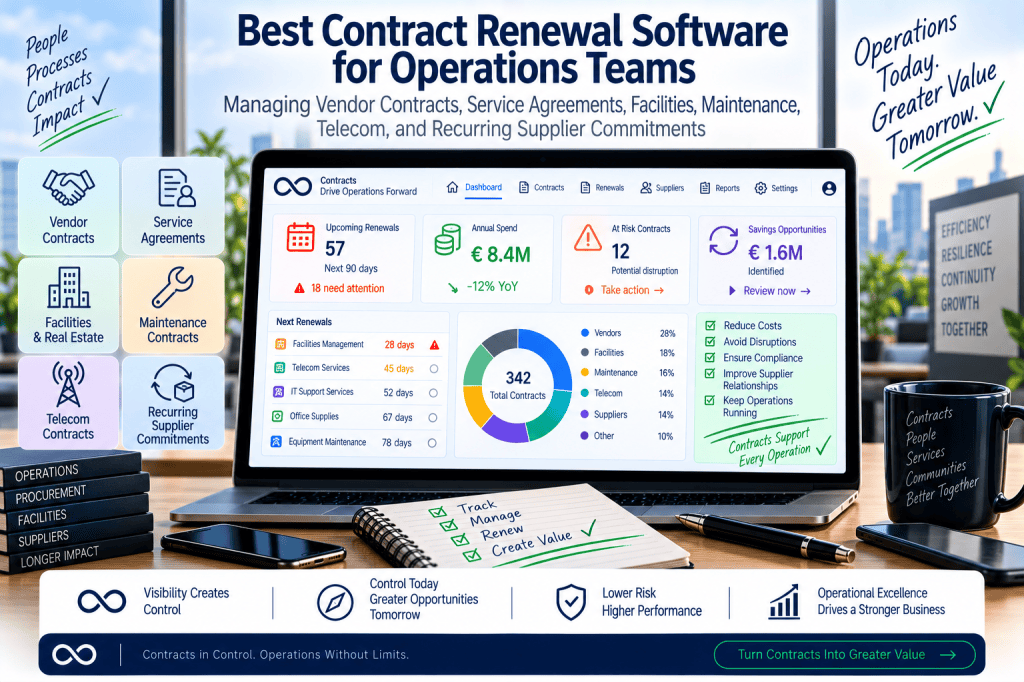
What Is Contract Renewal Software for Operations Teams?
Contract renewal software for Operations helps centralize recurring supplier agreements and manage the activities required before renewal, extension, renegotiation, replacement, or termination.
At minimum, it should track:
- supplier;
- service;
- location;
- contract owner;
- start and end dates;
- notice period;
- notice deadline;
- annual value;
- renewal status.
A more mature platform can also support:
- service performance;
- location-level reporting;
- escalation;
- approvals;
- replacement planning;
- supplier consolidation;
- recurring-spend forecasting.
The goal is to move operational renewals from:
local knowledge
to:
managed organizational process.
Why Operations Contract Renewals Are Difficult
Operational contracts are often decentralized.
A headquarters facilities team may manage:
one supplier.
Regional offices may have:
another.
A warehouse may have:
its own cleaning agreement.
A local manager may have negotiated:
telecom services independently.
The result can be:
many relatively small contracts
with:
different owners and notice periods.
Individually, they appear manageable.
Collectively, they create substantial administrative and financial exposure.
Still Tracking Operational Supplier Contracts in Excel?
A spreadsheet may show your current suppliers, but it becomes harder to manage when multiple locations, owners, notice periods, and recurring services are involved.
Contract Renewal Tracker is designed to bring those agreements into one workspace so Operations can see upcoming renewals, contract values, responsible owners, and required actions before deadlines become urgent.
Centralize your operational contract renewals →
Operations Feature 1: Central Supplier Contract Register
Operations should have one view of all recurring supplier agreements.
For example:
| Service | Supplier | Site | Owner | Annual Value | Notice Deadline |
|---|---|---|---|---|---|
| Cleaning | CleanCo | Amsterdam | Facilities | €75K | Oct 1 |
| Security | SecureCo | Rotterdam | Operations | €120K | Nov 15 |
| Telecom | TelcoCo | All Sites | IT Ops | €95K | Sep 30 |
| Waste | EcoWaste | Utrecht | Site Manager | €25K | Dec 1 |
This immediately creates visibility.
Operations Feature 2: Location Tracking
This is particularly important for Operations.
Contracts may apply to:
- one site;
- several locations;
- one country;
- the whole organization.
Track:
Location
or:
Site
as structured data.
Why Location Matters
Suppose the company has:
15 offices.
Five different cleaning contracts.
Three telecom suppliers.
Four security providers.
Without location-level visibility, consolidation opportunities can remain hidden.
Operations Feature 3: Regional Ownership
A contract might be owned by:
Site Manager Amsterdam.
Another by:
Regional Operations Europe.
Ownership should be explicit.
This prevents the familiar problem:
“I thought head office was handling it.”
Operations Feature 4: Named Owner
Do not rely on:
Facilities
or:
Operations
as the only owner.
Use:
a named person.
For example:
Business Owner:
Maria Janssen.
Role:
Facilities Manager.
This creates accountability.
Operations Feature 5: Notice Deadline
As with other contract categories, the operational deadline may occur long before expiration.
Example:
Contract End:
December 31.
Notice:
120 days.
Notice Deadline:
early September.
If the site manager only reviews the agreement in November:
the commercial choice may already be limited.
Operations Feature 6: Auto-Renewal
Many recurring operational services renew automatically.
Examples:
- cleaning;
- waste collection;
- maintenance;
- telecom;
- equipment rental.
The system should clearly identify:
Auto-Renewal = Yes
and:
the renewal term.
Example
Cleaning contract:
€80K/year.
Auto-renewal:
12 months.
Notice:
90 days.
If no action occurs:
another €80K commitment may arise.
That is material even if the individual contract seems operationally routine.
Operations Feature 7: Service Category
Useful categories include:
Facilities
Maintenance
Security
Telecom
Fleet
Logistics
Utilities
Cleaning
Waste
Equipment
This improves reporting and consolidation.
Operations Feature 8: Service Description
Do not store only:
supplier name.
Track what the supplier actually provides.
For example:
Supplier:
ABC Services.
Service:
Preventive HVAC Maintenance.
This helps Operations understand:
the purpose of the contract.
Operations Feature 9: Business Criticality
Not every operational service has the same impact.
Classify:
Low
Medium
High
Critical
For example:
Coffee machine maintenance:
Low.
Fire alarm maintenance:
Critical.
This should affect:
renewal priority.
Operations Feature 10: Renewal Decision
Use structured options:
Renew
Renegotiate
Reduce
Replace
Extend
Terminate
Operational agreements often require:
Renegotiate
or:
Replace
rather than simple renewal.
Example: Cleaning Contract
Current:
5 days/week.
Office occupancy has fallen.
Future requirement:
3 days/week.
Decision:
Reduce
This may lower:
annual spend.
Example: Fleet Contract
Current:
40 vehicles.
Future requirement:
Renewal becomes:
a capacity review,
not merely:
a price discussion.
Example: Maintenance Agreement
Supplier performance:
poor.
Decision:
Replace
Now replacement planning becomes part of:
renewal management.
Operations Feature 11: Service Volume
Where applicable, track:
- square meters cleaned;
- devices maintained;
- vehicles;
- telecom lines;
- waste collections;
- equipment units.
This helps connect:
cost
with:
actual requirement.
Operations Feature 12: Demand Review
Before renewal, ask:
Do we still need the same level of service?
This is just as important for Operations as:
license optimization
is for IT.
Example
Security guarding:
24/7.
Site operating hours:
now 12 hours/day.
Potential service reduction:
significant.
Renewal should challenge:
current scope.
Operations Feature 13: Unit Cost
Examples:
Cost per:
- site;
- square meter;
- vehicle;
- telecom line;
- maintenance asset.
This helps compare:
suppliers and locations.
Example
Cleaning Site A:
€2.80/m².
Site B:
€4.10/m².
Why?
Possible differences:
- scope;
- frequency;
- local market;
- inefficient contract.
The renewal process can investigate.
Operations Feature 14: Supplier Performance
Operational suppliers can be evaluated using:
- SLA compliance;
- responsiveness;
- service quality;
- incident history;
- site feedback.
This should inform:
renewal decisions.
Supplier Performance Example
Cleaning supplier:
Quality:
72%.
Responsiveness:
85%.
Cost:
68%.
Stakeholder Satisfaction:
70%.
Overall:
74%.
Decision:
Renegotiate / Consider Alternative.
Operations Feature 15: SLA Tracking
For maintenance or managed services:
track:
- response times;
- resolution times;
- uptime;
- completion rates.
Poor SLA performance can create:
commercial leverage.
Operations Feature 16: Incident History
If a supplier caused:
repeated disruption,
the renewal review should know.
For example:
Security supplier:
six staffing failures.
Maintenance provider:
three missed preventive visits.
This matters.
Operations Feature 17: Contract Price History
Track:
Year 1:
€70K.
Year 2:
€76K.
Year 3:
€84K.
Supplier Proposal:
€92K.
Now Operations and Procurement can see:
cost escalation.
Operations Feature 18: Supplier Proposal
The renewal system should store:
supplier’s proposed new value.
This allows:
comparison with:
current cost.
Operations Feature 19: Final Renewal Value
Once negotiation completes:
record:
final value.
This allows Finance to see:
actual impact.
Operations Feature 20: Budget Variance
Example:
Facilities budget:
€500K.
Expected renewals:
€540K.
Variance:
+€40K.
Operations can then identify:
which renewals need intervention.
Operations Feature 21: Supplier Consolidation
This is a particularly strong opportunity.
Suppose:
12 locations
use:
7 cleaning suppliers.
Total spend:
€800K.
The organization may be able to consolidate:
regionally
or:
nationally.
Renewal timing creates:
the opportunity.
Consolidation Window
If:
five cleaning contracts renew within:
six months,
the system can surface:
Consolidation Candidate
This gives Procurement time to:
run a broader sourcing exercise.
Operations Feature 22: Contract Fragmentation
A supplier may have:
different contracts at:
several sites.
The system should show:
supplier-level total spend.
For example:
Supplier:
CleanCo.
Contracts:
Locations:
Total annual spend:
€420K.
This changes negotiating leverage.
Operations Feature 23: Local vs Central Contract
Track whether agreement is:
Local
Regional
Global
This helps governance.
Operations Feature 24: Standardization Opportunity
If different sites buy:
the same service
under:
different terms,
renewal can be used to:
standardize.
For example:
payment terms,
SLA,
notice period,
pricing structure.
This creates:
operational efficiency.
Operations Feature 25: Facility Lease-Related Agreements
Operations may also manage agreements connected to:
- offices;
- warehouses;
- equipment spaces.
These can have:
long notice periods.
Early visibility is essential.
Operations Feature 26: Equipment Rental and Leasing
Track:
- asset;
- contract term;
- end date;
- return obligations;
- renewal options.
A rental agreement may continue automatically if:
equipment is not returned.
This creates:
renewal risk.
Operations Feature 27: Maintenance Coverage
A maintenance contract should identify:
what assets are covered.
If assets have been:
retired,
the service may no longer be required.
This is a common savings opportunity.
Example
Maintenance contract:
€45K.
Covers:
30 printers.
Current installed base:
Renewal:
Reduce.
This is straightforward demand optimization.
Operations Feature 28: Telecom Contracts
Telecom is often especially fragmented.
Track:
- mobile;
- fixed lines;
- internet;
- WAN;
- site connectivity.
These agreements may contain:
auto-renewal and minimum-term provisions.
Telecom Renewal Review
Ask:
- how many lines are active;
- whether sites changed;
- current usage;
- supplier performance;
- alternative providers.
This can reduce unnecessary spend.
Operations Feature 29: Utility Contracts
Some organizations may track:
electricity,
gas,
water,
energy services.
These contracts may require:
different renewal logic.
They still benefit from:
deadline visibility.
Operations Feature 30: Fleet Agreements
Track:
- vehicle count;
- lease term;
- mileage assumptions;
- replacement dates.
Renewal can then align with:
actual fleet requirement.
Operations Feature 31: Logistics Agreements
Contracts may include:
- warehousing;
- transport;
- courier;
- freight.
Renewal decisions should consider:
volume trends
and:
service performance.
Operations Feature 32: Volume Forecast
Suppose transport contract covers:
100,000 shipments.
Expected next year:
70,000.
Renewing the same commercial structure may be:
inefficient.
Demand forecasts should inform:
renewal.
Operations Feature 33: Seasonal Service Agreements
Some contracts have:
seasonal requirements.
Examples:
winter maintenance.
temporary staffing.
grounds maintenance.
Renewal planning should account for:
operating cycle.
Operations Feature 34: Replacement Lead Time
Changing an operational supplier can require:
- site surveys;
- onboarding;
- equipment;
- permits;
- training;
- transition.
Therefore:
replacement should start early.
Example
Security supplier ends:
December 31.
New supplier mobilization:
90 days.
Notice deadline:
September 30.
If replacement decision occurs:
September 20,
the transition becomes:
high risk.
Operations Feature 35: Mobilization Plan
For a supplier replacement:
track:
Contract Award
↓
Mobilization
↓
Site Readiness
↓
Go-Live
↓
Incumbent Exit
This reduces:
service disruption.
Operations Feature 36: Bridge Extension
If the replacement is delayed:
Operations may need:
short extension.
Track:
duration
and:
cost.
This prevents:
accidental full-year renewals.
Operations Feature 37: Continuity Risk
Operational services can be:
business-critical.
For example:
security,
maintenance,
logistics.
A renewal decision should consider:
continuity.
This is not only:
a pricing exercise.
Operations Feature 38: Health and Safety Requirements
Some supplier agreements relate directly to:
safety.
Examples:
fire systems,
elevator maintenance,
security.
Renewal workflows may require:
compliance review.
Operations Feature 39: Regulatory or Certification Dependencies
Some operational suppliers need:
specific certification.
The renewal process can include:
validation.
This is especially relevant for:
regulated facilities.
Operations Feature 40: Insurance Requirements
Supplier insurance certificates may need renewal.
Track:
where relevant.
This reduces operational risk.
Operations Renewal Risk Score
A useful risk score could combine:
Notice Deadline
25%.
Business Criticality
25%.
Contract Value
20%.
Supplier Performance
15%.
Replacement Complexity
15%.
This helps prioritize:
the portfolio.
Example
Waste contract:
€20K.
Easy replacement.
30 days remaining.
Risk:
Medium.
Security contract:
€500K.
Critical service.
Poor supplier performance.
60 days remaining.
Replacement lead time:
120 days.
Risk:
Critical.
Operations should focus:
accordingly.
Operations Opportunity Score
Risk is not the same as:
savings opportunity.
Another score can combine:
- fragmented spend;
- poor service;
- high unit cost;
- reduced demand.
This can identify:
commercial opportunities.
Example
Cleaning spend:
€600K.
Seven suppliers.
Variable unit costs.
Renewals clustered:
within nine months.
Opportunity:
High.
This may justify:
centralized sourcing.
Operations Dashboard
A useful dashboard might show:
Active Operational Contracts
Annual Value
€6.8M.
Renewing Next 90 Days
€1.2M.
Auto-Renewing
€3.4M.
Critical
Missing Owners
Consolidation Candidates
4 supplier categories.
This creates:
operational visibility.
Site Manager Dashboard
A site manager should see:
only relevant contracts.
For example:
Amsterdam Office:
Cleaning.
Security.
Waste.
Telecom.
Elevator maintenance.
This makes the platform:
practical.
Regional Operations Dashboard
A regional leader might see:
- spend by site;
- supplier fragmentation;
- renewal risk;
- service performance.
This supports:
central governance.
COO Dashboard
A COO may care about:
Critical Services at Renewal
Major Supplier Risk
Consolidation Opportunities
Cost Increase Exposure
Decisions Required
Again:
exception-focused reporting.
Operations KPI 1: Notice Deadline Coverage
Percentage of active material contracts with:
known notice deadline.
Operations KPI 2: Owner Coverage
Percentage with:
named owner.
Operations KPI 3: Renewal Decision Coverage
Percentage of near-term contracts with:
confirmed decision.
Operations KPI 4: Auto-Renewal Exposure
Value of contracts:
able to roll over automatically.
Operations KPI 5: Supplier Performance
Average performance score by:
category.
Operations KPI 6: Cost Increase
Supplier proposal increase:
versus current.
Operations KPI 7: Demand Reduction
Savings from reduced:
service volume.
Operations KPI 8: Supplier Consolidation
Spend consolidated.
Operations KPI 9: Transition Readiness
Replacement contracts on track before:
incumbent expiry.
Operations KPI 10: Critical Missed Deadlines
Target:
zero.
These ten metrics create a strong operating scorecard.
Excel vs Contract Renewal Software for Operations
Excel is often where Operations starts.
And it may remain sufficient for:
small portfolios.
But once:
locations,
owners,
suppliers,
and:
notice periods
multiply,
the spreadsheet becomes increasingly difficult to manage reliably.
Dedicated software creates:
centralized control.
Facilities Management Software vs Renewal Software
Facilities platforms may manage:
- work orders;
- assets;
- maintenance.
They may not always provide:
contract renewal governance.
Contract Renewal Tracker can complement:
these systems.
ERP vs Renewal Software
ERP tracks:
- supplier;
- invoice;
- purchase order.
Contract Renewal Tracker tracks:
- renewal timing;
- notice deadline;
- owner;
- decision.
Again:
different purposes.
Procurement Platform vs Operations Renewal Software
Procurement platforms may support:
sourcing and supplier management.
Contract Renewal Tracker can provide:
the operational renewal pipeline
that brings site-level contracts into:
procurement visibility.
Contract Renewal Tracker as the Coordination Layer
A sensible architecture is:
Facilities System:
assets and service history.
ERP:
spend.
Contract Renewal Tracker:
contract renewal workflow.
This avoids:
trying to replace everything.
Operations Product Positioning
For Operations teams, a strong message is:
Put Every Recurring Supplier Contract on One Renewal Calendar.
Clear and practical.
Another Strong Message
Know Which Operational Contracts Need Action Before the Notice Window Closes.
This emphasizes:
risk.
Another
Stop Letting Local Supplier Agreements Renew by Accident.
Strong for:
multi-site organizations.
Another
Centralize Facilities, Maintenance, Telecom, and Service Renewals Without Enterprise CLM Complexity.
This defines:
the use case.
Best Initial Operations Segment
Multi-site businesses may be particularly attractive.
For example:
- retail;
- hospitality;
- professional services;
- logistics;
- healthcare;
- manufacturing.
They often manage:
many local supplier contracts.
This creates:
a clear pain point.
Example Customer
20 sites.
150 operational contracts.
Annual recurring supplier spend:
€3M.
No centralized renewal system.
This is an excellent Contract Renewal Tracker use case.
Operations Beta Experience
For the first beta:
keep it simple.
Allow the customer to import:
- supplier;
- location;
- service;
- annual value;
- end date;
- notice period;
- owner.
Then show:
upcoming actions.
That alone can create:
substantial visibility.
Operations Beta Aha Moment 1
17 supplier contracts enter their notice window within 90 days.
Useful.
Operations Beta Aha Moment 2
€420K of operational contracts auto-renew and have no recorded decision.
Now the insight becomes:
financial.
Operations Beta Aha Moment 3
Six contracts across four locations have no named owner.
Now you have:
governance visibility.
Post-Beta Operations Feature 1
Add:
Location.
This should probably be relatively early because it is broadly useful.
Post-Beta Operations Feature 2
Add:
Service Category.
This enables:
portfolio segmentation.
Post-Beta Operations Feature 3
Add:
Supplier Performance.
This supports:
renewal quality.
Post-Beta Operations Feature 4
Add:
Service Volume.
This creates:
demand optimization.
Post-Beta Operations Feature 5
Add:
Supplier Consolidation Analysis.
This creates:
strategic value.
AI for Operations: Renewal Portfolio Summary
A user could ask:
Which operational contracts need attention this month?
AI could summarize:
- deadlines;
- values;
- owners;
- risks.
This reduces:
manual searching.
AI for Operations: Supplier Consolidation
For example:
Seven cleaning contracts across five locations renew within eight months. Combined annual spend is €740K. Consider evaluating a regional sourcing event.
This is a strong future capability.
AI for Operations: Performance Review
For example:
SecureCo’s current contract renews in 75 days. Service score is 68%, with four SLA failures this year. Replacement lead time is estimated at 90 days.
This helps:
decision-making.
AI for Operations: Demand Change
For example:
Office occupancy at Site A declined substantially, but the cleaning contract remains unchanged. Review service frequency before renewal.
This links:
operational data
with:
contract action.
AI Should Not Make Safety-Critical Decisions Automatically
For services involving:
security,
safety,
critical maintenance,
AI can support:
analysis.
Human owners should make:
the final decision.
Contract Renewal Tracker Beta Launch — September 21, 2026
Contract Renewal Tracker is launching its first SaaS beta on September 21, 2026. The beta is designed to help operations teams centralize recurring supplier agreements such as facilities, maintenance, telecom, cleaning, security, equipment, and other services by bringing contract dates, notice periods, owners, values, and upcoming actions into one workspace. For organizations currently managing operational renewals across multiple spreadsheets and local calendars, the beta provides a practical way to identify which agreements require attention before contractual options begin to narrow. [Notify Me When the Beta Launches →] (One launch notification only — no newsletter or ongoing marketing emails.)
Lead Magnet Opportunity
This article is ideal for a:
Vendor Contract Renewal Calendar Template for Operations
Fields could include:
- site;
- supplier;
- service;
- annual cost;
- owner;
- end date;
- notice period;
- auto-renewal;
- performance;
- decision.
This would be particularly useful for:
multi-site organizations.
Suggested CTA
Download the Operations Contract Renewal Calendar
Track facilities, maintenance, telecom, cleaning, security, logistics, equipment, and other recurring supplier contracts across sites using one structured renewal template.
Download the Free Operations Template →
Second Lead Magnet
Another useful asset:
Supplier Service Renewal Review Checklist
Include:
- current scope;
- service volume;
- performance;
- incidents;
- pricing;
- future demand;
- replacement options.
This creates another high-intent entry point.
Commercial CTA
Still Managing Operational Contracts Across Multiple Spreadsheets?
Contract Renewal Tracker brings supplier agreements, sites, values, owners, notice periods, and renewal decisions into one workspace so Operations can see what needs attention before agreements renew automatically or commercial options disappear.
Join the Contract Renewal Tracker Beta →
Final Thoughts
For Operations teams, contract renewal management is fundamentally about:
continuity
and:
control.
The process should connect:
Supplier Contract
↓
Location / Service
↓
Notice Deadline
↓
Business Requirement
↓
Performance
↓
Commercial Decision
↓
Replacement / Renewal
↓
Service Continuity
That is different from simply:
tracking expirations.
Good renewal management helps Operations avoid two opposite problems:
continuing services the business no longer needs
and:
disrupting services the business cannot operate without.
For Contract Renewal Tracker, Operations creates another strong product opportunity because these teams often manage exactly the kind of fragmented recurring contracts that spreadsheets handle poorly:
many suppliers,
many owners,
many locations,
many notice periods,
and:
a constant flow of recurring commitments.
A focused renewal platform can turn that fragmented landscape into:
one operational renewal calendar with clear ownership and action.
Next Article in the Contract Renewal Tracker Series
The next article can expand beyond internal procurement and address SaaS businesses specifically, where there are two renewal portfolios to manage:
vendor renewals and recurring costs on one side, customer renewals and recurring revenue on the other.
That creates an interesting positioning opportunity for Contract Renewal Tracker around both cost protection and revenue visibility.

