Legal teams approach contract renewals differently from Procurement, Finance, or IT.
Procurement may ask:
Can we negotiate better terms?
Finance may ask:
What will this cost?
IT may ask:
Do we still need this software?
Legal asks:
What does the contract actually require, which document governs, what notice must be given, and can we prove we complied?
That makes renewal management a legal-control problem as much as a commercial one.
A contract may have:
- a master agreement;
- several amendments;
- renewal language in an order form;
- conflicting notice provisions;
- specific delivery requirements;
- termination rights;
- approval obligations.
If those details are not tracked correctly, a renewal system can create false confidence.
For Legal, the best contract renewal software should therefore connect contractual evidence, deadlines, amendments, approvals, termination workflows, and audit history rather than simply showing an expiration date.
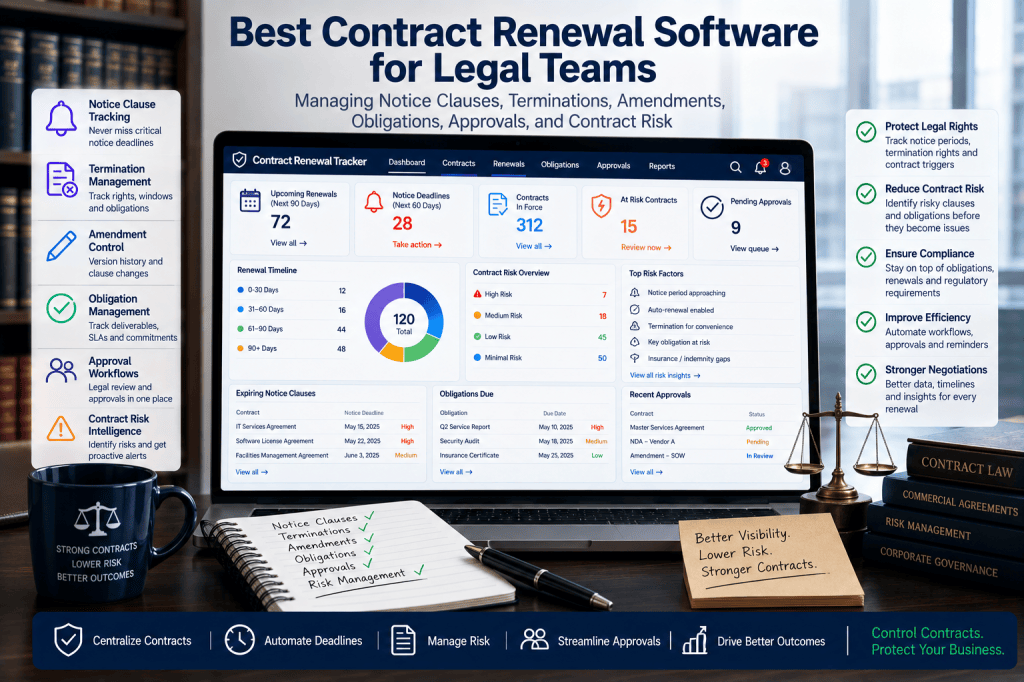
What Is Contract Renewal Software for Legal Teams?
Contract renewal software for Legal helps manage the legal obligations and evidence surrounding contract renewal, extension, non-renewal, and termination.
Core legal use cases include:
- identifying governing renewal provisions;
- verifying notice periods;
- tracking amendments;
- resolving conflicting clauses;
- managing termination notices;
- recording approvals;
- preserving proof of delivery;
- maintaining audit history.
The objective is:
Make sure the organization knows what contractual action is required, performs it correctly, and can later prove what happened.
Legal’s Core Renewal Problem
A commercial team may see:
Contract End Date:
December 31.
Legal may discover:
The agreement automatically renews for another year unless written notice is delivered to a specified address at least 120 days before the end of the current term.
That is a very different operational reality.
The legal question is not:
When does the contract end?
It is:
What must we do, by what date, under which provision, and in what form?
Contract Renewal Tracker for Legal
A legal-oriented Contract Renewal Tracker should connect:
Contract
↓
Governing Document
↓
Renewal Clause
↓
Notice Requirement
↓
Deadline
↓
Decision
↓
Approval
↓
Notice Execution
↓
Evidence
This creates a traceable legal renewal process.
Need More Than Contract Expiration Dates?
Legal teams need confidence that critical deadlines are supported by the actual agreement, including amendments and notice mechanics.
Contract Renewal Tracker is designed to evolve beyond simple date tracking by linking renewal actions to verified contract terms, ownership, workflow, and audit evidence.
Bring legal control into the renewal process →
Legal Feature 1: Governing Document Hierarchy
A contract relationship may include:
Master Services Agreement
↓
Statement of Work
↓
Order Form
↓
Amendment
↓
Renewal Letter
The system should preserve these relationships.
This matters because:
the latest document may modify the original renewal clause.
Example
MSA:
Notice Period:
90 days.
Amendment 2:
Notice Period:
120 days.
If the system only reads the MSA:
the calculated deadline is wrong.
Legal needs:
document hierarchy.
Legal Feature 2: Amendment Tracking
Every material amendment should be linked to:
the underlying agreement.
Track:
- amendment date;
- effective date;
- modified provisions.
This reduces the risk of relying on obsolete terms.
Legal Feature 3: Renewal Clause Source
A critical deadline should ideally show:
Source Document
Clause / Section
Verification Status
For example:
Notice Period:
120 days.
Source:
Amendment 2 §4.1.
Verified By:
Legal.
This creates trust.
Legal Feature 4: Notice Period
The system must distinguish:
- 30 days;
- 90 days;
- 3 months;
- fixed calendar date.
Not every contractual notice period is best modeled as:
a simple number of days.
Legal should be able to override or verify calculated dates.
Legal Feature 5: Notice Deadline
The platform should calculate or store:
the operational notice deadline.
But the calculation should remain explainable.
For example:
Contract End:
December 31.
Notice:
120 days.
Notice Deadline:
September 2.
Source:
Section 14.2.
Legal Feature 6: Conflicting Clause Detection
Suppose:
MSA:
90 days.
Order Form:
60 days.
Amendment:
120 days.
The system should not silently choose:
one.
A safer result is:
Conflict Detected — Legal Review Required
This is particularly important if AI is used for extraction.
Legal Feature 7: Verification Status
Useful statuses:
Unverified
AI Extracted
Business Verified
Legal Verified
For high-risk terms:
Legal Verified
may be required before workflow activation.
Legal Feature 8: Auto-Renewal Terms
Legal should see:
- whether renewal is automatic;
- length of renewal term;
- required notice;
- whether renewal pricing changes.
This helps assess:
legal and financial exposure.
Legal Feature 9: Renewal Rights
Some agreements may give:
one party
or:
both parties
specific renewal rights.
Track:
who has the option.
This matters for:
strategic contracts.
Legal Feature 10: Termination for Convenience
A contract may allow:
termination for convenience.
That can be highly relevant before renewal.
Track:
- notice period;
- fees;
- restrictions.
This may provide flexibility beyond:
waiting for expiry.
Legal Feature 11: Termination for Cause
If supplier performance is poor:
termination for cause may be relevant.
The platform should not determine legal entitlement automatically.
But it can help:
surface the clause and route legal review.
Legal Feature 12: Notice Recipient
Formal notice may need to be sent to:
- legal department;
- registered office;
- named officer.
Track:
the contractual recipient.
This should not be left to memory.
Legal Feature 13: Notice Address
A formal address may be specified in:
the contract.
Track:
the current verified address.
This is especially important if amendments change it.
Legal Feature 14: Required Delivery Method
Examples:
- registered mail;
- courier;
- email plus hard copy;
- hand delivery.
A termination workflow should reflect:
the contractual method.
Legal Feature 15: Notice Timing Rule
Some contracts say:
“at least 90 days before.”
Others:
“no later than September 30.”
Others:
“between 90 and 120 days before renewal.”
The system needs flexibility.
A simple minus-days formula may not always be sufficient.
Legal Feature 16: Business-Day Rules
Some agreements use:
business days
rather than:
calendar days.
This can materially affect the deadline.
A mature system should eventually support:
different calculation rules.
Legal Feature 17: Jurisdiction-Specific Considerations
Legal requirements can vary across:
jurisdictions.
Contract Renewal Tracker should not attempt to replace:
legal judgment.
But it can preserve:
governing law
and:
jurisdiction fields
to support review.
Legal Feature 18: Governing Law
Track:
governing law.
For example:
Netherlands.
England & Wales.
New York.
This is useful when legal review is required.
Legal Feature 19: Renewal Obligation Checklist
Some renewals require more than:
notice.
For example:
- certifications;
- updated insurance;
- compliance documents;
- data-processing terms.
The workflow can create:
renewal obligations.
Legal Feature 20: Contractual Preconditions
A renewal may depend on:
certain conditions.
Track:
preconditions
where relevant.
This prevents operational teams from assuming:
renewal is automatic.
Legal Feature 21: Non-Renewal Workflow
A decision:
Do Not Renew
should initiate:
a controlled legal process.
For example:
Verify Clause
↓
Draft Notice
↓
Approve
↓
Sign
↓
Deliver
↓
Store Evidence
This is materially different from:
changing a status field.
Legal Feature 22: Notice Template Management
For repeatable contracts:
Legal may want:
approved notice templates.
For example:
- non-renewal;
- termination for convenience;
- renewal rejection.
Templates should still require:
appropriate review.
Legal Feature 23: Authorized Signatory
Track:
who is permitted to sign:
termination or renewal documents.
This reduces:
execution risk.
Legal Feature 24: Approval Workflow
Legal approvals may be required for:
- termination;
- unusual renewal terms;
- liability changes;
- data-protection changes.
The system should route:
these cases appropriately.
Legal Feature 25: Reapproval After Material Change
Suppose:
Legal approved renewal terms.
Then supplier changes:
liability cap.
The previous approval may no longer be valid.
The platform should support:
reapproval triggers.
Legal Feature 26: Proof of Notice
Store:
- signed notice;
- courier receipt;
- email confirmation;
- delivery acknowledgment.
This is one of the strongest legal-control features.
Legal Feature 27: Delivery Confirmation
The workflow should distinguish:
Sent
from:
Delivered
from:
Acknowledged
Those are not the same.
Legal Feature 28: Failed Delivery
If notice is returned:
the contract should immediately enter:
Critical.
For example:
Termination notice returned undelivered. 7 days remain before contractual deadline.
This deserves:
immediate escalation.
Legal Feature 29: Audit Trail
Legal should be able to reconstruct:
who changed:
- notice period;
- owner;
- decision;
- approval.
And:
when.
This is essential for governance.
Legal Feature 30: Immutable Historical Context
If a renewal term changes:
do not overwrite history without trace.
Preserve:
old value
and:
new value.
This is particularly important for:
legal evidence.
Legal Feature 31: Decision History
Example:
June:
Terminate.
August:
Extend.
September:
Renew.
The system should show:
each decision
and:
reason.
This can be important later.
Legal Feature 32: Approval History
Track:
- who approved;
- when;
- what document/version;
- what value or terms.
This makes approvals defensible.
Legal Feature 33: Legal Review Queue
A useful Legal dashboard might show:
Notice Verification Required
Terminations Awaiting Review
Conflicting Clauses
Approvals Pending
Critical Deadlines
This gives Legal:
an exception-based work queue.
Legal Feature 34: Materiality Thresholds
Legal does not need to review:
every €100 SaaS renewal.
Use rules such as:
- value;
- contract risk;
- unusual clause.
This prevents Legal from becoming:
a bottleneck.
Example
Standard low-risk SaaS:
no Legal review.
Strategic agreement:
Legal review required.
Termination:
Legal review required.
Conflicting clauses:
Legal review required.
This is scalable.
Legal Feature 35: Contract Risk Classification
Possible:
Low
Medium
High
Critical
The classification can influence:
workflow.
Legal Feature 36: Clause Risk Flags
Examples:
- unusual auto-renewal;
- short notice window;
- strict notice mechanics;
- termination fees.
These can help prioritize review.
Legal Feature 37: Liability Changes at Renewal
A supplier may use renewal to introduce:
new legal terms.
Track:
whether liability provisions changed.
This may require:
Legal approval.
Legal Feature 38: Data Protection Changes
Technology renewals may include:
new DPA terms.
Legal/privacy teams may need:
review.
This should be part of:
renewal workflow
where appropriate.
Legal Feature 39: Security Terms
Some renewals modify:
security obligations.
Legal and security may need:
joint review.
The system should support:
cross-functional tasks.
Legal Feature 40: Insurance Requirements
Some contracts require:
insurance certificates.
Renewal can trigger:
verification.
This is another example of:
obligation management.
Legal Feature 41: Notice Clause Extraction
AI can help identify:
renewal and termination clauses.
But extraction should be:
evidence-backed.
For example:
Auto-renews for 12 months unless either party provides 90 days’ written notice.
Then show:
source clause.
Legal Feature 42: AI Confidence
The platform should say:
High Confidence
or:
Needs Review
rather than pretending:
certainty.
This is particularly important for legal terms.
Legal Feature 43: AI Source Citation
If AI says:
Notice Period:
90 days,
the user should be able to click:
the source.
This is fundamental for legal trust.
Legal Feature 44: AI Conflict Detection
If two documents contain:
different renewal provisions,
AI should flag:
the conflict.
It should not:
silently resolve legal hierarchy.
Legal Feature 45: AI Should Abstain
A good legal AI system must be able to say:
I cannot determine the governing notice period from the available documents.
That is safer than:
guessing.
Legal Feature 46: Permission-Aware AI
A user should never retrieve:
restricted contract information
through:
AI.
Authorization must apply:
before retrieval.
This is essential.
Legal Feature 47: AI Guardrails
AI should not autonomously:
send termination notices;
approve contracts;
make legal determinations.
It can:
draft,
summarize,
identify.
Human authorization remains necessary.
Legal Feature 48: Clause Comparison
A useful future capability:
compare:
current renewal clause
with:
proposed renewal clause.
For example:
Old:
90-day notice.
New:
120-day notice.
Legal can immediately see:
the change.
Legal Feature 49: Amendment Comparison
Similarly:
compare amendments.
This can accelerate:
renewal review.
Legal Feature 50: Contract Q&A
Legal users could ask:
Which document governs termination notice?
The system returns:
evidence.
This can save:
document-search time.
Legal Dashboard
A strong legal dashboard might show:
Contracts Requiring Legal Review
Notice Deadlines <60 Days
Conflicting Renewal Terms
Termination Notices Pending
Failed Delivery
Approval Required
This is highly actionable.
Legal KPI 1: Verified Notice Coverage
Percentage of:
material contracts
with:
verified notice terms.
This should be high.
Legal KPI 2: Termination Notice Compliance
Percentage of non-renewals:
executed before deadline.
Target:
100% for material contracts.
Legal KPI 3: Conflicting Clause Resolution Time
How quickly are:
conflicts
resolved?
This can measure:
legal process efficiency.
Legal KPI 4: Legal Review Lead Time
Time from:
Legal task creation
to:
completion.
This helps identify:
bottlenecks.
Legal KPI 5: Failed Notice Delivery
This should be:
rare.
Any occurrence deserves:
review.
Legal KPI 6: Amendment Coverage
Percentage of contract records with:
relevant amendments linked.
This improves data reliability.
Legal KPI 7: Audit Completeness
Are critical changes:
traceable?
This is an important governance metric.
Legal KPI 8: Unverified Critical Clauses
Number of:
high-risk contracts
where renewal terms remain unverified.
This should trend toward:
zero.
Legal KPI 9: Approval Compliance
Percentage of renewals:
approved according to policy.
Legal KPI 10: Legal Exceptions
Number of renewals requiring:
manual intervention.
This can help optimize:
workflow design.
Contract Renewal Tracker vs CLM for Legal
Legal teams may already use:
CLM.
If that platform handles:
renewal obligations
well,
Contract Renewal Tracker may not need to replace it.
The better architecture may be:
CLM:
documents + legal lifecycle.
Contract Renewal Tracker:
operational renewal workflow.
This avoids unnecessary duplication.
Contract Renewal Tracker as a Renewal Control Layer
The product can complement:
existing repositories.
For example:
Document Source:
CLM.
Renewal Workflow:
Contract Renewal Tracker.
Financial Data:
ERP.
This is a sensible enterprise model.
Legal Should Not Be Forced to Re-upload Everything
If a contract repository already exists:
link it.
Avoid:
duplicate document management
unless there is a strong reason.
This reduces:
implementation complexity.
Excel vs Contract Renewal Software for Legal
Excel can track:
notice periods.
But once Legal needs:
- source clauses;
- document hierarchy;
- audit history;
- notice evidence;
the spreadsheet becomes less suitable.
This is where:
dedicated software
creates value.
Email vs Controlled Termination Workflow
Email can coordinate:
termination.
But it may be difficult to prove later:
who approved,
which version,
when notice was delivered.
A controlled workflow improves:
evidence.
Shared Drive vs Structured Record
A folder can contain:
contracts.
But it does not necessarily tell you:
which clause controls the renewal.
Structured metadata adds:
operational meaning.
Legal Product Positioning
For Legal teams, a strong message is:
Know the Contractual Deadline—and the Clause Behind It.
This is excellent positioning.
Another Strong Legal Message
Turn Renewal and Termination Requirements into Controlled Legal Workflows.
This emphasizes:
process.
Another
Stop Letting Critical Notice Periods Live Inside PDFs.
That is particularly compelling.
Another
Every Renewal Deadline Should Be Traceable to the Contract.
Strong trust-oriented messaging.
Legal Beta Strategy
For the first beta:
do not try to build:
full legal workflow.
Focus on:
- end date;
- notice period;
- document reference;
- owner;
- reminder.
This creates:
the foundation.
Legal Beta Aha Moment 1
Three contracts have notice deadlines within 60 days.
Useful.
Legal Beta Aha Moment 2
Two high-value contracts have missing notice periods.
This creates:
risk visibility.
Legal Beta Aha Moment 3
One contract is marked auto-renewing but has no confirmed renewal decision.
Again:
practical value.
Post-Beta Legal Feature 1
Add:
contract document attachment.
Post-Beta Legal Feature 2
Add:
source clause reference.
Post-Beta Legal Feature 3
Add:
verification status.
Post-Beta Legal Feature 4
Add:
termination workflow.
Post-Beta Legal Feature 5
Add:
delivery evidence.
This creates:
a strong legal roadmap.
AI for Legal: Contract Term Extraction
One of the most valuable early AI capabilities may be:
extract:
- end date;
- auto-renewal;
- notice period.
This directly reduces:
data entry.
AI for Legal: Renewal Clause Summary
For example:
Agreement auto-renews for successive 12-month periods unless either party provides written notice at least 90 days before the then-current term ends.
Then:
show source.
This is highly useful.
AI for Legal: Governing Document Analysis
A more advanced system might identify:
Amendment 3 modifies the renewal notice requirement in the original MSA.
This can save:
substantial review time.
But human confirmation should remain:
available.
AI for Legal: Termination Preparation
AI could draft:
a first version
of:
termination notice.
But Legal should:
review and approve
before delivery.
This is a sensible guardrail.
AI for Legal: Portfolio Exceptions
Legal could ask:
Which contracts have conflicting renewal terms?
or:
Which termination notices are due within 30 days?
This turns AI into:
workflow intelligence.
Contract Renewal Tracker Beta Launch — September 21, 2026
Contract Renewal Tracker is launching its first SaaS beta on September 21, 2026. The beta is designed to help legal and contract-management teams bring critical renewal dates, notice periods, owners, auto-renewal information, and upcoming actions into one dedicated workspace instead of relying on scattered spreadsheets and calendar reminders. The initial foundation can later support deeper legal controls such as clause verification, amendment hierarchy, termination workflows, delivery evidence, audit history, and AI-assisted contract retrieval. [Notify Me When the Beta Launches →] (One launch notification only — no newsletter or ongoing marketing emails.)
Lead Magnet Opportunity
This article is ideal for:
Contract Renewal Legal Review Checklist
Fields could include:
- governing document;
- amendment review;
- renewal clause;
- notice period;
- notice recipient;
- delivery method;
- signatory;
- approval;
- proof of notice.
This would attract:
legal and contract-operations visitors.
Suggested CTA
Download the Contract Renewal Legal Review Checklist
Review renewal and termination obligations using a structured checklist covering governing documents, amendments, notice periods, recipient requirements, approvals, delivery methods, and evidence.
Download the Free Legal Checklist →
Second Lead Magnet
Another useful asset:
Contract Termination Notice Process Checklist
This can include:
- Verify right to terminate.
- Confirm deadline.
- Confirm recipient.
- Confirm delivery method.
- Draft notice.
- Obtain approval.
- Send.
- Preserve evidence.
- Confirm receipt.
This is highly aligned with:
the product.
Commercial CTA
Still Tracking Legal Renewal Deadlines Manually?
Contract Renewal Tracker can centralize contract end dates, notice periods, responsible owners, and upcoming renewal actions so Legal can focus on exceptions and critical contractual requirements rather than rebuilding renewal calendars from spreadsheets.
Join the Contract Renewal Tracker Beta →
Final Thoughts
For Legal, contract renewal management is fundamentally about:
correct interpretation
and:
correct execution.
The process should be:
Governing Contract
↓
Renewal Clause
↓
Verified Deadline
↓
Decision
↓
Approval
↓
Notice / Renewal Execution
↓
Evidence
The most dangerous renewal failure is not merely:
forgetting the expiration date.
It is:
acting on the wrong contractual assumption.
That is why legal-grade renewal software needs to combine:
- deadlines;
- source evidence;
- amendments;
- approvals;
- auditability.
For Contract Renewal Tracker, Legal creates an important product-development direction.
The platform can begin with:
structured dates and notice periods
and evolve toward:
a renewal control system where every critical action is linked back to the contractual evidence that justifies it.
That is a strong and defensible long-term value proposition.
Next Article in the Contract Renewal Tracker Series
The next persona article can focus on the contracts that often fall between formal Procurement and IT ownership: facilities agreements, cleaning, maintenance, telecom, logistics, equipment, utilities, fleet, outsourced operations, recurring service agreements, and local vendors.
The central message can be:
“Operations teams need one place to see which recurring supplier agreements are renewing, which services are still needed, who owns them, and what must happen before notice periods expire.”

