IT departments manage a growing number of recurring supplier commitments.
SaaS subscriptions.
Cloud platforms.
Cybersecurity tools.
Telecommunications contracts.
Managed service providers.
Support agreements.
Hardware maintenance.
Software licenses.
Data platforms.
Developer tools.
Many of these agreements renew automatically, scale with user counts, and become more expensive over time.
That creates a specific IT renewal problem:
The contract may renew before the organization has confirmed whether it still needs the same product, quantity, service level, or supplier.
For IT teams, the best contract renewal software should therefore do more than track expiration dates.
It should help answer:
- what technology contracts are renewing;
- when the real notice deadline occurs;
- who owns the application or service;
- how much the organization currently spends;
- whether usage still justifies that spend;
- whether licenses can be reduced;
- whether a replacement is realistic;
- what needs to happen before the renewal window closes.
That is where Contract Renewal Tracker can become particularly valuable for IT departments.
Why IT Contract Renewals Are Different
Technology contracts have several characteristics that make renewal management difficult.
They often involve:
- recurring subscriptions;
- annual price increases;
- seat-based pricing;
- usage-based charges;
- auto-renewal clauses;
- implementation dependencies;
- migration costs;
- security requirements.
A contract may look simple financially but be difficult to replace operationally.
A €100,000 SaaS platform may support:
hundreds of users,
multiple integrations,
and:
critical business processes.
That makes timing extremely important.
IT Often Has More Contracts Than It Realizes
A typical IT environment may include:
Productivity
Microsoft 365.
CRM
Salesforce or another CRM platform.
Security
EDR, SIEM, IAM, vulnerability management.
Cloud
AWS, Azure, Google Cloud.
Development
GitHub, CI/CD, monitoring, developer tools.
Support
Hardware support, database support, managed services.
Collaboration
Video conferencing, messaging, file sharing.
Infrastructure
Backup, storage, networking, telecom.
Individually:
many contracts appear manageable.
Collectively:
they can represent a large recurring technology budget.
Still Managing IT Renewals in Excel?
A spreadsheet can tell you when software contracts expire.
It is less effective at answering:
Which auto-renewing SaaS agreements still have unused licenses, which high-value technology contracts need a decision this quarter, and which replacement projects need to start now?
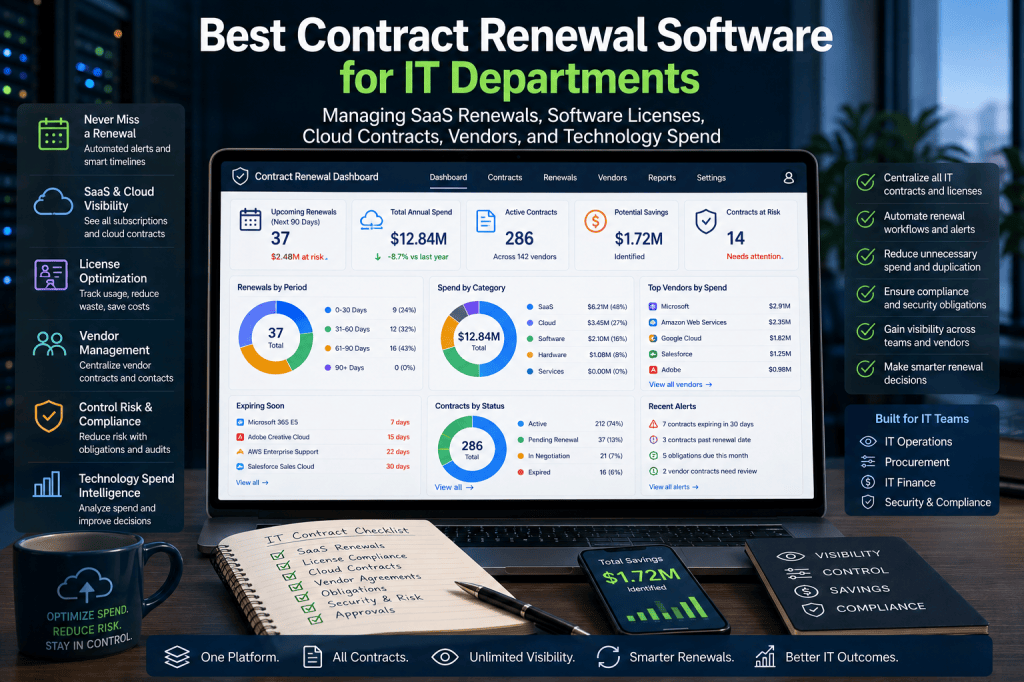
Contract Renewal Tracker is designed to bring IT contracts, notice periods, owners, values, renewal decisions, and upcoming actions into one dedicated workspace.
Bring your technology renewals under control →
The Core IT Renewal Problem: Renewal Comes Before Evaluation
A common sequence is:
Supplier sends renewal quote.
IT checks current contract.
Someone asks:
Are we still using this?
Finance asks:
Why did the price increase 12%?
Procurement asks:
Can we negotiate?
Then someone discovers:
the contract requires 90 days’ notice
and:
the deadline is next week.
At that point, the organization has fewer options.
A Better Sequence
A stronger process is:
Notice Deadline Identified
↓
Usage Reviewed
↓
Business Need Confirmed
↓
Security / Technical Review
↓
Renewal Decision
↓
Procurement Negotiation
↓
Approval
↓
Renew / Reduce / Replace / Terminate
This creates time for a real technology decision.
IT Feature 1: Central Technology Contract Register
Every material technology agreement should be visible in one place.
At minimum:
- application/service;
- supplier;
- IT owner;
- department;
- end date;
- notice period;
- annual value.
This becomes the IT renewal portfolio.
IT Feature 2: Application Owner
Contract owner and system owner may differ.
For example:
Procurement owns:
commercial process.
But:
IT Application Manager
owns:
technical requirement.
Track both where relevant.
Example
Contract:
CRM Platform.
Supplier:
ExampleCRM.
Application Owner:
Sales Systems Manager.
IT Owner:
Enterprise Applications.
Procurement Owner:
Category Manager.
Annual Value:
€420K.
This creates clearer accountability.
IT Feature 3: Notice Deadline
Technology contracts often auto-renew.
That makes:
notice deadline
more important than:
expiration date.
Example:
End Date:
December 31.
Notice:
90 days.
IT must decide:
whether to continue
before:
early October.
A December reminder is too late.
IT Feature 4: Auto-Renewal Tracking
IT should know:
how much technology spend can renew without explicit action.
For example:
Total IT contracts:
€12M.
Auto-renewing:
€7.4M.
Undecided:
€1.3M.
That creates immediate management visibility.
IT Feature 5: License Counts
For SaaS contracts, track:
Purchased Licenses
Assigned Licenses
Active Licenses
This can materially improve renewal decisions.
Example
Purchased:
1,000.
Assigned:
Active:
Renewing:
1,000
would likely be unnecessary.
This is one of the clearest technology renewal optimization opportunities.
License Utilization
Formula:
Active Licenses ÷ Purchased Licenses
For example:
620 ÷ 1,000
=
62%.
That should trigger:
a quantity review.
IT Feature 6: Cost Per Active User
Suppose:
Annual cost:
€300K.
Active users:
Effective cost per active user:
€500/year.
This may provide better insight than:
contract value alone.
IT Feature 7: License Reduction Opportunity
Example:
Purchased:
1,000.
Future requirement:
Unit cost:
€400.
Potential reduction:
300 × €400
=
€120K annually.
This can immediately improve the business case for renewal software.
IT Feature 8: SaaS Renewal Calendar
IT should see:
all SaaS renewals across:
12 months.
For example:
| Month | SaaS Renewals | Value |
|---|---|---|
| September | 18 | €620K |
| October | 12 | €410K |
| November | 24 | €950K |
| December | 31 | €1.8M |
This helps IT prepare usage reviews and procurement activity.
IT Feature 9: Technology Category
Useful categories might include:
SaaS
Cloud
Cybersecurity
Infrastructure
Telecom
Managed Services
Development Tools
Hardware Support
This enables category-specific reporting.
IT Feature 10: Renewal Decision
Recommended options:
Renew
Renegotiate
Reduce
Replace
Extend
Terminate
This is particularly useful for IT because:
Reduce
and:
Replace
occur frequently.
Decision: Reduce
Typical reasons:
- unused licenses;
- fewer users;
- lower capacity needs;
- overlapping tooling.
This can generate immediate savings.
Decision: Replace
Typical reasons:
- poor functionality;
- cost;
- security concerns;
- technical debt;
- vendor strategy.
Replacement requires:
much earlier action.
IT Feature 11: Replacement Lead Time
This is critical for technology contracts.
A replacement may require:
- requirements;
- selection;
- testing;
- migration;
- integration;
- training.
Therefore:
replacement feasibility should be assessed:
months before renewal.
Example
Current contract ends:
December 31.
Estimated replacement implementation:
6 months.
Notice deadline:
September 30.
If evaluation starts:
September,
replacement may already be:
unrealistic.
The software should make this visible.
Replacement Readiness
A useful field:
Estimated Replacement Go-Live
Compare against:
Incumbent End Date
This creates:
transition risk.
Example
Incumbent ends:
December 31.
Replacement ready:
February 15.
Gap:
46 days.
Now IT can decide whether it needs:
a short bridge extension.
IT Feature 12: Bridge Extension Management
Instead of signing:
another full year,
IT may negotiate:
three months.
Track:
- bridge start;
- bridge end;
- bridge cost.
This can reduce unnecessary lock-in.
IT Feature 13: Cloud Commitments
Cloud contracts can differ from simple SaaS.
They may include:
- committed spend;
- consumption tiers;
- reserved instances;
- credits.
Renewal decisions should therefore consider:
usage trends.
Example
Annual cloud commitment:
€2M.
Actual forecast usage:
€1.5M.
Renewing the same commitment could create:
€500K excess commitment risk.
This is a major optimization opportunity.
Cloud Commitment Utilization
Formula:
Actual Consumption ÷ Committed Spend
For example:
€1.5M ÷ €2M
=
75%.
That should be reviewed before renewal.
IT Feature 14: Support and Maintenance Contracts
Not all technology agreements are SaaS.
Examples:
- database support;
- hardware maintenance;
- network support.
Track:
whether the supported asset or product is:
still in use.
Example
Maintenance agreement:
€80K.
Covered hardware:
retired.
Renewal decision:
Terminate.
This is straightforward avoided spend.
IT Feature 15: Cybersecurity Contracts
Security tools require particular care.
A low-usage security tool may still be:
business-critical.
So usage alone should not determine:
renewal.
Consider:
- risk coverage;
- regulatory need;
- integration;
- security architecture.
This is why renewal decisions need:
context.
Cybersecurity Renewal Review
Ask:
- Is the tool still part of the target security architecture?
- Is functionality duplicated?
- Is the supplier performing?
- Has pricing increased?
- Is migration realistic?
- What security risk would removal create?
This creates a better decision.
IT Feature 16: Duplicate Tool Detection
Technology estates often accumulate overlapping tools.
For example:
two:
project management tools.
three:
monitoring platforms.
multiple:
password managers.
Renewal is a good moment to rationalize.
Example
Department A:
Tool X — €40K.
Department B:
Tool Y — €35K.
IT standard:
Tool Z — €60K.
Potential consolidation:
remove X and Y.
This can reduce:
spend and complexity.
IT Feature 17: Technology Standard Alignment
Track whether the product is:
Strategic
Approved
Tolerated
Deprecated
Retire
A renewal for:
Deprecated
technology should receive stronger scrutiny.
Example
Application:
Legacy Reporting Tool.
Architecture Status:
Deprecated.
Renewal:
€90K.
Decision:
Replace.
Now the renewal system connects:
architecture strategy
with:
commercial action.
IT Feature 18: End-of-Life Risk
A vendor product may approach:
end of support.
That should affect:
renewal.
Track:
- end-of-life date;
- end-of-support date.
This is particularly important for:
infrastructure and security.
IT Feature 19: Vendor Dependency
Some technology suppliers become:
deeply embedded.
For example:
cloud providers,
ERP,
identity platforms.
A simple:
Replace
decision may be unrealistic.
The system should record:
switching complexity.
Switching Complexity
Possible:
Low
Medium
High
Critical
This can be part of:
renewal risk scoring.
IT Feature 20: Integration Dependency
A SaaS platform may integrate with:
20 systems.
Replacement is not:
just buying another license.
Track:
number or criticality of integrations
where useful.
This improves transition planning.
IT Feature 21: Data Migration Complexity
If the supplier stores:
critical business data,
replacement may require:
migration.
Track:
Data Migration Required: Yes/No
This influences:
lead time.
IT Feature 22: Security Review
Before renewing certain platforms, IT or security may need to assess:
- security posture;
- incidents;
- access controls;
- compliance.
This can become:
a renewal workflow task.
IT Feature 23: Architecture Review
For strategic technology:
ask:
Does this product still belong in the target architecture?
This prevents contracts from renewing automatically even when technology strategy has changed.
IT Feature 24: Usage Review
Usage should be reviewed before:
pricing.
That means:
IT renewal sequence should often be:
Usage
↓
Requirement
↓
Quantity
↓
Price
Not:
Supplier Quote
↓
Discount Negotiation
This can create much larger savings.
IT Feature 25: User Growth Forecast
Do not simply use:
current active users.
Estimate:
next-term requirement.
Example:
Current:
Expected growth:
10%.
Future requirement:
Add buffer:
Renew:
700,
not:
1,000.
This is a much better demand model.
IT Feature 26: License Tier Optimization
Some SaaS products have:
Basic.
Professional.
Enterprise.
A company may be paying for:
Enterprise
while only using:
Professional features.
Track:
tier
and:
business requirement.
Example
Current tier:
Enterprise.
Annual:
€180K.
Professional:
€130K.
Unused enterprise-only features.
Potential reduction:
€50K.
That is another renewal optimization source.
IT Feature 27: Feature Utilization
Where usage data exists:
look at:
not only users
but:
feature adoption.
If premium functionality is unused:
downgrade may be possible.
IT Feature 28: Renewal Price Increase
Technology vendors often increase:
subscription pricing.
Track:
Current:
€200K.
Proposal:
€230K.
Increase:
15%.
That deserves:
commercial review.
IT Feature 29: Price Per User
For seat-based products:
compare:
historic unit pricing.
Example:
2024:
€25/user/month.
2025:
€27.
2026 proposal:
€31.
This creates:
trend visibility.
IT Feature 30: Price Benchmarking
Where possible:
record internal or market benchmarks.
This gives Procurement:
better negotiating context.
IT Feature 31: SaaS Spend by Department
Many tools are used outside:
central IT.
Marketing.
Sales.
HR.
Finance.
This can create:
shadow SaaS.
Contract Renewal Tracker could eventually show:
technology spend by:
department.
Shadow SaaS Renewal Risk
If departments buy software independently:
renewal dates may never reach IT.
A centralized register can expose:
these agreements.
This creates:
security and financial value.
IT Feature 32: Supplier Consolidation
A company may buy several products from:
one vendor.
For example:
Microsoft.
Adobe.
Salesforce.
Atlassian.
Renewing those contracts separately can reduce:
commercial leverage.
Supplier grouping helps.
Example
Vendor:
ExampleTech.
Product A:
€200K.
Product B:
€100K.
Product C:
€80K.
Combined:
€380K.
Renewal windows:
within 90 days.
Possible action:
consolidate negotiation.
IT Feature 33: Security Tool Consolidation
This is particularly valuable.
Organizations may accumulate overlapping:
- endpoint tools;
- identity products;
- vulnerability scanners.
Renewal periods can become:
architecture simplification windows.
IT Feature 34: Managed Service Provider Renewals
IT may rely on:
MSPs.
These contracts can include:
- help desk;
- infrastructure;
- cloud management;
- security services.
Renewal review should consider:
service quality and SLA performance.
MSP Supplier Scorecard
Possible metrics:
- SLA attainment;
- ticket resolution;
- availability;
- escalation quality;
- customer satisfaction;
- cost.
A poor score strengthens:
renegotiation or replacement.
IT Feature 35: SLA Performance
If supplier promised:
99.9% uptime
but delivered:
99.5%,
renewal should reflect that history.
This can become:
negotiating evidence.
IT Feature 36: Incident History
Track:
major incidents
associated with:
the supplier.
Example:
5 P1 incidents.
Two prolonged outages.
This provides context.
IT Feature 37: Support Quality
A technology product may work well technically but have:
poor support.
That affects:
renewal decision.
IT Feature 38: Security Incident History
If a vendor experienced:
material incidents,
IT/security may need to reassess:
risk before renewal.
This is more important than:
price alone.
IT Feature 39: Data Processing and Privacy Requirements
Technology contracts often involve:
personal or sensitive data.
Renewal review may need:
privacy/security confirmation.
This can become:
a workflow checkpoint.
IT Feature 40: Technical Exit Plan
For critical systems:
know:
what happens if the organization leaves.
Does the supplier allow:
data export?
How long is migration?
What happens to:
integrations?
Renewal is a good time to reassess:
exit feasibility.
SaaS Renewal Scorecard
A useful scorecard might combine:
| Dimension | Score |
|---|---|
| Utilization | 65 |
| Business Criticality | 90 |
| Supplier Performance | 75 |
| Pricing Competitiveness | 60 |
| Security | 88 |
| Replacement Difficulty | 85 |
Then recommendation:
Renegotiate / Reduce
This provides:
structured decision support.
IT Renewal Risk Score
Possible factors:
Notice Deadline
25%.
Annual Value
20%.
Auto-Renewal
15%.
Usage
15%.
Business Criticality
15%.
Replacement Complexity
10%.
This can prioritize:
the IT portfolio.
Example
Software A:
Value:
€20K.
Utilization:
30%.
Replacement:
easy.
Deadline:
80 days.
Opportunity:
High.
Software B:
Value:
€1.5M.
Business Criticality:
Critical.
Replacement:
12 months.
Deadline:
60 days.
Risk:
Critical.
These are different types of priority.
Risk vs Opportunity
This distinction is useful.
Some contracts are:
high risk
because:
replacement is difficult.
Others are:
high opportunity
because:
usage is low.
Contract Renewal Tracker could eventually show both.
IT Dashboard
A strong IT dashboard could show:
Technology Contracts
Annual Technology Contract Value
€9.4M.
Renewing Next 90 Days
€2.1M.
Auto-Renewing
€5.6M.
Low Utilization Renewals
€480K.
Critical Transition Risk
4 contracts.
This gives IT leadership:
a clear view.
CIO Dashboard
A CIO likely wants:
- upcoming technology commitments;
- major renewal risk;
- consolidation opportunities;
- cost optimization;
- strategic decisions.
Not:
every reminder.
Example CIO View
Next 12-Month IT Renewal Spend
€12M.
Potential License Reduction
€650K.
Supplier Price Increase Exposure
€900K.
Strategic Replacements
Critical Renewals
This is much more valuable.
IT KPI 1: SaaS Utilization at Renewal
Average active-license utilization.
Higher is not always better, but:
very low utilization
requires review.
IT KPI 2: License Reduction Value
Annual spend removed through:
quantity reduction.
IT KPI 3: SaaS Contracts with Decision
Percentage of renewals with:
confirmed action before deadline.
IT KPI 4: Auto-Renewal Exposure
Technology spend that can renew:
automatically.
IT KPI 5: Renewal Lead Time
Average days:
between:
review start
and:
notice deadline.
This should improve over time.
IT KPI 6: Replacement Readiness
Percentage of replacement projects:
on track before incumbent expiry.
IT KPI 7: Price Increase Avoidance
Supplier proposed increase:
minus final increase.
IT KPI 8: Tool Consolidation Savings
Spend removed through:
application rationalization.
IT KPI 9: Unowned Technology Contracts
This should trend toward:
zero.
IT KPI 10: Technology Contract Coverage
Percentage of material IT contracts:
inside the renewal system.
These ten KPIs create:
a useful IT operating scorecard.
Excel vs Contract Renewal Software for IT
Excel can work well when:
the IT portfolio is small.
But as the organization manages:
hundreds of recurring technology contracts,
a spreadsheet becomes more difficult to connect with:
- reminders;
- owners;
- usage;
- renewal decisions;
- transition planning.
Dedicated software becomes more useful.
SaaS Management Platform vs Contract Renewal Tracker
A SaaS Management Platform may specialize in:
- application discovery;
- licenses;
- usage;
- SaaS spend.
Contract Renewal Tracker focuses more broadly on:
the contractual renewal process.
The two can eventually:
complement each other.
Example Integration
SaaS Management Platform:
usage.
Contract Renewal Tracker:
contract dates + decision workflow.
Together:
much stronger renewal intelligence.
Cloud Cost Management vs Renewal Management
FinOps tools can help optimize:
cloud consumption.
Contract Renewal Tracker can help manage:
contract commitment and renewal timing.
Again:
different layers.
ITSM vs Renewal Management
ITSM handles:
incidents,
requests,
assets.
It may not provide:
commercial renewal workflow.
Integration can be useful.
Contract Renewal Tracker Should Not Try to Replace Every IT Tool
This is a critical product principle.
It should become:
the renewal coordination layer.
Usage can come from:
other systems.
Spend can come from:
ERP.
Contract documents can come from:
CLM.
Contract Renewal Tracker then orchestrates:
the renewal decision.
IT Product Positioning
For IT departments, a strong message is:
Know Which Technology Contracts Are Renewing Before the Vendor Does.
That is compelling.
Another Message
Stop Renewing Software You No Longer Need.
Strong for:
SaaS-heavy companies.
Another
Turn SaaS Renewals into License Optimization Opportunities.
This is highly commercial.
Another
Track Every Software Renewal, Notice Deadline, Owner, and License Decision in One Place.
Clear and practical.
Best Initial IT Segment
SaaS-heavy organizations are likely particularly promising.
Why?
They have:
- frequent renewals;
- clear recurring spend;
- measurable usage;
- common auto-renewal risk.
This makes the product value:
easy to demonstrate.
Example Customer
150 employees.
80 SaaS products.
Annual SaaS spend:
€600K.
If average waste is even:
modest,
one or two optimized renewals may pay for:
the software.
IT Services Companies
Another potentially strong segment.
They often understand:
software contracts
and:
recurring supplier costs.
They may also manage:
client-facing infrastructure.
This could be a useful early customer group.
MSPs
Managed Service Providers may have:
both:
internal contracts
and:
vendor agreements supporting client services.
Renewal management can therefore be:
important.
Contract Renewal Tracker Beta for IT
For the first beta, the core IT experience can remain simple:
- Import technology contracts.
- Add annual value.
- Add end date.
- Add notice period.
- Assign owner.
- See upcoming renewals.
This already creates:
real visibility.
IT Beta Aha Moment 1
You have 14 technology contracts entering their notice window within 90 days.
Immediate value.
IT Beta Aha Moment 2
€180K of those contracts auto-renew and still have no decision.
Now the insight becomes:
financial.
IT Beta Aha Moment 3
Four contracts have no named owner.
Now the platform creates:
governance value.
Post-Beta IT Feature 1
Add:
License Quantity.
This may be one of the most valuable next additions.
Post-Beta IT Feature 2
Add:
Current Active Users.
Then calculate:
utilization.
This creates:
SaaS optimization.
Post-Beta IT Feature 3
Add:
Renewal Quantity.
Now the system can calculate:
demand reduction.
Post-Beta IT Feature 4
Add:
Replacement Date.
This creates:
transition risk.
Post-Beta IT Feature 5
Integrate usage sources.
This can dramatically increase:
automation.
AI for IT Renewal Management
AI can eventually help:
summarize contracts,
extract notice terms,
and:
prioritize renewals.
But the most powerful AI may combine:
contract + usage + spend.
Example AI Renewal Brief
Adobe Creative Cloud Renewal
Annual cost: €185K.
Purchased licenses: 420.
Active users: 287.
Utilization: 68%.
Supplier proposed increase: 9%.
Notice deadline: 72 days.Potential action: Review quantity before commercial negotiation.
This is practical AI.
AI Could Identify Duplicate Tools
For example:
Three applications in the analytics category renew within six months. Combined annual spend is €220K. Consider rationalization before renewal.
This is much more strategic.
AI Could Prioritize IT Renewals
Example:
Of 42 upcoming technology renewals, five account for 71% of total spend and two have replacement lead times longer than the remaining notice window.
That helps CIOs focus.
AI Should Not Decide Security Risk Alone
For cybersecurity or critical infrastructure:
AI can:
summarize evidence.
Human specialists should still make:
material architecture and security decisions.
Beta Launch CTA
Contract Renewal Tracker is launching its first SaaS beta on September 21, 2026. The beta is designed to help IT teams bring software, cloud, cybersecurity, support, and technology supplier renewals into one dedicated workspace with contract dates, notice periods, owners, values, and upcoming actions. For organizations currently managing renewals through spreadsheets and calendar reminders, the beta provides a practical way to see upcoming technology commitments before renewal options begin to disappear. [Notify Me When the Beta Launches →] (One launch notification only — no newsletter or ongoing marketing emails.)
Lead Magnet Opportunity
This article is ideal for:
Free SaaS Renewal Audit Template
Fields:
- application;
- supplier;
- annual cost;
- licenses;
- active users;
- utilization;
- notice deadline;
- auto-renewal;
- decision.
This could attract:
IT and FinOps prospects.
Suggested CTA
Download the SaaS Renewal Audit Template
Review software renewals using contract dates, notice periods, annual spend, purchased licenses, active users, utilization, supplier pricing, and renewal decisions.
Download the Free IT Renewal Template →
Second Lead Magnet
Technology Contract Renewal Calendar Template
with:
- software;
- cloud;
- cybersecurity;
- MSP;
- support.
This could be another useful asset.
Commercial CTA
Still Tracking Software Renewals in Excel?
Contract Renewal Tracker can bring your technology contracts, renewal dates, notice periods, owners, annual values, and upcoming decisions into one place—helping IT identify renewal risk before the supplier’s deadline becomes your emergency.
Final Thoughts
For IT departments, renewal management is not only:
contract administration.
It sits at the intersection of:
Technology
Cost
Usage
Architecture
Risk
A good renewal process therefore follows:
Contract Deadline
↓
Usage Review
↓
Business Need
↓
Architecture / Security Review
↓
Quantity Decision
↓
Commercial Negotiation
↓
Renew / Reduce / Replace / Terminate
The most important improvement is often:
starting earlier.
When IT knows what is renewing months in advance, it can:
- remove unused licenses;
- rationalize duplicate tools;
- challenge supplier increases;
- prepare migrations;
- avoid unwanted auto-renewals.
For Contract Renewal Tracker, this is an especially attractive vertical because IT contracts combine exactly the problems the platform is designed to solve:
recurring commitments, notice deadlines, distributed ownership, high renewal frequency, and measurable optimization opportunities.
Next Article in the Contract Renewal Tracker Series
The next article can shift the product story from IT’s usage and technology-spend optimization toward Legal’s priorities: accurate contractual deadlines, governing-document hierarchy, clause verification, termination execution, evidence, approvals, audit trails, and safe AI-assisted contract retrieval.

