Not every contract renewal deserves the same level of attention.
A €600 annual software subscription with a 30-day rolling renewal does not represent the same risk as a €2 million infrastructure agreement that automatically renews for another three years unless notice is submitted within the next 18 days.
Yet traditional contract spreadsheets frequently treat both as rows in the same table.
The result is predictable.
Teams spend time reviewing relatively insignificant renewals while genuinely dangerous contracts remain buried among hundreds of records.
A Contract Renewal Tracker needs a way to answer one critical question:
Which renewal should we work on first?
That is the purpose of Contract Renewal Risk Scoring.
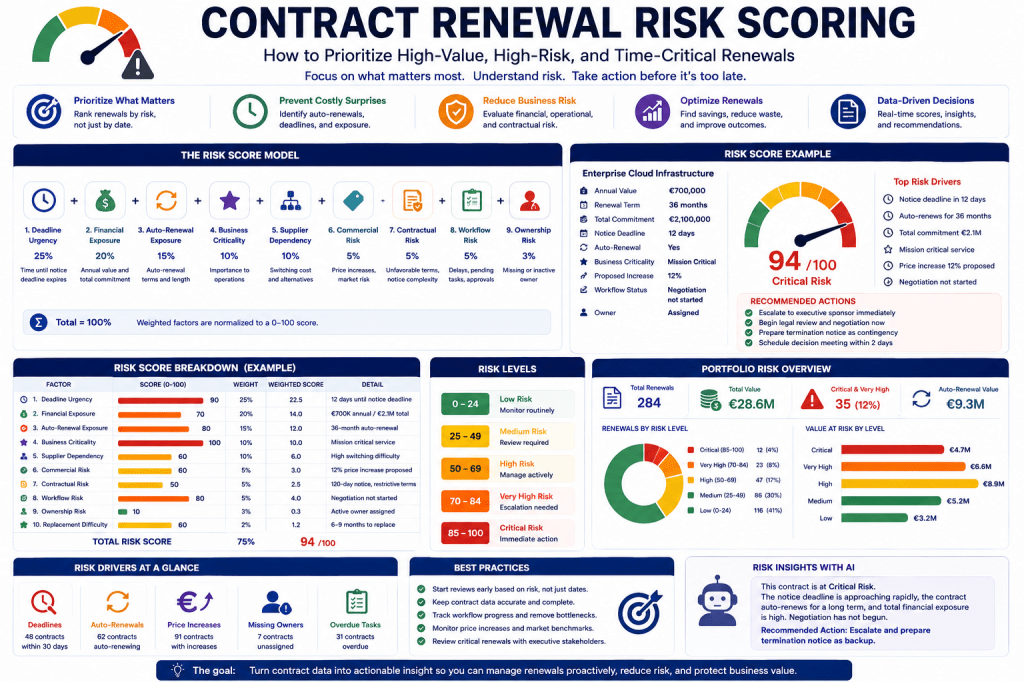
By combining deadline urgency, financial exposure, auto-renewal terms, business criticality, supplier dependency, workflow status, price increases, ownership, and other factors, the system can calculate a dynamic risk score for every approaching renewal.
Instead of managing contracts chronologically, organizations can manage them according to business risk and urgency.
What Is a Contract Renewal Risk Score?
A Contract Renewal Risk Score is a numerical or categorical measure representing the relative risk associated with an upcoming contract renewal.
For example:
Contract A
Risk Score: 18/100
Risk Level: Low
Contract B
Risk Score: 67/100
Risk Level: High
Contract C
Risk Score: 94/100
Risk Level: Critical
The score allows hundreds or thousands of contracts to be ranked automatically.
The renewal team can then focus on the contracts where delay or inaction could have the greatest consequences.
Why Renewal Date Alone Is Not Enough
Imagine three contracts.
| Contract | Annual Value | Notice Deadline | Auto-Renewal |
|---|---|---|---|
| Design Tool | €2,400 | 10 days | Yes |
| Analytics Platform | €180,000 | 45 days | Yes |
| Cloud Infrastructure | €1.4M | 90 days | Yes |
If contracts are ranked purely by deadline, the €2,400 design tool appears first.
But the cloud infrastructure agreement may represent a much larger business exposure.
Perhaps it:
- renews for three years;
- has a 12% price increase;
- supports critical production systems;
- requires six months to replace.
Its real risk may be substantially higher despite the longer deadline.
Renewal prioritization therefore needs multiple dimensions.
The Core Risk Dimensions
A practical renewal risk model can evaluate several major dimensions:
- Deadline Urgency
- Financial Exposure
- Auto-Renewal Exposure
- Business Criticality
- Supplier Dependency
- Commercial Risk
- Contractual Risk
- Workflow Risk
- Ownership Risk
- Replacement Difficulty
Each dimension contributes to the final score.
1. Deadline Urgency
Time is one of the strongest risk factors.
A contract with 180 days remaining is generally less urgent than one with seven days remaining.
A simple urgency model could be:
| Days Until Notice Deadline | Score |
|---|---|
| 180+ days | 0 |
| 91–180 days | 10 |
| 61–90 days | 25 |
| 31–60 days | 50 |
| 15–30 days | 70 |
| 8–14 days | 85 |
| 0–7 days | 100 |
| Deadline Passed | 100 |
But urgency alone should not determine overall risk.
It becomes one component of the total model.
2. Financial Exposure
Contract value is another obvious factor.
A simple scoring model might use:
| Annual Value | Financial Risk |
|---|---|
| Under €5K | 5 |
| €5K–€25K | 15 |
| €25K–€100K | 30 |
| €100K–€250K | 50 |
| €250K–€500K | 70 |
| €500K–€1M | 85 |
| Above €1M | 100 |
However, annual value is not always the best measure.
The tracker should also consider total renewal commitment.
Total Renewal Commitment
Suppose:
Annual contract value:
€700,000
Automatic renewal term:
36 months
The organization could become committed to:
€2.1 million
if the renewal occurs.
Therefore:
Renewal Commitment Exposure = Recurring Cost × Renewal Term
Additional fees can also be included.
For example:
Three-year subscription:
€2.1M
Implementation:
€150K
Mandatory support:
€90K
Total commitment:
€2.34M
This provides a more realistic financial risk measure.
3. Auto-Renewal Exposure
Auto-renewal increases risk because inaction can itself create a contractual outcome.
A simple factor might be:
No Auto-Renewal: 0
Auto-Renewal — Monthly: 10
Auto-Renewal — 12 Months: 40
Auto-Renewal — 24 Months: 70
Auto-Renewal — 36+ Months: 100
The score could increase further as the notice deadline approaches.
Auto-Renewal Risk Is Multiplicative
Consider:
Annual value:
€800,000
Renewal term:
36 months
Notice deadline:
12 days
Decision:
Not recorded
The combined situation is much more dangerous than any factor individually.
The system should recognize this interaction.
For example:
Critical Risk: Missing the notice deadline could create approximately €2.4M of additional contractual commitment.
This is more useful than simply displaying three separate metrics.
4. Business Criticality
Financial value does not always equal operational importance.
A relatively inexpensive service may still be critical.
Examples include:
- DNS provider;
- identity provider;
- cybersecurity monitoring;
- payroll system;
- backup platform;
- payment processing;
- domain registration;
- emergency communications.
The tracker could classify contracts as:
Low
Moderate
Important
Business Critical
Mission Critical
A mission-critical contract receives a higher risk score even if its financial value is relatively modest.
5. Supplier Dependency
How dependent is the organization on the supplier?
Factors might include:
- switching difficulty;
- proprietary technology;
- data lock-in;
- integration complexity;
- specialist knowledge;
- supplier concentration;
- availability of alternatives.
For example:
Low Dependency
Multiple equivalent suppliers.
Easy migration.
Low switching cost.
High Dependency
Proprietary platform.
Extensive integrations.
Large migration effort.
Few realistic alternatives.
Higher dependency increases renewal risk.
6. Commercial Risk
Commercial terms can create additional renewal pressure.
Factors include:
- proposed price increase;
- unfavorable renewal pricing;
- minimum commitments;
- usage growth;
- volume commitments;
- currency exposure.
Suppose the supplier proposes:
Current annual cost:
€400,000
Renewal price:
€468,000
Increase:
17%
That should increase the risk score.
A configurable model might treat:
| Price Increase | Risk |
|---|---|
| 0–3% | Low |
| 3–5% | Moderate |
| 5–10% | High |
| 10–20% | Very High |
| Above 20% | Critical |
7. Contractual Risk
Certain contract terms make renewals more sensitive.
Examples include:
- long notice periods;
- restrictive termination rights;
- automatic price increases;
- long renewal periods;
- minimum purchase obligations;
- exclusivity;
- limited termination for convenience;
- unfavorable liability provisions.
A contract containing several restrictive provisions should receive additional risk weight.
Notice Complexity
Even the termination process itself can create risk.
Compare:
Contract A
30-day notice.
Cancellation through online portal.
Contract B
120-day notice.
Signed written notice.
Registered mail.
Specific legal address.
Receipt required before deadline.
Contract B has greater execution risk.
The scoring engine should recognize this.
8. Workflow Risk
A contract may have favorable terms and plenty of time but still become risky if the renewal workflow is stalled.
Possible warning signals include:
- overdue tasks;
- incomplete business review;
- negotiation not started;
- legal review pending;
- approval delayed;
- termination notice not prepared.
Workflow risk should increase as delays accumulate.
Example Workflow Risk
Notice deadline:
28 days
Renewal decision:
Renegotiate
Supplier contacted:
No
Legal review:
Not started
Finance approval:
Not started
The system could increase the score substantially.
The problem is not merely the deadline.
It is the amount of unfinished work relative to the time remaining.
9. Ownership Risk
A renewal without a responsible owner is inherently risky.
Possible ownership states include:
Active Owner Assigned
Low risk.
Owner Assigned but Inactive
Medium risk.
Owner Leaving Organization
High risk.
No Owner Assigned
Critical.
A simple rule might be:
Any auto-renewing contract without an active owner receives a minimum High risk rating.
This prevents orphaned contracts from disappearing.
10. Replacement Difficulty
If the organization chooses not to renew, how long would replacement take?
For example:
Design Application
Replacement lead time:
2 weeks.
Payroll Platform
Replacement lead time:
6 months.
ERP Platform
Replacement lead time:
18 months.
The ERP renewal should be reviewed much earlier.
Replacement difficulty can therefore influence both:
- risk score;
- workflow start date.
Building a Weighted Risk Formula
The Contract Renewal Tracker can combine these dimensions using weights.
For example:
Renewal Risk Score =
25% Deadline Urgency
- 20% Financial Exposure
- 15% Auto-Renewal Exposure
- 10% Business Criticality
- 10% Supplier Dependency
- 5% Commercial Risk
- 5% Contractual Risk
- 5% Workflow Risk
- 3% Ownership Risk
- 2% Replacement Difficulty
The result is normalized to:
0–100
These weights are only an example.
Different organizations should configure them according to their priorities.
Example Risk Calculation
Consider:
Contract
Enterprise Analytics Platform
Annual Value
€420,000
Notice Deadline
22 days
Auto-Renewal
Yes
Renewal Term
24 months
Business Criticality
High
Supplier Dependency
Medium
Price Increase
8%
Workflow
Negotiation not started
Owner
Assigned
Suppose the normalized factor scores are:
Deadline Urgency:
80
Financial Exposure:
70
Auto-Renewal:
70
Business Criticality:
80
Supplier Dependency:
50
Commercial Risk:
60
Contractual Risk:
40
Workflow Risk:
80
Ownership Risk:
10
Replacement Difficulty:
50
Applying the weighted model could produce approximately:
Renewal Risk Score: 69/100
Classification:
High Risk
The system can then explain why.
Explainable Risk Scoring
A score without explanation is not enough.
If a dashboard displays:
Risk Score: 87
the user should be able to ask:
Why?
The tracker might respond:
Why This Renewal Is Critical
- Notice deadline is 9 days away.
- Contract automatically renews for 24 months.
- Total renewal commitment is €1.6M.
- Supplier proposes an 11% price increase.
- Negotiation has not been completed.
- Finance approval remains pending.
This makes the score actionable.
Positive Factors Can Reduce Risk
Risk models should not only add penalties.
Some factors can reduce risk.
For example:
- renewal decision completed;
- supplier terms agreed;
- legal review approved;
- notice already prepared;
- replacement plan ready;
- owner actively managing renewal.
Suppose a contract has only 10 days remaining but:
- decision is Terminate;
- notice has been approved;
- registered mail has already been dispatched;
- delivery tracking confirms arrival tomorrow.
The deadline is close, but operational risk may actually be low.
A dynamic model should recognize progress.
Risk Categories
A simple classification might be:
0–24 — Low
Routine monitoring.
25–49 — Medium
Review required.
50–69 — High
Active management required.
70–84 — Very High
Escalation required.
85–100 — Critical
Immediate intervention required.
Color coding can help users scan dashboards quickly.
Risk Should Be Recalculated Continuously
Renewal risk changes over time.
A contract might begin:
120 days remaining
Risk Score:
32 — Medium
Thirty days later:
90 days remaining
Supplier announces 12% price increase.
Risk Score:
51 — High
Later:
30 days remaining
Negotiation unresolved.
Risk Score:
76 — Very High
Finally:
10 days remaining
Executive approval pending.
Risk Score:
91 — Critical
The tracker should recalculate automatically whenever relevant information changes.
Event-Driven Risk Recalculation
Risk can be recalculated when events occur.
For example:
- contract uploaded;
- clause verified;
- deadline changes;
- owner changes;
- supplier proposal received;
- price changes;
- decision recorded;
- task becomes overdue;
- legal review completed;
- approval granted;
- notice submitted.
This keeps the score synchronized with reality.
Risk Velocity
An advanced metric is Risk Velocity.
This measures how quickly risk is increasing.
For example:
Monday:
Risk Score 52.
Friday:
Risk Score 68.
Risk increase:
+16 points in four days
The contract may deserve attention even if it has not yet reached the Critical threshold.
Rapidly deteriorating renewals can be surfaced proactively.
Predicted Deadline Risk
Historical workflow data can also be used to estimate whether a renewal is likely to finish on time.
Suppose:
Time remaining:
24 business days
Remaining workflow:
- negotiation;
- legal review;
- finance approval;
- executive approval.
Historical average completion time for similar contracts:
31 business days
The tracker could warn:
Based on similar renewals, the remaining workflow is likely to exceed the available time.
This is more valuable than waiting until the deadline is almost missed.
Risk and Priority Are Related but Different
A contract can have high risk but relatively low business priority—or high priority without immediate risk.
For example:
A €5 million contract expiring next year may have:
Current Risk: Medium
but:
Strategic Priority: Very High
The system should therefore distinguish:
Risk
How likely or severe is an adverse outcome?
from:
Priority
How much organizational attention should this contract receive?
Combining the two creates better work queues.
Renewal Priority Score
A separate priority score could include:
- renewal risk;
- financial value;
- strategic importance;
- savings opportunity;
- deadline urgency.
For example:
Priority Score =
50% Risk
- 20% Financial Impact
- 15% Strategic Importance
- 15% Savings Opportunity
This identifies where procurement resources may create the most value.
Savings Opportunity as a Priority Factor
Not all high-priority renewals are dangerous.
Some are opportunities.
Suppose:
Annual value:
€900,000.
License utilization:
62%.
Renewal deadline:
120 days.
Risk:
Medium.
Potential savings:
€200,000.
The system might classify:
Risk: Medium
Opportunity: High
Overall Priority: High
This ensures cost optimization opportunities receive attention.
Renewal Risk Dashboard
A portfolio dashboard could display:
Portfolio Risk
Active renewals:
284
Critical:
12
Very High:
23
High:
47
Medium:
86
Low:
116
Financial Exposure
Value in Critical Risk:
€4.7M
Value in High/Very High:
€11.3M
Total renewal value:
€28.6M
Auto-Renewal Exposure
Critical auto-renewals:
8
Value:
€3.9M
Workflow Risk
Overdue renewals:
31
Unassigned renewals:
7
Approvals at risk:
14
This provides management with a portfolio-level view.
Risk Heatmap
A useful visualization combines:
Financial Value
and:
Deadline Urgency
For example:
| Low Value | Medium Value | High Value | |
|---|---|---|---|
| 90+ Days | Low | Low | Medium |
| 31–90 Days | Low | Medium | High |
| 0–30 Days | Medium | High | Critical |
Contracts in the upper-risk zone receive immediate attention.
Additional dimensions can then adjust the score.
Supplier Risk Concentration
The tracker can also aggregate renewal risk by supplier.
For example:
ExampleCloud
Active contracts:
8
Annual value:
€3.2M
Upcoming renewals:
4
Critical renewals:
2
Total risk exposure:
€2.1M
This can reveal excessive dependency on a single supplier.
Department Risk
Risk can also be grouped by business unit.
For example:
IT
Critical renewals:
9
Value:
€5.4M
Marketing
Critical renewals:
2
Value:
€310K
HR
Critical renewals:
1
Value:
€180K
Management can identify departments needing additional support.
Risk Alerts
Instead of sending reminders for every contract, the system can generate exception-based alerts.
For example:
Risk Increased: Medium → High
Cybersecurity Platform
Notice deadline: 37 days
Supplier proposed 14% price increase.
Renewal decision remains pending.
Or:
Critical Renewal
Cloud Infrastructure
€2.4M renewal commitment
8 days until notice deadline
Executive approval pending.
These alerts are far more actionable than generic notifications.
Risk Escalation Rules
Rules can automatically escalate high-risk renewals.
For example:
Risk Score 50+
Notify renewal owner.
Risk Score 70+
Notify owner + manager + procurement.
Risk Score 85+
Notify executive sponsor.
Risk Score 95+
Immediate critical escalation.
The system can also create tasks automatically.
Risk Override
Automated scoring should not prevent human judgment.
An authorized user may know information the model does not.
For example:
Supplier has verbally agreed to extend the deadline by 30 days.
The user might temporarily reduce urgency.
However, overrides should require:
- reason;
- user identity;
- timestamp;
- expiration date;
- supporting evidence where appropriate.
The original calculated score should remain visible.
Avoiding False Precision
A risk score such as:
73.42
may appear scientifically precise even when some underlying inputs are subjective.
For most operational use cases:
73 — Very High
is sufficient.
More important than decimal precision is explaining:
- what factors contributed;
- which data is verified;
- which assumptions were used;
- what action is recommended.
Data Confidence Should Influence Risk
Suppose the system cannot determine whether a contract automatically renews.
That uncertainty itself is a risk.
The tracker might show:
Auto-Renewal: Unknown
Notice Period: Unverified
Deadline Confidence: Low
The risk model can add an Information Risk factor.
Missing critical contract data should not be interpreted as zero risk.
Missing Data Risk
Examples include:
- missing end date;
- unknown notice period;
- unknown auto-renewal status;
- missing contract value;
- no owner;
- unsigned amendment;
- conflicting contract documents.
A contract with incomplete renewal data should be flagged for verification.
AI-Assisted Risk Analysis
AI can help interpret structured and unstructured contract information.
For example:
AI Risk Summary
Risk Level: Critical
Primary factors:
- Notice deadline is 11 days away.
- Contract automatically renews for three years.
- Total renewal commitment is approximately €2.7M.
- Supplier proposed a 9% price increase.
- Business owner has not recorded a renewal decision.
- Legal review has not started.
Recommended Next Actions:
- escalate to renewal owner;
- begin legal review immediately;
- prepare non-renewal notice as contingency;
- schedule executive decision.
This turns risk scoring into decision support.
Explainable Recommendations
If the system recommends:
Prepare termination notice
it should explain why.
For example:
Negotiation remains unresolved and only 12 days remain before the notice deadline. Preparing notice preserves the organization’s ability to terminate while negotiations continue.
This is much more useful than an unexplained automated recommendation.
Risk Scoring Governance
The scoring model itself should be governed.
Organizations should define:
- scoring factors;
- weights;
- thresholds;
- calculation rules;
- override permissions;
- review frequency.
Changes to the model should be versioned.
For example:
Risk Model Version: 2.3
Effective date:
January 1.
This allows historical scores to be interpreted correctly.
Different Contract Categories May Need Different Models
A software subscription and a property lease may have very different risk characteristics.
For example:
SaaS Risk Model
Higher weight on:
- utilization;
- auto-renewal;
- price increase;
- license quantities.
Property Lease Risk Model
Higher weight on:
- replacement lead time;
- notice period;
- operational location dependency;
- long-term commitment.
Outsourcing Risk Model
Higher weight on:
- supplier dependency;
- service continuity;
- transition complexity;
- business criticality.
The Contract Renewal Tracker can select the appropriate model automatically.
Risk History
The system should preserve previous scores.
For example:
| Date | Score | Level |
|---|---|---|
| June 1 | 31 | Medium |
| July 1 | 42 | Medium |
| July 20 | 58 | High |
| August 1 | 73 | Very High |
| August 10 | 91 | Critical |
This provides a risk trajectory.
Users can see when and why the renewal deteriorated.
Risk After Completion
Risk scoring can also evaluate the outcome.
For example:
Renewal completed:
Yes.
New expiration captured:
Yes.
Notice period verified:
Yes.
Contract owner assigned:
Yes.
Next renewal workflow scheduled:
Yes.
Residual renewal risk:
Low
The cycle then begins again.
Measuring Risk Management Performance
Useful metrics include:
Critical Renewals Avoided
How many contracts were resolved before missing deadlines?
Risk Resolution Time
How quickly do High or Critical renewals return to acceptable levels?
Missed Deadline Rate
What percentage of renewals miss contractual deadlines?
Unassigned Contract Rate
How many contracts lack owners?
Unverified Renewal Data
How many contracts have uncertain renewal terms?
Value at Risk
How much financial commitment is associated with High and Critical renewals?
These metrics measure the effectiveness of the renewal operation.
Example Portfolio Prioritization
Suppose the tracker contains five contracts.
| Contract | Score | Risk | Value |
|---|---|---|---|
| Cloud Infrastructure | 94 | Critical | €1.8M |
| Cybersecurity Platform | 82 | Very High | €420K |
| ERP Support | 67 | High | €600K |
| Marketing Platform | 39 | Medium | €85K |
| Design Tool | 21 | Low | €4K |
The work queue becomes obvious.
The team starts with:
Cloud Infrastructure
not simply whichever contract appears first alphabetically or has the nearest expiration date.
From Risk Scoring to Renewal Intelligence
Risk scoring becomes even more valuable when combined with the other capabilities of the Contract Renewal Tracker.
The system already knows:
- contract terms;
- notice deadlines;
- renewal dates;
- workflow status;
- approval status;
- supplier information;
- pricing;
- usage;
- contract ownership.
The risk engine brings these signals together.
The architecture becomes:
Contract Data
Renewal Clauses
Deadlines
Financial Exposure
Workflow Progress
Supplier and Usage Data
↓
Risk Engine
↓
Priority Score
↓
Recommended Action
↓
Escalation
This becomes the intelligence layer of renewal management.
Final Thoughts
Organizations rarely fail at contract renewal because every contract is equally difficult.
They fail because the important contracts are not distinguished from the routine ones early enough.
A Contract Renewal Risk Score solves that prioritization problem.
Instead of asking:
Which contract expires next?
the organization can ask:
Which contract creates the greatest risk if we do nothing today?
That is a much more powerful question.
A strong risk model combines:
Time + Money + Contract Terms + Business Importance + Supplier Dependency + Workflow Progress + Ownership + Uncertainty
The result should not merely be a number.
It should produce:
Risk → Explanation → Priority → Recommended Action → Escalation
When implemented properly, contract renewal risk scoring turns a large contract portfolio into an ordered, actionable work queue.
Teams know where to focus.
Managers know where exposure exists.
Executives know which decisions require intervention.
And the Contract Renewal Tracker moves another step beyond simple deadline management toward genuine renewal intelligence.
Next Article in the Contract Renewal Tracker Series
The next article will connect renewal management directly to financial value. It will cover license utilization, unused subscriptions, duplicate tools, supplier consolidation, price increases, benchmark pricing, negotiation targets, avoided spend, negotiated savings, multi-year commitments, renewal opportunity scoring, and AI-assisted cost optimization—showing how the Contract Renewal Tracker can evolve from a defensive deadline tool into a platform that actively reduces contract spend.

