A contract can be reviewed, negotiated, and ready for renewal—and still miss its deadline because the approval process takes too long.
Perhaps the department manager has not responded.
Finance is waiting for budget confirmation.
Legal has approved the contract but procurement has not.
The executive who must authorize the commitment is traveling.
Or nobody is entirely certain who actually has authority to approve the renewal.
These are not unusual exceptions. They are common weaknesses in contract renewal management.
A Contract Renewal Tracker should therefore do more than identify upcoming contracts and create reminders. It should understand the organization’s approval rules and automatically route each renewal through the correct decision-makers.
The objective is straightforward:
Every renewal should reach the right approver, at the right time, with the right information, before the contractual deadline.
This article explains how to design contract renewal approval workflows using financial thresholds, approval matrices, conditional routing, parallel approvals, escalation rules, delegation, separation of duties, and complete audit trails.
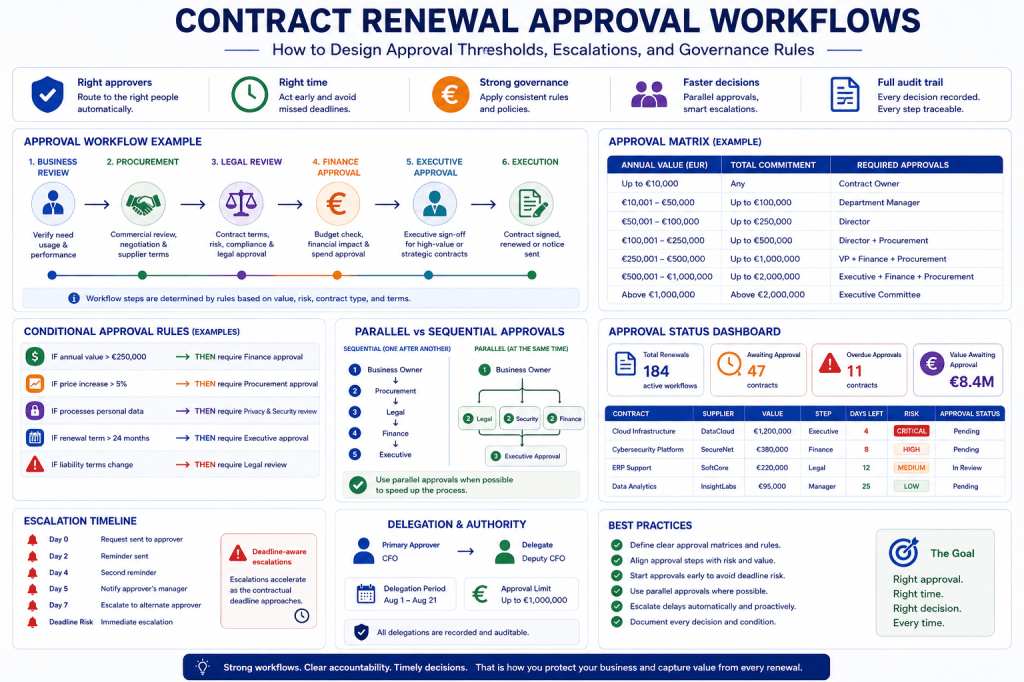
Why Contract Renewal Approvals Become Bottlenecks
Consider a €480,000 software agreement.
The procurement team completes negotiations 30 days before the contractual notice deadline.
The supplier has agreed to improved pricing.
Legal has reviewed the amendment.
Everything appears ready.
But the renewal requires:
- business owner approval;
- procurement approval;
- finance approval;
- CIO approval.
If those approvals happen sequentially and each person takes several days to respond, the remaining 30-day buffer can disappear quickly.
The problem is not the contract.
The problem is the approval architecture.
A Contract Renewal Tracker should therefore calculate approval requirements early rather than discovering them at the end of negotiations.
What Is a Contract Renewal Approval Workflow?
A contract renewal approval workflow defines:
- who must approve a renewal;
- when approval is required;
- what information approvers receive;
- in which order approvals occur;
- which conditions trigger additional approvals;
- what happens when an approver does not respond;
- who can act as a delegate;
- how decisions are recorded.
A simple workflow might be:
Contract Owner
↓
Department Manager
↓
Finance
↓
Approved
A strategic agreement might require:
Business Owner
↓
Procurement + Legal + Security
↓
Finance
↓
CFO
↓
Executive Sponsor
↓
Final Approval
The workflow should reflect the organization’s governance model.
Approval Rules Should Be Defined Before Renewal Starts
A common mistake is determining approval requirements only after negotiations finish.
A better approach is to identify the required approval path when the renewal workflow is created.
Suppose the system knows:
Annual Contract Value: €650,000
Renewal Term: 36 months
Total Commitment: €1.95 million
Contract Category: Cloud Infrastructure
Personal Data: Yes
Auto-Renewal: Yes
The tracker can immediately determine:
- procurement review required;
- finance approval required;
- legal review required;
- privacy review required;
- information security review required;
- executive approval required.
Everyone knows the governance requirements months before the deadline.
Start with an Approval Matrix
The foundation of automated approval routing is an approval matrix.
For example:
| Annual Contract Value | Required Approval |
|---|---|
| Up to €10,000 | Contract Owner |
| €10,001–€50,000 | Department Manager |
| €50,001–€100,000 | Director |
| €100,001–€250,000 | Director + Procurement |
| €250,001–€500,000 | VP + Procurement + Finance |
| €500,001–€1M | Executive + Finance + Procurement |
| Above €1M | Executive Committee |
This provides a starting point.
But contract value should not be the only factor.
Annual Value vs Total Contract Commitment
Approval rules should distinguish between annual cost and total commitment.
Consider:
Annual Value: €400,000
Renewal Term: 5 years
Total contractual commitment:
€2 million
If the approval matrix considers only annual value, the contract may receive insufficient scrutiny.
A better metric is:
Total Renewal Commitment = Recurring Value × Renewal Term + One-Time Costs
For example:
Annual recurring cost:
€400,000
Five-year term:
€2,000,000
Implementation services:
€150,000
Total renewal commitment:
€2.15 million
Approval routing should be based on the organization’s financial governance rules, which may consider both annual and total values.
Different Decisions May Require Different Approvals
Renewing is not the only possible outcome.
A contract may be:
- renewed;
- renegotiated;
- terminated;
- replaced;
- extended;
- consolidated.
Each decision can have different approval requirements.
For example:
Renew Under Existing Terms
Department manager + finance.
Renew with Price Increase Above 10%
Procurement + finance + executive approval.
Terminate Business-Critical Supplier
Business executive + procurement + operations.
Replace Supplier
Procurement + security + legal + business owner.
Temporary Extension
Procurement + legal + finance.
The workflow should therefore react to the renewal decision.
Conditional Approval Routing
Rules can determine which approvals are required.
For example:
IF contract value > €250,000
THEN require finance approval.
IF price increase > 5%
THEN require procurement approval.
IF personal data = Yes
THEN require privacy review.
IF critical infrastructure = Yes
THEN require information security approval.
IF liability clause changed
THEN require legal approval.
IF renewal term > 24 months
THEN require executive approval.
IF non-standard contract terms = Yes
THEN require legal review.
This makes the approval process dynamic.
Approval Workflows Should Be Risk-Based
A €5,000 low-risk SaaS renewal should not require the same governance process as a €5 million outsourcing contract.
Overly complex approval processes create unnecessary administrative work.
Too little governance creates financial and contractual risk.
The objective is proportionality.
A Contract Renewal Tracker might classify approvals as:
Lightweight
Low-value, low-risk contracts.
Standard
Normal operational contracts.
Enhanced
Higher-value or higher-risk agreements.
Strategic
Major business-critical commitments.
The workflow template is selected automatically.
Example: Lightweight Renewal Approval
Contract:
Design software subscription.
Annual value:
€3,600
Renewal term:
12 months.
Risk:
Low.
Workflow:
Contract Owner Review
↓
Manager Approval
↓
Renew
This could be completed in minutes.
Example: Strategic Renewal Approval
Contract:
Enterprise Cloud Infrastructure.
Annual value:
€1.8 million
Renewal term:
36 months.
Total commitment:
€5.4 million
Business criticality:
Critical.
Personal data:
Yes.
Workflow:
Business Review
↓
Procurement Review
↓
Legal + Security + Privacy Reviews
↓
Finance Approval
↓
CIO Approval
↓
CFO Approval
↓
Executive Approval
↓
Execution
The same system handles both cases, but the governance is proportional to risk.
Sequential Approvals
In a sequential workflow, approvals happen one after another.
For example:
Business Owner
↓
Procurement
↓
Finance
↓
Executive
This is useful when each approval depends on the previous decision.
However, sequential workflows can become slow.
If each approval takes three business days, four approvals may require 12 business days or more.
That can become dangerous near a renewal deadline.
Parallel Approvals
Some approvals can occur simultaneously.
For example:
After commercial terms are agreed:
Legal Review
Security Review
Privacy Review
Finance Review
can all begin together.
Once all required approvals are complete:
↓
Executive Approval
Parallel processing can dramatically reduce cycle time.
A capable workflow engine should therefore support both parallel and sequential approval structures.
Approval Dependencies
Some approvals should not begin until prerequisites are complete.
For example:
Finance may require final pricing.
Legal may require the supplier’s final contract.
Executive approval may require both finance and legal clearance.
The workflow can model dependencies.
For example:
Negotiation Complete
↓
Legal Review + Finance Review
↓
Both Approved
↓
Executive Approval
↓
Signature
This prevents approvals based on incomplete information.
What Should an Approver See?
An approver should not have to read a 70-page agreement merely to understand what decision is being requested.
The Contract Renewal Tracker should provide an approval summary.
For example:
Renewal Approval Request
Supplier: ExampleCloud
Contract: Enterprise Infrastructure Agreement
Current Annual Cost: €620,000
Proposed Annual Cost: €590,000
Savings: €30,000
Renewal Term: 24 months
Total Commitment: €1.18M
Auto-Renewal: Yes
Notice Deadline: 42 days
Business Recommendation: Renew
Procurement: Approved
Legal: Approved with minor changes
Security: Approved
Risk: Medium
Decision
Approve
Reject
Request Changes
This gives the approver decision-ready information.
AI-Generated Approval Briefs
AI can make this process even more efficient.
For example:
AI Renewal Brief
The proposed renewal reduces annual cost from €620,000 to €590,000, producing €60,000 of savings over the proposed two-year term.
Service utilization remains high at 91%.
Supplier SLA performance averaged 99.94%.
Legal has approved the revised liability terms.
Procurement recommends renewal.
The termination notice deadline occurs in 42 days.
Primary Consideration: The agreement includes a two-year commitment with limited early termination rights.
An executive can understand the essential decision quickly.
Approval Decisions Need More Than Approve or Reject
Useful decision options include:
- Approve
- Reject
- Request Changes
- Approve with Conditions
- Delegate
- Return to Procurement
- Request Legal Review
- Request Additional Information
For example:
Approve provided renewal term is reduced from 36 months to 24 months.
That condition should become part of the workflow rather than disappearing into an email.
Conditional Approval
Suppose the CFO approves a renewal subject to:
Annual cost must not exceed €450,000.
The workflow can store:
Approval Status: Conditional
Condition: Maximum annual value €450,000
If negotiations later produce:
€470,000
the previous approval should no longer be considered sufficient.
The workflow may automatically require reapproval.
Material Changes Should Trigger Reapproval
This is an important governance rule.
Suppose a contract was approved based on:
Annual cost:
€300,000.
Term:
12 months.
After approval, the supplier changes the proposal to:
Annual cost:
€325,000.
Term:
36 months.
The approved business case has materially changed.
The Contract Renewal Tracker should detect this and reopen the approval workflow.
Possible triggers include:
- price increase beyond tolerance;
- longer contract term;
- changed liability;
- changed termination rights;
- changed scope;
- changed data processing;
- new auto-renewal terms.
This prevents stale approvals from authorizing materially different contracts.
Separation of Duties
Good governance may require different people to perform different actions.
For example, the person negotiating the contract should not necessarily be the only person approving it.
A separation-of-duties rule might require:
Contract Owner ≠ Final Approver
or:
Requester ≠ Financial Approver
or:
Procurement Negotiator ≠ Executive Approver
The Contract Renewal Tracker can enforce these rules automatically.
Self-Approval Prevention
Suppose a department manager creates a renewal request worth €180,000.
If the manager also happens to hold an approval role, the system should determine whether self-approval is allowed.
A policy might state:
Users may not approve renewal requests they initiated above €25,000.
The workflow automatically routes the request to the next authorized approver.
Delegation
Approvers are not always available.
They may be:
- on vacation;
- traveling;
- ill;
- changing roles;
- temporarily unavailable.
A workflow should support controlled delegation.
For example:
Primary Approver: CFO
Delegate: Deputy CFO
Delegation Period: August 1–August 21
Approval Limit: €1 million
The system can automatically route qualifying approvals to the delegate.
Delegation Must Be Auditable
Delegation should never obscure accountability.
The audit trail might show:
Approval originally assigned to CFO.
Delegation rule active.
Routed to Deputy CFO.
Deputy CFO approved August 12 at 14:32.
That preserves governance transparency.
Approval Authority Limits
Delegates may have lower authority limits.
For example:
CFO:
Up to €5 million.
Deputy CFO:
Up to €1 million.
A €2 million renewal should therefore not automatically route to the deputy.
The workflow may escalate to another authorized executive.
Deadline-Aware Approval Routing
Approval urgency should depend on the contractual deadline.
Suppose two approval requests are waiting.
Contract A
Value:
€200,000
Notice deadline:
75 days.
Contract B
Value:
€180,000
Notice deadline:
6 days.
Contract B should appear first.
The Contract Renewal Tracker can prioritize approvals using:
Deadline Urgency + Financial Exposure + Business Criticality + Renewal Risk
This creates a risk-based approval queue.
Approval Escalations
Approvers sometimes do not respond.
The system needs escalation rules.
For example:
Day 0
Approval request sent.
Day 2
Reminder.
Day 4
Second reminder.
Day 5
Notify approver’s manager.
Day 7
Escalate to alternate approver.
Deadline Risk Threshold
Immediate escalation.
Escalation should become more aggressive as the contractual deadline approaches.
Dynamic Escalation
A fixed seven-day escalation may be acceptable when the notice deadline is 90 days away.
It is unacceptable when the deadline is tomorrow.
Therefore:
If deadline > 60 days
Normal escalation.
If deadline 30–60 days
Accelerated escalation.
If deadline 7–30 days
High-priority escalation.
If deadline < 7 days
Critical escalation.
The workflow should adapt automatically.
Approval SLA
Organizations can establish approval service-level targets.
For example:
Manager approval:
2 business days
Procurement approval:
3 business days
Legal approval:
5 business days
Finance approval:
3 business days
Executive approval:
5 business days
The system can measure performance against these targets.
Approval Bottleneck Analytics
Over time, the tracker can calculate:
Average Approval Time
Median Approval Time
Overdue Approval Rate
Approvals by Department
Approvals Escalated
Approval Rejection Rate
Average Rework Cycles
For example:
| Approval Type | Average Time |
|---|---|
| Business | 1.8 days |
| Procurement | 3.2 days |
| Finance | 4.7 days |
| Legal | 8.9 days |
| Executive | 6.4 days |
This reveals where renewal workflows slow down.
Approval Heatmaps
The system could identify periods where approval workload becomes concentrated.
For example:
September:
34 approvals
October:
87 approvals
November:
29 approvals
If October contains a major renewal peak, managers can prepare in advance.
This connects renewal forecasting with operational capacity planning.
Approval by Exception
Not every renewal needs manual approval at every level.
For low-risk contracts, organizations may choose policy-based approval.
For example:
IF:
- annual value < €5,000;
- price increase < 3%;
- same supplier;
- same scope;
- same contract terms;
- business owner confirms continued need;
THEN:
Use simplified approval workflow.
This reduces unnecessary administrative work.
High-risk exceptions receive human attention.
Price Increase Governance
Price increases are a common reason to trigger additional approval.
For example:
Increase Below 3%
Standard approval.
Increase 3–5%
Manager review.
Increase 5–10%
Procurement review required.
Increase Above 10%
Executive approval required.
The thresholds should be configurable.
Non-Standard Terms Governance
Financial value is only one dimension of risk.
A €40,000 contract may still contain significant legal exposure.
Additional approval can be triggered by:
- unlimited liability;
- restrictive termination provisions;
- unusual auto-renewal;
- long notice periods;
- data transfer requirements;
- intellectual property provisions;
- exclusivity;
- minimum purchase commitments.
The approval engine should therefore combine commercial and contractual risk.
Emergency Approval Workflow
Sometimes a renewal reaches a critical deadline before the normal approval chain can finish.
The organization may need an emergency process.
For example:
Notice Deadline: 48 hours
Business-Critical Service: Yes
Normal Approval Incomplete: Yes
The system could activate:
Emergency Renewal Workflow
Possible requirements:
- executive sponsor approval;
- finance confirmation;
- legal risk acknowledgment;
- documented reason for emergency;
- mandatory post-event review.
Emergency workflows should be exceptions, not shortcuts around governance.
Temporary Extension as a Risk-Control Option
When a full renewal cannot be approved in time, a temporary extension may sometimes provide an alternative.
For example:
Extend existing contract for 90 days while negotiations continue.
The tracker can treat this as a separate decision requiring appropriate approval.
This can be preferable to entering an unwanted multi-year renewal merely because time ran out.
Rejection Workflow
What happens when an approver rejects a renewal?
The contract should not simply return to an undefined state.
The workflow might ask for:
Rejection Reason
Examples:
- price too high;
- insufficient business case;
- unacceptable contract terms;
- budget unavailable;
- alternative supplier required;
- security risk;
- incomplete information.
Then route the contract appropriately.
For example:
Rejected — Price
↓
Return to Procurement
↓
Renegotiate
↓
Resubmit for Approval
This creates a controlled feedback loop.
Approval Versioning
Every approval should relate to a specific version of the renewal proposal.
For example:
Proposal Version 3
Annual cost:
€420,000
Term:
24 months
Legal document:
Amendment v3
Approved by Finance:
August 14
If Proposal Version 4 changes the economics, the system can determine whether previous approvals remain valid.
This prevents confusion over what was actually approved.
Electronic Approval Records
The tracker should record:
- approver;
- decision;
- timestamp;
- proposal version;
- comments;
- conditions;
- delegated authority;
- IP/session information where appropriate;
- supporting documents.
This creates a defensible audit trail.
Approval Audit Trail Example
A renewal record might show:
August 3 — 09:14
Business owner approved.
August 4 — 15:37
Procurement approved commercial terms.
August 6 — 11:22
Legal requested changes.
August 8 — 16:05
Supplier Amendment v4 uploaded.
August 9 — 10:41
Legal approved Amendment v4.
August 10 — 14:18
Finance approved €480,000 annual commitment.
August 12 — 08:52
CIO approved.
August 13 — 17:06
Contract signed.
This provides complete decision traceability.
Renewal Approval Dashboard
A dedicated approval dashboard might show:
Approval Queue
Awaiting Approval:
47
Overdue:
11
Critical Deadline:
5
Value Awaiting Approval:
€8.4M
By Approval Type
Business:
9
Procurement:
12
Legal:
8
Finance:
10
Executive:
8
Deadline Risk
Due within 7 days:
6
Due within 30 days:
21
Auto-Renewal Exposure:
€2.7M
This gives managers immediate visibility.
Approver Work Queue
Individual approvers should receive a focused queue.
For example:
Your Renewal Approvals
Critical — Cloud Infrastructure
€1.2M commitment
Notice deadline: 4 days
High — Cybersecurity Platform
€380K commitment
Notice deadline: 18 days
Standard — Analytics Platform
€95K commitment
Notice deadline: 61 days
The most important decisions appear first.
Mobile Approval
Senior managers frequently work away from their desks.
A renewal approval system should therefore make simple decisions possible from mobile devices.
An approver should be able to review:
- contract summary;
- financial impact;
- recommendation;
- risks;
- completed reviews;
- deadline.
Then choose:
Approve
Reject
Request Changes
Complex contracts can still require deeper desktop review.
Notifications Should Contain Context
A notification saying:
Contract approval required.
is not very useful.
A better alert is:
Critical Renewal Approval Required
Supplier: ExampleCloud
Total Commitment: €1.4M
Decision: Renew
Notice Deadline: 6 days
Procurement: Approved
Legal: Approved
Finance: Approved
Your Approval: Pending
This tells the recipient why immediate action matters.
Approval Governance Policies
Organizations can define reusable policies.
For example:
Policy: High-Value Renewal
Condition:
Total commitment > €1M.
Requirements:
- procurement approval;
- finance approval;
- legal review;
- executive approval.
Policy: High Price Increase
Condition:
Increase > 10%.
Requirements:
- procurement negotiation;
- business justification;
- finance approval;
- executive approval.
Policy: Personal Data
Condition:
Supplier processes personal data.
Requirements:
- privacy review;
- security review;
- DPA verification.
Policy: Long-Term Commitment
Condition:
Renewal term >= 36 months.
Requirements:
- strategic business case;
- finance approval;
- executive approval.
The rules engine can apply multiple policies simultaneously.
Governance Without Creating Bureaucracy
Approval systems can become counterproductive if every contract requires excessive review.
The objective should be:
Low risk → fast path
Normal risk → standard path
High risk → enhanced controls
Critical risk → executive governance
This creates scalable contract management.
Automation handles routine routing while people concentrate on material decisions.
Measuring Approval Effectiveness
Useful KPIs include:
Average Approval Cycle Time
How long does approval take?
Approval Before Deadline Rate
What percentage of renewals receive approval before internal deadlines?
Escalation Rate
How often do approvals require escalation?
Rework Rate
How frequently are proposals returned for changes?
Emergency Approval Rate
How often does the organization rely on emergency workflows?
Approval Bottleneck by Function
Which teams create the most delay?
Value Approved
How much contractual commitment passes through the process?
These metrics make governance measurable.
AI Can Identify Approval Risk
AI can help predict when a renewal is likely to miss its approval deadline.
For example:
This renewal requires four remaining approvals. Similar contracts require an average of 17 business days to complete approval. The contractual notice deadline is 14 business days away.
Risk: Critical
Recommended Action:
Begin parallel approvals immediately and notify the executive sponsor.
This shifts the system from reactive escalation toward predictive renewal management.
AI Can Detect Unusual Approvals
The system can also identify anomalies.
For example:
This €1.8M contract was approved without finance review, although similar contracts require finance approval.
or:
Contract term changed from 12 months to 36 months after executive approval.
These alerts strengthen governance.
Human reviewers should remain responsible for determining whether the situation is actually problematic.
From Approval Workflow to Renewal Governance
Once approval rules are structured, the Contract Renewal Tracker can answer strategic questions such as:
How much contractual commitment is currently waiting for approval?
Which renewals are likely to miss deadlines because of approval delays?
Which departments approve contracts fastest?
How many renewals bypassed normal approval procedures?
Which contracts required emergency approvals?
Which executives have the largest approval workload next quarter?
Which approval policies create unnecessary delays?
This turns approval data into operational intelligence.
Recommended Approval Architecture
A practical architecture can be represented as:
Renewal Trigger
↓
Contract Classification
↓
Risk Assessment
↓
Approval Policy Evaluation
↓
Required Approvers Identified
↓
Parallel/Sequential Routing
↓
Decision Capture
↓
Escalation if Required
↓
Final Authorization
↓
Contract Execution
↓
Audit Record
The key is that approval routing is generated from rules rather than improvised for every renewal.
Final Thoughts
A contract renewal is not complete because negotiations are finished.
It is complete when the organization has made an authorized decision and executed it before the relevant deadline.
That requires an approval system that understands:
- financial authority;
- contract risk;
- business criticality;
- approval dependencies;
- delegation;
- separation of duties;
- deadline urgency;
- escalation;
- version control.
A strong Contract Renewal Tracker can automate much of this coordination.
The progression becomes:
Renewal → Risk → Approval Requirements → Routing → Decision → Escalation → Authorization → Execution → Audit
When designed correctly, approval workflows provide two benefits that can otherwise appear contradictory:
stronger governance and faster decisions.
Routine renewals move quickly.
High-risk commitments receive appropriate scrutiny.
And critical contracts do not sit forgotten in someone’s inbox while the renewal deadline approaches.
Next Article in the Contract Renewal Tracker Series
The next article will build the scoring model behind the renewal dashboard. It will cover deadline urgency, annual contract value, total renewal commitment, auto-renewal exposure, business criticality, supplier dependency, notice complexity, price increases, workflow delays, missing ownership, decision status, weighted scoring, explainable risk factors, and dynamic risk recalculation—allowing the Contract Renewal Tracker to determine which contracts require attention first.

