Contract renewal negotiation often begins too late.
A supplier sends:
Here is your renewal proposal.
The internal team checks the price.
Someone asks whether the increase can be reduced.
Procurement gets involved.
A few emails go back and forth.
The supplier offers a discount.
The organization signs.
That process may produce a better price.
But it is not necessarily:
renewal negotiation intelligence.
A stronger approach begins much earlier and combines multiple sources of evidence:
- current contract value;
- supplier opening proposal;
- historical pricing;
- previous negotiation outcomes;
- actual utilization;
- future demand;
- supplier performance;
- market benchmarks;
- alternative suppliers;
- switching costs;
- notice deadlines;
- consolidation opportunities;
- previous concessions.
The objective is to enter the negotiation knowing:
what the organization needs, what leverage it has, what the supplier is likely to ask for, what a good outcome looks like, and how much time remains to pursue alternatives.
That is where Contract Renewal Tracker can eventually evolve from a tracking platform into a genuine renewal negotiation intelligence system.
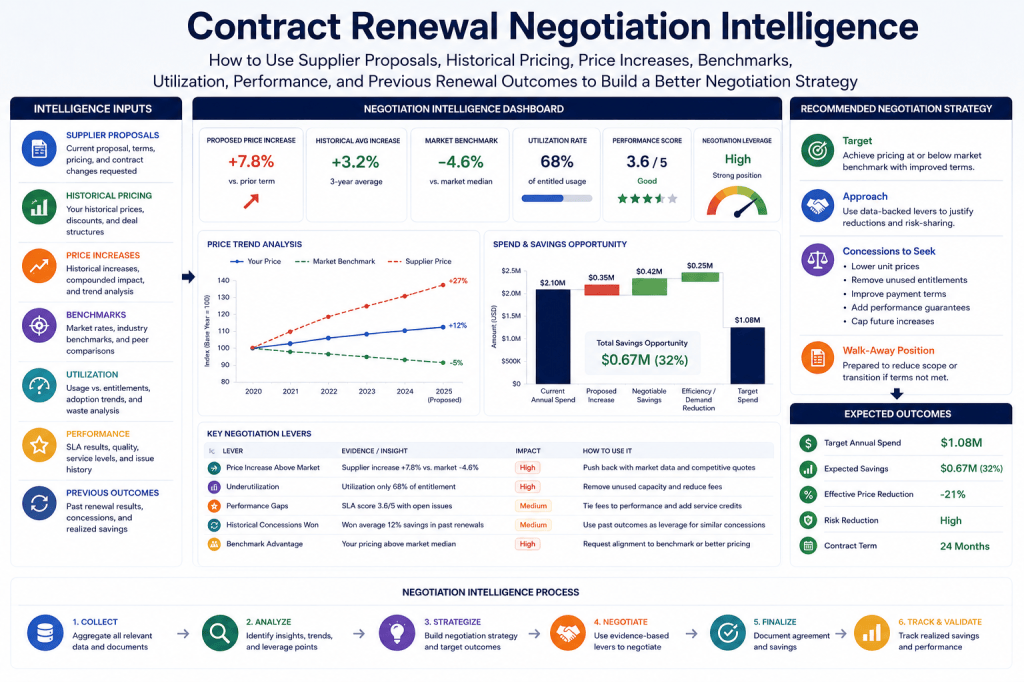
What Is Contract Renewal Negotiation Intelligence?
Contract renewal negotiation intelligence is the structured use of historical, contractual, financial, supplier, and usage data to prepare and manage renewal negotiations.
Instead of approaching the negotiation with:
“The supplier wants 12% more.”
the organization approaches with:
“The supplier wants 12% more, utilization has fallen 18%, performance declined from 86% to 72%, three related contracts renew within six months, our internal benchmark is 9% lower, and the notice deadline is 110 days away.”
That creates:
a completely different negotiation.
Negotiation Intelligence Starts Before the Supplier Proposal
The supplier’s renewal quote should not determine:
when the organization starts thinking.
A mature process begins:
before the supplier contacts you.
For strategic contracts:
perhaps 180 days
or:
365 days
before the notice deadline.
This creates time to:
- review demand;
- compare alternatives;
- establish targets;
- assess switching feasibility;
- consolidate spend;
- develop a BATNA.
Time itself becomes:
negotiating leverage.
The Renewal Negotiation Intelligence Stack
A useful model is:
Contract Terms
Historical Spend
Supplier Proposal
Usage
Performance
Benchmarks
Alternatives
Deadline
Previous Negotiation History
=
Negotiation Strategy
This strategy then drives:
Target
Opening Position
Concessions
Walk-Away Position
Next Best Action
Why Supplier Price Alone Is Insufficient
Suppose:
current contract:
€500,000.
Supplier renewal proposal:
€550,000.
Increase:
10%.
At first glance:
the objective may be to negotiate the increase downward.
But now add:
license utilization:
62%.
Future requirement:
700 rather than 1,000 licenses.
The real question becomes:
not:
Can we get 5% off?
but:
Why are we negotiating pricing for 300 licenses we no longer need?
This is exactly why negotiation intelligence must combine:
price
and:
demand.
Negotiation Principle 1: Determine Demand Before Price
For variable-volume contracts:
always establish:
future requirement
before final price negotiation.
Sequence:
Current Usage
↓
Future Demand
↓
Required Quantity
↓
Commercial Structure
↓
Unit Price
This can produce substantially more value than:
discount negotiation alone.
SaaS Example
Current:
1,000 licenses.
Unit price:
€500.
Annual value:
€500K.
Active users:
Forecast need:
Supplier proposal:
1,000 licenses × €550
=
€550K.
If Procurement negotiates:
10% discount,
the new cost becomes:
€495K.
Looks successful.
But if quantity is first reduced to:
700,
even at €500:
annual value:
€350K.
Demand intelligence changes:
the entire negotiation.
Negotiation Principle 2: Know the Supplier’s Opening Position
Capture:
the original renewal proposal.
Do not overwrite it when:
a revised quote arrives.
The opening proposal provides:
important evidence.
Supplier Proposal Record
Track:
Proposal Date
Annual Value
Term
Quantity
Unit Price
Price Increase
Payment Terms
Renewal Conditions
This becomes:
the starting commercial position.
Example
Current annual value:
€800K.
Supplier Proposal:
€920K.
Increase:
15%.
Three-year term requested.
Annual escalator:
5%.
Now the total commercial impact is:
much larger than:
€120K.
Multi-Year Supplier Proposal
Year 1:
€920K.
Year 2:
€966K.
Year 3:
€1.0143M.
Total:
approximately €2.9M.
A negotiation should therefore evaluate:
the full commitment.
Not only:
Year 1.
Negotiation Principle 3: Use Historical Pricing
A single renewal price lacks:
context.
Historical pricing reveals:
the trend.
For example:
2024
€420K.
2025
€450K.
2026 Current
€500K.
2027 Supplier Proposal
€575K.
Now management can see:
the compounding increase.
Historical Price Increase
2024 → 2025:
7.1%.
2025 → 2026:
11.1%.
2026 → proposed 2027:
15%.
This may indicate:
an accelerating pricing pattern.
That is valuable negotiation intelligence.
Historical Unit Price Is Even Better
Total contract value may change because:
volume changed.
Track:
unit price.
Example:
2024:
€420/user.
2025:
€435.
2026:
€455.
2027 proposal:
€520.
Now the supplier’s price trajectory becomes:
clear.
Price Trend Dashboard
A future Contract Renewal Tracker view could show:
Current Unit Price
Historical Average
Latest Proposal
Percentage Increase
Internal Benchmark
This provides:
immediate context.
Negotiation Principle 4: Compare Against Previous Renewal Outcomes
Last year’s negotiation is:
valuable evidence.
Suppose:
Supplier Opening Proposal:
+12%.
Final Outcome:
+4%.
Previous negotiation took:
three rounds.
Supplier also granted:
Net 60 payment terms.
This history should not disappear in:
email.
Previous Renewal Memory
Track:
Initial Ask
Final Price
Concessions
Negotiation Rounds
Outcome
Notes
This creates:
institutional memory.
Example
2025:
Supplier asked:
+10%.
Final:
+3%.
2026:
Supplier asked:
+13%.
Final:
+4%.
2027 opening:
+14%.
The organization now has evidence that:
the supplier’s opening proposal is not necessarily:
the expected endpoint.
Negotiation Principle 5: Capture the Target Before Negotiating
Do not negotiate without:
an internal target.
Possible fields:
Target Annual Value
Target Unit Price
Maximum Acceptable Price
Target Term
Target Payment Terms
Target Price Cap
This helps maintain:
discipline.
Example
Supplier Proposal:
€575K.
Procurement Target:
€500K.
Maximum Approved:
€525K.
Now the team understands:
the negotiation range.
Target vs Walk-Away
These are different.
Target
The desired outcome.
Walk-Away Position
The point beyond which:
the current deal becomes unacceptable.
The walk-away position may depend on:
the BATNA.
BATNA
BATNA means:
Best Alternative to a Negotiated Agreement.
For supplier renewals, this might be:
- alternative supplier;
- reduced service;
- self-provision;
- temporary extension;
- termination.
A credible BATNA increases:
negotiating leverage.
Example BATNA
Current supplier:
€1M/year.
Alternative supplier:
€850K/year.
Migration:
€200K.
Implementation:
6 months.
Three-year economics:
Current Supplier Proposal:
€3.3M.
Alternative:
€2.75M including migration.
Now the organization has:
a credible alternative.
Negotiation Principle 6: Understand Switching Cost
An alternative supplier may look:
cheaper
but:
not actually be cheaper after transition.
Include:
- migration;
- training;
- integration;
- implementation;
- downtime risk;
- dual running.
These determine:
real BATNA strength.
Switching Cost Example
Alternative subscription saving:
€200K/year.
Migration cost:
€400K.
If expected contract term:
1 year,
replacement makes:
little economic sense.
Over:
5 years,
it may become:
very attractive.
This is why:
TCO matters.
Negotiation Principle 7: Know How Much Time the BATNA Requires
A BATNA is useless if:
there is not enough time to execute it.
Suppose:
replacement requires:
180 days.
Notice deadline:
90 days away.
Your practical BATNA is:
weak.
This should be visible.
BATNA Readiness
A useful status:
Ready
Feasible
At Risk
Not Feasible
This can influence:
negotiation strategy.
Example
Replacement:
6 months.
Notice window:
4 months.
BATNA:
At Risk.
Procurement should recognize:
the supplier has more leverage.
Negotiation Principle 8: Use Supplier Performance as Evidence
Supplier performance should influence:
renewal strategy.
Examples:
- missed SLAs;
- outages;
- poor support;
- delivery failures;
- stakeholder dissatisfaction.
This evidence can support:
commercial challenge.
Example
Annual contract:
€600K.
Supplier asks:
+12%.
Performance:
68/100.
SLA failures:
Recommendation:
Challenge price increase and seek performance-related commercial concessions.
This is stronger than:
“We think the increase is too high.”
Supplier Performance Brief
Include:
SLA Compliance
Major Incidents
Service Quality
Support Performance
Stakeholder Satisfaction
Contractual Credits
This creates:
structured leverage.
Negotiation Principle 9: Use Benchmarks Carefully
Market benchmarks can help:
set targets.
Examples:
- price per user;
- price per device;
- hourly rate;
- price per site.
But benchmarks must be:
comparable.
Benchmark Quality
Consider:
- volume;
- geography;
- product tier;
- contract duration;
- service level;
- timing.
A meaningless benchmark can:
damage negotiation credibility.
Internal Benchmarks Can Be Especially Valuable
Multi-entity organizations may already pay:
different prices
for:
the same product.
Example:
France:
€48/user.
Germany:
€41.
Netherlands:
€39.
UK:
€52.
Now the next renewal has:
a powerful internal benchmark.
Private Equity Benchmarking
Across portfolio companies:
Company A:
€35/user.
Company B:
€48.
Company C:
€40.
This creates:
portfolio negotiation intelligence.
Negotiation Principle 10: Identify Supplier Consolidation Leverage
One contract may represent:
€500K.
But the same supplier may have:
six contracts totaling:
€3M.
If Procurement negotiates only:
one agreement,
it may ignore:
significant leverage.
Supplier-Level Negotiation Brief
A supplier-level view should show:
Total Annual Spend
€3M.
Number of Contracts
Entities
Renewals Next 12 Months
Combined Renewal Value
€2.6M.
This changes:
the negotiation.
Negotiation Principle 11: Identify Category Consolidation
Even different suppliers may overlap.
Example:
three analytics platforms.
Combined annual value:
€400K.
If the business can standardize on:
one,
the negotiation becomes:
a rationalization exercise.
This is:
greater leverage than:
price negotiation alone.
Negotiation Principle 12: Understand Strategic Importance
A supplier can be:
high spend
but:
low strategic importance.
Another can be:
moderate spend
but:
mission-critical.
Negotiation tactics should reflect:
relationship importance.
Supplier Segmentation
Possible:
Strategic
Leverage
Bottleneck
Routine
This resembles classic procurement portfolio thinking.
The renewal strategy can differ:
by segment.
Strategic Supplier
Focus:
- long-term value;
- resilience;
- innovation;
- service quality;
- pricing discipline.
Not:
price alone.
Leverage Supplier
High spend.
Many alternatives.
Focus:
commercial optimization.
Bottleneck Supplier
Lower spend.
Few alternatives.
Focus:
continuity and risk.
Routine Supplier
Low value.
Low risk.
Automate:
where possible.
Negotiation Principle 13: Separate Must-Haves from Tradeables
Before negotiation, classify:
requirements.
Must-Haves
Non-negotiable.
Targets
Strong preference.
Tradeables
Can be exchanged.
This creates:
better negotiation flexibility.
Example
Must-Have:
Data residency.
Target:
€450K annual cost.
Tradeable:
3-year term.
Potential deal:
supplier gives:
10% price reduction
in exchange for:
longer commitment.
This becomes:
a deliberate trade.
Negotiation Principle 14: Track Concessions
Price is only:
one variable.
Concessions can include:
- payment terms;
- renewal caps;
- service credits;
- implementation support;
- training;
- termination rights;
- volume flexibility;
- SLA improvements.
These should be:
recorded.
Concession Log
For each concession:
Supplier Concession
Customer Concession
Estimated Value
Accepted
This helps avoid:
giving away value unintentionally.
Example
Supplier:
−5% price.
Customer:
3-year commitment.
Supplier:
3% annual cap.
Customer:
minimum volume.
Now management can evaluate:
the complete package.
Negotiation Principle 15: Never Give a Concession for Free
If the customer gives:
longer term,
seek something in return.
For example:
- lower price;
- better cap;
- improved payment terms.
This is basic negotiation discipline.
Contract Renewal Tracker could help:
capture concession exchanges.
Negotiation Rounds
Track:
each major supplier position.
For example:
| Round | Supplier | Customer |
|---|---|---|
| Opening | €575K | €470K |
| Round 2 | €550K | €490K |
| Round 3 | €530K | €500K |
| Final | €515K | €515K |
This creates:
valuable renewal memory.
Negotiation Velocity
How quickly:
did positions move?
How many rounds?
How long did:
supplier responses take?
These metrics can inform:
future lead times.
Supplier Response Time
Example:
Supplier averages:
12 days
between counteroffers.
If negotiation usually requires:
three rounds,
you may need:
at least 36 days
just for commercial exchanges.
This supports:
more realistic scheduling.
Negotiation Lead Time
Formula:
Negotiation Start Date → Agreement Date
Track this by:
supplier
and:
contract type.
Over time:
Contract Renewal Tracker can learn:
how early to start.
Negotiation Principle 16: Model the Full Economic Package
Compare:
not just:
annual price.
Include:
- term;
- escalators;
- payment terms;
- minimum commitments;
- one-time fees;
- credits.
This gives:
true economics.
Example
Option A:
€500K/year.
1-year term.
Option B:
€450K/year.
3-year term.
5% annual increase.
Option B looks cheaper initially.
But calculate:
the full commitment.
TCV Comparison
Option A:
€500K if renewed annually at flat price.
Option B:
Year 1:
€450K.
Year 2:
€472.5K.
Year 3:
€496.1K.
TCV:
approximately €1.419M.
Now compare:
flexibility
and:
future assumptions.
Negotiation Principle 17: Include Renewal Cap
A low Year 1 price with:
an aggressive annual escalator
can become expensive.
Track:
price caps.
Example:
3% max annual increase.
This can be:
as valuable as:
initial discount.
Negotiation Principle 18: Challenge Minimum Commitments
Especially relevant for:
SaaS and cloud.
Suppliers may seek:
minimum spend
or:
minimum licenses.
If business demand is uncertain:
push for:
flexibility.
Example
Supplier wants:
1,000 minimum users.
Business forecast:
750–900.
Negotiation target:
800 committed + growth band.
This can reduce:
future waste.
Negotiation Principle 19: Align Payment Terms
Renewal is a natural time to improve:
payment terms.
Examples:
Net 30 → Net 60.
Annual upfront → quarterly.
These changes can:
improve cash flow.
Negotiation Principle 20: Prepare the Negotiation Brief Before Supplier Engagement
The most useful feature Contract Renewal Tracker could eventually generate is:
a standardized:
Renewal Negotiation Brief.
This would summarize:
all material evidence in:
one page.
Renewal Negotiation Brief
Contract
ExampleCloud Enterprise Agreement.
Supplier
ExampleCloud.
Current Annual Value
€850K.
Supplier Proposal
€975K.
Increase
14.7%.
Current Quantity
1,200 licenses.
Active Usage
Future Requirement
Supplier Performance
72/100.
Notice Deadline
104 days.
Previous Outcome
Last renewal: supplier opened +11%, final +4%.
Benchmark
Internal benchmark approximately 8% lower.
Consolidation
Two related agreements totaling €250K.
BATNA
Alternative supplier feasible in 6 months.
Recommended Strategy
Reduce quantity first, consolidate agreements, reject double-digit increase, target flat-to-low-single-digit effective pricing.
This is powerful.
Negotiation Objective
The brief should define:
Target
Maximum
Preferred Term
Key Concessions
BATNA
This ensures:
internal alignment.
Example
Target Annual Value:
€700K.
Maximum:
€760K.
Term:
24 months.
Price Cap:
3%.
Payment Terms:
Net 60.
Quantity:
Now Procurement enters:
with a plan.
Negotiation Strategy Categories
Contract Renewal Tracker could eventually classify:
strategy.
Possible:
Routine Renewal
Price Challenge
Demand Reduction
Strategic Renegotiation
Competitive Retender
Supplier Consolidation
Exit / Replacement
This creates:
consistent playbooks.
Routine Renewal
Use when:
- performance good;
- price competitive;
- low strategic risk;
- low opportunity.
Minimal effort.
Price Challenge
Use when:
supplier proposes:
material increase.
Focus:
price.
Demand Reduction
Use when:
utilization low.
Focus:
quantity first.
Strategic Renegotiation
Use when:
high value,
important supplier,
multiple commercial dimensions.
Competitive Retender
Use when:
alternatives are viable
and:
current position poor.
Supplier Consolidation
Use when:
multiple related contracts create leverage.
Exit / Replacement
Use when:
strategic fit or performance is unacceptable.
Negotiation Opportunity Score
A future score could combine:
Spend
20%.
Price Increase
20%.
Utilization
20%.
Supplier Performance
15%.
Benchmark Gap
10%.
Consolidation
10%.
BATNA Strength
5%.
Then:
rank:
negotiations.
BATNA Strength Score
Possible:
No Alternative
Weak
Moderate
Strong
Ready Alternative
This helps:
strategy.
Supplier Leverage vs Buyer Leverage
A useful future model:
Buyer Leverage
based on:
- alternatives;
- combined spend;
- demand flexibility.
Supplier Leverage
based on:
- switching difficulty;
- business criticality;
- implementation dependency.
Then compare:
both.
Example
Buyer Leverage:
Supplier Leverage:
Interpretation:
supplier still has:
strong position.
Strategy:
begin earlier,
focus on relationship and concessions,
not:
unrealistic threats.
Negotiation Intelligence Should Not Encourage Bluffing
The platform should reflect:
real alternatives.
If replacement is:
not feasible,
do not pretend:
the organization has a strong BATNA.
Good negotiation intelligence should make:
strategy more realistic.
Procurement Work Queue
The system could show:
Negotiations to Start
Supplier Proposals to Review
High Price Increases
Quantity Reviews
Consolidation Opportunities
This turns negotiation intelligence into:
operations.
Negotiation Priority
Combine:
Risk Score.
Opportunity Score.
Negotiation Readiness.
For example:
Supplier A
Priority:
Reason:
near deadline + large increase + underutilization.
Supplier B
Priority:
Reason:
large consolidation opportunity.
This helps:
allocate Procurement effort.
Negotiation Readiness Score
Before contacting supplier:
check:
- demand confirmed;
- performance reviewed;
- benchmark available;
- target approved;
- BATNA assessed.
If only:
2/5 complete,
negotiation readiness:
Low.
This is useful.
Example Readiness Checklist
Business Requirement
✓
Quantity
✓
Performance
✓
Benchmark
✕
Target
✓
BATNA
✕
Readiness:
67%.
Recommendation:
Complete benchmark and alternative assessment before supplier meeting.
Excellent next-best-action logic.
Negotiation Calendar
For strategic contracts, the system could create:
T-180
Business requirement.
T-150
Benchmark.
T-120
Supplier proposal.
T-90
Negotiation.
T-60
Final commercial position.
T-30
Approval.
This standardizes:
lead time.
Contract Renewal Tracker and Supplier Meetings
A user could open:
the contract
before a supplier meeting
and click:
Generate Negotiation Brief.
That could become:
a signature feature.
AI-Generated Negotiation Brief
AI could summarize:
structured data into:
a concise briefing.
Example:
Supplier has proposed a 14.7% increase despite utilization declining to 65% and service performance falling below target. Two related agreements renew within six months, creating potential consolidation leverage. Last year the supplier reduced its opening increase from 11% to 4%. Recommended starting position: reduce committed quantity to 850 licenses and challenge any effective unit-price increase above 3%.
This is very useful.
But AI Should Use Grounded Data
The AI should receive:
verified:
- current values;
- proposal;
- usage;
- performance;
- history.
Do not let it invent:
benchmarks
or:
supplier behavior.
This keeps:
trust.
AI Negotiation Questions
A user could ask:
What leverage do we have?
Assistant:
Your strongest leverage comes from reduced demand, two additional contracts that could be consolidated, and a viable replacement option. The primary constraint is the 104-day notice window.
Very useful.
Another Query
What did we achieve last time?
Assistant:
The supplier initially proposed an 11% increase and settled at 4% after three negotiation rounds. Payment terms were also extended from Net 30 to Net 45.
This creates:
institutional memory.
Another Query
What should our target be?
AI should not simply:
invent a target.
A safer answer:
Your internal benchmark is 8% below the supplier proposal, while utilization supports a lower quantity. A reasonable target range should be reviewed against your approved budget and BATNA before supplier engagement.
Then use:
organization policy.
AI and Negotiation Strategy
AI can:
suggest.
Human Procurement professionals should determine:
final strategy.
Especially for:
material agreements.
This is consistent with:
the broader next-best-action architecture.
Negotiation Outcome Tracking
After negotiation:
capture:
- final price;
- quantity;
- term;
- escalator;
- payment terms;
- concessions;
- savings classification.
Then compare:
against the opening position.
This closes:
the negotiation loop.
Negotiation Effectiveness
Possible metrics:
Opening Increase
14%.
Final Increase
4%.
Increase Avoided
10 percentage points.
Quantity Reduction
15%.
Final Annual Value
€780K.
This provides:
clear results.
Negotiation Yield
One possible metric:
Supplier Opening Proposal − Final Value
Example:
€975K − €780K
=
€195K.
Call this:
Negotiated Reduction from Opening Proposal.
Not:
automatically hard savings.
Negotiation Cycle Time
Track:
days from:
supplier proposal
to:
commercial agreement.
This can help:
process improvement.
Negotiation Round Count
Some suppliers may consistently require:
more rounds.
This informs:
future planning.
Supplier Concession Rate
Track:
what concessions:
were achieved.
This creates:
historical intelligence.
Example
Supplier X historically accepts:
- price reductions;
- payment-term extensions.
But resists:
shorter contract terms.
This can inform:
future trade strategy.
Supplier Negotiation Memory
Over time, the platform can build:
a supplier negotiation profile.
For example:
Typical Opening Increase
12%.
Typical Final Increase
4%.
Average Negotiation Duration
47 days.
Common Concessions
Payment terms, price caps.
Typical Resistance
Short contract terms.
This could become:
extremely valuable.
Category Negotiation Intelligence
Across a category:
Average SaaS supplier increase:
9%.
Average final increase:
4%.
Average license reduction:
11%.
Now Procurement can:
benchmark new negotiations.
Internal Negotiation Benchmark
Example:
Supplier asks:
+15%.
Category median final result:
+4%.
This provides:
context.
Negotiation Playbooks
Contract Renewal Tracker could eventually provide:
playbooks by:
category.
Examples:
SaaS Renewal Playbook
Cloud Renewal Playbook
Telecom Renewal Playbook
Professional Services Renewal Playbook
Facilities Renewal Playbook
Each could recommend:
different preparation.
SaaS Playbook
Focus:
- users;
- feature usage;
- tier;
- price per seat;
- minimum commitment.
Cloud Playbook
Focus:
- consumption forecast;
- commitment utilization;
- credits;
- growth;
- unit economics.
Professional Services Playbook
Focus:
- rates;
- utilization;
- outcomes;
- scope;
- alternative providers.
Facilities Playbook
Focus:
- service volume;
- location;
- performance;
- labor/index changes.
This improves:
category-specific intelligence.
Negotiation Governance
Material negotiations may require:
approved boundaries.
For example:
Procurement can negotiate within:
€700K–€760K.
Beyond:
Finance reapproval required.
This prevents:
unauthorized commitments.
Approval Boundary
If supplier final proposal:
€780K,
the system says:
Outside approved negotiation range — Finance approval required.
This is:
excellent workflow control.
Concession Approval
Some concessions may also require:
approval.
Example:
5-year term.
Even if:
price is good.
This prevents:
trading away flexibility unintentionally.
Negotiation Decision Log
Record:
important decisions.
Example:
Accepted three-year term in exchange for 12% unit-price reduction and 3% annual escalation cap.
This becomes:
valuable historical evidence.
Contract Renewal Tracker Beta
The September beta does not need:
a full negotiation intelligence engine.
Start with:
- current value;
- supplier proposal;
- final value;
- renewal decision.
This already creates:
the commercial foundation.
Beta Negotiation Feature 1
Add field:
Supplier Proposal Value.
Then calculate:
increase.
Beta Negotiation Feature 2
Add:
Negotiation Status.
Possible:
Not Started.
In Progress.
Final Offer.
Complete.
Beta Negotiation Feature 3
Add:
Target Value.
This allows:
simple negotiation tracking.
Post-Beta Phase 1
Historical pricing.
Phase 2
Quantity and usage.
Phase 3
Supplier performance.
Phase 4
Benchmarking.
Phase 5
Negotiation brief.
Phase 6
Supplier negotiation memory.
Phase 7
AI-assisted strategy.
This is:
a logical path.
Negotiation Dashboard
A future dashboard could show:
Active Negotiations
Current Contract Value
€8.5M.
Supplier Opening Proposals
€9.7M.
Current Negotiated Position
€9.0M.
Potential Cost Avoidance
€700K.
High Price Increases
This gives Procurement:
excellent visibility.
CFO View
Finance may see:
Supplier Opening Increase
€1.2M.
Expected Final Increase
€500K.
Cost Avoidance Forecast
€700K.
This improves:
renewal forecasting.
Procurement Director View
Negotiations Behind Schedule
Major Supplier Increases
Consolidation Opportunities
Negotiations Without Targets
This drives:
governance.
Negotiation KPI 1 — Opening Increase
Average supplier initial increase.
KPI 2 — Final Increase
Average negotiated increase.
KPI 3 — Increase Avoidance
Difference between:
opening
and:
final.
KPI 4 — Price Reduction
Comparable unit-price reduction.
KPI 5 — Demand Reduction
Quantity removed.
KPI 6 — Negotiation Cycle Time
Time to final agreement.
KPI 7 — Negotiation Lead Time
How early:
negotiation starts.
KPI 8 — Target Achievement
Percentage of negotiations:
at or below:
target.
KPI 9 — Benchmark Position
Final price relative to:
benchmark.
KPI 10 — Concession Value
Commercial improvements:
beyond price.
This creates:
a comprehensive procurement scorecard.
Lead Magnet Opportunity
This article is ideal for a:
Contract Renewal Negotiation Brief Template
Include:
- supplier;
- current contract value;
- opening proposal;
- historical pricing;
- current usage;
- future demand;
- supplier performance;
- benchmark;
- BATNA;
- target;
- walk-away position;
- concessions;
- notice deadline;
- strategy.
This could be:
one of the strongest Procurement lead magnets on the site.
Suggested CTA
Download the Contract Renewal Negotiation Brief Template
Prepare supplier renewals using a structured one-page brief covering current spend, supplier proposals, historical pricing, usage, performance, benchmarks, consolidation leverage, BATNA, negotiation targets, concessions, and contractual deadlines.
Download the Free Negotiation Brief →
Second Lead Magnet
Create:
Supplier Renewal Negotiation Checklist — 30 Questions
Questions such as:
- What do we currently pay?
- What has price done over three years?
- What is actual usage?
- What is the supplier asking for?
- What is our benchmark?
- What alternatives exist?
- What is our target?
- What will we trade?
This can attract:
high-intent Procurement searches.
Interactive Negotiation Preparation Tool
A future website tool could ask:
- annual spend;
- proposed increase;
- utilization;
- supplier performance;
- benchmark gap;
- days to notice deadline.
Then return:
Negotiation Readiness
74%.
Primary Leverage
Demand reduction.
Secondary Leverage
Supplier performance.
Main Risk
Limited notice window.
Suggested Next Action
Complete BATNA assessment before supplier engagement.
This is highly aligned with:
the SaaS product.
Contract Renewal Tracker Beta Launch — September 21, 2026
Contract Renewal Tracker is launching its first SaaS beta on September 21, 2026. The beta begins with the structured commercial data needed to make supplier renewals more manageable: contract values, notice periods, owners, renewal decisions, and upcoming actions. As the platform develops, those records can be combined with supplier proposals, historical pricing, utilization, performance, benchmarks, previous negotiation outcomes, and alternatives to generate richer renewal negotiation briefs and explainable commercial recommendations. [Notify Me When the Beta Launches →] (One launch notification only — no newsletter or ongoing marketing emails.)
Product Positioning Opportunity
Negotiation intelligence creates a much stronger Procurement story.
Instead of:
Track supplier renewals.
you can say:
Enter Every Renewal Negotiation With the Full Commercial Picture.
That is compelling.
Another Positioning Message
Know the Supplier’s Ask, Your Target, Your Leverage, and Your Alternatives Before Negotiation Starts.
Strong.
Another
Turn Renewal History Into Negotiation Leverage.
Excellent.
Another
Stop Starting Every Supplier Renewal From Scratch.
Perhaps one of the strongest messages.
Because many organizations:
do exactly that.
Why Negotiation Memory Could Become a Product Moat
The first year:
Contract Renewal Tracker knows:
dates.
The second renewal cycle:
it knows:
previous pricing.
Next:
it knows:
supplier behavior.
After several cycles:
it knows:
how that supplier negotiates
with that customer.
This historical context becomes:
increasingly valuable.
Supplier Negotiation Intelligence Loop
Opening Proposal
↓
Negotiation
↓
Concessions
↓
Final Outcome
↓
Savings
↓
Supplier Memory
↓
Better Next Negotiation
This is a powerful loop.
Contract-Level Memory
Over time:
the platform remembers:
what happened during:
each renewal.
This reduces:
institutional knowledge loss
when:
employees change roles.
Procurement Knowledge Retention
A buyer leaves.
Normally:
their negotiation knowledge leaves with them.
If Contract Renewal Tracker retains:
- targets;
- supplier positions;
- concessions;
- outcomes;
the organization keeps:
that intelligence.
This is a major enterprise benefit.
Final Thoughts
Good renewal negotiations are not primarily about:
asking suppliers for:
a discount.
They are about:
entering the discussion with:
better information.
The strongest negotiation preparation combines:
Historical Price
Current Demand
Supplier Proposal
Performance
Benchmarks
Alternatives
Timing
Previous Outcomes
Then converts those facts into:
Target
BATNA
Strategy
Concessions
Walk-Away Position
That changes the commercial conversation.
Instead of:
“Can you reduce the 12% increase?”
the buyer can say:
“Our required quantity is down 18%, your performance score has declined, our internal benchmark is lower, we have additional contracts that can be consolidated, and we have enough time to evaluate alternatives. Here is the commercial structure we are prepared to consider.”
That is:
negotiation intelligence.
For Contract Renewal Tracker, this creates another important evolution:
remember the renewal
↓
prioritize the renewal
↓
recommend the action
↓
measure the outcome
↓
learn from the negotiation
The result is a platform that does not force Procurement teams to:
reconstruct every renewal from email and memory.
Instead, it preserves:
the full commercial history
and turns that history into:
better preparation for the next negotiation.
Next Article in the Contract Renewal Tracker Series
Article 110 — “Contract Renewal Supplier Performance Intelligence: How to Combine SLA Results, Incidents, Service Quality, Business Feedback, Risk, Spend, and Renewal History Into Supplier Scorecards and Renewal Decisions”
The next article can define a structured Supplier Renewal Scorecard and show how performance should influence decisions such as Renew, Renegotiate, Replace, Reduce, or Escalate—connecting supplier management directly to the risk, negotiation, priority, and next-best-action layers already developed in the series.

