Contract renewal management fails surprisingly often for one simple reason:
everybody assumes somebody else owns it.
The business owner assumes Procurement is tracking the renewal.
Procurement assumes the contract owner will confirm future demand.
Finance sees the cost but not the notice deadline.
Legal knows the clause but may not know the business plans to terminate.
IT understands usage but may not own the commercial decision.
Operations may depend on the service every day without knowing that the agreement is already inside its cancellation window.
The result is a fragmented process built around handoffs, emails, spreadsheets, and individual memory.
A stronger model is to treat contract renewal management as a cross-functional operating process with explicit ownership, decision rights, controls, and escalation.
The goal is not to involve every department in every renewal.
It is to ensure that the right function participates at the right point.
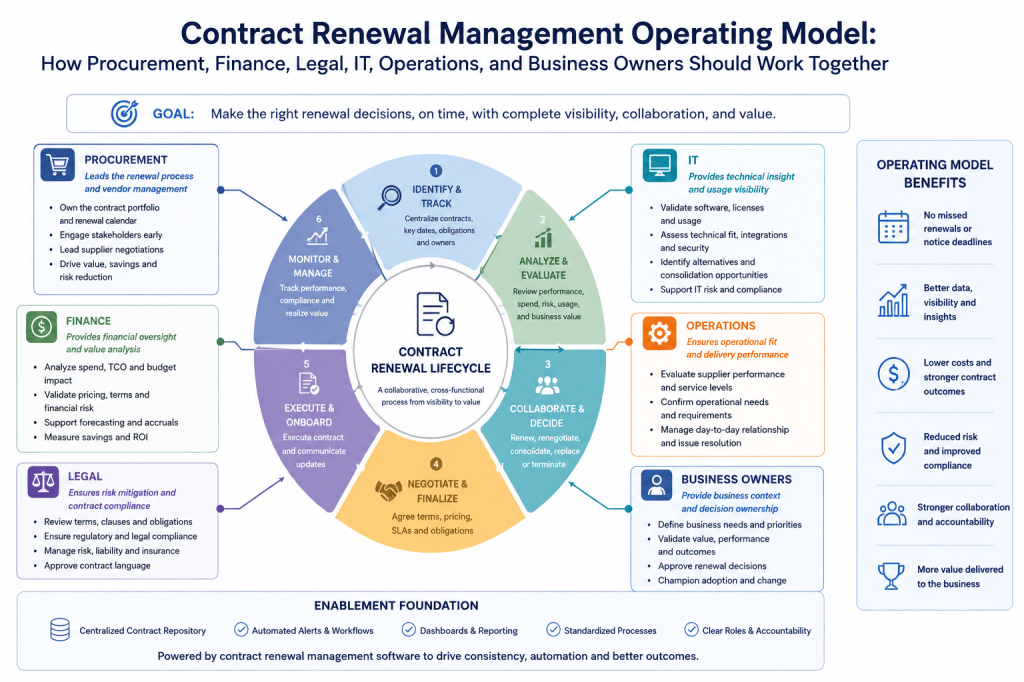
What Is a Contract Renewal Management Operating Model?
A contract renewal operating model defines:
- who owns the contract record;
- who owns the business decision;
- who verifies contractual requirements;
- who negotiates;
- who approves financial commitments;
- who executes termination or renewal actions;
- who monitors deadlines;
- who escalates overdue work;
- who reports performance.
It turns renewal management from an informal administrative activity into a repeatable business process.
A useful operating model connects:
Contract Data
↓
Deadline Control
↓
Business Review
↓
Commercial Decision
↓
Approval
↓
Execution
↓
Measurement
Different functions own different parts of that chain.
Why One “Contract Owner” Is Not Enough
Many organizations assign one contract owner and assume that solves accountability.
It helps.
But one person cannot realistically own every dimension of a material renewal.
Consider a €2 million technology agreement.
The business owner understands:
whether the service is still required.
IT understands:
usage and technical dependency.
Procurement understands:
commercial strategy.
Legal understands:
notice and contractual risk.
Finance understands:
budget and commitment.
The executive sponsor may have:
final approval authority.
Trying to collapse all of that responsibility into one generic field called:
Contract Owner
creates ambiguity.
A better model defines several distinct roles.
The Seven Core Renewal Roles
A practical renewal operating model usually involves some combination of:
- Business Owner
- Contract / Renewal Operations
- Procurement
- Finance
- Legal
- IT or Technical Owner
- Executive Approver
Operations may also be a separate functional owner for facilities, logistics, maintenance, and other service contracts.
Not every contract needs all seven roles.
That is important.
The workflow should scale according to materiality and risk.
Role 1: Business Owner
The business owner should answer the most fundamental question:
Do we still need this contract?
This person understands:
- business requirement;
- future demand;
- service importance;
- user needs;
- operating impact.
The business owner should generally own the need decision, not the entire renewal process.
Business Owner Responsibilities
Typical responsibilities include:
- confirm whether the service is still required;
- estimate future quantity;
- review operational performance;
- identify changing requirements;
- select a preferred renewal direction.
That direction might be:
Renew
Renegotiate
Reduce
Replace
Extend
Terminate
This gives downstream teams a clear mandate.
What the Business Owner Should Not Own
The business owner should not necessarily be expected to:
- interpret complex notice clauses;
- calculate procurement savings;
- negotiate strategic pricing;
- execute legal termination notices;
- maintain system-wide renewal policies.
Those belong elsewhere.
Keeping roles focused improves adoption.
Role 2: Contract or Renewal Operations
As the portfolio grows, one function should own:
the integrity of the renewal process itself.
This might be called:
- Contract Operations;
- Renewal Operations;
- Commercial Operations;
- Procurement Operations.
For smaller companies, this responsibility may sit with:
Finance,
Operations,
or:
Procurement.
Renewal Operations Responsibilities
Typical responsibilities include:
- maintain contract metadata;
- monitor deadlines;
- ensure owner coverage;
- configure reminders;
- manage escalation;
- coordinate workflow;
- maintain reporting;
- remediate missing data.
This is the operational control layer.
Renewal Operations Does Not Make Every Decision
This distinction is crucial.
Renewal Operations ensures:
the decision happens.
It does not necessarily decide:
what the decision should be.
That remains with:
business and commercial stakeholders.
Role 3: Procurement
Procurement enters when the renewal has:
commercial significance.
It should typically own:
- negotiation strategy;
- supplier engagement;
- benchmarking;
- consolidation;
- sourcing alternatives;
- savings measurement.
Procurement should not have to discover a contract:
three days before the supplier expects signature.
The operating model should bring Procurement in:
early enough to influence the outcome.
Procurement Trigger Rules
Not every renewal requires Procurement.
Possible triggers:
Annual Value >€50K
or:
Decision = Renegotiate
or:
Decision = Replace
or:
Supplier Risk = High
or:
Consolidation Opportunity = Yes
This creates exception-based procurement involvement.
Role 4: Finance
Finance should own:
the financial governance of the renewal.
Typical responsibilities:
- verify budget;
- review financial commitment;
- approve material spend;
- validate savings;
- support forecasting.
Finance does not need to manage:
every reminder.
It needs timely access to:
material financial information.
Finance Trigger Rules
Examples:
Final Value > Budget
Contract Value > Approval Threshold
Multi-Year Commitment >€1M
Savings Claim Requires Validation
These rules keep Finance focused.
Role 5: Legal
Legal should own interpretation and execution where:
contractual risk is material.
Responsibilities may include:
- verify notice clauses;
- review conflicting documents;
- confirm termination rights;
- review amendments;
- approve legal exceptions;
- validate formal notice requirements.
Legal should not have to review:
every low-value SaaS renewal.
That would create unnecessary bottlenecks.
Legal Trigger Rules
Examples:
Decision = Terminate
Conflicting Renewal Terms
Notice Clause Unverified
Material Contract Amendment
High-Risk Liability Change
This allows Legal to work on:
exceptions.
Role 6: IT or Technical Owner
Technology agreements need technical context.
IT may own:
- architecture fit;
- usage;
- license quantities;
- security dependencies;
- transition feasibility.
For a SaaS renewal, this role can be essential.
IT Trigger Rules
Examples:
Category = Technology
Decision = Replace
Usage Review Required
Security Review Required
This creates technical input without involving IT in unrelated contracts.
Role 7: Operations
Operations may own the business requirement for:
- facilities;
- maintenance;
- logistics;
- telecom;
- security;
- fleet;
- outsourced services.
Operations should evaluate:
- service levels;
- volume;
- continuity;
- site requirements;
- replacement readiness.
This is especially important for multi-site businesses.
Role 8: Executive Approver
Executives should participate only when:
materiality or strategic risk justifies it.
Examples:
- major multi-year commitments;
- strategic suppliers;
- exceptional risk;
- large budget variance.
Executives should not be buried under:
routine renewals.
The Core Principle: Separate Process Ownership from Decision Ownership
This is one of the most important design principles.
Renewal Operations
owns:
the process.
Business Owner
owns:
the business need.
Procurement
owns:
commercial strategy.
Legal
owns:
contractual interpretation.
Finance
owns:
financial approval.
Executive
owns:
material decision authority.
This clarity prevents:
ownership confusion.
A Practical Renewal RACI
A simple RACI might look like this:
| Activity | Business | Renewal Ops | Procurement | Finance | Legal | IT/Ops |
|---|---|---|---|---|---|---|
| Maintain contract record | C | A/R | C | C | C | C |
| Confirm business need | A/R | C | C | C | C | C |
| Verify notice clause | C | C | C | C | A/R | C |
| Determine commercial strategy | C | C | A/R | C | C | C |
| Review usage / demand | A | C | C | C | C | R |
| Negotiate supplier terms | C | C | A/R | C | C | C |
| Approve budget | C | C | C | A/R | C | C |
| Prepare termination notice | C | C | C | C | A/R | C |
| Track workflow | C | A/R | C | C | C | C |
| Measure financial outcome | C | C | R | A | C | C |
The exact design should match:
your organization.
The table is a starting point, not a universal standard.
RACI Definitions
R — Responsible
Performs the activity.
A — Accountable
Ultimately owns the outcome.
C — Consulted
Provides input.
I — Informed
Receives information.
Try to avoid:
several Accountable roles
for the same activity.
That usually recreates ambiguity.
The Renewal Lifecycle Operating Model
A strong renewal process can be broken into eight stages.
Stage 1: Contract Onboarding
When a contract is signed or imported:
capture:
- supplier;
- owner;
- value;
- end date;
- notice period;
- auto-renewal;
- governing document.
Renewal Operations typically owns:
data completeness.
Legal may verify:
critical terms.
Stage 2: Monitoring
The system continuously monitors:
notice deadlines.
No business activity is needed yet.
This is where Contract Renewal Tracker can provide:
automated control.
Stage 3: Business Review
At the appropriate lead time:
the business owner receives:
a review.
Questions might include:
- Still required?
- Expected quantity?
- Performance acceptable?
- Any replacement plans?
This produces:
the initial decision direction.
Stage 4: Strategy
Depending on the decision:
Procurement,
IT,
Legal,
or:
Operations
join the workflow.
Example:
Decision:
Reduce.
Next:
usage and negotiation.
Decision:
Replace.
Next:
transition planning.
Decision:
Terminate.
Next:
Legal verification.
Stage 5: Commercial Process
Procurement may:
- request proposal;
- benchmark;
- negotiate;
- compare alternatives.
Finance receives:
expected spend.
The renewal becomes increasingly concrete.
Stage 6: Approval
Approval should depend on:
materiality.
Possible:
Business Manager.
Finance.
CFO.
Executive Committee.
The system should route:
the correct approver automatically.
Stage 7: Execution
Depending on outcome:
Renew
sign agreement.
Terminate
deliver notice.
Replace
complete transition.
Execution is where:
renewal decisions become contractual reality.
Stage 8: Close and Reset
After completion:
update:
- new contract value;
- new term;
- next end date;
- next notice deadline;
- savings;
- supplier history.
Then:
the next renewal cycle begins.
This prevents the organization from:
starting from scratch every year.
Renewal Lead-Time Policies
The operating model should define:
when each contract enters workflow.
Not every contract needs:
180 days.
A useful tier model might be:
Tier 1 — Strategic
365–180 days.
Tier 2 — Material
180–120 days.
Tier 3 — Standard
90–60 days.
Tier 4 — Low Value
60–30 days.
This keeps effort proportional.
Contract Tiering Criteria
Possible factors:
- annual value;
- criticality;
- replacement complexity;
- regulatory risk;
- auto-renewal;
- supplier concentration.
Use several factors rather than:
value alone.
Example Tier 1
Cloud infrastructure agreement.
€3M/year.
Critical.
Replacement lead time:
12 months.
Start:
365 days before notice deadline.
Example Tier 4
Design plug-in.
€600/year.
Easy replacement.
Start:
30 days before deadline.
Same system.
Different workflow.
The Importance of Internal Deadlines
Do not use the contractual notice deadline as:
the internal decision deadline.
That leaves no buffer.
For example:
Contractual deadline:
September 30.
Internal decision deadline:
August 31.
Legal execution deadline:
September 15.
This creates:
safety margin.
Three Deadline Layers
A mature process often has:
Contractual Deadline
Hard external boundary.
Internal Decision Deadline
When the business should decide.
Task Deadline
When each participant must complete their work.
These should be separate fields.
Escalation Operating Model
Escalation should be:
predictable.
Not:
ad hoc.
For example:
Task Due
Owner.
5 Days Overdue
Manager.
10 Days
Renewal Operations.
15 Days / Critical Window
Executive escalation.
This creates:
closed-loop accountability.
Escalation Should Consider Risk
A €500 contract
does not deserve:
the same escalation path
as:
a €5M auto-renewal.
Use:
materiality.
Example High-Risk Rule
IF annual_value >= 500000AND notice_deadline <= 30_daysAND decision = UNDECIDEDTHEN escalate_to = CFO + Procurement Director
This is appropriate automation.
Meeting Cadence for Renewal Operations
Large organizations may benefit from:
a regular renewal review.
For example:
weekly.
Agenda:
- critical deadlines;
- overdue decisions;
- material negotiations;
- termination risk;
- upcoming approvals.
This becomes:
the operational heartbeat.
Monthly Executive Review
Executives do not need:
weekly task detail.
A monthly view might include:
- next-quarter renewal spend;
- critical risks;
- savings;
- major supplier decisions.
This keeps leadership:
informed without overloading them.
Quarterly Portfolio Review
A quarterly review can focus on:
longer-term opportunities.
For example:
- supplier consolidation;
- upcoming strategic renewals;
- contract rationalization;
- forecast changes.
This shifts the organization from:
reactive
to:
strategic.
Contract Renewal Committee
Large enterprises may establish:
a cross-functional renewal governance group.
Potential participants:
Procurement.
Finance.
Legal.
IT.
Contract Operations.
This is useful for:
major contracts,
not:
every renewal.
What Renewal Operations Should Own
A dedicated Renewal Operations function should typically own:
Process
Data Quality
Deadline Monitoring
Workflow Configuration
Escalation
Reporting
It should not become:
the approval authority
for every contract.
What Procurement Should Own
Commercial Strategy
Negotiation
Supplier Consolidation
Savings
What Finance Should Own
Budget
Forecast
Financial Approval
Savings Validation
What Legal Should Own
Contract Interpretation
Legal Exceptions
Termination Mechanics
Legal Approval
What Business Owners Should Own
Need
Demand
Operational Decision
What IT / Operations Should Own
Technical or Operational Feasibility
Usage
Transition
This division is clean.
Data Ownership Is Also Important
Who can update:
contract end date?
Notice period?
Annual value?
Decision?
Not everyone should edit:
everything.
A useful model:
Contract Metadata
Renewal Operations / Legal.
Business Decision
Business Owner.
Financial Values
Procurement / Finance.
Legal Verification
Legal.
This improves:
data integrity.
Field-Level Governance
For advanced environments:
sensitive fields could have:
specific edit rights.
Example:
Notice Deadline.
Business Owner:
view only.
Legal / Renewal Ops:
edit.
This reduces:
accidental errors.
Auditability
Every critical change should preserve:
- old value;
- new value;
- user;
- timestamp.
Especially:
- notice period;
- deadline;
- decision;
- approval;
- contract value.
Auditability supports:
governance and trust.
Renewal Decision Governance
The system should distinguish:
Recommendation
from:
Approved Decision.
Example:
Business recommends:
Terminate.
Legal identifies:
termination penalty.
Final decision:
Extend six months.
That decision history should remain visible.
Decision Statuses
Useful:
Proposed
Under Review
Approved
Executed
This prevents:
a draft decision
from being mistaken for:
final action.
Procurement Strategy Statuses
Potential:
Not Started
Benchmarking
Supplier Engaged
Negotiating
Final Offer
Completed
This creates:
commercial visibility.
Legal Review Statuses
Potential:
Not Required
Pending
In Review
Verified
Exception
Simple statuses help management understand:
where the process is blocked.
Approval Status
Not Required
Pending
Approved
Rejected
Reapproval Required
Clear.
Execution Status
For termination:
Draft
Approved
Sent
Delivered
Acknowledged
This creates:
real control.
Who Owns an Auto-Renewal?
The system should not treat:
automatic renewal
as:
“no decision required.”
Quite the opposite.
Auto-renewal should require:
an explicit business decision
before:
the notice deadline.
This is one of the strongest operating controls.
Recommended Auto-Renewal Policy
Every material auto-renewing contract must have an explicit renewal decision before its internal decision deadline.
This eliminates:
passive renewal
as the default process.
“No Response” Is Not “Renew”
This is another key principle.
If owner does not respond:
the system should not silently interpret that as:
Renew.
Instead:
escalate.
Silence should be:
an exception.
Exception Management
A mature operating model focuses on:
exceptions.
Examples:
- missing owner;
- missing notice period;
- conflicting clause;
- overdue decision;
- supplier proposal missing;
- approval overdue;
- termination notice failed.
These should be visible:
centrally.
Renewal Exception Dashboard
For example:
Missing Owners
Missing Notice Periods
Decisions Overdue
Approvals Overdue
Critical Notice Deadlines
This becomes:
the Renewal Operations dashboard.
Do Not Treat Every Exception Equally
Prioritize by:
Impact
and:
Urgency.
A missing owner on:
€5K contract
is not equivalent to:
a missing notice period on:
€4M auto-renewal.
Risk scoring helps.
Renewal Risk Formula
A conceptual model:
Deadline Proximity
Financial Value
Auto-Renewal
Criticality
Data Quality
=
Renewal Risk
This allows:
exception prioritization.
Cross-Functional Communication
One of the most valuable features of a renewal platform is:
reducing email dependency.
Instead of:
Procurement asking Finance for status,
Finance asking Legal,
Legal asking the owner,
all parties can see:
the workflow state.
This reduces:
coordination cost.
Use Email as Notification, Not System of Record
Email is excellent for:
alerting users.
It is poor for:
maintaining authoritative renewal status.
The system should remain:
the source of truth.
Example
Email:
Your renewal review is due.
User clicks:
Complete Review.
Decision stored:
inside Contract Renewal Tracker.
This is much better than:
replying:
“Looks fine to me.”
Renewal Governance Policies
Organizations should define:
a small set of policies.
For example:
Policy 1
All material contracts must have:
a named business owner.
Policy 2
All auto-renewing contracts require:
explicit decision.
Policy 3
All termination decisions require:
legal verification.
Policy 4
All contracts >€500K require:
Finance approval.
These make the operating model:
clear.
Avoid Policy Overload
Do not create:
50 rules
before launch.
Start with:
a few critical controls.
Then mature.
This mirrors:
the maturity model from the previous article.
Small-Business Operating Model
A small company may not need:
seven separate roles.
One person may cover:
Finance + Procurement + Renewal Operations.
Another:
business owner.
The principle remains:
responsibilities should be explicit.
Example Small Business
Founder:
approver.
Finance Manager:
Renewal Operations + Finance.
Department Head:
business owner.
Legal:
external counsel only when necessary.
This can work well.
Mid-Market Operating Model
More specialized:
Renewal Operations.
Procurement.
Finance.
Legal.
Business Owners.
This is where structured workflow becomes:
highly valuable.
Enterprise Operating Model
Potentially:
central Contract Operations
plus:
regional/local ownership.
This becomes:
federated renewal management.
Federated Model
Central team defines:
- standards;
- policies;
- reporting;
- escalation.
Local teams own:
- requirements;
- contract context;
- execution.
This supports:
scale.
Multi-Entity Model
For example:
Group Procurement.
Regional Finance.
Local Owner.
Central Legal.
The workflow can cross:
organizational levels.
This is why entity-aware permissions matter.
Private Equity Operating Model
Portfolio company:
owns contracts.
Portfolio operating team:
sees aggregated opportunities.
This allows:
central intelligence
without:
centralizing every decision.
M&A Operating Model
Integration team adds:
another temporary role:
Integration Owner.
This person owns:
contract rationalization.
Later:
responsibility transitions to:
steady-state owner.
This should be tracked.
Renewal Operations KPIs
A mature operating model needs:
measurement.
Useful KPIs include:
- Contract coverage.
- Owner coverage.
- Notice deadline coverage.
- Decision coverage.
- On-time workflow completion.
- Critical missed deadlines.
- Approval cycle time.
- Renewal lead time.
- Savings.
- Forecast accuracy.
This balances:
control and value.
KPI 1: Contract Coverage
Percentage of:
material contracts
inside the renewal process.
KPI 2: Owner Coverage
Target:
close to 100%.
KPI 3: Notice Deadline Coverage
Percentage with:
known actionable deadline.
KPI 4: Decision Coverage
Percentage of near-term renewals:
with approved direction.
KPI 5: On-Time Completion
Workflow tasks completed:
before due date.
KPI 6: Missed Notice Deadlines
The most important control metric.
Target:
zero material misses.
KPI 7: Renewal Lead Time
How early:
the workflow begins.
More lead time generally increases:
options.
KPI 8: Procurement Savings
Track:
validated value.
KPI 9: Forecast Accuracy
Expected renewal spend versus:
final.
KPI 10: Exception Rate
How many renewals require:
urgent escalation?
This should decline as:
maturity improves.
Operating Model Maturity
The organization can evolve:
Stage 1
Informal ownership.
Stage 2
Named owners.
Stage 3
Automated reminders.
Stage 4
Cross-functional workflows.
Stage 5
Exception-based governance.
Stage 6
AI-assisted coordination.
Again:
progressive maturity.
AI’s Role in the Operating Model
AI can help:
coordinate,
summarize,
prioritize.
It should not:
erase accountability.
For example:
AI says:
This renewal is at high risk because the owner has not responded, the contract auto-renews, and 21 days remain.
That helps.
But:
the accountable person
still needs to act.
AI Renewal Coordinator
A future Contract Renewal Tracker assistant could act like:
a virtual Renewal Operations analyst.
It could:
- summarize overdue work;
- prepare briefs;
- identify gaps;
- suggest escalation.
This could save:
substantial administration.
Example
Five renewals need attention today. Two are waiting for owner decisions, one is awaiting Finance approval, and two have unverified notice clauses.
This is useful.
AI for Role-Specific Briefings
Procurement:
Three negotiations require action.
Finance:
€2.4M of renewal commitments require approval.
Legal:
Four notice clauses need verification.
Business Owner:
Two decisions are due.
Same data.
Different role.
This is powerful.
AI Should Respect Decision Rights
AI may recommend:
Terminate.
But only:
the authorized business owner or approver
can make:
that decision.
This is essential for governance.
AI Should Never Bypass Legal Controls
A chatbot should not:
send a termination notice
simply because:
the user typed:
“Cancel this contract.”
It should initiate:
the approved workflow.
That is the correct enterprise pattern.
Contract Renewal Tracker as the Operating System
This article points toward a useful long-term product position:
Contract Renewal Tracker is not simply a database of contracts. It is the operating system that coordinates who needs to do what before each renewal deadline.
That is much stronger than:
“reminder software.”
Product Workflow Model
The core product could be:
Contract
↓
Event
↓
Task
↓
Role
↓
Decision
↓
Approval
↓
Action
↓
Audit
That architecture supports:
all maturity levels.
Beta Operating Model
For the September 21 beta:
keep this simple.
The initial workflow only needs:
Contract
↓
Owner
↓
Reminder
↓
Decision
This proves:
the basic coordination model.
Beta Role Model
You probably only need:
Admin
Manages workspace.
Owner
Manages assigned contracts.
Potentially:
Viewer
Read-only.
Do not build:
20 roles
before the first users arrive.
Post-Beta Role Evolution
Then add:
Procurement.
Finance.
Legal.
Approver.
This creates:
increasingly specialized workflows.
Post-Beta Workflow Evolution
Phase 1
Owner reminder.
Phase 2
Escalation.
Phase 3
Approval.
Phase 4
Termination / replacement workflows.
Phase 5
Financial intelligence.
This remains:
a coherent product roadmap.
Operating Model as Customer Onboarding
When a new customer signs up:
ask:
- Who owns renewal administration?
- Who makes business decisions?
- What value requires approval?
- Does Legal review terminations?
- When should renewals start?
Those five questions can configure:
most early workflows.
Avoid Complex Configuration Screens
Instead of:
100 rule settings,
use:
a guided setup.
For example:
Contracts over what value require Finance approval?
Customer:
€100K.
Done.
This makes:
enterprise concepts
accessible to smaller customers.
Workflow Templates
Provide defaults:
Standard Renewal
Owner → Decision → Complete.
High-Value Renewal
Owner → Procurement → Finance.
Termination
Owner → Legal → Approval → Execute.
This dramatically reduces setup time.
Operating Model Template as Lead Magnet
This article is an excellent candidate for:
Contract Renewal Operating Model & RACI Template
It could include:
- renewal lifecycle;
- RACI matrix;
- role descriptions;
- approval thresholds;
- escalation rules;
- meeting cadence.
That is a valuable buyer resource.
Suggested CTA
Download the Contract Renewal Operating Model & RACI Template
Define who owns contract data, business decisions, negotiations, legal review, financial approvals, termination execution, escalation, and renewal reporting using a ready-to-use governance framework.
Download the Free Operating Model Template →
Second Lead Magnet
Another useful resource:
Contract Renewal Responsibility Matrix
A simpler one-page version for:
small and mid-sized companies.
This could be highly downloadable.
Commercial CTA
Need More Than Renewal Reminders?
Contract Renewal Tracker can provide the coordination layer between business owners, Procurement, Finance, Legal, IT, and Operations so each renewal moves through the right actions before the contractual window closes.
Join the Contract Renewal Tracker Beta →
Contract Renewal Tracker Beta Launch — September 21, 2026
Contract Renewal Tracker is launching its first SaaS beta on September 21, 2026. The beta starts with the core coordination problem: bringing contract dates, notice periods, owners, values, and upcoming renewal actions into one workspace so responsibility is clear and renewals do not depend on individual memory. From that foundation, the platform can progressively add escalation, approvals, procurement workflows, legal controls, financial intelligence, and role-specific renewal operations. [Notify Me When the Beta Launches →] (One launch notification only — no newsletter or ongoing marketing emails.)
Final Thoughts
Contract renewal management is inherently:
cross-functional.
No single function has:
all the information
or:
all the authority
required to manage every material renewal.
The operating model should therefore separate:
Process Ownership
from:
Decision Ownership
and:
Functional Expertise.
A strong model looks like:
Renewal Operations
controls:
the process.
Business Owner
determines:
business need.
Procurement
controls:
commercial strategy.
Finance
controls:
financial commitment.
Legal
controls:
contractual interpretation.
IT / Operations
controls:
technical or operational feasibility.
Executives
approve:
material exceptions.
When those roles are clear, the software can automate:
the coordination between them.
That is the real opportunity for Contract Renewal Tracker.
The long-term product is not simply:
a place where contracts are stored.
It can become:
the coordination and intelligence layer that ensures every important renewal reaches the right people, with the right information, early enough to make a good decision.
Next Article in the Contract Renewal Tracker Series
Article 102 — “Contract Renewal Governance Framework: Policies, Approval Thresholds, Escalation Rules, Controls, Audit Evidence, and Management Reporting”
The next article can build directly on this operating model and define the formal governance layer: renewal policies, mandatory data fields, auto-renewal controls, approval matrices, legal-review triggers, escalation SLAs, exception handling, segregation of duties, audit requirements, KPI reporting, and management oversight.

