Small businesses have contracts too.
Software subscriptions.
Telecommunications agreements.
Equipment leases.
Insurance policies.
Maintenance agreements.
Professional services contracts.
Cloud services.
Office leases.
Supplier agreements.
The problem is that many small businesses do not have:
a procurement department,
a contract-management team,
or:
an enterprise Contract Lifecycle Management platform.
Instead, contract renewals are often managed using a combination of:
Excel
Outlook or Google Calendar
Someone’s memory
That approach can work surprisingly well—until the number or value of contracts increases.
Then one missed notice deadline can turn into another 12-month commitment.
The question becomes:
Does a small business really need enterprise CLM software just to manage contract renewals?
Usually, no.
For many smaller organizations, the better answer is a focused contract renewal management system that sits between a spreadsheet and a full enterprise CLM platform.
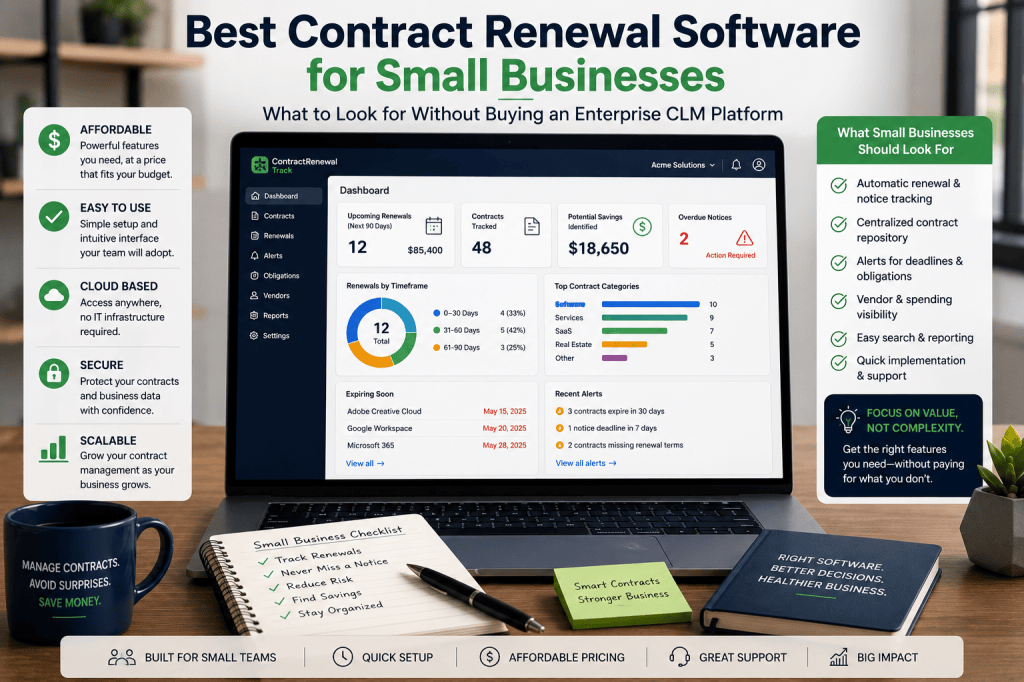
What Is Contract Renewal Software for Small Businesses?
Contract renewal software helps a business keep track of:
- active contracts;
- suppliers;
- expiration dates;
- notice periods;
- automatic renewals;
- responsible owners;
- upcoming renewal decisions;
- reminders.
More advanced platforms may add:
- escalation;
- approvals;
- financial tracking;
- document storage;
- AI contract extraction.
The objective is straightforward:
Know which contracts require attention before the business loses its ability to make a good renewal decision.
The Small-Business Contract Management Gap
There is a large conceptual gap between:
Spreadsheet
and:
Enterprise CLM
A small company may not need:
contract authoring,
clause libraries,
redlining,
legal playbooks,
complex approval orchestration,
and dozens of integrations.
It may simply need:
“Tell us what is renewing, when we need to act, who owns it, and whether somebody has actually made a decision.”
Current products aimed at smaller teams increasingly emphasize exactly this narrower problem: centralized contract records, notice periods, renewal alerts, owners, and simplified workflows rather than only traditional enterprise CLM functionality. (Timemy)
That is also an important market position for Contract Renewal Tracker.
Do You Need Contract Renewal Software?
Start with the problem rather than the software.
Ask:
Have we ever discovered a renewal later than we would have liked?
Then:
Do we know the notice deadline for every material contract?
Then:
Does every contract have someone responsible for deciding what happens next?
If the answers are uncomfortable, a dedicated tracker may already provide value.
When Excel Is Still Enough
Suppose your business has:
15 active contracts.
One person manages them.
The agreements are relatively simple.
Total supplier spend is modest.
An Excel spreadsheet may be perfectly adequate.
There is little reason to introduce software merely because:
software exists.
When Excel Starts Becoming Risky
Now imagine:
80 active contracts.
15 business owners.
€1.5 million annual supplier spend.
25 auto-renewing subscriptions.
Different notice periods.
Contracts stored across:
email,
OneDrive,
Google Drive,
and local folders.
Now the problem changes.
You are no longer simply maintaining:
a list.
You are managing:
a recurring operational process.
Contract Count Is Not the Best Threshold
Do not use:
50 contracts
or:
100 contracts
as an absolute rule.
Complexity matters more.
A company with:
25 high-value technology contracts
may have more renewal risk than a company with:
200 simple low-value agreements.
Better Indicators
Look at:
Contract Value
Auto-Renewal Exposure
Notice Period Complexity
Number of Owners
Business Criticality
Administrative Effort
These provide a better indication of whether software is justified.
What Should Small-Business Contract Renewal Software Do?
For most small businesses, I would consider these capabilities fundamental.
1. Central Contract Register
2. Contract End Dates
3. Notice Periods
4. Notice Deadline Calculation
5. Auto-Renewal Tracking
6. Contract Ownership
7. Automated Reminders
8. Renewal Decisions
Everything beyond these capabilities should justify its additional complexity.
Feature 1: Central Contract Register
You need one place where you can answer:
What contracts do we currently have?
The system should show:
- contract;
- supplier;
- owner;
- value;
- renewal status.
This becomes the central renewal register.
Feature 2: Contract Expiration Dates
Basic but essential.
Every active contract should have:
an end date
where applicable.
But this alone is not enough.
Feature 3: Notice Period
The platform should track:
how much notice must be provided.
For example:
30 days.
60 days.
90 days.
6 months.
This is particularly important for:
automatic renewals.
Feature 4: Notice Deadline
The software should calculate or clearly store:
the date by which action must occur.
For example:
Contract End:
December 31.
Notice:
90 days.
Notice Deadline:
approximately early October.
That October date is operationally more important than:
December 31.
Current renewal-focused products increasingly highlight notice-period or notice-deadline alerts specifically, rather than relying only on expiration dates. (Remindax)
Feature 5: Auto-Renewal Tracking
You should be able to answer:
Which of our contracts renew automatically?
And:
How much money is exposed to those renewals?
For example:
25 auto-renewing contracts.
Annual value:
€450,000.
That immediately creates:
management visibility.
Feature 6: Named Contract Owner
Every material contract should have:
someone responsible.
Not:
“IT.”
But:
Sarah — IT Manager
This creates accountability.
Feature 7: Automated Reminders
The system should send reminders before:
the relevant action deadline.
For example:
90 days.
60 days.
30 days.
You should not have to manually maintain:
hundreds of Outlook reminders.
Feature 8: Renewal Decision
A reminder should lead somewhere.
Capture:
Renew
Renegotiate
Reduce
Replace
Extend
Terminate
This turns:
date tracking
into:
renewal management.
Feature 9: Simple Dashboard
Small businesses do not need:
47 dashboards.
One useful dashboard can answer:
What Requires Attention?
What Is Renewing Soon?
What Is Auto-Renewing?
What Is Still Undecided?
How Much Money Is Involved?
That may be enough.
Feature 10: Excel Import
This is extremely important.
Most small businesses will not start with:
an empty system.
They already have:
a spreadsheet.
The platform should therefore make:
Excel → Contract Renewal Software
as painless as possible.
Ideal Migration
Upload Spreadsheet
↓
Map Columns
↓
Validate
↓
Import
↓
See Upcoming Renewals
The customer should not need:
an implementation consultant
to import 50 contracts.
Feature 11: Easy Data Entry
Adding a contract should take:
minutes,
not:
20 minutes.
For an MVP, ask only for information necessary to manage the renewal.
For example:
Contract Name
Supplier
Owner
End Date
Notice Period
Auto-Renewal
Value
That is enough to begin.
Feature 12: Document Attachment
Being able to attach:
the actual PDF
is useful.
Then the renewal record and source agreement remain connected.
But do not turn:
document management
into:
the entire product.
Feature 13: Search
The user should be able to type:
Microsoft
and immediately find:
all relevant contracts.
Search sounds trivial.
Once the portfolio reaches:
hundreds of agreements,
it becomes essential.
Feature 14: Basic Permissions
Small companies still need security.
For example:
Administrator.
Manager.
User.
You may not need:
hundreds of permission combinations.
But users should not automatically see sensitive information they do not need.
Feature 15: Audit History
At minimum, material changes should eventually be traceable.
For example:
Notice Period:
90 → 120 days.
Owner:
Sarah → Mark.
Decision:
Renew → Terminate.
This becomes increasingly important as more users participate.
What Small Businesses Probably Do NOT Need Initially
This is equally important.
Do not automatically pay for:
- sophisticated contract drafting;
- advanced clause libraries;
- complex legal playbooks;
- enterprise sourcing;
- large integration catalogs;
- extensive custom workflow engines.
Unless:
you actually need them.
The Enterprise CLM Problem
A full CLM platform can be extremely valuable.
But its purpose is broader.
CLM may cover:
Request
↓
Draft
↓
Negotiate
↓
Approve
↓
Sign
↓
Store
↓
Manage Obligations
↓
Renew
For a small business whose primary problem is:
We keep forgetting renewals
that may be excessive.
Renewal Management Starts Later in the Lifecycle
A focused Contract Renewal Tracker can begin with:
Signed Contract
↓
Track
↓
Remind
↓
Decide
↓
Renew / Exit
This is a much narrower product.
That can be an advantage.
Complexity Has a Cost
Software cost is not only:
subscription price.
It also includes:
- setup;
- configuration;
- training;
- administration.
A €50/month product that requires:
two weeks of configuration
may be more expensive than it appears.
Time-to-Value Matters
For small-business software, I would consider this a crucial metric:
How long from signup until I can see my first useful renewal insight?
Ideally:
minutes.
Not:
weeks.
The Ideal First 10 Minutes
A user should be able to:
Create Account
↓
Add Contract
↓
Enter End Date
↓
Enter Notice Period
↓
See Notice Deadline
↓
Set Reminder
Now the product has already created value.
The Ideal First Hour
Even better:
Import Existing Spreadsheet
↓
See Entire Portfolio
↓
Identify Upcoming Deadlines
↓
Find Missing Information
That creates a much stronger:
“aha” moment.
AI Can Help Small Businesses
AI can potentially reduce:
manual data entry.
For example:
upload contract.
AI identifies:
- supplier;
- end date;
- notice period;
- auto-renewal clause;
- contract value.
Several current SME-oriented contract platforms already market AI-assisted extraction of key dates and terms as a way to simplify contract intake. (Timemy)
This could eventually become valuable for Contract Renewal Tracker as well.
But AI Should Not Make the Product Harder
Do not add AI because:
every SaaS product needs AI.
Use it where it eliminates:
real work.
For example:
Upload PDF
↓
Extract Renewal Terms
is useful.
A decorative chatbot that does not improve renewal decisions:
less so.
Human Verification Still Matters
Suppose AI extracts:
Notice Period:
90 days.
For a material contract, show:
AI Extracted
and ideally:
Source Clause
Then allow:
human verification.
Contractual deadlines should not depend on invisible AI assumptions.
Small-Business Dashboard
I would keep the default dashboard extremely focused.
Upcoming Notice Deadlines
Renewals Next 90 Days
Auto-Renewing
Missing Owner
Undecided
This tells the business:
where to focus.
Financial Dashboard
Add:
Annual Contract Value
€850K.
Renewing Next 90 Days
€180K.
Auto-Renewal Exposure
€320K.
Undecided Renewal Value
€95K.
This converts contract management into:
financial visibility.
Why Financial Visibility Matters
A small business may have:
€1M annual supplier spend
without realizing how much is:
contractually recurring.
Centralizing contracts can reveal:
the true commitment profile.
Example
Accounting software:
€12K.
CRM:
€25K.
Cloud:
€80K.
Cybersecurity:
€35K.
Telecom:
€18K.
Various SaaS:
€60K.
Total:
€230K.
Seeing these agreements together creates:
negotiating opportunities.
Renewal Software Can Pay for Itself Quickly
Suppose software costs:
€30/month.
Annual:
€360.
One unwanted subscription prevented:
€2,500.
The financial case becomes:
simple.
Administrative ROI
Suppose someone spends:
3 hours each week
maintaining:
spreadsheets and reminders.
That is:
156 hours/year.
Even reducing this by:
50%
can create meaningful value.
Do Not Overpromise ROI
The platform cannot guarantee:
savings.
It can create:
better visibility and earlier action.
The organization still has to:
make good decisions.
That distinction matters.
Small-Business Security Requirements
“Small business” does not mean:
security does not matter.
The system may contain:
- supplier pricing;
- contractual commitments;
- business relationships;
- uploaded agreements.
At minimum, evaluate:
authentication,
access control,
data protection,
backup/recovery,
and:
exportability.
GDPR Matters for European Businesses
If the product stores personal information associated with:
contract owners,
supplier contacts,
or documents,
privacy obligations need to be considered.
Small companies are not exempt simply because:
they are small.
Data Portability
Ask:
Can I export my contract data if I leave?
This should have:
a clear answer.
At minimum:
CSV export.
Ideally:
document export too.
Avoid unnecessary lock-in.
Backup and Recovery
Ask:
What happens if data is accidentally deleted?
The platform should have:
a defined recovery approach.
Again:
small SaaS does not mean:
casual data management.
Multi-User Access
Even a company with:
20 employees
may need:
Finance,
Operations,
IT,
and:
Management
to access different contracts.
Therefore:
multi-user support matters earlier than many founders expect.
Avoid Per-User Pricing That Punishes Adoption
For renewal software:
many users may only access the system:
occasionally.
A business owner might log in:
four times per year.
If every occasional user costs:
€30/month,
customers may avoid inviting them.
That damages:
workflow adoption.
Better Pricing Models
Potential approaches include:
Contract-Based
or:
Workspace-Based
with:
reasonable user allowances.
For Contract Renewal Tracker, pricing should encourage:
ownership participation,
not discourage it.
Example Small-Business Pricing Structure
Conceptually:
Free / Trial
Small number of contracts.
Starter
Basic tracking + reminders.
Professional
More contracts + workflow + reporting.
Business
Advanced controls + integrations.
The precise pricing should be validated through:
beta behavior.
Do Not Lock Core Renewal Safety Behind Expensive Plans
For example:
notice deadline tracking
should probably be:
core.
Why?
Because it is fundamental to:
the product promise.
Advanced:
analytics
can justify higher tiers.
What Should Be Core?
I would consider:
- contract dates;
- notice periods;
- reminders;
- ownership;
- basic decisions.
These define:
renewal management.
What Could Be Premium?
Potential premium features:
- advanced workflow;
- approvals;
- AI extraction;
- analytics;
- integrations;
- custom policies;
- SSO.
That creates natural tiering.
Contract Renewal Software Evaluation Scorecard
For a small business, I would score platforms like this:
| Category | Weight |
|---|---|
| Ease of Use | 20% |
| Renewal Tracking | 20% |
| Reminder Reliability | 15% |
| Notice Period Management | 10% |
| Import / Setup | 10% |
| Price | 10% |
| Security | 10% |
| Reporting | 5% |
Notice:
ease of use
is weighted heavily.
That is intentional.
Why Ease of Use Should Be #1
Enterprise software may have:
dedicated administrators.
Small businesses usually do not.
The product must be:
self-service.
If users need:
a consultant
to configure basic reminders,
the product is probably wrong for this segment.
15 Questions to Ask Before Buying
Use these questions during evaluation:
- Can I import my existing spreadsheet?
- Can I track notice periods separately from end dates?
- Does the system calculate notice deadlines?
- Can I identify auto-renewing contracts?
- Can I assign an owner?
- Can I configure several reminders?
- What happens if an owner does not respond?
- Can I record Renew / Reduce / Replace / Terminate?
- Can I attach the contract?
- Can I search all contracts?
- Can I see upcoming renewal spend?
- Can several employees use the platform?
- Can I restrict access?
- Can I export everything?
- How long does setup realistically take?
Those questions will eliminate many unsuitable platforms quickly.
Warning Sign 1: Expiration Date Only
If the product tracks:
expiration
but not:
notice periods,
be careful.
For automatic renewals:
the notice deadline may be the more important date.
Warning Sign 2: Reminders Cannot Be Assigned
A reminder that only goes to:
the administrator
creates another bottleneck.
Ideally:
notify the actual owner.
Warning Sign 3: No Import
If you have:
200 contracts in Excel
and must manually recreate each record,
implementation friction becomes substantial.
Warning Sign 4: No Export
Avoid platforms that make:
leaving difficult.
Your contract metadata belongs to:
your organization.
Warning Sign 5: Too Much Complexity
If the demo requires:
an hour
just to explain:
how to add a contract,
consider whether you are buying:
the wrong category of software.
Warning Sign 6: AI Without Evidence
If AI says:
Notice period = 90 days
ask:
Where did that come from?
For critical contract data:
source evidence matters.
Warning Sign 7: Hidden Implementation Costs
Ask about:
- setup fees;
- migration fees;
- support fees;
- integration fees.
A low monthly price can become:
expensive
if basic onboarding requires professional services.
Warning Sign 8: Expensive Occasional Users
Understand:
how users are licensed.
Renewal management benefits from:
distributed ownership.
Pricing should support that operating model.
Warning Sign 9: Reminder Without Escalation
Ask:
What happens when the owner ignores the reminder?
If the answer is:
nothing,
the system may still depend heavily on:
manual administration.
Warning Sign 10: No Financial Context
At minimum, you should eventually be able to answer:
How much contract value is renewing next quarter?
That is a fundamental management question.
Contract Renewal Tracker’s Market Opportunity
There is a useful position between:
Excel
and:
Enterprise CLM.
Current offerings demonstrate demand for simpler tools centered on renewals, notice periods, alerts, and small-team usability, while broader small-business CLM products add repositories, permissions, approvals, and reporting. (ContractSafe)
Contract Renewal Tracker can occupy a focused position:
Dedicated renewal management for businesses that need more control than a spreadsheet but less complexity than enterprise CLM.
That is clear.
And commercially understandable.
Keep the Product Narrow Initially
Do not immediately try to compete with:
every CLM platform.
Own:
renewals.
Then deepen the product around:
- deadlines;
- reminders;
- decisions;
- financial outcomes.
This creates differentiation.
A Strong Homepage Positioning
For example:
Never Lose Control of a Contract Renewal Again
Track renewal dates, notice periods, auto-renewals, owners, and upcoming decisions in one simple workspace.
That communicates:
the problem
and:
the solution.
Alternative Positioning
Contract Renewal Management Without Enterprise CLM Complexity
This is particularly strong for:
small-business landing pages.
Another Option
Move Your Contract Renewals Out of Excel
This is probably one of the strongest:
conversion messages.
Because it describes:
the actual migration journey.
Customer Persona 1: Business Owner
Company:
10–50 employees.
Problem:
too many subscriptions.
Need:
visibility.
Customer Persona 2: Finance Manager
Company:
50–250 employees.
Problem:
supplier commitments difficult to forecast.
Need:
renewal spend dashboard.
Customer Persona 3: IT Manager
Company:
50–500 employees.
Problem:
SaaS subscriptions and IT supplier contracts.
Need:
renewal reminders and license optimization.
Customer Persona 4: Operations Manager
Problem:
contracts distributed across departments.
Need:
central control.
Customer Persona 5: Procurement Manager
Smaller procurement team.
Problem:
business owners start renewals too late.
Need:
earlier decisions and escalation.
These are promising initial audiences.
SaaS-Heavy Businesses Could Be Particularly Attractive
Companies using:
50–150 SaaS applications
can accumulate substantial:
recurring contractual spend.
That creates:
high renewal frequency.
This is a natural use case for Contract Renewal Tracker.
IT Services Companies Are Another Good Segment
They may manage:
- software;
- cloud;
- subcontractors;
- licenses;
- telecom;
- insurance;
- facilities.
They understand:
technology
and:
recurring contracts.
That can reduce customer education.
Agencies and Professional Services Firms
These businesses may have:
fewer contracts,
but limited administrative capacity.
Simple automation can therefore be valuable.
Beta Launch Strategy
The beta should test:
which segment activates most strongly.
Do not assume:
the customer profile
before observing behavior.
Track:
Company Size
Industry
Number of Contracts
Primary Problem
Then compare:
activation.
Example Beta Analysis
IT Companies
Signup:
Activation:
72%.
Agencies
Signup:
Activation:
48%.
Consultants
Signup:
Activation:
30%.
That would provide strong evidence about:
where to focus marketing.
Activation Matters More Than Signups
Suppose:
500 people join the beta.
But only:
50 add contracts.
That is weak.
Better:
150 signups.
100 active portfolios.
That demonstrates:
real product use.
Small-Business Activation Funnel
Track:
Signup
↓
First Contract
↓
5 Contracts
↓
First Notice Deadline
↓
First Reminder
↓
First Decision
↓
Return Visit
This will tell you where:
onboarding fails.
Contract Renewal Tracker Beta Launch — September 21, 2026
Contract Renewal Tracker is launching its first SaaS beta on September 21, 2026. The beta is aimed at businesses that need better control over contract renewals without adopting a large enterprise CLM platform, starting with the practical fundamentals of contract dates, notice periods, owners, reminders, and upcoming renewal actions. If your organization currently manages renewals through Excel, calendars, or manual email reminders, the beta provides an opportunity to test a more structured approach using your own contract portfolio. [Notify Me When the Beta Launches →] (One launch notification only — no newsletter or ongoing marketing emails.)
Lead Magnet Opportunity
This article is ideal for a:
Small Business Contract Renewal Software Buyer’s Checklist
It could include:
- 15 evaluation questions;
- required features;
- optional features;
- security questions;
- pricing considerations;
- Excel migration checklist.
This captures:
high commercial intent.
Suggested CTA
Download the Small Business Contract Renewal Software Buyer’s Checklist
Compare renewal platforms using practical criteria for reminders, notice periods, auto-renewals, ownership, security, pricing, data migration, and ease of use.
Download the Free Buyer’s Checklist →
Commercial CTA
Then:
Need More Than Excel but Less Than Enterprise CLM?
Contract Renewal Tracker is being built specifically around the renewal process—giving businesses a simpler way to track deadlines, notice periods, owners, reminders, and renewal decisions.
Final Thoughts
The best contract renewal software for a small business is not necessarily:
the platform with the most features.
It is the platform that solves:
the organization’s actual renewal problem
with:
the least unnecessary complexity.
For many small businesses, that means:
Central Contract Register
↓
Notice Deadlines
↓
Owners
↓
Reminders
↓
Decisions
↓
Visibility
That is enough to create substantial improvement over:
Excel + calendar reminders.
When the organization grows:
workflow,
approvals,
analytics,
AI,
and:
integrations
can follow.
The key is to avoid jumping directly from:
spreadsheet
to:
enterprise transformation project
when what the business actually needs is:
a reliable contract renewal system.
That creates a clear opportunity for Contract Renewal Tracker:
More control than Excel. Less complexity than enterprise CLM.
Next Article in the Contract Renewal Tracker Series
Article 90 — “Best Contract Renewal Software for Procurement Teams: How to Manage Supplier Renewals, Negotiations, Savings, and Notice Deadlines”
This should move the series into a valuable persona-specific commercial cluster. After Procurement, I would continue with dedicated pages for Finance Teams, IT Departments, Legal Teams, Operations Teams, SaaS Companies, Professional Services Firms, and CFOs.
That gives you an additional SEO architecture:
Contract Renewal Software
→ Small Business
→ Procurement
→ Finance
→ IT
→ Legal
→ Operations
Each article can target a different search intent while directing high-intent visitors toward the same Contract Renewal Tracker product.

