Mergers and acquisitions create immediate contract complexity.
Two organizations become one group, but their supplier agreements do not magically consolidate overnight.
Instead, the combined business may inherit:
- duplicate SaaS subscriptions;
- overlapping technology vendors;
- separate telecom contracts;
- multiple insurance policies;
- parallel facilities agreements;
- different support providers;
- inconsistent commercial terms;
- mismatched notice periods;
- hundreds or thousands of renewal dates.
This creates both risk and opportunity.
The risk is that unwanted contracts continue to renew because nobody has a complete view of what the acquired company committed to.
The opportunity is that upcoming renewals create natural windows to consolidate suppliers, eliminate overlap, standardize terms, and capture post-acquisition savings.
That is where dedicated contract renewal software can become highly valuable during M&A integration.
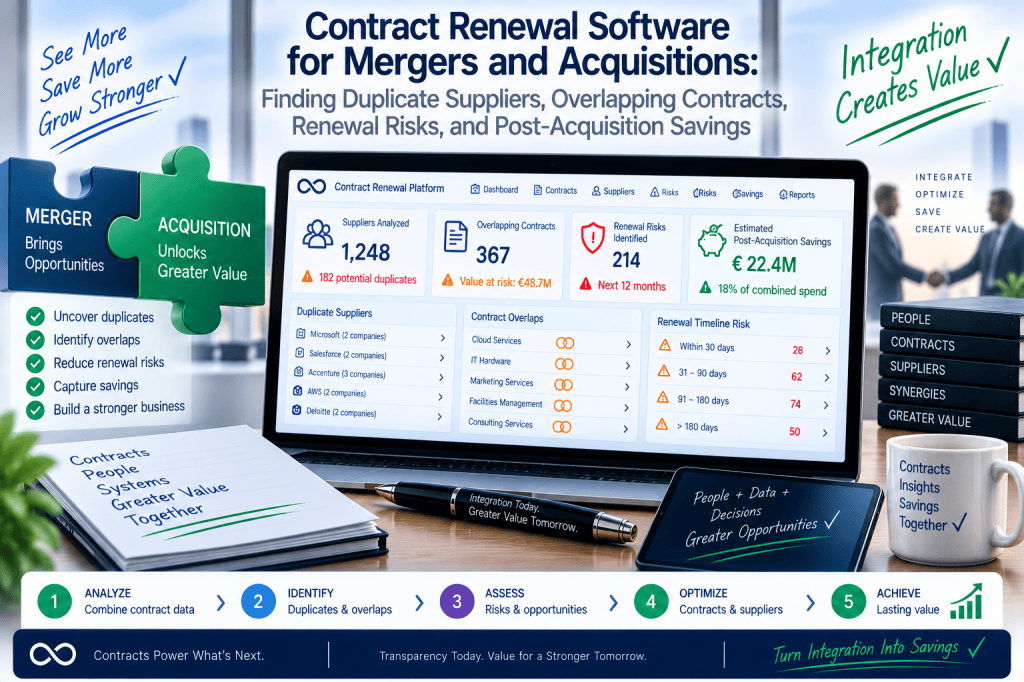
Why Contract Renewals Matter After an Acquisition
Most acquisition integration programs focus quickly on:
- people;
- systems;
- finance;
- customers;
- legal entities;
- operations.
Supplier contracts can be less visible.
Yet they may represent millions in recurring commitments.
A newly acquired company could have:
400 contracts.
The acquiring company:
1,500.
Combined:
1,900.
Some are duplicates.
Some are strategic.
Some auto-renew.
Some have 30-day notice periods.
Others require six months.
The first question should be:
Which contracts require action before we lose the opportunity to rationalize them?
M&A Contract Rationalization Is a Timing Problem
Suppose both companies use:
different CRM platforms.
The acquisition strategy is to standardize on:
one.
That sounds straightforward.
But if the acquired company’s CRM agreement auto-renews next month and requires:
90 days’ notice,
the rationalization opportunity may already have been missed.
The technical consolidation plan and the contractual renewal calendar therefore need to be connected.
Contract Renewal Tracker for M&A
A renewal-management platform can help structure the process as:
Import Both Contract Portfolios
↓
Normalize Suppliers
↓
Identify Overlap
↓
Map Notice Deadlines
↓
Prioritize Near-Term Renewals
↓
Decide Consolidate / Retain / Exit
↓
Track Savings and Execution
This turns contract integration into an actionable workstream.
Integrating an Acquired Contract Portfolio?
Do not begin by cleaning every historical record.
Start with contracts that create near-term financial or operational exposure.
Contract Renewal Tracker can provide a central renewal view across acquiring and acquired businesses so integration teams can identify duplicate suppliers, overlapping services, auto-renewals, and upcoming decision windows before opportunities disappear.
Turn inherited contracts into an M&A renewal action plan →
M&A Feature 1: Separate Source Portfolios
During integration, preserve where each contract came from.
For example:
Legacy Company A
Legacy Company B
This matters for:
- auditability;
- ownership;
- integration tracking.
Do not erase acquisition provenance immediately.
M&A Feature 2: Legal Entity Mapping
Each inherited agreement belongs to:
a specific legal entity.
Track:
- acquiring entity;
- acquired entity;
- future target entity if novation is planned.
This supports legal and financial integration.
M&A Feature 3: Supplier Normalization
This is one of the most important steps.
Company A may record:
Microsoft.
Company B:
Microsoft Ireland Operations Ltd.
Another record:
MSFT.
Normalize them under:
Supplier Group: Microsoft
while preserving:
the actual legal counterparty.
Now overlap becomes visible.
Example
Before normalization:
Microsoft — €400K.
MSFT — €180K.
Microsoft Ireland — €250K.
After normalization:
Microsoft Group Total:
€830K.
That changes the negotiation perspective immediately.
M&A Feature 4: Duplicate Supplier Detection
The system should identify:
suppliers used by both organizations.
For example:
| Supplier | Company A | Company B | Combined |
|---|---|---|---|
| Microsoft | €400K | €250K | €650K |
| Adobe | €90K | €70K | €160K |
| Salesforce | €300K | €180K | €480K |
This provides a first consolidation map.
M&A Feature 5: Overlapping Product Detection
Duplicate supplier does not always mean duplicate service.
But product-level overlap matters.
For example:
Company A:
Salesforce.
Company B:
HubSpot.
Different supplier.
Same broad business function.
That may represent:
application rationalization opportunity.
M&A Feature 6: Category Mapping
Map contracts into categories such as:
- CRM;
- Finance;
- HR;
- Collaboration;
- Cybersecurity;
- Cloud;
- Facilities;
- Telecom;
- Insurance;
- Professional Services.
This helps identify functional overlap across different vendors.
Example
Company A:
Project Tool X.
Company B:
Project Tool Y.
Combined annual spend:
€140K.
Strategic standard:
Tool X.
Decision:
Do not renew Tool Y.
Potential recurring savings:
€60K.
M&A Feature 7: Renewal Deadline Overlay
Duplicate detection alone is not enough.
You need to know:
when action is possible.
For example:
Tool Y:
Notice deadline in 40 days.
That makes it:
high priority.
Another duplicate:
notice deadline in 11 months.
Lower urgency.
M&A Priority Formula
Conceptually:
Overlap Value
Notice Deadline Proximity
Strategic Fit
Migration Complexity
=
Integration Priority
This creates a much stronger M&A work queue.
M&A Feature 8: Auto-Renewal Risk
Acquired contracts may continue automatically while integration teams are still reviewing them.
A dashboard should show:
Acquired Auto-Renewing Spend
€4.2M.
Notice Deadlines <90 Days
€1.1M.
No Integration Decision
€650K.
That €650K deserves immediate attention.
M&A Feature 9: Contract Owner Revalidation
Owners frequently change after acquisitions.
An inherited contract may still list:
someone who has:
- left;
- changed roles;
- been made redundant.
That is dangerous.
Owner Revalidation Workflow
For every material acquired contract:
Existing Owner
↓
Still Active?
↓
Still Responsible?
↓
Reassign if Needed
This should happen early.
M&A Feature 10: Integration Owner
You may also want:
a separate integration owner.
For example:
Contract Owner:
IT Applications Director.
Integration Owner:
M&A Technology Lead.
This distinguishes:
business ownership
from:
integration execution.
M&A Feature 11: Strategic Disposition
Each contract should eventually receive a disposition such as:
Retain
Consolidate
Replace
Terminate
Renegotiate
Temporarily Extend
This becomes the contract integration plan.
Example
Adobe licenses:
Consolidate.
Legacy CRM:
Terminate.
Cybersecurity provider:
Retain temporarily.
Telecom:
Renegotiate.
This makes the portfolio actionable.
M&A Feature 12: Retention Decision
Some acquired contracts may be superior to the acquiring company’s agreements.
Do not assume:
acquirer standard always wins.
Compare:
- price;
- capability;
- terms;
- performance.
Sometimes the acquired supplier should become:
the group standard.
M&A Feature 13: Contract Consolidation Candidate
A contract becomes a consolidation candidate when:
- same supplier;
- same service;
- overlapping term;
- combined volume creates leverage.
The system can flag these automatically.
Example
Company A:
500 licenses.
Company B:
300 licenses.
Separate contracts.
Potential:
800-license group agreement.
This may improve:
pricing and administration.
M&A Feature 14: Volume Leverage
Combined organization size may create:
better commercial tiers.
For example:
Before acquisition:
Company A pays €500/user.
Company B pays €550/user.
Combined volume may justify:
€450/user.
This becomes a classic synergy opportunity.
M&A Feature 15: Price Comparison
The same supplier may charge:
different prices.
Example:
Company A:
€42/user/month.
Company B:
€55.
That information strengthens:
renegotiation.
M&A Feature 16: Term Comparison
Different entities may also have:
different:
- notice periods;
- liability terms;
- payment terms;
- price caps.
This creates an opportunity to adopt:
the better commercial structure.
Example
Company A payment terms:
Net 30.
Company B:
Net 60.
Future group contract:
Net 60.
That creates working-capital improvement.
M&A Feature 17: Renewal Cap Comparison
Company A:
annual uplift capped at 3%.
Company B:
uncapped.
Future negotiation should aim for:
the better term.
This is another source of synergy beyond headline price.
M&A Feature 18: Application Rationalization
Technology overlap is often one of the largest post-acquisition contract opportunities.
Examples:
- CRM;
- ERP;
- HRIS;
- collaboration;
- project management;
- analytics;
- security.
Contract renewal timing determines:
how quickly rationalization can create savings.
Application Rationalization Matrix
For each duplicate:
| System | Cost | Users | Strategic Fit | Notice Deadline | Decision |
|---|---|---|---|---|---|
| CRM A | €300K | 400 | High | 8 months | Retain |
| CRM B | €180K | 220 | Low | 60 days | Terminate |
This makes integration planning concrete.
M&A Feature 19: Migration Lead Time
Do not terminate a duplicate system before:
users and data can move.
Track:
Migration Ready Date
and:
Contract End Date
This prevents:
business disruption.
Example
Legacy HR system:
Contract end:
December 31.
Replacement migration ready:
March 1.
Gap:
2 months.
Decision:
Bridge extension required.
That is better than:
either service disruption
or accidental full-year renewal.
M&A Feature 20: Bridge Extension
Post-acquisition integrations often slip.
A short extension can be much cheaper than:
another 12-month term.
Track:
- extension duration;
- extension cost;
- final exit date.
This is a critical M&A capability.
M&A Feature 21: Transition Service Agreements
Some acquisitions include:
TSAs.
These agreements have:
specific end dates.
They should be tracked alongside:
replacement readiness.
A missed TSA exit can be:
expensive.
TSA Renewal Risk
Track:
- TSA service;
- end date;
- exit dependency;
- internal replacement owner.
This is a highly relevant post-deal use case.
M&A Feature 22: Facilities Overlap
If companies operate:
nearby offices,
leases and local services may overlap.
Renewal dates create:
consolidation opportunities.
Examples:
- offices;
- cleaning;
- telecom;
- security.
M&A Feature 23: Insurance Rationalization
Both organizations may have:
separate policies.
Integration may allow:
group coverage.
But timing and legal requirements matter.
Track:
policy renewal windows.
M&A Feature 24: Professional Services Contracts
Acquired companies may have:
consultants,
agencies,
outsourced providers.
Review:
whether these remain necessary post-integration.
Some exist only because:
the acquired company lacked internal capability.
M&A Feature 25: Data and Research Subscriptions
These are commonly duplicated.
Examples:
analyst services,
market data,
legal databases.
Renewal rationalization can create:
quick savings.
M&A Feature 26: Supplier Criticality
Not every duplicate should be terminated immediately.
Some suppliers are:
critical to integration.
Track:
criticality.
For example:
Low.
Medium.
High.
Critical.
This prevents over-aggressive savings decisions.
M&A Feature 27: Integration Dependency
A contract may support:
the acquisition integration itself.
Examples:
data migration consultant.
temporary IT platform.
These may need:
short-term retention.
The system should understand:
integration dependency.
M&A Feature 28: Synergy Classification
Track savings by type.
For example:
Duplicate Tool Removal
Supplier Consolidation
Volume Discount
Contract Term Improvement
Demand Reduction
Service Elimination
This improves synergy reporting.
M&A Feature 29: Potential vs Realized Synergy
Do not report:
all identified overlap
as savings.
Use statuses:
Identified
↓
Validated
↓
Contracted
↓
Realized
This creates credible reporting.
Example
Potential duplicate software savings:
€500K.
Validated:
€350K.
Contracted:
€280K.
Realized:
€220K.
This tells the real story.
M&A Feature 30: Synergy Owner
Each opportunity should have:
an owner.
For example:
Supplier Consolidation:
Procurement.
Application Rationalization:
IT.
Facilities:
Operations.
Insurance:
Finance/Risk.
This prevents savings from remaining theoretical.
M&A Feature 31: Synergy Target Date
Track:
when the saving should become real.
Often:
the next renewal date.
This makes contract renewal the mechanism for:
synergy capture.
Example
Current duplicate tool:
€100K/year.
Notice deadline:
March.
Contract ends:
June.
Saving becomes effective:
July.
This is much more precise than:
“€100K synergy.”
M&A Feature 32: One-Time Exit Costs
Savings should be net of:
transition costs.
Example:
Annual savings:
€200K.
Migration cost:
€80K.
Year 1 net:
€120K.
Year 2:
€200K.
This creates more credible business cases.
M&A Feature 33: Termination Fees
Some contracts require:
early termination fees.
These must be included when evaluating:
exit.
Do not assume:
duplicate contract = immediate saving.
M&A Feature 34: Minimum Commitments
Cloud or software contracts may contain:
minimum spend.
This can delay:
consolidation economics.
Track:
remaining commitment.
M&A Feature 35: Novation Requirements
A contract may need to move from:
acquired entity
to:
new group entity.
That can require:
supplier consent.
Track:
novation status.
This is important for legal integration.
M&A Feature 36: Change-of-Control Clauses
Some contracts contain:
change-of-control provisions.
These may trigger:
notice,
consent,
or:
termination rights.
Legal review should identify:
material clauses.
Change-of-Control Work Queue
For example:
Consent Required
8 contracts.
Notice Required
Termination Right Triggered
This is highly relevant immediately after a transaction.
M&A Feature 37: Assignment Restrictions
Some contracts cannot be:
assigned freely.
Track:
assignment rules.
Again:
legal review required.
M&A Feature 38: Data Processing and Security Review
Acquisition integration may change:
how data flows between entities.
Technology supplier agreements may require:
updated DPA or security review.
This can become part of:
renewal or novation workflow.
M&A Feature 39: Contract Repository Consolidation
The acquired company may store:
documents in:
SharePoint.
Dropbox.
CLM.
Local drives.
Renewal Tracker should at least know:
where the governing document resides.
Document consolidation can happen:
progressively.
M&A Feature 40: Data Completeness Score
Acquired contract records are often messy.
Measure:
- owner coverage;
- end-date coverage;
- notice-period coverage;
- contract-value coverage.
This gives integration teams:
a quality baseline.
Example
Acquired Company:
420 contracts.
End Date Complete:
92%.
Notice Period:
54%.
Owner:
71%.
Annual Value:
80%.
Now you know:
where remediation is needed.
Do Not Clean Everything Before Taking Action
This is critical in M&A.
If a contract’s notice deadline is:
20 days away,
do not wait for:
perfect taxonomy.
Act.
Use a risk-based model.
M&A Priority Tier 1
Contracts with:
- notice deadline <60 days;
- auto-renewal;
- high value;
- duplicate service.
Review immediately.
Tier 2
Strategic suppliers
or:
large savings opportunities
within:
180 days.
Tier 3
Longer-term portfolio cleanup.
This sequence protects:
near-term value.
M&A Contract Integration Dashboard
A useful dashboard could show:
Total Imported Contracts
1,900.
Acquired Contracts
Duplicate Suppliers
Overlapping Services
Notice Deadlines <90 Days
Auto-Renewing Spend at Risk
€2.1M.
Validated Synergy Opportunities
€1.4M.
This is highly actionable.
CIO M&A Dashboard
Technology-focused:
Duplicate Applications
Annual Overlap Cost
€1.8M.
Migration Risk
5 Critical.
Contracts Requiring Bridge Extension
This helps:
technology integration leadership.
Procurement M&A Dashboard
Duplicate Suppliers
Combined Spend
€18M.
Consolidation Candidates
Near-Term Negotiation Windows
This helps:
synergy capture.
CFO M&A Dashboard
Identified Contract Synergies
€3.2M.
Validated
€2.1M.
Contracted
€1.4M.
Realized
€900K.
One-Time Exit Costs
€300K.
This creates:
credible financial reporting.
Legal M&A Dashboard
Change-of-Control Review Required
Assignment Restrictions
Novations Pending
Notice Deadlines Critical
This provides:
legal control.
M&A KPI 1: Contract Inventory Coverage
Percentage of acquired material agreements:
captured.
KPI 2: Notice Deadline Coverage
Critical for:
actionability.
KPI 3: Duplicate Supplier Identification
How quickly overlap is found.
KPI 4: Duplicate Application Identification
Important for:
technology synergies.
KPI 5: Validated Savings
Realistic synergy pipeline.
KPI 6: Realized Savings
Actual financial benefit.
KPI 7: Contract Consolidation Rate
Percentage of:
identified duplicates
successfully consolidated.
KPI 8: Missed Renewal Rate
Should remain:
very low.
KPI 9: Owner Reassignment Coverage
How many inherited contracts have:
valid owners.
KPI 10: Integration Exit Readiness
Contracts scheduled for termination with:
replacement ready.
These create a strong M&A scorecard.
Contract Renewal Tracker as a Post-Merger Integration Tool
This is an interesting expansion opportunity.
Most contract-management products focus on:
repository or lifecycle.
Contract Renewal Tracker can focus on:
time-to-action.
That is particularly useful in:
post-merger integration.
The Strategic Insight
Not every contract needs to be renegotiated:
immediately.
The next renewal window determines:
when an opportunity becomes actionable.
Therefore:
The renewal calendar can become the sequencing mechanism for supplier synergy capture.
That is a powerful concept.
Example
20 duplicate supplier relationships.
Rather than launching:
20 sourcing events at once,
prioritize by:
next notice deadline.
This spreads:
integration workload
and:
captures value progressively.
M&A Integration Roadmap
Day 1–30
Inventory and urgent deadlines.
Day 30–90
Duplicate suppliers and quick wins.
Month 3–6
Application rationalization.
Month 6–12
Supplier consolidation.
12+ Months
Strategic contract standardization.
This aligns:
integration work
with:
contractual windows.
Quick Wins
Typical quick wins may include:
- duplicate SaaS;
- unused subscriptions;
- research tools;
- support contracts.
These can often be terminated:
relatively easily.
Medium-Term Synergies
Examples:
- telecom;
- facilities;
- professional services;
- software consolidation.
These may require:
some transition.
Strategic Synergies
Examples:
- ERP;
- cloud;
- CRM;
- major outsourcing.
These require:
longer timelines.
Contract renewal software helps:
sequence them correctly.
Contract Renewal Tracker Beta and M&A
The first beta does not need:
an M&A module.
But the architecture already being designed around:
- tenant;
- suppliers;
- contracts;
- ownership;
- history;
can later support:
acquired-company portfolios.
This is another reason to preserve:
source and organizational metadata.
Post-Beta M&A Feature 1
Add:
Source Organization.
Post-Beta M&A Feature 2
Add:
Contract Disposition.
Retain / Consolidate / Exit.
Post-Beta M&A Feature 3
Add:
Synergy Value.
Post-Beta M&A Feature 4
Add:
Integration Owner.
Post-Beta M&A Feature 5
Add:
Realization Status.
This could create:
a focused M&A contract integration module.
AI for M&A: Duplicate Supplier Detection
AI could help normalize:
supplier names.
Then identify:
group overlap.
For example:
The acquired company has 14 suppliers that also exist in the parent portfolio.
This accelerates:
analysis.
AI for M&A: Application Overlap
AI could classify:
product function.
For example:
Two CRM products, three project-management tools, and two endpoint-security platforms overlap across the combined organization.
This supports:
rationalization.
AI for M&A: Contract Term Comparison
For the same supplier:
Parent contract has a 3% annual price cap; acquired-company contract has no cap.
Useful:
negotiation insight.
AI for M&A: Priority Ranking
A future assistant could say:
These eight contracts should be reviewed first because they combine duplicate functionality, high annual value, and notice deadlines within 90 days.
That is exactly the type of:
M&A renewal intelligence
that could differentiate the product.
AI for M&A: Synergy Summary
For example:
€1.4M of validated contract synergies have been identified. €600K relates to duplicate software, €450K to supplier consolidation, and €350K to service elimination.
This can support:
integration reporting.
AI Should Not Invent Savings
Potential savings must remain:
evidence-backed.
AI can:
identify opportunity.
Procurement and Finance should:
validate the value.
This is essential.
Product Positioning for M&A
A strong message could be:
Turn Acquired Contract Portfolios Into Actionable Renewal Synergies.
Very strong.
Another
Find Duplicate Suppliers Before Their Contracts Renew Again.
Simple and compelling.
Another
Use Renewal Dates to Sequence Post-Merger Contract Consolidation.
This is more strategic.
Another
From Contract Inventory to Synergy Realization.
Excellent enterprise positioning.
Lead Magnet Opportunity
This article is ideal for a:
M&A Contract Integration Checklist
Sections:
- inventory;
- supplier normalization;
- notice deadlines;
- change-of-control;
- duplicate suppliers;
- duplicate software;
- owner reassignment;
- consolidation;
- synergy tracking.
This could attract:
M&A integration teams,
Procurement,
CFO offices,
and:
private equity operating teams.
Suggested CTA
Download the M&A Contract Integration Checklist
Review acquired contract portfolios using a structured process for supplier normalization, renewal deadlines, duplicate services, change-of-control clauses, ownership, consolidation opportunities, and synergy realization.
Download the Free M&A Checklist →
Second Lead Magnet
Another high-value resource:
Post-Acquisition Supplier Synergy Tracker
Columns:
- supplier;
- acquiring-company spend;
- acquired-company spend;
- overlap;
- notice deadline;
- consolidation strategy;
- potential synergy;
- validated synergy;
- realization date.
This could be especially valuable for:
corporate development and procurement teams.
Commercial CTA
Integrating an Acquired Contract Portfolio?
Contract Renewal Tracker can help centralize inherited agreements, identify duplicate suppliers and near-term renewal deadlines, assign integration ownership, and create a structured pipeline for consolidation opportunities before contracts automatically roll into another term.
Join the Contract Renewal Tracker Beta →
Contract Renewal Tracker Beta Launch — September 21, 2026
Contract Renewal Tracker is launching its first SaaS beta on September 21, 2026. The initial beta focuses on the renewal-management foundation: centralizing contracts, notice periods, owners, values, and upcoming actions so organizations can move beyond disconnected spreadsheets and calendar reminders. That same foundation can later support more advanced use cases such as post-acquisition contract consolidation, supplier overlap analysis, M&A synergy tracking, and multi-entity renewal intelligence. Notify Me When the Beta Launches → (One launch notification only — no newsletter or ongoing marketing emails.)
Final Thoughts
M&A contract integration is not only:
an inventory exercise.
It is:
a sequencing problem.
The organization needs to understand:
What Did We Inherit?
↓
Where Is the Overlap?
↓
When Can We Act?
↓
What Should We Consolidate?
↓
What Does It Save?
↓
Has the Saving Actually Been Realized?
The renewal deadline is what turns:
a theoretical synergy
into:
an actionable opportunity.
That makes contract renewal software particularly relevant after acquisitions.
For Contract Renewal Tracker, M&A represents a compelling enterprise extension because the platform’s core data model—contracts, suppliers, owners, notice deadlines, entities, and financial values—can eventually support a much larger use case:
helping organizations systematically convert inherited contract complexity into measurable post-acquisition savings and better supplier control.
Next Article in the Contract Renewal Tracker Series
Article 99 — “Contract Renewal Software for Private Equity Portfolio Companies: Managing Vendor Spend, SaaS Costs, Contract Synergies, and Renewal Savings Across Multiple Businesses”
This would build naturally on the M&A and multi-entity themes while targeting a particularly valuable commercial segment: private equity operating teams and portfolio companies that want repeatable procurement and contract-renewal savings across several independently managed businesses.

