One of the biggest mistakes in contract renewal management is starting with the supplier.
The organization receives a renewal quote.
Procurement starts negotiating.
Finance checks the budget.
Legal reviews the terms.
But nobody first asks the most important question:
Do we still need to buy the same thing at all?
That question belongs in the business review.
A strong renewal process should challenge the underlying need before commercial negotiation begins.
The organization should review:
- actual usage;
- business value;
- scope;
- service levels;
- duplicate capabilities;
- future demand;
- user adoption;
- strategic fit.
A dedicated Contract Renewal Tracker can make that review a standard part of every material renewal.
The objective is to decide:
Should we renew, reduce, replace, or terminate before procurement spends time negotiating price?
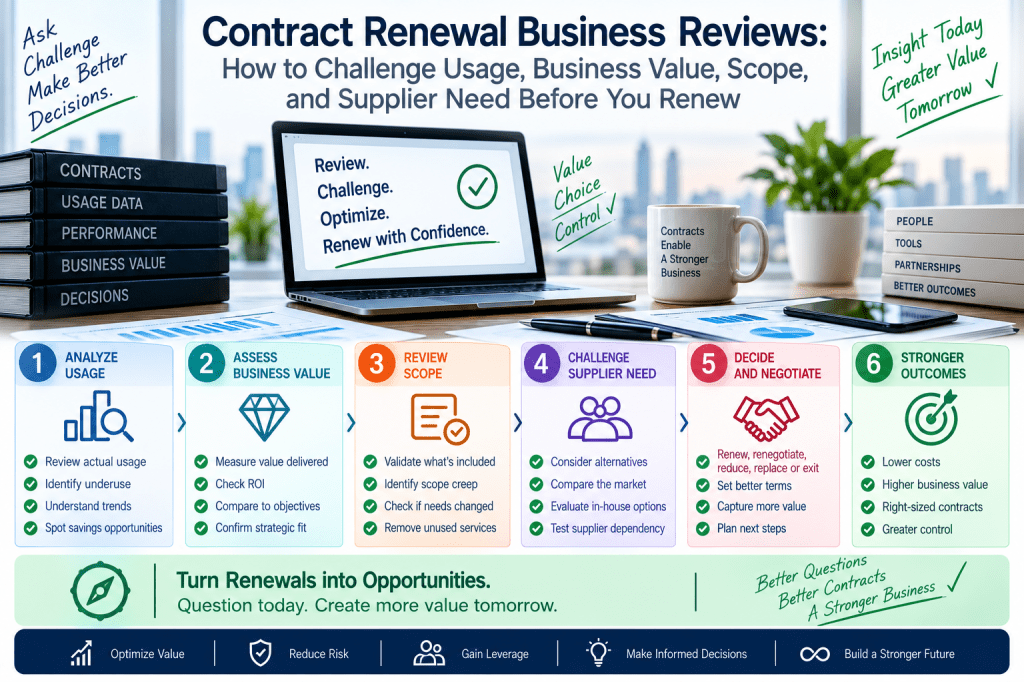
Why the Business Review Comes Before Negotiation
Suppose a SaaS contract costs:
€500,000 per year
The supplier proposes:
€550,000
Procurement might try to negotiate the increase down.
But if the organization only uses:
60% of the licenses
the much bigger opportunity may be to reduce quantity.
If the company needs only:
600 of 1,000 licenses,
then negotiating the existing quantity misses the real opportunity.
That is why demand validation comes first.
Before You Negotiate the Price, Challenge the Need
Many organizations renew unnecessary scope simply because last year’s contract becomes this year’s baseline.
Contract Renewal Tracker is designed to force a structured business review before renewal so contract owners can confirm actual need, usage, value, and future demand.
Stop renewing last year’s assumptions automatically →
The Core Business Review Question
Every material renewal should begin with:
If we were buying this service for the first time today, would we buy the same scope, quantity, supplier, and contract term?
That question removes historical inertia.
It forces the business to reconsider the contract based on current reality.
Business Review Outcomes
A structured review should lead to one of several decisions:
Renew As-Is
Renew and Reduce
Renegotiate
Replace
Terminate
Extend Temporarily
This gives procurement a clear starting position.
Business Review 1: Do We Still Need the Service?
The simplest question is often the most powerful.
Is this service still required?
Business priorities change.
Projects end.
Systems are replaced.
Teams reorganize.
A contract that was valuable three years ago may no longer serve a meaningful purpose.
Example
Annual subscription:
€48K.
Original purpose:
temporary transformation project.
Project status:
completed 14 months ago.
Current active users:
Decision:
Terminate
Potential avoided annual spend:
€48K
No supplier negotiation was necessary.
Business Need Status
Useful classifications include:
Critical
Must continue.
Important
Strong business value.
Useful
Some value but alternatives possible.
Low Value
Limited ongoing benefit.
No Longer Required
Termination candidate.
This gives procurement and finance useful context.
Business Review 2: Measure Usage
For software and subscription contracts, usage is often the best demand signal.
Possible metrics include:
- purchased users;
- assigned users;
- active users;
- login frequency;
- feature usage.
Example License Review
Purchased:
1,000.
Assigned:
Monthly Active:
Weekly Active:
Renewal quantity should probably not automatically remain:
1,000.
This creates an optimization opportunity.
Utilization Rate
A simple metric:
Active Users ÷ Purchased Licenses
610 ÷ 1,000
=
61%
This can trigger a review.
Utilization Thresholds
For example:
>85%
Healthy.
70–85%
Review growth needs.
50–70%
Optimization opportunity.
<50%
Major reduction review.
Thresholds vary by product and use case.
Usage Does Not Always Mean Logins
Different contracts need different utilization metrics.
For cloud:
consumption
For telecom:
active lines
For consulting:
hours used
For facilities:
locations served
For insurance:
usage may not be the right concept at all.
The business review should match the category.
Business Review 3: Identify Unused Capacity
Contracts often contain unused capacity because organizations bought for expected growth.
For example:
Committed cloud capacity:
€1.2M.
Actual consumption:
€820K.
Unused commitment:
€380K.
The renewal should challenge the commitment level.
Committed vs Actual Consumption
A Contract Renewal Tracker can surface:
Current Commitment
Actual Usage
Forecast Need
This provides a much stronger negotiation baseline.
Business Review 4: Forecast Future Demand
Usage history alone is not enough.
The organization must also ask:
What will we need next year?
A product may currently have low usage because rollout is incomplete.
Or current usage may be high but expected to decline after a business unit closes.
Future demand matters.
Demand Forecast Example
Current licenses:
1,000.
Current active:
Expected new employees:
+200.
Expected departures:
−50.
Forecast need:
approximately:
1,000.
In this case, reducing licenses may be inappropriate even though current utilization is only 85%.
Business Owner Forecast
Useful options:
Increase
Stable
Decrease
Unknown
Unknown should trigger additional review rather than automatic renewal.
Business Review 5: Measure Business Value
Usage alone is not enough.
A system may have:
high usage
but:
low value.
For example:
Employees may be forced to use a difficult application because no alternative exists.
The business review should ask whether the supplier is actually producing outcomes.
Business Value Questions
Examples include:
- Does this contract support a critical process?
- What business outcomes does it enable?
- What would happen if we stopped using it?
- Are alternatives available?
- Is the value increasing or declining?
These questions make the review strategic.
Business Value Score
For example:
Strategic Impact
9/10.
Productivity Impact
8/10.
User Satisfaction
5/10.
Replacement Availability
3/10.
Overall Business Value:
High
This helps interpret commercial options.
High Usage + Low Value
This is an important pattern.
A system can be heavily used because it is embedded in the workflow.
That does not mean it is the best solution.
If:
usage high
but:
satisfaction low
and:
alternatives strong,
a replacement assessment may be justified.
Low Usage + High Value
The reverse can also occur.
For example:
Disaster recovery service.
Rarely used.
But extremely important.
Low utilization should not imply termination.
This is why business context matters.
Business Review 6: Challenge Scope
A contract may include more services than the organization needs.
For example:
Managed Services Contract:
- 24/7 support;
- onsite engineer;
- weekend coverage;
- legacy platform support.
Current requirement:
- business-hours remote support only.
Renewal creates an opportunity to remove unnecessary scope.
Scope Reduction Example
Current annual cost:
€600K.
Weekend coverage:
€80K.
Onsite service:
€70K.
Legacy support:
€50K.
No longer needed:
€200K of scope.
Potential future spend:
€400K.
This can create far more value than a small price discount.
Business Review 7: Identify Duplicate Capabilities
The organization may already have another tool or supplier providing similar functionality.
Examples:
- two project-management platforms;
- multiple survey tools;
- duplicate security products;
- overlapping data services.
The business owner may not know about the overlap.
Portfolio intelligence can help.
Duplicate Capability Alert
For example:
This contract appears to overlap with two other active agreements in the Project Management category.
The business review can then ask:
Is separate renewal justified?
Consolidation Candidate
If the answer is no:
the renewal becomes:
Consolidation Opportunity
rather than:
standard renewal.
Business Review 8: Assess Supplier Performance
The supplier scorecard from the previous article can feed directly into the review.
For example:
Supplier Score:
62/100.
Performance:
Below target.
Pricing:
Above benchmark.
Business Satisfaction:
Low.
Now the business review has strong evidence to consider replacement.
Business Value + Supplier Performance
These should be evaluated together.
High Business Value + Strong Supplier
Renew.
High Value + Weak Supplier
Replace or improvement plan.
Low Value + Strong Supplier
Reduce / terminate.
Low Value + Weak Supplier
Strong termination candidate.
This is a useful matrix.
Business Review 9: Review User Satisfaction
For employee-facing tools, user feedback matters.
A short survey could ask:
- How satisfied are you?
- What would break if this disappeared?
- Which alternatives exist?
This can reveal issues usage data cannot.
User Satisfaction Example
Usage:
88%.
Satisfaction:
4.8/10.
That is a warning sign.
Procurement should not assume high adoption means users are happy.
Business Review 10: Review Support Experience
Recurring support problems may change the renewal strategy.
For example:
Critical tickets:
Open escalations:
Business review recommendation:
Renew only with performance commitments
or:
Evaluate replacement
Business Review 11: Check Strategic Fit
Business strategy changes.
A contract may support technology or processes the organization plans to retire.
For example:
Current platform:
On-premise.
Strategy:
Cloud migration.
Contract renewal:
36 months.
That could create unnecessary lock-in.
Strategic Alignment
Useful categories:
Aligned
Neutral
Misaligned
A misaligned contract should receive stronger review.
Example
Supplier supports:
legacy ERP.
Planned retirement:
18 months.
Supplier wants:
36-month renewal.
Recommendation:
Short extension only
This preserves flexibility.
Business Review 12: Review Internal Alternatives
Before replacing a supplier externally, ask:
Do we already have something else internally?
For example:
Business Unit A wants to renew analytics tool.
Enterprise already owns another platform with unused capacity.
Potential result:
Internal Consolidation
This can eliminate spend entirely.
Existing Enterprise Agreement
A particularly common SaaS problem:
one department pays separately
while:
enterprise license already includes the functionality.
The Contract Renewal Tracker can flag this.
Business Review 13: Challenge Contract Quantity
Quantities should be explicitly approved.
For example:
Supplier proposes:
1,000 licenses.
Business owner approves:
Procurement negotiates:
This prevents quantity drift.
Quantity Approval
The system could require:
Current Quantity
Requested Renewal Quantity
Reason for Change
This creates a clear record.
Quantity Variance
For example:
Current:
1,000.
Renewal:
Reduction:
25%.
This automatically feeds the savings model.
Business Review 14: Challenge Service Tier
A supplier may offer:
Basic.
Professional.
Enterprise.
The organization may currently be on:
Enterprise
but only use:
Professional-level features.
Downgrading can create savings.
Feature Utilization
Example:
Enterprise features used:
2 of 12.
Premium tier uplift:
€80K/year.
Business review can ask:
Is Enterprise tier still justified?
This is a strong SaaS optimization use case.
Business Review 15: Review Add-Ons
Contracts often accumulate optional components.
Examples:
- premium support;
- analytics module;
- sandbox environments;
- extra storage;
- training packages.
Each should be challenged before renewal.
Add-On Review Table
For example:
| Add-On | Cost | Usage | Decision |
|---|---|---|---|
| Premium Support | €40K | High | Keep |
| Training | €25K | Low | Remove |
| Sandbox | €18K | None | Remove |
Potential reduction:
€43K
Again, demand reduction beats price negotiation.
Business Review 16: Review Locations
For facilities, telecom, and network contracts:
locations change.
A contract may still include:
- closed offices;
- unused lines;
- decommissioned sites.
Renewal should reconcile actual footprint.
Example
Telecom sites contracted:
Active sites:
Remove:
Potential annual reduction:
€72K.
This is straightforward optimization.
Business Review 17: Review Professional Services Scope
Consulting agreements often renew based on historical scope.
Ask:
- Are the same skills still needed?
- Can internal teams perform the work?
- Can rates or capacity be reduced?
This may create substantial savings.
Contractor / Consultant Review
Current external consultants:
Business forecast:
12 needed.
Potential reduction:
This becomes a scope optimization opportunity.
Business Review 18: Challenge “Just in Case” Capacity
Organizations often pay for contingency capacity.
Some contingency is justified.
But it should be explicit.
For example:
Active users:
Forecast:
Current licenses:
1,000.
Why the extra 250?
If the answer is:
Just in case,
the business should quantify the required buffer.
Capacity Buffer Policy
For example:
Approved buffer:
10%.
Forecast:
Allowed quantity:
Now procurement has a defensible quantity target.
Business Review 19: Review Internal Cost Allocation
Sometimes business units behave differently when they do not see the cost.
Showing:
Annual Cost
Cost per User
can improve decision quality.
For example:
Department uses:
20 licenses.
Cost:
€2,000 each.
Annual cost:
€40K.
The owner may reconsider whether all 20 are necessary.
Cost Visibility Drives Better Decisions
A simple business review should always show:
This decision creates €X of annual spend.
Do not ask users:
Do you still need AnalyticsPro?
Ask:
Do you still need AnalyticsPro at €180K per year?
The second question creates better accountability.
Business Review 20: Review Total Commitment
If supplier offers:
three-year term,
the business owner should see:
Annual:
€500K.
Total:
€1.5M.
This makes the decision more concrete.
Internal Review Form
A business owner should not face a 50-field questionnaire.
A strong review can be concise.
For example:
1. Is the service still required?
Yes / No.
2. Expected usage next year?
Increase / Same / Reduce.
3. Business value?
High / Medium / Low.
4. Supplier satisfaction?
Good / Acceptable / Poor.
5. Recommended action?
Renew / Reduce / Replace / Terminate.
That may be enough for many contracts.
Adaptive Business Review Forms
More complex contracts can trigger additional questions.
For example:
If:
Reduce
then ask:
What quantity is required?
If:
Replace
ask:
Is an alternative identified?
If:
Terminate
ask:
Is operational transition required?
This keeps forms efficient.
Conditional Questions
Example:
IF renewal_decision = REDUCETHEN require forecast_quantity
Another:
IF renewal_decision = REPLACETHEN require replacement_readiness
This creates structured decision logic.
AI-Generated Business Review Brief
Before the owner completes the review, AI can summarize:
Contract
AnalyticsPro.
Annual Spend
€180K.
Licenses
Active Users
Utilization
62%.
Supplier Performance
78/100.
Internal Overlap
One similar platform detected.
Supplier Proposal
+9%.
Key Question
Does the business still require all 500 licenses?
This gives the owner useful context.
Ask AI: Do We Still Need This Contract?
AI should not make the decision autonomously.
But it can say:
Usage has declined 31% over 12 months, only 62% of purchased licenses are active, and another enterprise platform offers overlapping functionality. This suggests the current scope should be challenged before renewal.
That is valuable decision support.
Ask AI: What Should We Reduce?
The assistant might answer:
Based on current monthly active users and the approved 10% capacity buffer, a renewal quantity around 350–375 licenses appears more consistent with observed demand than the current 500.
This should remain a recommendation requiring owner confirmation.
Ask AI: What Would Termination Affect?
The assistant could summarize:
- users;
- integrations;
- dependent processes;
- replacement readiness.
This helps avoid overly simplistic termination decisions.
Dependency Analysis
Before termination:
What systems depend on the supplier?
What teams use it?
What integrations would break?
This information should feed the business review.
High Dependency + Low Usage
This can be tricky.
For example:
Few users.
But system supports:
critical month-end process.
The review should not recommend termination solely from low usage.
Context matters.
AI Must Explain Its Evidence
For example:
I am suggesting a quantity review because active-user data shows 310 users against 500 licenses for the last six months.
This is much more trustworthy than:
Reduce licenses.
AI Should Flag Missing Evidence
If usage is unavailable:
I cannot assess utilization because no usage data is connected. The business review should rely on owner validation until usage data is available.
This avoids false precision.
Automated Evidence Collection
A mature Contract Renewal Tracker can collect business-review inputs automatically.
For example:
ERP
Spend.
Usage System
Active users.
ITSM
Incidents.
Supplier Scorecard
Performance.
Then the owner simply confirms the decision.
This reduces review burden.
Pre-Populated Business Review
Instead of asking:
How many users are active?
show:
310 active users
and ask:
Is this accurate?
This improves completion rates.
Owner Confirmation
AI and integrations provide evidence.
The business owner provides:
business judgment.
That is the ideal division of responsibility.
Business Review Workflow
A standard workflow might be:
Renewal Window Opens
↓
Evidence Collected
↓
AI Summary Generated
↓
Owner Review
↓
Decision Recorded
↓
Procurement Strategy Starts
This makes business review a formal renewal gate.
Business Review Approval Gate
Procurement should not begin major negotiation before:
Business Need Confirmed
except where time requires parallel work.
This prevents negotiation of unnecessary scope.
Example Gate
IF business_review_status != COMPLETETHEN negotiation_strategy = BLOCKED
For strategic contracts, exceptions may be allowed with authorization.
Business Review SLA
For example:
Owner receives:
10 business days.
At:
7 days:
reminder.
At:
10:
overdue.
At:
13:
manager escalation.
This keeps the renewal moving.
Owner Review Timing
The review should occur early enough to influence the outcome.
For strategic contracts:
180–270 days before notice deadline.
For standard:
90–120.
For low value:
30–60.
The timing should be configurable.
Business Review Risk
If the owner review remains incomplete as the notice deadline approaches:
risk should increase.
This connects business accountability to renewal risk.
Example
Notice deadline:
45 days.
Business review:
not started.
Risk:
High.
Reason:
No confirmed business requirement.
This is a strong operational signal.
Business Review Dashboard
Contract operations might see:
Reviews Due
Completed
Overdue
Value Awaiting Business Decision
€8.4M.
This provides clear management visibility.
Decision Distribution
For example:
Renew As-Is:
48%.
Reduce:
22%.
Renegotiate:
15%.
Replace:
6%.
Terminate:
9%.
This reveals how actively the organization challenges recurring spend.
Reduce / Terminate Rate
A useful metric:
Percentage of business reviews resulting in reduced or eliminated scope.
For example:
18%.
This does not mean higher is always better.
But it shows whether reviews are meaningful.
Business Review Completion Rate
For example:
92%.
Target:
98%.
Low completion can explain downstream procurement delays.
Average Review Cycle Time
Measure:
assignment → decision.
For example:
7.2 days.
This can be improved over time.
Business Owner Response by Department
IT:
5 days.
Marketing:
HR:
This may indicate where escalation or training is needed.
Demand Reduction Value
The system can aggregate:
Annual spend reduction resulting from:
- quantity;
- scope;
- termination.
For example:
€1.8M.
This demonstrates business-review impact.
Termination Opportunities Identified
For example:
Business review identified:
42 termination candidates.
Potential annual spend:
€720K.
Validated:
€510K.
This creates an actionable savings pipeline.
Quantity Reduction Opportunities
For SaaS:
Current licenses:
12,000.
Recommended:
10,200.
Potential reduction:
1,800.
This can aggregate across the portfolio.
Unused License Exposure
Example:
Annual unused-license spend:
€620K.
This becomes a procurement and IT optimization metric.
Scope Optimization Dashboard
SaaS License Reduction
€420K opportunity.
Service Scope Reduction
€280K.
Termination
€510K.
Consolidation
€360K.
This demonstrates that business reviews create value before supplier negotiation even starts.
Business Review and Procurement Strategy
The business decision determines negotiation strategy.
Renew As-Is
Focus on price and terms.
Reduce
Focus on quantity and unit economics.
Replace
Focus on bridge period and exit.
Terminate
Focus on notice execution.
This ensures procurement works on the right objective.
Business Review and Finance
Finance receives:
- expected future demand;
- annual commitment.
This improves budgeting.
Business Review and Legal
Legal becomes involved when:
- termination;
- material scope change;
- replacement.
No need to review every routine business decision.
Business Review and Supplier Scorecard
The two should complement each other.
Business Review
asks:
Do we still need the service?
Supplier Scorecard
asks:
Is this supplier delivering enough value?
Together they create a stronger renewal decision.
Business Review and Portfolio Intelligence
Portfolio intelligence may tell the owner:
Another department buys a similar service.
This can materially change the decision.
Business Review and Benchmarking
The owner may also see:
Current price:
20% above comparable internal contracts.
This reinforces the case for negotiation.
Business Review and Savings Tracking
If scope reduces:
the system automatically creates a:
Demand Reduction Opportunity
with baseline and expected value.
This keeps financial impact traceable.
Business Review Audit Trail
The system should preserve:
- owner decision;
- date;
- evidence;
- comments.
For example:
Reduce licenses from 500 to 350 because average active users have remained below 320 for six months.
This gives future teams valuable context.
Historical Business Decisions
At the next renewal, the system can say:
Last year, licenses were reduced from 500 to 350 due to low utilization. Current usage has now increased to 340.
This creates longitudinal memory.
AI Longitudinal Review
The assistant could ask:
Last year’s reduction eliminated nearly all unused capacity. Current utilization is now 97%, so additional reduction may create operational risk.
This makes future reviews smarter.
Avoid Rubber-Stamp Reviews
A business review that simply asks:
Renew? Yes/No
can become a checkbox exercise.
The review should provide evidence that encourages real consideration.
Present the Cost Prominently
For example:
This decision represents €750K of annual spend and €2.25M over the proposed term.
That changes how the owner approaches the question.
Present Usage
Current utilization: 58%.
Again:
this creates context.
Present Supplier Performance
Supplier score: 61/100.
The owner now has evidence.
Present Overlap
Two similar contracts exist elsewhere in the organization.
This invites a consolidation discussion.
Renewal Challenge Score
A future system could calculate whether a contract deserves deeper business challenge.
Inputs might include:
- low usage;
- poor performance;
- high price;
- duplicate capability.
For example:
Challenge Priority: High
This helps focus owners.
Example
Annual value:
€450K.
Usage:
48%.
Supplier score:
Price:
18% above benchmark.
Overlap:
Yes.
Challenge Priority:
96/100
This is clearly not a routine renewal.
Low Challenge Priority
Annual:
€20K.
Usage:
98%.
Performance:
Price:
Competitive.
No overlap.
Challenge Priority:
10/100.
This can use a simple fast-track process.
Automation by Business Review Outcome
If:
Renew As-Is + low risk
→ standard negotiation or approval.
If:
Reduce
→ procurement quantity review.
If:
Replace
→ sourcing workflow.
If:
Terminate
→ termination workflow.
This makes the decision operational immediately.
Straight-Through Low-Risk Renewal
A small contract with:
- high usage;
- strong supplier;
- no price increase;
may be eligible for simplified renewal.
The business review provides the evidence to safely automate.
Business Review Exceptions
Sometimes urgent renewals lack complete usage data.
The owner may still make:
Provisional Decision
with explanation.
The system can record the uncertainty.
Provisional Decision
For example:
Renew for 12 months only.
Reason:
Usage data incomplete; migration study planned.
This is better than silently accepting a multi-year renewal.
Temporary Extensions as a Business Tool
If the organization is unsure:
short extensions can preserve flexibility.
For example:
6-month bridge.
This can be a deliberate business-review outcome.
Challenge the Term as Well as the Scope
Business value may be uncertain.
Then:
do not sign:
36 months
simply because price is lower.
A shorter term may be more appropriate.
Business Review and Strategic Roadmaps
If the business intends to replace a platform:
the review should know:
- project timeline;
- target go-live.
This prevents renewal from conflicting with transformation plans.
Example
ERP retirement:
15 months.
Supplier proposal:
36 months.
Business recommendation:
18-month extension maximum.
This is a strong strategic alignment use case.
Business Review for M&A
After an acquisition, review:
Is this contract duplicated in the acquiring organization?
Many inherited contracts may become:
Terminate / Consolidate
This makes the business-review process critical during integration.
Business Review for Private Equity
PE-backed companies can use structured reviews to challenge recurring spend during 100-day plans.
Examples:
- unused software;
- overlapping suppliers;
- unnecessary services.
This aligns directly with EBITDA improvement initiatives.
Business Review for Small Businesses
The process can remain simple.
Ask:
- Do we use it?
- Do we need it?
- Is the price acceptable?
- Keep or cancel?
Even this basic discipline can prevent unnecessary renewals.
Business Review for Enterprises
Add:
- usage integrations;
- supplier performance;
- strategy;
- consolidation.
Same principle, greater scale.
Business Review KPIs
Useful metrics include:
Review Completion Rate
Average Response Time
Renew As-Is Rate
Reduction Rate
Termination Rate
Demand Reduction Value
Unused Capacity Identified
These measure whether the process creates value.
Business Review Conversion
For example:
100 reviews.
28 optimization opportunities.
18 implemented.
Conversion:
64%.
This shows whether the review is translating into action.
Business Review Financial Value
Suppose reviews produce:
License reduction:
€400K.
Scope reduction:
€300K.
Terminations:
€500K.
Total recurring reduction:
€1.2M
This can create a very strong business case for the platform.
One Business Review Can Pay for the Platform
Example:
Unused marketing platform:
€60K/year.
Owner confirms:
no longer required.
Contract terminated.
If Contract Renewal Tracker subscription is significantly below €60K, one decision can justify the system.
This is a simple prospect-conversion story.
Contract Renewal Tracker as a Demand Challenge Platform
This is an important product position.
Basic renewal tools ask:
When does it renew?
Contract Renewal Tracker can ask:
Should we still be buying this at all?
That is far more commercially valuable.
From Renewal Reminder to Spend Challenge
The process becomes:
Upcoming Renewal
↓
Usage Evidence
↓
Business Value
↓
Future Demand
↓
Decision
↓
Commercial Action
This pushes cost optimization upstream.
The Best Savings Often Happen Before Negotiation
Consider two procurement approaches.
Approach A
Negotiate 8% discount on:
€500K.
Saving:
€40K.
Approach B
Determine only €350K of service is actually required.
Then negotiate 8%.
Final:
€322K.
Reduction:
€178K
The business review created most of the value.
That is why demand challenge should come first.
Ready to Challenge Every Renewal Before You Commit Again?
Recurring spend should not renew simply because it existed last year.
Contract Renewal Tracker is designed to make every material renewal prove its continuing business value before another commitment is created.
Use Contract Renewal Tracker to:
- request structured business-owner reviews;
- measure usage and utilization;
- forecast future demand;
- identify unused licenses;
- challenge service scope;
- review add-ons;
- detect duplicate capabilities;
- incorporate supplier performance;
- assess strategic fit;
- identify internal alternatives;
- recommend reduce/replace/terminate decisions;
- automate review workflows;
- measure demand-reduction savings;
- use AI to prepare evidence-based business review briefs.
The objective is to move from:
“What price will the supplier give us?”
to:
“What do we actually need next year—and only then, what should we pay for it?”
Start Your Contract Renewal Tracker Subscription →
Final Thoughts
A strong renewal process begins before procurement.
It begins with the business.
The company should first establish:
Need
↓
Usage
↓
Value
↓
Future Demand
↓
Scope
Only then should procurement negotiate.
This changes the renewal conversation from:
Can we get 5% off?
to:
Do we need 100% of what we currently buy?
That is a much more powerful question.
And for Contract Renewal Tracker, it creates one of the clearest financial value propositions in the entire product:
Help organizations stop negotiating unnecessary spend and start eliminating it before it reaches the supplier negotiation table.
Next Article in the Contract Renewal Tracker Series
Article 62 — “Contract Renewal Decision Management: How to Structure Renew, Renegotiate, Reduce, Replace, Extend, or Terminate Decisions”
The next article will focus on the actual decision model that sits between the business review and execution. It will cover decision options, required evidence, decision ownership, confidence, financial impact, replacement readiness, temporary extensions, decision deadlines, conditional decisions, reversals, approvals, audit trails, risk implications, and AI-assisted decision recommendations.
This will bring several earlier themes together and show how Contract Renewal Tracker can turn a vague “renew or cancel?” question into a structured, explainable, and governable decision process.

