Contract renewal management becomes significantly more difficult when an organization operates across multiple locations, subsidiaries, legal entities, countries, or business units.
A single-company contract spreadsheet may work reasonably well.
Then the organization grows.
It opens another office.
Acquires a company.
Creates a new subsidiary.
Expands internationally.
Allows regional teams to negotiate their own supplier agreements.
Before long, contract renewal information is spread across:
- different spreadsheets;
- local shared drives;
- procurement systems;
- finance systems;
- email inboxes;
- calendars;
- individual employees.
Headquarters may know that the organization spends millions with a supplier without knowing:
which entities have contracts with that supplier, when those agreements renew, and who owns each decision.
That creates a fundamental visibility problem.
Multi-entity organizations do not merely need a contract renewal calendar. They need a renewal portfolio that understands organizational structure.
This article explains what contract renewal software should provide when contracts span multiple offices, subsidiaries, countries, legal entities, and business units—and how Contract Renewal Tracker can evolve to support that complexity.
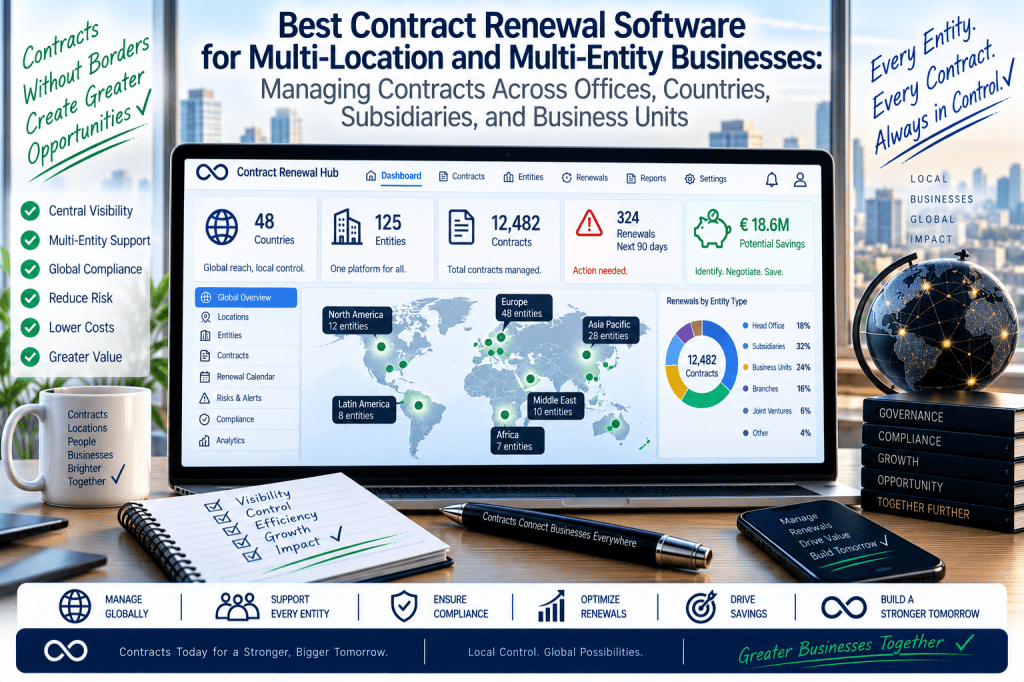
What Is Multi-Entity Contract Renewal Management?
Multi-entity contract renewal management is the process of tracking and coordinating renewal obligations across different organizational units.
Those units might be:
Legal Entities
Subsidiaries
Countries
Regions
Business Units
Departments
Offices
Sites
Instead of maintaining independent renewal lists, the organization creates:
a centralized renewal portfolio
while preserving:
local ownership and access.
The Basic Multi-Entity Structure
A useful hierarchy might look like:
Group
↓
Legal Entity
↓
Business Unit
↓
Location
↓
Contract
For example:
GlobalTech Group
↓
GlobalTech Netherlands BV
↓
Operations
↓
Rotterdam
↓
Facilities Contract
This creates much more context than:
a flat contract list.
Why Multi-Entity Organizations Struggle With Renewals
The problem usually develops gradually.
Company A begins with:
one spreadsheet.
Then it acquires:
Company B.
Company B has:
its own spreadsheet.
Company C maintains:
contracts in SharePoint.
The German office uses:
Excel.
The UK office uses:
a local procurement tool.
The result is:
fragmentation.
The Executive Problem
The CFO asks:
How much supplier spend renews next quarter?
Finance answers:
We know for headquarters, but we’re waiting for the subsidiaries.
Procurement asks:
How many contracts do we have with Supplier X?
Nobody is certain.
Legal asks:
Which entities have contracts containing automatic renewal?
Again:
manual investigation.
This is precisely the problem centralized renewal software should solve.
Managing Renewals Across Multiple Entities?
Separate spreadsheets may work locally, but they make group-level visibility increasingly difficult as subsidiaries, offices, suppliers, currencies, and owners multiply.
Contract Renewal Tracker is designed to create a centralized renewal portfolio while allowing contracts to remain associated with the correct entity, location, owner, and business unit.
Build one view of renewals across your organization →
Multi-Entity Feature 1: Legal Entity
Every contract should be associated with:
the correct contracting entity.
For example:
Example Group BV
is not necessarily the same legal party as:
Example Germany GmbH.
This distinction matters.
Why Legal Entity Matters
Suppose the organization has:
25 Microsoft-related agreements.
Some are signed by:
parent company.
Others by:
local subsidiaries.
Simply grouping them under:
Microsoft
is not enough.
The system must know:
which entity holds which obligation.
Multi-Entity Feature 2: Parent Organization
Subsidiaries should roll up into:
a parent structure.
Example:
Global Holdings
├── Netherlands BV
├── Germany GmbH
├── France SAS
└── UK Ltd
This allows:
group-level reporting.
Multi-Entity Feature 3: Business Unit
Some companies organize purchasing by:
business unit
rather than:
legal entity.
For example:
Consulting.
Software.
Managed Services.
Corporate.
Track both:
legal structure
and:
operational structure
where necessary.
Multi-Entity Feature 4: Location
A contract may apply to:
one specific site.
Example:
Cleaning Agreement.
Legal Entity:
Netherlands BV.
Location:
Rotterdam Office.
This allows:
local Operations
to manage it.
Multi-Entity Feature 5: Region
Useful regions might include:
EMEA.
North America.
APAC.
This gives:
regional leaders
their own renewal portfolios.
Multi-Entity Feature 6: Country
Country is useful for:
- reporting;
- currency;
- local ownership;
- legal context.
It also allows questions such as:
What contracts are renewing in Germany during Q4?
Multi-Entity Feature 7: Contract Scope
A contract may be:
Local
National
Regional
Global
This is extremely useful.
Example
Microsoft enterprise agreement:
Global.
Cleaning supplier:
Local.
Telecom agreement:
National.
Cybersecurity platform:
Regional.
Now the system can distinguish:
scope.
Multi-Entity Feature 8: Central vs Local Ownership
A global contract may have:
central owner.
A local contract may have:
regional owner.
Track both where necessary.
For example:
Group Procurement Owner:
Sarah.
Local Business Owner:
Thomas.
This improves:
coordination.
Multi-Entity Feature 9: Local Renewal Responsibility
The person using the contract locally may need to decide:
whether the service is still required.
Headquarters may handle:
negotiation.
That means renewal responsibility can be:
shared.
Example Workflow
Local Business Owner:
confirms requirement.
↓
Regional Procurement:
reviews alternatives.
↓
Group Procurement:
negotiates.
↓
Finance:
approves.
↓
Legal:
reviews exceptions.
This is a genuinely multi-entity workflow.
Multi-Entity Feature 10: Role-Based Visibility
Not every user should see:
every contract.
A Netherlands manager may need:
Netherlands contracts.
A regional procurement leader:
all EMEA contracts.
Group CFO:
all entities.
This requires:
hierarchical permissions.
Example
Site Manager
Own location only.
Country Manager
All contracts in country.
Regional Procurement
All contracts in region.
Group Procurement
Entire portfolio.
This is a natural enterprise permission model.
Multi-Entity Feature 11: Multi-Currency Support
International businesses will have contracts in:
EUR.
USD.
GBP.
CHF.
JPY.
and others.
The platform should preserve:
original contract currency.
Example
UK contract:
£100K.
German contract:
€150K.
US contract:
$200K.
These should not simply be:
added together.
Reporting Currency
A useful model is:
Contract Currency
plus:
Reporting Currency
For example:
Original:
£100K.
Group Reporting:
€115K.
This enables:
consolidated reporting.
Exchange Rate Date
If converted values are used:
the system should know:
which rate or date was used.
This prevents:
false precision.
Multi-Entity Feature 12: Group-Level Annual Contract Value
Leadership may want:
total annual supplier commitments.
For example:
Netherlands:
€3.2M.
Germany:
€4.1M.
France:
€2.8M.
UK:
€3.5M equivalent.
Total:
€13.6M.
This becomes:
portfolio intelligence.
Multi-Entity Feature 13: Supplier Normalization
This becomes extremely important.
One subsidiary may enter:
Microsoft.
Another:
Microsoft Corporation.
Another:
Microsoft Ireland Operations Ltd.
Another:
MSFT.
Without normalization:
the system may treat these as:
four suppliers.
Supplier Master
A better model:
Supplier Group
Microsoft
↓
Contracting Supplier Entity
Microsoft Ireland Operations Ltd.
This preserves:
legal accuracy
and:
commercial grouping.
Multi-Entity Feature 14: Group Supplier Spend
Once suppliers are normalized:
the organization can see:
total exposure.
Example:
Supplier X.
Netherlands:
€200K.
Germany:
€300K.
UK:
€150K.
France:
€250K.
Group Total:
€900K.
Now Procurement has:
more leverage.
Multi-Entity Feature 15: Renewal Clustering
Suppose four subsidiaries have contracts with:
the same supplier.
Renewal dates:
October.
November.
January.
February.
The system could flag:
Potential Consolidated Negotiation
This is a powerful capability.
Example
Supplier:
CloudCo.
Contracts:
Entities:
Combined annual value:
€1.8M.
Renewals within:
180 days.
Opportunity:
Consolidate negotiation.
This turns contract tracking into:
strategic procurement intelligence.
Multi-Entity Feature 16: Duplicate Contracts
Different entities may purchase:
the same product independently.
Example:
CRM Platform.
Germany:
€120K.
France:
€90K.
Netherlands:
€100K.
Group contract may potentially:
reduce cost.
Renewal visibility reveals:
the opportunity.
Multi-Entity Feature 17: Contract Standardization
Different subsidiaries may have:
different:
- payment terms;
- notice periods;
- liability provisions;
- pricing.
This creates:
administrative complexity.
Renewal periods provide an opportunity to:
standardize terms.
Example
Supplier X:
Netherlands notice:
30 days.
Germany:
90 days.
France:
120 days.
Group Procurement may decide:
future contracts should use:
90 days.
Contract Renewal Tracker can reveal:
the inconsistency.
Multi-Entity Feature 18: Renewal Policy
The organization may establish:
group-wide rules.
For example:
Contracts >€100K:
review 180 days before notice deadline.
Auto-renewing contracts:
require explicit decision.
Contracts >€500K:
CFO approval.
This creates:
consistent governance.
Local Policy Exceptions
Some entities may require:
different processes.
The system should support:
local exceptions
without destroying:
group standards.
Multi-Entity Feature 19: Local Notice Requirements
Contractual notice terms may differ by agreement.
The system should track:
the actual contract requirement
rather than assume:
one corporate rule.
This remains:
fundamental.
Multi-Entity Feature 20: Local Language Documents
International organizations may have contracts in:
Dutch.
German.
French.
Spanish.
Italian.
and other languages.
A future AI extraction system should therefore support:
multilingual documents.
Example
German contract:
“Kündigungsfrist.”
French contract:
“préavis.”
Dutch contract:
“opzegtermijn.”
The system ultimately needs to normalize these into:
structured renewal data.
Multi-Entity Feature 21: Local Time Zones
Notifications should respect:
local working hours.
A reminder for:
Tokyo
should not necessarily arrive according to:
Amsterdam time.
This becomes relevant as the product matures.
Multi-Entity Feature 22: Local Date Formats
Users may expect:
DD/MM/YYYY
or:
MM/DD/YYYY.
The database should store:
unambiguous dates.
The interface can display:
regional formatting.
Multi-Entity Feature 23: Local Contract Owners
Central Procurement cannot know:
every operational requirement.
Local ownership remains essential.
The platform should support:
central visibility
without:
centralizing every decision.
The Federated Renewal Model
This is perhaps the best model for larger organizations.
Central Governance
Local Ownership
Central teams define:
- policy;
- reporting;
- escalation.
Local teams manage:
- business requirement;
- supplier relationship;
- operational decision.
This creates:
federated renewal management.
Multi-Entity Feature 24: Escalation Hierarchy
If a local owner does not respond:
escalate.
For example:
Local Owner
↓
Country Manager
↓
Regional Procurement
↓
Group Procurement
This is much stronger than:
repeated email reminders.
Multi-Entity Feature 25: Entity-Level Dashboard
Example:
Netherlands BV
Active Contracts:
Annual Value:
€4.2M.
Renewing Next 90 Days:
€780K.
Undecided:
€240K.
Auto-Renewing:
€1.9M.
This gives:
local leadership
control.
Multi-Entity Feature 26: Regional Dashboard
Example:
EMEA
Entities:
Contracts:
1,450.
Annual Value:
€38M.
Renewing Next 90 Days:
€6.2M.
Critical:
This creates:
regional oversight.
Multi-Entity Feature 27: Group Dashboard
At headquarters:
Total Contracts
4,200.
Annual Contract Value
€112M.
Renewing Next 12 Months
€74M.
Auto-Renewing
€46M.
Undecided Within 90 Days
€8.3M.
Now contract renewal becomes:
an executive management discipline.
Multi-Entity Feature 28: Entity Comparison
Leadership may compare:
renewal maturity.
| Entity | Contracts | Owner Coverage | Notice Coverage | Undecided |
|---|---|---|---|---|
| Netherlands | 180 | 98% | 96% | 4% |
| Germany | 240 | 91% | 88% | 12% |
| France | 190 | 84% | 79% | 17% |
This identifies:
governance gaps.
Multi-Entity Feature 29: Renewal Maturity Score
A score could consider:
- owner coverage;
- notice coverage;
- decision timeliness;
- missed deadlines;
- contract completeness.
This allows:
entities to improve over time.
Multi-Entity Feature 30: Central Reporting Without Central Administration
This is a major requirement.
Headquarters should not need to:
maintain every record.
Instead:
local teams maintain:
their contracts.
Central teams receive:
consolidated visibility.
This makes scaling possible.
Multi-Entity Feature 31: Entity-Specific Imports
Each subsidiary may initially have:
its own spreadsheet.
Allow:
separate imports.
Then map:
each dataset
to:
the correct entity.
This could dramatically simplify:
onboarding.
Example Migration
Germany:
220 contracts.
France:
Netherlands:
UK:
Import each.
Assign:
entity.
Normalize:
suppliers.
Now the organization has:
one portfolio.
Multi-Entity Feature 32: Data Quality by Entity
The platform should identify:
which subsidiaries have:
poor contract data.
For example:
Germany:
15 missing notice periods.
France:
23 missing owners.
UK:
8 unknown auto-renewal statuses.
This creates:
targeted cleanup.
Multi-Entity Feature 33: Cross-Entity Search
A Group Procurement user should be able to search:
Salesforce
and find:
every related contract across:
all subsidiaries.
That sounds simple.
But it creates:
substantial value.
Multi-Entity Feature 34: Cross-Entity Renewal Calendar
Instead of:
separate calendars,
show:
one group renewal calendar.
Filter by:
- entity;
- region;
- supplier;
- category;
- value;
- owner.
This becomes:
the central operational view.
Multi-Entity Feature 35: Contract Transfer Between Entities
Organizations restructure.
A contract may move from:
one subsidiary
to:
another.
The system should preserve:
history.
Do not simply overwrite:
the entity.
Track:
the change.
Multi-Entity Feature 36: Mergers and Acquisitions
Acquisitions create:
renewal complexity.
The acquired company may bring:
hundreds of supplier agreements.
Contract Renewal Tracker could become:
a useful post-acquisition tool.
M&A Contract Integration
After acquisition:
- Import acquired contracts.
- Identify renewal dates.
- Normalize suppliers.
- Compare with existing suppliers.
- Find duplicate services.
- Identify consolidation opportunities.
This is a powerful use case.
Example Acquisition
Acquired company:
350 supplier contracts.
Existing company:
1,500.
Overlap:
75 suppliers.
Potential duplicate technology contracts:
This creates:
immediate synergy opportunities.
Multi-Entity Feature 37: Divestitures
The opposite can happen.
A business unit is sold.
The organization needs to know:
which contracts belong to:
that entity.
Structured entity relationships make:
separation easier.
Multi-Entity Feature 38: Shared Contracts
Some agreements support:
multiple entities.
For example:
global cloud contract.
Do not duplicate:
the contract 15 times.
Instead:
one contract
linked to:
multiple entities.
This requires:
many-to-many relationships.
Example
Contract:
Global Cybersecurity Platform.
Contracting Entity:
Parent Company.
Benefiting Entities:
18 subsidiaries.
That is:
one agreement
with:
multiple organizational relationships.
Multi-Entity Feature 39: Cost Allocation
A global contract may need:
internal allocation.
Example:
Total:
€1M.
Netherlands:
20%.
Germany:
30%.
France:
15%.
Others:
35%.
This could eventually support:
internal budgeting.
Multi-Entity Feature 40: Central vs Local Spend
Leadership may want:
Group Contracts:
€60M.
Local Contracts:
€40M.
This reveals:
how centralized procurement actually is.
Strategic Procurement Opportunity
Once this data exists:
Contract Renewal Tracker can identify:
where local contracts might move to:
group agreements.
This moves the product from:
renewal administration
toward:
procurement intelligence.
Example Insight
Eleven subsidiaries purchase the same software independently. Combined annual spend is €1.4M and eight agreements renew within the next nine months.
Recommended action:
Evaluate Group Agreement.
This is extremely valuable.
Renewal Risk Across Entities
The platform can identify:
which entity has:
the highest renewal exposure.
Example:
Germany:
€3M renewing.
France:
€1.2M.
Netherlands:
€800K.
This helps allocate:
Procurement resources.
Renewal Workload Forecast
Not only:
spend.
Also:
number of contracts.
Example:
Q1:
450 renewals.
Q2:
Q3:
Q4:
This helps:
capacity planning.
Multi-Entity Renewal Risk Score
Potential factors:
Notice Deadline
25%.
Contract Value
20%.
Business Criticality
20%.
Auto-Renewal
15%.
Owner Status
10%.
Data Quality
10%.
This can be calculated:
across the portfolio.
Group-Level Risk Distribution
For example:
Critical:
28 contracts.
High:
Medium:
Low:
3,247.
Now leadership can focus on:
exceptions.
Multi-Entity KPI 1: Group Contract Coverage
Percentage of:
known material contracts
inside the system.
KPI 2: Entity Owner Coverage
Contracts with:
named owners.
KPI 3: Notice Deadline Coverage
Contracts with:
known actionable deadlines.
KPI 4: Auto-Renewal Exposure
By:
entity,
region,
and:
group.
KPI 5: Undecided Renewal Value
How much spend is approaching:
the decision window
without:
a decision?
KPI 6: Cross-Entity Supplier Spend
Total spend with:
normalized supplier groups.
KPI 7: Consolidation Opportunities
Potential savings from:
duplicate suppliers/contracts.
KPI 8: Entity Renewal Maturity
Compare:
organizational units.
KPI 9: Late Renewal Decisions
Track:
where governance fails.
KPI 10: Missed Critical Deadlines
Target:
zero.
These metrics turn renewal management into:
a measurable group capability.
Multi-Tenant Architecture vs Multi-Entity Architecture
This is an important product distinction.
A SaaS platform may have:
many customers.
That is:
multi-tenancy.
Inside one customer:
there may be:
many subsidiaries.
That is:
multi-entity.
The architecture should not confuse:
the two.
Example
Contract Renewal Tracker Tenant:
Example Holdings.
Within that tenant:
Netherlands BV.
Germany GmbH.
France SAS.
UK Ltd.
Users should not need:
four separate Contract Renewal Tracker accounts.
That would destroy:
group visibility.
Recommended Data Model
Conceptually:
Tenant
↓
Organization / Entity
↓
Contract
with additional relationships to:
Location
Department
Supplier
Owner
This provides:
flexibility.
Entity Hierarchy
Do not assume:
only one level.
Some organizations may have:
Group
↓
Division
↓
Legal Entity
↓
Location.
A flexible hierarchy will scale better.
Why This Matters for Contract Renewal Tracker’s Architecture
Multi-entity support is not merely:
a dashboard feature.
It affects:
- database design;
- permissions;
- reporting;
- imports;
- workflows;
- AI retrieval.
It should therefore be considered:
relatively early in architecture planning,
even if the beta exposes only:
simple functionality.
Permission Scoping
A user might have access to:
Entity A
but not:
Entity B.
AI retrieval must respect:
the same permissions.
This is critical.
AI Must Understand Organizational Scope
Suppose a user asks:
What Microsoft contracts are renewing?
The answer depends on:
permissions.
A local manager might receive:
Netherlands only.
Group Procurement:
all entities.
This must be enforced:
before retrieval.
AI Opportunity 1: Cross-Entity Supplier Analysis
A future AI assistant could say:
Microsoft-related contracts exist across nine entities with combined annual spend of €3.4M. Six renew within the next 12 months.
This is:
high-value procurement intelligence.
AI Opportunity 2: Consolidation Detection
Five subsidiaries use different suppliers for the same service category. Combined spend is €860K.
Possible action:
Review regional sourcing opportunity.
This moves beyond:
basic reminders.
AI Opportunity 3: Data Quality
France has 28 contracts without verified notice periods, compared with four in Germany.
This helps:
contract operations.
AI Opportunity 4: Regional Renewal Brief
A regional leader could ask:
What requires attention in EMEA this quarter?
The assistant could summarize:
- major renewals;
- critical deadlines;
- supplier concentration;
- missing owners;
- consolidation opportunities.
This is a natural AI use case.
AI Opportunity 5: M&A Contract Analysis
After importing acquired-company contracts:
AI could identify:
31 suppliers overlap with the existing group portfolio. Combined acquired-company spend with those suppliers is €2.1M.
This could become:
very valuable.
AI Must Not Cross Entity Permissions
This is non-negotiable.
If the user lacks permission for:
Germany,
the AI must not:
retrieve,
summarize,
or reveal
German contract information.
Authorization should happen:
before retrieval.
Excel vs Contract Renewal Tracker for Multi-Entity Businesses
The spreadsheet problem becomes especially obvious here.
You can create:
one spreadsheet per entity.
But then:
group reporting
requires:
consolidation.
Or:
one massive spreadsheet.
Then:
permissions and ownership
become difficult.
A structured application handles:
both problems better.
CLM vs Contract Renewal Tracker
Large multi-entity businesses may already use:
enterprise CLM.
If renewal workflow is already strong:
Contract Renewal Tracker may:
integrate.
If contract storage exists but:
renewal visibility is weak,
Contract Renewal Tracker can become:
the renewal intelligence layer.
ERP vs Contract Renewal Tracker
ERP usually understands:
legal entities
very well.
It understands:
spend.
But it may not understand:
contract notice deadlines
or:
renewal workflow.
Integration between:
ERP entity structure
and:
Contract Renewal Tracker
could be powerful.
Procurement Platform vs Contract Renewal Tracker
Procurement platforms may manage:
supplier relationships.
Contract Renewal Tracker can specialize in:
time-sensitive renewal decisions.
Again:
integration rather than replacement
may be the best enterprise strategy.
Multi-Entity Product Positioning
A strong message is:
One Renewal Portfolio Across Every Entity, Office, and Business Unit.
Clear.
Another
Central Renewal Visibility Without Taking Control Away From Local Teams.
This captures:
federated governance.
Another
Replace Separate Subsidiary Spreadsheets With One Group Renewal Calendar.
Very practical.
Another
Know What Is Renewing Across the Entire Organization.
Simple.
Strong.
Another
Turn Fragmented Local Contracts Into Group-Level Renewal Intelligence.
This is excellent for:
larger organizations.
Target Customer Profile
Multi-entity Contract Renewal Tracker customers might include:
- international professional services firms;
- multi-site retailers;
- manufacturing groups;
- healthcare groups;
- technology companies;
- holding companies;
- acquisitive businesses.
Especially organizations with:
50–5,000+ employees
could encounter this problem.
Acquisition-Heavy Companies Could Be Especially Interesting
Companies executing:
multiple acquisitions
regularly inherit:
new contract portfolios.
That creates:
constant contract rationalization work.
Renewal Tracker could help:
surface the next actionable window.
This may eventually become:
a distinct use case.
Beta Strategy
Do not attempt to build:
full enterprise multi-entity functionality
before the September 21 beta.
The beta should remain:
simple.
But the underlying architecture should avoid:
assumptions that make multi-entity impossible later.
That is the important distinction.
Beta Model
Initially:
Organization.
Users.
Contracts.
Suppliers.
Owners.
Later:
Organization
becomes:
Tenant.
Then add:
Entities.
This can provide:
a clean expansion path.
Post-Beta Feature 1: Location
This is probably one of the simplest additions.
Post-Beta Feature 2: Department
Also broadly useful.
Post-Beta Feature 3: Legal Entity
This introduces:
multi-entity capability.
Post-Beta Feature 4: Entity Permissions
Now:
local teams
can participate safely.
Post-Beta Feature 5: Consolidated Reporting
Then:
group dashboards.
This is a logical progression.
Post-Beta Feature 6: Supplier Normalization
Once multiple entities participate:
this becomes:
very valuable.
Post-Beta Feature 7: Multi-Currency
Needed for:
international expansion.
Post-Beta Feature 8: Cross-Entity Intelligence
Only after:
the foundational data model
is reliable.
Then AI can create:
strategic insights.
Contract Renewal Tracker Beta Launch — September 21, 2026
Contract Renewal Tracker is launching its first SaaS beta on September 21, 2026. The beta is designed to give organizations a simpler way to centralize recurring contracts, notice periods, owners, values, and upcoming renewal actions instead of relying on disconnected spreadsheets and calendar reminders. The first release will establish the renewal-management foundation, with future capabilities able to extend that model across departments, locations, subsidiaries, and larger multi-entity organizations. [Notify Me When the Beta Launches →] (One launch notification only — no newsletter or ongoing marketing emails.)
Lead Magnet Opportunity
This article is particularly suitable for:
Multi-Entity Contract Renewal Tracker Template
Suggested columns:
- Group;
- Legal Entity;
- Country;
- Location;
- Department;
- Supplier;
- Contract;
- Currency;
- Annual Value;
- End Date;
- Notice Period;
- Owner;
- Auto-Renewal;
- Decision.
This could attract:
larger organizations
that are already struggling with:
multiple spreadsheets.
Suggested CTA
Download the Multi-Entity Contract Renewal Template
Consolidate contract renewals across subsidiaries, offices, countries, and business units using one structured template for entities, suppliers, owners, values, notice periods, and renewal decisions.
Download the Free Multi-Entity Renewal Template →
Second Lead Magnet
Another strong asset:
Contract Renewal Consolidation Checklist
Designed for organizations moving from:
multiple spreadsheets
to:
one renewal system.
Include:
- Collect entity spreadsheets.
- Standardize columns.
- Normalize suppliers.
- Identify legal entities.
- Validate end dates.
- Verify notice periods.
- Assign owners.
- Identify duplicates.
- Flag auto-renewals.
- Build group renewal calendar.
This would align extremely well with:
the product.
Commercial CTA
Managing Contract Renewals Across Multiple Entities?
Contract Renewal Tracker can give local teams ownership of their contracts while providing Finance, Procurement, Legal, and leadership with a consolidated view of upcoming renewals, notice periods, supplier exposure, and recurring commitments across the organization.
Final Thoughts
Multi-entity renewal management represents an important transition point.
A company moves from:
tracking contracts
to:
managing a contract portfolio.
The architecture becomes:
Group
↓
Entity
↓
Location / Business Unit
↓
Contract
↓
Owner
↓
Renewal Decision
But the strategic opportunity goes further.
Once contracts are centralized across entities, the organization can discover:
Supplier Consolidation
Duplicate Contracts
Pricing Differences
Inconsistent Terms
Regional Renewal Risk
M&A Synergies
That changes the value proposition.
Contract Renewal Tracker is no longer simply answering:
When does this contract renew?
It can eventually answer:
What does our entire organization have committed, where are those commitments located, which ones require action, and where can we use group-wide visibility to make better renewal decisions?
That is a significant step toward enterprise renewal intelligence.
Next Article in the Contract Renewal Tracker Series
Article 98 — “Contract Renewal Software for Mergers and Acquisitions: Finding Duplicate Suppliers, Overlapping Contracts, Renewal Risks, and Post-Acquisition Savings”
This would be a particularly strong next article because it builds directly on the multi-entity architecture while opening a new high-value search and commercial use case: using upcoming contract renewals as actionable windows for post-merger supplier consolidation and cost synergies.

