Replacing a supplier is often much harder than deciding to replace one.
The commercial decision may be straightforward:
- performance is poor;
- pricing is too high;
- the business has outgrown the service;
- a better supplier has been selected.
But the real operational challenge comes next.
The organization now needs to move from the incumbent supplier to the replacement without creating:
- service disruption;
- data loss;
- security gaps;
- billing overlap;
- missed dependencies;
- failed integrations;
- user confusion.
That is where contract renewal transition management becomes important.
A dedicated Contract Renewal Tracker can coordinate the contractual timeline with the operational migration so the organization does not terminate the incumbent before the replacement is actually ready.
The key question becomes:
Can we complete the transition safely before the existing contract ends—and if not, what should we do now?
Why Supplier Replacement Needs Its Own Workflow
A simple renewal tracker might record:
Decision: Replace
That is not enough.
Replacement can require:
- new supplier selection;
- implementation;
- configuration;
- data migration;
- user migration;
- integrations;
- security approval;
- training;
- supplier handover;
- final acceptance;
- incumbent termination.
All of these activities need to line up with the contractual deadline.
If they do not, the organization may face an uncomfortable choice:
extend the old supplier unexpectedly
or:
accept service disruption.
A transition workflow helps avoid both.
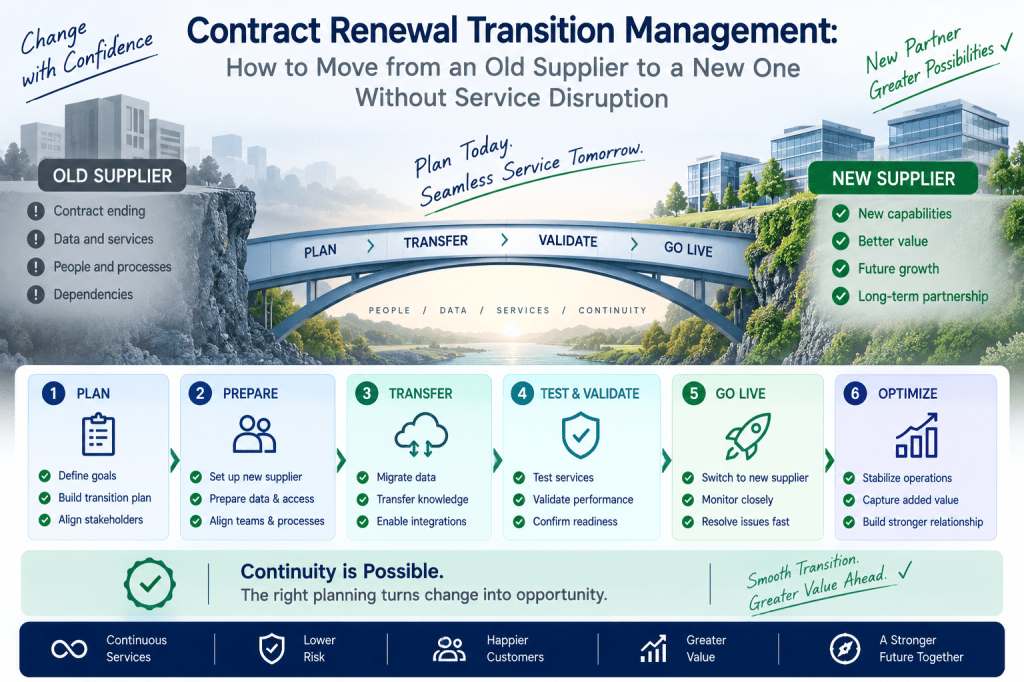
Replacing a Supplier? The Contract Deadline Is Only Half the Problem.
A new supplier may be commercially approved while still being months away from operational readiness.
Contract Renewal Tracker is designed to connect replacement decisions, notice deadlines, migration milestones, transition risks, and exit readiness in one controlled workflow.
Coordinate supplier replacement before the old contract runs out →
The Transition Timeline Starts with the Contract
Every replacement plan should begin with the contractual dates.
For example:
Existing Contract End:
December 31.
Notice Deadline:
September 30.
New Supplier Planned Go-Live:
December 1.
Parallel Run:
30 days.
This appears workable.
But if implementation slips by six weeks:
the whole strategy changes.
That is why contract and project timing must remain connected.
Build Backward from the Exit Date
Suppose the old contract ends:
December 31.
The organization wants:
30 days of parallel operation.
Therefore:
New Supplier Go-Live:
December 1.
User migration should finish:
November 25.
Data validation:
November 15.
System configuration:
October 31.
Implementation must therefore begin months earlier.
This is backward transition planning.
Contract Deadline vs Operational Deadline
Several dates matter:
Notice Deadline
When the old supplier must be told.
New Supplier Go-Live
When replacement becomes operational.
Parallel Run Start
When both systems operate.
Old Supplier End Date
When legacy service stops.
The tracker should keep these dates together.
Transition Readiness
A useful concept is:
Transition Readiness
Possible stages:
Not Started
Replacement approved but no migration plan.
Planning
Dependencies and milestones defined.
In Progress
Implementation underway.
Validation
Testing / parallel run.
Ready to Exit
Replacement operational.
Complete
Old supplier fully closed.
This gives management a clear status.
Transition Readiness Score
A future platform could calculate readiness from:
- new contract signed;
- implementation complete;
- data migrated;
- users trained;
- security approved;
- dependencies validated.
For example:
Readiness: 72%
But the underlying incomplete items are more important than the exact percentage.
Critical Readiness Gates
Some tasks should be mandatory before the old supplier is terminated.
Examples:
- replacement production-ready;
- critical data migrated;
- integrations tested;
- user access confirmed;
- business sign-off.
These become exit gates.
Exit Gate Example
IF replacement_production_ready = FALSETHEN incumbent_shutdown = BLOCKED
Another:
IF critical_data_migration_verified = FALSETHEN final_termination_completion = BLOCKED
This creates safer transitions.
Transition Workstream 1: Replacement Supplier Contracting
Before implementation begins, the replacement supplier may need:
- commercial approval;
- legal review;
- signature.
The new supplier contract has its own workflow.
This means the replacement process may involve two contracts simultaneously:
Old Supplier — Exit
and:
New Supplier — Entry
Contract Renewal Tracker can link them.
Link Replacement Contracts
For example:
Existing Contract
OldCRM.
Status:
Termination Pending.
Replacement Contract
NewCRM.
Status:
Implementation.
The system knows they belong to one transition initiative.
Transition Relationship
Useful relationship types include:
Replaces
Replaced By
This creates clear lineage.
Why Contract Linking Matters
Years later, users can answer:
Why was OldCRM terminated?
Because:
Replaced by NewCRM after 2027 renewal review.
This improves historical context.
Transition Workstream 2: Implementation Planning
The replacement supplier should have:
- project owner;
- milestones;
- target go-live;
- dependencies.
Contract Renewal Tracker does not necessarily need to become a full project-management platform.
It can track the critical milestones that affect the renewal exit.
Critical Milestones Only
For example:
Contract Signed
Complete.
Environment Ready
Complete.
Data Migration
In Progress.
User Acceptance Testing
Not Started.
Go-Live
Planned December 1.
Legacy Shutdown
December 31.
This is enough for renewal governance.
Integration with Project Management
If customers already use:
- Jira;
- Asana;
- Monday.com;
- Microsoft Planner;
the tracker can receive milestone status from those systems.
That keeps product scope focused.
Transition Workstream 3: Dependency Mapping
Before shutting down the incumbent, identify what depends on it.
Possible dependencies include:
- applications;
- APIs;
- reporting;
- business processes;
- external partners;
- user groups.
Missing one dependency can cause an outage.
Dependency Inventory
For example:
OldCRM connects to:
- ERP;
- marketing automation;
- data warehouse;
- customer portal.
All four need migration or replacement before shutdown.
Dependency Criticality
Classify dependencies:
Critical
Important
Low
Critical items become exit blockers.
Unknown Dependencies Are Risk
A system with:
Dependencies Unknown
should not be treated as transition-ready.
The tracker can flag:
Dependency Review Required
This is especially important for legacy systems.
AI-Assisted Dependency Discovery
AI can help summarize:
- integration documentation;
- previous project records;
- contract descriptions.
It may suggest:
The existing supplier appears to support the customer portal and reporting warehouse.
But technical teams should verify critical dependencies.
Transition Workstream 4: Data Migration
Many supplier replacements involve data.
Examples:
- customer records;
- documents;
- configuration;
- audit logs;
- historical transactions.
The transition plan should define:
What must move?
How much?
Who validates it?
Data Migration Status
Possible stages:
Inventory
Extract
Transform
Load
Validate
Complete
This can be summarized in Contract Renewal Tracker.
Data Migration Is Often the Longest Workstream
A replacement supplier may promise:
Go live in 60 days.
But moving years of historical data may take longer.
This can put the original termination plan at risk.
Migration Scope
Not all data needs to move.
The business should define:
- active records;
- historical records;
- legally required retention.
This prevents unnecessary migration work.
Data Validation
Migration is not complete because files were transferred.
Someone must confirm:
- record counts;
- key fields;
- attachments;
- relationships.
This should become an exit gate.
Example
Source records:
1,240,000.
Destination records:
1,239,842.
Difference:
Status:
Validation Failed
Legacy shutdown should not proceed until understood.
Transition Workstream 5: Integration Migration
Applications often connect to the incumbent.
Each integration may need:
- endpoint changes;
- authentication;
- data mapping;
- testing.
These are frequent sources of transition failure.
Integration Checklist
For each integration:
Owner
New Endpoint
Test Status
Production Status
This gives transition visibility.
API Credential Rotation
When switching suppliers:
- old API keys should eventually be revoked;
- new credentials activated.
The timing matters.
Revoking too early can break operations.
Revoking too late creates unnecessary security exposure.
Transition Workstream 6: Security Review
A new supplier may need:
- security assessment;
- data-protection review;
- access approval.
These reviews must complete before production go-live.
Security Exit Requirements for Old Supplier
At exit, the organization may need to:
- disable vendor accounts;
- revoke VPN;
- revoke API keys;
- remove privileged access.
These should be tracked.
Security Entry Requirements for New Supplier
For example:
- SSO configured;
- MFA enabled;
- production access approved;
- DPA signed.
This prevents security from becoming a late blocker.
Transition Workstream 7: User Migration
Replacing user-facing systems requires:
- account creation;
- permission mapping;
- training;
- support.
The new system can be technically ready while users are not.
That creates transition risk.
User Migration Metrics
For example:
Users:
1,200.
Accounts Created:
1,200.
Activated:
1,050.
Training Complete:
Readiness:
Not Complete.
This gives a realistic picture.
Critical User Groups
Not every user group has equal importance.
For example:
Finance closing team:
must be ready before cutover.
Occasional reporting users:
can migrate later.
The transition plan should prioritize critical users.
Transition Workstream 8: Training
Training may include:
- end users;
- administrators;
- support staff.
A transition can fail operationally even when the technology works.
Training Completion
For example:
Target:
90% before go-live.
Current:
68%.
Status:
At Risk
This may require additional sessions.
Transition Workstream 9: Knowledge Transfer
Service suppliers often hold significant institutional knowledge.
Examples:
- infrastructure configurations;
- support procedures;
- runbooks;
- architecture knowledge.
The incumbent may need to hand this over before exit.
Knowledge Transfer Checklist
- documentation delivered;
- runbooks validated;
- credentials transferred;
- outstanding issues explained;
- support contacts transitioned.
This can become a formal exit requirement.
Knowledge Transfer Acceptance
The new supplier or internal team should confirm:
Information received and usable.
Otherwise, “documentation delivered” may not mean much.
Transition Workstream 10: Asset Transfer
Some supplier transitions involve:
- hardware;
- leased devices;
- licenses;
- certificates.
The transition plan should clarify ownership and return obligations.
Asset Register
For example:
Network Devices:
Returned:
Outstanding:
Old contract should not close until obligations are resolved where required.
Transition Workstream 11: Open Issues and Tickets
Before exit:
what happens to unresolved support tickets?
Options include:
- incumbent completes them;
- transfer to new supplier;
- close as accepted risk.
This should be explicit.
Open Issue Handover
For example:
High Priority:
Medium:
Transferred to replacement:
Incumbent resolving:
This prevents work from disappearing during handover.
Transition Workstream 12: Service Continuity
The biggest concern is usually:
Will the business still work on day one after the transition?
That requires continuity planning.
Critical Service Continuity Checklist
- core workflow tested;
- integrations operational;
- critical users active;
- support available;
- rollback defined.
This becomes the go-live gate.
Parallel Run
For high-risk migrations, the organization may run:
old
and:
new
systems simultaneously.
For example:
30 days.
This allows validation before final shutdown.
Parallel Run Cost
Parallel operation can increase costs.
Old supplier:
€50K/month.
New supplier:
€45K/month.
One-month overlap:
€95K total.
This should be included in transition economics.
Parallel Run Is Often Worth the Cost
Paying one extra month may be preferable to:
- production outage;
- data loss.
The business case should consider risk reduction, not only direct cost.
Parallel Run Exit Criteria
Before ending incumbent service:
- transaction reconciliation complete;
- critical errors zero;
- user acceptance signed.
These should be explicit.
Cutover
The cutover is the point when the new supplier becomes primary.
This deserves its own milestone.
For example:
December 1, 22:00.
The transition record can capture:
- cutover status;
- incident count.
Go-Live Decision
Someone should explicitly approve:
Ready for Go-Live
The decision may involve:
- project owner;
- business owner;
- IT/security.
This is another governance point.
Go-Live Gate
For example:
IF critical_test_failures > 0THEN go_live = BLOCKED
The system helps prevent premature cutover.
Rollback Plan
For critical transitions:
What happens if go-live fails?
A rollback plan might include:
- revert traffic;
- restore incumbent service;
- delay termination.
This provides resilience.
Rollback Readiness
If rollback requires incumbent service to remain available:
the old contract must not be terminated too early.
This is another reason transition and contract management need to be connected.
Bridge Extensions
One of the most important transition decisions is whether a temporary extension is required.
Suppose:
Old contract ends:
December 31.
New go-live slips to:
February 15.
The organization needs:
approximately 2 more months.
A short bridge may be safer than rushing migration.
Bridge Extension vs Full Renewal
The goal should be:
minimum term needed for safe transition
not:
supplier’s standard 12-month renewal.
For example:
3-month bridge.
This can prevent unnecessary lock-in.
Bridge Extension Workflow
Transition Delay Detected
↓
Revised Go-Live Forecast
↓
Bridge Duration Calculated
↓
Supplier Negotiation
↓
Approval
↓
New Exit Date
This makes the extension intentional.
Bridge Cost
Old supplier may charge a premium for short-term extensions.
For example:
Normal:
€50K/month.
Bridge:
€65K/month.
Three months:
€195K.
Still potentially better than another:
12-month €600K renewal.
The system can compare scenarios.
Bridge Decision Example
Full Renewal
€600K.
3-Month Bridge
€195K.
Difference
€405K.
If replacement is genuinely ready after three months, the bridge is much more attractive.
Transition Delay Risk
The system should monitor:
planned milestones
against:
actual progress.
For example:
Data migration:
21 days late.
Go-live buffer:
30 days.
Risk:
High.
This provides early warning.
Schedule Variance
For each critical milestone:
Planned
vs:
Forecast
Example:
Planned Go-Live:
December 1.
Forecast:
December 20.
Variance:
19 days.
Old contract ends:
December 31.
Buffer remaining:
11 days.
Risk is now substantial.
Transition Buffer
A useful metric:
Old Contract End Date − Forecast New Supplier Readiness
For example:
30 days.
As this approaches zero:
risk rises.
Negative Transition Buffer
If:
replacement readiness:
January 15.
Old service ends:
December 31.
Buffer:
−15 days
The platform can flag:
Service gap predicted.
Immediate action required.
Transition Risk Score
Potential inputs:
- schedule variance;
- critical blockers;
- migration status;
- contract end proximity;
- rollback readiness.
This creates a transition-specific risk view.
Transition Risk Levels
Low
Significant buffer; milestones on track.
Medium
Minor delays.
High
Critical milestone delayed.
Critical
Predicted service gap.
This is easy for executives to understand.
Transition Risk Is Different from Renewal Risk
Renewal risk asks:
Could we miss a contractual decision or deadline?
Transition risk asks:
Could replacement fail operationally?
Both should be visible.
Critical Transition Alert
Example:
Replacement at Risk
Old supplier ends in 42 days.
Data migration is 18 days behind schedule.
Parallel testing has not started.
Current transition buffer: 7 days.
This deserves immediate attention.
Transition Dependencies
A milestone may depend on another.
For example:
User training cannot finish before:
environment configured.
This should be modeled where practical.
Transition Critical Path
The system does not need a full project-management engine to identify:
critical exit milestones
that directly determine readiness.
This keeps the product focused.
Milestone Owner
Every critical milestone should have:
- owner;
- due date.
For example:
Data Migration:
IT Data Team.
UAT:
Business Operations.
Security:
Cybersecurity.
This creates accountability.
Transition Escalation
If a critical milestone becomes overdue:
project owner.
↓
functional manager.
↓
executive sponsor
depending on risk.
This follows the same closed-loop model used elsewhere in Contract Renewal Tracker.
Transition Decision Meetings
Strategic migrations may have regular:
Transition Readiness Reviews
For example:
weekly during final 60 days.
The platform can generate the agenda from:
- blockers;
- milestones;
- risks.
AI Transition Brief
Before the meeting:
Replacement remains on track, but data migration is nine days late. User training and security approval are complete. Current projected go-live is December 8, leaving 23 days before the incumbent contract ends.
This is much more useful than manually collecting project updates.
Ask AI: Are We Ready to Terminate the Old Supplier?
The assistant might answer:
Not yet. The new platform is production-ready, but two critical integrations have not passed validation and 18% of users have not completed migration. Terminating the incumbent now would create material continuity risk.
This is a strong decision-support use case.
Ask AI: What Is Blocking Exit?
For example:
Three items currently block exit: finance-system integration testing, historical data validation, and privileged-access migration.
Now management knows where to focus.
Ask AI: Do We Need a Bridge Extension?
The assistant can compare:
- projected readiness;
- remaining buffer.
For example:
Current forecast places replacement readiness 12 days after the incumbent termination date. Unless the implementation plan recovers at least 12 days, a bridge extension should be evaluated.
This is actionable without making the final commercial decision automatically.
Ask AI: How Long Should the Bridge Be?
The assistant might say:
The current migration forecast indicates 12 additional days, but a 30-day operational buffer would suggest negotiating a 6–8 week extension rather than the supplier’s standard 12-month renewal.
This can help procurement prepare.
AI Should Not Guarantee Migration Success
The assistant should use:
- project status;
- recorded milestones.
It should not say:
Migration will definitely finish by February.
Use:
forecast
and:
confidence.
Transition Forecast Confidence
For example:
Forecast Go-Live: February 15
Confidence: Medium
because:
- data migration still incomplete;
- testing not started.
This gives better context.
Transition Workload
Replacement creates work across:
- IT;
- legal;
- procurement;
- finance;
- business.
The system can identify:
who owns critical tasks.
This helps leadership resolve resource constraints.
Shared Transition Plan
All stakeholders should see:
- milestones;
- blockers;
- deadlines.
This reduces fragmented coordination.
New Supplier Responsibilities
Transition tasks are not all internal.
The replacement supplier may own:
- configuration;
- data loading;
- training;
- support setup.
The system can track external responsibilities too.
Incumbent Responsibilities
The old supplier may need to provide:
- data export;
- knowledge transfer;
- equipment return;
- transition support.
These should be explicitly tracked before contract closure.
Transition Assistance Clauses
Some contracts include:
Exit Assistance
or:
Transition Services
These can be highly valuable.
The AI assistant can identify them during replacement planning.
Example Exit Assistance
Contract provides:
90 days of transition assistance
at:
existing rates.
This can materially reduce transition risk.
Procurement and legal should know it exists.
Exit Assistance Deadline
The organization may need to request transition support within a certain period.
That can become another workflow deadline.
Transition Pricing
Incumbents may charge:
special exit fees.
These should be captured in:
transition cost.
This improves the replacement business case.
Total Transition Cost
Possible components:
- implementation;
- migration;
- parallel run;
- exit fees;
- temporary extension;
- training.
A replacement’s financial case should include all of them.
Example
New supplier saving:
€180K/year.
Implementation:
€200K.
Parallel run:
€90K.
Exit assistance:
€40K.
Total transition cost:
€330K.
Payback:
approximately 22 months.
This is much more realistic than comparing subscription prices alone.
Transition Savings Realization Date
The savings do not necessarily begin:
on signature.
They may begin:
after full cutover.
This matters for finance forecasting.
Example
Old supplier:
€600K/year.
New supplier:
€420K/year.
Go-live:
July 1.
Current-year savings:
roughly:
€90K
before considering implementation/overlap.
Full annualized saving:
€180K.
The tracker can report both.
Double-Run Costs
If both suppliers operate for two months:
old:
€100K.
new:
€70K.
Additional overlap cost:
€170K.
This affects first-year savings.
Net Transition Economics
A strong dashboard can show:
Annualized Saving
€180K.
Implementation
€200K.
Parallel Run
€170K.
Exit Fees
€20K.
Total One-Time Costs
€390K.
Payback
2.17 years.
This supports CFO decisions.
Transition and Budget
Finance should know which year costs and savings occur.
This helps avoid:
Great long-term saving, but unexpected current-year overspend.
Transition and Procurement
Procurement manages:
- replacement contract;
- bridge negotiation.
The transition tracker gives procurement the dates that matter.
Transition and Legal
Legal may manage:
- exit obligations;
- data return;
- transition assistance;
- termination notice.
This connects legal and operational execution.
Transition and Security
Security manages:
Old Supplier
access removal.
New Supplier
access approval.
This is a critical handoff.
Transition and Business Owners
Business owners should approve:
- user readiness;
- process readiness.
Technology alone should not determine exit.
Business Acceptance
Before final cutover:
Business Owner:
Accept
or:
Not Ready
This creates clear accountability.
Final Exit Readiness Review
A structured checklist may include:
Replacement Operational
Yes.
Data Migrated
Yes.
Critical Integrations
Yes.
Business Acceptance
Yes.
Security
Yes.
Legacy Data Export
Yes.
Notice Delivered
Yes.
Only then:
Ready to Exit
Go / No-Go Decision
For strategic transitions:
a formal:
Go
or:
No-Go
decision may be appropriate.
The system can preserve:
- decision;
- approvers;
- timestamp.
This becomes part of the audit trail.
No-Go Outcome
If:
No-Go,
the system should immediately evaluate:
- remaining incumbent term;
- bridge options.
This prevents last-minute panic.
Final Shutdown
After the new supplier is stable:
old service can be shut down.
Tasks may include:
- account termination;
- access revocation;
- final data export.
This completes the operational exit.
Hypercare
The new supplier may require a short:
hypercare period
after go-live.
For example:
30 days of heightened support.
The old supplier may remain available during part of this period.
Hypercare Exit Criteria
- critical incidents resolved;
- user adoption stable;
- operational KPIs acceptable.
Then:
transition complete.
Final Supplier Closure
The old supplier should only be marked:
Fully Closed
after:
- service ended;
- final invoice settled;
- assets returned;
- access removed;
- data obligations completed.
This is more accurate than closing immediately at notice delivery.
Transition Audit Trail
A complete history might show:
January
Replace decision approved.
February
New supplier selected.
April
Implementation started.
September
Non-renewal notice delivered.
November
Data migration completed.
December 1
New supplier go-live.
December 31
Incumbent service ended.
January 15
Final invoice closed.
This is valuable organizational history.
Transition KPIs
Useful metrics include:
On-Time Go-Live Rate
Bridge Extension Rate
Transition Budget Variance
Service Disruption Rate
Migration Completion Rate
Average Transition Duration
These measure replacement effectiveness.
On-Time Transition Rate
For example:
82%.
If low:
replacement decisions may be starting too late.
Bridge Extension Rate
For example:
30% of replacements require unexpected extensions.
This is a strong diagnostic metric.
A mature organization should aim to reduce unplanned bridge extensions.
Planned vs Unplanned Extensions
Important distinction:
Planned Bridge
part of strategy.
Emergency Extension
caused by delay.
The second is a process failure signal.
Service Disruption Rate
How many transitions caused:
material business outage?
The target should be:
very low.
Transition Budget Accuracy
Forecast transition cost:
€400K.
Actual:
€480K.
Variance:
20%.
Over time, planning should improve.
Transition Duration by Category
SaaS:
3 months.
Cloud:
Outsourcing:
Historical benchmarks can improve future decision timing.
Replacement Lead-Time Benchmark
If data shows:
ERP replacements typically require 14 months,
then a replacement decision made 6 months before renewal is already too late.
This is valuable institutional learning.
Transition Lessons Learned
After completion, capture:
- what caused delays;
- which dependencies were missed;
- what worked.
This can improve future migrations.
AI Lessons Summary
The assistant could say:
The main delay came from late discovery of two finance integrations. Future replacements of similar systems should begin dependency mapping at least 120 days earlier.
This turns history into planning intelligence.
Transition Templates by Category
A platform can offer:
SaaS Replacement
Telecom Migration
MSP Transition
Cloud Migration
Professional Services Handover
Each has different critical milestones.
SaaS Replacement Template
- data export;
- SSO;
- users;
- integrations;
- training.
Managed Service Provider Transition
- runbooks;
- credentials;
- asset inventory;
- support handoff;
- service desk integration.
Different category, different playbook.
Cloud Provider Transition
This may involve:
- workloads;
- data;
- networking;
- security.
The lead time may be very long.
Contract Renewal Tracker should begin the renewal decision much earlier for these agreements.
Telecom Transition
May require:
- number porting;
- circuits;
- physical installations.
Again, critical transition milestones affect renewal timing.
Professional Services Transition
Focus may be:
- knowledge transfer;
- project files;
- internal ownership.
The workflow can remain simpler.
Small-Business Transition Management
For a small company switching CRM:
- sign new vendor;
- export data;
- import;
- test;
- train;
- cancel old vendor.
Even this basic checklist can prevent service disruption.
Enterprise Transition Management
At enterprise scale:
- multiple workstreams;
- regions;
- dependencies.
The same principle still applies:
Do not end the old contract until the new operating model is ready.
M&A Transition Management
Post-acquisition, duplicate suppliers may need consolidation.
Transition tracking can coordinate:
- legacy systems;
- target platform.
This is particularly valuable during integration programs.
Private Equity Transition Management
PE portfolio companies may identify:
supplier replacement
as part of value creation.
But the financial saving only materializes if transition succeeds.
Contract Renewal Tracker can connect the savings target to operational readiness.
Transition Management and Savings Tracking
Suppose replacement creates:
€300K annual saving.
The savings module should not mark:
Realized
until:
old supplier stops billing
and:
new cost is active.
This keeps ROI reporting honest.
Transition Management and Portfolio Intelligence
The platform may identify:
Five replacement projects are scheduled for Q4.
This could create:
implementation overload.
Portfolio-level transition capacity becomes another planning dimension.
Transition Workload Forecasting
For example:
Q4:
5 migrations.
IT project capacity:
Risk:
High.
Management can reschedule or add resources.
Transition Management and AI
The AI assistant can answer:
Which replacements are most likely to miss their exit dates?
It combines:
- schedule variance;
- blockers;
- contract deadlines.
This is highly valuable.
AI Transition Risk Summary
For example:
Two replacement projects are at high risk. The CRM migration has only a 12-day buffer remaining, while the telecom transition depends on number-porting activity that is 21 days overdue.
This gives leadership a concise intervention list.
AI Next-Best Transition Action
For example:
Complete finance-integration testing this week. It is currently the critical-path item and threatens the planned December 1 go-live.
This connects transition data to action.
Contract Renewal Tracker as a Transition Control Layer
This further evolves the product.
The platform no longer stops at:
Replace supplier.
It helps answer:
Can we actually exit the incumbent safely, and what must happen before we do?
That is a materially stronger capability.
From Replacement Decision to Safe Exit
The lifecycle becomes:
Replace Decision
↓
Replacement Contract
↓
Transition Plan
↓
Migration
↓
Validation
↓
Go-Live
↓
Incumbent Exit
↓
Closure
This is the complete replacement process.
Ready to Replace a Supplier Without Creating an Operational Crisis?
Supplier replacement should not become a race between:
migration readiness
and:
contract expiry.
Contract Renewal Tracker is designed to keep the contractual timeline and operational transition connected from the moment a replace decision is made.
Use Contract Renewal Tracker to:
- link incumbent and replacement contracts;
- track critical transition milestones;
- map dependencies;
- monitor data migration;
- track integration readiness;
- manage security handoffs;
- monitor user migration and training;
- track knowledge transfer;
- manage parallel-running periods;
- calculate transition buffers;
- identify bridge-extension needs;
- monitor transition risk;
- track go/no-go decisions;
- preserve complete transition evidence;
- connect realized savings to actual supplier exit;
- use AI to summarize blockers and predict exit risk.
The objective is to move from:
“We selected a new supplier.”
to:
“The replacement is operational, critical dependencies have been validated, the old supplier can be safely exited, and the financial benefit can now be realized.”
Start Your Contract Renewal Tracker Subscription →
Final Thoughts
A replace decision only creates value if execution succeeds.
The organization must coordinate:
Contract Timing
Implementation
Data
Users
Security
Supplier Exit
The key risk is the gap between:
when the incumbent contract ends
and:
when the replacement is truly ready.
A dedicated transition-management layer lets Contract Renewal Tracker detect that gap early.
The process becomes:
Decide to Replace
↓
Plan
↓
Migrate
↓
Validate
↓
Cut Over
↓
Exit
That transforms Contract Renewal Tracker from a system that records replacement decisions into one that helps organizations execute them safely.
And commercially, that matters because the cost of a failed transition can easily exceed the cost of the contract-renewal software itself.
Next Article in the Contract Renewal Tracker Series
Article 65 — “Contract Renewal Supplier Consolidation: How to Combine Multiple Contracts, Align Renewal Dates, Increase Negotiation Leverage, and Reduce Vendor Sprawl”
The next article will focus on one of the largest portfolio-level savings opportunities: identifying multiple contracts or suppliers that can be consolidated. It will cover supplier-family analysis, fragmented spend, duplicate contracts, co-termination strategies, master agreements, volume discounts, price harmonization, vendor reduction, consolidation business cases, migration costs, risk concentration, phased consolidation, governance, and AI-assisted consolidation opportunity detection.
This should be another strong prospect-conversion article because it shows how Contract Renewal Tracker can turn multiple unrelated renewal dates into a strategic sourcing opportunity with measurable financial value.

