Buying contract renewal software is ultimately a financial decision.
A prospect may agree that:
- spreadsheets are fragile;
- reminders should be automated;
- ownership should be clearer;
- renewal workflows should be standardized.
But a CFO or procurement leader will still ask:
What financial value will this software create relative to its cost?
That is the right question.
A dedicated Contract Renewal Tracker should not be justified only because it is more convenient than Excel.
The strongest business case comes from combining several sources of measurable value:
- avoiding unwanted auto-renewals;
- reducing recurring spend;
- negotiating better supplier outcomes;
- cutting administrative effort;
- improving budget visibility;
- lowering renewal execution risk.
The objective is to calculate a conservative, defensible return rather than assume that every potential opportunity becomes cash savings.
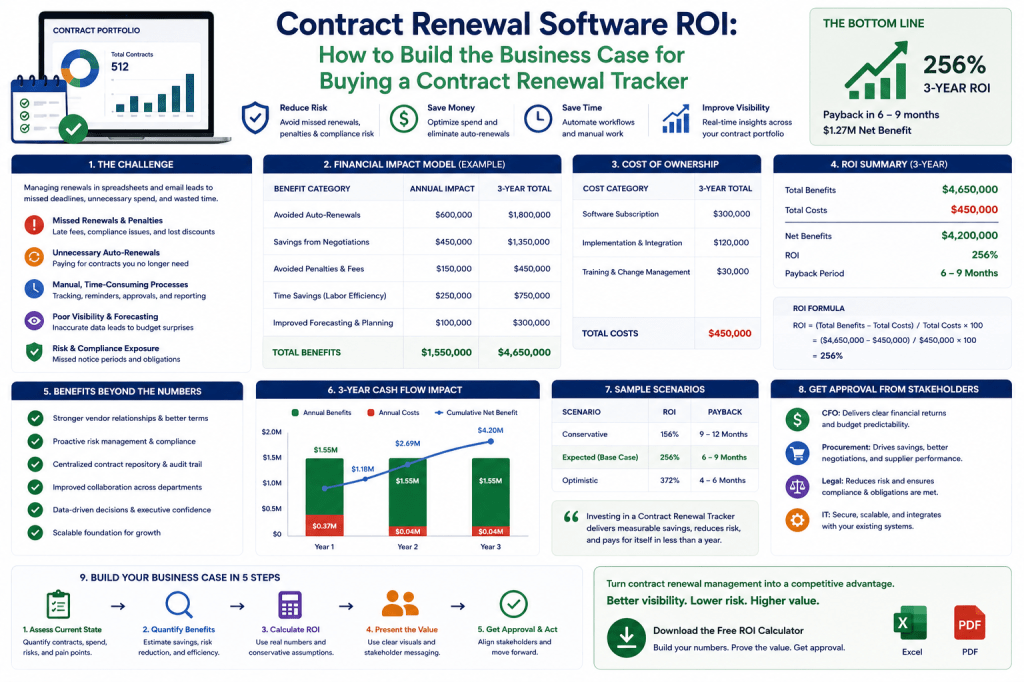
What Is Contract Renewal Software ROI?
Contract renewal software ROI compares the economic value generated or protected through the renewal process with the cost of the platform.
A simple formula is:
ROI = (Financial Benefit − Software Cost) ÷ Software Cost × 100
For example:
Annual software cost:
€4,000.
Validated annual benefit:
€40,000.
ROI:
900%
because:
(€40K − €4K) ÷ €4K = 9.
But the important question is:
What should count as financial benefit?
That requires more discipline.
Building the Business Case for Contract Renewal Tracker?
Do not rely on vague claims such as:
“It will save us time.”
A stronger business case quantifies the renewal risks, recurring spend, and administrative effort that the platform helps manage.
Contract Renewal Tracker can support that analysis by tracking financial outcomes directly against renewal activity.
Calculate how little improvement it takes for Contract Renewal Tracker to pay for itself →
ROI Source 1: Avoided Unwanted Auto-Renewals
This is often the easiest value to understand.
Suppose a company has:
Annual contract spend:
€15M.
Auto-renewing spend:
€6M.
One €75K subscription is no longer required.
Without a controlled notice process:
it renews for another year.
With Contract Renewal Tracker:
the notice deadline is identified early and termination is completed correctly.
Potential avoided spend:
€75K
If the platform costs:
€4K/year,
that one avoided renewal is already:
18.75× annual subscription cost.
Why This Is a Strong ROI Category
The connection is relatively direct.
The company:
- intended to terminate;
- avoided a renewal it did not want.
That makes the financial value much easier to defend than speculative productivity claims.
Avoided Renewal Value Formula
A simple calculation:
Unwanted Renewal Cost Avoided − Any Termination Costs
For example:
Annual contract:
€100K.
Exit cost:
€10K.
Net avoided spend:
€90K
This becomes part of the platform value case.
ROI Source 2: Demand Reduction
One of the largest savings opportunities occurs when organizations buy less at renewal.
Examples include:
- unused SaaS licenses;
- excessive cloud commitments;
- unnecessary support tiers;
- consultant capacity;
- obsolete locations.
This value is often highly measurable.
SaaS Example
Current licenses:
1,000.
Active requirement:
Annual unit cost:
€400.
Quantity reduction:
Annual recurring reduction:
€100K
If Contract Renewal Tracker surfaces the usage evidence and structures the business review, that outcome can be attributed as:
renewal-related demand reduction managed through the platform.
Be Careful with Attribution
The software did not personally decide to remove:
250 licenses.
The business owner did.
A defensible statement is:
Contract Renewal Tracker helped identify, manage, and document €100K of annual demand reduction during renewal.
That is stronger than claiming:
The software saved €100K by itself.
ROI Source 3: Negotiated Hard Savings
Procurement may reduce the actual comparable cost of a renewal.
Example:
Current comparable spend:
€500K.
Final renewed cost:
€460K.
Hard savings:
€40K
This can be tracked directly.
Hard Savings Formula
Comparable Baseline − Final Comparable Cost
If:
€500K − €460K
=
€40K.
This is usually the strongest procurement savings category because it represents actual lower spend.
ROI Source 4: Cost Avoidance
Supplier proposes:
€600K.
Final negotiated:
€520K.
Current spend:
€500K.
The outcome includes:
€80K cost avoidance
but not:
€80K hard savings.
The organization still spends:
€20K more than last year.
This distinction is important.
Correct Reporting
Current Spend
€500K.
Supplier Proposal
€600K.
Final
€520K.
Cost Avoidance
€80K.
Increase vs Current
€20K.
This keeps the ROI business case credible.
ROI Source 5: License and Usage Optimization
A specific form of demand reduction is:
unused-license reclamation.
Suppose:
500 inactive seats.
Annual cost:
€250 each.
Potential annual reduction:
€125K
Even if only:
40%
can actually be removed,
validated saving:
€50K.
This is the figure that should enter the base-case ROI.
ROI Source 6: Supplier Consolidation
Contract Renewal Tracker may identify several contracts with:
the same supplier
or:
overlapping suppliers.
Consolidating them can create:
- volume discounts;
- reduced fixed fees;
- price harmonization.
Example
Current fragmented spend:
€2M.
Consolidated agreement:
€1.85M.
Annual recurring reduction:
€150K.
Migration and implementation:
€50K.
Year 1 net value:
€100K
Year 2 onward:
€150K/year.
This is a strong strategic ROI source.
ROI Source 7: Contract Termination
Sometimes the most financially valuable renewal outcome is:
do not renew.
Example:
Annual analytics subscription:
€60K.
Business value:
low.
Alternative already available internally.
Decision:
Terminate.
Annual spend eliminated:
€60K.
If there are no transition costs:
this can be treated as:
avoided recurring spend.
ROI Source 8: Tier Downgrades and Add-On Removal
Suppose:
Enterprise software tier:
€180K.
Professional tier:
€130K.
Premium features:
barely used.
Annual reduction:
€50K.
Remove unused training package:
€15K.
Combined annual value:
€65K
This can be an easy renewal optimization win.
ROI Source 9: Better Escalation Caps
Some renewal value appears over multiple years.
Suppose a €1M contract includes:
7% annual escalation.
Procurement negotiates:
3%.
Over three years, the difference can become significant.
Example
7% Escalation
Year 1:
€1.00M.
Year 2:
€1.07M.
Year 3:
€1.145M.
Total:
€3.215M.
3% Escalation
Year 1:
€1.00M.
Year 2:
€1.03M.
Year 3:
€1.061M.
Total:
€3.091M.
Difference:
approximately:
€124K
This is long-term cost avoidance.
ROI Source 10: Avoided Bridge Renewals
Poor transition planning can force:
unexpected extensions.
Suppose a replacement project slips.
Without early visibility, the organization signs:
another 12-month contract for:
€600K.
With transition-risk monitoring, procurement negotiates:
3-month bridge:
€180K.
Potential avoided commitment:
€420K
This can be a very substantial value source.
ROI Source 11: Billing Leakage Prevention
A contract may be renewed at:
€450K.
But invoices continue at:
€500K.
Without reconciliation, the organization overpays:
€50K.
Contract Renewal Tracker can help identify the discrepancy.
Recovered or prevented leakage:
€50K
This is measurable financial value.
ROI Source 12: Unclaimed Credits or Rebates
Suppose supplier owes:
€30K service credits.
Renewal review reveals they were never claimed.
Recovering them contributes:
€30K.
This may not happen every year, but it can strengthen the business case.
ROI Source 13: Administrative Time Savings
This is the most common productivity argument.
Suppose contract operations spends:
10 hours per week
maintaining:
- spreadsheets;
- reminders;
- reports.
Annual effort:
520 hours.
Assume loaded labor cost:
€60/hour.
Annual administrative cost:
€31,200
If Contract Renewal Tracker reduces that effort by:
50%,
time value:
€15,600/year
Do Not Assume All Time Becomes Cash Savings
This is important.
Saving:
260 hours
does not necessarily reduce payroll by:
€15,600.
Often the real benefit is:
capacity released for more valuable work.
So classify it as:
Productivity Value
rather than:
hard savings.
This keeps the business case honest.
ROI Source 14: Management Reporting Time
Suppose monthly renewal reporting takes:
12 hours.
Automation reduces it to:
Time saved:
10 hours/month.
120 hours/year.
At:
€80/hour.
Productivity value:
€9,600/year
Again, valuable—but separate from cash savings.
ROI Source 15: Legal Administration
Legal may spend time:
- finding clauses;
- verifying notice dates;
- reconstructing approval history.
Centralized evidence and clause retrieval can reduce this effort.
This is another productivity benefit.
ROI Source 16: Procurement Capacity
If procurement receives renewals earlier:
buyers can spend more time:
negotiating strategically
and less time:
handling emergency renewals.
This can indirectly improve savings.
Avoid double-counting this if savings outcomes are already included elsewhere.
ROI Source 17: Forecast Accuracy
Improved forecast accuracy does not always create direct savings.
But it can reduce:
- budget surprises;
- emergency cost cuts.
This should usually be treated as:
financial planning value
rather than hard cash savings.
Example Forecast Improvement
Old 90-day forecast error:
10%.
New:
3%.
On:
€20M of renewal spend,
uncertainty falls substantially.
This can improve budgeting confidence.
But avoid assigning an arbitrary € value unless finance agrees on the methodology.
ROI Source 18: Risk Reduction
Some platform benefits are hard to convert directly into euros.
Examples:
- correct termination evidence;
- fewer unauthorized commitments;
- better auditability;
- supplier continuity.
These may still be central to the buying decision.
Not every benefit needs a fake cash value.
Risk-Reduction Example
A strategic supplier worth:
€10M
has a termination notice dispute.
A complete audit trail could materially reduce legal uncertainty.
It would be misleading to assign:
€10M
as ROI.
Instead report:
Material legal risk controlled.
That is more credible.
Separate the ROI Categories
A strong business case should distinguish:
Cash / Recurring Financial Value
Hard savings.
Demand reduction.
Avoided spend.
Cost Avoidance
Prevented supplier increases.
Productivity Value
Administrative time.
Risk / Control Value
Deadline, compliance, auditability.
This prevents inflated totals.
Example ROI Business Case
Suppose a mid-market company manages:
€12M of annual supplier renewals.
Contract Renewal Tracker Business:
€3,990/year.
During the first year:
Hard Savings
€60K.
Demand Reduction
€90K.
Avoided Unwanted Renewal
€40K.
Cost Avoidance
€80K.
Productivity Value
€10K.
Total tracked value:
€280K.
But for a conservative cash-focused calculation, perhaps use only:
€60K + €90K + €40K
=
€190K
Conservative ROI
Platform cost:
€3,990.
Cash-like value:
€190K.
Net benefit:
€186,010.
ROI:
approximately 4,662%
This is a very strong business case.
Payback Period
Payback asks:
How quickly does the financial value cover the subscription?
Formula:
Annual Platform Cost ÷ Annual Benefit × 12
Example:
€3,990 ÷ €190K × 12
=
approximately:
0.25 months
In reality, benefits may occur unevenly through the year, so avoid presenting this as precise operational timing.
A More Conservative Example
Annual software:
€3,990.
Only one validated benefit:
€20K license reduction.
ROI:
(€20K − €3,990) ÷ €3,990
=
approximately:
401%
Even a modest result can justify the software.
Break-Even Analysis
Often the simplest buying argument is not:
What ROI will we achieve?
It is:
How small an improvement is needed for the software to pay for itself?
Break-Even Formula
Platform Cost ÷ Managed Renewal Spend
Suppose:
Platform:
€3,990.
Managed renewal spend:
€10M.
Break-even improvement:
€3,990 ÷ €10M
=
0.0399%
or:
about:
4 basis points
That is an extremely small improvement.
Professional Plan Example
Annual cost:
€990.
Managed renewals:
€2M.
Break-even:
0.0495%
Again, a tiny improvement.
Enterprise Example
Annual platform:
€30K.
Managed renewals:
€250M.
Break-even:
0.012%
That means preventing or optimizing only a very small fraction of managed spend can cover the subscription.
Break-Even Is One of the Strongest Sales Metrics
A prospect does not need to believe:
Contract Renewal Tracker will create:
10% savings.
It may only need to produce:
0.04%
improvement.
That is much easier to defend.
ROI Scenario 1: Conservative
Use only highly attributable benefits.
For example:
One avoided renewal:
€30K.
One license reduction:
€20K.
Total:
€50K.
Platform:
€3,990.
Net benefit:
€46,010.
This is a credible base case.
ROI Scenario 2: Expected
Add:
- hard savings;
- some productivity.
For example:
Avoided renewal:
€30K.
Demand reduction:
€50K.
Hard savings:
€40K.
Productivity:
€10K.
Total:
€130K.
This becomes the expected case.
ROI Scenario 3: Upside
Include:
- supplier consolidation;
- broader optimization.
For example:
Total:
€300K+.
This should remain clearly labeled:
Upside Scenario
not guaranteed.
Why Three Scenarios Work Well
CFOs generally prefer:
- conservative;
- expected;
- upside.
This demonstrates that the business case has been stress-tested.
Example ROI Table
| Scenario | Benefit | Platform Cost | Net Value |
|---|---|---|---|
| Conservative | €50K | €3,990 | €46K |
| Expected | €130K | €3,990 | €126K |
| Upside | €300K | €3,990 | €296K |
This is much more persuasive than:
Huge ROI.
ROI by Plan: Starter
Suppose Starter costs:
€390/year.
A small business avoids:
one €2,500 auto-renewal.
Net financial benefit:
€2,110.
ROI:
approximately:
541%
That is easy to understand.
ROI by Plan: Professional
Annual:
€990.
Business avoids:
€10K renewal
and:
€5K license waste.
Benefit:
€15K.
ROI:
approximately:
1,415%
ROI by Plan: Business
Annual:
€3,990.
Validated optimization:
€50K.
ROI:
approximately:
1,153%
The business case can become compelling even with relatively modest savings.
ROI by Plan: Enterprise
Annual:
€30K.
Managed spend:
€250M.
One supplier negotiation improvement:
€300K.
Net benefit:
€270K.
ROI:
900%
Again, enterprise economics can be strong.
ROI Should Be Calculated on Real Customer Data
This is crucial.
Generic examples help explain the concept.
But the strongest sales motion uses the prospect’s own:
- contract count;
- renewal spend;
- recent missed renewals;
- administration hours.
This creates a personalized business case.
ROI Discovery Questions for Prospects
A sales or onboarding process should ask:
- How much annual supplier spend is subject to renewal?
- How many active contracts do you manage?
- Have you experienced unwanted auto-renewals?
- How many hours are spent monthly maintaining renewal data?
- Are unused SaaS licenses a known issue?
- Does procurement track renewal savings today?
From six answers, you can build a reasonable first ROI model.
Example Prospect
Annual renewal spend:
€25M.
Contracts:
Recent unwanted renewal:
€60K.
Monthly admin:
40 hours.
Expected annual license waste:
€100K.
The business case is already visible before assuming any negotiated savings.
Conservative Prospect ROI
Avoided future incident assumption:
do not automatically use the full historical €60K.
Use:
€30K expected annualized avoidance.
License optimization:
€50K validated.
Admin productivity:
€15K.
Total:
€95K.
Business plan:
€3,990.
Still very attractive.
Why Conservative Modeling Increases Trust
If the software business case works under conservative assumptions:
there is no need to inflate estimates.
That makes CFO approval easier.
Avoid Double Counting Savings
This is one of the most important ROI rules.
Suppose:
Current contract:
€500K.
Demand reduction lowers requirement to:
€400K.
Then procurement negotiates:
€380K.
Correct:
Demand reduction:
€100K.
Hard savings on optimized baseline:
€20K.
Total:
€120K.
Do not calculate:
€100K demand reduction
plus:
€120K negotiation savings.
That would double-count.
Establish a Baseline First
Every savings calculation should have:
Baseline
Then:
Final Outcome
Without a clear baseline:
ROI claims become unreliable.
Finance Validation
For stronger customers, Contract Renewal Tracker could allow:
Finance Validated
on financial outcomes.
This makes the ROI dashboard much more credible.
Savings Status
For example:
Identified
€250K.
Validated
€150K.
Contracted
€110K.
Realized
€90K.
Only:
€90K
should normally be reported as fully realized value.
Contracted vs Realized
A contract may promise:
€50K saving.
But invoice errors can reduce realization.
This is why the software should track:
outcome
beyond signature.
ROI Funnel
A useful product dashboard could show:
Potential Renewal Value
€500K.
Business Validated
€300K.
Contracted
€200K.
Realized
€160K.
This tells customers:
how much opportunity converts into actual financial impact.
ROI Dashboard
A CFO dashboard might show:
Platform Cost
€3,990.
Hard Savings
€65K.
Demand Reduction
€82K.
Avoided Spend
€35K.
Cost Avoidance
€60K.
Productivity Value
€12K.
Total Tracked Value
€254K.
Then:
Value-to-Cost Ratio
63.7×.
Again, categories should remain visible.
Better Than One Giant “Savings” Number
Showing:
Total Savings:
€254K
would be misleading because:
productivity and cost avoidance are not identical to hard cash savings.
Keep the categories separate.
This increases credibility.
Value-to-Cost Ratio
Some executives understand this more quickly than ROI percentage.
Formula:
Tracked Value ÷ Platform Cost
Example:
€254K ÷ €3,990
=
63.7×
This can be a powerful SaaS metric.
Renewal Spend Coverage
Another useful metric:
Platform Cost as percentage of:
managed renewal spend.
For example:
€3,990 / €25M
=
0.016%
This shows how small the software cost is relative to the financial exposure.
ROI and Contract Volume
Suppose:
500 contracts.
Platform:
€990.
Cost per managed contract:
€1.98/year
This can also provide useful context.
Cost Per Renewal Event
If:
200 renewals/year.
€990 annual subscription.
Cost per renewal event:
€4.95.
If the software saves:
even 10 minutes per renewal,
the operational value can exceed that.
Administrative Break-Even
Suppose employee cost:
€60/hour.
Platform:
€990.
Required time saving:
€990 ÷ €60
=
16.5 hours/year.
That is:
less than:
1.4 hours/month.
Very small productivity improvement required.
Business Plan Administrative Break-Even
€3,990 ÷ €60
=
66.5 hours/year.
Approximately:
5.5 hours/month.
For a team handling hundreds of renewals, that can be realistic.
The Business Case Should Include Qualitative Benefits
Not everything should be forced into a financial formula.
Important qualitative benefits include:
- stronger governance;
- clearer accountability;
- better supplier data;
- institutional memory;
- easier audits.
These support the buying decision even when not monetized.
Strategic Value
A procurement organization may also gain:
- earlier negotiations;
- supplier consolidation insight.
These can create strategic advantages that do not fit neatly into one ROI figure.
CFO Business Case Structure
A good internal proposal could be only one page.
Problem
Current renewal process depends on spreadsheets and manual reminders.
Exposure
€25M annual supplier spend across 900 contracts.
Proposed Solution
Contract Renewal Tracker Business.
Annual Cost
€3,990.
Conservative Financial Benefit
€50K–€100K.
Break-Even
<0.02% improvement in managed renewal spend.
Additional Benefits
Governance, forecasting, auditability.
That is a compelling business case.
Procurement Business Case
Procurement may emphasize:
- savings pipeline;
- supplier benchmarking;
- negotiation readiness.
Legal Business Case
Legal may emphasize:
- notice compliance;
- termination evidence;
- audit trail.
Finance Business Case
Finance may emphasize:
- recurring-spend forecast;
- budget variance;
- validated outcomes.
Different stakeholders should receive the same product case from different angles.
IT / Security Business Case
IT may emphasize:
- centralized ownership;
- SSO;
- secure contract access.
This helps obtain cross-functional approval.
Business Case for Small Organizations
For a smaller company, keep the calculation simple.
Example:
Platform:
€390/year.
One software renewal accidentally missed last year:
€2,400.
Therefore:
preventing one similar incident more than covers:
six years of subscription.
No complex ROI model is necessary.
Business Case for Mid-Market
Focus on:
- unwanted renewals;
- SaaS optimization;
- admin productivity.
This creates a tangible case.
Business Case for Enterprise
Focus on:
- managed spend;
- supplier leverage;
- forecasting;
- governance.
The subscription price becomes relatively immaterial compared with portfolio exposure.
Implementation Cost Should Be Included
If the platform requires:
€5K onboarding,
the Year 1 business case should include it.
Do not calculate ROI using subscription only.
Example Year 1
Subscription:
€4K.
Implementation:
€5K.
Total:
€9K.
Benefit:
€100K.
Year 1 net:
€91K.
Still highly attractive.
Year 2
Subscription:
€4K.
No implementation.
Benefit:
€100K.
ROI increases substantially.
This demonstrates the long-term case.
Integration Costs
Enterprise deployments may also include:
- SSO;
- ERP integration.
These should be included in:
total cost of ownership.
Three-Year TCO
For enterprise:
Subscription
€30K/year × 3:
€90K.
Implementation
€20K.
Integrations
€15K.
Total 3-year TCO:
€125K
Then compare with:
three-year validated value.
This is more meaningful than annual license comparison.
Three-Year Benefit Example
Hard savings:
€600K.
Avoided spend:
€300K.
Cost avoidance:
€700K.
Productivity:
€100K.
Total tracked:
€1.7M.
Three-year TCO:
€125K.
Value-to-cost:
13.6×.
Very compelling.
Discount Future Benefits?
For very large business cases, finance may apply:
NPV
or:
discounted cash flow.
For a €4K/year SaaS purchase, that is probably unnecessary.
Keep the calculation proportional.
ROI Sensitivity Analysis
A useful business-case tool lets users change:
- savings rate;
- renewal spend;
- admin hours.
This shows how robust the business case is.
Example Sensitivity
Managed spend:
€10M.
Platform:
€3,990.
If improvement is:
0.05%
Value:
€5K.
Still positive.
0.10%
€10K.
0.50%
€50K.
This demonstrates how little improvement is required.
ROI Calculator for the Website
This should become a strong conversion asset.
Inputs:
Annual Renewal Spend
Current Number of Contracts
Estimated Unwanted Renewal Cost
Monthly Admin Hours
Platform Plan
Then calculate:
- break-even improvement;
- potential productivity value;
- scenario ROI.
This is excellent bottom-of-funnel content.
Example Website Calculator
User enters:
Annual Renewal Spend:
€20M.
Platform:
€3,990.
Output:
Contract Renewal Tracker needs to improve renewal outcomes by only 0.02% to cover its annual subscription.
Then:
One prevented €10K unwanted renewal would already create more than 2.5× subscription value.
This is persuasive without making unrealistic promises.
Use ROI Calculator as Lead Capture
After basic result:
offer:
Email me the full Contract Renewal ROI Business Case
Prospect enters:
name/email.
The generated report could include:
- assumptions;
- calculations;
- plan recommendation.
This could become a very strong sales funnel.
Downloadable ROI Business Case Template
Another lead magnet:
Contract Renewal Software ROI Calculator — Excel Template
This may attract finance and procurement prospects.
The spreadsheet itself can then promote:
Contract Renewal Tracker.
Free ROI Assessment
For larger prospects:
offer:
Send us your contract count and annual renewal spend. We will produce a conservative Contract Renewal Tracker business case.
This supports sales-assisted Business/Enterprise deals.
ROI During Trial
The product should begin building the customer’s ROI story immediately.
For example:
Trial imports:
500 contracts.
System identifies:
- €300K near-term auto-renewal exposure;
- 20 missing owners;
- €50K suspected unused licenses.
This makes conversion much easier.
Trial Value Summary
Before the trial expires:
Renewal Spend Monitored
€4.2M.
Critical Risks Identified
Optimization Opportunities
€35K.
Admin Tasks Automated
Then:
Upgrade to continue monitoring these renewals.
This is much stronger than a generic trial-expiry email.
Post-Purchase ROI Tracking
Do not stop measuring ROI after the sale.
The platform should help the customer demonstrate:
ongoing value.
This is important for:
renewal and expansion.
Customer Renewal Report
Before Contract Renewal Tracker’s own subscription renews:
send:
During the last 12 months, your workspace managed €28M in contract renewals, tracked €180K of validated financial outcomes, and recorded zero material missed deadlines.
This is an excellent retention mechanism.
The Product Should Prove Its Own Renewal Value
This is particularly appropriate for Contract Renewal Tracker.
If the product helps customers manage supplier renewals, it should make its own renewal easy to evaluate.
Annual Value Review
The platform could generate:
Subscription Cost
€3,990.
Financial Value Managed
€180K.
Value-to-Cost
45×.
Contracts Managed
Deadlines Protected
This supports SaaS retention.
Expansion ROI
If a customer begins on:
Professional
then upgrades to:
Business,
show the incremental value of:
- spend optimization;
- forecasting.
This helps justify expansion.
ROI by Feature
A mature product might attribute:
Reminder / Deadline Control:
€40K avoided spend.
Business Reviews:
€70K demand reduction.
Supplier Consolidation:
€100K.
This helps customers understand which capabilities matter most.
Avoid Over-Attribution to AI
If AI identified:
an opportunity,
but procurement validated and negotiated it,
do not say:
AI saved €100K.
Say:
AI surfaced an opportunity that was later validated and converted into €100K of negotiated value.
That is much more credible.
AI Can Help Explain ROI
A CFO could ask:
Where did the €180K value come from?
The assistant could answer:
€70K came from SaaS quantity reductions, €45K from hard savings, €40K from avoided unwanted renewals, and €25K from supplier cost avoidance.
This improves transparency.
Ask AI: Which Renewal Created the Most Value?
The system could rank:
- contract;
- outcome.
This makes ROI tangible.
Ask AI: What Value Is Still in the Pipeline?
For example:
€220K remains in validated but unrealized opportunities, primarily from two supplier consolidations and one SaaS license reduction.
This helps procurement prioritize.
Ask AI: What Could Improve ROI Next Quarter?
For example:
The largest near-term opportunities are three contracts with low utilization and two supplier groups with fragmented spend totaling €3.4M.
This turns ROI measurement into future action.
ROI KPIs
Useful product-level metrics include:
Managed Renewal Spend
Validated Hard Savings
Demand Reduction
Avoided Spend
Cost Avoidance
Productivity Value
Platform Cost
Value-to-Cost Ratio
These create a compelling customer dashboard.
ROI Confidence
Not every value figure has equal certainty.
For example:
Hard Savings:
High confidence.
Potential consolidation:
Low.
The dashboard should separate:
- realized;
- forecast.
This prevents misleading claims.
Financial Value Status
A useful hierarchy:
Potential
↓
Validated
↓
Contracted
↓
Realized
This is consistent with the broader product model.
ROI Governance
Finance should own or validate the methodology for:
- hard savings;
- cost avoidance.
This ensures numbers are accepted internally.
Build the CFO’s Trust First
The fastest way to weaken a software business case is:
inflated savings.
Better to show:
€100K defensible value
than:
€500K questionable value.
Contract Renewal Tracker should make conservative reporting part of the product philosophy.
Contract Renewal Tracker ROI Example
Consider a customer with:
Annual renewal spend:
€10M.
Active contracts:
Software:
Business plan at €3,990/year.
Conservative Year 1 outcomes:
One Prevented Unwanted Renewal
€20K.
License Reduction
€25K.
Hard Savings
€20K.
Productivity Value
€5K.
Total tracked:
€70K.
Cash-like value:
€65K.
Platform cost:
€3,990.
Net cash-like value:
€61,010.
That is already a strong business case.
What If the Software Produces No Major Savings?
Suppose it only:
- prevents missed deadlines;
- reduces reporting effort.
The customer may still value:
governance and control.
ROI should not be the only purchase criterion.
But for procurement and finance buyers, a measurable financial story makes the sale much easier.
The Strongest ROI Message
Do not promise:
Contract Renewal Tracker will save you 10%.
Instead say:
If your organization manages €10 million in annual renewal spend, Contract Renewal Tracker only needs to improve outcomes by about 0.04% for a €3,990 subscription to break even.
That is precise, conservative, and compelling.
The Second Strongest ROI Message
One prevented unwanted renewal can pay for the software.
Simple.
Easy to understand.
Highly aligned with the product’s core value.
The Third Strongest ROI Message
The platform does not need to find savings everywhere. It only needs to improve a very small number of renewal decisions to justify its cost.
This lowers the perceived hurdle.
Strong Sales CTA
A highly effective CTA for this article would be:
Calculate Your Contract Renewal Tracker ROI
Enter your annual renewal spend and estimated plan cost to see the percentage improvement required for the platform to pay for itself.
Calculate My Break-Even ROI →
This should ideally link to an interactive calculator once the website/product is ready.
Secondary CTA
Already have a renewal spreadsheet? Upload it to Contract Renewal Tracker and identify the contracts, deadlines, and recurring-spend opportunities that can form your own ROI business case.
This connects ROI directly with onboarding.
Ready to Build the Business Case for Contract Renewal Tracker?
The software does not need to transform every renewal to justify its subscription.
It needs to create enough value across a handful of areas such as:
- avoiding unwanted renewals;
- reducing unnecessary demand;
- improving commercial terms;
- reducing manual administration.
For many portfolios, the break-even threshold is extremely small relative to total renewal spend.
Use Contract Renewal Tracker to:
- track unwanted renewal avoidance;
- measure demand reduction;
- record hard savings;
- track cost avoidance;
- identify supplier-consolidation opportunities;
- monitor administrative efficiency;
- separate potential, contracted, and realized value;
- calculate value-to-cost ratios;
- build conservative/expected/upside ROI scenarios;
- use AI to explain where renewal value was created.
The objective is to move from:
“Contract renewal software costs money.”
to:
“We know exactly how little financial improvement is required for the software to pay for itself—and we can measure whether it actually does.”
Start Your Contract Renewal Tracker Subscription →
Final Thoughts
A strong SaaS business case should not rely on exaggerated savings assumptions.
For Contract Renewal Tracker, the economics can work with very modest improvements because the software manages decisions around potentially large recurring supplier commitments.
The ROI model is:
Platform Cost
↓
compare with:
Managed Renewal Spend
↓
then measure:
Avoided Spend
Demand Reduction
Hard Savings
Productivity
The strongest buying question becomes:
What percentage improvement do we need to break even?
If annual renewal spend is large, that percentage can be tiny.
That is why Contract Renewal Tracker can have a compelling commercial proposition even before advanced AI and portfolio-intelligence features are considered.
The platform only needs to help the organization avoid a few bad renewal outcomes—or improve a few good ones—to earn its place in the software stack.
Next Article in the Contract Renewal Tracker Series
Article 79 — “Contract Renewal Software Business Case Template: How to Get CFO, Procurement, Legal, and IT Approval for a Renewal Management Platform”
The next article can turn the ROI framework into a practical internal buying document. It will cover problem statement, current-state costs, financial exposure, risk analysis, solution requirements, alternatives including Excel and CLM, implementation costs, ROI scenarios, security requirements, stakeholder benefits, approval criteria, rollout plan, KPIs, and a copy-ready executive business-case structure.
This should be another strong bottom-of-funnel article because it targets the prospect who has effectively decided they need better renewal management but now has to answer the internal question:
“How do I get everyone else to approve the purchase?”

