Selecting contract renewal software becomes much easier when the organization defines what the system must actually do before evaluating vendors.
Without a requirements checklist, software selection can quickly become driven by:
- attractive dashboards;
- impressive AI demonstrations;
- vendor feature lists;
- whichever stakeholder speaks the loudest.
A better approach is to translate the organization’s renewal process into a structured set of requirements and then evaluate every platform against the same criteria.
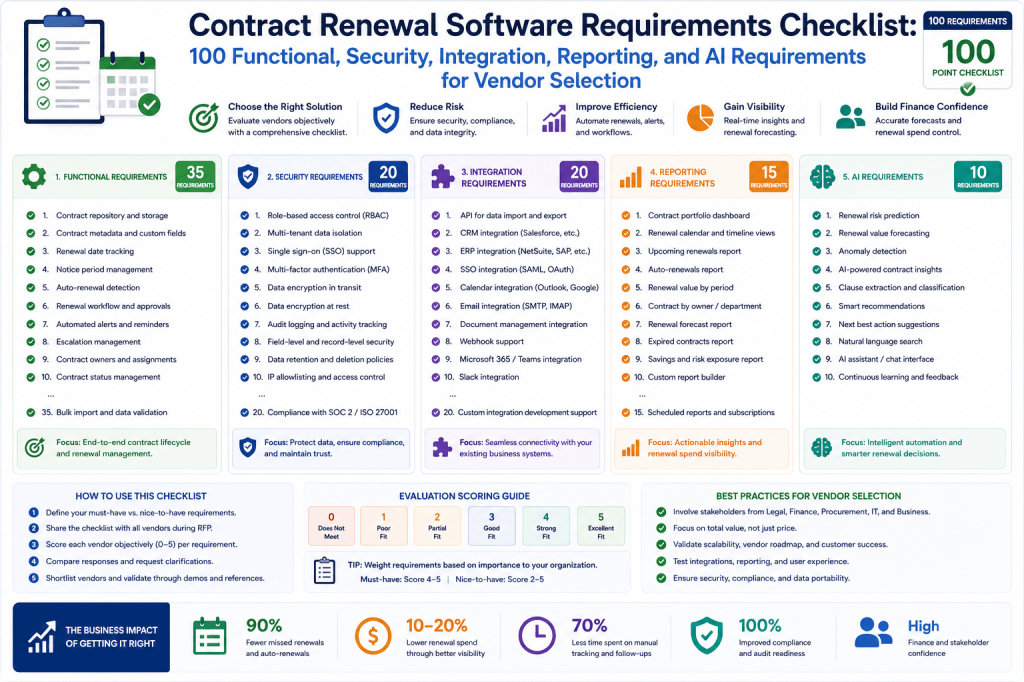
This article provides a 100-point contract renewal software requirements checklist covering functional capabilities, workflow, financial management, security, integrations, reporting, AI, implementation, and enterprise scalability.
It can be used when evaluating a dedicated platform such as Contract Renewal Tracker, comparing renewal-management vendors, preparing an RFP, or determining whether an existing CLM system can already meet the organization’s requirements.
Why Create Requirements Before Selecting Contract Renewal Software?
The purpose of requirements is not to create the longest possible feature list.
It is to answer:
What capabilities must exist for our renewal process to operate safely, efficiently, and measurably?
That distinction matters.
A 300-feature platform can still be unsuitable if it cannot reliably handle:
- notice deadlines;
- owner escalation;
- termination execution.
Conversely, a focused platform may be the better choice if it solves those critical processes extremely well.
Evaluating Contract Renewal Software?
Before requesting demonstrations, divide your requirements into three categories:
Must Have
The solution cannot be selected without it.
Should Have
Important, but not necessarily a deal-breaker.
Could Have
Useful differentiation or future capability.
This prevents optional features from receiving the same importance as essential renewal controls.
Contract Renewal Software Requirements at a Glance
The 100 requirements in this checklist are grouped into ten areas:
| Area | Requirements |
|---|---|
| Contract Data & Repository | 10 |
| Renewal & Deadline Management | 10 |
| Workflow & Ownership | 10 |
| Decisions, Approvals & Execution | 10 |
| Spend & Supplier Intelligence | 10 |
| Reporting & Analytics | 10 |
| Security & Governance | 10 |
| Integrations & APIs | 10 |
| AI & Automation | 10 |
| Implementation & Enterprise Operations | 10 |
| Total | 100 |
This creates a balanced evaluation.
Category 1: Contract Data and Repository
Everything begins with reliable contract information.
A renewal-management platform does not necessarily need to replace a complete document-management or CLM environment, but it needs enough contract context to operate the renewal lifecycle correctly.
Requirement 1: Central Contract Register
Recommended priority: Must Have
The system should maintain one centralized register of active contracts.
Typical information includes:
- contract name;
- supplier;
- business owner;
- start date;
- end date;
- value;
- status.
This becomes the operational renewal source of truth.
Requirement 2: Contract Document Storage
Should Have
Users should be able to attach or link:
- signed agreements;
- amendments;
- order forms;
- schedules.
The renewal record should not exist independently of its supporting contractual evidence.
Requirement 3: Contract Metadata
Must Have
The system should support structured metadata such as:
- contract type;
- category;
- legal entity;
- supplier;
- department;
- region;
- currency.
This enables filtering and reporting.
Requirement 4: Custom Fields
Should Have
Organizations should be able to add fields relevant to their process without custom software development.
For example:
Data Processing Agreement Required
or:
Critical Service Classification
Configuration is preferable to bespoke development.
Requirement 5: Contract Relationships
Should Have
The system should support relationships between:
- master agreements;
- order forms;
- amendments.
This becomes important when different documents govern different renewal terms.
Requirement 6: Parent/Child Contracts
Should Have
A parent contract may have several child agreements.
The system should preserve these relationships without incorrectly treating every document as an independent supplier relationship.
Requirement 7: Historical Versions
Must Have
Important contract metadata changes should preserve history.
If:
Notice Period changes from 90 to 120 days,
users should be able to determine:
- previous value;
- new value;
- who changed it;
- when.
Requirement 8: Supplier Legal Entity
Should Have
The system should distinguish:
Supplier Group
from:
Legal Counterparty.
This supports both legal accuracy and supplier-level analytics.
Requirement 9: Multi-Currency Support
Should Have
International organizations should be able to store:
original contract currency
and potentially:
reporting currency.
This supports portfolio reporting.
Requirement 10: Contract Status Management
Must Have
Typical statuses may include:
- Draft Record;
- Active;
- Renewal In Progress;
- Extended;
- Terminated;
- Expired;
- Replaced.
The lifecycle should be explicit.
Category 2: Renewal and Deadline Management
This is the heart of dedicated contract renewal software.
If a platform is weak here, advanced functionality elsewhere matters much less.
Requirement 11: Contract End Date
Must Have
The system must track the contractual end date.
Simple—but foundational.
Requirement 12: Notice Period
Must Have
The notice requirement should be a first-class contract attribute.
Examples:
30 days.
90 days.
180 days.
Requirement 13: Notice Deadline
Must Have
The system should track or calculate the actual date by which action is required.
This must remain distinct from:
contract expiration.
Requirement 14: Notice Deadline Calculation
Must Have
Where appropriate, the platform should calculate:
Contract End Date − Notice Period
while allowing verified overrides when contractual language requires different treatment.
Requirement 15: Auto-Renewal Tracking
Must Have
The system should identify:
- whether the contract auto-renews;
- renewal duration;
- associated notice requirement.
This is central to renewal-risk management.
Requirement 16: Configurable Reminder Schedules
Must Have
Administrators should be able to define reminders such as:
180 days.
120 days.
90 days.
60 days.
30 days.
Different contract categories may require different schedules.
Requirement 17: Deadline-Based Reminder Logic
Must Have
Reminders should work backward from the:
actionable notice deadline,
not merely the expiry date.
This is a critical requirement.
Requirement 18: Renewal Calendar
Should Have
Users should have a calendar or timeline view showing:
- upcoming notice deadlines;
- renewals;
- expirations.
This helps with workload planning.
Requirement 19: Renewal Window Classification
Should Have
Contracts should be filterable into windows such as:
- next 30 days;
- 31–60;
- 61–90;
- 91–180.
This makes portfolio prioritization easier.
Requirement 20: Critical Deadline Alerts
Must Have
High-risk deadlines should generate stronger alerts and escalation.
A €5M auto-renewal approaching its notice deadline should not appear as an ordinary notification.
Category 3: Workflow and Ownership
Renewal software must ensure that somebody actually acts.
This is where dedicated workflow becomes more valuable than a spreadsheet.
Requirement 21: Named Contract Owner
Must Have
Every material contract should have a named accountable owner.
Requirement 22: Procurement Owner
Should Have
The system should optionally track a separate procurement owner.
This is useful when:
business ownership
and:
commercial ownership
differ.
Requirement 23: Legal Owner
Should Have
Strategic or complex contracts may require a legal owner.
Requirement 24: Owner Reassignment
Must Have
Contracts should be easily reassigned when employees:
- leave;
- change roles.
Bulk reassignment should be supported.
Requirement 25: Inactive Owner Detection
Should Have
Ideally, identity integration should help detect inactive owners.
This prevents renewal workflows from being assigned to former employees.
Requirement 26: Automated Task Creation
Must Have
Renewal events should create required tasks automatically.
Users should not have to manually build every renewal checklist.
Requirement 27: Workflow Templates
Should Have
Useful templates may include:
- Standard Renewal;
- Strategic Renewal;
- Termination;
- Replacement.
This accelerates implementation.
Requirement 28: Conditional Workflows
Should Have
Workflow behavior should be configurable based on:
- contract value;
- decision;
- risk;
- category.
Example:
If value >€1M:
Executive Approval Required.
Requirement 29: Escalation
Must Have
If an assigned task is ignored:
the platform should escalate it.
This is one of the clearest differences between renewal software and calendar reminders.
Requirement 30: Escalation Hierarchy
Should Have
Escalation paths should support:
Owner
↓
Manager
↓
Procurement
↓
Executive.
This creates closed-loop accountability.
Category 4: Decisions, Approvals, and Execution
Renewal management is ultimately about making and executing a decision.
The software should support more than a binary:
renew / cancel.
Requirement 31: Structured Renewal Decisions
Must Have
Recommended options include:
- Renew;
- Renegotiate;
- Reduce;
- Replace;
- Extend;
- Terminate.
Requirement 32: Decision Rationale
Should Have
Users should be able to record:
why
a decision was made.
This creates institutional memory.
Requirement 33: Decision History
Must Have
If a decision changes:
the previous decision should remain visible.
For example:
Replace → Extend.
This is important for auditability.
Requirement 34: Conditional Decisions
Could Have
Example:
Renew if final price ≤€500K.
This can support strategic negotiation scenarios.
Requirement 35: Approval Routing
Must Have
Approvals should route according to organizational policy.
For example:
<€50K:
Business Owner.
€500K:
Finance + Procurement.
€2M:
Executive.
Requirement 36: Approval History
Must Have
The system should preserve:
- approver;
- date/time;
- amount;
- relevant version.
Requirement 37: Reapproval After Material Change
Should Have
If approved terms change materially:
the workflow should be capable of requiring new approval.
Requirement 38: Termination Workflow
Must Have
A termination decision should trigger:
- notice verification;
- approval;
- delivery;
- evidence.
Changing a status field is not sufficient.
Requirement 39: Notice Delivery Evidence
Should Have
The system should retain:
- sent notice;
- courier confirmation;
- acknowledgment.
This creates defensible evidence.
Requirement 40: Replacement / Transition Workflow
Should Have
For replacement decisions, the system should track:
- replacement readiness;
- incumbent end date;
- transition risk.
This helps prevent service gaps.
Category 5: Spend and Supplier Intelligence
This is where renewal software begins creating value beyond deadline control.
Procurement and finance should pay particular attention to this category.
Requirement 41: Current Annual Contract Value
Must Have
The system should store the current financial baseline.
Requirement 42: Supplier Renewal Proposal
Should Have
The vendor’s proposed renewal amount should be stored separately.
This enables proper negotiation analysis.
Requirement 43: Final Renewal Value
Must Have
The final agreed value should be captured.
Requirement 44: Hard Savings Calculation
Should Have
The platform should support defensible hard-savings calculations.
Requirement 45: Cost Avoidance
Should Have
Supplier increase avoidance should be tracked separately from hard savings.
This distinction is important for finance.
Requirement 46: Demand Reduction
Should Have
The system should support quantity reductions such as:
- licenses;
- seats;
- capacity.
This can be one of the largest renewal-value drivers.
Requirement 47: Savings Status
Should Have
Financial outcomes could progress through:
Potential
↓
Validated
↓
Contracted
↓
Realized.
This prevents inflated savings reporting.
Requirement 48: Supplier-Level Aggregation
Should Have
The system should aggregate multiple contracts under:
a supplier group.
This enables broader commercial analysis.
Requirement 49: Supplier Scorecards
Could Have
Strategic suppliers can be evaluated across:
- price;
- performance;
- service;
- risk.
This helps inform renewal decisions.
Requirement 50: Consolidation Opportunities
Could Have
The platform should ideally identify:
multiple contracts with the same supplier
or:
overlapping services.
This can create strategic sourcing opportunities.
Category 6: Reporting and Analytics
Different stakeholders need different views.
Reporting should convert renewal data into operational and executive intelligence.
Requirement 51: Upcoming Renewals Dashboard
Must Have
Users should immediately see:
what is approaching.
Requirement 52: Notice Deadline Dashboard
Must Have
The system should specifically show:
upcoming actionable deadlines.
Do not rely only on expiration reporting.
Requirement 53: At-Risk Renewals
Must Have
The platform should identify contracts with:
- approaching deadline;
- no owner;
- no decision;
- overdue actions.
Requirement 54: Auto-Renewal Exposure
Should Have
Users should be able to see:
financial value exposed to automatic renewal.
Requirement 55: Decision Coverage
Should Have
For example:
78% of contracts renewing within 90 days have a confirmed decision.
This is a useful management KPI.
Requirement 56: Spend Forecast
Should Have
Finance should be able to see expected future renewal spend.
Requirement 57: Savings Dashboard
Should Have
The platform should report:
- hard savings;
- demand reduction;
- cost avoidance.
Separately.
Requirement 58: Supplier Reporting
Should Have
Users should be able to report by:
- supplier;
- supplier group.
Requirement 59: Department / Category Reporting
Should Have
Filters should support:
- department;
- category;
- region;
- entity.
Requirement 60: Executive Dashboard
Should Have
Executives should see:
- exposure;
- critical risk;
- undecided spend;
- expected financial outcome;
- decisions requiring intervention.
This should be exception-oriented rather than operationally cluttered.
Category 7: Security and Governance
Contract data can contain highly sensitive:
- pricing;
- legal terms;
- supplier information.
Security should therefore be evaluated early.
Requirement 61: Role-Based Access Control
Must Have
The platform should enforce permissions according to:
user role.
Requirement 62: Contract-Level Access
Should Have
Some organizations may require permissions at:
individual contract
or:
business-unit level.
Requirement 63: Tenant Isolation
Must Have for SaaS
Customer data must remain isolated from other customers.
This is foundational.
Requirement 64: Encryption in Transit
Must Have
Network communication should be encrypted.
Requirement 65: Encryption at Rest
Must Have
Stored contract data should be encrypted appropriately.
Requirement 66: Audit Logging
Must Have
Important actions should be auditable.
Examples:
- date changes;
- decisions;
- approvals;
- permissions.
Requirement 67: SSO
Should Have / Enterprise Must Have
Support may include enterprise identity providers.
Requirement 68: User Provisioning / SCIM
Could Have / Enterprise
Larger customers may require automated identity lifecycle management.
Requirement 69: Data Retention Controls
Should Have
Enterprise customers may require configurable retention.
Requirement 70: Data Export
Must Have
Customers should be able to export their contract and renewal data.
Avoid unnecessary lock-in.
Category 8: Integrations and APIs
Renewal management rarely operates in isolation.
The platform should connect to relevant systems where doing so creates meaningful operational value.
Requirement 71: Excel / CSV Import
Must Have
Most implementations will begin with spreadsheets.
Migration should be straightforward.
Requirement 72: Import Validation
Must Have
The system should identify:
- invalid dates;
- missing fields;
- duplicates.
Do not silently import poor-quality data.
Requirement 73: REST API
Should Have
Larger organizations may need programmatic integration.
Requirement 74: ERP Integration
Should Have / Enterprise
ERP integration can provide:
- supplier;
- actual spend.
This improves financial accuracy.
Requirement 75: CLM Integration
Should Have
If a separate CLM exists, renewal software should be able to coexist with it.
Requirement 76: E-Signature Integration
Could Have
Approved renewal documents may move directly to signature.
Requirement 77: Identity Provider Integration
Should Have
Enterprise authentication and user lifecycle management may depend on this.
Requirement 78: Email Integration
Should Have
Notifications and workflow participation should integrate cleanly with email.
Requirement 79: Teams / Slack Integration
Could Have
Organizations may want:
- renewal alerts;
- approval prompts.
This can improve adoption.
Requirement 80: BI / Data Export Integration
Could Have
Larger organizations may want renewal information in:
enterprise analytics platforms.
Category 9: AI and Automation
AI can substantially improve contract renewal management.
But it should enhance a reliable control system rather than compensate for a weak one.
Requirement 81: AI Contract Metadata Extraction
Should Have
AI can identify:
- dates;
- notice periods;
- auto-renewal terms.
This reduces manual setup.
Requirement 82: Extraction Confidence
Must Have if AI Extraction Is Used
The system should distinguish:
high-confidence
from:
uncertain extraction.
Requirement 83: Source Evidence
Must Have if AI Is Used
AI-extracted contractual information should link back to:
the source clause.
This improves verification.
Requirement 84: Human Verification
Must Have
High-risk contractual data should be reviewable before becoming authoritative.
Requirement 85: Contract Q&A
Should Have
Users could ask:
What is the termination notice period?
The system should return:
answer + source.
Requirement 86: Portfolio Q&A
Could Have
Example:
Which auto-renewing contracts over €250K have no decision?
This can make portfolio analysis much easier.
Requirement 87: Renewal Brief Generation
Should Have
AI could summarize:
- contract;
- usage;
- supplier history;
- financial position.
This helps business owners and procurement.
Requirement 88: Next-Best-Action Recommendations
Could Have
For example:
Validate license quantity before negotiation.
Recommendations should be explainable.
Requirement 89: Permission-Aware AI Retrieval
Must Have
AI must never reveal information the user is not authorized to access.
This is a critical security requirement.
Requirement 90: AI Guardrails
Must Have
AI should not autonomously perform high-impact actions such as:
- approving contracts;
- committing spend;
- issuing termination notices;
without appropriate authorization and workflow.
Category 10: Implementation, Support, and Enterprise Operations
A technically strong product can still fail if implementation is too difficult or ongoing operations are poorly supported.
These requirements should not be overlooked.
Requirement 91: Self-Service Onboarding
Should Have
Smaller customers should be able to begin without a consulting project.
Requirement 92: Bulk Migration
Must Have
Large numbers of existing contracts should be importable efficiently.
Requirement 93: Data Quality Remediation
Should Have
The system should surface:
- missing owners;
- missing notice periods;
- questionable data.
This supports progressive improvement.
Requirement 94: Phased Rollout
Should Have
Customers should be able to begin with:
one department
or:
high-risk contracts.
This reduces implementation risk.
Requirement 95: Configuration Without Development
Should Have
Administrators should be able to modify:
- fields;
- thresholds;
- workflows;
- reminders.
Configuration should handle most customer variation.
Requirement 96: Support
Must Have
The vendor should provide an appropriate support mechanism for the purchased tier.
Enterprise customers may require defined:
response times.
Requirement 97: Backup and Recovery
Must Have
The platform should have appropriate backup and recovery procedures.
Requirement 98: Service Availability
Should Have / Enterprise Must Have
Larger customers should understand:
availability targets
and:
service commitments.
Requirement 99: Scalability
Should Have
The system should support growth from:
hundreds
to:
thousands of contracts
without requiring migration to an entirely different product.
Requirement 100: Customer Data Portability
Must Have
At the end of the relationship, customers should be able to retrieve their data in a usable form.
A renewal-management platform should not create another difficult contract exit problem.
The 20 Requirements I Would Make Non-Negotiable
If a 100-point checklist feels too extensive, start with these.
- Central contract register.
- Contract end date.
- Notice period.
- Notice deadline.
- Auto-renewal tracking.
- Automated reminders.
- Deadline-based reminder logic.
- Critical deadline alerts.
- Named ownership.
- Owner reassignment.
- Automated tasks.
- Escalation.
- Structured renewal decisions.
- Approval routing.
- Approval history.
- Termination workflow.
- Upcoming renewal dashboard.
- RBAC.
- Audit logging.
- Data export.
These capabilities establish the renewal-control foundation.
The 10 Most Important Enterprise Requirements
For enterprise selection, I would add particular emphasis to:
- tenant isolation;
- SSO;
- SCIM;
- contract-level permissions;
- audit logs;
- encryption;
- APIs;
- data retention;
- backup/recovery;
- scalability.
Without these, a product may work operationally but fail enterprise security or architecture review.
The 10 Most Important Procurement Requirements
Procurement should prioritize:
- early renewal visibility;
- structured decisions;
- supplier proposal tracking;
- hard savings;
- cost avoidance;
- demand reduction;
- supplier aggregation;
- supplier scorecards;
- consolidation opportunities;
- financial outcome reporting.
This shifts the product from:
administrative control
toward:
commercial optimization.
The 10 Most Important Finance Requirements
Finance should focus on:
- current spend;
- proposed spend;
- final spend;
- savings classification;
- finance validation;
- realized value;
- spend forecasting;
- renewal exposure;
- decision coverage;
- executive reporting.
These features improve financial credibility.
The 10 Most Important Legal Requirements
Legal may prioritize:
- source clauses;
- verified notice periods;
- contract relationships;
- decision history;
- approval history;
- termination workflow;
- notice recipient;
- delivery method;
- proof of delivery;
- audit history.
These reduce execution and evidence risk.
AI Requirements Should Be Evaluated Separately
A vendor may say:
We use AI.
That tells you very little.
Instead ask:
What does AI do?
What evidence does it show?
What permissions does it respect?
What happens when it is uncertain?
What actions can it perform?
Those questions reveal much more.
AI Requirement: Explainability
If the system recommends:
Reduce
the user should be able to ask:
Why?
The answer might include:
- 28% unused licenses;
- declining usage;
- duplicate tooling.
That makes the recommendation actionable.
AI Requirement: Evidence
If AI states:
The notice period is 120 days,
it should point to:
the governing contractual clause.
Without evidence, users may not trust the result.
AI Requirement: Uncertainty
If the MSA says:
90 days
and:
an amendment says 120,
the correct system behavior may be:
Conflicting renewal terms detected. Legal verification required.
That is a feature, not a weakness.
AI Requirement: Safe Actions
Conversational interfaces may eventually allow:
Start the termination process.
The system can prepare:
the workflow.
But sending legally significant notice should require:
appropriate authorization.
This is how AI becomes useful without removing governance.
How to Turn These Requirements into an RFP
Add columns for:
- Requirement ID;
- Requirement;
- Priority;
- Vendor Response;
- Available Today?;
- Configuration Required?;
- Custom Development?;
- Additional Cost?;
- Evidence / Demo Notes.
Then send the same document to every shortlisted vendor.
Example RFP Row
| ID | Requirement | Priority | Vendor Response |
|---|---|---|---|
| R13 | Calculate actionable notice deadline separately from contract expiry | Must Have | |
| R29 | Escalate overdue renewal actions automatically | Must Have | |
| R38 | Support controlled termination workflow | Must Have | |
| R89 | Enforce user permissions before AI retrieval | Must Have |
This creates a much more objective evaluation.
Require “Available Today?” as a Separate Field
This is important.
Vendors sometimes answer:
Supported
when they actually mean:
On our roadmap.
Use:
- Available;
- Configurable;
- Custom;
- Roadmap;
- Not Supported.
This makes responses much clearer.
Require Evidence
For important requirements, do not accept:
Yes.
Ask for:
- screenshot;
- documentation;
- live demonstration.
For critical requirements:
test them.
Requirement Scoring
One possible model:
Must Have
5 points.
Should Have
3 points.
Could Have
1 point.
Then score vendor capability:
Full
100%.
Partial
50%.
None
0%.
This provides a weighted comparison.
Do Not Let Total Score Override Deal-Breakers
Suppose:
Vendor A scores:
92%.
But does not support:
termination workflow.
If termination control is:
Must Have,
the vendor should potentially be eliminated.
A weighted score cannot replace mandatory requirements.
Security Requirements Should Have Their Own Gate
Similarly:
a product with:
excellent workflow
but unacceptable tenant isolation
should not pass because its total score is high.
Some requirements are binary approval gates.
Recommended Selection Process
A practical evaluation can follow:
1. Define Requirements
↓
2. Identify Must-Haves
↓
3. Vendor RFP
↓
4. Score Responses
↓
5. Demo Critical Scenarios
↓
6. Security Review
↓
7. Pilot
↓
8. Commercial Evaluation
↓
9. Selection
This is much stronger than choosing a platform after one demonstration.
Requirements Before Demo
The previous article covered:
40 questions to ask during the software demo.
This requirements checklist should ideally come first.
Requirements determine:
what needs to be demonstrated.
The demo then verifies:
whether the vendor can actually deliver it.
Use Requirements During the Pilot
Do not stop after selection.
Turn Must-Haves into:
pilot acceptance criteria.
For example:
R13 — Notice Deadline Calculation
Test:
20 contracts.
Expected:
100% correct verified deadlines.
This makes the pilot measurable.
Use Requirements During Implementation
The same checklist can become:
implementation scope.
For example:
Phase 1:
R1–R40.
Phase 2:
R41–R80.
Phase 3:
advanced AI.
This prevents uncontrolled scope expansion.
Use Requirements During Contract Negotiation
Important vendor commitments can also be reflected in:
- order form;
- implementation statement;
- SLA.
Especially if a critical feature requires configuration.
Requirements Can Become Product Acceptance Criteria
For Contract Renewal Tracker itself, this checklist is valuable beyond content marketing.
It can become a product-development benchmark.
For each requirement:
Not Started
Planned
Building
Beta
Production
This creates a capability maturity matrix.
Contract Renewal Tracker MVP Requirements
For the first SaaS release, I would emphasize:
- centralized register;
- renewal dates;
- notice deadlines;
- reminders;
- ownership;
- basic workflow;
- dashboard;
- secure authentication;
- tenant isolation;
- auditability.
These are the product foundations.
Do Not Try to Ship All 100 Requirements in the First Beta
This is particularly important for the September 21 beta launch.
The 100-point list describes:
the potential mature product.
It should not become:
a requirement to finish 100 enterprise capabilities before releasing.
That would dramatically increase scope.
The beta should prove:
Can Contract Renewal Tracker solve the core renewal-control problem exceptionally well?
That is enough.
Beta Priority 1: Contract Register
Users must be able to:
- create;
- import;
- manage contracts.
Beta Priority 2: Deadline Engine
The system must reliably handle:
- end dates;
- notice periods;
- renewal dates.
This is the core intellectual function.
Beta Priority 3: Reminder Engine
The software should notify:
the right person
at:
the right time.
Beta Priority 4: Ownership
Every renewal needs:
accountability.
Beta Priority 5: Dashboard
Users should immediately understand:
What requires attention?
This creates the product’s initial value proposition.
Beta Priority 6: Security Foundation
Even in beta:
- authentication;
- tenant isolation;
- authorization;
must be designed correctly.
These are difficult to retrofit later.
Post-Beta Product Expansion
After the core is stable:
add:
Workflow
↓
Approvals
↓
Termination
↓
Spend
↓
Supplier Intelligence
↓
AI
↓
Enterprise Integrations
This creates a sensible maturity path.
Requirements as Product Roadmap
The 100 requirements can therefore become:
a roadmap framework.
For example:
Foundation
R1–R30.
Renewal Operations
R31–R40.
Financial Intelligence
R41–R60.
Enterprise Platform
R61–R80.
AI and Scale
R81–R100.
Not every requirement must be implemented in numerical order, but the structure is useful.
The September Beta Can Help Validate Priorities
Beta customers can be asked:
Which missing capability would create the most value?
Then map their answers to:
requirement IDs.
After several beta customers:
you may discover that:
R38 Termination Workflow
is much more important than:
R49 Supplier Scorecards.
That is valuable product evidence.
Add Requirement Voting to the Beta
A simple feedback mechanism could show planned capabilities and let beta users vote.
For example:
Approval Workflows
32 votes.
AI Contract Extraction
Supplier Scorecards
This can guide development.
Avoid Building Based Only on Votes
Votes indicate:
interest.
But roadmap priority should also consider:
- strategic value;
- complexity;
- revenue impact.
A few enterprise customers requesting:
SSO
may matter more than many free users requesting:
dark mode.
Requirements Can Also Help Qualify Customers
During sales:
ask prospects which requirements are Must Have.
If they require:
SCIM + ERP + custom retention + complex RBAC,
they are probably:
Enterprise.
If they need:
dates + reminders + dashboard,
they may be:
Starter.
This naturally supports pricing segmentation.
Requirements-Based Plan Recommendation
The website could eventually offer:
Which Contract Renewal Tracker Plan Do I Need?
Prospect checks requirements.
The system recommends:
Starter.
Professional.
Business.
Enterprise.
This could become a useful conversion tool.
Example
Customer selects:
- reminders;
- notice deadlines;
- dashboard.
Recommendation:
Starter
Another selects:
- approvals;
- savings;
- forecasting.
Recommendation:
Business
This is more useful than asking customers to compare a giant pricing table.
Requirements Gap Analysis
Another future product-led sales tool:
Prospect uploads:
current process / spreadsheet.
Contract Renewal Tracker generates:
Renewal Management Gap Assessment
For example:
Deadline Control
Strong.
Ownership
Moderate.
Escalation
Weak.
Financial Intelligence
Weak.
Governance
Moderate.
This can lead naturally into the SaaS trial.
Free Requirements Checklist as Lead Magnet
This article is particularly suitable for a downloadable resource:
Contract Renewal Software Requirements Checklist — 100 Requirements
Format:
Excel.
Columns:
- ID;
- Category;
- Requirement;
- Priority;
- Vendor 1;
- Vendor 2;
- Vendor 3;
- Notes.
This would be genuinely useful for procurement teams.
Strong CTA for This Article
Download the 100-Point Contract Renewal Software Requirements Checklist
Compare vendors using a structured RFP covering renewal management, workflow, financial intelligence, security, integrations, AI, and enterprise operations.
Download the Free Requirements Checklist →
This should be a strong bottom-of-funnel lead magnet.
Beta CTA
Given the upcoming product launch, I would also include:
Contract Renewal Tracker Beta Launch — September 21, 2026
Contract Renewal Tracker is preparing its first SaaS beta, focused on the core renewal-management capabilities businesses need to move beyond spreadsheets and manual reminders. The initial release will provide the foundation for increasingly sophisticated workflow, financial intelligence, automation, and AI capabilities as the platform develops.
Notify Me When the Beta Is Available →
One launch notification only — no ongoing newsletter required.
This fits naturally into this particular article because the requirements list shows where the product can ultimately go.
Ready to Build Your Contract Renewal Software Requirements List?
Do not select contract renewal software because:
it has the most features.
Select it because:
it satisfies the requirements that matter to your renewal process.
Begin with:
Deadline Control
Then:
Ownership
Then:
Workflow
Then:
Decision and Execution
Then:
Financial Intelligence
Then:
Security and Integration
Finally:
AI and advanced automation.
For organizations evaluating Contract Renewal Tracker, use exactly the same standard.
The platform should earn its place by solving:
the core renewal problem first.
Advanced capabilities should build on that foundation.
Final Thoughts
A good requirements document protects buyers from two common mistakes.
The first is:
buying too little.
A basic reminder application may not provide the workflow, auditability, and escalation required for a serious renewal portfolio.
The second is:
buying too much.
A heavyweight enterprise CLM may introduce substantial cost and implementation complexity when the primary business problem is simply:
renewal control.
The right approach is therefore:
Requirements
↓
Priorities
↓
Vendor Evidence
↓
Demo
↓
Pilot
↓
Selection
The 100 requirements in this article provide a structured starting point.
But the most important question remains straightforward:
Which capabilities must work reliably for us to stop managing renewals reactively?
Answer that first.
Then evaluate every vendor—including Contract Renewal Tracker—against it.
Next Article in the Contract Renewal Tracker Series
Article 82 — “Contract Renewal Software RFP Template: How to Write a Request for Proposal for a Contract Renewal Management System”
The next article can turn these 100 requirements into an actual procurement document, covering RFP objectives, company background, scope, functional requirements, technical architecture, security questionnaire, AI requirements, implementation, migration, integrations, support, SLA, pricing response, vendor references, evaluation methodology, proof-of-concept requirements, contractual terms, and a copy-ready RFP structure.
That takes the buyer one stage further down the funnel:
requirements identified → vendors invited to bid.

