Contract renewal software can range from a lightweight reminder tool to a full enterprise renewal-operations platform.
That makes pricing difficult to compare.
One vendor may charge by:
- user;
- contract count;
- managed spend;
- feature tier.
Another may bundle:
- AI;
- SSO;
- integrations;
- implementation;
- support.
The headline subscription price therefore tells only part of the story.
The better question is:
How much should contract renewal software cost relative to the financial exposure and operational work it helps manage?
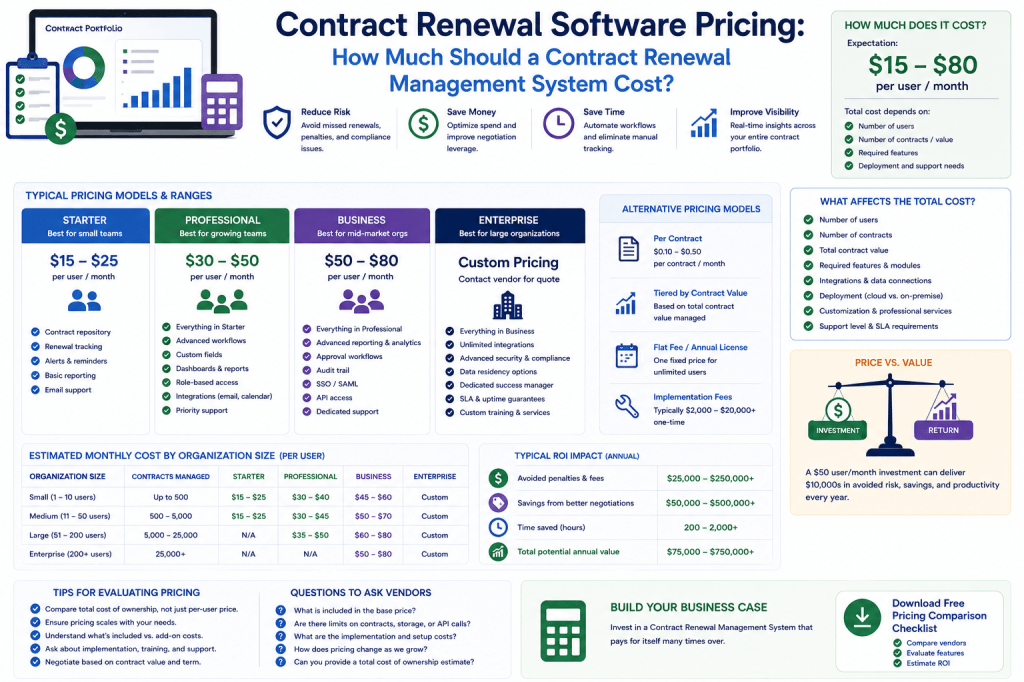
For a dedicated Contract Renewal Tracker, pricing should be simple enough for smaller teams to adopt, while still supporting larger customers that need advanced workflow, security, integrations, and portfolio intelligence.
This article explains the major pricing models, hidden costs to consider, and a practical pricing structure that could make sense for Contract Renewal Tracker itself.
Why Contract Renewal Software Pricing Varies So Much
The category overlaps with several software markets:
- contract management;
- CLM;
- procurement;
- SaaS management;
- vendor management;
- spend optimization.
A product that only tracks renewal dates should cost far less than one that also provides:
- approval workflows;
- supplier intelligence;
- AI analysis;
- SSO;
- enterprise integrations.
That is why feature scope matters.
What Are You Actually Paying For?
At the lowest level, software gives you:
Visibility
Which contracts are renewing?
At the next level:
Control
Who needs to act and when?
Then:
Decision Support
Should we renew, reduce, replace, or terminate?
And eventually:
Financial Intelligence
Where can we reduce spend and what will future commitments cost?
The more of that lifecycle the software manages, the stronger the economic case for a higher subscription.
Evaluating Contract Renewal Tracker for Your Organization?
The cost of renewal software should be compared with the amount of recurring supplier spend and renewal risk it helps control—not only with the price of a spreadsheet.
Contract Renewal Tracker is designed to start with straightforward renewal tracking and expand into workflow automation, spend optimization, supplier intelligence, forecasting, and AI-assisted renewal operations.
Compare the subscription cost with the financial exposure it helps manage →
Pricing Model 1: Per-User Pricing
A common SaaS approach is:
€X per user per month
For example:
10 users × €25
=
€250/month.
Advantages include:
- easy to understand;
- predictable at small scale.
But it can become problematic for renewal software.
Why Per-User Pricing Can Discourage Adoption
Contract renewal workflows may involve:
- procurement;
- finance;
- legal;
- business owners.
Some users may only enter the platform:
three times per year.
Charging a full seat for every occasional business owner can make the system unnecessarily expensive.
This can also encourage customers to restrict access.
That hurts workflow adoption.
Better Use of Seat Pricing
A stronger model may distinguish:
Core Users
Procurement, legal, contract operations.
Participants
Business owners, approvers.
Participants could be:
free
or:
very low cost.
This reduces friction.
Pricing Model 2: Contract-Count Pricing
Another option is to charge based on the number of active contracts.
For example:
Up to 100 Contracts
Starter.
101–500
Professional.
501–2,000
Business.
2,000+
Enterprise.
This aligns pricing with portfolio scale.
Why Contract-Based Pricing Fits the Product
The primary workload driver is often:
number of managed renewals.
More contracts create:
- more workflows;
- more reminders;
- more storage;
- more AI processing.
Therefore, contract count is a logical pricing dimension.
Potential Problem
A customer could have:
50 contracts
worth:
€500M.
Another has:
5,000
worth:
€5M.
Contract count alone does not reflect customer value or complexity.
Still, it is easy to understand.
Pricing Model 3: Managed Spend
Some procurement platforms price partly around:
spend under management.
For example:
0.05% of managed renewal spend.
If customer manages:
€50M,
price:
€25K/year.
This aligns price with potential economic value.
But it has drawbacks.
Why Spend-Based Pricing Can Be Difficult
Customers may dislike:
sharing exact spend.
They may also feel punished for:
growing supplier spend.
Pricing becomes less predictable.
For Contract Renewal Tracker, I would avoid making spend the primary billing metric.
It is better as an ROI metric.
Pricing Model 4: Feature Tiers
This is probably the strongest primary structure for Contract Renewal Tracker.
For example:
Starter
Professional
Business
Enterprise
Each adds more advanced capabilities.
This lets customers grow with the product.
Pricing Model 5: Base Platform + Usage
A hybrid model could include:
Base Subscription
plus:
AI Usage
or:
Contract Volume
This can work well if AI processing creates meaningful variable cost.
But pricing must remain understandable.
Avoid a billing model that customers cannot predict.
Pricing Model 6: Flat Annual Subscription
For small businesses:
a simple annual plan may work.
For example:
€499/year.
Up to:
100 contracts.
This can be very attractive for spreadsheet users.
What Should Contract Renewal Tracker Cost?
Given the product positioning we have developed across this series, I would use four plans.
The exact prices can evolve, but a sensible starting architecture could be:
| Plan | Indicative Price | Active Contracts |
|---|---|---|
| Starter | €39/month | up to 100 |
| Professional | €99/month | up to 500 |
| Business | €249/month | up to 2,000 |
| Enterprise | Custom | 2,000+ |
Annual billing could provide approximately:
15–20% discount.
This keeps entry pricing accessible while leaving room for enterprise expansion.
Starter — €39/Month
Target:
- freelancers;
- consultants;
- small businesses;
- small procurement teams.
Suggested capabilities:
- up to 100 active contracts;
- renewal register;
- notice-period tracking;
- automated reminders;
- basic dashboards;
- CSV/Excel import.
This is the Excel replacement plan.
Why €39 Could Work
It is low enough to compare favorably with:
manual administration.
Yet high enough to support a real SaaS product.
At annual billing:
perhaps:
€390/year
instead of €468.
That creates an easy purchasing decision for small organizations.
Starter CTA
The value proposition is simple:
Stop managing renewal deadlines manually.
No need to lead with AI.
Professional — €99/Month
Target:
- growing SMEs;
- procurement teams;
- finance/legal users.
Suggested features:
Everything in Starter, plus:
- up to 500 contracts;
- structured renewal workflows;
- escalations;
- approvals;
- business reviews;
- termination workflows;
- savings tracking.
This becomes the likely core commercial plan.
Why Professional Is Important
This is where Contract Renewal Tracker stops being:
a reminder product
and becomes:
a renewal operations platform.
For many customers, this should probably be the default recommended plan.
Professional Annual Price
Potential annual billing:
€990/year
or:
€1,068 if using a smaller discount.
That remains modest compared with even one missed renewal.
Business — €249/Month
Target:
- mid-market procurement;
- finance teams;
- larger portfolios.
Suggested features:
Everything in Professional, plus:
- up to 2,000 active contracts;
- supplier scorecards;
- supplier consolidation;
- spend optimization;
- advanced dashboards;
- forecasting;
- API access;
- advanced reporting;
- multi-entity support.
This is where the strategic intelligence capabilities become more important.
Business Annual Price
Potential:
€2,490/year
on annual billing.
Even if the final price moves materially higher later, this gives an attractive entry point during the product’s early market phase.
Is €249 Too Cheap?
Potentially.
If Business includes:
- significant AI usage;
- enterprise integrations;
- complex analytics;
€249/month may underprice the value and support burden.
An alternative could be:
€399–€599/month
once product-market fit and customer value are proven.
For early adoption, however, aggressive pricing may help build the customer base.
Enterprise — Custom Pricing
Target:
- large organizations;
- global procurement;
- complex security/governance.
Enterprise should include:
- unlimited or negotiated contract count;
- SSO;
- SCIM;
- advanced RBAC;
- audit controls;
- dedicated integrations;
- advanced API;
- custom retention;
- enterprise support;
- AI governance;
- board reporting.
Indicative pricing might begin around:
€10,000–€20,000/year
and rise with scale and complexity.
Large Enterprise Pricing
For organizations managing:
10,000+ contracts
and:
hundreds of millions in supplier spend,
annual pricing in the range of:
€25K–€75K+
could still be economically easy to justify.
But that pricing should only come once:
- product maturity;
- security;
- support;
can justify enterprise expectations.
Avoid Pricing Too Low for Enterprise
A €1,000/year product managing:
€500M in supplier commitments
can actually create sales problems.
Enterprise buyers may interpret extremely low pricing as:
- immature;
- insufficiently supported.
Pricing itself signals market position.
Suggested Final Packaging
I would currently position the tiers like this:
Starter — €39/month
Never miss a renewal.
Professional — €99/month
Manage the full renewal workflow.
Business — €399/month
Optimize spend and suppliers.
Enterprise — Custom
Control renewals across the enterprise.
This creates a very clear maturity progression.
Why I Prefer €399 Over €249 for Business
The Business tier includes potentially high-value capabilities:
- spend optimization;
- forecasting;
- supplier intelligence.
If the software helps identify:
one €20K savings opportunity,
the annual subscription is already justified.
Therefore, the tier does not need to compete purely on low price.
Potential Annual Billing
Example:
| Plan | Monthly | Annual |
|---|---|---|
| Starter | €39 | €390 |
| Professional | €99 | €990 |
| Business | €399 | €3,990 |
| Enterprise | Custom | Custom |
This effectively gives:
roughly two months free.
It also improves SaaS cash flow.
Monthly vs Annual Billing
I would allow monthly billing for:
Starter
and:
Professional.
For Business:
monthly could remain available but annual should be strongly encouraged.
Enterprise:
annual contract only.
This matches typical buying behavior.
Free Plan?
A free plan is tempting.
For example:
10 contracts.
But I would be cautious.
A free tier can attract:
many low-intent users
with support cost.
A 14-day or 30-day free trial may be better.
Better Than a Permanent Free Plan
Offer:
Free Contract Renewal Spreadsheet Health Check
and:
30-Day Trial
This generates leads while keeping paid-plan positioning strong.
Trial Limits
Trial could include:
- up to 100 imported contracts;
- reminders;
- risk dashboard;
- workflow preview.
This lets prospects see value with real data.
No Credit Card Trial?
For early growth:
yes.
Removing credit-card friction can increase trials.
Later, once traffic and brand strength increase, this can be tested.
Implementation Fees
For Starter and Professional:
€0 implementation fee.
Self-service onboarding should be the goal.
Business Implementation
Potential:
included standard onboarding.
Or:
one-time:
€500–€1,500
for assisted migration/integration.
Early on, I would probably include onboarding to accelerate customer success.
Enterprise Implementation
This can reasonably be:
paid separately.
For example:
€5K–€25K+
depending on:
- data migration;
- integrations;
- configuration.
Enterprise customers expect implementation services.
Avoid Mandatory High Implementation Fees for Mid-Market
If:
software costs €1K/year
but implementation costs:
€10K,
the sales motion becomes difficult.
The product should be designed for:
self-service migration wherever possible.
AI Pricing
AI introduces variable cost.
There are several approaches.
Option A: Include AI Generously
For example:
Starter:
limited extraction.
Professional:
1,000 AI actions/month.
Business:
5,000.
Enterprise:
negotiated.
This is straightforward.
Option B: AI Credit Packs
For example:
10,000 additional AI actions:
€50.
But credit systems often confuse customers.
Avoid unless costs require it.
Option C: Fair-Use AI
Include AI under:
reasonable usage limits.
Then contact customers with very high usage.
This may create a better early customer experience.
What Counts as an AI Action?
Potential:
- document extraction;
- contract question;
- generated renewal brief;
- portfolio query.
Keep billing simple.
Customers should not worry about every prompt.
My Preference
For early Contract Renewal Tracker:
include AI in Professional and above under fair-use limits.
Do not create complex token-based billing.
The customer is buying:
renewal intelligence,
not API tokens.
Should Starter Include AI?
Possibly:
limited contract extraction.
This provides a strong:
Aha Moment.
But advanced portfolio AI could remain:
Professional+.
Integration Pricing
Basic integrations could be included in Business.
For example:
- Teams/Slack;
- common e-signature.
Enterprise-grade custom integrations:
Enterprise.
Do Not Charge for Every Small Integration
Nickel-and-diming customers for basic integrations can reduce perceived value.
Use integrations to encourage:
higher plan adoption.
SSO Pricing
A controversial SaaS practice is:
charging significantly extra for SSO.
For Contract Renewal Tracker, I would include:
SSO only in:
Enterprise
initially,
because the surrounding enterprise capabilities also belong there.
Avoid selling SSO as a standalone punitive add-on.
Storage Pricing
Contract documents are usually small relative to video/media workloads.
Therefore:
reasonable storage should be included.
For example:
Starter
5 GB.
Professional
25 GB.
Business
100 GB.
Enterprise:
custom.
Do not make storage the main monetization mechanism.
Contract Limits
How should contract counts work?
Use:
active contracts
rather than:
historical contracts.
This is customer-friendly.
A terminated contract should not continue consuming a paid active-contract slot forever.
Historical Contract Retention
All plans could retain historical contracts.
This encourages long-term use and preserves benchmarking history.
What Happens When the Customer Exceeds the Limit?
Do not immediately block access.
Better:
notify:
You have exceeded your 500-active-contract allowance.
Give:
30 days
to upgrade.
This creates a better user experience.
Additional Contract Packs
Potential:
Professional:
extra 250 active contracts for:
€25/month.
This can smooth the jump between tiers.
But avoid making pricing overly complicated at launch.
User Limits
I would avoid tight seat limits.
For example:
Starter
3 core users + unlimited participants.
Professional
10 core users + unlimited participants.
Business
25 core users + unlimited participants.
Enterprise
custom/unlimited.
This encourages business-owner participation.
Who Is a Participant?
A participant can:
- complete assigned review;
- approve;
- comment.
But may not:
- administer portfolio;
- create reports.
This is a strong SaaS pricing model.
Why Unlimited Participants Matter
A customer with:
five procurement users
may have:
100 business owners.
Charging €20/month for all 100 creates:
bad economics for the buyer
and:
poor adoption.
Unlimited/light participants solves this.
Hidden Software Costs to Compare
When evaluating vendors, look beyond license fee.
Potential costs include:
- onboarding;
- data migration;
- implementation;
- API fees;
- support;
- AI usage;
- SSO;
- storage;
- integration fees.
A seemingly cheap product can become expensive.
Total Cost of Ownership
For example:
Subscription:
€10K.
Implementation:
€15K.
SSO:
€5K.
Integration:
€10K.
Year 1:
€40K.
This is what should be compared.
Contract Renewal Tracker Should Aim for Transparent Pricing
For Starter through Business:
publish prices publicly.
This reduces friction.
Enterprise can remain:
Contact Sales.
Why Public Pricing Matters
Prospects comparing:
spreadsheet vs SaaS
often want to know immediately:
Is this €50/month or €50,000/year?
Hiding all pricing can lose smaller customers.
Enterprise Price Can Still Be Custom
Because enterprise cost depends on:
- scale;
- integrations;
- support.
This is reasonable.
Pricing Based on Value, Not Feature Quantity
Do not create:
30 tiny paid add-ons.
Keep tiers understandable.
The customer should know:
why the next plan costs more.
Starter Value Proposition
Control deadlines.
Professional Value Proposition
Control the process.
Business Value Proposition
Improve the economics.
Enterprise Value Proposition
Control the portfolio.
That is an elegant packaging structure.
Contract Renewal Software Pricing Comparison
When comparing platforms, normalize costs to:
Annual Cost
and:
Managed Spend
For example:
Platform:
€10K/year.
Managed renewal spend:
€25M.
Platform cost as percentage of managed spend:
0.04%
This creates context.
Break-Even Calculation
Formula:
Annual Software Cost ÷ Managed Renewal Spend
Example:
€10K ÷ €25M
=
0.04%
The system only needs to improve renewal outcomes by:
4 basis points
to break even financially.
Starter Example
Annual cost:
€390.
Supplier spend:
€250K.
Break-even:
0.156%.
One cancelled unused:
€2K subscription
already creates:
more than 5× annual software cost.
Professional Example
Annual:
€990.
Managed spend:
€2M.
Break-even:
0.0495%
Very small improvement required.
Business Example
Annual:
€3,990.
Managed spend:
€20M.
Break-even:
0.02%
That is a compelling argument.
Enterprise Example
Annual platform:
€30K.
Managed spend:
€250M.
Break-even:
0.012%
This illustrates why enterprise renewal software can have strong economics.
ROI Should Not Be Overstated
The software does not single-handedly create:
all procurement savings.
People negotiate.
Business owners reduce demand.
The platform enables and tracks these outcomes.
The more defensible language is:
Renewal-related financial value managed through the platform.
This builds trust.
ROI Category 1: Avoided Unwanted Renewal
Example:
€80K.
This is often easy to attribute.
ROI Category 2: Demand Reduction
Unused licenses removed:
€120K.
ROI Category 3: Hard Savings
Procurement reduction:
€60K.
ROI Category 4: Administrative Time
Renewal reporting hours saved.
This is useful but should be kept separate from cash savings.
Example Total Value
Avoided spend:
€80K.
Demand reduction:
€120K.
Hard savings:
€60K.
Administrative value:
€10K.
Total tracked:
€270K.
Platform cost:
€3,990.
Value-to-cost:
approximately:
68×
This is possible in a meaningful portfolio, though actual results will vary substantially.
Pricing vs One Missed Renewal
This is perhaps the easiest sales comparison.
Business plan:
€3,990/year.
One unwanted auto-renewal:
€25K.
Preventing it:
covers more than six years of subscription.
That is very easy to communicate.
Pricing vs One License Optimization
Unused SaaS seats:
Cost:
€500/year.
Opportunity:
€25K.
Again:
one finding can justify the subscription.
Pricing vs Staff Time
Suppose contract manager costs:
€60/hour.
Manual administration:
10 hours/month.
Annual cost:
€7,200.
If software reduces that by:
50%,
time value:
€3,600.
That nearly covers a Business plan before financial savings.
Pricing for Consultants and Advisors
There may also be an opportunity for:
consulting firms
managing renewals on behalf of clients.
Potential:
Partner Plan
later.
Features:
- multiple workspaces;
- client switching;
- branded reports.
Do not necessarily launch this immediately.
But the pricing architecture should not prevent it.
White-Label Pricing
Probably unnecessary early.
Focus on:
core SaaS.
Avoid product complexity before demand exists.
Nonprofit Discounts
Could offer:
20–30%.
This may help acquisition.
But not necessary for launch.
Startup Discount
Potential:
first-year discount.
Again, be careful not to undermine standard pricing.
Launch Pricing
For early customers, consider:
Founding Customer Pricing
For example:
Professional:
€59/month locked for 24 months.
Business:
€249/month locked.
This can generate early adoption.
Why Founding Pricing Can Work
Early customers accept:
- immature product;
- provide feedback.
Discount compensates for that.
But make it:
time-limited.
Lifetime Deals?
I would not recommend a lifetime deal.
Contract Renewal Tracker will have ongoing:
- hosting;
- AI;
- support.
Lifetime pricing can damage SaaS economics.
Use recurring subscriptions.
Free Trial
Recommended:
30 days
because contract renewal value may take more than:
7 days
to appreciate.
Let users:
- import real contracts;
- configure reminders.
This creates deeper engagement.
Trial Conversion Trigger
During trial, show:
You have €1.2M of contracts entering notice windows within six months.
That is much more powerful than:
Your trial ends in 14 days.
Use customer data to demonstrate value.
Trial ROI Summary
Before trial ends:
Contracts Imported
Upcoming Renewal Exposure
€3.8M.
High-Risk
€620K.
Missing Owners Found
This demonstrates value.
Sales-Assisted vs Self-Service
Starter:
fully self-service.
Professional:
self-service with optional assistance.
Business:
optional sales/demo.
Enterprise:
sales-assisted.
This creates efficient customer acquisition.
Avoid Forcing a Demo for €39/Month
Customers should be able to buy:
Starter
without talking to sales.
This reduces friction.
Business Plan Demo
A prospect considering:
€399/month
may appreciate:
demo.
But should still be able to trial directly.
Enterprise Sales Motion
Enterprise requires:
- security review;
- procurement;
- legal.
Sales assistance is appropriate.
Future Usage-Based Pricing
Once product data exists:
the company can analyze:
- contracts;
- workflows;
- AI.
Then optimize pricing empirically.
Do not over-engineer pricing before customers exist.
Pricing Metrics to Track
After launch:
Trial Conversion
ARPA
Churn
Upgrade Rate
Contract Usage
AI Usage
These will tell you whether tiers are appropriately designed.
Starter-to-Professional Upgrade Trigger
Likely when customer needs:
- escalation;
- approvals;
- termination workflow.
This is a natural upgrade path.
Professional-to-Business Trigger
Likely when:
- procurement wants savings;
- finance wants forecasting;
- supplier intelligence becomes important.
This creates value-based expansion.
Business-to-Enterprise Trigger
Likely when:
- SSO;
- advanced security;
- large portfolio;
- integrations.
This is a clear enterprise boundary.
Avoid Artificial Feature Gating
Do not cripple:
basic security
or:
core deadline functionality
just to force upgrades.
Every plan should perform its core job safely.
Higher tiers should unlock:
scale and additional business value.
Example Pricing Page Structure
Starter — €39/month
For small teams replacing spreadsheets.
Up to 100 contracts
- contract register;
- notice deadlines;
- automated reminders;
- Excel import;
- basic dashboard.
Start Free Trial
Professional — €99/month
For teams managing structured renewal workflows.
Up to 500 contracts
Everything in Starter, plus:
- escalation;
- renewal decisions;
- approvals;
- business reviews;
- termination workflows;
- savings tracking;
- unlimited participants.
Start Free Trial
Business — €399/month
For procurement and finance teams optimizing supplier spend.
Up to 2,000 contracts
Everything in Professional, plus:
- spend optimization;
- supplier scorecards;
- benchmarking;
- supplier consolidation;
- forecasting;
- advanced analytics;
- API access;
- AI portfolio assistant.
Start Free Trial / Book Demo
Enterprise — Custom
For complex global renewal operations.
Everything in Business, plus:
- negotiated contract volumes;
- SSO;
- SCIM;
- advanced RBAC;
- custom integrations;
- data retention policies;
- enterprise support;
- AI governance;
- board reporting.
Contact Sales
Should Contract Renewal Tracker Charge by User?
Not primarily.
I recommend:
contract-count + feature tier
with:
generous/unlimited participant access.
This aligns much better with how renewal workflows actually work.
Should Pricing Be in Euros?
Since the initial product and your likely early audience are European:
yes.
Display:
EUR
by default.
Later support:
USD / GBP.
For international prospects, detect or allow currency selection.
VAT
For EU customers:
clearly state:
Prices exclude VAT where applicable.
This avoids confusion.
Billing Currency
Initially:
EUR.
Stripe can later support:
multiple currencies.
Keep launch simpler.
Can the Product Be Cheaper?
Certainly.
You could launch:
€19 / €59 / €199.
But I think that risks:
underpricing the value
once workflows and intelligence are included.
The key competitor is not:
a €5 task app.
It is the financial cost of unmanaged supplier renewals.
Could the Product Be More Expensive?
Yes.
Especially Business/Enterprise.
A mature Business tier could plausibly become:
€500–€1,000/month
if it consistently produces:
commercial intelligence.
The current pricing should support:
early market entry.
Pricing Should Increase with Product Maturity
A practical path:
MVP
Starter €29.
Professional €79.
Strong Workflow Product
€39 / €99.
Intelligence Product
Business €399+.
Enterprise Platform
€15K–€75K+ annually.
This lets pricing follow delivered value.
Grandfather Early Customers
If pricing rises:
keep early customers on:
existing rate
for a reasonable period.
This builds trust.
Annual Price Increases
Avoid surprise increases.
If prices change:
provide clear notice.
A contract renewal product should itself model:
good subscription-renewal behavior.
That is important for credibility.
Transparent Cancellation
Likewise:
make cancellation clear.
It would be ironic for a Contract Renewal Tracker product to rely on:
obscure auto-renewal practices.
The brand should model the standards it promotes.
Strong Trust Positioning
For example:
No hidden implementation fees on self-service plans. Clear renewal terms. Export your data at any time. Cancel before your subscription renewal date.
This can become a competitive differentiator.
Your Own Subscription Renewal Should Be Visible
A clever product feature:
Contract Renewal Tracker automatically tracks:
its own subscription
inside the customer workspace.
So the customer sees:
Contract Renewal Tracker renews on November 1.
That reinforces trust and showcases the product.
Contract Renewal Tracker Pricing Philosophy
I would build pricing around four principles:
Easy to Start
Low-cost Starter.
Easy to Collaborate
Unlimited/light participants.
Pay More for Business Value
Advanced intelligence in Business.
Enterprise Pays for Enterprise Complexity
Security, integrations, scale.
This is a sustainable structure.
Buyer Question: Is €39/Month Worth It?
If you manage:
30 contracts
and:
one unwanted renewal could cost €5K,
probably yes.
If you manage:
5 contracts
worth €500/year total,
probably not.
The software should not pretend otherwise.
Buyer Question: Is €399/Month Worth It?
If the organization manages:
€10M+ of recurring supplier spend
and uses:
spend optimization;
a very small percentage improvement can justify it.
Break-Even at €399/Month
Annual cost:
€4,788 if billed monthly.
Managed spend:
€10M.
Break-even:
0.0479%
That is less than:
five basis points.
This is a powerful business case.
Buyer Question: Why Pay €20K+ for Enterprise?
Because the product may manage:
- hundreds of millions in commitments;
- thousands of workflows.
The software cost becomes tiny relative to the financial exposure.
The bigger question is:
whether the platform is secure and capable enough.
Enterprise ROI Example
Annual software:
€30K.
Managed renewal spend:
€300M.
Break-even:
0.01%
One minor commercial improvement can justify the platform.
Pricing Comparison Should Include Risk Avoidance
Cost savings are only part of the benefit.
A platform may prevent:
- invalid termination;
- accidental auto-renewal;
- service disruption.
These risks can be expensive even if they do not occur frequently.
Avoid Claiming Guaranteed Savings
Do not market:
Save 10% automatically.
That is not credible.
Better:
Identify the renewals where savings and risk-reduction opportunities exist before the organization recommits.
This aligns with the product’s actual role.
Pricing CTA for the Website
A strong CTA could be:
See How Little Improvement It Takes to Pay for Contract Renewal Tracker
Enter your annual renewal spend and plan price to calculate your break-even percentage.
Calculate My Renewal ROI →
This could become a very strong interactive conversion tool.
ROI Calculator Example
Inputs:
Annual supplier spend:
€10M.
Contract Renewal Tracker:
€3,990/year.
Output:
Contract Renewal Tracker breaks even if it improves renewal outcomes by approximately 0.04%.
This is compelling.
Another CTA: Pricing Estimator
Ask:
How many active contracts?
Then recommend:
Professional
or:
Business.
This makes pricing easier to understand.
Pricing Page Should Avoid Complexity
Do not show:
15 add-ons.
Keep it to:
four cards
and:
a comparison table.
Then answer:
common questions below.
This helps conversion.
Ready to Compare the Cost of Contract Renewal Software with the Cost of Unmanaged Renewals?
The right price for contract renewal software depends on:
- portfolio size;
- complexity;
- financial exposure.
For smaller organizations, Contract Renewal Tracker should remain inexpensive enough to replace spreadsheet administration.
For larger customers, pricing should scale with the advanced workflow, analytics, security, and integration capabilities required.
A strong pricing model for Contract Renewal Tracker is:
Starter — €39/month
for basic renewal control.
Professional — €99/month
for structured renewal operations.
Business — approximately €399/month
for spend optimization, supplier intelligence, forecasting, and AI.
Enterprise — Custom
for scale, integrations, SSO, governance, and enterprise support.
The most important comparison is not:
Is €99/month cheaper than Excel?
Excel may already be included in your office suite.
The real comparison is:
How much supplier spend and renewal risk are we managing, and how small an improvement is required for the software to pay for itself?
For many organizations, that break-even threshold can be remarkably low.
Start Your Contract Renewal Tracker Subscription →
Final Thoughts
Contract renewal pricing should reflect the value progression of the product.
The customer journey is:
Track Deadlines
↓
Control Workflows
↓
Improve Decisions
↓
Optimize Spend
↓
Manage Enterprise Exposure
Pricing should follow that same progression.
For Contract Renewal Tracker, I would avoid building a complex seat-based pricing model.
A simpler combination of:
contract volume
feature maturity
is more aligned with how the platform creates value.
The commercial proposition then becomes easy to understand:
Start inexpensively when you simply need better renewal control. Upgrade when the platform begins helping procurement, finance, legal, and executives manage larger financial and strategic outcomes.
That creates a natural land-and-expand SaaS model.
Next Article in the Contract Renewal Tracker Series
Article 78 — “Contract Renewal Software ROI: How to Build the Business Case for Buying a Contract Renewal Tracker”
The next article should be one of the most conversion-focused pieces in the entire series. It can cover unwanted renewal avoidance, labor savings, negotiated savings, license optimization, supplier consolidation, forecast improvement, risk reduction, break-even calculations, payback period, CFO business cases, conservative/expected/upside scenarios, and an ROI calculator framework.
This will let us turn the pricing architecture above into a direct financial argument for a prospect asking:
“I understand what Contract Renewal Tracker costs—but how do I prove internally that buying it is worth the money?”

