Recognizing that your organization needs better contract renewal management is only the first step.
The next challenge is often internal approval.
A procurement manager may clearly see the operational problem.
But the CFO may ask:
What is the financial return?
Legal may ask:
How does this reduce contract and notice risk?
IT may ask:
Is the platform secure and easy to integrate?
Business owners may ask:
Will this create more administrative work for us?
A strong software business case needs to answer all of those questions.
For a dedicated Contract Renewal Tracker, the internal proposal should show that the platform is not simply another software subscription. It is a control layer for recurring supplier commitments, renewal decisions, spend optimization, and contractual risk.
This guide provides a practical business-case structure that can be used to justify the purchase of contract renewal management software internally.
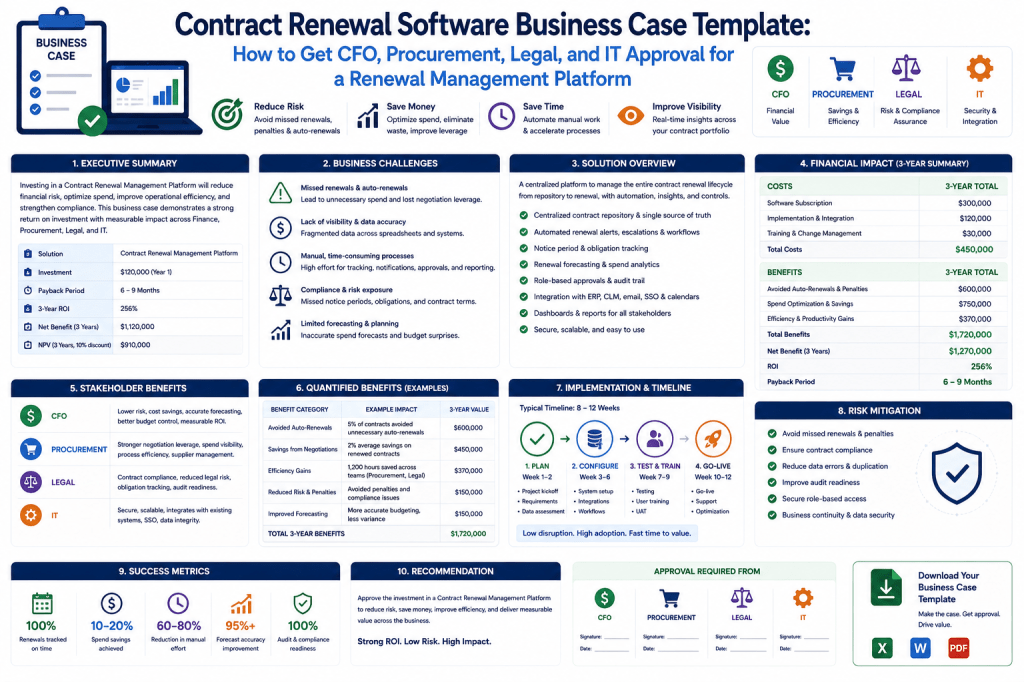
Why Contract Renewal Software Needs a Business Case
A small €30/month tool may be purchased directly.
But once renewal management affects:
- procurement;
- legal;
- finance;
- IT;
- hundreds or thousands of contracts;
the buying decision becomes cross-functional.
Different stakeholders evaluate different benefits.
That means the business case must translate the same platform into several different value propositions.
Need Internal Approval for Contract Renewal Software?
A successful business case should not say only:
“Our spreadsheets are difficult to manage.”
It should show:
- how much renewal spend is exposed;
- where the operational risk sits;
- what financial improvement is possible;
- how the proposed platform addresses the problem;
- how success will be measured.
Contract Renewal Tracker is designed to turn those elements into a measurable renewal-management program.
Build the financial and operational case for moving beyond manual renewal tracking →
Business Case Section 1: Executive Summary
The first section should fit on roughly one page.
Senior stakeholders should be able to understand:
- the problem;
- the proposed solution;
- the cost;
- the expected value;
- the decision requested.
Do not make the CFO read 20 pages before discovering what you want approved.
Example Executive Summary
An executive summary could say:
The organization currently manages approximately 850 active supplier contracts and €22 million of annual renewal-related spend using spreadsheets, email, and individual calendar reminders. This creates limited visibility into notice deadlines, unclear ownership, manual reporting, and risk of unwanted auto-renewals.
We propose implementing Contract Renewal Tracker as the centralized renewal-management platform. The system would provide automated notice deadlines, reminders, workflow escalation, structured renewal decisions, approval controls, termination tracking, spend visibility, and management reporting.
The proposed annual software cost is approximately €3,990 for the Business plan, plus any agreed implementation costs. The platform would need to improve renewal outcomes by less than 0.02% of managed spend to cover its annual subscription cost.
Approval is requested to implement Contract Renewal Tracker for an initial 12-month period, beginning with the highest-value and highest-risk contracts.
That is concise and decision-ready.
Business Case Section 2: Define the Current Problem
Avoid generic language such as:
Our process could be better.
Describe the current operating model.
For example:
- renewals tracked in Excel;
- notice dates calculated manually;
- owners chased by email;
- monthly reports assembled manually;
- termination evidence stored inconsistently.
This creates a concrete baseline.
Current-State Process
A typical process might look like:
Spreadsheet
↓
Calendar Reminder
↓
Email Business Owner
↓
Manual Follow-Up
↓
Procurement Negotiation
↓
Approval by Email
↓
Update Spreadsheet
This process may work.
But it becomes fragile as scale increases.
Current-State Weakness 1: Notice Deadlines
The spreadsheet may track:
contract expiry.
But many agreements require action:
60, 90, or 180 days before expiry.
This creates an operational control problem.
Current-State Weakness 2: Ownership
Contract ownership may be recorded as:
IT.
Marketing.
Finance.
But no named individual is accountable.
Or the recorded employee may have already left the organization.
Current-State Weakness 3: Manual Reminders
If reminders depend on:
personal calendars;
the control can disappear when people change roles.
Current-State Weakness 4: No Escalation
If the business owner does not respond:
someone must manually follow up.
At larger scale, this becomes a significant administrative burden.
Current-State Weakness 5: Limited Financial Visibility
Finance may know:
supplier spend.
Procurement may know:
renewals.
But nobody can easily answer:
How much spend is renewing in the next six months?
That limits planning.
Current-State Weakness 6: Passive Renewals
Without structured business reviews:
the default decision may become:
renew what we bought last year.
That can preserve:
- unused licenses;
- unnecessary scope;
- duplicate services.
Current-State Weakness 7: Weak Auditability
Approval may exist in:
an email.
Termination confirmation may sit:
in an inbox.
This makes later evidence retrieval difficult.
Business Case Section 3: Quantify the Exposure
This is where the proposal becomes financially meaningful.
Start with:
How much spend does the current renewal process control?
For example:
Annual supplier spend:
€40M.
Spend subject to renewal during next 12 months:
€22M.
Auto-renewing spend:
€8M.
That provides context for a €4K or €20K software investment.
Contract Count
Include:
Active contracts:
Renewals/year:
Strategic contracts:
Volume helps explain operational burden.
Renewal Exposure
For example:
Next 90 Days
€4.8M.
Next 180 Days
€9.5M.
Next 12 Months
€22M.
This shows urgency.
Auto-Renewal Exposure
For example:
Auto-renewing contracts:
Annual value:
€8.2M.
This is one of the strongest risk metrics.
Missing Data
Current review might find:
Contracts with missing notice period:
Missing named owner:
These provide evidence that the current process has control gaps.
Business Case Section 4: Show Historical Problems
If possible, use real internal incidents.
Examples:
- unwanted renewal;
- late supplier negotiation;
- missed cancellation;
- duplicate subscription.
Real history makes the business case much stronger.
Example Incident
Last year:
a €45K SaaS contract automatically renewed because the cancellation window was missed.
That one event already exceeds:
several years of software subscription.
This is powerful evidence.
Another Example
Procurement received:
a €1M supplier renewal
only:
20 days before the deadline.
The supplier negotiation had to be rushed.
The financial impact may be difficult to quantify.
But the process risk is obvious.
Do Not Invent Historical Costs
If the organization has not experienced a known missed renewal:
do not manufacture one.
Use:
current exposure
and:
conservative scenario analysis instead.
This improves credibility.
Business Case Section 5: Define the Desired Future State
The solution should not be:
Buy Contract Renewal Tracker.
First describe what the organization wants operationally.
For example:
All active material contracts should have a verified renewal deadline, named owner, structured decision workflow, and visible status.
This keeps the business case outcome-focused.
Desired Future State
The organization should be able to answer:
What renews next?
Who owns it?
What is the notice deadline?
What is the intended renewal decision?
What is the expected financial outcome?
What requires escalation?
That is a much stronger target state.
Future-State Process
Central Contract Register
↓
Automated Deadline
↓
Owner Workflow
↓
Business Review
↓
Decision
↓
Negotiation / Termination
↓
Approval
↓
Execution
↓
Outcome Tracking
This shows what the platform changes.
Business Case Section 6: Define Solution Requirements
Do not simply list every software feature.
Translate requirements directly from business problems.
Requirement 1: Central Renewal Register
Required because:
current records are fragmented.
Requirement 2: Notice-Deadline Calculation
Required because:
expiry dates do not represent the real decision deadline.
Requirement 3: Automated Reminders and Escalation
Required because:
manual chasing does not scale.
Requirement 4: Named Ownership
Required because:
department-level ownership is insufficient.
Requirement 5: Structured Renewal Decisions
Required because:
renewal intent is currently implicit.
Requirement 6: Business Review
Required to challenge:
usage;
scope;
future demand.
Requirement 7: Approval Workflow
Required to enforce:
delegated authority.
Requirement 8: Termination Management
Required to preserve:
notice evidence
and:
delivery confirmation.
Requirement 9: Dashboards
Required for:
procurement;
finance;
leadership visibility.
Requirement 10: Security
Required for:
sensitive contract and pricing information.
This may include:
SSO, RBAC, encryption, and audit logs.
Business Case Section 7: Evaluate the Alternatives
This section helps demonstrate that the recommendation is not predetermined.
Typical alternatives include:
- Continue with current spreadsheet.
- Improve spreadsheet/manual process.
- Use existing CLM.
- Buy dedicated renewal software.
This makes the proposal more balanced.
Alternative 1: Continue Current Process
Advantages
No new software cost.
Users already know the process.
Disadvantages
- continued manual effort;
- fragmented ownership;
- limited workflow control;
- risk remains.
This may be acceptable for a very small portfolio.
Alternative 2: Improve Excel
Possible improvements:
- stronger formulas;
- shared ownership;
- conditional formatting;
- Outlook reminders.
This can reduce some risks.
But it still does not provide:
- closed-loop escalation;
- workflow;
- structured audit trail.
Alternative 3: Use Existing CLM
If the company already owns a CLM:
this should be assessed seriously.
Ask:
Can the existing CLM provide the required renewal workflow economically and practically?
If yes:
buying another system may be unnecessary.
That is an important credibility point.
When Dedicated Renewal Software Makes More Sense
A specialized platform may be preferable if:
- current CLM renewal capabilities are limited;
- implementation is too heavy;
- business users do not interact with it.
Contract Renewal Tracker can then serve as the renewal-operations layer.
Business Case Section 8: Why Contract Renewal Tracker?
The proposal should map platform capability directly to the identified requirements.
For example:
| Requirement | Contract Renewal Tracker |
|---|---|
| Central register | Yes |
| Notice deadline tracking | Yes |
| Automated reminders | Yes |
| Escalations | Yes |
| Structured decisions | Yes |
| Approvals | Yes |
| Termination workflows | Yes |
| Savings tracking | Yes |
| Forecasting | Business/Enterprise |
| SSO | Enterprise |
This makes the evaluation transparent.
Avoid Unnecessary Feature Claims
If a feature is not yet available:
do not include it as delivered.
Mark:
Roadmap
or:
Not Required for Initial Phase
That is much safer for the SaaS business.
Business Case Section 9: Financial Cost
Include the full cost.
Not only:
subscription.
For example:
Subscription
€3,990/year.
Initial Migration
Included.
Standard Onboarding
Included.
Optional Integration
€1,500.
Total Year 1
€5,490.
Then the ROI uses:
€5,490.
This avoids manipulating the business case.
Enterprise Example
Subscription:
€30K.
Implementation:
€15K.
ERP integration:
€10K.
Year 1:
€55K.
Years 2+:
€30K.
This allows a proper multi-year comparison.
Business Case Section 10: Build the ROI
Use the ROI methodology from the previous article.
Keep categories separate.
ROI Category A: Avoided Spend
For example:
Conservative estimate:
one unwanted renewal avoided:
€20K.
ROI Category B: Demand Reduction
Expected SaaS/license optimization:
€30K.
ROI Category C: Hard Savings
Expected comparable price reduction:
€20K.
ROI Category D: Productivity Value
Administrative time reduction:
€8K.
Total expected value:
€78K.
Conservative Financial Value
If you want a very defensible CFO view:
exclude productivity.
Use only:
€20K + €30K + €20K
=
€70K
Then compare with:
€5,490 Year 1 cost.
Still a strong case.
ROI Formula
Net Benefit:
€70,000 − €5,490
=
€64,510.
ROI:
€64,510 ÷ €5,490 × 100
=
approximately:
1,175%
A conservative model can still be compelling.
Break-Even Calculation
Managed renewal spend:
€22M.
Year-1 solution cost:
€5,490.
Required improvement:
€5,490 ÷ €22M
=
approximately:
0.025%
That is around:
2.5 basis points.
This is perhaps the strongest CFO metric.
Business Case Section 11: Use Three Scenarios
A good proposal should avoid one overly optimistic forecast.
Use:
Conservative
€30K benefit.
Expected
€70K.
Upside
€150K.
This shows sensitivity.
Scenario Table
| Scenario | Annual Value | Year-1 Cost | Net Value |
|---|---|---|---|
| Conservative | €30K | €5.5K | €24.5K |
| Expected | €70K | €5.5K | €64.5K |
| Upside | €150K | €5.5K | €144.5K |
The business case remains positive even in the conservative case.
That is what you want.
Business Case Section 12: CFO Benefits
For the CFO, focus on:
- recurring-spend visibility;
- budget forecasting;
- financial outcomes.
The CFO probably does not care that:
the software has 14 reminder templates.
Translate functionality into financial control.
CFO Message
Contract Renewal Tracker gives finance earlier visibility into upcoming supplier commitments, supplier increases, undecided spend, and validated savings before those commitments become fixed.
That is much stronger.
Business Case Section 13: Procurement Benefits
Procurement cares about:
- earlier negotiation;
- supplier leverage;
- savings;
- consolidation.
Procurement Message
Contract Renewal Tracker starts renewals earlier, brings usage and supplier history into the decision, and provides a structured pipeline for savings and negotiation opportunities.
This is procurement-specific.
Business Case Section 14: Legal Benefits
Legal cares about:
- notice deadlines;
- clause verification;
- termination evidence;
- approvals.
Legal Message
The platform creates a controlled renewal and termination workflow with verified notice requirements, evidence, and audit history.
This makes the legal value clear.
Business Case Section 15: IT and Security Benefits
IT wants:
- SSO;
- access control;
- manageable architecture.
Do not talk to IT primarily about:
savings.
Address the technical requirements.
IT/Security Message
Contract Renewal Tracker will centralize commercially sensitive contract information under role-based access, audit logging, and enterprise identity controls.
For Enterprise:
include SSO/SCIM requirements.
Business Case Section 16: Business-Owner Benefits
Business owners may worry:
This means more forms.
The value proposition should be:
less administrative confusion.
Business-Owner Message
Instead of receiving unstructured renewal emails, owners receive a clear task showing the contract, cost, deadline, usage, and decision required.
That improves adoption.
Business Case Section 17: Implementation Approach
Stakeholders often reject software because:
implementation sounds risky.
The plan should be phased.
Phase 1 — Data Import
Import:
existing Excel/CSV contract register.
Focus on:
active, material contracts.
Phase 2 — Data Validation
Verify:
- end dates;
- notice periods;
- owners.
Prioritize high-risk contracts.
Phase 3 — Workflow Activation
Turn on:
- reminders;
- escalation;
- decision workflows.
Phase 4 — Pilot
Start with:
one category or department.
For example:
IT SaaS.
Phase 5 — Wider Rollout
Expand after:
pilot KPI review.
This makes implementation manageable.
Business Case Section 18: Pilot Scope
A pilot can reduce perceived risk.
For example:
150 IT SaaS contracts
over:
90 days.
Track:
- deadline coverage;
- owner response;
- savings opportunities.
Pilot Success Criteria
For example:
Verified Notice Coverage
95%.
Named Owner Coverage
98%.
Material Missed Deadlines
Decision Coverage
90%.
User Satisfaction
Positive.
This creates measurable go/no-go criteria.
Business Case Section 19: Security Review
For enterprise customers, security must be considered early.
Possible requirements:
- encryption in transit;
- encryption at rest;
- RBAC;
- tenant isolation;
- audit logging;
- SSO.
This prevents late procurement delays.
Data Classification
The organization should identify whether contract data contains:
- confidential pricing;
- personal data.
That informs security requirements.
Business Case Section 20: Integration Requirements
Do not integrate everything on day one.
Separate:
Required for Pilot
from:
Future Integration
For example:
Pilot:
Excel import + email.
Future:
ERP + Entra ID + e-signature.
This reduces complexity.
Business Case Section 21: Risks of Implementing
A balanced business case should acknowledge project risks.
Possible risks:
- poor source data;
- low user adoption;
- notification fatigue;
- duplicate systems.
Then show mitigation.
Implementation Risk: Poor Data
Mitigation:
risk-based validation and remediation queue.
Implementation Risk: User Resistance
Mitigation:
role-specific workflows and limited required input.
Implementation Risk: Dual Systems
Mitigation:
defined cutover date and archived spreadsheet.
Implementation Risk: Overconfiguration
Mitigation:
start with standard workflow templates.
This demonstrates practical implementation thinking.
Business Case Section 22: Risks of Doing Nothing
This is often more important than implementation risk.
Possible risks include:
- unwanted renewals;
- late negotiations;
- supplier cost increases;
- weak audit trail;
- manual effort.
The comparison should not be:
software risk vs zero risk.
It is:
implementation risk vs current-state risk.
Cost of Doing Nothing
If recent unwanted renewal:
€45K.
Manual annual administration:
€20K equivalent.
Potential exposure:
€65K+.
Compare with:
€5K solution cost.
This creates perspective.
Business Case Section 23: Success Metrics
Define these before purchase.
For example:
- 100% of material contracts have named owners.
- 95%+ verified notice-date coverage.
- Zero material missed renewal deadlines.
- 90% business-review completion.
- €X validated renewal value identified.
This creates accountability.
Operational KPI
Decision Coverage.
Financial KPI
Validated Savings / Avoided Spend.
Control KPI
Notice Compliance.
Productivity KPI
Hours required for monthly reporting.
These provide a balanced view.
Business Case Section 24: Governance
Define who owns the platform.
For example:
Business Owner
Head of Procurement.
System Administrator
Contract Operations.
Finance Validation
FP&A.
Legal Governance
Legal Operations.
This prevents implementation ambiguity.
Business Case Section 25: Decision Requested
End the document with a clear request.
For example:
Approval is requested to purchase a 12-month Contract Renewal Tracker Business subscription at €3,990/year and implement an initial pilot covering approximately 150 IT and SaaS contracts.
That is much better than:
We recommend moving forward.
Include Budget Source
For example:
Procurement Operations Budget.
Or:
Technology Budget.
This removes another approval question.
Copy-Ready Business Case Template
A practical internal document can use the following structure.
1. Proposal
Implement Contract Renewal Tracker as the centralized system for managing contract renewals.
2. Current Situation
Renewals are currently managed using spreadsheets, email, and calendar reminders.
3. Business Problem
The current process creates limited notice-deadline control, fragmented ownership, manual administration, and insufficient visibility into renewal spend and decisions.
4. Financial Exposure
Annual renewal-related spend: €____
Active contracts: ____
Auto-renewing spend: €____
Contracts renewing next 12 months: €____
5. Proposed Solution
Contract Renewal Tracker will provide centralized renewal tracking, automated notice deadlines, reminders, escalation, decisions, approvals, termination management, dashboards, and financial outcome tracking.
6. Cost
Subscription: €____
Implementation: €____
Integrations: €____
Total Year-1 Cost: €____
7. Financial Benefit
Avoided unwanted renewals: €____
Demand reduction: €____
Hard savings: €____
Productivity value: €____
8. Break-Even
Required improvement:
Total Cost ÷ Managed Renewal Spend = ____%
9. Implementation
Import → Validate → Pilot → Rollout.
10. Success Metrics
- zero material missed deadlines;
- 95% verified notice coverage;
- 90% decision coverage;
- €____ validated financial value.
11. Decision Requested
Approve Contract Renewal Tracker for a 12-month initial deployment.
This is enough for many internal approvals.
One-Page CFO Version
If the CFO wants an even shorter version:
Problem
€22M of annual renewals managed through spreadsheets/manual processes.
Risk
Auto-renewal exposure €8M; ownership and notice-date gaps remain.
Solution
Contract Renewal Tracker Business.
Cost
€3,990/year.
Break-Even
0.018% of managed spend.
Conservative Value
€30K+.
Proposed Action
90-day pilot followed by enterprise rollout if KPI thresholds are met.
This is extremely concise.
Procurement Approval Version
Add:
- savings pipeline;
- supplier benchmarking;
- consolidation.
Legal Approval Version
Add:
- termination workflow;
- audit evidence;
- notice verification.
IT Approval Version
Add:
- architecture;
- security;
- authentication;
- integrations.
One business case can therefore have:
a shared core
with:
stakeholder-specific appendices.
Avoid Writing Four Entirely Different Business Cases
Keep one source document.
Tailor the executive summary or appendix for each stakeholder.
This keeps facts and financial calculations consistent.
Common CFO Objection: “Why Not Keep Using Excel?”
A good response is:
Excel remains useful for analysis, but it does not provide the closed-loop reminders, escalation, ownership, audit trail, and workflow controls required for a larger renewal portfolio.
Then show:
the financial exposure.
Common CFO Objection: “Where Are the Guaranteed Savings?”
Answer:
The business case does not assume guaranteed savings. The conservative case only requires a very small improvement relative to annual renewal spend for the subscription to break even.
This is much more credible.
Common Procurement Objection: “We Already Manage Renewals”
The question becomes:
How early, consistently, and measurably?
The platform should improve:
process control
rather than imply procurement is currently failing.
Common Legal Objection: “This Is Not a Legal System”
Correct.
Contract Renewal Tracker does not need to replace:
CLM
or:
legal judgment.
Its role is to operationalize:
renewal and termination requirements.
This positioning is important.
Common IT Objection: “Another SaaS Application”
The response should focus on:
- scope;
- integration;
- security.
If the company already has a system that can solve the problem well, the business case should acknowledge that.
Do not force redundant software.
Common User Objection: “This Creates More Work”
The product should actually reduce work by:
- pre-populating information;
- making the decision clear.
If it increases administrative burden, adoption will suffer.
Procurement Committee Presentation
If a formal committee is involved, a five-slide deck could be:
- Current renewal risk.
- Financial exposure.
- Proposed Contract Renewal Tracker solution.
- Cost/ROI.
- Implementation and decision requested.
Keep it simple.
Board-Level Approval
For a €4K SaaS purchase:
board approval is unlikely to be required.
But a large enterprise implementation may fall under:
IT investment governance.
Scale the business case accordingly.
Business Case for Starter Plan
For a small company:
the business case can be as simple as:
We spend €390/year to prevent manual tracking of €300K of supplier renewals. One missed €2,000 subscription already costs more than five years of the software.
No 20-page proposal required.
Business Case for Professional
Focus on:
workflow and administrative savings.
Business Case for Business
Focus on:
spend optimization and finance visibility.
Business Case for Enterprise
Focus on:
governance, security, integrations, and portfolio exposure.
This mirrors the pricing/value architecture.
The Business Case Can Become a Product Feature
This is an interesting opportunity for Contract Renewal Tracker itself.
During the trial, the platform can generate:
Your Contract Renewal Business Case
using the prospect’s imported data.
For example:
Contracts
Managed Renewal Spend
€18M.
Auto-Renewal Exposure
€5.4M.
Critical Data Gaps
Subscription
€3,990.
Break-Even Improvement
0.022%.
That is a powerful sales tool.
AI-Generated Business Case
The prospect could ask:
Build a CFO business case from my renewal portfolio.
The assistant could generate a structured proposal using:
- contract volume;
- spend;
- current risks;
- plan price.
This is a very natural AI use case for Contract Renewal Tracker.
AI Should Use Conservative Assumptions
If no historical savings data exists:
do not invent:
10% savings.
Use:
break-even calculations
and:
clearly labelled scenarios.
This keeps the proposal credible.
AI Could Generate Stakeholder Versions
For example:
CFO Version
financial.
Legal Version
risk.
IT Version
security.
This could materially shorten the buying process.
Contract Renewal Tracker Can Help Sell Itself
This creates an elegant product-led sales loop.
Prospect imports:
contract spreadsheet.
↓
System identifies:
renewal exposure.
↓
System calculates:
break-even.
↓
AI generates:
internal business case.
↓
Prospect forwards:
to CFO/procurement/IT.
That is a strong conversion mechanism.
Business Case Health Score
A future feature could show:
Business Case Strength: High
because:
- large managed spend;
- known missed renewal history;
- significant admin effort.
This can help prioritize sales leads.
Strong Lead-Qualification Signal
A prospect with:
€100K renewal spend
and:
10 contracts
may not need Business plan.
Another with:
€50M spend;
1,500 contracts
is much stronger.
The ROI calculator can help qualify customers automatically.
Best CTA for This Article
The strongest CTA here is not simply:
Buy Now.
It is:
Build Your Contract Renewal Software Business Case
Enter your annual renewal spend, contract volume, and current renewal process to calculate the break-even point and create a CFO-ready justification for Contract Renewal Tracker.
Build My Business Case →
This matches the reader’s intent perfectly.
Secondary CTA
Already using Excel? Import your renewal register and let Contract Renewal Tracker identify the financial exposure, critical deadlines, and data gaps that can support your internal approval request.
This creates a natural product trial.
Ready to Get Internal Approval for Contract Renewal Tracker?
The strongest software proposal does not begin with:
features.
It begins with:
financial exposure
and:
operational risk.
A well-structured business case should show:
- what is wrong with the current process;
- how much supplier spend depends on it;
- what the proposed system changes;
- what the full cost is;
- how little improvement is needed to break even;
- how the rollout will be controlled;
- how success will be measured.
Contract Renewal Tracker can support the business case by giving procurement, finance, legal, and IT one shared renewal operating model.
Use the platform to:
- quantify renewal exposure;
- identify auto-renewal risk;
- reveal missing owners and notice dates;
- calculate break-even ROI;
- track financial outcomes;
- demonstrate workflow control;
- provide security and audit evidence;
- establish measurable pilot KPIs;
- produce role-specific management reporting;
- use AI to generate stakeholder-specific business-case summaries.
The objective is to move from:
“We would like better renewal software.”
to:
“We have €22 million of recurring supplier commitments managed through a manual process, the proposed solution costs a fraction of that exposure, the implementation risk is controlled, and we have measurable criteria for proving whether the investment works.”
Start Your Contract Renewal Tracker Subscription →
Final Thoughts
A strong business case changes the conversation.
The buying discussion should not be:
Is another SaaS subscription really necessary?
It should be:
What level of control is appropriate for the amount of recurring supplier spend we are managing?
The framework is:
Current Process
↓
Financial Exposure
↓
Risk
↓
Solution
↓
Cost
↓
Measured Value
↓
Approval
For Contract Renewal Tracker, this is particularly powerful because the annual software price can be very small compared with the financial commitments being managed.
The product does not need to promise dramatic savings on every contract.
The business case can work if it simply helps the organization avoid a few expensive mistakes, make a few better renewal decisions, and reduce the manual effort required to manage the portfolio.
That is a defensible argument for finance, procurement, legal, and IT alike.
Next Article in the Contract Renewal Tracker Series
Article 80 — “Contract Renewal Software Demo Checklist: 40 Questions to Ask Before Choosing a Contract Renewal Management Platform”
The next article should be another high-intent buyer piece. It can cover exactly what prospects should test during vendor demos: notice deadlines, reminders, escalation, owner changes, auto-renewal risk, business reviews, decisions, approvals, termination execution, savings, dashboards, integrations, security, AI grounding, implementation, pricing, support, exports, and enterprise scalability.
This is likely to attract prospects who are already very close to vendor evaluation and therefore should be another strong opportunity to position Contract Renewal Tracker as the platform that can demonstrate those capabilities rather than merely claim them.

