Contract renewal management usually does not become sophisticated overnight.
Most organizations evolve through stages.
They may begin with:
- spreadsheets;
- calendar reminders;
- shared inboxes;
- manual owner follow-up.
Then, as contract volume and supplier spend increase, those methods become harder to manage.
The organization introduces:
- standardized fields;
- structured workflows;
- approval rules;
- reporting;
- integrations.
Eventually, more advanced teams start using:
- portfolio analytics;
- predictive risk;
- AI-assisted decision support;
- automated renewal intelligence.
This progression can be described as a contract renewal maturity model.
A dedicated Contract Renewal Tracker can support that journey by helping organizations move from reactive renewal administration toward a more controlled, measurable, and increasingly intelligent operating model.
The important question is:
Where is your organization today—and what capabilities should come next?
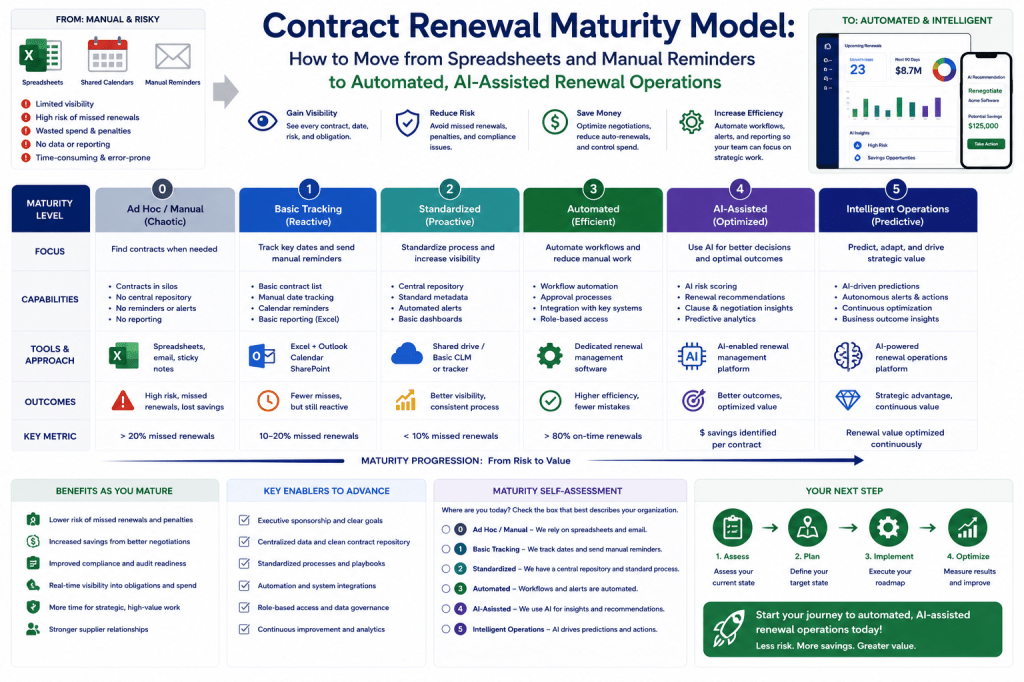
What Is a Contract Renewal Maturity Model?
A contract renewal maturity model describes how an organization’s renewal processes evolve from basic tracking to sophisticated, integrated, and data-driven renewal operations.
A practical model can use five levels:
Level 1 — Reactive
Spreadsheets and manual reminders.
Level 2 — Controlled
Centralized renewal tracking and structured workflows.
Level 3 — Integrated
Renewal operations connected to procurement, finance, legal, and other systems.
Level 4 — Predictive
Risk scoring, forecasting, benchmarking, and portfolio intelligence.
Level 5 — Intelligent
AI-assisted renewal decisions, optimization, and proactive portfolio management.
The objective is not necessarily to reach Level 5 immediately.
The objective is to identify the capabilities that solve the problems created at the organization’s current level of complexity.
Still Managing Renewals with Spreadsheets and Calendar Reminders?
That approach can work when an organization has a small number of contracts.
But as recurring supplier spend, contract volume, and organizational complexity increase, the same process can create:
- missed deadlines;
- unclear ownership;
- unwanted auto-renewals;
- rushed negotiations;
- unreliable forecasts.
Contract Renewal Tracker is designed to provide a practical path from basic renewal tracking toward structured, automated, and AI-assisted renewal operations.
See what the next level of renewal maturity could look like →
Level 1 — Reactive Renewal Management
At Level 1, the organization manages renewals largely manually.
Typical tools include:
- Excel;
- Google Sheets;
- calendar reminders;
- email.
There may be no dedicated renewal-management application.
Typical Level 1 Contract Register
Columns might include:
Supplier
Contract Value
Start Date
End Date
Owner
Notes
This may work initially.
The problem is not the spreadsheet itself.
The problem is everything the spreadsheet cannot reliably do as complexity increases.
Level 1 Characteristics
Typical characteristics include:
- decentralized contract records;
- manual reminders;
- unclear ownership;
- no standardized renewal workflow;
- limited reporting.
Renewals tend to be handled:
when somebody remembers them.
Level 1 Renewal Process
A typical process:
Someone notices contract expiry
↓
Emails business owner
↓
Asks supplier for renewal quote
↓
Negotiates quickly
↓
Signs
This is reactive.
Level 1 Problem: Expiration Date Focus
Many spreadsheets track:
End Date
But not:
Notice Deadline
That creates a dangerous misunderstanding.
A December 31 contract may effectively require action by:
September.
If the spreadsheet only highlights December:
the real commercial deadline has already passed.
Level 1 Problem: Personal Calendar Dependence
A contract owner may create:
Outlook reminder.
But then:
- changes roles;
- leaves organization;
- deletes calendar.
The reminder is not an organizational control.
It is personal memory.
Level 1 Problem: No Escalation
If the owner ignores an email:
nothing happens.
There is no automatic escalation to:
- manager;
- procurement;
- legal.
This allows deadlines to become urgent silently.
Level 1 Problem: No Portfolio Visibility
Management may know:
how many contracts exist.
But not:
- how much spend renews next quarter;
- how many remain undecided;
- how much is exposed to auto-renewal.
This makes planning difficult.
Level 1 Problem: Renewal Decisions Are Implicit
The organization may have no formal:
Renew / Reduce / Replace / Terminate
decision.
The default becomes:
renew.
That can preserve unnecessary recurring spend.
Level 1 Problem: No Financial Outcome Tracking
Even when procurement negotiates a good result:
the saving may remain in someone’s spreadsheet.
The organization cannot easily prove:
what the renewal process achieved.
Level 1 Risk Profile
Typical risks:
High deadline risk
High key-person dependency
Low forecasting confidence
Limited auditability
Who Can Stay at Level 1?
Very small organizations with:
perhaps 20–30 simple supplier contracts
may function adequately with spreadsheets.
There is no reason to introduce enterprise complexity where it is not needed.
But warning signs appear as the portfolio grows.
Signals You Are Outgrowing Level 1
Examples:
Nobody is completely sure the contract register is current.
Renewal reminders depend on one employee.
Procurement regularly receives renewals too late.
Auto-renewals are occasionally missed.
At that point, Level 2 starts making sense.
Level 2 — Controlled Renewal Management
Level 2 introduces a dedicated centralized renewal process.
This is where a product such as Contract Renewal Tracker starts delivering substantial value.
The organization now manages:
- renewal dates;
- notice periods;
- ownership;
- reminders;
- workflows;
in one place.
Level 2 Objective
Move from:
Remember the renewal
to:
Control the renewal.
This is the most important maturity transition.
Central Contract Renewal Register
Instead of multiple spreadsheets:
one shared renewal system.
Each contract contains:
- end date;
- notice period;
- calculated deadline;
- owner;
- value;
- renewal status.
This creates a consistent source of operational truth.
Automatic Notice Deadline Calculation
The system calculates:
Contract End − Notice Period
For example:
End:
December 31.
Notice:
120 days.
Deadline:
early September.
This protects against expiration-date thinking.
Automated Renewal Reminders
Instead of manually creating calendar events:
the platform schedules reminders automatically.
For example:
180 days.
This creates systematic preparation.
Closed-Loop Reminder Management
A stronger Level 2 process does not simply send reminders.
It tracks:
Sent
↓
Acknowledged
↓
Task Completed
↓
Escalated if necessary
This creates accountability.
Ownership
Every renewal has:
Business Owner
and possibly:
Procurement Owner
This removes ambiguity.
Owner Reassignment
If someone leaves:
contracts can be reassigned centrally.
This reduces key-person dependency.
Standard Renewal Workflow
For example:
Renewal Identified
↓
Business Review
↓
Decision
↓
Negotiation
↓
Approval
↓
Execution
This creates consistency.
Structured Renewal Decisions
Instead of:
Renew? Yes/No.
The organization records:
Renew
Renegotiate
Reduce
Replace
Extend
Terminate
This makes strategy explicit.
Level 2 Dashboards
Useful metrics include:
- renewals next 90 days;
- overdue decisions;
- high-risk deadlines;
- auto-renewal exposure.
Management begins to see the portfolio.
Level 2 Auditability
The system records:
- changes;
- decisions;
- approvals.
This creates a more reliable historical record.
Level 2 Benefits
The biggest benefits usually include:
Fewer Missed Deadlines
Earlier Decisions
Clear Ownership
Standardized Process
This alone may justify a dedicated renewal SaaS product.
Level 2 Remaining Limitations
The renewal system may still operate largely independently.
Users manually enter:
- spend;
- supplier information;
- usage.
That creates the next maturity challenge.
Moving from Level 2 to Level 3
Typical signs include:
Contract renewal data constantly needs manual reconciliation with finance.
Owners leave and records become stale.
Users want Teams or Slack notifications.
Executed documents must be copied manually between systems.
Now integration becomes valuable.
Level 3 — Integrated Renewal Operations
Level 3 connects Contract Renewal Tracker to the broader business technology ecosystem.
This may include:
- CLM;
- ERP;
- finance;
- identity;
- collaboration;
- e-signature;
- usage systems.
The objective is to reduce manual data movement.
Level 3 Objective
Move from:
Renewal system as another application
to:
Renewal system as an operational layer connected to existing systems.
This increases both automation and data quality.
CLM Integration
CLM can provide:
- contract document;
- end date;
- renewal terms.
Contract Renewal Tracker manages:
- renewal operations.
This avoids unnecessary duplication.
ERP Integration
ERP provides:
- actual supplier spend;
- purchase orders.
Now the renewal team can compare:
Contract Value
vs:
Actual Spend
This improves financial decisions.
Identity Integration
Microsoft Entra ID, Okta, or HR systems can identify:
inactive contract owners.
When someone leaves:
reassignment workflow starts.
This eliminates a major data-quality risk.
Teams and Slack
Business users can receive:
renewal actions
inside the tools where they already work.
This improves adoption.
E-Signature Integration
Once approvals are complete:
the renewal can move directly to:
- DocuSign;
- another e-signature platform.
Executed documents can return automatically.
This closes the workflow.
Usage Integration
For SaaS agreements:
the platform can import:
- purchased seats;
- active users.
Now business reviews become evidence-based.
Example Level 3 Renewal
Contract:
€500K SaaS.
Usage system shows:
62% utilization.
ERP shows:
€540K actual spend.
Supplier proposes:
€600K.
Business decision:
Reduce.
Procurement now enters negotiation with much stronger data.
This is a major improvement over Level 2.
Level 3 Data Provenance
The system knows where information came from.
For example:
Annual Spend:
ERP.
Notice Period:
Contract.
Usage:
Application API.
This increases trust.
Level 3 Automation
Connected events can trigger workflows.
For example:
Owner becomes inactive.
↓
Contract reassignment.
Or:
E-signature completes.
↓
Next renewal date calculated.
This reduces administrative work.
Level 3 Financial Integration
The renewal system can begin supporting:
- budget impact;
- savings validation.
This broadens its relevance to finance.
Level 3 Supplier Context
The system can combine:
- spend;
- performance;
- contract history.
Supplier renewal decisions become more informed.
Level 3 Benefits
The organization gains:
Less Manual Reconciliation
Better Data Quality
Richer Renewal Context
Improved User Adoption
The renewal process becomes integrated into normal operations.
Level 3 Challenge
The organization now has much more data.
The next problem becomes:
How do we use all of this information intelligently?
That leads to Level 4.
Level 4 — Predictive and Portfolio-Driven Renewal Management
Level 4 moves beyond executing workflows.
The organization begins using accumulated data to:
- predict;
- benchmark;
- optimize.
The focus shifts from:
individual renewals
toward:
portfolio intelligence.
Level 4 Objective
Move from:
What is happening?
to:
What is likely to happen, where is the risk, and where is the opportunity?
This is a significant maturity step.
Dynamic Renewal Risk
The system calculates risk based on:
- deadline proximity;
- decision status;
- workflow delays;
- contract value.
For example:
Contract:
€2M.
Notice deadline:
32 days.
Decision:
Undecided.
Risk:
Critical
This prioritizes attention.
Explainable Risk
The system does not only say:
Risk 82.
It explains:
High risk because the notice deadline is approaching, business review is overdue, and the supplier proposal has not been received.
This improves trust.
Spend Forecasting
The system can estimate:
future renewal spend
using:
- current value;
- supplier increases;
- decisions;
- savings.
Finance receives a forward-looking view.
Forecast Accuracy
Historical forecasts are compared with:
actual outcomes.
The system learns:
which assumptions are unreliable.
This creates a feedback loop.
Supplier Benchmarking
Contract Renewal Tracker can compare:
- unit prices;
- notice periods;
- supplier increases;
- negotiation outcomes.
Each new renewal benefits from previous ones.
Portfolio Intelligence
The platform can identify patterns such as:
- fragmented supplier spend;
- duplicate software;
- renewal clusters;
- concentration risk.
This creates strategic sourcing opportunities.
Supplier Consolidation
For example:
six contracts
with:
same supplier.
Combined:
€4M.
All renew within:
180 days.
The platform flags:
Consolidated Negotiation Opportunity
This goes well beyond reminder software.
Spend Optimization
The system identifies:
- unused licenses;
- duplicate services;
- unnecessary tiers;
- excessive commitments.
Renewal becomes an opportunity to reduce spend systematically.
Supplier Scorecards
Performance, pricing, and risk are combined.
The renewal question becomes:
Has this supplier earned another term?
This improves supplier governance.
Transition Risk
When replacement is selected:
the system tracks whether:
the new supplier will be ready before the old contract ends.
This prevents failed replacements.
Executive Dashboards
Management receives:
- critical exposure;
- undecided spend;
- savings;
- budget variance.
The system becomes a management control layer.
Level 4 Benefits
The organization gains:
Better Prioritization
Stronger Forecasting
Commercial Intelligence
Portfolio Optimization
This is where renewal management begins producing strategic value.
Level 4 Requires Good Data
Predictive intelligence is only valuable if:
- dates;
- values;
- usage;
are trustworthy.
Therefore, strong:
- data-quality controls;
become essential.
Moving from Level 4 to Level 5
Typical question:
We have the analytics. Can the system help users understand and act on them more naturally?
This leads to:
AI-assisted renewal operations.
Level 5 — Intelligent, AI-Assisted Renewal Operations
At Level 5, AI becomes an interaction and decision-support layer across the renewal platform.
The objective is not:
Let AI autonomously run contracts.
The objective is:
Let AI make complex renewal information easier to understand, prioritize, and act on while deterministic rules and humans remain in control of consequential decisions.
This distinction is critical.
Conversational Contract Portfolio
Users can ask:
What renews next quarter?
Which contracts are at highest risk?
Where can we reduce €500K?
Why is this renewal Critical?
The system retrieves the relevant data and explains the answer.
Contract Q&A
A user can ask:
What is the notice period?
The assistant answers:
120 days.
Then cites:
the governing document and clause.
This makes contract intelligence accessible.
AI Renewal Briefs
Before a business review:
the system automatically summarizes:
- usage;
- spend;
- supplier performance;
- renewal terms.
This reduces preparation time.
AI Negotiation Briefs
Before procurement meets a supplier:
the system can summarize:
- current spend;
- supplier proposal;
- internal benchmark;
- historical concessions;
- negotiating leverage.
This improves preparation.
AI Next-Best Actions
The assistant can recommend:
Validate license quantity before responding to supplier pricing.
or:
Legal verification is the most urgent action because the notice deadline is 38 days away.
This reduces cognitive workload.
AI Portfolio Questions
Leadership can ask:
Which suppliers have the strongest consolidation opportunities?
The system can combine:
- supplier families;
- spend;
- renewal dates.
This makes portfolio intelligence easier to use.
AI Budget Questions
Finance can ask:
Why is the Q4 renewal forecast above budget?
The assistant explains:
- supplier inflation;
- delayed savings;
- bridge costs.
This makes financial analysis conversational.
AI Forecast Explanations
Instead of merely showing:
Forecast Confidence: Medium.
The assistant explains:
€4M of spend remains undecided and two major supplier proposals have not yet been received.
This improves trust.
AI Supplier Recommendations
For example:
Supplier performance is strong, but pricing is 18% above internal benchmark. Continued use appears justified, but commercial renegotiation should be prioritized.
AI supports the decision.
It does not make the final commitment.
AI Should Respect Permissions
The AI layer must enforce:
- tenant;
- role;
- contract-level permissions.
A chatbot should never become a shortcut around security.
This is essential for Level 5 maturity.
AI Should Respect Data Confidence
If the notice period is uncertain:
the AI should say:
I cannot confirm the deadline until the conflicting amendment is legally verified.
This is better than generating a confident guess.
AI Action Guardrails
AI can safely:
- create a draft task;
- prepare a summary.
It should require stronger confirmation for:
- termination;
- approval;
- financial commitments.
This keeps automation controlled.
Level 5 Benefits
The organization gains:
Faster Access to Information
Better Decision Support
Proactive Opportunity Detection
Reduced Administrative Burden
But only if the underlying Level 2–4 foundations are strong.
AI Cannot Fix an Immature Renewal Process
This is an important point.
Adding AI on top of:
- missing contract dates;
- undefined ownership;
- unreliable data;
does not create maturity.
It creates:
faster access to unreliable information.
Organizations should build the foundation first.
The Five-Level Model
The maturity progression is:
Level 1 — Reactive
Spreadsheet + manual reminders.
↓
Level 2 — Controlled
Centralized tracker + workflow.
↓
Level 3 — Integrated
Connected enterprise systems.
↓
Level 4 — Predictive
Forecasting + portfolio intelligence.
↓
Level 5 — Intelligent
AI-assisted decisions and optimization.
Each level builds on the previous one.
Maturity Assessment: Renewal Data
Level 1
Spreadsheet.
Level 2
Central database.
Level 3
Integrated source systems.
Level 4
Verified and scored data.
Level 5
AI-grounded retrieval and reasoning.
Maturity Assessment: Reminders
Level 1
Calendar reminders.
Level 2
Automated reminders.
Level 3
Multi-channel notifications.
Level 4
Risk-based prioritization.
Level 5
AI-personalized next actions.
Maturity Assessment: Decisions
Level 1
Implicit renewals.
Level 2
Structured decision.
Level 3
Evidence-enriched decision.
Level 4
Scenario-based decision support.
Level 5
AI-assisted recommendations.
Maturity Assessment: Finance
Level 1
Historical spend.
Level 2
Contract value tracking.
Level 3
ERP-connected actual spend.
Level 4
Forecasting and savings.
Level 5
AI-assisted scenario analysis.
Maturity Assessment: Procurement
Level 1
Reactive negotiations.
Level 2
Earlier workflows.
Level 3
Integrated supplier/spend data.
Level 4
Benchmarking and consolidation.
Level 5
AI negotiation intelligence.
Maturity Assessment: Legal
Level 1
Last-minute review.
Level 2
Structured legal gates.
Level 3
CLM integration.
Level 4
Clause-risk analytics.
Level 5
AI-grounded legal term retrieval.
Maturity Assessment: Reporting
Level 1
Manual spreadsheets.
Level 2
Operational dashboards.
Level 3
Role-based reports.
Level 4
Predictive executive dashboards.
Level 5
AI-generated executive narratives.
Maturity Assessment: Savings
Level 1
Anecdotal.
Level 2
Manually recorded.
Level 3
Finance validated.
Level 4
Opportunity pipeline.
Level 5
AI-assisted opportunity discovery.
Maturity Assessment: Supplier Management
Level 1
Contract-by-contract.
Level 2
Basic supplier records.
Level 3
Integrated performance.
Level 4
Supplier scorecards and concentration.
Level 5
AI supplier strategy recommendations.
Maturity Assessment: Portfolio Management
Level 1
No portfolio view.
Level 2
Renewal calendar.
Level 3
Spend and owner segmentation.
Level 4
Pattern detection.
Level 5
Proactive AI optimization.
How to Determine Your Current Level
Ask a few simple questions.
Can you reliably identify every notice deadline?
No:
likely Level 1.
Do you have structured renewal workflows and owners?
Yes:
at least Level 2.
Does your renewal process automatically receive ERP, identity, or usage data?
Yes:
Level 3.
Can you predict spend and identify portfolio-level optimization opportunities?
Yes:
Level 4.
Can users ask natural-language questions and receive grounded renewal recommendations?
Yes:
Level 5.
This gives a practical starting point.
Most Organizations Will Be Mixed
Maturity is rarely uniform.
For example:
Renewal reminders:
Level 3.
Financial forecasting:
Level 1.
Supplier intelligence:
Level 2.
This is normal.
The maturity model should identify:
where to improve next
rather than force one overall score.
Maturity by Capability
A dashboard could score:
Deadline Management
4/5.
Decision Management
3/5.
Finance Integration
2/5.
AI
1/5.
This gives a much more useful roadmap.
Do Not Rush to Level 5
A company may be attracted to:
AI.
But if its biggest problem is:
missing notice deadlines,
the highest-value improvement is probably:
Level 2 controls.
Start with the business problem.
Not the most advanced technology.
The Best Next Step from Level 1
If currently using spreadsheets:
start with:
- central contract register;
- notice deadlines;
- ownership;
- reminders.
Do not begin with predictive AI.
This produces fast risk reduction.
Level 1 → Level 2 Business Case
Suppose:
one unwanted auto-renewal costs:
€80K.
A basic renewal-management subscription costs:
far less.
Preventing one missed deadline may justify the investment.
This makes the first maturity step easy to understand.
The Best Next Step from Level 2
If reminders and workflows already work:
connect:
- ERP;
- identity;
- collaboration.
This reduces manual work and improves data.
Level 2 → Level 3 Business Case
Example:
20 hours/month
spent:
reconciling owners and spend.
Integrations reduce that to:
5 hours.
Administrative value appears immediately.
The Best Next Step from Level 3
If data is connected:
use it for:
- risk;
- forecasting;
- optimization.
This unlocks much greater financial value.
Level 3 → Level 4 Business Case
Example:
Portfolio intelligence identifies:
€300K supplier consolidation opportunity.
That is far more valuable than simply automating data entry.
The Best Next Step from Level 4
If analytics are strong:
make them easier to consume through:
AI.
This reduces the effort required to use the intelligence.
Level 4 → Level 5 Business Case
If executives can ask:
What requires my attention?
and receive:
a grounded, personalized answer,
the system becomes significantly easier to use across the organization.
Maturity and Contract Volume
A rough pattern might be:
Very Small Portfolio
Level 1–2 may be sufficient.
Hundreds of Contracts
Level 2–3 increasingly valuable.
Thousands
Level 3–4 often necessary.
Large Enterprise Portfolio
Level 4–5 can create substantial benefits.
But contract complexity matters as much as count.
A Small Portfolio Can Still Need High Maturity
A company may manage:
only 100 contracts
but:
€1 billion in supplier commitments.
The contract count is low.
The financial risk is huge.
That organization may still require:
advanced controls.
Maturity and Spend
A useful question is:
How much recurring supplier spend depends on the renewal process?
The greater the spend:
the stronger the business case for maturity.
Maturity and Auto-Renewal Exposure
A portfolio with many:
auto-renewing SaaS subscriptions
may need stronger deadline controls even at relatively modest spend.
Again, context matters.
Maturity and Supplier Dependency
Strategic outsourcing or cloud suppliers can justify:
advanced renewal management
because replacement requires long lead times.
Maturity and Organizational Complexity
Global organizations with:
- regions;
- legal entities;
- shared contracts;
need stronger:
data and governance.
This can accelerate the move toward Level 3–4.
Contract Renewal Maturity Assessment Scorecard
A prospect-facing assessment could evaluate:
- Renewal Data.
- Deadline Control.
- Ownership.
- Decision Process.
- Procurement.
- Legal.
- Finance.
- Reporting.
- Integration.
- AI.
Each scored:
1–5.
This could produce:
Renewal Maturity Score
Example Assessment
Renewal Data:
Deadline Control:
Ownership:
Decision Process:
Procurement:
Finance:
Average:
1.8.
Classification:
Reactive / Early Controlled
Then recommend:
centralized renewal workflow.
This would make an excellent lead-generation tool.
This Article Can Become an Interactive Sales Funnel
A website visitor could complete:
10-question Contract Renewal Maturity Assessment
Then receive:
Your organization is currently Level 2 — Controlled.
And:
Recommended next capabilities: ERP integration, automated owner validation, supplier spend enrichment.
This naturally leads into a Contract Renewal Tracker demo or trial.
CTA Opportunity 1: Maturity Assessment
A strong CTA could be:
Take the Free Contract Renewal Maturity Assessment →
This is likely stronger than immediately asking every informational visitor to buy.
It creates a lower-friction conversion.
CTA Opportunity 2: Spreadsheet Migration
For Level 1 readers:
Move Your Renewal Spreadsheet Into Contract Renewal Tracker →
This directly addresses their current pain.
CTA Opportunity 3: Demo
For more mature organizations:
See How Contract Renewal Tracker Supports Level 3–5 Renewal Operations →
This segments the sales message by maturity.
Contract Renewal Tracker Should Support Progressive Adoption
A customer does not need every feature on day one.
The adoption path could be:
Phase 1
Import contracts.
Phase 2
Activate reminders/workflows.
Phase 3
Add integrations.
Phase 4
Add analytics and savings.
Phase 5
Activate AI assistant.
This reduces implementation risk.
Progressive Licensing Could Match Maturity
Potential product packaging might eventually reflect this.
For example:
Starter
Tracking + reminders.
Professional
Workflow + reporting.
Business
Integrations + savings.
Enterprise
Advanced intelligence + SSO + AI.
This is a potential commercial structure, not necessarily the final pricing model.
Avoid Feature Overload During Onboarding
A Level 1 customer mainly wants:
Don’t let us miss renewals.
Do not force them to configure:
- advanced benchmarking;
- AI workflows;
on day one.
Deliver the first value quickly.
Time-to-Value by Maturity
The first useful result should be:
Upcoming Renewal Exposure
and:
Critical Deadlines
Once that is reliable:
move deeper.
This keeps onboarding focused.
Measure Maturity Progress
Contract Renewal Tracker could periodically show:
Last year, your renewal process operated primarily at Level 2. Current capabilities now satisfy 70% of Level 3 criteria.
This demonstrates progress.
Maturity Improvement Examples
Year 1
Centralize renewals.
Year 2
Integrate finance and identity.
Year 3
Add portfolio optimization.
The software grows with the process.
Maturity Is Not a Race
Level 5 is not automatically better if:
- cost;
- complexity;
outweigh the benefit.
The objective is:
appropriate maturity for organizational risk and scale.
This keeps the framework credible.
Renewal Maturity vs Process Burden
A poorly designed mature process can become bureaucratic.
More approvals do not automatically mean:
better governance.
Automation should reduce burden while increasing control.
High Maturity Should Feel Simpler
This is an important design principle.
At Level 5:
users should not perform:
five times more work.
The platform should perform more:
- automation;
- pre-population;
- prioritization.
The user sees:
less noise
and:
better decisions.
Example
Level 1:
User manually searches spreadsheet.
Level 5:
AI says:
You have three important renewal actions today.
Higher maturity should reduce cognitive burden.
Renewal Maturity and ROI
The financial value tends to broaden as maturity increases.
Level 2
Avoid missed renewals.
Level 3
Reduce administration.
Level 4
Generate savings and improve forecasts.
Level 5
Scale intelligence across the organization.
This creates a compelling product expansion path.
Example Maturity ROI
Level 2 value:
€100K unwanted renewal prevented.
Level 3:
€20K administrative value.
Level 4:
€400K spend optimization.
Level 5:
additional decision efficiency.
The exact results vary, but the sources of value become broader.
The Strongest Product Strategy for Contract Renewal Tracker
This maturity model suggests a useful positioning:
Contract Renewal Tracker should not present itself primarily as:
an AI contract application.
That narrows the value proposition too early.
A stronger message is:
A contract renewal operations platform that helps organizations progress from simple deadline tracking to intelligent recurring-spend and supplier decision management.
AI then becomes:
the advanced layer,
not the entire product story.
Why This Positioning Is Stronger
A prospect currently using:
Excel
may not care about:
RAG architecture.
They care about:
Stop missing renewals.
A procurement leader may care about:
Find savings.
A CFO:
Forecast spend.
An enterprise buyer:
Integrate and govern.
The maturity model lets one product speak to each stage.
The Product Can Meet the Customer Where They Are
This is especially important commercially.
A customer does not need to believe in the full vision immediately.
They can buy because:
We need renewal reminders.
Then discover:
- savings;
- forecasting;
- supplier intelligence.
That creates expansion potential.
SEO Value of This Article
This article can target broader searches such as:
contract management maturity model
contract renewal process maturity
procurement maturity model
contract renewal best practices
These queries may attract prospects earlier in the buying journey than highly product-specific searches.
Internal Linking Opportunity
This article should link heavily to previous series content.
For example:
From Level 2:
link to:
Automated Renewal Reminders
Renewal Workflows
From Level 3:
Contract Renewal Integrations
From Level 4:
Portfolio Intelligence
Benchmarking
Spend Optimization
From Level 5:
Contract Renewal AI Assistant
This makes it a strong hub page for the entire content cluster.
Strong Sales CTA for This Article
Near the end, I would use:
Where Is Your Renewal Process Today?
Whether you are moving away from spreadsheets or building an enterprise renewal operating model, Contract Renewal Tracker is designed to let you start with the controls you need now and add automation, integrations, analytics, and AI as your process matures.
Start Your Contract Renewal Tracker Subscription →
This fits the article naturally.
Ready to Move Beyond Spreadsheet Renewal Management?
You do not need to transform contract renewal operations overnight.
You need to solve the next highest-value problem.
For some organizations, that means:
centralizing renewal dates.
For others:
integrating spend and usage.
For mature procurement teams:
finding portfolio-level savings opportunities.
And for advanced enterprise users:
AI-assisted renewal intelligence.
Contract Renewal Tracker is designed to support that progression.
Use it to:
- centralize contract renewals;
- calculate notice deadlines;
- automate reminders;
- assign owners;
- structure renewal decisions;
- connect ERP and CLM systems;
- measure supplier performance;
- forecast future spend;
- identify consolidation and optimization opportunities;
- manage termination and transitions;
- track financial outcomes;
- use AI to explain risk and recommend next actions.
The objective is to move from:
Reactive
to:
Controlled
to:
Integrated
to:
Predictive
to:
Intelligent
at the pace that makes sense for your organization.
Start Your Contract Renewal Tracker Subscription →
Final Thoughts
Contract renewal maturity is ultimately about one thing:
increasing control before commitment becomes unavoidable.
At Level 1:
the organization discovers renewals.
At Level 2:
it manages them.
At Level 3:
it connects them.
At Level 4:
it predicts and optimizes them.
At Level 5:
it uses AI to make that intelligence easier to understand and act on.
The progression is:
Remember
↓
Control
↓
Connect
↓
Predict
↓
Optimize
That is also a useful summary of the Contract Renewal Tracker product vision.
The software can start by solving a simple, urgent problem:
Don’t miss the renewal deadline.
But the same underlying renewal data can eventually support something much more valuable:
Help the organization decide what it should renew, what it should renegotiate, what it should eliminate, and where its future supplier commitments should go.
That makes the maturity model both a practical framework for prospects and a strong roadmap for the SaaS platform itself.
Next Article in the Contract Renewal Tracker Series
Article 74 — “Contract Renewal Implementation Guide: How to Move from Excel and Shared Calendars to a Centralized Renewal Management System”
The next article will be especially practical and conversion-focused. It will cover inventorying existing spreadsheets, cleaning contract data, prioritizing active contracts, defining required fields, importing records, verifying notice dates, assigning owners, setting reminder policies, creating workflow templates, onboarding users, running a pilot, parallel operation, measuring early success, and retiring the old spreadsheet process.
This should be a particularly valuable article for prospects who already recognize the renewal problem but are asking the next buying question:
“Moving to a dedicated system sounds useful—but how difficult will it be to implement?”

