Board reporting should not be a larger version of an operational dashboard.
Boards and executive committees do not need every renewal task, every overdue reminder, or every contract field.
They need a concise view of the issues that could materially affect:
- financial performance;
- strategic execution;
- supplier dependency;
- operational continuity;
- legal exposure;
- cost transformation.
That means contract renewal reporting at board level should focus on materiality, concentration, trend, and required decisions.
A dedicated Contract Renewal Tracker can turn detailed renewal activity into board-ready reporting that answers:
What strategic supplier commitments are approaching, where is the organization exposed, what has changed since the last report, and does senior leadership need to intervene?
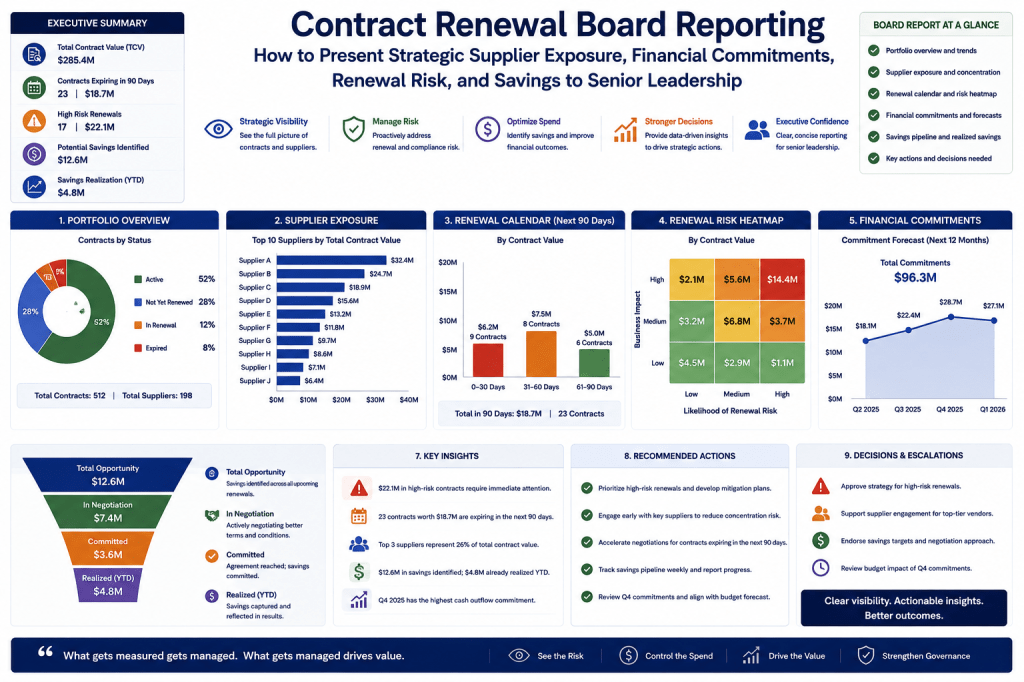
Why Contract Renewals Belong in Senior Leadership Reporting
Not every renewal belongs on a board agenda.
A €5,000 software subscription does not.
But a €25 million cloud agreement, a critical outsourcing renewal, or a major supplier replacement potentially does.
These contracts can affect:
- cost base;
- transformation programs;
- cybersecurity exposure;
- business continuity;
- cash flow.
The goal is therefore not:
Report every contract.
It is:
Identify the contract renewal events that are materially relevant to enterprise governance.
Are Strategic Supplier Renewals Visible Before They Become Executive Problems?
Large supplier commitments can remain operational issues for months before suddenly becoming executive issues because a deadline, negotiation, replacement, or approval has gone wrong.
Contract Renewal Tracker is designed to surface those material developments early and convert them into concise, decision-ready leadership reporting.
Turn renewal operations into board-level strategic visibility →
Board Reporting Starts with Materiality
The first question should be:
Which contracts are material enough to report?
A company can define thresholds based on:
- annual value;
- total contract value;
- strategic criticality;
- supplier concentration.
For example:
Financially Material
TCV > €5M.
Strategically Material
Critical infrastructure regardless of value.
Risk Material
High/Critical renewal with significant operational impact.
This creates a manageable reporting population.
Materiality Is Not Only Financial
A €200K cybersecurity service may be more strategically important than a €2M commodity supplier.
Board reporting should therefore consider both:
Value
and:
Business Criticality
This prevents smaller but essential suppliers from disappearing from view.
Materiality Matrix
A simple model:
| Low Criticality | High Criticality | |
|---|---|---|
| Low Value | Operational | Risk-Based Review |
| High Value | Financial Review | Board / Executive Attention |
This helps define escalation.
Board Reporting Metric 1: Strategic Renewal Exposure
A useful opening metric is:
Value of material contracts renewing within the next 12 months
For example:
Strategic renewal exposure:
€180M
That immediately establishes scale.
Break Exposure by Horizon
For example:
Next 90 Days
€24M.
Next 180 Days
€65M.
Next 12 Months
€180M.
This tells leadership when major commitments are approaching.
Strategic Exposure Should Be Compared with Total Spend
If annual third-party spend is:
€500M
and:
€180M renews next year,
36% of supplier spend is potentially subject to renewal decisions.
That is strategically meaningful.
Board Reporting Metric 2: High-Risk Strategic Renewals
Do not simply report:
12 high-risk contracts.
Report:
€42M of strategic renewal exposure is High or Critical risk.
This gives the risk financial context.
High-Risk Breakdown
For example:
Deadline / Notice Risk
€8M.
Negotiation Risk
€14M.
Replacement Risk
€12M.
Supplier / Security Risk
€8M.
This tells leadership what kind of exposure exists.
Top Material Renewals
A board-level table may include only five or ten items.
For example:
| Supplier | Commitment | Status | Key Issue |
|---|---|---|---|
| CloudCo | €32M | Negotiation | +14% supplier proposal |
| OutsourcingCo | €25M | Replace | Transition delayed |
| CyberSecure | €8M | High Risk | Security remediation |
| TelecomCo | €12M | Negotiation | Consolidation opportunity |
This is enough for discussion.
Board Reporting Metric 3: Strategic Supplier Concentration
Supplier concentration can create systemic dependency.
For example:
Top 5 strategic suppliers:
42% of critical technology spend
That deserves senior visibility.
Concentration by Supplier
For example:
Cloud Supplier A:
18%.
ERP Supplier:
11%.
Managed Services:
8%.
Cybersecurity:
5%.
This shows where dependency is concentrated.
Concentration Plus Renewal Timing
Even more useful:
70% of Cloud Supplier A’s €24M annual relationship renews within the next six months.
That creates both:
- negotiation leverage;
- strategic risk.
This is board-relevant.
Single-Supplier Dependency
A board may want to know:
Which critical capabilities rely on one supplier with limited alternatives?
For example:
Core ERP:
High dependency.
Replacement lead time:
24 months.
This helps frame renewal strategy.
Board Reporting Metric 4: Multi-Year Financial Commitments
Renewal value should not be reported only on an annual basis.
Example:
Annual value:
€8M.
Five-year term:
€40M commitment.
The board may care more about the latter.
Annual Spend vs TCV
A board report should distinguish:
Annual Cost
from:
Total Contractual Commitment
This avoids understating long-term obligations.
New Commitments During Reporting Period
For example:
Approved during quarter:
€72M TCV.
This provides a view of new long-term supplier commitments entered into.
Commitment Maturity Profile
A useful view might show:
1-Year Commitments
€30M.
2–3 Years
€90M.
4+ Years
€140M.
This reveals long-term lock-in.
Board Reporting Metric 5: Contractual Flexibility
Senior leadership may want to understand:
how much supplier spend is locked into long-term agreements.
For example:
Spend under >36-month commitments:
€120M.
Strategic suppliers:
€95M.
This is a useful flexibility metric.
Lock-In Exposure
Long-term commitments are not necessarily bad.
But if technology or strategy is changing rapidly, excessive lock-in can constrain the business.
Renewal reporting can make this visible.
Board Reporting Metric 6: Supplier Inflation Exposure
For example:
Strategic supplier proposals:
Average increase:
9.4%.
Current procurement expectation:
4.8%.
Potential gross annual increase:
€6.2M.
This is relevant to financial planning.
Proposed vs Expected
A board report can show:
Supplier Ask
+€6.2M.
Expected Negotiated Outcome
+€3.1M.
This demonstrates both pressure and procurement response.
Price Inflation by Strategic Category
For example:
Cloud:
+11%.
Software:
+8%.
Managed Services:
+5%.
This gives leadership context.
Board Reporting Metric 7: Renewal Savings
Savings should be presented carefully.
A board does not need every methodology detail.
But it should distinguish:
Hard Savings
Cost Avoidance
Avoided Spend
For example:
Hard Savings YTD
€4.2M.
Cost Avoidance
€7.1M.
Avoided Spend
€2.4M.
This avoids inflated “total savings” claims.
Savings vs Target
For example:
Annual hard-savings target:
€5M.
Realized:
€4.2M.
Forecast:
€5.4M.
Status:
On Track.
This is concise and useful.
Savings Should Be Finance-Validated
For board reporting, use:
validated
or:
realized
financial outcomes where possible.
Avoid presenting early pipeline opportunities as achieved value.
Board Reporting Metric 8: Unwanted Renewal Avoidance
This is a strong operational outcome.
For example:
Contracts prevented from unwanted auto-renewal:
Annual spend avoided:
€1.8M.
This can demonstrate control effectiveness.
Missed Renewals
The board may also need to know if material failures occurred.
For example:
Material missed renewal deadlines:
Or:
Associated financial impact:
€350K.
Material exceptions should be transparent.
Board Reporting Metric 9: Major Supplier Replacements
A significant supplier replacement can create:
- continuity risk;
- transformation dependencies.
The board may need a status summary.
Example Replacement Report
Supplier:
Legacy ERP Provider.
Replacement:
NewERP.
Current status:
Migration 78%.
Old contract ends:
March 31.
Forecast go-live:
February 15.
Buffer:
44 days.
Risk:
Medium.
This is enough for executive oversight.
Transition Risk Should Be Reported as Exceptions
No need to report every project milestone.
Only report:
- material delays;
- predicted service gaps;
- major bridge costs.
This keeps the report strategic.
Board Reporting Metric 10: Bridge Extensions
Unexpected bridge extensions may indicate:
- project delay.
For example:
Emergency extensions YTD:
Incremental cost:
€1.2M.
This could be relevant if material.
Board Reporting Metric 11: Supplier Performance
For major strategic suppliers:
report where performance is below expectation.
For example:
Strategic supplier spend below performance threshold:
€22M.
This gives leadership a vendor-quality view.
Supplier Performance Trend
For example:
Strategic suppliers below score 70:
Q1:
Q2:
Q3:
Improving.
This may be more useful than raw detail.
Board Reporting Metric 12: Third-Party Risk
Major supplier risks may include:
- cyber;
- financial instability;
- regulatory issues.
A board report could say:
Two strategic suppliers totaling €18M annual spend are currently classified High third-party risk and enter renewal within six months.
That is decision-relevant.
Board Reporting Metric 13: Compliance Exceptions
Senior leadership may need visibility into material control exceptions.
For example:
Renewals Executed Without Required Approval
Material Notice Exceptions
Segregation-of-Duties Exceptions
This demonstrates governance.
Policy Exception Trend
For example:
Q1:
Q2:
Q3:
This shows improving process maturity.
Only material trends may belong in board reporting.
Board Reporting Metric 14: Budget Impact
The board may see:
Current renewal forecast:
€84M.
Budget:
€82M.
Variance:
+€2M.
Main drivers:
supplier inflation and delayed replacement.
This gives immediate financial context.
Budget Bridge
Example:
Budget:
€82M.
Supplier Inflation:
+€4M.
Growth:
+€2M.
Savings:
−€3M.
Terminations:
−€1M.
Expected:
€84M.
This is an excellent senior-level financial narrative.
Board Reporting Metric 15: Forecast Confidence
If major renewal outcomes remain unresolved, the board should know.
For example:
Forecast Confidence: Medium
because:
€16M of strategic spend remains under negotiation.
This communicates uncertainty responsibly.
Forecast Range
Instead of:
Expected:
€84M.
Use:
Expected:
€84M.
Likely range:
€82.5M–€86M.
This gives leadership a better understanding of potential outcomes.
Board Reporting Metric 16: Decision Requirements
Perhaps the most important section is:
What decisions does leadership need to make?
For example:
Decision 1
Approve 24-month CloudCo renewal.
TCV:
€32M.
Decision 2
Authorize 6-month bridge for outsourcing transition.
Cost:
€2.5M.
Decision 3
Approve replacement sourcing strategy for cybersecurity supplier.
This makes the report actionable.
Keep Decision Requests Separate from Information
A report should clearly distinguish:
For Information
from:
Decision Required
This improves meeting efficiency.
Board Reporting Metric 17: Changes Since Last Meeting
Senior leaders often care more about movement than absolute numbers.
For example:
Since last report:
- Critical exposure decreased €8M.
- Forecast cost increased €1.2M.
- One strategic replacement moved to High risk.
- Savings forecast improved €700K.
This is an excellent opening summary.
Change Reporting Prevents Repetition
Do not re-present:
the entire portfolio
every month.
Highlight:
what changed
and:
why.
This keeps board packs concise.
Management Commentary
Numbers alone are not enough.
A strong board report includes a short narrative such as:
Strategic renewal exposure remains manageable, with no material missed deadlines. Cost pressure increased due to double-digit software proposals, but procurement savings remain ahead of plan. The main emerging concern is the ERP supplier replacement, where migration delay has reduced the transition buffer to 45 days.
This is much more useful than charts alone.
AI-Generated Board Commentary
Contract Renewal Tracker can generate a draft management narrative from underlying metrics.
For example:
During the quarter, Critical renewal exposure fell from €52M to €38M following completion of two major supplier negotiations. Forecast renewal spend increased €1.2M, primarily due to software inflation. One supplier replacement has moved to High risk because migration milestones slipped.
This can save substantial reporting time.
AI Should Not Invent Executive Interpretation
The narrative should remain grounded in:
- actual metrics;
- recorded risks.
It should not create dramatic commentary unsupported by evidence.
AI Board Summary Should Be Reviewed
For formal board materials, a human owner should review AI-generated commentary before publication.
This ensures:
- accuracy;
- tone;
- governance.
Board Reporting Structure
A practical report might include:
Executive Summary
One page.
Strategic Renewal Exposure
Material contracts.
Financial Outlook
Budget, inflation, savings.
Strategic Supplier Risk
Concentration and performance.
Major Exceptions
Transition, legal, compliance.
Decisions Required
Specific approvals.
That is often enough.
Keep the Main Pack Short
The detailed contract data can sit in:
appendix
or:
dashboard drill-down.
Boards need:
decision clarity.
Not:
operational clutter.
One-Page Executive Summary
For example:
Strategic Renewals Next 12 Months
€180M.
High/Critical Risk
€38M.
Forecast Budget Variance
+€2M.
Realized Hard Savings
€4.2M.
Strategic Replacements at Risk
Material Missed Deadlines
Board Decisions Required
This is highly usable.
Trend Arrows
The report might show:
Critical Exposure:
€38M ↓ €14M.
Budget Variance:
€2M ↑ €800K.
Savings:
€4.2M ↑ €1.1M.
This gives instant context.
Strategic Supplier Table
Keep it concise:
| Supplier | Renewal Value | Risk | Current Position |
|---|---|---|---|
| CloudCo | €32M | Medium | Final negotiation |
| OutsourcingCo | €25M | High | Transition delay |
| ERPCo | €18M | Low | Approval |
| CyberSecure | €8M | High | Security remediation |
This is enough for discussion.
Avoid Red-Yellow-Green Without Explanation
A red status alone is insufficient.
Use:
High — transition is forecast 12 days beyond incumbent contract end
That gives meaning.
Risk Should Always Have a Reason
For every material red/amber item:
- why;
- owner;
- next action.
This creates accountability.
Action Owner
For example:
ERP Replacement.
Risk Owner:
CIO.
Next Action:
Executive transition review August 20.
This closes the reporting loop.
Board Materiality Thresholds Should Be Configurable
One organization may report:
contracts >€5M.
Another:
€1M.
Thresholds should depend on:
- size;
- governance.
Contract Renewal Tracker can support configurable reporting tiers.
Example Tiering
Tier 1 — Board
€10M or strategic critical.
Tier 2 — Executive Committee
€2M–€10M.
Tier 3 — Functional Leadership
€500K–€2M.
Tier 4 — Operational
<€500K.
This keeps governance proportional.
Material Event Reporting
Some issues should escalate regardless of scheduled board cycle.
For example:
- missed notice on strategic supplier;
- major third-party incident;
- critical transition failure.
Contract Renewal Tracker can flag:
Material Renewal Event
This can trigger immediate executive reporting.
Event-Based Escalation
For example:
IF contract_value > 10MAND risk = CRITICALTHEN executive_material_event = TRUE
This creates automatic governance.
Board Reporting by Supplier Concentration
Another useful view:
Top strategic suppliers:
Supplier A:
€40M.
Supplier B:
€28M.
Supplier C:
€20M.
Renewal dates:
visible.
This gives leadership insight into dependence timing.
Board Reporting by Category
For example:
Cloud:
€45M renewing.
Software:
€38M.
Outsourcing:
€30M.
This helps link renewal exposure to strategy.
Board Reporting by Geography
For multinational organizations:
Europe:
€60M.
North America:
€90M.
APAC:
€30M.
Useful when different regional issues exist.
Board Reporting by Legal Entity
This may be relevant where commitments sit across several subsidiaries.
Again, only if material.
Scenario Reporting
The board may need to understand alternative outcomes for major renewals.
For example:
CloudCo:
Option A — 36 Months
€32M.
Option B — 12 Months
€12M but higher annual rate.
Option C — Replacement
€26M + €8M migration.
This provides decision context.
Scenario Risk
Each scenario should show:
- cost;
- lock-in;
- transition risk.
The lowest cost option may not be strategically best.
Major Renewal Business Cases
For very large renewals, a board pack may include a one-page decision summary:
Recommendation
Financial Impact
Risk
Alternatives
Management Decision Required
Contract Renewal Tracker can generate much of the data automatically.
Example
Recommendation
Renew strategic cloud supplier for 24 months.
TCV
€28M.
Supplier Proposal
€32M.
Negotiated Outcome
€28M.
Cost Avoidance
€4M.
Key Risk
Supplier concentration remains High.
Mitigation
Multi-cloud exit roadmap.
This is board-ready.
Savings Reporting Needs Integrity
Avoid presenting:
Supplier proposal €32M.
Final €28M.
as:
€4M “hard savings”
if current comparable cost was:
€27M.
The board should see:
Cost Avoidance: €4M
and:
Spend Increase vs Current: €1M
Both can be true.
This builds trust.
Avoid Double Counting at Board Level
Board reports should never combine:
hard savings
cost avoidance
demand reduction
without clear methodology.
Finance validation should underpin reported figures.
Board Reporting and Auditability
Every summary number should be traceable back to:
contract-level data.
Executives may not drill down often.
But audit and finance teams must be able to.
Board Report Snapshot
When a board pack is generated:
preserve:
- reporting date;
- underlying portfolio snapshot;
- metrics.
This supports historical governance.
Why Snapshotting Matters
If the board asks six months later:
What did we know when we approved this?
The organization can retrieve the exact report context.
This is important for major commitments.
Board Decision Audit Trail
If leadership approves:
a strategic renewal
or:
bridge extension,
Contract Renewal Tracker should preserve:
- decision;
- date;
- terms.
This connects governance directly to execution.
Board Decision → Workflow
Example:
Board approves:
24-month renewal.
↓
Contract Renewal Tracker updates:
Approved Strategy.
↓
Final signature workflow starts.
This reduces manual handoffs.
Executive Committee vs Board
Not every material renewal requires formal board approval.
Some may belong to:
executive committee.
The system should support different governance levels.
Governance Routing
Based on:
- contract value;
- strategic criticality;
- policy.
For example:
€5M:
Executive Committee.
€25M:
Board.
This can be automated.
Board Reporting Frequency
Possible:
monthly
for highly dynamic portfolios.
Quarterly
for many organizations.
The platform should support both:
scheduled
and:
event-driven reporting.
Monthly Management Pack
Useful for:
CFO/Executive Committee.
Board report may be:
quarterly.
Same data, different level of aggregation.
Trend History
The platform can show:
12-month trajectory of:
- critical exposure;
- supplier inflation;
- savings.
This helps leadership evaluate progress.
Example Trend
Critical Renewal Exposure:
Q1:
€52M.
Q2:
€45M.
Q3:
€38M.
This indicates improving control.
Strategic Supplier Concentration Trend
Top 5 concentration:
48% → 45% → 42%.
This may demonstrate diversification.
Savings Trend
Realized savings:
€2M → €3.5M → €4.2M.
This shows financial benefit.
Missed Deadline Trend
Material misses:
3 → 1 → 0.
This is a strong governance improvement metric.
Board-Level Renewal Health Indicator
A simple indicator could summarize:
Financial
Risk
Execution
Control
For example:
Renewal Portfolio Health:
Green / Stable
But it should always be supported by explicit metrics.
Avoid a Black-Box Board Score
One number such as:
87/100
may be visually convenient.
But boards need to understand:
what drives the result.
Use it only as a summary.
Board-Level KPIs
A concise set might include:
Strategic Renewal Exposure
High/Critical Exposure
Budget Variance
Supplier Inflation
Realized Savings
Strategic Supplier Concentration
Material Compliance Exceptions
Decisions Required
These cover most of the board-level story.
AI: “What Should the Board Know?”
A senior executive could ask:
What should I put in the board renewal update?
The assistant could produce:
Three issues are board-relevant this quarter. First, €32M cloud renewal negotiations remain €4M above internal target. Second, the €25M outsourcing replacement is High risk because migration has slipped six weeks. Third, procurement savings remain on track at €5.4M forecast versus €5M target.
This is an excellent executive AI use case.
AI: “What Changed Since Last Board Meeting?”
The assistant might answer:
Critical exposure decreased €14M, but the outsourcing transition moved from Medium to High risk. Renewal budget variance widened from €1.2M to €2M due mainly to software supplier inflation.
This creates concise continuity.
AI: “Which Decision Needs Board Approval?”
For example:
The CloudCo 24-month renewal requires board approval under current authority policy because total commitment is €28M.
This turns governance rules into usable guidance.
AI: “What Is the Biggest Financial Risk?”
Response:
The largest near-term financial risk is the unresolved CloudCo negotiation. Accepting the current supplier proposal would increase two-year commitment by €4M above management target.
This keeps leadership focused.
AI: “What Is the Biggest Operational Risk?”
Response:
The outsourcing replacement currently presents the largest operational risk because replacement readiness is forecast 18 days after incumbent contract expiry.
Again, clear and actionable.
Role-Aware Board Briefing
CFO focus:
- cost;
- savings.
CIO:
- transition;
- critical suppliers.
General Counsel:
- notice and compliance.
The platform can produce different briefing views from the same underlying data.
Board Pack Automation
A mature feature could automatically assemble:
- KPI page;
- strategic renewal table;
- commentary;
- decision requests.
The report remains reviewed and approved by management before distribution.
Board Report Export
Potential formats:
- PDF;
- PowerPoint;
- secure dashboard.
The format matters less than the quality of underlying data and commentary.
Board Reporting ROI
Management reporting often consumes significant time.
Suppose procurement, finance, and legal spend:
40 hours per quarter
creating a strategic renewal pack.
Automation reduces:
40 → 10.
Annual saving:
120 hours.
At €100/hour:
€12,000 productivity value
But as elsewhere, the larger value is better executive decision-making.
One Earlier Executive Intervention Can Be Worth Far More
If the board or executive committee identifies a:
€25M strategic supplier issue
months earlier,
the cost avoidance or risk reduction can substantially exceed the reporting efficiency.
This is why the reporting layer matters.
Board Reporting Makes the Product More Strategic
Operational SaaS often struggles to gain executive visibility.
Board reporting changes that.
When Contract Renewal Tracker provides:
- supplier concentration;
- commitment;
- strategic risk;
- savings;
the platform becomes relevant to senior governance.
That can materially strengthen enterprise adoption.
Contract Renewal Tracker as an Enterprise Governance Platform
The product evolution becomes:
Renewal Dates
↓
Workflows
↓
Financial Outcomes
↓
Supplier Risk
↓
Executive Dashboards
↓
Board Governance
That is far beyond reminder software.
From Operational Detail to Strategic Narrative
The full process is:
Thousands of Contract Events
↓
Portfolio Aggregation
↓
Materiality Filter
↓
Strategic Exceptions
↓
Board Narrative
↓
Decision
This is exactly what senior leadership reporting should do.
Ready to Bring Strategic Renewals into Executive Governance?
Boards and executive committees should not need to understand the operational mechanics of contract management.
But they should have visibility into:
- major supplier commitments;
- financial exposure;
- strategic dependency;
- critical renewal risk;
- significant savings;
- major exceptions.
Contract Renewal Tracker is designed to translate complex renewal portfolios into concise, board-ready management information.
Use Contract Renewal Tracker to:
- define materiality thresholds;
- track strategic renewal exposure;
- quantify high-risk commitments;
- monitor supplier concentration;
- report multi-year obligations;
- measure supplier inflation;
- report finance-validated savings;
- monitor material compliance exceptions;
- report strategic replacement risk;
- track forecast ranges and confidence;
- identify decisions requiring executive approval;
- preserve historical board snapshots;
- generate AI-assisted management commentary grounded in actual renewal data.
The objective is to move from:
“The board only hears about supplier renewals when something goes wrong.”
to:
“Leadership sees the material commitments, risks, financial implications, and required decisions early enough to influence the outcome.”
Start Your Contract Renewal Tracker Subscription →
Final Thoughts
Board-level renewal reporting is not about showing more data.
It is about filtering the portfolio to the handful of issues that matter most.
The process should convert:
Contracts
↓
Materiality
↓
Financial Exposure
↓
Strategic Risk
↓
Decision
The strongest board reporting answers four questions:
What is changing?
What is material?
What is the risk?
What decision is required?
For Contract Renewal Tracker, this creates another important commercial step.
The platform can begin as a tool that helps individual teams avoid missed renewal dates.
It can grow into the system leadership uses to understand strategic supplier commitments before those commitments become financial or operational surprises.
That is a much stronger enterprise proposition.
Next Article in the Contract Renewal Tracker Series
Article 72 — “Contract Renewal KPI Framework: The 25 Metrics Every Procurement, Finance, Legal, and Contract Operations Team Should Track”
The next article will consolidate many of the metrics developed throughout the series into one practical measurement framework. It will cover renewal exposure, decision coverage, notice compliance, auto-renewal exposure, cycle time, approval SLA, savings, cost avoidance, supplier inflation, forecast accuracy, supplier performance, data quality, termination execution, transition success, concentration, and renewal ROI.
This should be a strong search and conversion article because it provides prospects with a practical measurement framework while naturally demonstrating how Contract Renewal Tracker can become the system that calculates and monitors those KPIs automatically.

