Contract renewal management becomes significantly more valuable when every important action is traceable.
A renewal may involve:
- business review;
- supplier negotiation;
- legal review;
- finance approval;
- executive authorization;
- termination notice;
- signature;
- document replacement;
- deadline changes;
- workflow overrides.
If those actions happen across email, spreadsheets, chat messages, and shared drives, reconstructing the history later can be difficult.
That becomes a serious problem during:
- internal audit;
- compliance reviews;
- disputes;
- financial investigations;
- procurement reviews;
- legal inquiries.
A dedicated Contract Renewal Tracker can provide a structured audit trail that answers:
Who changed what, when did they change it, what did they approve, which document version was involved, and what happened before the organization became committed?
That is the foundation of renewal auditability.
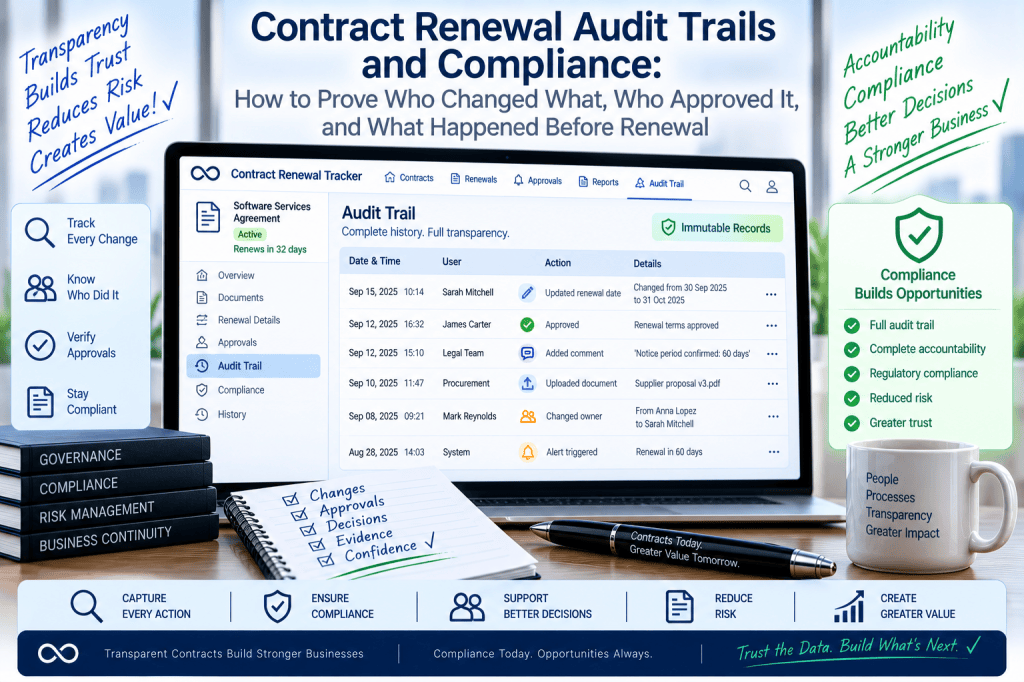
Why Audit Trails Matter in Renewal Management
A renewal decision can create substantial legal and financial obligations.
If the organization later asks:
Why did we renew this contract?
the answer should not depend on one employee’s memory.
The system should be able to show:
- the business decision;
- procurement recommendation;
- legal review;
- finance approval;
- final negotiated terms;
- signature;
- exact timeline.
That creates institutional accountability.
Can You Reconstruct a Renewal Decision Six Months Later?
If the answer requires searching through emails, spreadsheets, Teams messages, and several document versions, the renewal process is difficult to audit.
Contract Renewal Tracker is designed to preserve the full decision history of each renewal in one structured record.
Create a complete audit trail for every renewal decision →
What Should a Renewal Audit Trail Capture?
A strong audit history may include:
Field Changes
Workflow Events
Approvals
Document Versions
Comments
Escalations
Notifications
Overrides
Signatures
Notice Delivery Evidence
All of these contribute to a defensible record.
Field Change History
Suppose someone changes:
Notice Period:
90 days
to:
120 days.
The system should record:
Previous Value
90 days.
New Value
120 days.
Changed By
User.
Date / Time
Recorded.
This is essential because deadline changes can materially affect the renewal process.
Contract Value Changes
The same applies to financial data.
For example:
Annual Value:
€420K → €520K.
The audit trail should preserve:
- old value;
- new value;
- user;
- reason where required.
This prevents silent rewriting of commercial history.
Owner Changes
If the contract owner changes:
Sarah → Michael.
The system records:
- previous owner;
- new owner;
- date;
- administrator.
This is useful during organizational changes.
Renewal Decision History
A contract may move through:
Undecided
↓
Renegotiate
↓
Terminate
↓
Temporary Extension
The history should remain visible.
Do not simply overwrite the current decision.
Why Decision History Matters
Suppose the organization initially decided:
Terminate
but later approved:
12-month extension
because migration was delayed.
That context is important.
Without history, the final status hides the reason.
Workflow Event History
Every workflow transition can be logged.
For example:
June 1
Renewal workflow started.
June 4
Business review assigned.
June 10
Business review completed.
June 12
Procurement negotiation opened.
July 3
Legal review completed.
July 8
Finance approved.
July 9
Sent for signature.
July 12
Renewal completed.
This creates a complete operational timeline.
Task Audit Trail
Each task should show:
- creator;
- owner;
- assigned date;
- due date;
- completion date;
- status changes.
This helps explain delays.
Example
Business Review.
Assigned:
June 1.
Due:
June 7.
Completed:
June 14.
Delay:
7 days.
That may explain why procurement later had insufficient negotiation time.
Approval Evidence
Approvals are one of the most important audit events.
The system should record:
Approver
Role
Decision
Approved Value
Approved Term
Document Version
Timestamp
Comments
This creates defensible authorization evidence.
Example Approval Record
Finance Approval:
Approved.
Approved Commitment:
€1.8M.
Term:
36 months.
Approver:
Finance Director.
Date:
August 5.
Document:
Renewal Amendment v7.
This is much stronger than an email saying:
Looks fine.
Approval Version Binding
The approval should be tied to the exact commercial and document version.
If:
v7 approved.
Then:
v8 uploaded.
The system should record:
Approval no longer applies
if material changes occurred.
This protects the integrity of the approval trail.
Reapproval History
Suppose:
v7 approved.
v8 changes price.
Finance reapproves.
The history should show both approvals.
Nothing should disappear.
Rejected Approvals
Rejections matter too.
For example:
Finance rejects:
€1.2M renewal.
Reason:
Over budget.
Procurement renegotiates:
€1.05M.
Finance later approves.
This history demonstrates control.
Conditional Approvals
Example:
Approved provided annual escalation remains ≤3%.
That condition should be preserved.
If the final agreement contains:
5% escalation,
the system should flag:
Approval condition violated.
This is an important audit control.
Document Version History
Contract repositories often suffer from files named:
final.docx
final2.docx
FINALFINAL.pdf
A structured renewal system should maintain explicit versions.
For example:
Renewal Amendment v1
v2
v3
Executed v4
This makes document history clear.
Document Metadata
Each version can include:
- uploader;
- date;
- document type;
- source;
- status.
For example:
Supplier Proposal
Counteroffer
Final Draft
Executed Agreement
This creates commercial context.
Document Hashing
For stronger integrity, the system may store a cryptographic hash of documents.
This can help demonstrate that:
The document approved is the same document preserved in the record.
This is especially useful for enterprise auditability.
Signed Document Verification
After signature:
store:
- executed document;
- signature status;
- completion timestamp;
- signatories;
- final hash/version.
This closes the approval chain.
Notice Delivery Evidence
Termination and non-renewal notices deserve special treatment.
The system should record:
Notice Created
Approved
Signed
Sent
Delivery Method
Recipient
Delivered
Acknowledged
This can be critical if the supplier later disputes notice.
Example Notice Audit Trail
September 5:
Business approved termination.
September 7:
Legal verified notice requirements.
September 8:
Notice v2 approved.
September 9:
Signed by authorized director.
September 10:
Sent by registered mail.
September 12:
Delivered.
September 13:
Supplier acknowledgment received.
This is a strong evidentiary chain.
Proof of Delivery
Possible evidence includes:
- courier receipt;
- email delivery confirmation;
- supplier acknowledgment;
- portal submission receipt.
The exact requirement depends on the contract.
The system should preserve the evidence.
Notice Address History
If the contractual notice address changes:
the system should record the change.
This becomes important when proving that notice was sent to the correct destination.
Workflow Overrides
Users may need to bypass a normal process.
For example:
Legal review skipped.
That should never happen invisibly.
The audit record should capture:
Override
Authorized User
Reason
Date
This creates accountability.
Example Override
Standard workflow:
Legal review required.
Override:
Skipped by Legal Operations Manager.
Reason:
Administrative amendment only.
The rationale remains visible.
Approval Overrides
Higher-risk overrides should require stronger governance.
For example:
CFO approval normally required.
Emergency exception approved by CEO.
The system should preserve:
- exception;
- authority;
- justification.
Policy Exceptions
If the organization permits:
36-month maximum term
but accepts:
60 months,
the system should record:
Policy Exception
and:
Approver
This helps internal audit identify repeated exceptions.
Audit Trail for Notifications
Important notifications may also be recorded.
For example:
June 1:
Owner notified.
June 6:
Reminder sent.
June 9:
Manager escalation.
June 10:
Task completed.
This proves the system followed the configured process.
Delivery Failure History
If an email fails:
record:
Delivery Failed
Then:
alternate route.
This can explain why escalation occurred.
Acknowledgment History
For critical alerts:
User acknowledged:
August 12 at 09:14.
Task completed:
August 14.
Again:
Acknowledgment and action are separate.
Both can be audited.
Access History
Some organizations may want to record:
- login;
- contract view;
- export.
This may be particularly important for:
- restricted contracts;
- sensitive negotiations;
- M&A agreements.
The appropriate level should depend on customer requirements.
Contract View Logs
For highly sensitive contracts, the system could record:
User viewed restricted contract.
This can strengthen security investigations.
Export Logs
Exports may be especially sensitive.
For example:
User exported:
247 contract records.
The system records:
- user;
- timestamp;
- scope;
- format.
This helps detect inappropriate data movement.
Permission Changes
Changes to access controls should be auditable.
For example:
User granted:
Global Procurement Access.
Changed by:
Administrator.
Date:
Recorded.
This protects against unauthorized permission escalation.
Role Changes
If a user changes:
Business Owner
to:
Administrator,
the history should remain visible.
This supports security governance.
Segregation of Duties Evidence
A system may enforce:
Requester ≠ Final Approver.
The audit trail should be able to demonstrate that policy was followed.
This becomes valuable during internal controls testing.
Example SoD Audit Query
Show all renewals above €1M where requester and final approver were the same person.
Expected result:
zero.
If not:
investigation required.
Internal Audit Queries
A mature system could support queries such as:
Show all renewals above €500K completed without procurement review.
Show all contracts where notice deadlines were manually changed.
Show all policy exceptions approved during Q4.
Show all executed renewals where final document differed from approved version.
These are powerful enterprise controls.
Audit Filters
Useful filters include:
- date range;
- user;
- contract value;
- region;
- event type;
- policy exception;
- approval outcome.
This makes investigations faster.
Contract-Specific Audit View
For one contract, users should be able to see the full timeline.
For example:
Created
↓
Owner Assigned
↓
Renewal Terms Extracted
↓
Notice Deadline Verified
↓
Business Review
↓
Negotiation
↓
Approval
↓
Signed
↓
Completed
This is the complete renewal story.
Portfolio Audit View
Internal audit may instead need:
All critical events across the enterprise.
This requires a cross-contract audit dataset.
Immutable Audit Events
Important audit records should generally not be editable by ordinary users.
Otherwise:
someone could change the history they are trying to prove.
Corrections should create:
new events
rather than silently modifying previous records.
Correction Example
Incorrect annual value recorded:
€500K.
Correct value:
€550K.
Do not delete history.
Record:
Original Value:
€500K.
Correction:
€550K.
Reason:
Supplier amendment omitted.
This preserves integrity.
Append-Only Event Model
A strong architecture uses:
append-only audit events
for critical changes.
Current state is derived from:
the latest valid event.
Historical state remains reconstructable.
Why Append-Only Matters
The system can answer:
What did we know on July 1?
not only:
What do we know today?
This can be important in disputes or investigations.
Point-in-Time Reconstruction
Suppose an auditor asks:
What was the approved contract value before signature?
The system can reconstruct that state.
This is a stronger capability than simple change logs.
Audit Event Schema
A typical event might include:
event_id
tenant_id
contract_id
actor
action
old_value
new_value
timestamp
source
This supports reliable history.
Source Tracking
Changes may originate from:
- user;
- API;
- AI extraction;
- integration;
- workflow rule.
The audit trail should identify the source.
AI-Generated Changes
If AI extracts:
Notice Period = 90 days,
the system should record:
Source: AI Extraction
If a legal user verifies it:
Source: Legal Verification
This distinction is important.
Human Verification History
For critical fields:
AI Extracted.
↓
User Verified.
↓
Later Amendment Changed.
This creates a clear confidence history.
Integration Events
Suppose ERP updates contract spend.
The audit trail can show:
Source: ERP Integration
This helps users understand automated changes.
API Changes
For enterprise integrations:
API updates should record:
- integration identity;
- timestamp;
- fields changed.
This supports technical investigations.
Audit Retention
Organizations may require audit records to remain available for:
- several years;
- life of contract;
- regulatory period.
Retention policies should be configurable where appropriate.
Retention Policy
For example:
Contract record:
7 years after closure.
Audit events:
7 years.
The exact policy depends on organizational and legal requirements.
Legal Hold
Certain contracts may be subject to:
Legal Hold
Meaning:
records must not be deleted according to normal retention schedules.
A mature enterprise product may need to support this.
Deletion Audit
If data is deleted according to authorized policy:
the action itself should be recorded where permitted.
This provides governance around lifecycle management.
Data Privacy Considerations
Audit logs can themselves contain:
- user identities;
- comments;
- access history.
They therefore require appropriate access controls and retention policies.
Auditability should not mean unrestricted visibility.
Restricted Audit Access
Possible roles:
Auditor
Compliance
Security Administrator
Ordinary users may only see contract-specific history relevant to them.
This protects sensitive metadata.
Privileged Legal Commentary
Some legal notes may require restricted access.
The audit system can record:
Legal comment added
without necessarily exposing the privileged content to every user.
This supports both auditability and confidentiality.
Audit Export
Internal auditors may require:
- CSV;
- PDF;
- structured API output.
The export should preserve:
- event sequence;
- timestamps;
- actors.
This makes review easier.
Signed Audit Reports
For formal investigations, the system could generate a read-only report containing:
- contract summary;
- audit timeline;
- approvals;
- documents;
- notice evidence.
This may become a strong enterprise feature.
Example Audit Report
Contract
Global Telecom Agreement.
Renewal Outcome
Renewed.
Annual Value
€2.4M.
Notice Deadline
Verified.
Procurement Approval
Completed.
Legal Approval
Completed.
Finance Approval
Completed.
Final Signature
Completed.
Policy Exceptions
None.
Timeline
Complete.
This creates a concise compliance package.
Audit Readiness Dashboard
A dashboard could show:
Contracts Missing Approval Evidence
Executed Documents Missing
Unverified Notice Records
Open Policy Exceptions
Audit Data Completeness
98.7%.
This helps contract operations maintain readiness.
Audit Completeness Score
The system can calculate whether required evidence exists.
For example:
Approval Evidence
Executed Document
Notice Evidence
Owner History
This gives a record-completeness score.
Compliance Exceptions
A renewal can be flagged when required controls were not followed.
For example:
Contract executed before finance approval.
This becomes:
Compliance Exception
The system should not hide it.
Exception Remediation
The workflow can require:
- record issue;
- assign remediation owner;
- determine root cause;
- complete corrective action.
This makes compliance operational.
Root Cause Analysis
Common causes might include:
- workflow bypass;
- incorrect approval rule;
- user training;
- emergency decision.
Over time, the organization can identify patterns.
Compliance Analytics
For example:
Policy Exceptions
Q1:
Q2:
Q3:
Trend improving.
This demonstrates stronger governance.
Repeat Exceptions
Suppose one department repeatedly executes contracts before approval.
The system can flag a recurring compliance issue.
This is more useful than treating each event independently.
Audit Trail vs Activity Log
These are related but different.
Activity Log
General user activity.
Audit Trail
Security- and governance-relevant changes that must be preserved reliably.
A product may support both.
Which Events Deserve Strong Audit Treatment?
Examples include:
- contract value change;
- deadline change;
- approval;
- permission change;
- document replacement;
- workflow override;
- final execution.
Minor UI actions may not need the same treatment.
Audit Trail and Internal Controls
For larger organizations, Contract Renewal Tracker can support internal controls around:
- approval authority;
- financial commitments;
- segregation of duties;
- policy compliance.
This increases relevance to finance and audit teams.
Audit Trail and Legal
Legal teams gain evidence around:
- notice;
- termination;
- document versions;
- approvals.
This can materially improve defensibility.
Audit Trail and Procurement
Procurement gains:
- negotiation history;
- approval evidence;
- savings validation.
This preserves commercial context.
Audit Trail and Finance
Finance can verify:
- commitment approval;
- budget exception;
- savings methodology.
This strengthens financial governance.
Audit Trail and Security
Security teams gain visibility into:
- access;
- permissions;
- exports;
- administrative changes.
This supports incident investigation.
Audit Trail and SaaS Trust
For enterprise prospects, auditability can become a major sales requirement.
Buyers often want to know:
Can we prove how this system was used during a critical renewal?
A strong audit model improves product credibility.
AI-Generated Audit Summaries
AI can make large event histories easier to understand.
A user could ask:
Summarize what happened on this renewal.
The assistant could answer:
The renewal started 180 days before the notice deadline. The business owner requested renegotiation, procurement reduced the supplier proposal from €620K to €560K, legal approved document v6, finance approved a €1.68M three-year commitment, and the final contract was executed on August 12. No policy exceptions were recorded.
This is useful for auditors and management.
Ask AI: Who Changed the Notice Deadline?
The assistant could answer:
The notice deadline was changed from September 30 to August 31 by Legal Operations on May 14 after Amendment 2 was verified. The amendment changed the notice period from 90 to 120 days.
This saves investigation time.
Ask AI: Why Was Reapproval Required?
Response:
Finance initially approved €1.5M total commitment. The final supplier offer increased total commitment to €1.62M, exceeding the configured 2% approval tolerance, so reapproval was automatically triggered.
This makes audit data understandable.
AI Should Never Rewrite the Audit Record
AI may:
- summarize;
- search;
- explain.
It should not:
- alter;
- remove;
- reinterpret away;
the original event history.
The audit record remains authoritative.
Audit Search with Natural Language
Authorized users could ask:
Show all high-value contracts completed with policy exceptions last quarter.
Or:
Which notice deadlines were manually overridden?
This can make enterprise audit much more efficient.
Explainability
AI-generated audit answers should cite:
- event;
- timestamp;
- document;
- approval.
Users need to verify the evidence.
Contract Renewal Tracker as a System of Record
This is a significant product evolution.
The platform does not only remember:
when the contract renews.
It remembers:
how the renewal decision happened.
That creates a durable system of record.
From Workflow to Evidence
The lifecycle becomes:
Action
↓
Event
↓
Audit Record
↓
Evidence
↓
Compliance Reporting
The workflow itself creates the audit trail.
This is much stronger than reconstructing events afterward.
Audit-by-Design
The best approach is:
Do not ask users to manually document compliance after the renewal.
Instead, the normal workflow automatically produces the evidence.
For example:
Approval action creates approval event.
Signature creates execution event.
Notice delivery creates evidence event.
Audit becomes a by-product of correct operations.
Contract Renewal Tracker Compliance Dashboard
A mature dashboard could show:
Approval Compliance
99.2%.
Notice Evidence Coverage
98.8%.
Policy Exceptions
Unauthorized Execution Events
Segregation-of-Duties Exceptions
Audit Completeness
99.1%.
This gives management strong visibility.
Audit KPIs
Useful metrics include:
Approval Evidence Coverage
Executed Document Coverage
Notice Evidence Coverage
Policy Exception Rate
Override Rate
SoD Exception Rate
Audit Completeness
Open Compliance Findings
These make renewal governance measurable.
Compliance Score by Business Unit
For example:
IT:
99%.
Marketing:
96%.
Operations:
91%.
This can guide remediation.
The goal should be process improvement, not simplistic employee ranking.
Compliance Trend
For example:
2027:
92%.
2028:
96%.
2029:
99%.
This demonstrates improving control maturity.
Audit Readiness Before External Review
Instead of scrambling before an audit, the organization already has:
- evidence;
- reports;
- complete history.
This reduces disruption.
Audit Preparation Time
Suppose auditors request:
50 renewal files.
Without a structured system:
several days of email and document searching.
With Contract Renewal Tracker:
generate audit packages quickly.
This creates administrative value.
Productivity ROI
Assume:
4 audits annually.
20 hours preparation each.
Automation reduces to:
5 hours each.
Time saved:
60 hours.
At:
€100/hour
internal value:
€6,000
This is one part of the compliance ROI.
Risk Reduction Is More Important
The larger value may come from preventing:
- unauthorized commitments;
- invalid notices;
- approval failures;
- policy breaches.
These can have significant financial consequences.
One Audit Failure Can Be Costly
Suppose an organization cannot prove:
who approved a €5M renewal.
Even if the underlying decision was legitimate, the absence of evidence can create:
- internal control concerns;
- audit findings;
- governance risk.
A reliable audit trail prevents that uncertainty.
Enterprise Sales Positioning
For enterprise prospects, the message becomes:
Contract Renewal Tracker does not simply manage renewal tasks. It creates a controlled, auditable history of every material renewal decision.
That strengthens trust.
Ready to Make Every Renewal Defensible?
A renewal should not leave behind a trail of disconnected emails and spreadsheets.
Contract Renewal Tracker is designed to preserve the complete history of renewal decisions, commercial changes, approvals, notices, documents, and exceptions automatically.
Use Contract Renewal Tracker to:
- record field changes;
- preserve workflow history;
- bind approvals to document versions;
- track reapprovals;
- maintain document version history;
- preserve termination-notice evidence;
- audit workflow overrides;
- record policy exceptions;
- track permission changes;
- monitor exports and sensitive access where required;
- enforce segregation of duties;
- retain immutable audit events;
- generate audit-ready reports;
- measure compliance KPIs;
- use AI to summarize renewal histories and answer audit questions.
The objective is to move from:
“We think the process was followed.”
to:
“We can show exactly what happened, who authorized it, which evidence supports it, and whether policy was followed.”
Start Your Contract Renewal Tracker Subscription →
Final Thoughts
A strong contract renewal process produces two outputs.
The first is:
the renewal decision.
The second is:
evidence of how that decision was reached.
That evidence matters because contracts create:
- financial obligations;
- legal rights;
- operational dependencies.
A mature Contract Renewal Tracker therefore needs to preserve:
Data Changes
Workflow
Approvals
Documents
Notices
Exceptions
↓
Complete Renewal History
That makes the system useful not only during renewal execution, but months or years afterward when the organization needs to understand or prove what happened.
For Contract Renewal Tracker, this is another important step away from basic reminder software and toward a true enterprise renewal operations system of record.
Next Article in the Contract Renewal Tracker Series
Article 55 — “Contract Renewal Integrations: How to Connect ERP, CLM, CRM, Microsoft Teams, Slack, DocuSign, and Finance Systems”
The next article will focus on the integration layer and explain how Contract Renewal Tracker can fit into an existing technology stack instead of becoming another isolated system. It will cover ERP and AP data, CLM synchronization, supplier master data, Teams/Slack notifications, e-signature workflows, SSO/identity, usage systems, procurement platforms, APIs, webhooks, event-driven architecture, source-of-truth decisions, integration failure handling, and reconciliation.
This should be another strong prospect-focused article because many serious buyers will eventually ask the same question:
“How does Contract Renewal Tracker fit with the systems we already use?”

