Contract renewal systems contain a lot of useful information.
But finding the right information can still take time.
A procurement manager may need to open several screens to determine:
- which contracts renew next quarter;
- which supplier proposed the largest increase;
- which agreements have unverified notice periods;
- which renewals are currently blocked;
- where savings opportunities exist.
A business owner may simply want to know:
When do I need to decide whether to keep this contract?
A CFO may ask:
How much contract value is likely to renew during Q4?
A legal user may ask:
Which agreement actually controls the termination notice period?
Instead of requiring every user to understand the structure of the application, a Contract Renewal AI Assistant can provide a conversational interface across the renewal portfolio.
Users ask questions in natural language.
The system retrieves the relevant contract, workflow, financial, supplier, and risk information.
Then it produces a concise, evidence-grounded answer.
The objective is not to replace dashboards, workflows, or human judgment.
It is to make them easier to use.
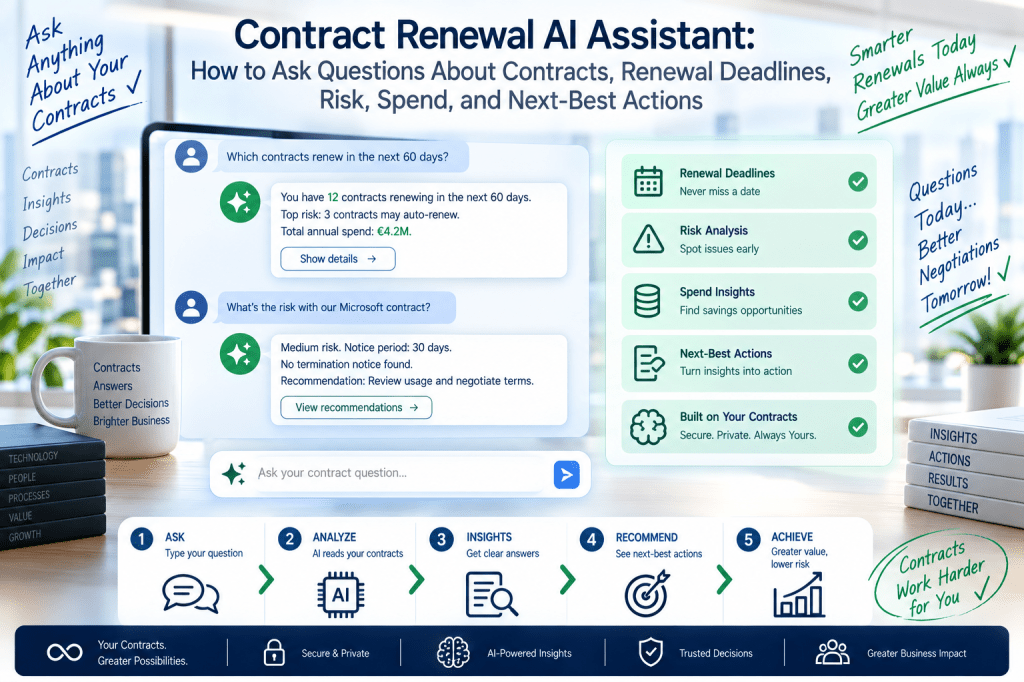
What Is a Contract Renewal AI Assistant?
A Contract Renewal AI Assistant is a conversational layer that helps authorized users interact with contract-renewal information using ordinary language.
Instead of navigating through filters and reports, the user could ask:
Which contracts require my attention this week?
What is renewing in the next 90 days?
Why is the ExampleCloud contract high risk?
What happens if we do not cancel this agreement?
Which suppliers are asking for increases above 10%?
Where can procurement find another €250K in savings?
The assistant translates the request into queries against the underlying renewal data and returns an answer.
Imagine Asking Your Contract Portfolio a Question
Traditional contract-management software expects the user to know:
- where information is stored;
- which filters to apply;
- which report to open.
Contract Renewal Tracker can make that experience much simpler.
Ask a question such as:
Which high-value contracts could auto-renew during the next 60 days?
and receive a prioritized answer grounded in the actual contract portfolio.
Turn your renewal data into a conversational decision system →
The AI Assistant Should Sit on Top of Structured Data
The strongest AI assistant is not one that simply reads PDFs.
It can combine:
Contract Documents
Structured Renewal Metadata
Workflow Status
Supplier Information
Spend
Usage
Approvals
Risk
The result is much more useful than basic document Q&A.
Document Q&A Is Only the Beginning
A conventional AI contract assistant might answer:
What is the termination clause?
Useful.
But a renewal-specific assistant can go further:
What is the termination clause, when must notice be sent, has legal verified it, and has anyone started the termination workflow?
That connects document interpretation to operational action.
Ask: “When Does This Contract Renew?”
A basic question might produce:
AnalyticsPro
Contract End:
December 31.
Auto-Renewal:
Yes.
Renewal Term:
12 months.
Notice Period:
90 days.
Notice Deadline:
October 2.
Internal Decision Deadline:
September 1.
That gives the user the dates that actually matter.
Explain the Deadline
The user might then ask:
Why do I have to decide in September if the contract ends in December?
The assistant can answer:
The contract requires 90 days’ prior notice to prevent automatic renewal, and your organization’s renewal policy adds a 30-day internal buffer so procurement has time to negotiate or prepare termination.
That is a much better user experience than expecting them to interpret multiple fields.
Ask: “What Happens If We Do Nothing?”
This is a powerful question.
The assistant could answer:
If no valid notice is delivered by October 2, the agreement appears to renew automatically for another 12 months. Based on the current annual value of €180K, that could create another €180K contractual commitment, subject to the governing terms being verified.
Now the consequence is clear.
AI Should Cite the Governing Source
For contract-specific answers, users should be able to see:
Source: MSA, Section 12.4
or:
Source: Amendment 3, Section 4.2
The assistant should not present legal conclusions without evidence.
Grounded Contract Answers
A strong response might say:
The latest verified renewal provision requires 120 days’ notice before the end of the term.
Then show:
Source Document
Amendment 3.
Section
4.2.
Verification Status
Legal Verified.
This builds trust.
AI Should Expose Conflicts
Suppose the contract set contains:
MSA:
90 days.
Amendment 3:
120 days.
The assistant should say:
I found conflicting notice periods. The MSA states 90 days, while Amendment 3 states 120 days. Amendment 3 appears later, but the governing effect has not been legally verified.
Then recommend:
Legal Verification Required
This is safer than silently selecting one value.
Ask: “Which Contracts Need My Attention?”
A business owner could ask:
What do I need to do this week?
The assistant might answer:
1. CRM Renewal
Decision due:
Thursday.
Annual Value:
€120K.
Action:
Confirm whether to renew or reduce licenses.
2. Marketing Analytics
Review overdue:
4 days.
Usage:
58%.
Action:
Complete business review.
This turns the AI assistant into a personal work queue.
Ask: “What Should I Prioritize?”
Procurement could ask:
What are my highest-priority renewals today?
The assistant could rank by:
- deadline;
- value;
- risk;
- savings opportunity.
For example:
1. ExampleCloud
€2.4M.
Risk:
Critical.
Reason:
21 days to notice deadline and negotiation unresolved.
2. DataPlatform
€820K.
Risk:
High.
Reason:
Supplier increase 14%.
This is decision-ready.
Ask: “Why Is This Contract High Risk?”
The assistant should explain the actual drivers.
For example:
The contract is rated High risk because its notice deadline is 34 days away, the renewal decision remains unresolved, the supplier has proposed an 11% increase, and the business owner review is nine days overdue.
This is much more useful than:
Risk Score: 78
Explainable Risk
The assistant could break the score into:
Deadline Risk
High.
Financial Exposure
High.
Workflow Delay
Medium.
Ownership
Low.
Supplier Dependency
High.
This gives the user context.
Ask: “What Changed?”
A manager might ask:
Why did this renewal move from Medium to High risk?
The assistant could answer:
Risk increased because the business review became overdue, the contract entered the final 60-day notice window, and the supplier submitted a price proposal 12% above the current contract.
That makes dynamic risk understandable.
Ask Portfolio-Level Questions
The real power appears when users can query multiple contracts.
For example:
What renews in the next 90 days?
The assistant might respond:
Contracts:
Annual Value:
€12.8M.
High/Critical Risk:
€3.1M.
Undecided:
€1.8M.
Auto-Renewing:
€4.2M.
This creates a portfolio summary instantly.
Ask: “Which Contracts Are Still Undecided?”
For example:
Show me contracts above €250K with no renewal decision.
The assistant might return:
11 contracts.
Combined annual value:
€6.4M.
Closest notice deadline:
19 days.
This helps management focus.
Ask: “Which Auto-Renewals Are Dangerous?”
The assistant could combine:
- auto-renewal;
- value;
- deadline;
- decision status.
For example:
Four contracts above €100K could auto-renew within 60 days without a completed renewal decision. Combined annual exposure is €1.7M.
That is a very strong operational query.
Ask: “Where Can We Save Money?”
A CFO or procurement leader could ask:
Which upcoming renewals have the strongest savings potential?
The assistant could identify:
- low usage;
- large supplier increases;
- overlapping suppliers;
- termination candidates.
For example:
AnalyticsPro
Potential:
€140K.
Driver:
39% unused licenses.
TelecomCo
Potential:
€90K.
Driver:
multiple unused lines.
Supplier X
Potential:
€180K.
Driver:
three contracts could be consolidated.
This turns portfolio data into opportunity.
AI Should Distinguish Opportunity from Savings
The assistant should say:
Potential opportunity
rather than:
Guaranteed savings
until:
- business need;
- negotiation;
- finance validation;
confirm the result.
This keeps financial reporting credible.
Ask: “How Much Have We Saved?”
The assistant could answer:
Finance-validated recurring hard savings are €1.2M year-to-date. Additional validated cost avoidance is €2.1M, and €480K of avoided spend resulted from contract terminations. These categories are reported separately to avoid double counting.
That is a strong executive use case.
Ask: “How Was That Saving Calculated?”
For a single contract:
The €60K hard saving compares the previous comparable annual cost of €500K with the new annual cost of €440K. Separately, the supplier’s initial proposal was €560K, resulting in €120K of cost avoidance relative to the proposal.
The assistant helps explain finance methodology.
Ask: “Which Suppliers Are Increasing Prices?”
For example:
Show suppliers proposing increases above 8%.
Response:
18 suppliers.
Combined affected spend:
€9.4M.
Largest:
Supplier A — 18%.
Supplier B — 14%.
Supplier C — 12%.
Procurement can immediately focus negotiations.
Ask: “What Is Our Relationship with This Supplier?”
A supplier brief might combine:
ExampleCloud
Active Contracts:
Annual Spend:
€6.4M.
Upcoming Renewals:
€4.2M.
Performance:
76/100.
Dependency:
Critical.
Open Issues:
Negotiations:
2 active.
This provides supplier intelligence from one question.
Ask: “What Happened Last Time?”
The assistant could use historical renewal memory.
For example:
During the 2027 renewal, ExampleCloud opened with an 11% increase. Procurement negotiated the increase down to 4% in exchange for a 24-month commitment. The final annual value was €1.18M.
This creates institutional knowledge.
Longitudinal Contract Memory
The assistant can help users understand:
- previous renewals;
- previous decisions;
- prior savings;
- recurring supplier behavior.
That makes each future renewal smarter.
Ask: “Did We Have Problems with This Supplier?”
For example:
Supplier performance declined during the last two quarters. Three critical incidents were recorded, and two QBR commitments remain unresolved.
Now procurement has additional negotiation context.
Ask: “What Did Legal Approve?”
The assistant could answer:
Legal approved Renewal Amendment v7 on August 5. Approval was conditional on retaining the 3% annual escalation cap. The final document remains within that condition.
This can save substantial manual checking.
Ask: “Why Is Reapproval Required?”
For example:
Finance originally approved a 24-month commitment of €1.6M. The supplier’s latest offer changes the term to 36 months and total commitment to €2.52M, so the previous approval no longer satisfies policy.
This makes workflows easier to understand.
Ask: “Who Is Blocking This Renewal?”
A manager might ask:
Why has this contract not progressed?
The assistant could answer:
The renewal is blocked at the Business Review stage because next-year license requirements have not been confirmed. The task is owned by the IT Applications Director and is nine days overdue.
This creates transparent accountability.
Avoid Blame-Oriented Language
The system should focus on process:
The required review is overdue.
rather than:
John failed to do his job.
This keeps operational reporting professional.
Ask: “What Should Happen Next?”
This is where the assistant moves from information retrieval to decision support.
For example:
The next recommended action is to confirm required license quantities before procurement responds to the supplier’s 12% price increase. The notice deadline is 81 days away, leaving sufficient time for negotiation if the business review is completed this week.
This is a genuine next-best-action capability.
Next-Best Action Architecture
Conceptually:
Current State
Deadline
Risk
Workflow
Policy
↓
Recommended Action
The assistant then explains why.
Deterministic Rules Should Remain Authoritative
If policy says:
CFO approval required above €1M,
AI should not decide:
CFO review can probably be skipped.
The AI can explain the requirement.
It should not override governance.
Example
User asks:
Can we skip legal review?
Assistant:
The current workflow requires legal review because the supplier changed the liability and termination clauses. I cannot treat that step as optional unless an authorized workflow exception is approved.
This keeps AI within guardrails.
Ask: “Which Approvals Are Still Missing?”
For example:
Finance and legal approvals are complete. CFO approval remains outstanding because the total three-year commitment is €2.4M.
This saves navigation.
Ask: “What Should the CFO Know?”
The assistant can generate an approval brief:
Decision
Approve €2.4M three-year renewal.
Current Spend
€850K/year.
Final
€800K/year.
Hard Savings
€50K/year.
Supplier Dependency
High.
Legal
Approved.
Key Risk
36-month lock-in.
This makes executive approval faster.
Ask: “Prepare Me for the Supplier Meeting”
This is one of the strongest procurement AI use cases.
The assistant could summarize:
Current Spend
Supplier Proposal
Internal Target
Usage
Performance
Other Contracts
Historical Negotiation Behavior
Then identify:
Likely Negotiation Leverage
Example Negotiation Brief
Supplier
ExampleCloud.
Current
€2.4M.
Proposed
€2.72M (+13.3%).
Target
€2.35M.
Usage
76%.
Performance
Below SLA target.
Additional Supplier Spend
€800K renewing this year.
Negotiation Focus
- reduce unused commitment;
- consolidate contracts;
- challenge price increase;
- improve SLA terms.
This turns the assistant into a procurement copilot.
Ask: “Compare the Latest Supplier Offers”
The assistant can summarize changes.
For example:
Round 2 vs Round 3
Improved
Annual price:
−€40K.
Support:
Premium included.
Worsened
Contract term:
24 → 36 months.
Termination:
Convenience right removed.
This prevents users from focusing only on headline pricing.
Ask: “What Is the Best Commercial Option?”
The assistant could compare scenarios.
For example:
Option A
€520K/year.
12 months.
Option B
€490K/year.
36 months.
Option C
€505K/year.
24 months + 3% cap.
Then explain:
Option B has the lowest annual cost but highest lock-in. Option C has a slightly higher annual price but materially lower total commitment risk than Option B.
The user makes the final decision.
Ask: “Which Contracts Have Data Problems?”
Contract operations could ask:
Show high-value renewals with unverified notice periods.
Response:
8 contracts.
Combined value:
€11.2M.
Closest deadline:
41 days.
This connects AI with data-quality remediation.
Ask: “Which Owners Have Left?”
With identity integration:
Twenty-three contracts are assigned to inactive users. Seven enter renewal windows during the next 90 days.
This creates an immediate ownership queue.
Ask: “Which Supplier Records May Be Duplicates?”
AI could identify potential supplier matches.
For example:
Example Tech BV.
Example Technology Netherlands.
Example Technologies Group.
Then recommend:
Supplier normalization review.
AI Should Not Merge Records Without Control
The assistant can suggest:
These appear related.
But supplier normalization should remain a controlled action, particularly when legal counterparties differ.
Ask: “What Is Our Renewal Forecast?”
Finance could ask:
What do we expect to spend on Q4 renewals?
The assistant might answer:
Current renewing spend:
€18.4M.
Supplier proposals:
€19.7M.
Expected outcome:
€18.9M.
Active savings pipeline:
€800K.
Forecast confidence:
Medium-High.
This turns renewal data into financial planning.
Ask: “What If Supplier Inflation Is Higher?”
The user could ask:
What happens if remaining suppliers increase prices by 10%?
The assistant can run a scenario using portfolio data.
It should label the result:
Scenario
rather than forecast.
Ask: “Where Will Procurement Be Overloaded?”
The assistant can analyze:
- number of renewals;
- complexity;
- assignment.
For example:
November is projected to exceed current procurement capacity by approximately 30%, driven by 18 high-complexity software and professional-services negotiations.
This supports capacity planning.
Ask: “Where Will Legal Be Overloaded?”
Same principle.
This makes the assistant useful beyond individual contract questions.
Personal AI Assistant
The system can provide a personalized daily view.
For example:
Good morning. You have four renewal actions requiring attention today. Two are procurement negotiations, one is an overdue approval, and one high-risk contract reaches its notice deadline in 23 days.
This makes the SaaS feel much more proactive.
Daily Renewal Brief
A user could receive:
Today
3 actions.
This Week
8 deadlines.
New Risks
Savings Opportunity
€140K.
This is a high-value user experience.
Weekly Executive Brief
The AI might summarize:
Critical renewal exposure decreased from €12.4M to €9.8M this week. Three strategic contracts moved to approved status, while one €4.1M outsourcing agreement became High risk because legal review is delayed.
This turns operational data into management narrative.
AI Portfolio Narrative
Instead of requiring executives to interpret charts:
Q4 renewal exposure remains €42M. Expected spend is currently €43.1M, €1.1M above budget. Procurement has €760K of weighted savings opportunity in active negotiations, leaving an estimated €340K gap if current assumptions hold.
This is directly actionable.
AI Should Show Confidence
An answer could include:
Confidence: High
because:
- dates verified;
- ERP spend current;
- supplier proposal attached.
Another might say:
Confidence: Medium
because:
- notice clause unverified;
- usage data 90 days old.
This is especially important for decision support.
Confidence Should Be Explainable
Instead of just:
72%.
Say:
Confidence is Medium because the latest signed amendment is not available and the notice period was extracted from an earlier contract version.
The reason matters more than a precise number.
Source-Grounded Retrieval
The assistant should retrieve information from:
- authorized structured records;
- authorized contract documents;
- relevant workflow events.
This is effectively a renewal-specific RAG architecture.
Retrieval-Augmented Generation
Conceptually:
User Question
↓
Authorization Check
↓
Relevant Contract / Portfolio Retrieval
↓
Relevant Document Clauses
↓
Structured Data
↓
Answer Generation
↓
Source Citations
This reduces hallucination risk.
Hybrid Retrieval
Contract questions may require both:
Semantic Search
for clauses
and:
Structured Queries
for dates and values.
Example:
Which contracts above €500K have termination rights for convenience?
The system needs:
structured financial filtering
plus:
contract clause retrieval.
This is more sophisticated than ordinary document search.
Structured Data Should Win for Structured Facts
If the verified renewal date is stored as:
December 31,
the AI should use that field.
It should not re-read the PDF every time and potentially derive a different date.
This creates consistency.
Documents Provide Evidence
The assistant can then use the contract to explain:
why
the structured field has that value.
For example:
Notice period:
120 days.
Source:
Amendment 3 §4.2.
This combines structured reliability with documentary evidence.
AI Should Know When Not to Answer
If the system cannot reliably determine a legal term:
I found conflicting termination language and cannot determine which provision governs without legal verification.
That is a good answer.
Accuracy matters more than appearing helpful.
Hallucination Guardrails
The assistant should avoid:
- inventing clauses;
- inventing dates;
- assuming supplier behavior;
- presenting estimates as facts.
Important responses should be grounded in data.
Missing Data Response
If the user asks:
What is the notice deadline?
but notice period is unknown:
The assistant should say:
The contract end date is December 31, but the notice period has not been verified, so I cannot calculate a reliable notice deadline yet.
Then:
Recommended Action: Verify Notice Clause
This is safe and useful.
Permission-Aware AI
Perhaps the most important enterprise requirement is:
The AI assistant must never become a shortcut around permissions.
If a user cannot see:
- confidential pricing;
- legal commentary;
- another region’s contracts;
the AI must not reveal that information.
Authorization Before Retrieval
Correct order:
Authenticate User
↓
Apply Permissions
↓
Retrieve Data
↓
Generate Answer
Not:
retrieve everything
then:
hide sensitive pieces.
The first approach is much safer.
Tenant Isolation
In a multi-tenant SaaS:
Company A’s AI query must never retrieve:
Company B’s contracts.
Tenant isolation must exist throughout:
- vector search;
- structured queries;
- caching;
- conversation memory.
This is fundamental.
Contract-Level Permissions
Even inside one company:
restricted M&A contracts
may be visible only to a small team.
The AI must respect that restriction.
Field-Level Permissions
Procurement may see:
walk-away price.
Business owner may not.
If the business owner asks:
What is procurement’s walk-away position?
the assistant should not reveal it.
Example Permission Response
You do not have access to the internal negotiation strategy for this contract. You can view the supplier proposal and approved renewal decision.
This preserves security clearly.
AI Conversation Memory
The assistant can remember conversational context within a session.
For example:
User:
Show me high-risk IT renewals.
Then:
Which one is largest?
The assistant understands:
“one”
refers to the filtered IT renewal set.
This makes interactions natural.
Persistent User Preferences
A future product may remember:
- preferred reporting currency;
- commonly used filters;
- favorite dashboard scope.
For example:
CFO normally asks in:
EUR.
Procurement director usually works in:
EMEA.
The system can personalize responsibly.
Persistent Memory Needs Guardrails
Memory should not override:
- current permissions;
- authoritative contract data.
If user role changes:
old memory must not reveal restricted information.
This is important.
Contract Memory
The system can also retain longitudinal context.
For example:
Last year you chose a temporary 12-month extension because migration was incomplete.
This becomes valuable during the next renewal.
Supplier Memory
Similarly:
This supplier has proposed double-digit increases in each of the last three renewal cycles.
That is useful negotiation intelligence.
Decision Memory
The assistant could say:
During the previous renewal, management agreed that this would be the final extension before replacement. The current replacement project is 62% complete.
This prevents recurring strategic decisions from being forgotten.
AI Should Separate Memory from Evidence
Historical conversation context may be helpful.
But important claims should still be supported by:
- contract data;
- workflow history;
- recorded decisions.
Memory should guide retrieval, not become the authoritative source.
AI Next-Best Actions
One of the most commercially interesting features is proactive recommendation.
For example:
Confirm license quantities this week.
Escalate finance approval.
Request legal verification of notice clause.
Combine supplier negotiations.
These recommendations can reduce cognitive workload.
Recommendation Ranking
The system could rank actions using:
Urgency
Value
Risk
Opportunity
For example:
Action 1
Resolve €2.4M critical renewal.
Action 2
Validate €180K savings opportunity.
Action 3
Reassign inactive owner.
This creates a prioritized workday.
Explain Every Recommendation
A next-best action should include:
Why
For example:
Start supplier negotiation now because the price proposal is 14% above current spend and only 73 days remain before the notice deadline.
This keeps recommendations transparent.
Recommendation Acceptance
Users could choose:
Accept
Dismiss
Snooze
Modify
This creates human control.
Accepted Recommendation → Workflow
For example:
AI recommends:
Start Legal Review
User accepts.
↓
Workflow task created.
This is where the assistant becomes operational.
Safe Action Execution
There is an important distinction between:
read actions
and:
write actions.
AI may safely answer:
What renews next quarter?
But changing:
renewal decision
or:
sending termination notice
requires stronger safeguards.
Confirmation for Material Actions
For example:
User:
Terminate this contract.
The system should not immediately send legal notice.
Instead:
- verify authorization;
- show consequence;
- require confirmation;
- start termination workflow.
This is safe conversational action orchestration.
Example
You are requesting termination of the €620K CyberSecure agreement. The current verified notice deadline is September 15. This will start the termination workflow; it will not send notice automatically. Continue?
This is an appropriate control.
AI Should Not Bypass Approval Workflows
User:
Approve this for the CFO.
If the user is not authorized:
the AI must refuse the action.
If authorized:
it can record the approval according to workflow requirements.
Governance remains intact.
Safe Persistent Personalization
The assistant can make the experience easier without becoming unpredictable.
Examples:
Show values in EUR.
Default to my region.
These are low-risk preferences.
But:
Always approve low-value contracts.
should remain a deterministic policy, not an informal AI memory.
This distinction is important.
AI Evaluation
AI quality should be measured continuously.
Useful metrics include:
Answer Accuracy
Citation Accuracy
Retrieval Relevance
Permission Compliance
Recommendation Acceptance
Hallucination Rate
This makes AI an operational capability rather than a marketing feature.
Test Questions
Evaluation sets might include:
What is the notice period?
Which document governs renewal?
How much is this contract worth?
Why is it high risk?
What approvals remain?
Expected answers can be tested against known data.
Permission Tests
For example:
Regional user asks:
Show global contract spend.
Expected:
Access denied or scope-limited answer.
These tests should be automated.
Hallucination Testing
Provide a contract with:
no termination-for-convenience clause.
Ask:
What is our convenience termination right?
Correct answer:
None found / cannot confirm.
Not:
an invented clause.
This is essential.
Source Citation Testing
If AI says:
Notice is 120 days,
the cited source should actually contain that term.
This can be evaluated.
AI Monitoring
Production monitoring can track:
- failed retrieval;
- unsupported claims;
- unusual query volume;
- permission errors.
This supports safer operations.
Human Feedback
Users can mark:
Helpful
Incorrect
Missing Context
This feedback can improve retrieval and prompts.
Do Not Learn Sensitive Facts Casually
Customer-specific AI improvements should be carefully governed.
Conversation data should not automatically become broad organizational memory without appropriate controls.
This is particularly important for legal and negotiation content.
AI Admin Controls
Enterprise administrators may want control over:
- enabled AI features;
- accessible data sources;
- retention;
- actions AI may perform.
This is important during enterprise sales.
AI Transparency
Users should know when content is:
AI Generated
versus:
Verified Contract Data
For example:
Verified
Notice Deadline: September 1.
AI Recommendation
Start negotiation within two weeks.
This distinction builds trust.
AI Assistant for Small Businesses
The same technology can remain simple.
A small-business owner might ask:
What contracts should I worry about this month?
The assistant might respond:
Three contracts require attention. Your insurance renews in 21 days, your CRM reaches its cancellation deadline in 38 days, and your IT support provider has proposed a 12% increase.
That is immediately useful.
AI Assistant for Mid-Market Companies
A procurement manager might ask:
Which contracts above €100K need negotiation this quarter?
The system produces:
a prioritized commercial queue.
AI Assistant for Enterprises
An executive might ask:
Why did global renewal risk increase this week?
The assistant summarizes:
- regions;
- suppliers;
- value;
- blockers.
Same platform, different scale.
AI Assistant for Legal
Legal might ask:
Which termination notices are due during the next 30 days?
or:
Which contracts have conflicting renewal clauses?
This creates a legal operations workbench.
AI Assistant for Finance
Finance might ask:
Which pending renewals exceed budget?
or:
What multi-year commitments require CFO approval next month?
This creates financial control.
AI Assistant for Procurement
Procurement might ask:
Where is our strongest negotiating leverage?
or:
Which suppliers have multiple contracts renewing this quarter?
This creates commercial intelligence.
AI Assistant for Business Owners
Business owners can simply ask:
Do I still need to do anything on this renewal?
The assistant translates the complex workflow into a clear answer.
This may be one of the biggest adoption benefits.
Conversational UI Can Reduce Training
Traditional enterprise software requires users to learn:
- menus;
- filters;
- reports.
Conversational access allows occasional users to ask:
What do I need to do?
This reduces training requirements.
But Do Not Remove Structured UI
Conversation is not always the best interface.
Users still need:
- dashboards;
- tables;
- timelines;
- approval screens.
The ideal product combines:
Conversational AI
Structured Application UI
The user chooses whichever is easier for the task.
AI Can Navigate the UI
For example:
User:
Show me the contracts with missing owners.
The assistant returns the result and links directly to:
Ownership Remediation Queue
Conversation becomes an entry point into structured workflows.
AI Can Create Saved Views
A user could ask:
Save this view as High-Value SaaS Renewals.
The system can create a reusable filter where allowed.
This is another way AI reduces configuration work.
AI Can Generate Reports
For example:
Prepare a one-page renewal summary for tomorrow’s CFO meeting.
The assistant can generate:
- key metrics;
- critical exceptions;
- forecast;
- required decisions.
This can save administrative time.
AI Can Explain Dashboards
User:
Why is the savings forecast below target?
The assistant interprets underlying data.
This makes analytics more accessible.
The AI Assistant Should Be Evidence-First
This product philosophy is critical.
The assistant should not try to sound certain.
It should try to be correct and traceable.
The sequence should be:
Retrieve
↓
Verify
↓
Explain
↓
Recommend
not:
Guess
↓
Generate
That distinction matters enormously in contract management.
Contract Renewal Tracker as a Conversational Renewal Platform
This is a powerful product evolution.
A basic renewal application requires the user to find the information.
A conversational renewal platform lets the user ask:
What do I need to know?
The system brings the relevant data together.
From Search to Decision Support
The progression becomes:
Ask
↓
Retrieve
↓
Ground
↓
Explain
↓
Recommend
↓
Act
This is where the AI assistant becomes much more than a chatbot.
It becomes part of the renewal operating model.
Commercial Value of the AI Layer
The AI assistant can potentially reduce:
- contract searching;
- dashboard navigation;
- report preparation;
- supplier briefing preparation;
- approval review time.
More importantly, it can help users recognize:
- risk;
- savings;
- required action.
That creates direct operational value.
Example Productivity ROI
Suppose:
50 users.
Each saves:
20 minutes per week
finding renewal information.
Annual time saved:
approximately 867 hours.
At:
€60/hour,
potential productivity value:
about:
€52,000/year
Actual results would depend on usage and organization.
The Larger Value Is Better Decision Timing
If the AI identifies:
one €500K high-risk auto-renewal
before the decision window closes,
the financial impact could be much larger than the productivity saving.
This reinforces the value proposition.
Ready to Ask Your Contract Portfolio What Needs Attention?
Users should not need to become contract-management experts just to find out what is renewing, why it matters, and what they need to do next.
Contract Renewal Tracker is designed to make the renewal portfolio conversational while keeping answers grounded in authorized contract data, workflow history, and verified evidence.
Use Contract Renewal Tracker to ask:
- What renews next?
- Which contracts are high risk?
- Why is this renewal critical?
- What is the notice deadline?
- Which document supports that answer?
- What approvals remain?
- Which suppliers are increasing prices?
- Where are the savings opportunities?
- What happened during the last renewal?
- What should I do next?
The AI assistant can then:
- retrieve relevant contracts;
- summarize renewal terms;
- explain deadlines;
- surface risk drivers;
- prepare supplier briefs;
- explain savings;
- identify blockers;
- recommend next-best actions;
- respect user permissions;
- expose uncertainty;
- cite the underlying evidence.
The goal is not to replace human judgment.
It is to give every authorized user faster access to the context required to make a better renewal decision.
Start Your Contract Renewal Tracker Subscription →
Final Thoughts
The AI opportunity in contract renewal management is much larger than:
Chat with your PDF.
A renewal decision depends on more than contract language.
It depends on:
Contract Terms
Spend
Usage
Supplier Performance
Workflow
Risk
Approvals
Historical Context
When AI can securely reason across those sources, the user experience changes dramatically.
Instead of asking:
Where do I find the right report?
the user asks:
What should I worry about this week?
Instead of asking:
Which document contains the renewal clause?
the user asks:
When do we need to act, and why?
Instead of asking procurement to manually prepare a supplier brief:
Prepare me for the negotiation.
That makes the Contract Renewal AI Assistant potentially one of the most visible differentiators in the SaaS product.
But its credibility will depend on four things:
grounded answers, explainable reasoning, permission-aware retrieval, and conservative handling of uncertainty.
If those are designed correctly, the AI layer can make Contract Renewal Tracker feel less like another enterprise database and more like an intelligent renewal operations assistant.
Next Article in the Contract Renewal Tracker Series
Article 58 — “Contract Renewal Portfolio Intelligence: How to Find Patterns, Supplier Concentration, Duplicate Spend, Renewal Clusters, and Hidden Opportunities Across Thousands of Contracts”
The next article will move from individual AI assistance toward portfolio-level intelligence. It will cover supplier concentration, renewal clustering, overlapping categories, fragmented purchasing, duplicate contracts, cross-department spend, timing concentration, category exposure, strategic supplier dependencies, spend anomalies, portfolio segmentation, opportunity detection, executive portfolio views, and AI-assisted pattern discovery.
This should be another strong commercial article because it answers a question that becomes increasingly important as customers grow:
“What can Contract Renewal Tracker tell us about the entire contract portfolio that we would never see by looking at contracts one at a time?”

