Choosing contract renewal software can look deceptively simple.
At first, the requirement may sound like:
We need something that reminds us when contracts are about to expire.
But renewal management becomes much more complicated once you introduce:
- notice periods;
- automatic renewals;
- multiple contract owners;
- approval requirements;
- supplier negotiations;
- termination notices;
- financial forecasting;
- audit requirements;
- thousands of contracts.
A basic reminder tool may solve the first problem while leaving most of the underlying renewal risk untouched.
That is why organizations evaluating the best contract renewal software should look beyond calendar notifications and ask a broader question:
Can this system help us control the entire renewal lifecycle—from identifying the deadline to making the decision, negotiating the outcome, completing approvals, executing termination when necessary, and measuring the financial result?
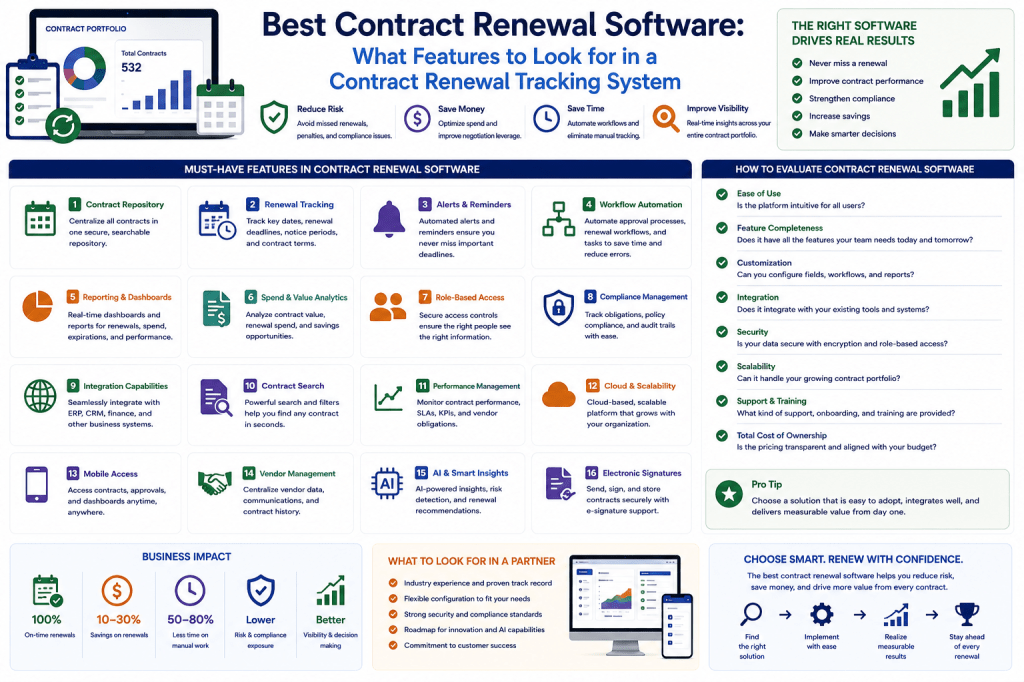
This buyer’s guide explains the features worth evaluating and how to determine whether a contract renewal tracking system is suitable for your organization.
What Is Contract Renewal Software?
Contract renewal software is a dedicated system for managing contracts approaching renewal, expiration, extension, or termination.
At minimum, it should help organizations track:
- contract end dates;
- notice periods;
- renewal deadlines;
- responsible owners.
More capable systems can also manage:
- renewal workflows;
- financial exposure;
- supplier negotiations;
- savings;
- termination notices;
- portfolio analytics.
The distinction matters.
A renewal date database is useful.
A renewal operating system is considerably more valuable.
Looking for Contract Renewal Software Rather Than Another Contract Spreadsheet?
The right system should do more than store dates.
Contract Renewal Tracker is designed around the operational problems that occur between the first renewal reminder and the final renewal, reduction, replacement, extension, or termination decision.
That includes automated deadlines, owner accountability, workflow escalation, spend visibility, decision management, and renewal intelligence.
See how Contract Renewal Tracker can replace manual renewal administration →
The First Question: What Problem Are You Actually Trying to Solve?
Before comparing features, define why you need software.
Common reasons include:
Missed Renewals
Contracts are renewing unexpectedly.
Manual Administration
Someone spends too much time maintaining spreadsheets and reminders.
Lack of Ownership
Nobody knows who should make the renewal decision.
Poor Procurement Visibility
Negotiations begin too late.
Financial Uncertainty
Finance cannot reliably forecast recurring supplier spend.
Supplier Cost Growth
The organization wants to use renewals as a spend-optimization opportunity.
Different problems require different capabilities.
Contract Renewal Software vs CLM Software
Contract Lifecycle Management—or CLM—platforms usually cover a broader process such as:
Request
↓
Draft
↓
Negotiate
↓
Approve
↓
Sign
↓
Store
↓
Manage
↓
Renew
Contract renewal software focuses more deeply on the final part:
what happens before, during, and after the renewal decision.
For organizations already using a CLM, a dedicated renewal system may complement rather than replace it.
Contract Renewal Software vs Spreadsheet
A spreadsheet can store:
- supplier;
- value;
- renewal date.
Dedicated software becomes valuable when the process also needs:
- automatic reminders;
- escalation;
- approvals;
- audit history;
- portfolio dashboards.
The key difference is:
workflow and control.
Feature 1: Centralized Contract Renewal Register
The foundation should be one centralized register.
Every active agreement should have a consistent renewal record.
Typical fields include:
- contract name;
- supplier;
- business owner;
- start date;
- end date;
- notice period;
- auto-renewal;
- annual value;
- renewal status.
This becomes the operational source of truth.
Why Centralization Matters
If IT, procurement, finance, and legal maintain separate spreadsheets:
the organization may not know which version is correct.
One system eliminates much of that ambiguity.
What to Ask During a Demo
Ask:
Can multiple departments manage their contracts while still maintaining one enterprise renewal register?
Also ask:
Can access be restricted by business unit or contract?
This will reveal whether the product can scale beyond a small team.
Feature 2: Notice-Period Tracking
This is one of the most important capabilities.
A contract may expire:
December 31.
But require:
120 days’ notice.
The operational deadline is therefore months earlier.
The software should explicitly track:
Contract End Date
and:
Notice Deadline
as separate dates.
Avoid Software That Only Reminds You About Expiry
An expiration reminder may arrive too late.
The system should calculate or capture:
the last date on which action can safely be taken.
This is central to renewal management.
What to Ask
Does the system calculate notice deadlines from contract terms?
Can the deadline be overridden when contract language requires special treatment?
Can users see where the notice period came from?
These are better questions than:
Does it send reminders?
Feature 3: Auto-Renewal Tracking
Automatic renewal clauses can create significant financial exposure.
The software should identify:
Auto-Renewal: Yes / No
and ideally:
- renewal period;
- notice requirement.
Auto-Renewal Risk View
A useful system should answer:
Which auto-renewing contracts have no decision and enter their notice window within 60 days?
That is considerably more useful than displaying a simple auto-renewal checkbox.
Feature 4: Automated Renewal Reminders
The system should automatically generate reminders before critical dates.
For example:
180 days.
These should be configurable.
Reminder Timing Should Use the Notice Deadline
This is critical.
If a contract ends December 31 but requires 120 days’ notice:
the reminder sequence should work backward from the notice deadline.
Not simply from December 31.
What to Ask
Are reminder schedules configurable by contract tier?
Can strategic contracts start 365 days early while small contracts start 60 days early?
A strong system should support this.
Feature 5: Escalation
Sending reminders is not enough.
What happens when the owner ignores them?
A strong system should support:
Reminder
↓
Follow-Up
↓
Manager Escalation
↓
Procurement / Contract Operations Escalation
This creates closed-loop renewal control.
Why Escalation Is Essential
A reminder says:
Someone was notified.
An escalation workflow answers:
Did anything actually happen?
That is a major difference.
Feature 6: Contract Ownership
Every renewal should have a clearly defined owner.
Possible roles include:
Business Owner
Procurement Owner
Contract Manager
The software should make responsibility visible.
Owner Changes
Ask:
What happens when an employee leaves?
A strong system should support:
- reassignment;
- ownership queues;
- identity integration.
This reduces one of the biggest spreadsheet weaknesses.
Feature 7: Renewal Decision Management
The system should not reduce every renewal to:
Yes / No
A stronger decision model includes:
- Renew;
- Renegotiate;
- Reduce;
- Replace;
- Extend;
- Terminate.
This better reflects real procurement decisions.
Why Structured Decisions Matter
Different decisions require different workflows.
For example:
Renew
→ approval.
Replace
→ sourcing + transition.
Terminate
→ notice workflow.
The software should understand that difference.
Feature 8: Business Review Workflow
Before procurement negotiates, the business should validate:
- need;
- usage;
- future demand.
This is especially valuable for recurring SaaS spend.
Example
Purchased licenses:
1,000.
Active:
Before negotiating price:
ask whether all 1,000 should be renewed.
This can create more value than a discount.
What to Look For
The software should support:
- business-owner questionnaires;
- usage evidence;
- quantity decisions.
This helps prevent automatic renewal of unnecessary scope.
Feature 9: Renewal Workflow Automation
A standard workflow might be:
Business Review
↓
Decision
↓
Negotiation
↓
Legal
↓
Approval
↓
Execution
The software should automatically route contracts through the appropriate stages.
Workflow Templates
Look for:
Standard Renewal
Strategic Renewal
Termination
Replacement
Templates reduce implementation effort.
Conditional Workflow Logic
For example:
If:
Contract Value >€1M
then:
CFO Approval Required.
If:
Decision = Terminate
then:
Legal Notice Workflow.
This is a major advantage of dedicated software.
Feature 10: Approval Workflows
Approvals should follow organizational authority rules.
For example:
<€50K
Business Owner.
€50K–€500K
Finance.
>€500K
Finance + Procurement.
>€2M
Executive approval.
The system should enforce the policy consistently.
Auditability of Approvals
The software should preserve:
- who approved;
- date/time;
- amount;
- relevant contract version.
This matters for governance.
Feature 11: Termination Management
This is often overlooked during product evaluation.
A user selecting:
Terminate
should not simply close the contract.
The system should help manage:
- notice requirements;
- legal approval;
- signature;
- delivery;
- evidence.
Why This Matters
A contract can still renew if:
the termination decision was made
but:
notice was not executed correctly.
That makes termination workflow one of the most valuable advanced features.
Feature 12: Proof of Notice
For important cancellations, the system should preserve:
- sent notice;
- proof of delivery;
- acknowledgment.
This creates defensible evidence.
Feature 13: Supplier Replacement and Transition Tracking
When a renewal decision is:
Replace
the software should help coordinate:
- old contract;
- replacement contract;
- transition deadlines.
At minimum, it should show whether replacement will be ready before the incumbent expires.
Transition Buffer
A useful metric is:
Incumbent End Date − Forecast Replacement Readiness
If negative:
the organization may need:
a bridge extension.
This can prevent service disruption.
Feature 14: Contract Hierarchies
Enterprise contracts often include:
Master Agreement
↓
Order Forms
↓
Amendments
The software should understand these relationships.
Otherwise:
terminating one order form
might incorrectly appear to terminate the entire supplier relationship.
Feature 15: Contract Documents and Clause Evidence
Users should be able to access:
- contract;
- amendment;
- relevant renewal clauses.
A good system should make it easy to understand:
Where did this notice deadline come from?
This improves trust.
Feature 16: Data Quality Controls
Software does not solve problems if the data is wrong.
Look for controls that identify:
- missing end dates;
- missing owners;
- conflicting clauses;
- duplicates.
Data quality should be visible.
Example
Notice Period:
120 days.
Verification:
Legal Verified.
Source:
Amendment 3 §4.2.
That is much stronger than:
120
in an unexplained spreadsheet field.
Feature 17: Supplier Normalization
Organizations may have:
Microsoft Corp.
Microsoft Ireland.
Microsoft UK.
The software should support:
Supplier Group
while retaining:
Legal Counterparty
This enables supplier-level analysis.
Why Supplier Normalization Matters
Without it:
procurement cannot reliably identify:
- total supplier exposure;
- contract consolidation opportunities.
This becomes important as portfolio size increases.
Feature 18: Spend Tracking
A renewal platform should ideally know:
- current annual value;
- supplier proposal;
- expected outcome;
- final value.
This creates financial visibility across the lifecycle.
Feature 19: Spend Optimization
More advanced software can identify:
- unused licenses;
- excessive capacity;
- duplicate services.
This shifts the product from:
deadline management
toward:
recurring-spend optimization.
Savings Opportunity Example
Current contract:
€500K.
Usage indicates:
€120K potential reduction.
Supplier increase:
€50K.
Procurement can now challenge both:
quantity
and:
price.
This is a significantly stronger renewal process.
Feature 20: Savings Tracking
Look for the ability to distinguish:
Hard Savings
Cost Avoidance
Avoided Spend
These are financially different outcomes.
Avoid Products That Inflate Savings
For example:
Supplier proposes €600K.
Current spend:
€500K.
Final:
€530K.
Correct reporting might be:
Cost Avoidance: €70K
Increase vs Current: €30K
Calling the €70K:
hard savings
would be misleading.
Feature 21: Supplier Benchmarking
The software can become more valuable over time if it preserves:
- previous prices;
- supplier increases;
- negotiation outcomes.
Then future renewals can compare against:
historical internal benchmarks.
Example
Supplier proposal:
€58/user.
Internal median:
€47.
Best comparable:
€44.
Procurement immediately gains negotiation context.
Feature 22: Supplier Scorecards
For strategic suppliers, renewal decisions should incorporate:
- performance;
- service quality;
- pricing;
- risk.
This answers:
Has the supplier earned another term?
Feature 23: Portfolio Intelligence
A strong platform should allow procurement to look beyond individual contracts.
Useful analysis includes:
- supplier concentration;
- fragmented spend;
- duplicate services;
- renewal clusters.
This creates strategic sourcing opportunities.
Example
Six contracts.
Same supplier group.
€4.2M combined spend.
Renew within:
six months.
System recommendation:
Evaluate Consolidated Negotiation
This can produce substantial value.
Feature 24: Renewal Spend Forecasting
Finance should be able to see:
- current renewing spend;
- expected future spend;
- supplier increases;
- savings.
This turns renewal data into budget intelligence.
Forecast Confidence
More advanced systems should distinguish:
Committed
Expected
Undecided
This prevents false precision.
Feature 25: Executive Dashboards
Executives should not need to inspect every contract.
A strong dashboard should answer:
- how much is renewing;
- how much is at risk;
- how much remains undecided;
- what requires intervention.
This is critical for larger customers.
Example Executive Dashboard
Next 90-Day Exposure
€12.8M.
Critical Risk
€2.1M.
Undecided
€1.4M.
Forecast Savings
€800K.
Executive Decisions Required
This is far more useful than a contract list.
Feature 26: KPI Reporting
Useful KPIs include:
- renewal exposure;
- decision coverage;
- missed deadlines;
- savings;
- cycle time;
- forecast accuracy.
This helps organizations measure renewal-process maturity.
Feature 27: Role-Based Access Control
Sensitive contract data should not be visible to everyone.
Look for:
RBAC
with roles such as:
- Business Owner;
- Procurement;
- Legal;
- Finance.
This is especially important for enterprise contracts.
Feature 28: SSO
Enterprise customers will often require:
- SSO.
For example:
Microsoft Entra ID.
Okta.
This reduces login friction and improves identity governance.
Feature 29: Tenant Isolation
For SaaS products, customer data must remain securely isolated.
This is foundational.
Ask vendors about:
- tenant separation;
- authorization controls.
Do not treat this as an optional enterprise feature.
Feature 30: Encryption
Contract data can be commercially sensitive.
Ask about:
- encryption in transit;
- encryption at rest.
This should be part of the standard security architecture.
Feature 31: Audit Logs
Important actions should be recorded.
For example:
- date changed;
- decision updated;
- approval completed;
- notice sent.
Audit history supports both:
security
and:
governance.
Feature 32: Integrations
A renewal platform should not necessarily replace everything.
Useful integrations include:
- CLM;
- ERP;
- identity;
- e-signature;
- Teams/Slack.
The system should fit the broader technology environment.
ERP Integration
ERP can provide:
actual spend.
This improves:
- forecasts;
- savings validation.
Identity Integration
Identity systems can detect:
inactive contract owners.
This prevents ownership data from becoming stale.
E-Signature Integration
Once approval completes:
renewal documents can move to:
signature.
This reduces manual handoffs.
Feature 33: Spreadsheet Import
This may sound basic.
But it is commercially important.
Most new customers will already have data in:
Excel
or:
CSV.
The platform should make migration easy.
Ask About Import Validation
A good import workflow should identify:
- missing fields;
- duplicate contracts;
- invalid dates.
Do not simply import bad data silently.
Feature 34: APIs
Larger customers may want:
- read/write APIs.
This enables custom integrations.
It also reduces vendor lock-in concerns.
Feature 35: AI Contract Extraction
AI can help identify:
- renewal dates;
- notice periods;
- auto-renewal clauses.
This can reduce manual setup.
But extracted values should preserve:
- confidence;
- source.
AI Should Not Become the Source of Truth Automatically
A contract field extracted by AI should be:
AI Extracted
until verified.
For high-risk legal terms:
human verification may remain appropriate.
Feature 36: AI Contract Q&A
A user could ask:
What is the notice period?
The system returns:
the answer
plus:
source clause.
This makes contract data easier to use.
Feature 37: AI Portfolio Assistant
More advanced systems may answer:
Which high-value contracts could auto-renew in the next 60 days?
or:
Where can we reduce €250K in recurring spend?
This creates much broader value than document chat alone.
Feature 38: AI Next-Best Actions
The assistant could recommend:
Validate license quantity before supplier negotiation.
or:
Legal verification is required because renewal clauses conflict.
These recommendations should be explainable.
Feature 39: Permission-Aware AI
This is essential.
AI should never reveal contract information the user could not see elsewhere.
Authorization should occur:
before retrieval.
Not after.
Feature 40: AI Guardrails
AI should not autonomously:
- approve contracts;
- send termination notices;
- create large financial commitments;
without appropriate workflow controls.
The best AI contract systems remain:
human-governed.
Feature 41: Configurability
Look for configurable:
- fields;
- thresholds;
- reminder schedules;
- workflows.
This allows the platform to adapt.
Configurable Is Better Than Heavily Customized
Custom development for every customer creates:
- long implementation;
- expensive upgrades.
SaaS should generally favor:
configuration.
This is better for both buyer and vendor.
Feature 42: Ease of Use
Do not underestimate usability.
Most business owners interact with renewal software only occasionally.
They should be able to answer:
What do I need to do?
without training.
Business-Owner UX
A good screen should show:
Contract
Deadline
Cost
Required Decision
Not dozens of technical fields.
This improves adoption.
Feature 43: Mobile Accessibility
Executives may want to:
- approve;
- review.
Mobile-friendly design can help.
But full mobile functionality may not be necessary for every use case.
Feature 44: Notifications Without Noise
Look for:
action-oriented alerts.
Not:
constant informational notifications.
Alert fatigue can undermine even a good system.
Feature 45: Implementation Simplicity
Ask:
Can we start with our current spreadsheet?
A system that requires:
months of data modeling
before the first reminder works
may be too heavy for some customers.
Ideal Implementation Path
Import
↓
Verify Critical Dates
↓
Assign Owners
↓
Activate Reminders
Then:
add advanced features.
This creates fast time-to-value.
Feature 46: Progressive Adoption
The software should let customers begin with:
basic tracking.
Then add:
- workflows;
- integrations;
- AI.
This reduces adoption barriers.
Feature 47: Data Export
Customers should be able to export their data.
This matters for:
- analysis;
- governance.
Avoid systems that make basic data export difficult.
Feature 48: Reporting Flexibility
Users should be able to filter by:
- supplier;
- department;
- category;
- region.
This allows different teams to use the same system.
Feature 49: Multi-Currency Support
International organizations may need:
- original contract currency;
- consolidated reporting currency.
This matters for financial forecasting.
Feature 50: Multi-Entity Support
Enterprise customers may need:
- several legal entities;
- different contract ownership.
This should be considered when evaluating scalability.
The 10 Most Important Features for Most Buyers
If you do not want to evaluate 50 capabilities, start with these ten:
- Notice deadline tracking.
- Automated reminders.
- Escalation.
- Contract ownership.
- Structured renewal decisions.
- Workflow automation.
- Approval routing.
- Termination management.
- Dashboards.
- Audit trails.
These form the core renewal-control layer.
For Procurement Teams, Add Five More
Procurement should also prioritize:
- Supplier benchmarking.
- Spend optimization.
- Savings tracking.
- Supplier consolidation.
- Supplier scorecards.
These turn renewal management into commercial value.
For Finance Teams, Add
- future spend forecasting;
- budget variance;
- multi-year commitment reporting;
- forecast confidence.
This broadens the platform beyond procurement.
For Enterprise IT and Security Teams, Add
- SSO;
- RBAC;
- tenant isolation;
- encryption;
- audit logs;
- APIs.
These are essential for enterprise deployment.
For Advanced AI Use Cases, Add
- grounded contract Q&A;
- portfolio Q&A;
- AI explanations;
- source citations;
- permission-aware retrieval.
AI should sit on top of the control foundation.
Contract Renewal Software Evaluation Scorecard
A buyer could score each platform from:
1 — Poor
to:
5 — Excellent.
Suggested categories:
| Category | Weight |
|---|---|
| Renewal Deadline Control | 20% |
| Workflow & Escalation | 15% |
| Decision Management | 10% |
| Spend & Savings | 10% |
| Reporting | 10% |
| Integrations | 10% |
| Security | 10% |
| AI | 5% |
| Implementation | 5% |
| Usability | 5% |
This provides a structured evaluation.
Do Not Let AI Dominate the Scorecard
An impressive chatbot should not compensate for:
weak:
- deadline controls;
- permissions;
- workflow.
The renewal problem must be solved first.
AI is an enhancement.
Demo Question 1
Ask:
Show me a contract that ends December 31 with 120 days’ notice. When will the system start acting?
This tests whether the vendor understands:
renewal deadlines.
Demo Question 2
Ask:
What happens if the contract owner ignores every reminder?
The answer should include:
escalation.
Not:
We send another email.
Demo Question 3
Ask:
Show me all auto-renewing contracts over €250K with no renewal decision.
This tests:
portfolio control.
Demo Question 4
Ask:
Show what happens when we decide to terminate.
You want to see:
- legal;
- notice;
- delivery evidence.
Not merely:
status = cancelled.
Demo Question 5
Ask:
What happens when an employee who owns 50 contracts leaves?
This tests:
ownership governance.
Demo Question 6
Ask:
Show how savings are calculated.
If the methodology is unclear:
finance may not trust the reporting.
Demo Question 7
Ask:
Can the system show several contracts with the same supplier?
This tests:
supplier-level intelligence.
Demo Question 8
Ask:
How do I export all of our contract data?
A good vendor should answer this easily.
Demo Question 9
Ask:
Show me exactly why the AI gave this answer.
Look for:
- source clause;
- underlying data.
This tests AI grounding.
Demo Question 10
Ask:
What can the AI do without human approval?
This tests:
guardrails.
A thoughtful answer is better than:
Everything is automated.
Pricing: What Should You Compare?
Do not compare subscription price alone.
Consider:
Software Cost
Implementation
Integration
Administration
Then compare this with:
- renewal spend;
- potential risk.
Cheap Software Can Be Expensive if It Does Not Solve the Problem
A €5K product that still requires:
20 hours/month of manual administration
may be more expensive than:
a €20K system that automates the process.
Compare:
Total Process Cost.
Expensive Enterprise CLM May Also Be Excessive
The opposite problem exists.
A small procurement team may not need:
an enterprise-wide contract authoring platform.
A focused renewal solution can be:
simpler.
The correct tool depends on the problem.
Contract Renewal Software ROI
A simple model:
Annual Software Cost:
€20K.
Renewal Spend Managed:
€20M.
Break-even improvement:
€20K ÷ €20M
=
0.1%
That is a useful way to evaluate economics.
One Unwanted Renewal
If the software prevents:
one €80K unwanted auto-renewal,
that alone can create:
4× the value of a €20K annual subscription.
This is why renewal software can have strong ROI even before advanced optimization.
Spend Optimization Can Increase the ROI Further
Suppose the platform also identifies:
€120K unused licenses.
Now renewal-related value becomes:
€200K.
The business case strengthens substantially.
Who Should Participate in Software Selection?
For a serious implementation, involve:
Contract Operations
Procurement
Legal
Finance
IT / Security
This ensures the system works across the entire renewal process.
Business Owners Should Also Be Tested
Do not evaluate the system only with administrators.
Give a business owner:
a renewal task.
Can they understand:
what to do
without training?
If not:
adoption may suffer.
Proof of Concept
For larger organizations:
test the platform with:
real contracts.
For example:
50–100 renewals.
This can expose:
- workflow gaps;
- integration issues.
A live pilot is more informative than a polished vendor demo.
Use High-Risk Contracts in the Pilot
Include:
- auto-renewals;
- multiple owners;
- different notice periods.
Do not test only:
simple examples.
This shows whether the software solves the real problem.
Migration Test
Import:
a copy of the existing spreadsheet.
Measure:
- mapping;
- duplicates;
- missing fields.
This tests implementation reality.
Security Review
Enterprise buyers should review:
- architecture;
- access controls;
- audit.
Security should be part of selection.
Not something discovered immediately before purchase.
Questions to Ask About Security
Examples:
Is SSO supported?
How are tenants isolated?
Is data encrypted at rest and in transit?
Are administrative actions audited?
These are sensible baseline questions.
Questions to Ask About AI
Examples:
Which data can the AI retrieve?
Does it respect contract-level permissions?
Does it cite source clauses?
Can customers disable AI features?
These reveal AI maturity.
Questions to Ask About Implementation
Can we import Excel?
How are missing notice periods handled?
Can we launch with incomplete historical data?
A flexible implementation model is a major advantage.
Questions to Ask About Support
How are critical deadline issues handled?
A renewal system may become operationally important.
Support quality therefore matters.
Red Flag 1: The System Only Tracks Expiration Dates
If notice periods are not first-class data:
the product is likely too basic for serious renewal management.
Red Flag 2: Reminders Have No Escalation
The system may simply be:
a prettier calendar.
This will not solve ownership problems.
Red Flag 3: No Audit History
If key fields can change without traceability:
the platform may be unsuitable for governed environments.
Red Flag 4: AI Answers Without Sources
Contract answers should be grounded.
A system that confidently states legal terms without showing evidence deserves caution.
Red Flag 5: No Easy Data Export
Your contract data is strategically important.
You should be able to retrieve it.
Red Flag 6: Implementation Requires Perfect Data
Real-world contract registers are rarely perfect.
A good product should help identify and progressively remediate bad data.
Red Flag 7: Savings Reporting Is Vague
Ask:
How exactly did you calculate this saving?
If there is no clear answer:
be cautious.
Red Flag 8: Every Customer Needs Custom Development
That may create:
- slow implementation;
- maintenance challenges.
Configuration is generally preferable.
Red Flag 9: Executives See the Same Dashboard as Administrators
Different roles need different information.
This can indicate limited product maturity.
Red Flag 10: Software Cannot Explain What Happens After “Terminate”
A serious renewal platform should understand:
notice execution.
This is a major differentiation point.
Where Contract Renewal Tracker Fits
The product vision for Contract Renewal Tracker is to sit between:
a basic expiration-date reminder tool
and:
a heavyweight end-to-end CLM platform.
The focus is specifically on:
renewal operations.
That includes:
- deadlines;
- decisions;
- workflow;
- spend;
- supplier intelligence;
- execution.
This focused positioning can be attractive to organizations whose primary problem is not contract drafting—but managing what happens after a contract already exists and approaches renewal.
Why a Focused Renewal Platform Can Be Attractive
Organizations may already have:
- Word;
- DocuSign;
- SharePoint;
- ERP.
They do not necessarily need another system for creating contracts.
They may need:
a better system for managing the recurring financial and operational decisions around existing contracts.
That is where Contract Renewal Tracker can differentiate.
Contract Renewal Tracker Core Value Proposition
The proposition can be summarized as:
Know what is renewing, act before the notice deadline, make an explicit decision, optimize the spend, execute the outcome, and prove what happened.
This is a much broader value proposition than:
“never forget a contract expiration.”
Core Features for the SaaS Product
For Contract Renewal Tracker itself, I would treat these as the core product:
- centralized contract register;
- notice-period engine;
- renewal calendar;
- reminder/escalation engine;
- ownership;
- decision workflow;
- approvals;
- termination workflow;
- dashboards;
- audit trail.
Those should be excellent before advanced features become the main sales story.
Commercial Differentiators
Then differentiate through:
- spend optimization;
- supplier intelligence;
- portfolio analysis;
- AI assistant.
These can move the product beyond commodity renewal tracking.
Enterprise Differentiators
For larger buyers:
- SSO;
- RBAC;
- integrations;
- security controls;
- enterprise reporting.
These become critical for closing larger contracts.
Buyer Scorecard Template
When comparing platforms, ask vendors to score or demonstrate:
Renewal Control
Can it prevent missed notice deadlines?
Accountability
Can it track owner action and escalation?
Decision Management
Can it structure renewal outcomes?
Financial Intelligence
Can it measure spend and savings?
Execution
Can it manage termination/replacement?
Security
Can it support enterprise requirements?
Intelligence
Can it help users understand and optimize the portfolio?
If a product performs strongly across these areas, it is much closer to a complete renewal-management platform.
Contract Renewal Software Buying Decision
The final decision should answer:
Does this system solve enough financial and operational risk to justify the cost and implementation effort?
That is ultimately the right test.
Not:
Which platform has the longest feature list?
When a Basic Tool Is Enough
Choose a simple product if:
- portfolio is small;
- reminders are the main issue.
Do not pay for complexity you will not use.
When a More Advanced System Is Justified
Choose a broader renewal platform when:
- supplier spend is significant;
- contract ownership is distributed;
- workflows involve several teams;
- reporting and auditability matter.
This is where the SaaS business case becomes much stronger.
When Enterprise Capabilities Become Necessary
For global portfolios:
- thousands of contracts;
- strategic supplier dependencies;
look for:
security, integrations, governance, analytics.
The platform now becomes operational infrastructure.
A Practical Buying Framework
Think about the selection in this order:
1. Protect Deadlines
Can the system prevent unwanted renewals?
↓
2. Create Accountability
Can it make sure someone acts?
↓
3. Structure Decisions
Can it manage renew/reduce/replace/terminate?
↓
4. Improve Economics
Can it identify and track savings?
↓
5. Scale
Can it support security, integrations, and portfolio intelligence?
This prioritizes business outcomes over feature quantity.
Ready to Evaluate Contract Renewal Software?
The best contract renewal software is not necessarily the system with the most features.
It is the one that reliably solves the renewal problems your organization actually has.
For organizations moving beyond spreadsheets and basic reminders, Contract Renewal Tracker is designed around the full operational renewal lifecycle.
Use Contract Renewal Tracker to:
- centralize contract renewals;
- calculate notice deadlines;
- track auto-renewal clauses;
- automate reminders;
- escalate overdue actions;
- assign accountable owners;
- structure renewal decisions;
- automate approval workflows;
- manage termination notices;
- monitor supplier transitions;
- track spend and savings;
- analyze suppliers and portfolio exposure;
- forecast future renewal spend;
- enforce role-based access;
- use AI to surface risk, answer contract questions, and recommend next actions.
The goal is to move from:
“We have software that reminds us about expiration dates.”
to:
“We have a controlled renewal process that tells us what is coming, what needs to happen, what it will cost, and where management needs to intervene.”
Start Your Contract Renewal Tracker Subscription →
Final Thoughts
The contract renewal software market can appear complicated because products overlap with:
- spreadsheets;
- CLM;
- procurement software;
- spend-management platforms;
- vendor-management systems.
But the buying question can be simplified.
Start with the renewal lifecycle:
Deadline
↓
Owner
↓
Decision
↓
Negotiation
↓
Approval
↓
Execution
↓
Financial Outcome
Then ask each vendor:
How much of this process can you reliably control?
For Contract Renewal Tracker, this is an important bottom-of-funnel opportunity.
The product does not need to claim that every organization needs dedicated renewal software.
Small businesses with a handful of simple contracts may be perfectly well served by Excel.
The strongest prospect is the organization where recurring supplier commitments have become large or complicated enough that:
missed deadlines, weak ownership, manual reporting, and passive renewals now have a real financial cost.
That is where a focused Contract Renewal Tracker SaaS platform can earn its subscription.
Next Article in the Contract Renewal Tracker Series
Article 77 — “Contract Renewal Software Pricing: How Much Should a Contract Renewal Management System Cost?”
The next article should be another highly commercial piece targeting prospects closer to a purchase decision. It can cover per-user vs portfolio-based pricing, contract-count tiers, Starter/Professional/Business/Enterprise plans, implementation fees, AI usage, integrations, SSO, storage, hidden costs, annual billing, ROI, break-even calculations, and how to compare software price against managed contract spend.
It will also give us an opportunity to develop a credible pricing architecture for Contract Renewal Tracker itself, rather than simply creating another informational article.

