Not every organization that struggles with contract renewals needs a full Contract Lifecycle Management platform.
Some do.
Others simply need a reliable way to manage:
- renewal dates;
- notice periods;
- auto-renewals;
- ownership;
- reminders;
- negotiation workflows;
- approvals;
- supplier exposure;
- savings;
- renewal risk.
This creates an important buying decision:
Do we need full Contract Lifecycle Management software, or would a focused Contract Renewal Tracker solve the actual problem more efficiently?
The answer depends on the scope of the organization’s contract-management needs.
A CLM platform usually attempts to manage the entire contract lifecycle—from request and drafting through negotiation, signature, obligations, renewal, amendment, and termination.
A Contract Renewal Tracker can be much narrower.
Its purpose is to become extremely good at one part of that lifecycle:
making sure contract renewals are visible, controlled, timely, financially optimized, and completed with the right decisions and approvals.
That narrower scope can be an advantage for organizations that are not looking to transform their entire contracting process.
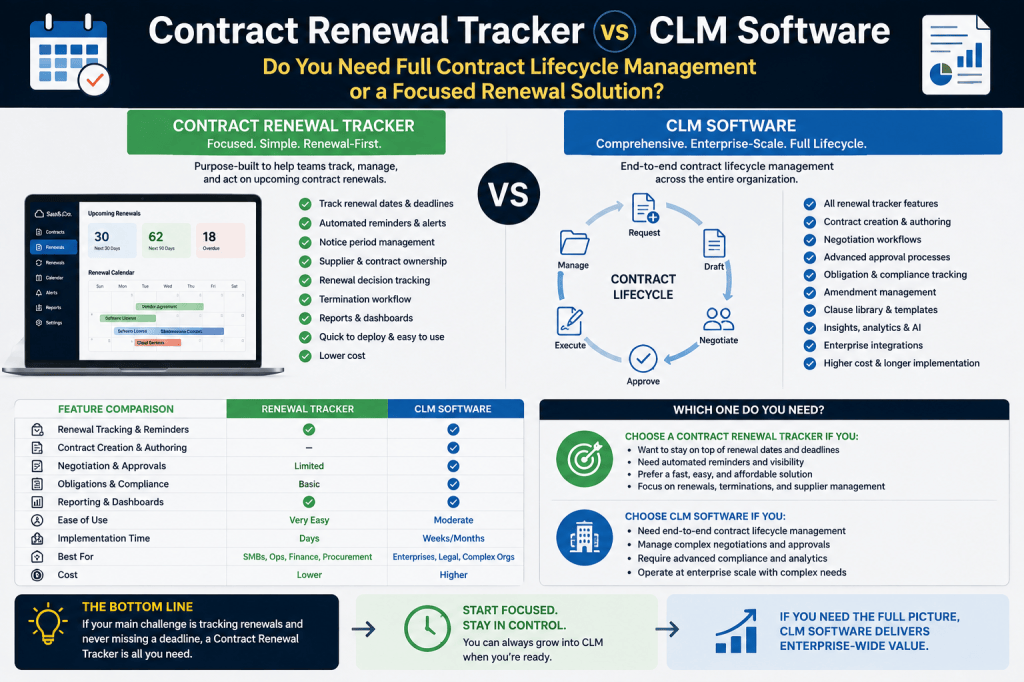
What Is Contract Lifecycle Management Software?
Contract Lifecycle Management, commonly shortened to CLM, refers to systems designed to manage contracts throughout their complete lifecycle.
A typical CLM platform may include:
Contract Request
↓
Template Selection
↓
Drafting
↓
Clause Management
↓
Internal Review
↓
Negotiation
↓
Approval
↓
Electronic Signature
↓
Repository
↓
Obligation Management
↓
Amendments
↓
Renewal
↓
Termination
This is a broad problem space.
For organizations with complex legal contracting processes, CLM can provide substantial value.
What Is a Contract Renewal Tracker?
A Contract Renewal Tracker has a more focused purpose.
It starts primarily after a contract already exists.
The core lifecycle might look like:
Active Contract
↓
Renewal Terms Identified
↓
Notice Deadline Calculated
↓
Renewal Workflow Started
↓
Business Decision
↓
Negotiation
↓
Approval
↓
Renewal / Termination
↓
Outcome Measured
The product concentrates on the recurring commercial and operational decisions around renewal.
Do You Need Full CLM—or Just Better Renewal Control?
Organizations sometimes assume that because contract renewals are difficult, they need to replace their entire contracting environment.
That can lead to unnecessary complexity.
Contract Renewal Tracker is designed for organizations whose primary problem is not contract drafting—it is knowing what renews, when action is required, who owns the decision, what the financial exposure is, and whether the renewal process is actually progressing.
Solve the renewal problem without replacing every contract process →
CLM vs Contract Renewal Tracker at a Glance
| Capability | Full CLM | Contract Renewal Tracker |
|---|---|---|
| Contract request intake | Strong | Limited / optional |
| Contract drafting | Strong | Not core |
| Template library | Strong | Not core |
| Clause library | Strong | Focus on renewal clauses |
| Redlining | Often included | Not core |
| Negotiation before signature | Strong | Renewal negotiation focused |
| E-signature | Often integrated | Integration possible |
| Contract repository | Strong | Renewal-focused repository |
| Renewal tracking | Usually included | Core capability |
| Notice deadlines | Included / configurable | Core capability |
| Auto-renewal management | Included | Core capability |
| Renewal workflows | Included | Core capability |
| Supplier renewal intelligence | Varies | Core focus |
| Cost optimization | Varies | Strong focus |
| Renewal risk scoring | Varies | Strong focus |
| Implementation complexity | Often higher | Lower potential |
| Time to value | Can be longer | Potentially faster |
| Best fit | Full contract transformation | Renewal operations |
The key difference is scope.
CLM Solves a Larger Problem
Suppose a legal department wants to standardize:
- how contracts are requested;
- which templates are used;
- approved clause language;
- redlining;
- negotiation workflows;
- signature authority;
- obligations;
- renewals.
That is a strong CLM use case.
A focused renewal product would not be sufficient.
Contract Renewal Tracker Solves a Narrower Problem
Now consider another organization.
Contracts are created through:
- procurement;
- Microsoft Word;
- supplier paper;
- legal counsel;
- existing systems.
The organization is reasonably satisfied with that process.
Its real problems are:
- missed renewals;
- unwanted auto-renewals;
- unclear ownership;
- poor notice tracking;
- late negotiations;
- approval delays;
- limited renewal visibility.
That organization may not need a full CLM transformation.
It may need a renewal operations layer.
The Scope Question
A useful buying question is:
Where does the current contracting process actually break?
If the problem starts at:
How do we create and negotiate new contracts?
CLM may be appropriate.
If the problem starts at:
We already have contracts, but we struggle to manage what happens when they approach renewal.
a focused Contract Renewal Tracker may be more appropriate.
Contract Authoring
CLM platforms often provide sophisticated authoring capabilities.
Examples include:
- template generation;
- clause insertion;
- fallback language;
- document automation.
Contract Renewal Tracker does not need to compete heavily here.
That is not the core job.
Clause Libraries
Legal teams may maintain approved contract language in CLM.
For example:
Limitation of Liability
Preferred clause.
Fallback clause.
Prohibited language.
This is valuable for drafting and negotiation.
A renewal-focused product may only need to understand renewal-related clauses such as:
- term;
- termination;
- notice;
- auto-renewal;
- pricing increases.
Again, the scope is intentionally smaller.
Pre-Signature Negotiation
Enterprise CLM can help legal teams negotiate the original contract.
A Contract Renewal Tracker focuses instead on:
renewal negotiation.
For example:
- supplier price proposal;
- usage reduction;
- renewal term;
- price cap;
- supplier concessions.
That is primarily a procurement and commercial workflow.
Post-Signature Focus
Contract Renewal Tracker is predominantly a post-signature product.
Its strongest value starts when the agreement becomes active.
The questions become:
What did we agree to?
When does it renew?
What notice is required?
What are we spending?
Do we still need it?
Should we renew?
Can we negotiate a better deal?
That creates a distinct product category.
The Contract Repository Question
Full CLM platforms often become the enterprise repository for all contracts.
Contract Renewal Tracker can also store or link documents, but the repository exists primarily to support renewal operations.
It may not need advanced drafting and legal-precedent functionality.
This can make the user experience simpler.
Simplicity Can Be a Product Advantage
More functionality is not automatically better.
Every additional CLM capability can introduce:
- configuration;
- training;
- governance;
- implementation;
- user complexity.
If an organization needs that functionality, it is worthwhile.
If it does not, the broader platform can become unnecessary overhead.
A focused SaaS can optimize for:
speed, clarity, and adoption.
Implementation Complexity
Full CLM implementations may involve decisions about:
- template libraries;
- clause standards;
- request workflows;
- signature processes;
- legal playbooks;
- metadata;
- migrations;
- integrations.
A renewal-focused implementation can potentially start with:
- Import contracts.
- Verify renewal terms.
- Assign owners.
- Configure reminder policies.
- Start workflows.
That can create a shorter path to value.
Time-to-Value
Imagine two software projects.
Project A
Replace the entire contract lifecycle.
Project B
Prevent contracts from renewing without review.
Project A is inherently broader.
Project B can often begin producing value with a much smaller scope.
This is an important positioning advantage.
Start with the Problem You Actually Need to Solve
You do not need to transform contract drafting, redlining, signature, storage, and legal operations merely because renewal deadlines are difficult to manage.
Contract Renewal Tracker is designed to focus implementation on the renewal lifecycle first—helping teams centralize deadlines, ownership, reminders, decisions, negotiations, and approvals without forcing a complete CLM transformation.
Get renewal control first. Expand only if you actually need more →
User Adoption
A major enterprise software challenge is adoption.
A legal team may understand a full CLM system well.
But contract renewals involve many occasional users:
- department managers;
- IT owners;
- finance approvers;
- executives.
These users may interact with the system only a few times per year.
A focused renewal interface can reduce learning requirements.
Example Contract Owner Experience
A contract owner may only need to answer:
Do you still need this service?
Has usage changed?
Renew, renegotiate, or terminate?
This is much simpler than teaching every contract owner the full functionality of a legal CLM platform.
Procurement Experience
Procurement can receive a more advanced workspace containing:
- supplier proposal;
- pricing history;
- benchmark data;
- negotiation targets;
- savings.
The interface adapts to the renewal use case.
Legal Experience
Legal can focus on:
- notice clause verification;
- contract changes;
- termination;
- approval exceptions.
Legal does not necessarily need to own the entire renewal workflow.
This distributes responsibility appropriately.
When Full CLM Is the Better Choice
A focused Contract Renewal Tracker should not pretend to replace CLM in every scenario.
CLM is likely a stronger fit when the organization needs several of the following:
- high contract-creation volume;
- standardized templates;
- clause libraries;
- redlining workflows;
- complex legal negotiation;
- contract-request portals;
- e-signature orchestration;
- broad obligation management;
- enterprise contract governance.
In that scenario, buying only a renewal tool may create unnecessary fragmentation.
When Contract Renewal Tracker May Be the Better Choice
A focused renewal system may be attractive when:
- existing contract creation is acceptable;
- renewals are the primary pain point;
- spreadsheets are no longer reliable;
- implementation speed matters;
- procurement owns much of the process;
- cost optimization matters;
- the organization does not want broad CLM transformation.
The narrower scope is intentional.
When You Might Use Both
These tools do not necessarily need to compete.
An organization could use:
CLM
for:
Drafting → Negotiation → Signature.
Then:
Contract Renewal Tracker
for specialized renewal operations.
Integration can synchronize:
- contract metadata;
- documents;
- expiration;
- supplier;
- renewal terms.
This is especially plausible when the CLM’s renewal capabilities do not meet procurement’s operational needs.
Renewal Tracker as a Specialized Layer
In this model:
CLM = Contract System of Record
while:
Contract Renewal Tracker = Renewal Operations System
The Renewal Tracker adds deeper functionality around:
- deadline intelligence;
- supplier renewal portfolios;
- negotiation;
- savings;
- risk;
- workflows.
This can complement CLM rather than replace it.
Integration with CLM
A future integration could work like:
Contract Signed in CLM
↓
Contract metadata pushed to Contract Renewal Tracker.
↓
Renewal terms verified.
↓
Future workflow scheduled.
↓
Renewal completed.
↓
Updated term pushed back to CLM.
This avoids duplication.
Excel, Renewal Tracker, or CLM?
A useful maturity model is:
Excel / Google Sheets
Best when:
- small portfolio;
- simple contracts;
- few users;
- low risk.
Contract Renewal Tracker
Best when:
- portfolio growing;
- renewal risk important;
- multiple stakeholders;
- workflow needed;
- procurement optimization important.
Full CLM
Best when:
- entire contracting lifecycle needs transformation;
- contract creation and legal workflows are major requirements.
This helps buyers evaluate their actual needs.
Decision Framework
Ask the following questions.
1. Do You Need Contract Drafting?
Yes:
CLM deserves serious consideration.
No:
Continue.
2. Is Renewal Management the Main Pain Point?
Yes:
Focused renewal software may fit.
3. Do You Need Clause Libraries and Legal Playbooks?
Yes:
CLM may provide stronger value.
4. Do You Need Advanced Renewal Workflow?
Yes:
Both categories may work—compare depth.
5. Is Fast Deployment Important?
Yes:
Focused software may have an advantage.
This creates a clearer buying process.
Feature Breadth vs Feature Depth
CLM usually wins on:
breadth.
A focused renewal product should aim to win on:
depth within renewal management.
That depth might include:
- sophisticated renewal risk;
- supplier aggregation;
- negotiation workspace;
- cost optimization;
- renewal ROI;
- portfolio prioritization.
This is how a specialized SaaS can differentiate.
Renewal Analytics
A CLM may report:
74 contracts expire next quarter.
A specialized renewal product might go further:
€8.4M of contract value reaches notice deadlines next quarter, €2.1M remains undecided, seven renewals are Critical, and €680K of optimization opportunity has been identified.
That deeper renewal context is a strong product position.
Supplier Renewal Intelligence
A focused product can connect:
All contracts with supplier
Pricing history
Performance
Upcoming renewals
Negotiation outcomes
This creates specialized supplier renewal intelligence.
It may go deeper than generalized CLM.
Renewal Cost Optimization
Cost optimization should be one of the clearest differentiators.
The product can ask:
Are we paying for unused licenses?
Is the supplier increasing prices?
Are several contracts overlapping?
Could renewals be consolidated?
This aligns strongly with procurement value.
Renewal ROI
A focused platform can also demonstrate:
Hard Savings
Cost Avoidance
Avoided Renewals
Administrative Value
This turns renewal management into a measurable financial program.
CLM Pricing Considerations
Buyers should compare more than license cost.
The total investment can include:
- software subscription;
- implementation;
- migration;
- integration;
- configuration;
- training;
- administration.
A focused SaaS may have a lower overall implementation burden because it solves a narrower problem.
The actual economics will depend on the vendor and organization.
Avoid Buying More Software Than You Need
Organizations sometimes buy an enterprise platform because it appears to offer every possible feature.
Then they use only:
20%.
That can create poor ROI.
A focused product can be attractive because the customer pays primarily for the process it actually intends to use.
Avoid Buying Too Little
The opposite mistake is equally possible.
If the organization genuinely needs:
- legal drafting;
- clause libraries;
- request intake;
- e-signature;
- obligation management;
a simple renewal tracker may not be enough.
The correct choice depends on the scope.
The Middle-Ground Position
This is where Contract Renewal Tracker has a compelling strategic position.
It can sit between:
Excel
and:
Enterprise CLM
The progression becomes:
Manual Spreadsheet
↓
Focused Renewal SaaS
↓
Full Contract Lifecycle Management
Not every organization needs to jump directly from the first to the third.
Why This Middle Ground Matters
There are many organizations that:
- have too many contracts for spreadsheets;
- do not want a large CLM project;
- care specifically about renewals.
That is the customer segment a focused renewal SaaS can target.
Positioning Statement
A strong product message could be:
Contract Renewal Tracker gives organizations the workflow, automation, risk controls, supplier intelligence, and reporting needed to manage renewals professionally—without requiring a full CLM transformation.
This clearly establishes the product’s position.
For Procurement-Led Buyers
Procurement may not care about sophisticated legal drafting.
Their priorities may be:
- supplier renewals;
- pricing;
- negotiation;
- savings;
- commitment visibility.
A focused renewal platform aligns closely with those needs.
For CFO-Led Buyers
Finance may care about:
- upcoming commitments;
- unwanted auto-renewals;
- cost avoidance;
- approval governance.
Again, full contract authoring may not matter to the business case.
For Legal-Led Buyers
Legal may be more likely to favor CLM when:
- contract drafting;
- templates;
- legal review;
are central priorities.
But a renewal-focused platform could still complement the existing legal stack.
For IT Buyers
IT may prefer focused SaaS if the objective is:
- fast deployment;
- low implementation burden;
- straightforward integrations;
- clear use case.
This can shorten the buying process.
Security Expectations Are Similar
Even a focused SaaS should still support serious controls.
These may include:
- SSO;
- RBAC;
- tenant isolation;
- audit logging;
- secure documents;
- enterprise permissions.
Focused scope should not mean weak security.
Integrations Reduce the Need to Replace Systems
A prospect may already have:
- SharePoint;
- ERP;
- CRM;
- e-signature;
- procurement platform.
Contract Renewal Tracker can integrate with those systems.
The message becomes:
We do not need to replace everything. We need to coordinate renewals better.
This reduces implementation anxiety.
Avoiding System Duplication
If a CLM already stores the contract, Contract Renewal Tracker should not necessarily create another disconnected copy.
Integration or document linking can maintain a clear source-of-truth model.
This becomes important for enterprise adoption.
AI in CLM vs AI in Renewal Tracker
CLM AI may focus on:
- drafting;
- clause analysis;
- contract review.
Renewal Tracker AI may focus more heavily on:
- renewal clauses;
- risk;
- next-best action;
- supplier negotiation;
- portfolio opportunities.
Both can use AI, but for different jobs.
Renewal-Specific AI Example
A user asks:
What should we focus on this month?
The Contract Renewal Tracker might answer:
Seven high-value auto-renewals have unresolved decisions, three suppliers are proposing increases above 10%, and €420K of SaaS optimization opportunity exists across contracts renewing within 90 days.
That is specialized renewal intelligence.
Total Cost of Ownership
When comparing solutions, evaluate:
Software
Implementation
Administration
Training
Integration
A lower subscription does not always mean a lower TCO.
Likewise, a feature-rich CLM may create more value if the organization genuinely needs its broader capabilities.
Time-to-Value
A focused renewal system should aim to deliver early value.
For example:
Week 1
Import spreadsheet.
Week 2
Verify high-risk renewals.
Week 3
Activate alerts and workflows.
Week 4
Begin managing upcoming renewal portfolio.
The exact timing depends on implementation, but the product philosophy should optimize for rapid operational value.
Full CLM Transformation
A full CLM implementation may justify a broader program if the organization is changing:
- contracting policy;
- legal templates;
- approval processes;
- authoring workflows;
- signature processes.
That larger transformation may take longer because it is solving more problems.
This is not necessarily a weakness.
It is a scope difference.
A Simple Buying Rule
If the buyer’s core statement is:
We need to manage all contracting from request through signature and post-signature.
evaluate CLM.
If the buyer says:
We already have contracts, but renewals are badly controlled.
evaluate Contract Renewal Tracker.
That distinction can save considerable time during software selection.
A More Detailed Comparison
Choose Excel When
- contracts are few;
- process is simple;
- one owner manages them;
- risk is low.
Choose Contract Renewal Tracker When
- renewal volume is growing;
- notice deadlines matter;
- auto-renewals create risk;
- multiple stakeholders participate;
- supplier negotiation matters;
- savings need to be tracked.
Choose CLM When
- drafting and contracting workflows are also broken;
- legal standardization is required;
- end-to-end contract governance is the objective.
This makes the decision practical.
Do You Need an Enterprise CLM Project to Fix Your Renewal Problem?
Sometimes yes.
Often, no.
If your organization already has acceptable processes for creating and signing contracts but struggles afterward with renewal dates, ownership, auto-renewals, negotiations, and approvals, a focused solution can offer a more direct path.
Contract Renewal Tracker is designed to provide the capabilities between basic spreadsheets and broad CLM suites:
- renewal automation;
- notice deadline control;
- workflow;
- approvals;
- supplier intelligence;
- financial optimization;
- reporting;
- AI-assisted renewal analysis.
Solve the renewal problem first →
Migration from Excel
For prospects coming from spreadsheets, Contract Renewal Tracker can provide a natural progression.
Excel
↓
Import
↓
Verify
↓
Automate
↓
Manage
The implementation can remain focused.
Migration from CLM
For organizations already using CLM, the onboarding model can be:
CLM Integration
↓
Synchronize active contracts
↓
Extract renewal data
↓
Run specialized renewal workflows
↓
Push final status back
This positions the SaaS as complementary.
Competitive Positioning
Contract Renewal Tracker should avoid claiming:
We are a complete CLM replacement.
unless the product actually evolves into one.
A stronger positioning is:
We specialize in the point where many contract-management systems become operationally weak: the renewal decision.
Specialization is easier to defend.
Commercial Advantages of Focus
Focused scope can create several SaaS advantages:
- simpler messaging;
- shorter onboarding;
- easier adoption;
- clearer ROI;
- targeted integrations;
- lower implementation friction.
It also makes SEO easier because the product can own a specific problem category.
SEO and Buyer Intent
Articles such as:
Contract Renewal Tracker vs Excel
and:
Contract Renewal Tracker vs CLM
are valuable because they target prospects much closer to a purchasing decision.
The buyer is no longer merely learning about notice periods.
They are evaluating solutions.
This type of content should therefore contain stronger conversion paths than early educational articles.
Bottom-of-Funnel CTA
At this stage, the prospect likely understands the problem.
The CTA can be more direct.
Too complex for spreadsheets, but not ready for enterprise CLM?
Contract Renewal Tracker is designed to give growing organizations the automation, workflows, approvals, supplier intelligence, and renewal reporting they need without forcing a full contract-lifecycle transformation.
Ready to Choose the Right Level of Contract Software?
The right solution is not necessarily the system with the most features.
It is the system that solves the problems your organization actually has.
Choose:
Excel
when renewal management is still simple.
Choose:
Contract Renewal Tracker
when renewals have become a real operational and financial process.
Choose:
Full CLM
when the entire contracting lifecycle requires transformation.
For many growing organizations, Contract Renewal Tracker can occupy a valuable middle ground:
more control than spreadsheets, less complexity than enterprise CLM.
Start Your Contract Renewal Tracker Subscription →
Final Thoughts
The contract-software market does not have to be viewed as:
Spreadsheet
versus:
Massive Enterprise Platform
There is room for focused solutions.
Contract Renewal Tracker can be positioned specifically around:
Active Contracts
↓
Renewal Deadlines
↓
Business Decisions
↓
Negotiations
↓
Approvals
↓
Savings
↓
Renewal Intelligence
That focus matters because renewals themselves can represent substantial:
- spend;
- risk;
- administrative effort;
- negotiation opportunity.
If those are the customer’s primary problems, solving them well can be more valuable than implementing functionality they do not currently need.
The buying question ultimately becomes:
How much of the contract lifecycle are we actually trying to fix?
If the answer is:
Mainly renewals.
then a specialized Contract Renewal Tracker deserves serious consideration.
Next Article in the Contract Renewal Tracker Series
Article 30 — “Best Contract Renewal Software: What to Look for in a Contract Renewal Management Platform”
The next article will be one of the strongest commercial-intent pieces in the series. It will target buyers actively researching contract renewal software and cover the essential selection criteria: automated reminders, notice-period calculations, auto-renewal detection, contract imports, AI extraction, workflows, approvals, supplier management, negotiation tracking, reporting, security, integrations, implementation, pricing considerations, ROI, scalability, and vendor evaluation.
It will position Contract Renewal Tracker directly against the buying checklist, making it suitable as a bottom-of-funnel SEO page designed to turn active software researchers into trials or subscribers.

