A contract renewal rarely exists in isolation.
The organization may have five agreements with the same supplier.
Different departments may purchase different products from that vendor.
One contract may renew in March, another in June, and another in November.
Procurement may have negotiated a discount last year that another business unit knows nothing about.
The supplier may consistently propose large price increases.
Service performance may have deteriorated.
Or the organization may have become so dependent on the supplier that switching would require a major migration project.
Looking at each contract independently hides these relationships.
A Contract Renewal Tracker should therefore provide another level of intelligence:
the supplier view.
Instead of asking only:
What is happening with this contract?
the organization should also be able to ask:
What is our complete relationship with this supplier, and how should that influence the next renewal?
Supplier management connects contracts, spend, performance, risk, negotiations, and renewal history into a single commercial picture.
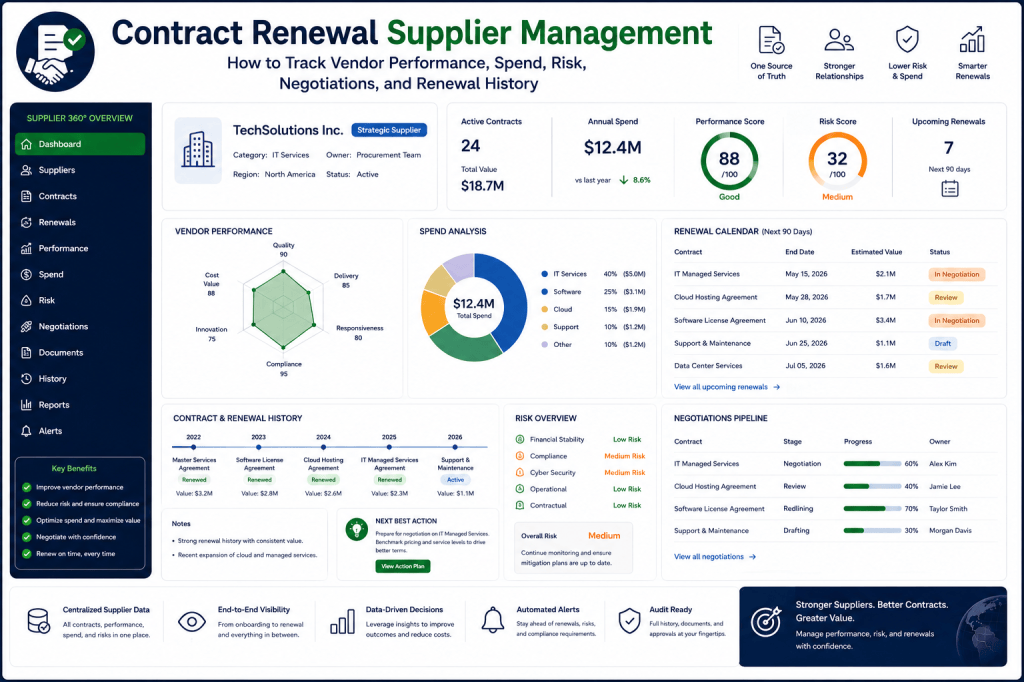
Why Supplier-Level Renewal Management Matters
Consider an organization with four contracts from the same technology supplier:
| Contract | Annual Value | Renewal |
|---|---|---|
| Cloud Infrastructure | €850,000 | March |
| Analytics Platform | €240,000 | May |
| Security Services | €180,000 | June |
| Premium Support | €130,000 | August |
If each contract is reviewed independently, the organization sees four renewals.
But from the supplier perspective, it sees:
Total Annual Supplier Spend: €1.4 million
That changes the negotiation.
A procurement manager negotiating a €130,000 support renewal has considerably more leverage when the supplier understands that the total relationship is worth €1.4 million annually.
This is why the Contract Renewal Tracker should connect every contract to a supplier profile.
From Contract Record to Supplier 360
The contract record answers:
What are the terms of this agreement?
The supplier profile answers:
What is our complete commercial relationship with this vendor?
A Supplier 360 view might combine:
Supplier Identity
All Active Contracts
Total Spend
Upcoming Renewals
Supplier Performance
Renewal History
Negotiation History
Risk
Savings
Contacts
↓
Supplier Intelligence
This becomes extremely valuable when preparing for renewal negotiations.
The Supplier Profile
Every supplier should have a central profile.
For example:
ExampleCloud
Supplier Status: Strategic
Active Contracts: 7
Annual Spend: €4.2M
Total Contract Commitment: €7.8M
Next Renewal: 42 days
Contracts Renewing Next 180 Days: 5
Renewal Value Next 180 Days: €3.4M
Supplier Risk: High
Average Performance Score: 87/100
Average Proposed Price Increase: 8.7%
Savings YTD: €240K
This immediately provides context that individual contract records cannot.
Supplier Master Data
The supplier profile should contain consistent master data.
Useful fields include:
- legal supplier name;
- trading name;
- supplier ID;
- headquarters;
- website;
- primary category;
- supplier status;
- account manager;
- procurement owner;
- business owner;
- strategic classification;
- risk classification;
- parent company;
- subsidiaries.
Standardized supplier data is important because duplicate supplier records can fragment the analysis.
Duplicate Supplier Detection
Consider records such as:
Microsoft
Microsoft Corp
Microsoft Corporation
Microsoft BV
MSFT
A simple contract database may treat these as separate suppliers.
That produces incorrect spend analysis.
A Contract Renewal Tracker should support supplier normalization.
AI can assist by identifying likely duplicate supplier entities and asking an authorized user to confirm consolidation.
Supplier Hierarchies
Some relationships are more complex.
For example:
Global Technology Group
↓
European Subsidiary
↓
Cloud Division
↓
Security Division
Different contracts may reference different legal entities.
The system should support:
Parent Supplier
Legal Entity
Commercial Brand
This allows both legal accuracy and consolidated spend analysis.
All Contracts for One Supplier
The supplier workspace should display every relevant agreement.
For example:
Active Contracts — ExampleCloud
| Contract | Annual Value | Notice Deadline | Decision | Risk |
|---|---|---|---|---|
| Cloud Infrastructure | €1.8M | 42 days | Renegotiate | High |
| Analytics | €580K | 93 days | Undecided | Medium |
| Security | €420K | 118 days | Renew | Medium |
| Support | €260K | 147 days | Renegotiate | Low |
| Data Platform | €340K | 171 days | Undecided | Medium |
Now procurement sees the relationship as a portfolio.
Supplier Spend
One of the most important metrics is:
Total Annual Supplier Spend
But spend should be analyzed at multiple levels.
For example:
Contracted Annual Value
€4.2M
Actual Trailing-12-Month Spend
€4.7M
Future Committed Spend
€6.8M
Spend Under Renewal
€3.1M
Each tells a different story.
Contracted Spend vs Actual Spend
Suppose a cloud supplier contract commits:
€1.5M annually
but actual usage produces:
€1.9M spend
That €400K difference should be visible before renewal.
Alternatively:
Committed spend:
€1.5M
Actual usage:
€1.1M
The organization may be overcommitted.
Supplier-level analysis can reveal patterns across multiple agreements.
Spend by Business Unit
A supplier may be used throughout the organization.
For example:
IT:
€2.4M
Marketing:
€620K
Finance:
€480K
Operations:
€390K
HR:
€210K
Other:
€100K
Total:
€4.2M
Without a central supplier view, each department may believe it is negotiating a relatively small relationship.
Spend by Product
The supplier profile can also show where money is going.
For example:
Cloud:
€2.1M
Security:
€740K
Analytics:
€580K
Support:
€420K
Consulting:
€360K
This can expose consolidation and bundling opportunities.
Supplier Renewal Calendar
The Contract Renewal Tracker should create a supplier-specific renewal timeline.
For example:
March 15
Cloud Infrastructure — €1.8M
May 1
Analytics — €580K
June 30
Security — €420K
August 15
Support — €260K
This immediately raises an important question:
Should these renewals really be negotiated separately?
Renewal Concentration
A useful metric is:
Supplier Renewal Concentration
For example:
Total annual supplier spend:
€4.2M
Value renewing during next 180 days:
€3.1M
Renewal concentration:
74%
This represents a significant negotiation event.
The tracker can flag:
74% of annual spend with this supplier becomes negotiable during the next six months.
That is valuable commercial intelligence.
Consolidated Negotiation Opportunities
When several contracts renew within a similar period, the system can recommend a consolidated negotiation.
For example:
Four ExampleCloud contracts worth €3.1M annually renew within 180 days.
Potential Action:
Evaluate consolidated supplier negotiation.
Possible benefits include:
- volume discount;
- reduced price increases;
- improved support;
- better payment terms;
- standardized contract language;
- aligned renewal dates;
- stronger service commitments.
Co-Termination Opportunities
The organization may also negotiate common renewal dates.
Suppose contracts currently renew in:
March
May
August
November
Procurement may propose moving them to:
December 31
This is known as co-termination.
Benefits can include:
- one annual negotiation;
- consolidated budgeting;
- better supplier leverage;
- simplified administration;
- improved spend visibility.
The Contract Renewal Tracker can identify suppliers where co-termination could be useful.
Supplier Performance
Price should never be evaluated without performance.
Supplier performance data might include:
- SLA compliance;
- uptime;
- incidents;
- support response time;
- delivery quality;
- implementation success;
- account management;
- user satisfaction;
- security incidents.
For example:
Supplier Performance
Overall Score:
78/100
SLA Compliance:
94%
Target:
99%
Critical Incidents:
7
Support Satisfaction:
3.1/5
Delivery Performance:
82%
The renewal team now has evidence for negotiation.
Supplier Scorecard
A standardized supplier scorecard can combine multiple dimensions.
For example:
| Dimension | Score |
|---|---|
| Service Performance | 82 |
| Support | 74 |
| Commercial | 69 |
| Security | 91 |
| Relationship | 86 |
| Innovation | 77 |
Overall:
80/100
The weighting should depend on the supplier category.
Supplier Performance Trends
One score is less useful than the trend.
For example:
2025:
92/100
2026:
87/100
2027:
80/100
The Contract Renewal Tracker can flag:
Supplier performance has declined during three consecutive review periods.
This becomes especially important if prices are simultaneously increasing.
Price vs Performance
Suppose:
Supplier performance:
−12%
Proposed renewal increase:
+11%
The tracker could generate:
Supplier performance has declined while the proposed renewal price increases 11%.
That is a powerful negotiation insight.
SLA History
For service contracts, SLA performance should be linked to renewal decisions.
For example:
| Quarter | SLA Target | Actual |
|---|---|---|
| Q1 | 99.9% | 99.8% |
| Q2 | 99.9% | 99.5% |
| Q3 | 99.9% | 99.4% |
| Q4 | 99.9% | 99.1% |
The trend is clearly negative.
Procurement can use this information when negotiating:
- pricing;
- credits;
- service improvements;
- termination rights.
Incident History
Major supplier incidents should also be visible.
For example:
March 12
Critical outage — 4 hours.
June 7
Security incident.
September 19
API outage — 2.5 hours.
November 4
Major support escalation.
The renewal team should not have to search separate systems to reconstruct supplier history.
Renewal History
Every completed renewal should become part of the supplier intelligence record.
For example:
2025 Renewal
Supplier requested:
+7%.
Final result:
+3%.
Savings:
€60K.
2026 Renewal
Supplier requested:
+9%.
Final result:
+2%.
Savings:
€110K.
2027 Renewal
Supplier requested:
+11%.
Current status:
Negotiating.
This history gives procurement context.
Price Increase History
A particularly useful supplier metric is:
Initial Proposed Increase vs Final Increase
For example:
| Year | Proposed | Final |
|---|---|---|
| 2025 | 7% | 3% |
| 2026 | 9% | 2% |
| 2027 | 11% | Pending |
The pattern suggests that initial supplier proposals have historically been negotiable.
The Contract Renewal Tracker can surface this automatically.
Negotiation History
The system should preserve important negotiation events.
For example:
Supplier Initial Proposal
€720K
Internal Target
€630K
Counteroffer
€610K
Supplier Revision
€675K
Final Agreement
€645K
This creates useful institutional knowledge.
Negotiation Outcome
A structured outcome record might include:
Initial Supplier Proposal: €720K
Final Price: €645K
Previous Price: €660K
Hard Savings: €15K
Cost Avoidance: €75K
Term: 24 months
Additional Benefit: Enhanced SLA credits
This allows supplier negotiation performance to be analyzed over time.
Negotiation Duration
Another useful metric is:
Negotiation Cycle Time
For example:
Average supplier negotiation:
28 days
Strategic contract negotiation:
61 days
If the supplier historically requires long negotiations, the next workflow should start earlier.
Supplier Negotiation Behavior
Over time, the Contract Renewal Tracker can identify patterns.
For example:
Supplier typically opens renewal negotiations with increases between 8% and 12%.
Final increases historically average 2.8%.
Average negotiation requires three commercial proposals.
Negotiations typically take 34 days.
This information helps procurement prepare.
Supplier Dependency
A supplier can represent significant operational dependency even if pricing is competitive.
Factors include:
- critical systems;
- proprietary technology;
- integrations;
- data lock-in;
- migration complexity;
- limited alternatives;
- specialist skills.
The tracker can calculate a Supplier Dependency Score.
For example:
Dependency: 91/100 — Critical
Reasons:
- supports core infrastructure;
- 42 integrations;
- estimated migration duration: 12 months;
- limited viable alternatives.
This changes renewal strategy.
Switching Difficulty
A useful supplier field is:
Estimated Replacement Lead Time
For example:
Low:
<30 days.
Medium:
1–3 months.
High:
3–9 months.
Critical:
9+ months.
If replacement requires 12 months, starting renewal analysis 90 days before notice is clearly too late.
Supplier Concentration Risk
Suppose one supplier represents:
31% of total technology spend
and supports:
- cloud infrastructure;
- identity;
- security;
- analytics.
That creates concentration risk.
The supplier may be excellent, but dependency is significant.
The dashboard can flag:
Supplier represents 31% of technology contract spend and supports four business-critical services.
This is strategic information.
Supplier Risk Score
A supplier-level risk score can combine:
- financial exposure;
- operational dependency;
- service performance;
- cybersecurity risk;
- concentration;
- renewal exposure;
- commercial behavior;
- unresolved disputes.
For example:
Supplier Risk
82/100 — Very High
Primary contributors:
Supplier dependency:
+24
Spend concentration:
+18
Upcoming renewal exposure:
+16
Declining SLA performance:
+12
Price increase trend:
+8
Open dispute:
+4
This provides a supplier-level risk perspective.
Strategic Supplier Classification
Not all suppliers need the same management intensity.
Possible classifications include:
Transactional
Low value and easily replaceable.
Important
Meaningful spend or operational relevance.
Strategic
High value and significant business importance.
Critical
Major operational dependency or concentration.
The Contract Renewal Tracker can apply different renewal workflows based on classification.
Alternative Suppliers
Supplier management should also consider alternatives.
For example:
Current Supplier
ExampleCloud
Annual spend:
€2.8M.
Alternatives
Supplier B
Supplier C
Supplier D
The tracker does not necessarily need to become a complete sourcing platform, but recording known alternatives can improve renewal planning.
Replacement Readiness
For high-dependency suppliers, the system could track:
Alternative Identified: Yes
Technical Assessment: Complete
Migration Estimate: 9 months
Estimated Switching Cost: €480K
Business Continuity Plan: Incomplete
This gives management a clearer understanding of its negotiating position.
Supplier Contacts
The supplier profile should include relevant relationship contacts.
For example:
Account Executive
Customer Success Manager
Legal Contact
Billing Contact
Escalation Contact
Executive Sponsor
Internal contacts may include:
Procurement Owner
Business Owner
Technical Owner
Executive Sponsor
This makes renewal coordination easier.
Relationship Timeline
A supplier timeline could combine:
- contract signatures;
- amendments;
- renewals;
- price increases;
- incidents;
- executive meetings;
- negotiations;
- disputes;
- performance reviews.
For example:
January
Strategic review.
March
Critical outage.
May
Contract amendment.
August
Renewal negotiation started.
September
Supplier proposal received.
October
Renewal signed.
This creates a complete relationship history.
Supplier Documents
The supplier workspace can also collect:
- master agreements;
- amendments;
- order forms;
- SLAs;
- pricing schedules;
- security assessments;
- performance reports;
- supplier proposals.
The AI assistant can then reason across the entire supplier relationship.
AI Supplier Summary
The Contract Renewal Tracker can generate an executive supplier summary.
For example:
ExampleCloud — Supplier Intelligence
ExampleCloud is a strategic technology supplier with seven active contracts and €4.2M in annual spend.
Five contracts representing €3.4M renew during the next 180 days.
Supplier performance has declined from 91/100 to 80/100 during the last two years.
The supplier has proposed average renewal increases of 9.3%, although historical negotiations have reduced final increases to approximately 3%.
The organization has high dependency due to extensive infrastructure integration and an estimated 12-month replacement period.
Recommended Focus
Consolidate upcoming renewals into a supplier-level negotiation and prioritize service-performance commitments alongside pricing.
That summary would be extremely useful before an executive supplier meeting.
AI Negotiation Brief
A procurement manager could ask:
Prepare me for the ExampleCloud negotiation.
The assistant might return:
Commercial Position
Annual spend:
€4.2M.
Spend renewing within 180 days:
€3.4M.
Supplier proposed increases:
8–12%.
Historical final increases:
2–4%.
Performance Position
SLA performance declined during three consecutive quarters.
Seven critical incidents occurred during the last year.
Leverage
Five contracts renew within six months.
Two contracts contain overlapping support services.
Unused capacity exists in the analytics contract.
Risk
Supplier dependency is high.
Replacement would require approximately 12 months.
Suggested Negotiation Priorities
- Consolidate renewal discussions.
- Challenge proposed price increases.
- Request volume discount.
- Improve SLA credits.
- Align renewal dates.
- Preserve termination flexibility.
This turns historical supplier data into negotiation intelligence.
AI Can Detect Supplier Patterns
Across the portfolio, AI could identify patterns such as:
Three suppliers account for 48% of infrastructure spend.
or:
Supplier X has proposed price increases above 10% in four consecutive renewals.
or:
Six contracts with Supplier Y renew within 120 days.
or:
Supplier Z’s performance score has declined while annual spend increased 24%.
These insights may not be obvious from individual contract records.
Supplier Comparison
Users could ask:
Compare our cybersecurity suppliers.
The assistant might produce:
| Supplier | Spend | Performance | Risk | Renewal |
|---|---|---|---|---|
| SecureNet | €720K | 91 | Medium | 47 days |
| CyberCore | €480K | 78 | High | 82 days |
| ShieldOne | €310K | 87 | Low | 143 days |
Then explain the main differences.
This becomes valuable during consolidation or sourcing discussions.
Supplier Savings
Savings should also be aggregated by supplier.
For example:
ExampleCloud Savings History
2025:
€90K
2026:
€140K
2027:
€210K
Cumulative:
€440K
The organization can see which supplier relationships produce the largest optimization opportunities.
Supplier Opportunity Score
The system can calculate a commercial opportunity score.
Possible factors:
- supplier spend;
- number of upcoming renewals;
- price increases;
- performance deterioration;
- duplicate contracts;
- benchmark gaps;
- unused licenses;
- consolidation potential.
For example:
Opportunity Score: 89/100
Reasons:
- €4.2M annual spend;
- five upcoming renewals;
- average proposed increase 9%;
- declining performance;
- co-termination opportunity.
This tells procurement where supplier-level intervention may generate the greatest value.
Risk and Opportunity Together
Supplier prioritization becomes more powerful when both dimensions are considered.
| Low Opportunity | High Opportunity | |
|---|---|---|
| Low Risk | Monitor | Optimize |
| High Risk | Protect | Strategic Priority |
A supplier with:
Risk: High
and:
Opportunity: High
should receive senior procurement attention.
Supplier Dashboard
A supplier management dashboard could show:
Portfolio
Active suppliers:
316
Strategic suppliers:
24
Critical suppliers:
9
Annual supplier spend:
€48.7M
Concentration
Top 10 suppliers:
52% of spend
Largest supplier:
€6.8M
Upcoming Supplier Renewals
Next 90 days:
€7.4M
Next 180 days:
€16.2M
Performance
Suppliers below performance threshold:
17
Critical suppliers below threshold:
3
Commercial
Average proposed increase:
7.8%
Average negotiated increase:
3.2%
Supplier optimization opportunity:
€3.4M
This gives procurement a portfolio-wide supplier view.
Supplier 360 Dashboard
Clicking an individual supplier could open:
Overview
Spend, risk, performance, classification.
Contracts
All active and historical agreements.
Renewals
Upcoming renewal pipeline.
Performance
SLA and service trends.
Financial
Pricing and spend history.
Negotiations
Proposal and outcome history.
Risk
Dependency and concentration.
Documents
Contracts and supplier materials.
Timeline
Complete relationship history.
AI Insights
Risks, opportunities, and recommended actions.
This becomes a genuine Supplier 360 workspace.
Conversion Point: From Supplier Spreadsheets to Supplier Intelligence
Organizations frequently maintain contract dates in one spreadsheet, supplier spend in another, performance reports elsewhere, and negotiation history inside email.
That fragmentation weakens renewal decisions.
Contract Renewal Tracker can bring contracts, supplier spend, renewal deadlines, risk, performance, and negotiation history into one supplier-level view.
Instead of reconstructing the supplier relationship before every renewal, teams can work from a continuously maintained Supplier 360 record.
Role-Based Supplier Views
Different users need different information.
Procurement
Spend, pricing, negotiation, savings.
Legal
Contracts, clauses, amendments, disputes.
Finance
Commitments, forecast, price increases.
IT or Operations
Performance, incidents, dependency.
Executive
Strategic exposure, concentration, major decisions.
Role-based access ensures that users see the information appropriate to their responsibilities.
Supplier Alerts
The tracker can generate supplier-level alerts.
For example:
Renewal Concentration Alert
Five ExampleCloud contracts worth €3.4M renew within 180 days.
Or:
Performance Alert
Supplier performance has fallen below the strategic-supplier threshold.
Or:
Commercial Alert
Supplier’s average proposed price increase across three upcoming renewals is 11.2%.
Or:
Concentration Alert
Supplier now represents 28% of infrastructure contract spend.
These alerts encourage proactive supplier management.
Supplier Governance
Strategic suppliers may require structured governance.
For example:
Monthly
Operational performance review.
Quarterly
Business review.
Semi-Annual
Commercial review.
Pre-Renewal
Renewal strategy meeting.
The Contract Renewal Tracker can connect these activities to the renewal lifecycle.
Supplier Review Before Renewal
A strategic renewal should ideally begin with a supplier review.
Questions include:
- Has the supplier performed well?
- Has spend increased?
- Have requirements changed?
- Are users satisfied?
- Are alternatives available?
- Has dependency increased?
- Are prices competitive?
- Are multiple contracts approaching renewal?
- Should the relationship expand, shrink, or end?
The answers inform the renewal strategy.
Renewal Strategy at Supplier Level
Instead of setting strategy only for individual contracts, the organization can establish a supplier strategy.
For example:
Supplier Strategy
Relationship: Continue
Commercial Position: Consolidate and renegotiate
Target Spend Reduction: 8%
Contract Strategy: Co-terminate four agreements
Service Strategy: Strengthen SLA commitments
Risk Strategy: Develop secondary provider
Individual contract renewals then align with the broader supplier strategy.
Why Supplier-Level Strategy Creates Better Outcomes
Without supplier-level coordination:
Contract A may renew for three years.
Two months later, Contract B may be terminated.
Then Contract C may be renegotiated separately.
The organization loses leverage and creates inconsistent commitments.
Supplier-level planning allows all of these decisions to be coordinated.
Measuring Supplier Management Performance
Useful KPIs include:
Supplier Spend
Total spend by supplier.
Renewal Concentration
Value renewing within defined periods.
Average Proposed Increase
Supplier’s initial renewal pricing behavior.
Average Final Increase
Negotiated outcome.
Supplier Performance Score
Operational quality.
Negotiation Savings
Financial improvement.
Dependency Score
Difficulty of replacing supplier.
Supplier Risk
Overall relationship exposure.
Consolidation Opportunity
Potential value from coordinated negotiation.
These metrics make supplier renewal management measurable.
Supplier Intelligence and the AI Assistant
The previous article introduced the AI Contract Renewal Assistant.
Supplier intelligence makes that assistant much more powerful.
Instead of asking only:
What does this contract say?
users can ask:
What is our history with this supplier?
How much do we spend with them?
What price increases have they proposed previously?
How successful have previous negotiations been?
What other contracts renew soon?
How has their performance changed?
What leverage do we have?
What should we negotiate?
This moves AI from document interpretation toward commercial relationship intelligence.
From Contract-Centric to Relationship-Centric Renewal Management
The product architecture now has two important perspectives.
Contract View
Answers:
What is happening with this agreement?
Supplier View
Answers:
What is happening across our entire relationship with this vendor?
Together they provide much stronger renewal intelligence.
The progression becomes:
Contract → Renewal → Workflow → Risk → Cost → Supplier Relationship → Negotiation Strategy
Take Control of Supplier Renewals
Managing supplier renewals through disconnected spreadsheets makes it difficult to see total spend, upcoming commitments, historical price increases, performance trends, and negotiation opportunities.
A dedicated Contract Renewal Tracker can create one source of truth for:
- supplier contracts;
- renewal deadlines;
- total supplier spend;
- performance;
- risk;
- negotiation history;
- savings opportunities;
- upcoming decisions.
This gives procurement and contract teams the context they need before negotiations begin—not after the renewal has already happened.
Final Thoughts
A contract tells you the terms of one agreement.
A supplier profile tells you the commercial reality of the relationship.
That distinction matters.
A €200,000 renewal may appear relatively ordinary until the organization discovers that the same supplier already receives €5 million annually.
A proposed 10% increase may appear difficult to challenge until historical data shows that the supplier has reduced similar proposals during every previous negotiation.
A supplier may appear inexpensive until declining SLA performance and increasing dependency are considered.
The Contract Renewal Tracker should therefore connect:
Contracts + Spend + Performance + Risk + Renewal History + Negotiations + Supplier Dependency
to create:
Supplier Intelligence
That gives organizations a stronger basis for deciding:
Renew?
Renegotiate?
Consolidate?
Reduce?
Replace?
Diversify?
And it gives the Contract Renewal Tracker another important commercial capability: helping customers manage not just individual renewal dates, but the supplier relationships behind them.
Next Article in the Contract Renewal Tracker Series
Article 16 — “Contract Renewal Negotiation Management: How to Plan Negotiations, Set Targets, Track Supplier Offers, and Measure Savings”
The next article will move directly into the commercial negotiation workspace. It will cover negotiation preparation, target pricing, opening positions, walk-away thresholds, supplier proposals, counteroffers, negotiation rounds, pricing history, benchmark evidence, concessions, non-price terms, negotiation timelines, savings calculations, approval boundaries, AI negotiation briefs, and the complete negotiation audit trail.
It will also continue the stronger prospect-conversion structure by showing where a dedicated Contract Renewal Tracker replaces spreadsheets, email threads, and fragmented negotiation records.

