A Contract Renewal Tracker should do more than organize renewal dates.
It should create measurable financial value.
For a prospective customer, this leads to one of the most important questions:
Will a Contract Renewal Tracker subscription actually pay for itself?
In many organizations, the business case can be surprisingly strong.
The financial value can come from several sources:
- preventing unwanted auto-renewals;
- avoiding missed termination windows;
- negotiating renewals earlier;
- reducing unnecessary licenses;
- eliminating unused services;
- consolidating suppliers;
- avoiding unnecessary price increases;
- reducing administrative work;
- accelerating approvals;
- improving purchasing decisions.
Some of these benefits create direct savings.
Others create cost avoidance, productivity gains, or risk reduction.
Together, they provide the economic justification for moving contract renewals away from spreadsheets, calendar reminders, inboxes, and manual processes into a dedicated Contract Renewal Tracker SaaS platform.
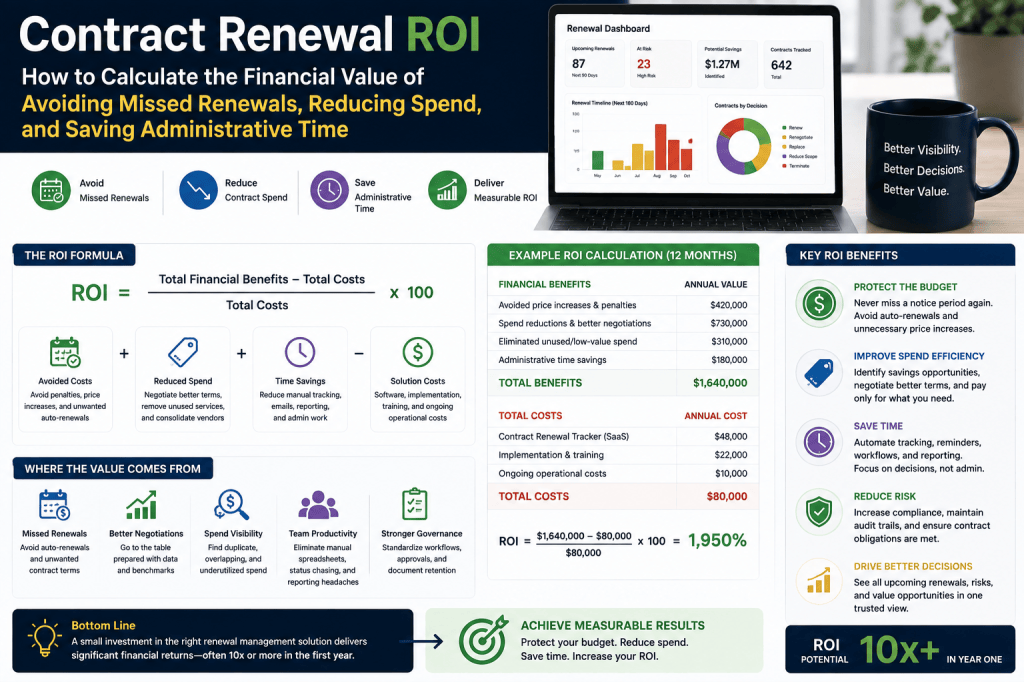
The Contract Renewal ROI Equation
At its simplest:
ROI = Financial Benefits − Cost of the Software
A more conventional percentage calculation is:
ROI % = ((Financial Benefits − Software Cost) ÷ Software Cost) × 100
Suppose a company spends:
€6,000 per year
on Contract Renewal Tracker.
During the year, it identifies:
- €18,000 avoided auto-renewal;
- €22,000 negotiated savings;
- €14,000 license optimization;
- €8,000 administrative productivity value.
Total measurable benefit:
€62,000
Net benefit:
€56,000
ROI:
933%
The precise numbers will vary by customer.
The important point is that renewal software does not need to generate enormous percentage improvements to justify its subscription cost.
Want to Know Whether Contract Renewal Tracker Pays for Itself?
The business case should not depend on vague claims about “better contract management.”
Contract Renewal Tracker can help organizations connect renewal activity to measurable outcomes such as prevented auto-renewals, negotiated savings, reduced licenses, avoided increases, and administrative time saved.
Calculate the financial value hidden inside your renewal portfolio →
Where Does Contract Renewal ROI Come From?
A useful business case can separate value into five categories:
1. Avoided Unwanted Renewals
Contracts the organization would otherwise have renewed unnecessarily.
2. Commercial Savings
Better pricing achieved through earlier and better-prepared negotiation.
3. Spend Optimization
Reduction of unnecessary licenses, quantities, products, or services.
4. Productivity Savings
Administrative time saved through automation.
5. Risk Reduction
Financial exposure reduced through stronger deadline and approval controls.
This makes ROI easier to explain to finance and executives.
ROI Source 1: Preventing Unwanted Auto-Renewals
This is one of the clearest sources of financial value.
Suppose an organization has a software subscription costing:
€48,000 annually
The contract automatically renews unless notice is provided 90 days before expiration.
The business no longer needs the software.
But nobody notices the deadline.
The company becomes committed for another year.
Cost:
€48,000
A Contract Renewal Tracker that identifies the notice window and triggers the decision process could potentially prevent that unnecessary commitment.
One avoided renewal may pay for the SaaS subscription several times over.
The Cost of a Missed Notice Deadline
The actual exposure may be even larger.
Consider:
Annual value:
€180,000
Renewal term:
3 years
Automatic renewal:
Yes
Notice requirement:
120 days
If the missed deadline creates a three-year commitment, potential exposure could be:
€540,000
This is why tracking the contractual notice deadline—not merely the expiration date—is so important.
Calculate Auto-Renewal Exposure
A portfolio-level calculation might be:
Auto-Renewing Contracts: 420
Annual Value: €14.8M
Undecided Within Notice Window: €1.7M
The €1.7M does not mean it will all be wasted.
But it represents spend that requires active decision-making.
That visibility has economic value.
ROI Source 2: Starting Negotiations Earlier
Negotiation leverage decreases as deadlines approach.
If a supplier knows the customer has only two weeks before auto-renewal, the customer may have limited alternatives.
If the organization starts 180 days earlier, it has time to:
- benchmark;
- evaluate alternatives;
- review usage;
- consolidate suppliers;
- prepare negotiation targets;
- run a competitive process.
The tracker therefore creates value by creating time.
Example Negotiation Savings
Current contract:
€500,000
Supplier proposal:
€550,000
Initial increase:
10%
After negotiation:
€510,000
Avoided increase:
€40,000
Depending on the organization’s methodology, this may be classified as:
Cost Avoidance: €40,000
The Contract Renewal Tracker can record that outcome.
Hard Savings vs Cost Avoidance
These terms should be separated.
Suppose current annual spend is:
€500,000
Supplier proposes:
€550,000
Final negotiated price:
€480,000
Then:
Hard Savings
Compared with current spend:
€20,000
Cost Avoidance
Compared with supplier proposal:
€70,000
Both are valuable, but they represent different financial concepts.
The platform should report them separately.
ROI Source 3: License Optimization
Software contracts are particularly suitable for renewal optimization.
Suppose the company pays for:
1,000 licenses
at:
€300 each
Annual cost:
€300,000
Usage analysis shows:
760 active users
The organization reduces the renewal to:
800 licenses
New cost:
€240,000
Annual savings:
€60,000
The renewal deadline creates the opportunity to correct the quantity.
License Optimization Formula
A simple calculation is:
Unused Licenses × Unit Cost = Optimization Opportunity
For example:
200 unnecessary licenses
×
€300
=
€60,000
If the tracker integrates with usage systems, these opportunities can be surfaced automatically.
ROI Source 4: Eliminating Unused Services
Not every unnecessary contract is software.
Organizations may continue paying for:
- support packages;
- consulting retainers;
- maintenance agreements;
- subscriptions;
- data services;
- telecom services.
A structured renewal review forces the question:
Do we still need this?
That question alone can generate significant savings.
Example Service Termination
Annual service:
€72,000.
Business owner review:
Service no longer required.
Decision:
Terminate.
Avoided future spend:
€72,000 annually
Without an organized renewal process, the agreement might simply continue.
ROI Source 5: Supplier Consolidation
An organization may have several contracts with the same supplier.
For example:
Contract A:
€400K.
Contract B:
€220K.
Contract C:
€180K.
Contract D:
€100K.
Total supplier relationship:
€900K
If each renewal is handled separately, procurement may negotiate from the perspective of each individual agreement.
A Contract Renewal Tracker can reveal the consolidated relationship.
That creates additional leverage.
Example Consolidation Savings
Total supplier spend:
€900,000
Negotiated portfolio reduction:
5%
Potential annual savings:
€45,000
The system can attribute those savings to supplier consolidation.
ROI Source 6: Preventing Unnecessary Price Increases
Some renewal clauses include:
- fixed increases;
- CPI adjustments;
- indexation;
- supplier discretionary increases.
The tracker can surface these before renewal.
Suppose:
Current contract:
€800,000.
Proposed increase:
7%.
Additional annual cost:
€56,000
After negotiation:
Increase reduced to 3%.
Additional cost:
€24,000.
Cost avoided:
€32,000
This becomes measurable commercial value.
ROI Source 7: Administrative Time Savings
Renewal management can consume significant employee time.
Typical manual activities include:
- updating spreadsheets;
- checking contract dates;
- sending reminder emails;
- chasing owners;
- creating reports;
- finding documents;
- tracking approvals;
- reconciling different contract lists.
Automation can reduce this work.
Example Productivity Calculation
Suppose the organization manages:
800 renewals per year
Manual administration averages:
45 minutes per renewal
Total:
600 hours.
After automation:
20 minutes per renewal.
Total:
267 hours.
Time saved:
333 hours
If loaded employee cost is:
€50/hour
Productivity value:
€16,650 annually
This can be included in the ROI model.
Be Conservative with Productivity Savings
Time savings do not always translate directly into cash savings.
Employees may use the saved time for other work rather than reducing headcount.
It is therefore often better to classify this as:
Productivity Value
rather than:
Hard Savings
This makes the ROI calculation more credible.
ROI Source 8: Faster Approvals
Slow approvals can create commercial consequences.
Suppose procurement completes negotiation but finance approval takes 18 days.
The organization loses an early-renewal discount worth:
€15,000
Better approval routing may prevent that.
The system can measure:
- approval cycle time;
- overdue approvals;
- approval bottlenecks.
This connects workflow efficiency to economic value.
ROI Source 9: Avoiding Emergency Procurement
Missed renewal planning can force organizations into urgent purchases.
Urgency reduces:
- negotiation time;
- competitive sourcing;
- alternative evaluation.
A renewal tracker provides earlier visibility.
That may reduce emergency purchasing.
ROI Source 10: Avoiding Business Disruption
Not every renewal failure causes unnecessary spend.
Some create the opposite problem.
A critical service may expire unexpectedly.
Examples include:
- cybersecurity services;
- cloud infrastructure;
- support agreements;
- software licenses;
- maintenance contracts.
The resulting disruption can be far more expensive than the contract itself.
This risk is harder to quantify but should still be acknowledged.
Cost of Inaction
A compelling business case does not only calculate:
What will the software save us?
It also asks:
What does continuing the current process cost us?
This is the cost of inaction.
Cost-of-Inaction Model
Possible components include:
Missed Auto-Renewals
Unchallenged Price Increases
Unused Licenses
Administrative Work
Emergency Renewals
Lost Negotiation Leverage
This provides a broader financial picture.
Example Cost of Inaction
Suppose an organization manages:
1,500 active contracts
with annual contract spend of:
€24M
Estimated annual leakage:
Missed unwanted renewals:
€90K.
Unoptimized licenses:
€180K.
Unchallenged increases:
€140K.
Administrative inefficiency:
€40K.
Estimated annual opportunity:
€450K
Even recovering a fraction may justify the SaaS subscription.
The 1% Argument
For organizations with significant contract spend, very small improvements matter.
Suppose managed spend is:
€20M
A 1% improvement equals:
€200,000
A Contract Renewal Tracker does not need to transform every contract.
It only needs to help capture a small portion of preventable leakage to create meaningful financial value.
ROI by Contract Portfolio Size
The value proposition can scale with the portfolio.
Small Business
50 contracts.
Annual managed spend:
€500K.
One avoided €10K renewal can justify the product.
Mid-Market
500 contracts.
Managed spend:
€8M.
Small optimization improvements can produce tens or hundreds of thousands of euros.
Enterprise
5,000+ contracts.
Managed spend:
€100M+.
Even fractions of a percentage become substantial.
This allows Contract Renewal Tracker to support different customer segments.
ROI by Contract Type
Different contract categories create different opportunities.
SaaS
License optimization.
Cloud
Consumption and commitment optimization.
Telecom
Service and pricing optimization.
Professional Services
Scope and rate negotiation.
Facilities
Term and supplier optimization.
Maintenance
Unused coverage and pricing review.
The ROI model can eventually adapt by category.
The Renewal Opportunity Score
The platform could calculate an estimated opportunity for each contract.
For example:
ExampleCloud
Annual Value:
€620K
Unused Capacity:
€74K
Proposed Increase:
€42K
Consolidation Opportunity:
€18K
Estimated Renewal Opportunity:
€134K
This helps procurement prioritize.
Opportunity Does Not Equal Savings
The platform should distinguish:
Identified Opportunity
from:
Realized Savings
An opportunity is potential.
Savings should only be counted after the renewal outcome is known.
This prevents inflated ROI claims.
Savings Attribution
When a renewal completes, the user can record:
Baseline
€500K.
Supplier Proposal
€550K.
Final Price
€470K.
Previous Quantity
1,000 licenses.
New Quantity
The system can then calculate the relevant financial outcomes.
Renewal Outcome Record
A completed renewal could store:
Hard Savings: €30K
Cost Avoidance: €80K
Avoided Spend: €0
License Reduction: 150
Term: 2 years
This creates a historical value record.
Multi-Year Savings
Be careful when reporting multi-year savings.
Suppose annual savings are:
€50K
and the new contract runs:
3 years.
Potential contractual savings:
€150K
But annual reporting should still distinguish:
Annualized Savings: €50K
from:
Total Contract-Term Savings: €150K
This prevents misleading dashboards.
Payback Period
Prospects may find payback easier to understand than ROI percentage.
Formula:
Payback Period = Software Cost ÷ Monthly Financial Benefit
Suppose annual subscription:
€12,000.
Expected annual benefit:
€120,000.
Monthly benefit:
€10,000.
Payback:
1.2 months
The investment potentially pays for itself early in the year.
Break-Even Analysis
Another useful calculation asks:
How much savings must Contract Renewal Tracker create to cover its subscription?
If annual subscription cost is:
€6,000
then break-even benefit is:
€6,000
For a company managing €5M in contract spend, that equals:
0.12%
of managed spend.
This can be a powerful sales metric.
Break-Even as Percentage of Spend
Formula:
Subscription Cost ÷ Managed Contract Spend × 100
Example:
€10,000 SaaS cost
÷
€10,000,000 managed spend
×
100
=
0.1%
The platform needs to help recover only one-tenth of one percent of managed spend to break even.
ROI Calculator for Prospects
Contract Renewal Tracker could eventually include an interactive ROI calculator.
Inputs:
Number of Contracts
Annual Contract Spend
Auto-Renewal Exposure
Number of Employees Managing Renewals
Average Hours per Renewal
Estimated Optimization Rate
Then calculate:
Potential Annual Value
Break-Even Improvement
Estimated Payback
Potential ROI
This would be useful on the product website and during sales conversations.
Example ROI Calculator
Imagine a prospect enters:
Contracts:
Managed Spend:
€12M.
Auto-Renewal Spend:
€3M.
Renewal Administration:
1,000 hours annually.
Estimated Recoverable Leakage:
1%.
The calculator could estimate:
Spend optimization:
€120K.
Productivity value:
€25K.
Total potential value:
€145K
The exact result should be presented as an estimate, not a guarantee.
Use Conservative Assumptions
A credible calculator should avoid exaggerated claims.
For example, instead of assuming:
10% savings across all spend
use scenarios:
Conservative
0.5%.
Moderate
1%.
High Opportunity
2%.
This allows prospects to assess their own situation.
ROI Scenarios
For example:
Managed spend:
€20M.
0.25% Improvement
€50K.
0.5% Improvement
€100K.
1% Improvement
€200K.
Even the conservative scenario may justify the subscription.
ROI Dashboard Inside Contract Renewal Tracker
Once a customer subscribes, the platform can measure actual value.
For example:
Renewal Value Created YTD
Hard Savings:
€420K.
Cost Avoidance:
€610K.
Avoided Renewals:
€280K.
License Optimization:
€190K.
Productivity Value:
€48K.
Total Tracked Value:
€1.548M
This makes the SaaS value visible continuously.
Subscription ROI Dashboard
The platform could also compare value with software cost.
For example:
Contract Renewal Tracker Annual Cost:
€18K.
Tracked Financial Value:
€1.548M.
Value-to-Cost Ratio:
86:1
This becomes extremely useful at subscription renewal time.
Ironically, the Contract Renewal Tracker should be able to justify its own renewal.
ROI by Department
IT:
€420K.
Marketing:
€130K.
Operations:
€210K.
HR:
€75K.
This helps demonstrate where the system creates value.
ROI by Strategy
Price Negotiation:
€310K.
License Reduction:
€280K.
Termination:
€240K.
Supplier Consolidation:
€160K.
Avoided Increase:
€140K.
This identifies the most productive renewal strategies.
ROI by Supplier
For example:
ExampleCloud:
€180K.
DataWorks:
€92K.
CyberSecure:
€74K.
TelecomCo:
€63K.
Procurement can see where negotiation activity creates the greatest value.
ROI by Contract Owner
The system could also measure outcomes by portfolio owner, although this should be used carefully.
The goal should be to identify effective practices rather than create simplistic employee rankings.
Finance Validation
For enterprise customers, savings may need finance validation.
Workflow:
Procurement Records Savings
↓
Finance Reviews Methodology
↓
Savings Approved
↓
Included in Official ROI Reporting
This makes the metrics more defensible.
Savings Status
Possible statuses:
Estimated
Negotiated
Realized
Finance Verified
This prevents preliminary opportunities from being confused with actual financial outcomes.
ROI Audit Trail
Every financial-value claim should be explainable.
For example:
Why does this renewal show €80K cost avoidance?
The system can show:
Supplier initial proposal:
€550K.
Final contract:
€470K.
Difference:
€80K.
Source documents:
Linked.
This increases credibility.
ROI and AI
AI can help identify financial opportunities.
A user might ask:
Where can we save the most money in the next 180 days?
The assistant could analyze:
- contract value;
- renewal timing;
- supplier increases;
- usage;
- duplicate tools;
- negotiation history.
Then prioritize opportunities.
Example AI Renewal Opportunity Brief
Twelve contracts represent approximately €420K of identifiable optimization opportunity over the next 180 days. The largest opportunities are concentrated in three SaaS renewals with low license utilization and two suppliers proposing increases above 10%.
This gives procurement a focused starting point.
AI Should Not Invent Savings
AI-generated savings should remain estimates until validated.
The system should clearly distinguish:
AI Estimated Opportunity
from:
Verified Financial Outcome
This is essential for trustworthy ROI reporting.
CFO Business Case
For a CFO, the purchasing case can be summarized around four questions.
What Does It Cost?
Annual SaaS subscription.
What Can It Recover?
Preventable spend and optimization opportunities.
How Quickly Does It Pay Back?
Payback period.
Can We Measure the Result?
Tracked renewal outcomes and savings.
This turns Contract Renewal Tracker from an operational tool into a financial investment case.
Example CFO Summary
Contract Renewal Tracker Business Case
Managed Spend:
€25M.
Annual Subscription:
€15K.
Conservative Recoverable Value:
0.5%.
Potential Benefit:
€125K.
Net Potential Benefit:
€110K.
Estimated ROI:
733%
Break-Even Improvement:
0.06% of managed spend
This is a much stronger purchasing argument than:
It sends renewal reminders.
Procurement Business Case
Procurement may emphasize:
- earlier negotiations;
- supplier consolidation;
- price-increase control;
- savings tracking.
Legal may emphasize:
- notice deadlines;
- contractual risk.
Operations may emphasize:
- automation;
- accountability.
The same SaaS product creates different forms of value for different stakeholders.
The Value of Better Decisions
Not every benefit can be measured precisely.
Suppose a company renews a strategic supplier because the tracker provided:
- better performance information;
- clearer alternatives;
- earlier review;
- stakeholder input.
The resulting decision may be better even if the price remains unchanged.
That decision quality has value, even when it cannot be reduced to a single savings number.
The Value of Visibility
Before implementation, executives may not know:
How much contract value renews next quarter?
After implementation:
€18.4M.
That visibility improves:
- budgeting;
- planning;
- procurement capacity;
- risk management.
Again, this value is real even if it is harder to quantify.
The Value of Accountability
Without a structured system:
Who owns this renewal?
may be unclear.
With Contract Renewal Tracker:
Owner
Next Action
Deadline
Escalation
are explicit.
That reduces operational failure.
Avoid Double Counting
ROI calculations need disciplined methodology.
Suppose reducing 200 licenses creates:
€60K savings.
Do not also count the same €60K as:
“negotiation savings”
unless there is a separate commercial effect.
Every financial outcome should have a clear attribution rule.
Conservative ROI Builds Trust
For SaaS sales, a conservative, transparent ROI model is often more persuasive than an exaggerated one.
A prospect should be able to inspect:
- assumptions;
- formulas;
- baseline;
- results.
This makes the business case defensible internally.
Calculate Your Cost of Doing Nothing
The most important comparison may not be:
Contract Renewal Tracker vs €0
because the existing manual process is not free.
It already costs money through:
- administrative work;
- missed deadlines;
- unused subscriptions;
- unnecessary renewals;
- poor negotiation timing;
- unchallenged price increases.
The real comparison is:
Current Renewal Process
vs:
Controlled Renewal Management
Example Before and After
Before
Spreadsheets.
Manual reminders.
Reactive negotiations.
Unknown auto-renewal exposure.
No savings tracking.
No portfolio-level ROI.
With Contract Renewal Tracker
Central renewal portfolio.
Automated reminders.
Early negotiation windows.
Auto-renewal visibility.
Savings attribution.
ROI reporting.
The SaaS subscription becomes part of a measurable financial-control process.
Can One Avoided Renewal Pay for the Entire Subscription?
For many customers, potentially yes.
Suppose the annual SaaS subscription costs:
€4,800
One unnecessary contract costs:
€18,000 annually
Preventing that renewal creates:
€13,200 net benefit
before considering any other savings or productivity improvements.
This is one of the simplest ways to explain the product’s economic value.
Turn Renewal Management into Measurable Financial Value
Contract renewals should not only be tracked as administrative events.
They are recurring financial decision points.
Contract Renewal Tracker is designed to help organizations identify and measure the value created during those decisions.
Use Contract Renewal Tracker to:
- prevent unwanted auto-renewals;
- start negotiations earlier;
- reduce unused licenses;
- identify unnecessary services;
- control supplier price increases;
- consolidate supplier spend;
- track hard savings;
- measure cost avoidance;
- calculate avoided spend;
- quantify administrative time saved;
- calculate payback periods;
- report ROI to finance and executives.
The question becomes more than:
Did we renew the contract on time?
It becomes:
Did we make the right renewal decision—and what financial value did it create?
Start Your Contract Renewal Tracker Subscription →
Final Thoughts
The strongest business case for Contract Renewal Tracker is not simply operational efficiency.
It is the combination of:
Financial Control
Spend Optimization
Risk Reduction
Administrative Efficiency
A contract renewal is a recurring opportunity to reconsider spend.
Without a structured process, organizations may default to:
Renew.
With better visibility, they can choose:
Renew
Renegotiate
Reduce
Replace
or:
Terminate
Each of those decisions has financial consequences.
The Contract Renewal Tracker can make those consequences measurable.
The progression becomes:
Renewal Visibility
↓
Earlier Decisions
↓
Better Negotiation
↓
Reduced Waste
↓
Measured Savings
↓
Demonstrable ROI
That is an important evolution in the commercial positioning of the product.
Contract Renewal Tracker is not merely software for remembering dates.
It can be positioned as software for protecting contract spend and improving the economics of every renewal decision.
And that creates a compelling answer when a prospect asks:
Why should we pay for this?
Because the subscription does not need to save millions to justify itself.
It only needs to prevent a small amount of unnecessary contract spend.
In many organizations, one avoided unwanted renewal could pay for the entire year.
Next Article in the Contract Renewal Tracker Series
Article 28 — “Contract Renewal Tracker vs Excel: Why Spreadsheets Fail as Contract Portfolios Grow”
The next article will be strongly focused on prospect conversion. It will compare Excel and Google Sheets with a dedicated Contract Renewal Tracker across deadline calculations, auto-renewals, reminders, ownership, workflows, approvals, audit trails, permissions, AI extraction, reporting, integrations, scalability, and ROI.
It will target prospects who currently think:
“We already have a contract renewal spreadsheet. Why would we pay for software?”
That makes Article 28 an important bottom-of-funnel article for converting spreadsheet users into potential Contract Renewal Tracker subscribers.

