Managing ten contract renewals is a scheduling problem.
Managing a hundred becomes a coordination problem.
Managing thousands becomes a portfolio management problem.
At that scale, the organization is no longer asking only:
When does this contract renew?
It needs answers to much broader questions:
- Which departments have the largest renewal workload?
- Which suppliers represent the greatest financial exposure?
- Which countries have the most contracts approaching notice deadlines?
- How much contract value becomes negotiable next quarter?
- Where are renewal decisions consistently late?
- Which teams are overloaded?
- Which suppliers have several contracts renewing at the same time?
- Where is auto-renewal risk concentrated?
- How much renewal activity will procurement, legal, and finance need to handle next month?
These questions cannot be managed effectively with isolated spreadsheets and calendar reminders.
A Contract Renewal Tracker designed for portfolio-scale operations needs to organize contracts across departments, suppliers, legal entities, countries, owners, categories, risk levels, renewal horizons, and workflows.
The objective is to turn thousands of individual renewal dates into a manageable operating portfolio.
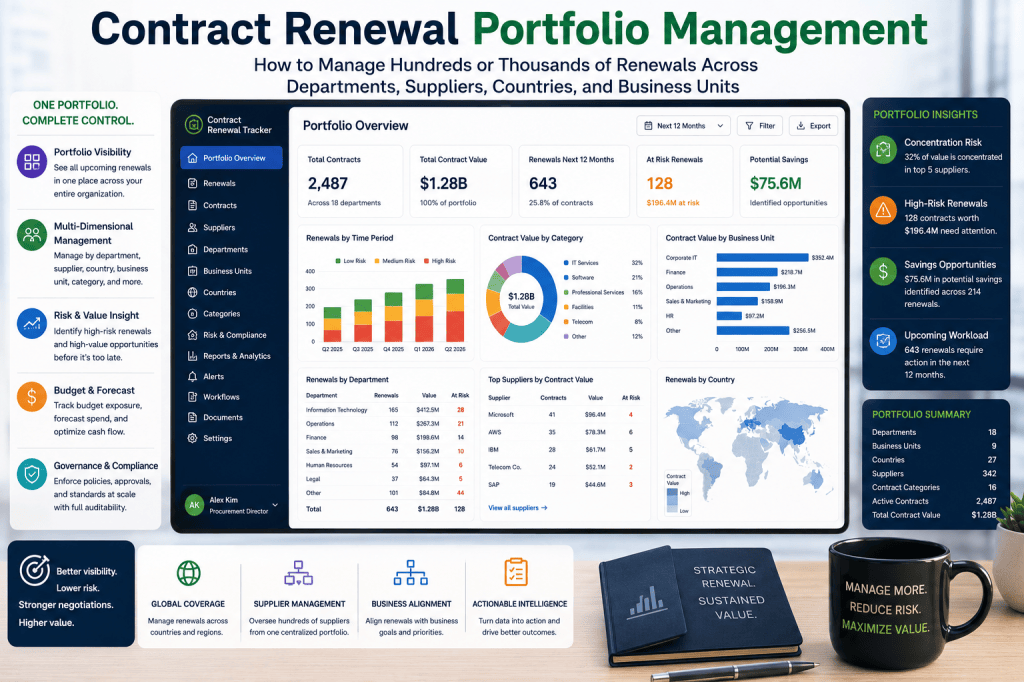
What Is Contract Renewal Portfolio Management?
Contract Renewal Portfolio Management is the coordinated management of renewal activity across the entire organization.
Instead of focusing on one contract, it looks at:
All Contracts
All Upcoming Renewals
All Suppliers
All Business Units
All Contract Owners
All Notice Deadlines
All Risks
All Renewal Decisions
↓
One Renewal Portfolio
This allows management to prioritize, allocate resources, and identify concentrated risk.
Why Portfolio Management Becomes Necessary
Suppose an organization manages:
4,800 active contracts
with:
1,650 renewal events per year
That averages more than:
30 renewals per week.
But they are unlikely to be evenly distributed.
One month may contain:
€2 million of relatively routine renewals.
Another may contain:
€40 million of high-value strategic contracts.
The number of contracts alone does not tell management where attention is needed.
Portfolio management provides context.
When Spreadsheets Stop Scaling
Spreadsheets can work surprisingly well for small portfolios.
But as contract volume grows, several problems emerge:
- multiple spreadsheet versions;
- inconsistent contract owners;
- incomplete notice periods;
- duplicate supplier names;
- conflicting status fields;
- manual sorting;
- no workflow coordination;
- weak audit history;
- limited role-based access;
- difficult portfolio analytics.
Eventually the spreadsheet becomes a database that users are trying to operate manually.
That is usually the point where dedicated renewal software becomes increasingly valuable.
Outgrowing Your Contract Renewal Spreadsheet?
Once renewals are spread across multiple departments, owners, countries, and suppliers, maintaining one reliable view becomes difficult.
Contract Renewal Tracker is designed to centralize contract renewal portfolios and give teams a shared view of deadlines, value, risk, ownership, workflow status, and upcoming workload.
Move your renewal portfolio from spreadsheets to one operational platform →
The Portfolio Hierarchy
Large organizations need several levels of organization.
A practical hierarchy could be:
Organization
↓
Legal Entity
↓
Business Unit
↓
Department
↓
Contract Category
↓
Supplier
↓
Contract
This allows users to analyze renewals from different perspectives.
Business Unit Views
A global organization may contain:
- IT;
- Finance;
- Marketing;
- HR;
- Operations;
- Sales;
- Legal;
- R&D.
Each function may manage different contracts.
For example:
IT
Active Contracts:
842
Annual Value:
€26.4M
Renewing Next 180 Days:
€8.1M
Critical Renewals:
12
Marketing
Active Contracts:
326
Annual Value:
€6.8M
Renewing Next 180 Days:
€2.2M
Critical Renewals:
4
The same platform can provide both a centralized enterprise view and departmental views.
Department-Level Ownership
Not every renewal needs centralized procurement ownership.
Some organizations prefer:
Central Governance + Distributed Ownership
For example:
Business departments own the commercial requirement.
Procurement manages large negotiations.
Legal reviews contractual changes.
Finance approves commitments.
The Contract Renewal Tracker connects those responsibilities.
Centralized vs Decentralized Renewal Management
Organizations generally operate somewhere between two models.
Centralized
A dedicated procurement or contract-management team coordinates most renewals.
Advantages:
- consistency;
- expertise;
- stronger negotiation leverage;
- centralized governance.
Challenges:
- potential bottlenecks;
- large workload;
- distance from business context.
Decentralized
Business units manage their own renewals.
Advantages:
- local ownership;
- faster business decisions;
- stronger operational knowledge.
Challenges:
- inconsistent processes;
- duplicate tools;
- weak supplier leverage;
- higher risk of missed deadlines.
A SaaS platform can support a hybrid model.
Hybrid Renewal Governance
A common model could be:
Business Units
Responsible for:
- business need;
- usage;
- renewal recommendation.
Procurement
Responsible for:
- commercial review;
- negotiation;
- supplier consolidation.
Legal
Responsible for:
- contract terms;
- risk exceptions.
Finance
Responsible for:
- budget;
- financial authority.
Central Contract Operations
Responsible for:
- renewal governance;
- data quality;
- reporting;
- escalation.
The Contract Renewal Tracker can orchestrate all five.
Contract Categories
Portfolio segmentation by category is also important.
Examples include:
- SaaS;
- cloud services;
- telecommunications;
- professional services;
- facilities;
- equipment;
- insurance;
- marketing;
- consulting;
- outsourcing;
- leases.
Different categories may require different workflows and lead times.
Category-Specific Renewal Playbooks
For example:
SaaS
Focus on:
- licenses;
- utilization;
- pricing;
- auto-renewal.
Cloud Infrastructure
Focus on:
- committed spend;
- usage forecast;
- migration difficulty;
- strategic dependency.
Professional Services
Focus on:
- project demand;
- rate cards;
- consultant utilization.
Property Lease
Focus on:
- long notice periods;
- location strategy;
- relocation lead time.
One platform can apply the appropriate renewal playbook automatically.
Supplier Portfolio View
Large organizations should also manage renewal concentration by supplier.
For example:
ExampleCloud
Active Contracts:
14
Annual Spend:
€7.8M
Renewing Next 180 Days:
9 contracts
Renewal Value:
€5.4M
Risk:
High
This may justify a coordinated supplier-level negotiation.
Supplier Concentration
A useful metric is:
Supplier Spend Concentration
Suppose:
Top 5 suppliers:
€28M
Total contract spend:
€60M
Top 5 concentration:
47%
This indicates substantial dependency.
Now combine this with renewal timing.
If three of those suppliers renew during the same quarter, executive attention may be required.
Contract Renewal Waves
Large portfolios often experience renewal waves.
For example:
Q1:
210 renewals.
Q2:
460 renewals.
Q3:
280 renewals.
Q4:
700 renewals.
This workload distribution matters.
Procurement and legal teams need to prepare for Q4 long before the contracts arrive.
Renewal Value by Quarter
Count alone is insufficient.
For example:
| Quarter | Renewals | Value |
|---|---|---|
| Q1 | 210 | €8.2M |
| Q2 | 460 | €16.4M |
| Q3 | 280 | €11.7M |
| Q4 | 700 | €41.8M |
Q4 clearly represents the most significant commercial period.
Capacity Planning
The Contract Renewal Tracker can help estimate future workload.
Suppose historical data shows:
Low-value renewal:
1.5 hours average effort.
Standard renewal:
6 hours.
Strategic renewal:
45 hours.
Then the system can estimate next-quarter workload.
For example:
Low-value:
220 × 1.5 = 330 hours.
Standard:
80 × 6 = 480 hours.
Strategic:
12 × 45 = 540 hours.
Total estimated effort:
1,350 hours
This is useful for resource planning.
Procurement Capacity
The system might predict:
Procurement is expected to receive 46 high-value negotiations in October, 38% above normal monthly capacity.
Possible actions:
- start negotiations earlier;
- redistribute ownership;
- add temporary support;
- fast-track low-risk renewals.
This is portfolio intelligence rather than simple deadline tracking.
Legal Capacity
The same principle applies to legal.
Suppose:
42 legal reviews expected in September.
Historical capacity:
30/month.
The system can flag:
Legal workload is projected to exceed historical capacity by 40%.
Renewal workflows could automatically start legal review earlier.
Approval Capacity
Executive approvals can also cluster.
For example:
22 contracts above €1M require CFO approval during December.
This creates an approval bottleneck.
The system can surface the upcoming queue months in advance.
Renewal Calendar at Portfolio Scale
A calendar for thousands of contracts can become overwhelming.
The system therefore needs multiple levels.
Annual View
Shows renewal concentration by month.
Quarterly View
Shows category and value.
Monthly View
Shows active contract groups.
Daily View
Shows specific deadlines.
Users move from portfolio to individual contract.
Renewal Heatmap
A heatmap can show where activity is concentrated.
For example:
| Jan | Feb | Mar | Apr | May | Jun | |
|---|---|---|---|---|---|---|
| IT | Med | High | High | Low | High | Critical |
| Marketing | Low | Low | Med | High | Med | Low |
| HR | Low | Med | Low | Low | Med | High |
| Operations | High | Med | High | Med | High | High |
This helps management identify upcoming workload.
Renewal Risk Concentration
Risk should also be aggregated.
For example:
Portfolio Risk
Critical:
32 contracts
Very High:
61
High:
144
Medium:
422
Low:
780
But value is even more important.
Critical value:
€11.2M.
High + Critical:
€29.4M.
This allows executives to understand material exposure.
Risk by Business Unit
For example:
IT
High/Critical value:
€14.2M.
Operations
€7.8M.
Marketing
€2.4M.
HR
€1.1M.
The central contract-management team can prioritize support accordingly.
Risk by Supplier
A supplier portfolio may show:
ExampleCloud
Risk Exposure:
€5.2M.
Global Telecom
€3.8M.
DataWorks
€2.1M.
This combines supplier dependency with renewal timing.
Risk by Geography
Global organizations may also need country or regional views.
For example:
Europe:
€18M renewing next 12 months.
North America:
€22M.
APAC:
€9M.
LATAM:
€4M.
Geography can affect:
- legal rules;
- currencies;
- notice calculations;
- approval authority;
- local ownership.
Multi-Currency Portfolios
Global portfolios may contain:
EUR
USD
GBP
JPY
CHF
and others.
The system should preserve:
Contract Currency
while optionally reporting in:
Portfolio Base Currency
For example:
Original:
$850,000.
Portfolio equivalent:
€730,000.
Exchange-rate policies should be consistent and transparent.
Legal Entity Views
Contracts may belong to different corporate entities.
For example:
Parent Company.
Dutch Subsidiary.
German Subsidiary.
UK Subsidiary.
US Subsidiary.
The system should allow:
Entity-Level Portfolio View
and:
Consolidated Group View
This supports governance and reporting.
Local vs Global Suppliers
A supplier may appear under several regional legal entities.
For example:
ExampleCloud BV.
ExampleCloud Inc.
ExampleCloud UK Ltd.
The Contract Renewal Tracker can preserve legal distinctions while also showing consolidated supplier exposure.
Contract Owner Portfolio
Managers may need to see how many renewals each owner manages.
For example:
| Owner | Active Renewals | High Risk |
|---|---|---|
| Sarah | 26 | 4 |
| James | 18 | 1 |
| Helen | 39 | 8 |
| Peter | 14 | 2 |
Helen may be overloaded.
The system can support workload balancing.
Workload Balancing
If one owner has:
45 active renewals
and another has:
8,
management can reassign contracts.
But raw contract count may still mislead.
Ten strategic renewals may require more work than 100 low-value subscriptions.
Therefore, the platform should estimate weighted workload.
Weighted Renewal Workload
Example:
Low Complexity:
1 point.
Standard:
3 points.
High:
8 points.
Strategic:
20 points.
User A:
10 low + 5 strategic
=
110 points.
User B:
40 standard
=
120 points.
Their workloads are actually similar despite different contract counts.
Portfolio Segmentation
Large organizations need saved segments.
Examples:
Strategic Renewals
Critical Auto-Renewals
Contracts Above €500K
Software Renewals
Europe Renewals
Unassigned Contracts
Termination Decisions
Negotiations in Progress
Executive Approvals Required
These segments become operational queues.
Dynamic Portfolios
Users should also be able to create dynamic filters.
For example:
Show all SaaS contracts above €100K with renewal deadlines within 120 days and utilization below 70%.
As data changes, the list updates automatically.
This can become a procurement optimization portfolio.
Shared-Service Contract Management
Some organizations operate a central contract-management or procurement shared service.
Business units submit renewals to the central team.
The Contract Renewal Tracker can manage:
Renewal Intake
↓
Prioritization
↓
Assignment
↓
Execution
↓
Completion
This makes workload visible across the shared service.
Renewal Intake Queue
A central team might see:
New renewals:
Unassigned:
Critical:
Awaiting business information:
Ready for procurement:
This becomes an operational queue.
Service-Level Agreements
A shared-service model can define internal SLAs.
For example:
Initial review:
2 days.
Owner assignment:
1 day.
Commercial review:
5 days.
Negotiation preparation:
10 days.
Legal review:
7 days.
The platform can measure performance.
Portfolio-Level Exceptions
Management should focus on exceptions rather than every contract.
Examples include:
- no owner;
- missing notice period;
- high risk;
- missed workflow milestone;
- high price increase;
- late approval;
- potential unwanted auto-renewal;
- critical supplier.
Exception-based management makes large portfolios manageable.
Portfolio Exception Dashboard
For example:
Immediate Attention
Critical Renewals:
18
Unassigned Contracts:
23
Deadlines <14 Days:
31
Late Approvals:
12
Missing Notice Terms:
41
Supplier Increases >10%:
27
This is much more useful than viewing thousands of contracts equally.
Portfolio Alerts
The system can create higher-level alerts.
For example:
Renewal Wave Alert
€18.4M of contract value reaches notice deadlines during September, 62% above the monthly average.
Or:
Supplier Concentration Alert
Four strategic contracts with ExampleCloud renew within the next 90 days.
These are management alerts rather than individual contract reminders.
AI Portfolio Prioritization
The AI Contract Renewal Assistant becomes particularly useful at scale.
A manager could ask:
What should our renewal team focus on this month?
The assistant might identify:
- Critical notice deadlines.
- High-value unresolved negotiations.
- Contracts with major optimization potential.
- Overloaded contract owners.
- Upcoming approval bottlenecks.
This reduces the effort required to analyze large portfolios manually.
Ask Portfolio Questions in Natural Language
Examples include:
Which department has the highest renewal exposure next quarter?
What suppliers have more than €1M renewing in the next six months?
Which teams have too many high-risk renewals?
Where is our largest auto-renewal exposure?
How much procurement workload do we expect in October?
Which contracts should start negotiation earlier?
This turns portfolio analytics into conversational decision support.
AI Portfolio Brief
A weekly briefing might say:
Enterprise Renewal Portfolio
Upcoming 90-Day Value: €24.7M
Critical Exposure: €5.8M
Contracts Without Owner: 17
High-Value Negotiations Behind Schedule: 8
Largest Renewal Wave: October
Primary Supplier Concentration: ExampleCloud — €4.6M
Recommended Actions
- Reassign seven high-risk renewals from overloaded owners.
- Begin October strategic renewals four weeks earlier.
- Consolidate three ExampleCloud negotiations.
- Escalate five unresolved contracts with deadlines under 14 days.
This is portfolio intelligence.
Renewal Portfolio KPIs
Useful KPIs include:
Active Contracts
Annual Contract Value
Upcoming Renewal Value
Notice Deadline Exposure
High/Critical Risk Value
Unassigned Contracts
Renewals by Business Unit
Renewals by Supplier
Renewals by Country
Average Renewal Cycle Time
On-Time Completion Rate
Negotiation Workload
Savings
These metrics help management understand portfolio health.
Portfolio Data Quality
Large-scale analytics are only useful when data is reliable.
Useful metrics include:
Owner Coverage
98%.
Verified Notice Periods
91%.
Contract Value Coverage
96%.
Supplier Normalization
94%.
Renewal Status Coverage
99%.
Data-quality gaps should become actionable work queues.
Missing Ownership
Suppose:
4,800 active contracts.
193 have no owner.
That may not sound catastrophic.
But perhaps:
27 of those renew within 90 days.
6 are worth more than €500K.
The portfolio view makes the real risk visible.
Duplicate Contracts
Large organizations may accidentally load the same agreement more than once.
Duplicate detection can compare:
- supplier;
- contract number;
- dates;
- document similarity;
- contract value.
AI can flag likely duplicates for review.
Duplicate Suppliers
Supplier normalization is equally important.
For example:
IBM.
IBM Corp.
IBM Netherlands.
International Business Machines.
The platform can preserve legal entities while creating a consolidated supplier group.
Portfolio Search
Users should be able to search across thousands of contracts.
For example:
“Adobe”
or:
“contracts with 90-day notice”
or:
“all agreements with annual price increases”
Combined search and filters make portfolio navigation practical.
Role-Based Portfolio Access
Not every user should see the full enterprise portfolio.
For example:
Business owner:
Only owned contracts.
Department manager:
Department portfolio.
Procurement:
Commercial contracts across the organization.
Legal:
Relevant legal portfolio.
Executive:
Aggregated enterprise metrics.
The system should enforce appropriate access automatically.
Geographic Data Residency
Enterprise prospects may also care where contract data is stored and processed.
Portfolio-scale deployment may require:
- regional hosting;
- tenant isolation;
- data residency controls;
- enterprise authentication;
- auditability.
These considerations become increasingly important as the SaaS moves upmarket.
Portfolio Workflow Automation
The workflow engine should operate at scale.
For example:
At midnight:
1,400 contracts are evaluated.
34 enter renewal windows.
12 strategic workflows are created.
18 standard renewals are created.
4 contracts trigger immediate escalation.
The organization does not need to initiate each workflow manually.
Batch Operations
Contract administrators may need to perform operations across groups.
Examples:
- assign owner to 40 contracts;
- apply renewal playbook;
- change category;
- add portfolio tag;
- export renewal schedule.
Batch functionality becomes increasingly important at scale.
Portfolio Tags
Organizations may create custom tags.
Examples:
M&A Contracts
Cost Reduction Program
Strategic 2027 Renewals
AI Vendors
Cybersecurity Review
These enable custom portfolio programs.
Renewal Programs
A portfolio can support strategic initiatives.
For example:
SaaS Cost Reduction Program
Contracts:
Annual spend:
€12.8M.
Target savings:
€1.5M.
Renewals within 12 months:
The Contract Renewal Tracker becomes a program-management tool for contract optimization.
M&A Portfolio Integration
When an organization acquires another company, it may inherit hundreds of contracts.
The tracker can help identify:
- duplicate vendors;
- overlapping software;
- different pricing;
- renewal deadlines;
- consolidation opportunities.
This can accelerate post-merger optimization.
Example M&A Analysis
Acquirer:
3 project-management platforms.
Acquired company:
2 additional platforms.
Combined annual spend:
€720K.
Four contracts renew within nine months.
This creates a consolidation opportunity.
Portfolio Scenario Planning
Management may want to model future outcomes.
For example:
Scenario A
Renew everything.
Future annual spend:
€62M.
Scenario B
Terminate low-utilization SaaS.
€59M.
Scenario C
Consolidate strategic suppliers.
€57.8M.
Scenario D
Full optimization program.
€55.6M.
Portfolio-level planning supports budgeting and procurement strategy.
Forecasting
The Contract Renewal Tracker can forecast:
- renewal value;
- expected spend;
- approval workload;
- procurement workload;
- legal workload;
- savings pipeline.
This turns contract renewal management into forward planning.
Renewal Value Forecast
For example:
Next Quarter:
€16M.
Next 6 Months:
€29M.
Next 12 Months:
€52M.
Potential identified savings:
€4.1M.
This gives finance and procurement a much stronger planning view.
Manage the Portfolio, Not Just the Contracts
Once an organization has hundreds or thousands of agreements, the problem is no longer remembering individual dates.
It becomes coordinating renewal volume, people, suppliers, risk, value, and workload across the enterprise.
Contract Renewal Tracker is designed to give procurement, contract operations, finance, legal, and business teams one portfolio-level view while preserving the detail behind every renewal.
See every renewal portfolio from one place →
Portfolio Dashboard
A strong enterprise dashboard might show:
Contracts
4,842
Annual Value
€61.7M
Renewing Next 180 Days
1,104
Renewal Value
€24.8M
High/Critical Risk
€7.9M
Auto-Renewal Exposure
€11.3M
Unassigned Renewals
23
Negotiations Active
86
Approval Backlog
31
Savings YTD
€3.6M
This provides an immediate operational overview.
Drill from Enterprise to Contract
The navigation should follow:
Enterprise
↓
Business Unit
↓
Supplier
↓
Renewal Portfolio
↓
Individual Contract
The executive can start with portfolio risk and progressively drill down until the specific contract or task causing the issue is visible.
Executive Portfolio View
Executives typically care about:
- financial exposure;
- strategic suppliers;
- critical deadlines;
- major savings opportunities;
- high-value decisions.
They do not need to see every renewal task.
For example:
Executive Renewal Outlook
Next 90-day commitment:
€18.2M.
Executive decisions required:
€7.4M.
Critical supplier renewals:
Potential savings:
€2.1M.
This keeps the executive experience focused.
Procurement Portfolio View
Procurement may focus on:
- negotiations;
- supplier concentration;
- price increases;
- savings opportunities;
- upcoming renewals.
For example:
Procurement Queue
Active negotiations:
Supplier proposals >10% increase:
High savings opportunity:
Consolidation opportunities:
This becomes a commercial workbench.
Legal Portfolio View
Legal may focus on:
- notice terms;
- contract deviations;
- terminations;
- approval workload;
- data processing.
The system provides the same underlying contracts but a different operational view.
Finance Portfolio View
Finance may focus on:
- future commitments;
- budget impact;
- approval queue;
- price increases;
- expected savings.
For example:
€12.8M of multi-year commitments require finance approval during the next quarter.
That is a meaningful planning metric.
Scaling Through Automation
Portfolio management becomes possible only when routine work is automated.
Without automation, adding more contracts usually means adding more administrators.
With workflow automation:
- workflows start automatically;
- owners are assigned automatically;
- reminders are scheduled automatically;
- approvals are routed automatically;
- escalations are triggered automatically;
- analytics update automatically.
Humans focus on decisions and exceptions.
Exception-Based Operations
This is the operating model that enables scale.
Instead of manually reviewing 4,800 contracts every week, teams focus on:
23 unassigned
18 critical
31 overdue
12 high-value undecided
9 major consolidation opportunities
The platform handles the rest.
Portfolio Operating Rhythm
Organizations can establish recurring review cycles.
Daily
Critical exceptions.
Weekly
Renewal operations review.
Monthly
Supplier and workload review.
Quarterly
Portfolio and optimization review.
Annual
Strategic renewal planning.
The Contract Renewal Tracker provides consistent data for each cadence.
Weekly Renewal Operations Review
A weekly meeting might examine:
- Critical renewals.
- Deadlines within 30 days.
- Negotiation bottlenecks.
- Approval backlog.
- Owner workload.
- New risks.
- Savings opportunities.
The software becomes the source of truth for the meeting.
Portfolio Governance
At enterprise scale, governance may define:
- required ownership;
- approved playbooks;
- escalation thresholds;
- approval policies;
- data-quality standards;
- notification policies;
- portfolio KPIs.
The system ensures those policies are applied consistently.
AI-Assisted Portfolio Management
AI can help turn large volumes of renewal data into concise management insight.
For example:
Portfolio risk increased 12% this week because seven strategic renewals entered the 30-day notice window and three finance approvals became overdue.
Or:
Procurement capacity is likely to become constrained in October because 41 high-value negotiations are scheduled concurrently.
These insights help teams act before bottlenecks occur.
What Makes a Portfolio-Scale Renewal Platform Valuable?
At scale, the SaaS value proposition expands well beyond reminders.
The platform can help organizations:
- centralize renewal data;
- organize by business unit;
- manage supplier concentration;
- forecast workload;
- prioritize high-risk renewals;
- balance ownership;
- coordinate shared services;
- identify renewal waves;
- monitor enterprise exposure;
- optimize contract spend.
That makes Contract Renewal Tracker relevant not only to individual contract owners but also to:
- procurement leaders;
- CFO organizations;
- legal operations;
- vendor management;
- IT leadership;
- shared-service teams.
Ready to Manage Contract Renewals at Enterprise Scale?
Once contract volume grows, spreadsheets and individual calendar reminders stop providing enough control.
Contract Renewal Tracker is designed to give organizations one operational view across contracts, suppliers, departments, countries, owners, risks, negotiations, approvals, and renewal workloads.
Use Contract Renewal Tracker to:
- manage thousands of renewal dates;
- segment portfolios by department, supplier, country, or category;
- identify renewal waves;
- forecast procurement and legal workload;
- monitor strategic supplier concentration;
- prioritize high-risk renewals;
- balance contract ownership;
- manage centralized or decentralized renewal models;
- track enterprise KPIs;
- use AI to identify the portfolio issues that require attention first.
The goal is not merely to know when contracts renew.
It is to manage renewal operations as a portfolio.
Start Your Contract Renewal Tracker Subscription →
Final Thoughts
As contract volume increases, renewal management changes fundamentally.
The progression looks like:
Individual Contracts
↓
Renewal Calendar
↓
Workflow Management
↓
Supplier Management
↓
Portfolio Management
At portfolio scale, the critical questions become:
Where is the exposure?
Where is the workload?
Where is the risk?
Where are the opportunities?
Who needs help?
What should start earlier?
A Contract Renewal Tracker capable of answering those questions becomes much more than a contract reminder application.
It becomes an operational platform connecting:
Contracts + People + Suppliers + Deadlines + Workflows + Risk + Financial Value
across the enterprise.
That is the foundation required for managing hundreds or thousands of renewals without allowing complexity to become chaos.
Next Article in the Contract Renewal Tracker Series
Article 22 — “Contract Renewal Data Quality: How to Detect Missing Dates, Wrong Owners, Duplicate Contracts, and Unverified Renewal Terms”
The next article will focus on the often-overlooked foundation behind every automated renewal process: data quality. It will cover missing contract dates, incorrect notice periods, duplicate supplier records, orphaned contracts, conflicting amendments, incomplete financial data, AI extraction confidence, verification queues, data-quality scoring, automated anomaly detection, ownership reconciliation, bulk remediation, and governance policies.
It will also continue positioning Contract Renewal Tracker as the SaaS system that makes renewal data reliable enough for automation, risk scoring, alerts, workflows, and executive reporting.

