Contract renewal failures often happen for a surprisingly simple reason:
The organization knows when the contract ends, but does not know when it must act.
That distinction matters because many contracts require advance notice before termination, non-renewal, renegotiation, or cancellation.
A contract might expire on December 31, but if the agreement requires 120 days’ written notice, the practical deadline arrives months earlier.
Missing that deadline can result in:
- automatic renewal;
- loss of termination rights;
- additional financial commitment;
- reduced negotiation leverage;
- operational disruption;
- emergency legal review;
- rushed procurement decisions.
For this reason, a Contract Renewal Tracker should treat notice periods as first-class contract data.
The system should not merely store a contract end date.
It should calculate the real last day to act.
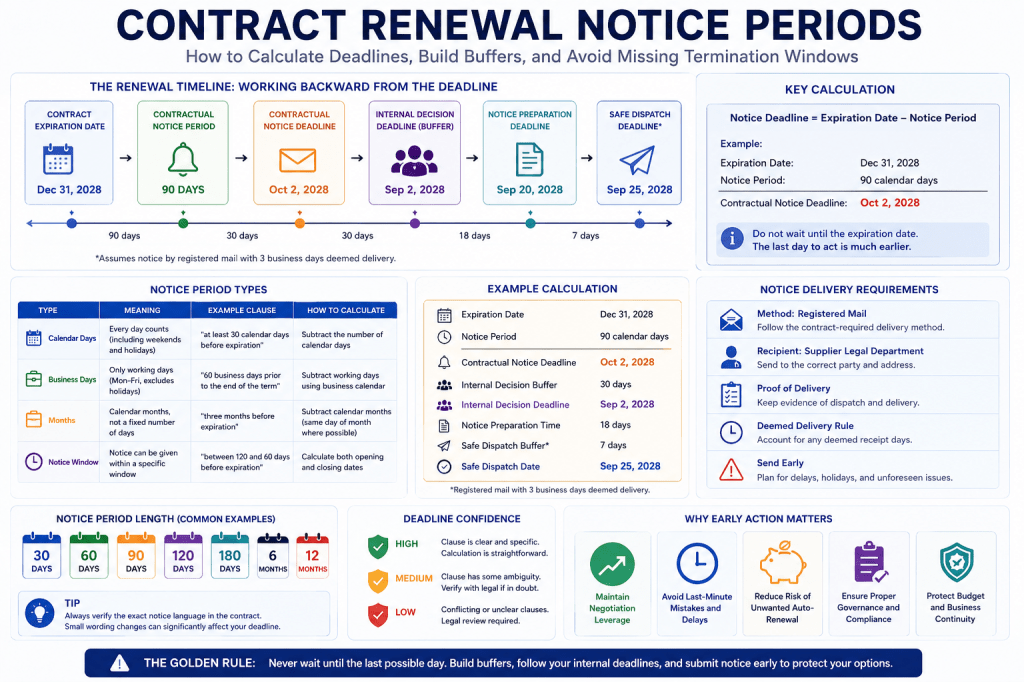
What Is a Contract Notice Period?
A contract notice period defines how far in advance one party must communicate a contractual decision to the other party.
That decision might involve:
- termination;
- non-renewal;
- cancellation;
- renegotiation;
- price objection;
- service reduction;
- renewal refusal.
A typical provision might state:
Either party may elect not to renew the agreement by providing written notice at least 90 days before the expiration of the then-current term.
The operational meaning is straightforward.
If the agreement expires December 31, the organization cannot wait until December to decide.
The relevant deadline occurs approximately 90 days earlier.
Why Notice Periods Matter More Than Expiration Dates
Consider a contract with these terms:
Expiration Date: December 31, 2028
Auto-Renewal: Yes
Renewal Term: 12 months
Notice Requirement: 120 days
At first glance, someone may think:
We have until December to decide.
In reality, the decision must be completed much earlier.
The notice deadline occurs approximately at the beginning of September.
If the company begins its renewal review in October, the contractual termination window may already be closed.
That is why a Contract Renewal Tracker should prominently display:
Days Until Notice Deadline
rather than only:
Days Until Contract Expiration
Common Notice Periods
Notice periods vary considerably.
Common examples include:
- 7 days;
- 14 days;
- 30 days;
- 45 days;
- 60 days;
- 90 days;
- 120 days;
- 180 days;
- six months;
- twelve months.
Some contracts define notice periods using calendar days.
Others use:
- business days;
- working days;
- months;
- quarters;
- anniversary dates.
The calculation logic therefore needs to be flexible.
A Simple Notice Deadline Calculation
At its simplest:
Notice Deadline = Contract End Date − Notice Period
For example:
Contract end date:
December 31, 2028
Notice period:
90 days
Notice deadline:
approximately October 2, 2028
But real contracts often make this more complicated.
The system may need to interpret wording such as:
not less than three months before expiration
or:
at least 90 calendar days prior to the renewal date
or:
no later than 60 business days before the end of the current term.
Those expressions do not always produce identical results.
Calendar Days vs Business Days
One of the most important distinctions is whether a contract uses calendar days or business days.
Calendar Days
Every day counts.
That includes:
- weekends;
- public holidays;
- non-working days.
A 30-calendar-day notice period is usually straightforward.
Business Days
Only working days count.
Depending on jurisdiction and contract language, weekends and public holidays may be excluded.
That means:
30 business days
can extend considerably longer than:
30 calendar days.
A Contract Renewal Tracker should therefore store the notice unit explicitly.
For example:
Notice Amount: 60
Notice Unit: Business Days
That is much safer than simply storing:
Notice Period: 60
Months Are Not Always Equivalent to Days
Another common problem is converting contractual months into fixed day counts.
For example:
3 months
is not necessarily identical to:
90 days.
Depending on the dates involved, three calendar months can contain:
- 89 days;
- 90 days;
- 91 days;
- 92 days.
A contract saying:
three months before expiration
should normally be modeled as a calendar-month calculation rather than automatically converted to 90 days.
This becomes particularly important around:
- February;
- leap years;
- month-end dates.
Month-End Edge Cases
Suppose a contract expires:
May 31
and requires:
3 months’ notice.
What is the deadline?
A naive system might subtract 90 days.
A more contract-aware system may interpret the requirement as:
February 28 or February 29, depending on the year.
Now consider:
Contract end:
August 31
Notice period:
6 months
The calculated date might be:
February 28 or 29.
These edge cases show why notice-period calculations should use date-aware logic rather than simple arithmetic.
“At Least” and “No Later Than” Matter
Contract wording can subtly change the meaning of a deadline.
For example:
at least 90 days before expiration
means notice must be delivered no later than the 90-day threshold.
Similarly:
not less than 90 days before expiration
creates a minimum advance period.
By contrast:
within 90 days prior to expiration
could potentially describe a window rather than a minimum.
A Contract Renewal Tracker should preserve the original clause text alongside the structured interpretation.
That allows users to verify how the system reached its calculation.
Notice Window vs Notice Deadline
Some contracts specify a notice window rather than a single deadline.
For example:
Customer may terminate by providing written notice no earlier than 120 days and no later than 60 days before the expiration date.
Now there are two relevant dates:
Notice Window Opens: 120 days before expiration
Notice Window Closes: 60 days before expiration
The tracker should represent both.
The user should not receive a misleading message such as:
Termination deadline in 120 days.
Instead, the system should show:
Notice Window Opens: September 2
Notice Window Closes: November 1
This gives a much clearer operational picture.
Internal Deadlines Should Be Earlier Than Contractual Deadlines
Organizations should rarely treat the contractual deadline as their operational deadline.
If notice must be submitted by October 1, waiting until September 30 creates unnecessary risk.
Instead, the organization could establish an internal buffer.
For example:
Contractual notice deadline:
October 1
Internal decision deadline:
September 1
Internal approval deadline:
September 15
Notice preparation deadline:
September 20
Notice submission target:
September 23
This creates time to deal with:
- approvals;
- legal review;
- absence of key stakeholders;
- supplier communication;
- notice delivery problems;
- unforeseen delays.
Building Deadline Buffers
A Contract Renewal Tracker can automatically create internal buffers.
For example:
Low-Risk Contract
Contractual deadline minus:
7 days
Standard Contract
Contractual deadline minus:
30 days
High-Value Contract
Contractual deadline minus:
60 days
Strategic Contract
Contractual deadline minus:
90 days
The appropriate buffer can depend on:
- annual contract value;
- contract complexity;
- approval requirements;
- business criticality;
- replacement difficulty;
- procurement process;
- legal review requirements.
Example: Strategic Contract
Suppose a company has:
Contract Value: €1.5 million annually
Expiration: December 31
Notice Requirement: 180 days
Auto-Renewal Term: 24 months
The contractual notice deadline occurs around early July.
But waiting until June to begin review would be dangerous.
The organization might establish:
Renewal Review Start: January
Supplier Performance Review: February
Alternative Supplier Assessment: March
Commercial Strategy: April
Internal Decision Deadline: May
Executive Approval: June
Notice Submission Target: Mid-June
Contractual Deadline: Early July
This is an example of working backward from the legal deadline.
Notice Delivery Requirements Matter
Knowing the deadline is not enough.
The contract may also specify how notice must be delivered.
Possible requirements include:
- registered mail;
- certified mail;
- courier;
- email;
- customer portal;
- personal delivery;
- notice to registered office;
- notice to a named legal representative.
A valid deadline calculation is useless if notice is sent through the wrong channel.
A Contract Renewal Tracker should therefore capture:
Notice Method
Notice Recipient
Notice Address
Required Copies
Proof of Delivery Required
Clause Reference
Delivery Date vs Sending Date
Another important question is whether notice is considered effective when it is:
- sent;
- received;
- acknowledged;
- delivered;
- deemed received after a specified number of days.
For example, a clause might say:
Notice sent by registered post shall be deemed received three business days after dispatch.
If the termination deadline is October 1, sending the letter on September 30 may be too late.
The system may need to calculate a latest dispatch date earlier than the contractual notice deadline.
Example: Deemed Receipt Rule
Suppose:
Notice must be received by:
October 1
Delivery method:
Registered post
Deemed delivery:
3 business days after dispatch
The Contract Renewal Tracker might calculate:
Latest Safe Dispatch Date: September 25
depending on weekends and holidays.
The system could then warn:
Contractual notice deadline is October 1, but notice should be dispatched no later than September 25 to satisfy the delivery requirement.
This is much more useful than simply showing October 1.
Public Holidays Can Affect Notice Calculations
Business-day calculations become more complicated across jurisdictions.
A contract governed by Dutch law may have different working-day assumptions than an agreement involving another country.
If notice must be sent to a foreign legal entity, local public holidays may also matter.
A sophisticated tracker may therefore need:
- contract jurisdiction;
- delivery jurisdiction;
- business calendar;
- public holiday calendar.
For critical contracts, the system should also flag uncertainty rather than pretending that every calculation is definitive.
Deadline Confidence
Because contract wording can be ambiguous, an intelligent Contract Renewal Tracker should assign confidence to calculated deadlines.
For example:
Deadline Confidence: High
Clause clearly states:
90 calendar days before expiration.
Deadline Confidence: Medium
Clause states:
three months prior to renewal.
Potential calendar interpretation requires verification.
Deadline Confidence: Low
Multiple amendments contain conflicting renewal provisions.
This can trigger human review.
The system should never hide uncertainty.
AI-Assisted Notice Period Extraction
AI can help identify notice requirements from uploaded contracts.
For example, the system might extract:
Clause Type: Non-Renewal
Notice Period: 90
Unit: Calendar Days
Reference Date: Current Term End
Method: Written Notice
Recipient: Supplier Legal Department
Auto-Renewal: Yes
Renewal Term: 12 Months
Confidence: 97%
The Contract Renewal Tracker can then generate the renewal timeline automatically.
Human verification should remain available for legally significant deadlines.
Clause Citations Improve Trust
When AI extracts a notice period, users should be able to see where the information came from.
For example:
Notice Period: 120 days
Source: Section 8.2 — Term and Termination
Document: Master Services Agreement
Page: 17
The user can open the original clause immediately.
This is especially important when several documents modify the same contract.
Amendments Can Change Notice Periods
Suppose the original agreement states:
Notice Period: 60 days
Then Amendment 2 says:
Section 10.3 is amended by replacing “60 days” with “120 days.”
The current notice requirement is now:
120 days
A Contract Renewal Tracker should understand that the amendment supersedes the original term.
This requires a document hierarchy such as:
Master Agreement
↓
Amendment 1
↓
Amendment 2
↓
Current Effective Terms
Without amendment awareness, the system may calculate a dangerous deadline.
Contract Extensions Can Change the Reference Date
A contract may originally expire December 31, 2027.
Later, the parties sign an extension moving expiration to:
June 30, 2028
The notice deadline must then be recalculated.
A strong Contract Renewal Tracker should automatically update dependent dates when the effective contract end date changes.
This includes:
- notice deadline;
- internal decision deadline;
- reminder schedule;
- escalation timeline;
- renewal review start date.
Renewal Terms Can Be Conditional
Some contracts contain different notice periods depending on circumstances.
For example:
Termination for convenience: 90 days
Termination for breach: 30 days after cure period
Non-renewal: 120 days
Service reduction: 60 days
The tracker should not collapse these into one field called:
Notice Period
Instead, each notice type should be modeled separately.
Multiple Notice Requirements
A single contract might therefore contain:
| Notice Type | Period |
|---|---|
| Non-Renewal | 120 days |
| Convenience Termination | 90 days |
| Price Objection | 30 days |
| Service Reduction | 60 days |
| Breach Termination | 30 days after cure |
This structure is much more accurate.
The renewal workflow primarily uses the non-renewal notice period, but other deadlines may also be operationally important.
Contractual Deadline vs Business Decision Deadline
It is useful to distinguish two separate concepts.
Contractual Deadline
The final date allowed by the contract.
Business Decision Deadline
The earlier date by which the organization wants the decision completed.
For example:
Contractual Deadline: October 1
Business Decision Deadline: August 15
The 47-day gap provides operational protection.
It also gives procurement greater negotiation leverage.
Why Early Deadlines Improve Negotiation
Suppliers often understand that customers lose leverage after the cancellation deadline passes.
Before the deadline, the customer can credibly say:
We may terminate or move to another provider.
After the deadline, the supplier may know the contract has already renewed.
That can weaken commercial leverage.
A Contract Renewal Tracker should therefore help the organization negotiate before optionality disappears.
Notice Periods and Replacement Lead Time
The contractual notice period is not always the earliest deadline that matters.
Suppose a supplier requires 90 days’ termination notice.
But replacing the service takes six months.
The business should begin evaluating alternatives much earlier.
For example:
Replacement Lead Time: 180 days
Contractual Notice: 90 days
The system should trigger review at least:
180 days before the notice deadline, or potentially earlier.
This is especially important for:
- ERP systems;
- cloud infrastructure;
- telecom services;
- payroll providers;
- cybersecurity platforms;
- outsourced operations.
Renewal Deadline Risk Score
A Contract Renewal Tracker can combine several factors into a deadline-risk score.
For example:
Deadline Risk Score = Urgency + Contract Value + Auto-Renewal Exposure + Notice Complexity + Replacement Difficulty + Decision Status
A contract could become high risk because:
- only 20 days remain;
- annual value exceeds €500,000;
- renewal term is 36 months;
- notice requires registered mail;
- no decision has been recorded.
The risk score gives management a prioritized work queue.
Example Deadline Risk Analysis
Contract
Enterprise Support Agreement
Annual Value
€480,000
Notice Deadline
24 days
Auto-Renewal
Yes
Renewal Term
24 months
Notice Method
Registered mail
Decision
Pending
Risk
Critical
Reason
Missing the deadline could result in approximately €960,000 of additional contractual commitment.
This explanation makes the urgency immediately understandable.
Deadline Escalation Rules
Notice deadlines should drive escalation.
A practical model might be:
180 Days Before Deadline
Start renewal review.
120 Days
Assign renewal owner.
90 Days
Confirm renewal strategy.
60 Days
Require initial decision.
45 Days
Notify procurement and legal.
30 Days
Escalate unresolved decision.
14 Days
High-risk alert.
7 Days
Management escalation.
3 Days
Critical escalation.
1 Day
Immediate action required.
The exact schedule should vary by contract type and value.
Overdue Notice Deadlines
What happens if the deadline passes?
The Contract Renewal Tracker should not simply remove the contract from the queue.
Instead, it should create an exception.
For example:
Potential Missed Notice Deadline
Contract: Cloud Services Agreement
Deadline: September 1
Current Date: September 3
Auto-Renewal: Yes
Renewal Term: 12 months
Decision: Not Recorded
Recommended Action:
- confirm whether notice was submitted;
- verify supplier acknowledgment;
- involve legal if required;
- determine whether renewal has become effective;
- record outcome.
The system should treat this as an incident requiring resolution.
Proof of Notice
For high-value contracts, the organization should preserve evidence that notice was delivered.
Possible evidence includes:
- signed letter;
- courier receipt;
- registered mail confirmation;
- email delivery confirmation;
- portal submission receipt;
- supplier acknowledgment.
The renewal tracker can attach this evidence to the contract record.
This creates an audit trail.
Notice Workflow Statuses
A useful workflow might include:
- Notice Not Required
- Notice Requirement Unverified
- Deadline Calculated
- Decision Pending
- Notice Drafting
- Legal Review
- Approval Pending
- Notice Approved
- Notice Sent
- Delivery Pending
- Delivered
- Acknowledged
- Deadline Missed
- Disputed
These statuses provide much greater control than a simple checkbox.
Contract Owner Accountability
Every notice deadline should have a responsible owner.
The system should clearly identify:
Contract Owner
Renewal Owner
Procurement Owner
Legal Reviewer
They may not always be the same person.
If the contract owner leaves the company, ownership should be reassigned automatically or escalated.
An important rule might be:
No active contract with a renewal deadline may remain without an assigned owner.
Notice Period Dashboard
A dedicated dashboard can provide portfolio-wide visibility.
For example:
Notice Deadlines
Within 30 days:
26 contracts
Within 60 days:
54 contracts
Within 90 days:
91 contracts
Within 180 days:
207 contracts
Financial Exposure
Value reaching notice deadline within 30 days:
€3.2M
Within 90 days:
€8.7M
Risk
Critical:
7
High:
22
Medium:
64
Unverified notice clauses:
19
This gives management a much clearer view than an expiration calendar alone.
Filters for Notice Management
Useful filters include:
- notice deadline;
- notice period length;
- notice unit;
- notice method;
- auto-renewal status;
- annual contract value;
- renewal term;
- contract owner;
- supplier;
- business unit;
- risk level;
- verification status.
Procurement could ask:
Show all auto-renewing contracts worth more than €100,000 with notice deadlines in the next 90 days.
Legal could ask:
Show contracts where notice clauses have low extraction confidence.
Finance could ask:
Show contracts where more than €1 million of commitment becomes unavoidable within the next 30 days.
This is where structured notice data becomes highly valuable.
The Importance of Conservative Calculation
For legally significant deadlines, a system should generally avoid optimistic assumptions.
If wording is ambiguous, it is usually safer operationally to surface the earliest plausible deadline and request verification.
For example:
Possible Deadline: September 28–October 2
The system could display:
Conservative internal deadline: September 28. Legal verification recommended.
That is better than silently choosing the later date.
Notice Period Policies
Organizations can configure standard rules around notice periods.
For example:
Policy: Long Notice Period
Condition:
Notice period >= 120 days
Actions:
- begin review 180 days before notice deadline;
- require procurement owner;
- increase renewal risk score.
Policy: Complex Notice Delivery
Condition:
Notice method = Registered Mail OR Courier
Actions:
- calculate dispatch buffer;
- require proof of delivery;
- notify legal.
Policy: High-Value Auto-Renewal
Condition:
Annual value > €250,000
AND
Auto-renewal = Yes
Actions:
- create 90-day internal decision buffer;
- require management approval;
- escalate unresolved decisions.
Policy: Unverified Notice Clause
Condition:
Notice confidence < threshold
Actions:
- assign legal review;
- prevent deadline from being treated as verified.
These policies turn deadline management into a controlled process.
From Notice Tracking to Renewal Intelligence
Once notice periods are structured, the system can answer much more useful questions.
For example:
Which contracts lose termination flexibility next month?
How much contract value becomes effectively committed within the next 60 days?
Which contracts require the longest notice periods?
Which suppliers use unusually restrictive cancellation windows?
Which contracts have notice requirements we have not verified?
Which business units regularly wait until the final notice window?
These insights can improve both procurement behavior and future contract negotiations.
Negotiating Better Notice Terms
Historical renewal data may reveal that certain notice periods consistently create operational problems.
For example, the organization might determine that:
180-day non-renewal notice
is unnecessarily restrictive for a standard software subscription.
During the next negotiation, procurement could request:
60 or 90 days instead.
The Contract Renewal Tracker therefore does more than enforce existing terms.
It can identify contractual provisions that should be improved.
Notice Period Analytics
Over time, the organization can measure:
Average Notice Period
Average Internal Buffer
Percentage of Deadlines Met
Percentage of Notices Submitted Late
Average Time to Renewal Decision
Number of Missed Deadlines
Value of Avoided Auto-Renewals
Value Exposed to Missed Notice Windows
These metrics help evaluate the maturity of renewal operations.
A Better Deadline Model
A mature Contract Renewal Tracker should not think about one date.
It should maintain a complete deadline chain.
For example:
Contract End Date
↓
Contractual Notice Deadline
↓
Safe Dispatch Deadline
↓
Internal Decision Deadline
↓
Approval Deadline
↓
Renewal Review Start
Each date answers a different operational question.
Together, they create a reliable renewal timeline.
Recommended Notice Deadline Workflow
A practical end-to-end process could look like this:
1. Contract Uploaded
↓
2. Notice Clause Identified
↓
3. Notice Terms Extracted
↓
4. Clause Source Captured
↓
5. Human Verification Completed
↓
6. Contractual Deadline Calculated
↓
7. Delivery Buffer Applied
↓
8. Internal Decision Buffer Applied
↓
9. Renewal Workflow Scheduled
↓
10. Owner Assigned
↓
11. Decision Recorded
↓
12. Notice Prepared
↓
13. Notice Approved
↓
14. Notice Delivered
↓
15. Delivery Verified
↓
16. Outcome Stored
This turns deadline calculation into a controlled business process.
Final Thoughts
Contract expiration is only one date.
The date that often matters most is the date when the organization loses the ability to choose freely.
That is the notice deadline.
A strong Contract Renewal Tracker should therefore understand:
when notice is required, how the period is measured, what event the period is measured from, how notice must be delivered, when it must be received, and how much internal buffer the organization needs.
The progression becomes:
Contract Clause → Notice Period → Deadline Calculation → Internal Buffer → Reminder → Decision → Notice → Verification
When this process is automated, organizations gain more than deadline visibility.
They gain time.
And in contract renewal management, time creates:
- negotiation leverage;
- better procurement decisions;
- lower renewal risk;
- stronger governance;
- greater cost control.
The best renewal process does not warn the organization at the last possible moment.
It creates enough lead time that the contractual deadline becomes a safety boundary rather than an emergency.
Next Article in the Contract Renewal Tracker Series
Article 9 — “Contract Renewal Workflow: How to Move Every Renewal from Review to Decision, Approval, Negotiation, and Completion”
The next article will move beyond dates and reminders into the operational process itself. It will cover renewal stages, ownership, task creation, procurement and legal reviews, approval gates, supplier negotiation, termination workflows, escalation, audit trails, and how a Contract Renewal Tracker can ensure that every approaching renewal reaches a documented outcome.

