A contract renewal is often one of the best opportunities an organization has to improve its commercial position with a supplier.
Yet many companies manage renewal negotiations through a combination of:
- spreadsheets;
- email threads;
- meeting notes;
- supplier quotations;
- procurement documents;
- individual buyer knowledge.
The contract system may know the current contract value and renewal date.
It often does not know:
What did the supplier originally propose?
What was procurement’s target?
How many negotiation rounds occurred?
Which concessions were exchanged?
How much cost was avoided?
What was finally agreed?
That information matters.
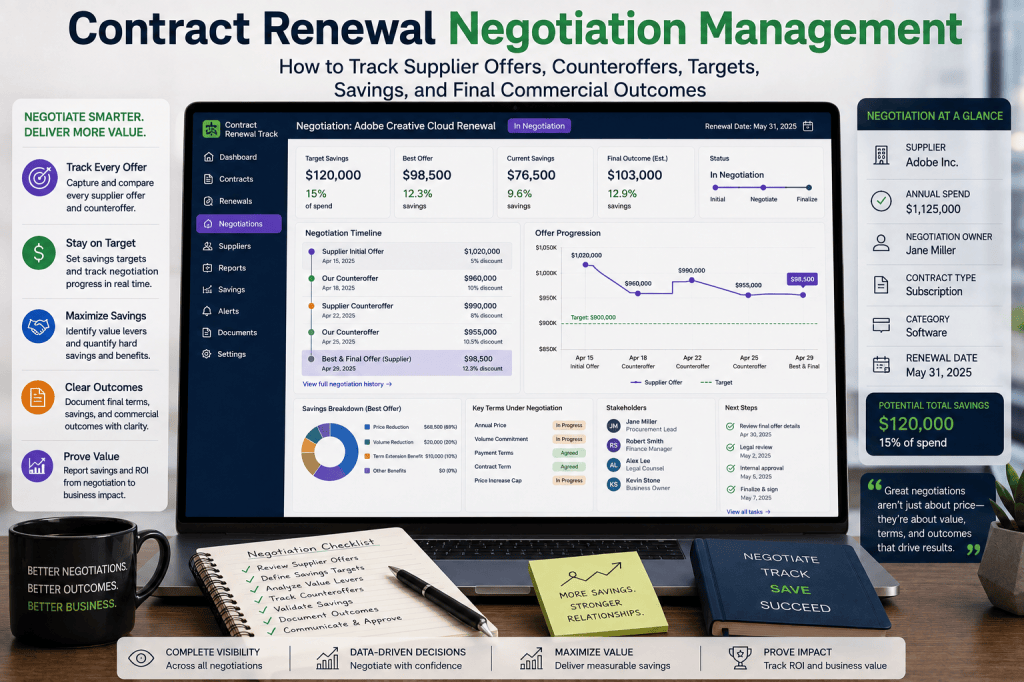
A dedicated Contract Renewal Tracker can make negotiation management part of the renewal record, creating a complete commercial history from the existing contract through the supplier’s opening proposal to the final negotiated outcome.
The objective is not to replace procurement professionals.
It is to give them a structured environment for answering:
What are we trying to achieve, what has the supplier offered, what have we conceded, and are we actually improving the commercial outcome?
Why Contract Renewal Negotiations Deserve Their Own Workflow
A renewal negotiation can involve much more than asking:
Can you give us a better price?
Commercial discussions may cover:
- unit pricing;
- license quantities;
- volume tiers;
- minimum commitments;
- payment terms;
- renewal duration;
- price caps;
- service levels;
- support packages;
- termination rights;
- implementation fees;
- professional services;
- credits;
- discounts.
These variables interact.
A supplier might offer:
8% lower pricing
in exchange for:
a three-year commitment.
That may or may not be a good deal.
Contract Renewal Tracker should help users evaluate the complete commercial package.
Still Negotiating Renewals Through Email and Spreadsheets?
When supplier proposals, counteroffers, targets, and concessions live across separate files and inboxes, it becomes difficult to know whether the final agreement actually represents a good commercial outcome.
Contract Renewal Tracker is designed to give procurement teams a structured negotiation workspace connected directly to the contract, renewal deadline, approvals, supplier history, and financial outcome.
Turn every renewal negotiation into a measurable commercial process →
Start with the Current Commercial Baseline
Before negotiating, establish what the organization has today.
For example:
Current Contract
Annual Spend:
€500,000.
Users:
1,000.
Unit Price:
€500.
Term:
12 months.
Payment:
Annual upfront.
Price Increase Cap:
5%.
This becomes the baseline against which proposals are measured.
Baseline Quality Matters
Do not compare supplier proposals against an incomplete baseline.
The tracker should capture:
- current quantity;
- unit price;
- recurring charges;
- one-time charges;
- discounts;
- credits.
Otherwise, apparent savings can be misleading.
Example
Current contract:
€500K.
Supplier renewal proposal:
€520K.
At first glance:
4% increase.
But suppose the business only needs:
800 of the current 1,000 licenses.
The real comparison is not simply:
€500K vs €520K.
The negotiation should also challenge demand.
Demand Before Price
One of the strongest procurement principles in renewal management is:
Optimize what you buy before negotiating what you pay.
If utilization is:
68%,
the first question should be:
Do we still need 1,000 licenses?
not:
Can we get a 5% discount?
Contract Renewal Tracker can connect usage review with negotiation planning.
Example Demand Optimization
Current:
1,000 licenses × €500
=
€500K.
Required:
800 licenses.
Supplier proposed new unit price:
€520.
Optimized spend before negotiation:
800 × €520
=
€416K.
The biggest saving came from quantity reduction, not discount negotiation.
Separate Demand Savings from Price Savings
This distinction matters.
Suppose:
Current:
€500K.
Reduced quantity effect:
−€100K.
Negotiated price improvement:
−€20K.
Final:
€380K.
Report:
Demand Reduction
€100K.
Price Savings
€20K.
Total Reduction
€120K.
This gives management a more accurate explanation.
Capture the Supplier’s Opening Proposal
The supplier proposal should become a structured record.
For example:
Supplier Proposal — Round 1
Annual Value:
€575K.
Increase:
15%.
Term:
36 months.
Payment:
Annual upfront.
Auto-Renewal:
12 months.
Price Escalation:
7% annually.
This creates the negotiation starting point.
Store the Original Proposal
Do not overwrite it when a new offer arrives.
The opening proposal is important because it establishes:
- initial supplier position;
- negotiation movement;
- cost avoidance.
Each subsequent offer should be another version.
Offer History
For example:
Round 1
€575K.
Round 2
€550K.
Round 3
€530K.
Final
€515K.
Now procurement can demonstrate movement.
Supplier Movement
Opening proposal:
€575K.
Final:
€515K.
Supplier Movement:
€60K
This is useful commercial intelligence.
But Supplier Movement Is Not Automatically Savings
Suppose current spend:
€500K.
Final:
€515K.
The organization is still paying:
€15K more.
Therefore:
Supplier movement:
€60K.
Cost avoidance:
potentially €60K relative to proposal.
Hard savings versus current baseline:
none.
This distinction is critical.
Define the Negotiation Target
Procurement should establish a target before negotiating.
For example:
Current:
€500K.
Supplier proposal:
€575K.
Procurement target:
€480K.
This creates a clear commercial objective.
Target Components
The target might include:
Annual Price
€480K.
Term
24 months.
Price Cap
3%.
Payment
Quarterly.
Termination
For convenience after 12 months.
Negotiation success should consider the whole package.
Target vs Minimum Acceptable Position
The target is:
What do we want?
The minimum acceptable position is:
What can we live with?
These are different.
Example
Target
€480K.
24 months.
3% price cap.
Acceptable
€510K.
24 months.
5% cap.
Unacceptable
€550K.
36 months.
7% annual escalation.
This creates negotiation guardrails.
Walk-Away Position
Some negotiations should have an explicit walk-away threshold.
For example:
Do not accept total three-year commitment above €1.6M.
If the supplier cannot meet that position:
- replacement;
- termination;
- executive exception;
may be required.
Walk-Away Positions Should Be Restricted
Sensitive negotiation strategy should not necessarily be visible to:
- every contract user;
- supplier-facing collaborators.
Contract Renewal Tracker should support permissions for commercially sensitive information.
Negotiation Strategy Record
Procurement can document:
Target
Minimum Position
Walk-Away
Leverage
Alternatives
Key Risks
This turns informal buyer knowledge into institutional knowledge.
Identify Negotiation Leverage
Possible leverage includes:
- competitive alternatives;
- unused licenses;
- supplier consolidation;
- upcoming additional purchases;
- poor supplier performance;
- multi-contract renewal alignment.
The tracker can surface these factors.
Example Leverage Brief
Supplier:
CloudWorks.
Current spend:
€2.4M.
Other contracts:
€800K.
Combined potential spend:
€3.2M.
Performance:
Below target.
Competitive alternatives:
This creates a stronger negotiation position.
Consolidated Negotiation
Suppose the same supplier has:
Contract A:
€600K.
Contract B:
€900K.
Contract C:
€400K.
All renew within four months.
Negotiating separately may reduce leverage.
Contract Renewal Tracker could flag:
Potential combined negotiation: €1.9M supplier exposure.
This is strategically valuable.
Align Renewal Dates
Procurement may negotiate contract terms so future agreements expire together.
This creates:
- better leverage;
- simpler governance;
- consolidated sourcing opportunities.
The system can track the target alignment date.
Benchmarking
Procurement should compare supplier proposals against relevant benchmarks when available.
Possible benchmarks include:
- previous price;
- internal price history;
- alternative suppliers;
- market pricing;
- inflation indices.
The benchmark becomes another negotiation input.
Internal Benchmark
Suppose:
Business Unit A pays:
€42/user.
Business Unit B pays:
€55/user.
Same supplier.
Same product.
That difference creates immediate leverage.
Contract Renewal Tracker can eventually detect these inconsistencies.
Supplier Historical Pricing
The system can retain:
2025:
€450/user.
2026:
€475.
2027:
€500.
2028 proposal:
€550.
Now procurement sees the price trajectory.
Price Increase History
For example:
2026:
+5.6%.
2027:
+5.3%.
2028 Proposal:
+10%.
This provides useful negotiation context.
Price Escalation Matters Beyond Year One
Suppose supplier offers:
Year 1:
€500K.
Year 2:
€540K.
Year 3:
€583K.
A buyer looking only at Year 1 may miss the real cost.
The tracker should calculate total commitment.
Total Contract Value
In this example:
€500K
€540K
€583K
=
€1.623M
Compare that against alternative scenarios.
Price Cap Negotiation
Instead of focusing solely on first-year price, procurement may negotiate:
Annual increase capped at 3%.
Over several years, this can create substantial value.
Example
Without cap:
€500K → €540K → €583K.
With 3% cap:
€500K → €515K → €530.45K.
Three-year difference:
approximately:
€77.6K
Commercial value extends beyond the first renewal year.
Term Length as a Negotiation Variable
Suppliers often offer discounts for longer commitments.
For example:
12 Months
€520K.
24 Months
€500K/year.
36 Months
€480K/year.
The lowest annual price is not automatically the best option.
Calculate Commitment
12 months:
€520K.
24 months:
€1M.
36 months:
€1.44M.
The organization must consider:
- flexibility;
- migration plans;
- technology change;
- supplier dependency.
Term-Discount Tradeoff
Contract Renewal Tracker could display:
| Term | Annual Cost | Total Commitment |
|---|---|---|
| 12 months | €520K | €520K |
| 24 months | €500K | €1.00M |
| 36 months | €480K | €1.44M |
This makes the tradeoff explicit.
Payment Terms
Payment timing also has value.
Supplier asks:
Annual upfront.
Procurement requests:
Quarterly.
Even if headline price stays the same, cash-flow terms improve.
The negotiation record should capture this.
Payment Discount
Supplier may offer:
2% discount
for:
annual upfront payment.
Finance can evaluate whether that is attractive.
Commercial optimization is cross-functional.
Service-Level Concessions
Negotiations are not only financial.
Procurement may secure:
- stronger SLA;
- service credits;
- faster support;
- dedicated account management.
These should be recorded as negotiated improvements.
Legal Concessions
Examples:
- improved termination rights;
- liability protection;
- reduced auto-renewal term;
- better data-protection language.
These may have substantial value even when price does not change.
Contract Flexibility as Value
Suppose:
Supplier refuses price reduction.
But agrees to:
termination for convenience after 12 months
inside a three-year contract.
That flexibility can materially reduce risk.
The system should capture qualitative outcomes alongside savings.
Concession Tracking
A negotiation workspace could record:
We Requested
3% price cap.
Supplier Offered
5%.
Final
4%.
This makes negotiation history clear.
Give/Get Framework
Procurement often exchanges concessions.
For example:
We Give
36-month term.
We Get
12% discount.
Or:
We Give
Annual upfront payment.
We Get
3% additional discount.
This can be explicitly documented.
Never Give Without Getting
A structured negotiation system can encourage the principle:
Every material concession should seek reciprocal value.
Contract Renewal Tracker could prompt:
What did the organization receive in exchange?
This strengthens negotiation discipline.
Negotiation Rounds
Each round can store:
- date;
- supplier offer;
- buyer counteroffer;
- concessions;
- notes;
- next action.
This creates a structured negotiation timeline.
Example Timeline
June 1
Supplier proposal:
€575K.
June 10
Procurement counter:
€470K.
June 17
Supplier:
€540K.
June 24
Procurement:
€490K + 3% cap.
July 2
Final:
€505K + 3% cap.
This provides full context.
Negotiation Deadline
Commercial negotiations should have an internal completion date.
For example:
Notice deadline:
September 30.
Negotiation target completion:
August 31.
This leaves time for:
- legal;
- finance;
- signature.
The system should prevent negotiation from consuming the entire renewal window.
Negotiation SLA
For standard contracts:
30 days.
Strategic:
90 days.
The system can track whether negotiations remain on schedule.
Negotiation Risk
Risk can increase if:
- supplier stops responding;
- deadline approaches;
- offers remain above threshold;
- replacement option disappears.
These events can update the renewal risk score.
Example Risk Escalation
IF days_to_notice_deadline < 30AND commercial_terms_final = FALSETHEN renewal_risk = HIGH
This connects negotiation status to renewal governance.
Supplier Response Time
Track:
How long does the supplier take to respond?
For example:
Average:
7.2 days.
This helps future planning.
Procurement Response Time
Likewise:
How quickly does the internal team respond?
This prevents blaming suppliers for internally caused delays.
Negotiation Cycle Time
Measure:
First Supplier Proposal → Final Commercial Agreement
For example:
46 days.
Over time, this supports better renewal planning.
Hard Savings
Hard savings typically compare final comparable cost against an appropriate baseline.
Example:
Baseline:
€500K.
Final:
€470K.
Hard Savings:
€30K/year
This is straightforward when scope is equivalent.
Cost Avoidance
Supplier proposal:
€575K.
Final:
€500K.
Cost Avoidance:
€75K
The organization avoided the proposed increase.
Do Not Add Hard Savings and Cost Avoidance Carelessly
If:
Baseline:
€500K.
Supplier proposal:
€575K.
Final:
€470K.
Then:
Hard savings:
€30K.
Cost avoidance relative to proposal:
€105K.
Reporting:
€135K “total savings”
would double-count part of the value.
The system should keep categories separate.
Demand Reduction
Current spend:
€500K.
Equivalent final pricing after quantity reduction:
€420K.
Difference:
€80K.
This may be categorized separately as:
Demand Reduction / Spend Avoidance
depending on finance policy.
Finance Validation
Procurement may calculate commercial value.
Finance should be able to:
Validate
Adjust
or:
Reject
the calculation.
This increases credibility.
Savings Status
Possible statuses:
Estimated
Negotiated
Contracted
Finance Validated
Executive dashboards should generally prefer:
Finance Validated
where available.
Savings Calculation Record
Store:
- baseline;
- methodology;
- supplier proposal;
- final value;
- category;
- calculation;
- validator.
This creates auditability.
Multi-Year Savings
Suppose:
Baseline:
€500K/year.
Final:
€470K/year.
Three-year term.
Nominal savings:
€90K.
But if baseline would have increased annually, the calculation becomes more complex.
The methodology should be explicit.
Cost Avoidance Over Multiple Years
Supplier proposed:
€575K
with:
7% annual increases.
Final:
€505K
with:
3% increases.
The difference compounds.
Contract Renewal Tracker can calculate the full commercial impact.
Scenario Comparison
For example:
Supplier Proposal
3-year TCV:
€1.846M.
Final Agreement
3-year TCV:
€1.561M.
Difference:
€285K
This is a strong commercial outcome.
Savings vs Budget
Finance may also compare:
Budget:
€520K.
Final:
€505K.
Budget Benefit:
€15K
This is another useful perspective.
Savings vs Current Spend
Current:
€500K.
Final:
€505K.
Spend Change:
+€5K
The same negotiation can therefore show:
Supplier Proposal:
€575K.
Final:
€505K.
Cost Avoidance:
€70K.
Spend Increase:
€5K.
Budget Benefit:
€15K.
All three can be true simultaneously.
This is why structured commercial reporting matters.
Final Commercial Outcome
At negotiation close, the system should capture:
Final Annual Value
€505K.
Term
36 months.
Price Cap
3%.
Payment Terms
Quarterly.
TCV
€1.561M.
Cost Avoidance
€285K vs supplier proposal over term.
Hard Savings
None vs current annual baseline.
Now the outcome is clear.
Negotiation Outcome Classification
Possible classifications:
Target Exceeded
Target Achieved
Within Acceptable Range
Below Target
Exception Required
This provides quick management visibility.
Target Achievement
For example:
Target:
€500K.
Final:
€505K.
Minimum acceptable:
€510K.
Result:
Within Acceptable Range
This is more informative than simply “negotiation completed.”
Exception Trigger
If:
Final value > minimum acceptable,
the system can require:
Procurement Director Exception
or:
Executive Approval
before proceeding.
Commercial Guardrail
For example:
IF final_value > walk_away_valueTHEN executive_exception_required = TRUE
This ensures negotiation strategy connects to approval governance.
Approval Handoff
Once commercial terms are final:
Negotiation Complete
↓
Final Commercial Summary
↓
Finance Approval
↓
Legal Approval
↓
Signature
This connects the negotiation module to the approval workflow.
Reopen Negotiation After Approval Changes
Suppose finance rejects:
36-month term.
Procurement may need to return to the supplier.
The workflow becomes:
Finance Rejects
↓
Negotiation Reopened
↓
New Supplier Offer
↓
Reapproval
This should remain fully traceable.
Negotiation Dashboard
A procurement dashboard could show:
Active Negotiations
38
Annual Value
€24.6M
Supplier Proposed Increase
€2.1M
Expected Cost Avoidance
€1.3M
Behind Schedule
7
High Risk
4
This gives procurement leadership a powerful operating view.
Negotiations by Stage
For example:
Strategy:
Supplier Proposal:
Counteroffer:
Final Terms:
Approval:
This shows pipeline status.
Negotiation Pipeline
The commercial process begins to resemble a sales pipeline—but from the buyer’s side.
Opportunity Identified
↓
Strategy
↓
Negotiation
↓
Agreement
↓
Validated Value
This is effectively a procurement value pipeline.
Savings Pipeline
For example:
Identified:
€2.4M.
Targeted:
€1.8M.
Negotiating:
€1.3M.
Contracted:
€900K.
Finance Validated:
€720K.
This creates transparent savings forecasting.
Negotiation Performance by Buyer
Possible metrics include:
- cycle time;
- target achievement;
- savings.
But performance should be interpreted carefully.
A buyer handling difficult strategic suppliers should not be compared simplistically with someone negotiating commodity contracts.
Negotiation Performance by Category
For example:
Software:
6.2% savings.
Telecom:
8.4%.
Cloud:
2.1%.
Professional Services:
5.6%.
This can inform category strategy.
Supplier Negotiation Behavior
Over time, the platform can build useful supplier intelligence.
For example:
Supplier A typically:
opens +12%.
Final average:
+4%.
Supplier B:
opens +5%.
Final:
+4%.
The first supplier has more negotiating movement.
Average Supplier Movement
Formula:
Opening Proposal → Final Position
This can be tracked historically.
For example:
ExampleCloud:
Average Movement:
7.4%.
This helps future planning.
Supplier Negotiation Duration
ExampleCloud:
Average:
62 days.
Another supplier:
24 days.
This can influence when future workflows should begin.
Supplier Concession History
The tracker can show:
Supplier historically accepts:
- longer payment terms;
- quantity flexibility.
But rarely accepts:
- termination for convenience.
This becomes valuable institutional knowledge.
Negotiation Knowledge Should Survive Employee Turnover
Without a structured system, buyer knowledge leaves when the buyer leaves.
Contract Renewal Tracker can preserve:
- previous targets;
- supplier behavior;
- concessions;
- final outcomes.
This creates organizational memory.
AI Negotiation Brief
Before a supplier meeting, AI could generate:
Supplier
ExampleCloud.
Current Spend
€2.4M.
Proposal
€2.72M (+13.3%).
Internal Target
€2.35M.
Historical Supplier Movement
Average 8%.
Utilization
76%.
Other Contracts
€800K renewing within six months.
Suggested Focus
Quantity optimization + combined supplier leverage.
This can save significant preparation time.
Ask AI: What Leverage Do We Have?
The assistant could answer:
The strongest leverage appears to be the €800K of additional supplier spend renewing this year, 24% unused licenses, and two viable alternative providers identified during the previous market review.
This turns data into negotiation intelligence.
Ask AI: How Has the Supplier Behaved Historically?
For example:
Across the last three renewals, the supplier’s opening increases averaged 11.2%, while final increases averaged 3.8%. Most movement occurred after multi-year commitment options were introduced.
That can influence strategy.
Ask AI: What Changed in the Latest Offer?
The system could compare Round 3 with Round 2:
Annual price decreased €20K, but the supplier increased the minimum term from 24 to 36 months and removed the previously offered termination option.
This prevents a headline discount from hiding worse terms.
AI Offer Comparison
This is a particularly strong product feature.
Supplier proposals are often difficult to compare because improvements in one area are offset by changes elsewhere.
AI can summarize:
Better
- price;
- support.
Worse
- term;
- termination rights.
Unchanged
- SLA.
The buyer remains responsible for the decision.
AI Counteroffer Preparation
AI could help generate internal negotiation options such as:
If the supplier cannot meet the €500K annual target, consider offering a 24-month commitment in exchange for a 3% escalation cap and quarterly payment.
This should be treated as decision support rather than autonomous negotiation authority.
AI Should Not Reveal Confidential Strategy
The system must protect:
- walk-away values;
- internal budgets;
- negotiation notes.
Supplier-facing outputs should never automatically include confidential internal strategy.
This requires strong access controls.
Procurement Permissions
A useful model might restrict:
General Contract Users
Current/final contract information.
Procurement
Targets and negotiation history.
Procurement Leadership
Walk-away positions and strategy.
Finance
Savings methodology and validation.
This protects commercially sensitive data.
Negotiation Audit Trail
The system can preserve:
June 1:
Supplier proposal received.
June 10:
Procurement counteroffer.
June 17:
Supplier Round 2.
June 24:
Internal target revised.
July 2:
Final terms agreed.
July 3:
Finance approval started.
This creates a complete commercial record.
Link Documents to Negotiation Rounds
Each offer can attach:
- supplier quote;
- pricing sheet;
- redline;
- email.
This prevents confusion over which document belongs to which proposal.
Negotiation Version Control
Instead of files named:
Final_v2_REALFINAL.xlsx
the system can structure:
Supplier Offer 1
Supplier Offer 2
Counteroffer 1
Final Commercial Terms
This is a practical SaaS benefit.
Negotiation Alerts
Examples:
Supplier response overdue.
Negotiation target date missed.
Latest proposal exceeds walk-away threshold.
Only 21 days remain before notice deadline.
These integrate with the alert engine.
Negotiation Escalation
A high-value negotiation can escalate when:
- no supplier response;
- no internal decision;
- deadline becomes critical;
- final offer exceeds authority.
This keeps commercial work moving.
Negotiation Calendar
Procurement may view:
This Week
8 supplier meetings.
Next 30 Days
17 negotiations need completion.
Next Quarter
€32M of spend entering negotiation.
This supports workload planning.
Negotiation Forecast
The system can estimate:
Current supplier proposals:
€18M.
Procurement expected:
€16.8M.
Target:
€16.2M.
This connects negotiations to financial forecasting.
Expected Savings
Each active negotiation may have:
Target Savings.
Expected Savings.
Probability.
This supports a weighted procurement forecast.
Example
Target:
€200K.
Expected:
€150K.
Probability:
70%.
Weighted forecast:
€105K
Across many renewals, this creates a savings pipeline.
Negotiation ROI
Suppose procurement manages:
€20M renewing spend.
Supplier proposals would create:
€1.8M additional annual cost.
Final negotiations reduce this to:
€600K.
Cost avoidance:
€1.2M annually.
A dedicated renewal negotiation system helps make that value visible.
Contract Renewal Tracker Becomes Commercially Strategic
This is another important step in the product’s evolution.
A basic renewal tracker answers:
When does the contract renew?
A workflow platform answers:
What needs to happen?
A negotiation platform adds:
How can we improve the commercial outcome before we renew?
That is where Contract Renewal Tracker begins generating measurable procurement value.
From Deadline Tracking to Commercial Optimization
The progression becomes:
Renewal Identified
↓
Demand Reviewed
↓
Baseline Established
↓
Supplier Proposal
↓
Target Defined
↓
Negotiation
↓
Final Terms
↓
Approval
↓
Savings Validated
↓
Outcome Recorded
This creates an end-to-end commercial renewal process.
Ready to Turn Contract Renewals into Negotiation Opportunities?
Every significant renewal represents a moment when the organization can reconsider:
- what it buys;
- how much it buys;
- what it pays;
- how long it commits;
- which protections it receives.
Contract Renewal Tracker is designed to help procurement teams manage that process systematically.
Use Contract Renewal Tracker to:
- establish commercial baselines;
- capture supplier proposals;
- preserve offer history;
- define negotiation targets;
- protect walk-away positions;
- track counteroffers;
- document concessions;
- compare term options;
- analyze price escalation;
- identify supplier consolidation opportunities;
- calculate hard savings;
- calculate cost avoidance;
- separate demand reduction from negotiation savings;
- route final terms for approval;
- preserve negotiation history;
- build supplier intelligence;
- use AI to prepare negotiation briefs and compare offers.
The goal is to move from:
“The supplier sent us a renewal quote.”
to:
“We know our baseline, our target, our leverage, our alternatives, and the commercial outcome we are prepared to accept.”
Start Your Contract Renewal Tracker Subscription →
Final Thoughts
Renewal negotiations should not be treated as isolated email exchanges.
They are repeatable commercial processes.
Every negotiation creates data about:
supplier behavior
pricing
leverage
concessions
cycle time
commercial outcomes
When that information is preserved, the next negotiation starts from a stronger position.
The organization no longer asks:
What did we negotiate last time?
Contract Renewal Tracker already knows.
That creates a valuable feedback loop:
Negotiate
↓
Measure
↓
Learn
↓
Remember
↓
Negotiate Better Next Time
For prospects evaluating Contract Renewal Tracker, this is an important commercial proposition.
The SaaS does not merely help prevent missed renewals.
It can help turn the renewal event itself into a structured opportunity for spend optimization, supplier leverage, and measurable procurement value.
Next Article in the Contract Renewal Tracker Series
Article 53 — “Contract Renewal Savings Tracking: How to Measure Hard Savings, Cost Avoidance, Demand Reduction, and Renewal ROI”
The next article will go deeper into the financial value layer and explain how organizations can calculate renewal savings without inflated or misleading numbers. It will cover baseline methodologies, hard savings, cost avoidance, avoided renewals, quantity reductions, multi-year savings, supplier price increases, budget impact, finance validation, savings attribution, double-counting prevention, realized versus forecast savings, and executive ROI reporting.
This should be a particularly strong prospect-conversion article because it directly connects the Contract Renewal Tracker subscription to measurable financial value and SaaS ROI.

