Vendor managers sit at an important intersection.
They see the operational relationship with the supplier.
They understand service performance.
They know whether escalations are frequent.
They often participate in quarterly business reviews.
They may track SLA performance, incidents, account-management quality, roadmap commitments, and unresolved issues.
But when renewal approaches, that supplier information is often disconnected from the contract-management process.
Procurement may focus on price.
Legal may focus on contractual terms.
Finance may focus on commitment.
The business owner may focus on need.
The vendor manager brings another critical perspective:
Has this supplier actually delivered enough value and performance to justify another commitment?
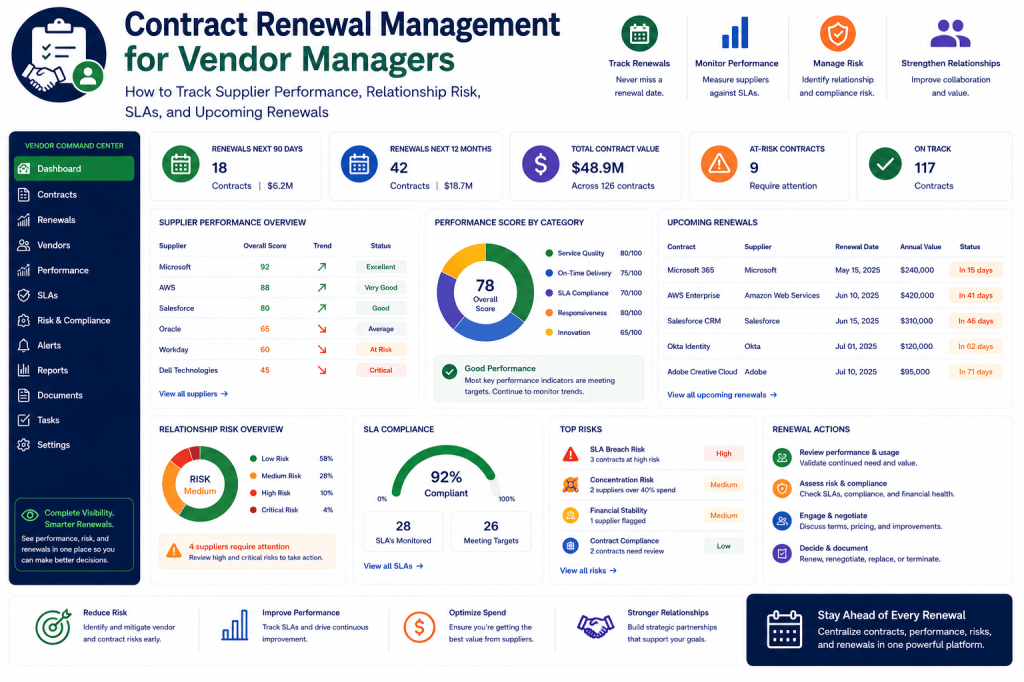
A dedicated Contract Renewal Tracker can bring supplier-performance information directly into the renewal process so vendor managers can help shape renewal strategy before negotiations begin.
Why Vendor Management and Renewal Management Belong Together
Vendor performance should influence renewal decisions.
Yet many organizations manage these activities separately.
Supplier-management software or spreadsheets may track:
- service quality;
- incidents;
- SLA attainment;
- business reviews;
- escalation history.
Meanwhile, renewal dates live somewhere else.
That separation creates a problem.
A supplier can receive:
Performance Score: 61/100
while its contract quietly moves toward:
automatic renewal.
A Contract Renewal Tracker should connect those two facts.
Supplier Performance Should Influence the Renewal Before the Deadline
A poor-performing supplier should not receive another contract term simply because performance information never reached the renewal team.
Contract Renewal Tracker is designed to connect supplier performance, contract value, risk, dependency, upcoming deadlines, and negotiation history in one renewal workspace.
Turn supplier performance into better renewal decisions →
The Vendor Manager’s Role in Renewal
Vendor managers may contribute information about:
- supplier performance;
- service delivery;
- SLA compliance;
- incident history;
- relationship quality;
- roadmap delivery;
- unresolved actions;
- dependency;
- business continuity.
Their role is not necessarily to negotiate pricing.
It is to provide evidence about whether the supplier relationship is healthy.
Vendor Manager vs Procurement
These roles overlap but are not identical.
Procurement
Usually focuses on:
- pricing;
- sourcing;
- negotiation;
- commercial terms.
Vendor Management
Usually focuses more on:
- performance;
- relationship;
- obligations;
- governance;
- supplier improvement.
At renewal, both perspectives should come together.
Vendor Manager vs Business Owner
The business owner may say:
We still need the service.
The vendor manager may say:
The supplier is consistently missing SLA targets.
Those are both valid inputs.
The renewal strategy might become:
Renew, but renegotiate performance commitments.
Build a Supplier 360 View
A Contract Renewal Tracker can provide vendor managers with a consolidated supplier profile.
For example:
ExampleCloud
Active Contracts:
8
Annual Spend:
€4.8M
Strategic Supplier:
Yes
Upcoming Renewals:
5
Renewal Value Next 180 Days:
€3.2M
Performance Score:
76/100
Open Critical Incidents:
2
Supplier Risk:
High
This immediately connects relationship health to commercial exposure.
Supplier Classification
Not every supplier needs the same level of management.
A useful framework includes:
Transactional
Low-value and easy to replace.
Preferred
Frequently used and generally reliable.
Strategic
High business value or spend.
Critical
Major operational dependency or significant risk.
Classification can influence:
- review cadence;
- renewal lead time;
- escalation path;
- executive involvement.
Strategic Supplier Renewals Should Start Earlier
A low-value office supplier may need little preparation.
A critical cloud or managed-service provider may need:
6–12 months or more.
Why?
Because the organization may need time to:
- assess performance;
- evaluate alternatives;
- plan remediation;
- develop negotiation strategy;
- model replacement.
The Contract Renewal Tracker can select a longer playbook automatically.
Supplier Performance Scorecards
A vendor-management scorecard can combine several dimensions.
For example:
| Dimension | Score |
|---|---|
| Service Quality | 84 |
| SLA Performance | 72 |
| Support | 68 |
| Relationship | 88 |
| Security | 91 |
| Innovation | 77 |
| Commercial | 71 |
Overall Supplier Score:
79/100
This creates a consistent evidence base.
Weight Performance by Supplier Type
Not every category should use the same weighting.
For a cybersecurity supplier:
Security may matter most.
For an MSP:
SLA + Support may dominate.
For a software vendor:
Product Quality + Roadmap + Support may matter more.
The scorecard should therefore be configurable.
SLA Performance
Service-level agreements provide measurable supplier evidence.
Typical metrics include:
- uptime;
- response time;
- resolution time;
- service availability;
- incident response;
- delivery time.
The tracker can show performance over time.
Example SLA Trend
| Quarter | Target | Actual |
|---|---|---|
| Q1 | 99.9% | 99.8% |
| Q2 | 99.9% | 99.6% |
| Q3 | 99.9% | 99.4% |
| Q4 | 99.9% | 99.2% |
The pattern is more important than one quarter.
Supplier performance is deteriorating.
Performance Trend at Renewal
The system could flag:
SLA performance declined during four consecutive quarters.
Now procurement has a fact-based negotiation position.
This may justify:
- lower pricing;
- stronger service credits;
- revised SLA thresholds;
- remediation plan.
SLA Credits
Some contracts include credits for poor performance.
Vendor managers should know:
- when credits were triggered;
- whether they were claimed;
- whether supplier behavior improved.
For example:
Eligible Credits:
€48K.
Credits Received:
€25K.
Unresolved:
€23K.
This should be part of the renewal review.
Service Credits Are Not a Substitute for Performance
Receiving credits may reduce financial loss.
But repeated SLA breaches can still represent a serious operational problem.
The renewal decision should look at both:
financial compensation
and:
service reliability.
Incident History
Major incidents should remain linked to the supplier relationship.
For example:
February
Critical outage — 3.5 hours.
April
Security incident.
July
Major service degradation.
October
Missed recovery target.
At renewal, management should be able to see the history immediately.
Incident Severity
Useful classifications might include:
Low
Medium
Major
Critical
A supplier with frequent low-level issues is different from one with two severe outages.
Both should remain visible.
Repeated Incident Patterns
The tracker can identify:
Five of the last seven critical incidents involved the supplier’s change-management process.
This creates a targeted renewal requirement:
Improve change-control obligations.
Open Issues Before Renewal
A supplier should not necessarily receive a clean renewal when major issues remain unresolved.
The supplier workspace could show:
Open Actions
Critical:
2
High:
5
Medium:
12
Oldest:
143 days
The renewal workflow can require a review of unresolved issues.
Renewal Gate Based on Critical Issues
For example:
IF open_critical_supplier_issues > 0THEN supplier_performance_review = REQUIRED
This does not automatically block renewal.
It ensures the issue cannot be ignored.
Supplier Relationship Health
Not every supplier issue is captured by an SLA.
Relationship factors can include:
- responsiveness;
- transparency;
- account management;
- executive engagement;
- innovation;
- roadmap alignment.
Vendor managers often have the best perspective on these areas.
Relationship Score
For example:
Executive engagement:
4/5.
Account management:
3/5.
Responsiveness:
2/5.
Transparency:
3/5.
Overall:
3.0/5
This qualitative information can still support renewal strategy.
Quarterly Business Reviews
Strategic suppliers may have regular QBRs.
A Contract Renewal Tracker can link:
- QBR notes;
- commitments;
- issues;
- improvement actions.
This creates a much richer supplier record.
QBR Commitment Tracking
Suppose a supplier promises during Q2:
Improve support response by Q3.
At Q3:
Target not achieved.
At renewal:
The system shows the outstanding commitment.
That is useful negotiation evidence.
Supplier Commitment Register
The tracker could maintain:
| Commitment | Owner | Due | Status |
|---|---|---|---|
| Improve support staffing | Supplier | June | Late |
| Deliver API feature | Supplier | August | Complete |
| Reduce incident backlog | Supplier | September | At Risk |
This makes relationship governance measurable.
Vendor Escalations
Strategic supplier relationships may have formal escalation paths.
For example:
Operational Manager
↓
Account Director
↓
Executive Sponsor
↓
Supplier Executive
The tracker can preserve escalation history.
Escalation Frequency
A supplier requiring frequent executive escalation may deserve a lower relationship score.
For example:
Executive escalations:
2026: 1
2027: 3
2028: 7
That trend matters.
Supplier Dependency
A high-performing supplier can still present risk if the organization is heavily dependent on it.
Dependency factors include:
- switching difficulty;
- integration depth;
- proprietary data formats;
- specialized skills;
- business criticality.
The tracker can maintain a dependency score.
Dependency Score Example
ExampleCloud
Business Criticality:
High.
Integration Complexity:
Very High.
Migration Time:
18 months.
Alternative Suppliers:
Available but untested.
Dependency:
92/100 — Critical
This changes the renewal strategy.
Dependency and Performance Together
Consider two suppliers.
Supplier A
Performance:
95/100.
Dependency:
90/100.
Supplier B
Performance:
60/100.
Dependency:
25/100.
Supplier B may be easier to replace despite worse performance.
Supplier A may still require strategic risk mitigation because dependency is so high.
Supplier Risk Matrix
A useful framework is:
| Low Dependency | High Dependency | |
|---|---|---|
| High Performance | Maintain | Strategic Protect |
| Low Performance | Replace Candidate | Critical Risk |
The lower-right category deserves serious management attention.
Business Continuity Considerations
For critical suppliers, vendor managers may also track:
- disaster recovery;
- business continuity;
- geographic concentration;
- financial health.
Renewal is a natural checkpoint for these issues.
Supplier Financial Risk
If a strategic supplier experiences financial instability, the renewal decision may need additional protections.
Possible actions:
- shorter term;
- transition rights;
- escrow;
- contingency plan;
- second source.
The Contract Renewal Tracker can incorporate this risk signal.
Cybersecurity Supplier Risk
For technology vendors, security risk can also influence renewal.
For example:
Supplier security rating:
Declined materially.
The workflow can add:
Security Review Required
before renewal approval.
Renewal Risk Is Broader Than Contract Risk
Vendor managers can help build a richer renewal-risk model.
For example:
Deadline Risk
Supplier Performance
Dependency
Incident History
Financial Risk
Security Risk
↓
Supplier Renewal Risk
This gives management a more complete view.
Example Supplier Renewal Risk
Supplier:
ExampleCloud.
Annual Spend:
€4.8M.
Performance:
76/100.
Dependency:
92/100.
Critical Incidents:
Notice Deadline:
84 days.
Renewal Decision:
Undecided.
Risk:
91 — Critical
Reasons are immediately visible.
Contract Concentration by Supplier
Vendor managers should also understand the number of agreements tied to the same supplier.
For example:
ExampleCloud:
12 contracts.
€6.4M total annual spend.
7 business units.
6 upcoming renewals.
This creates both dependency and negotiation leverage.
Renewal Concentration
A useful metric is:
Value Renewing Within 180 Days ÷ Total Supplier Spend
For example:
Total supplier spend:
€6M.
Renewing within 180 days:
€4.2M.
Concentration:
70%
That represents a major relationship event.
Turn Multiple Renewals into One Supplier Strategy
If several agreements with the same supplier are renewing close together, managing them independently can waste leverage.
Contract Renewal Tracker can bring all supplier contracts, performance history, open issues, spend, and upcoming renewal dates together so vendor management and procurement can build one coordinated strategy.
See the full supplier relationship before negotiating the next contract →
Supplier Renewal Strategy
The vendor manager can help define the relationship strategy.
Possible outcomes:
Grow
Increase supplier scope.
Maintain
Continue relationship.
Improve
Renew but require performance remediation.
Reduce
Decrease dependency or scope.
Diversify
Introduce second supplier.
Replace
Begin transition.
The contract-level decision should align with this broader strategy.
Example Supplier Strategy
Supplier
GlobalManagedServices.
Current Relationship
Strategic.
Performance
Below target.
Dependency
High.
Strategy
Maintain short term + diversify
Actions:
- Renew for 12 months only.
- Strengthen SLA credits.
- Require improvement plan.
- Begin second-source assessment.
This is more sophisticated than simply:
Renew.
Supplier Improvement Plans
For underperforming strategic suppliers, renewal may include a formal improvement plan.
For example:
Problem
Support response.
Current
5.4 hours.
Target
2 hours.
Deadline
90 days.
Review
Monthly.
The Contract Renewal Tracker can monitor commitments after renewal.
Link Improvements to Renewal Terms
A renewal might include:
Price increase accepted only if support staffing reaches agreed level.
The system can preserve that commercial-performance link.
Renewal Conditions
Instead of:
Approved
the decision may be:
Approved with Conditions
Examples:
- SLA improvement;
- security remediation;
- executive governance;
- reduced pricing.
These conditions should remain visible after signature.
Vendor Manager Renewal Brief
Before renewal, the system could automatically generate:
Supplier Health
Performance:
76/100.
Trend:
Declining.
SLA
Three quarters below target.
Incidents
2 critical, 7 major.
Open Actions
Relationship
Moderate.
Dependency
Critical.
Spend
€4.8M.
Renewing
€3.2M.
Recommended Focus
Require service-improvement commitments alongside commercial negotiation.
This saves preparation time.
AI Supplier Brief
A vendor manager could ask:
Prepare me for the ExampleCloud QBR and upcoming renewal.
The AI assistant can summarize:
- contracts;
- spend;
- performance;
- incidents;
- open commitments;
- renewal deadlines;
- negotiation history.
This creates a complete relationship briefing.
Ask Supplier Questions in Natural Language
For example:
Has this supplier’s performance improved?
What SLAs are they missing most often?
How many contracts do we have with them?
What renews this year?
What commitments from the last QBR remain open?
What should we focus on before renewal?
This makes supplier intelligence easier to access.
AI Supplier Trend Analysis
The assistant could identify:
Supplier support performance declined 18% during the last 12 months while total spend increased 11%.
That correlation can be useful for executive discussions.
AI Should Cite the Evidence
For example:
Three critical incidents occurred during the last six months.
The system should link to the incident records.
Similarly:
SLA performance fell below target in Q2 and Q3.
The user should be able to inspect the data.
Vendor Manager Dashboard
A dedicated workspace might show:
Strategic Suppliers
24
Critical Suppliers
6
Upcoming Supplier Renewals
€18.4M
Suppliers Below Performance Threshold
9
Critical Open Issues
14
High-Dependency Suppliers
11
This creates an operational portfolio.
Supplier Health Dashboard
Possible dimensions:
Performance
Risk
Dependency
Spend
Renewal Urgency
A supplier could appear:
Performance:
Amber.
Risk:
Red.
Dependency:
Red.
Renewal:
60 days.
That is a clear priority.
Supplier Heatmap
A visual matrix could plot:
Performance
against:
Dependency
or:
Spend
against:
Risk
This helps managers prioritize.
QBR Calendar
The platform can also coordinate:
- QBR dates;
- performance reviews;
- strategic reviews;
- renewal preparation.
For example:
QBR:
June.
Renewal Strategy:
August.
Negotiation:
October.
This creates continuity between vendor management and procurement.
QBR-to-Renewal Workflow
A strategic supplier QBR could automatically create:
Renewal Readiness Review
if the contract enters the 180-day window.
This turns governance events into workflow triggers.
Supplier Performance Review Before Renewal
A standard review might ask:
- SLA performance acceptable?
- Major incidents resolved?
- Business stakeholders satisfied?
- Open commitments completed?
- Supplier risk acceptable?
- Relationship strategy?
The result becomes part of the renewal record.
Vendor Manager Approval
For certain strategic contracts, the vendor manager may be a required reviewer.
For example:
IF supplier_classification = "Strategic"THEN vendor_manager_review = REQUIRED
This ensures relationship information is considered.
Vendor Management + Procurement
Vendor management provides:
Performance Evidence
Procurement provides:
Commercial Strategy
Together:
Renewal Negotiation Position
For example:
Reject 9% price increase because SLA achievement declined and two major commitments remain unresolved.
This is much stronger than negotiating price alone.
Vendor Management + Legal
Vendor managers may identify service failures.
Legal determines whether those failures:
- constitute breach;
- trigger credits;
- create termination rights.
The system connects the evidence.
Vendor Management + Finance
Finance may ask:
Why are we paying more for an underperforming supplier?
Vendor-management data provides the answer.
This can influence approval.
Vendor Management + Business Owners
Business owners provide subjective experience.
Vendor managers aggregate it across departments.
For example:
Five business units use the supplier.
Four report poor support.
That may indicate a systemic relationship issue.
Stakeholder Sentiment
The system could collect renewal feedback from several stakeholders.
For example:
IT:
3/5.
Finance:
4/5.
Operations:
2/5.
Marketing:
3/5.
Average:
3.0/5.
This contributes to relationship health.
Supplier Review History
Every renewal should preserve the previous supplier evaluation.
For example:
2026:
88/100.
2027:
82/100.
2028:
76/100.
The downward trend is difficult to ignore.
Renewal Outcome History
The supplier profile can also show:
2026:
Renewed.
2027:
Renegotiated.
2028:
Renewed with Improvement Plan.
2029:
Current Review.
This creates long-term relationship intelligence.
Vendor Manager Alerts
Useful alerts include:
Strategic supplier performance fell below threshold.
Critical supplier has unresolved renewal decision.
Supplier has four contracts renewing within 120 days.
Critical SLA breach occurred during active renewal negotiation.
These are more useful than generic contract reminders.
Performance-Triggered Renewal Escalation
For example:
IF supplier_performance < 70AND renewal_deadline <= 120 daysTHEN renewal_risk = HIGHAND vendor_manager_review = REQUIRED
This makes supplier performance operational.
Critical Incident During Renewal
Suppose a major outage occurs while negotiation is active.
The system can:
- add incident to supplier record;
- increase risk;
- notify procurement;
- update negotiation brief.
That ensures new information affects the commercial process.
Supplier Replacement Readiness
For problematic suppliers, vendor managers should track:
Alternative Supplier Identified
Migration Plan
Estimated Transition Time
Switching Cost
Business Continuity Risk
This turns dissatisfaction into an actionable exit strategy.
Replacement Lead Time
For example:
Supplier Replacement Estimate:
12 months.
Notice Deadline:
90 days.
This tells management:
Immediate replacement is not realistic.
The strategy may need to be:
short-term renewal + transition plan.
Second-Sourcing Strategy
For high-dependency suppliers, the decision may not be full replacement.
It may be:
Diversify.
For example:
70% current supplier.
30% secondary supplier.
The tracker can record the strategic intent.
Supplier Concentration Reduction
Vendor managers can monitor whether concentration is changing.
For example:
Supplier share of category spend:
2026: 48%.
2027: 45%.
2028: 39%.
This may indicate successful diversification.
Supplier Relationship KPIs
Useful metrics include:
SLA Compliance
Performance Score
Critical Incident Count
Open Action Rate
Supplier Dependency
Renewal Concentration
Stakeholder Satisfaction
Improvement-Plan Completion
These provide a measurable vendor-management framework.
Vendor Management Reporting
A monthly report might show:
Supplier Portfolio
Strategic:
Critical:
Below Performance Threshold:
Upcoming Renewal Exposure:
€18.4M.
Open Critical Actions:
Highest-Risk Supplier:
ExampleCloud.
This helps leadership focus.
Executive Supplier Briefing
For strategic relationships, an executive summary could show:
ExampleCloud
Annual Spend:
€6.2M.
Business Criticality:
Very High.
Performance:
76/100.
Trend:
Declining.
Upcoming Renewals:
€4.1M.
Open Major Issues:
Dependency:
Critical.
Decision
Supplier strategy required before September.
This is executive-ready.
Supplier Risk vs Renewal Risk
These should remain related but distinct.
Supplier Risk
Long-term relationship health.
Renewal Risk
Risk surrounding the current renewal process.
A supplier can have:
Supplier Risk:
Medium.
Renewal Risk:
Critical.
For example, because the decision is late.
Keeping both scores avoids confusion.
Vendor Management and Audit History
The system should preserve:
- performance reviews;
- QBR decisions;
- escalations;
- supplier commitments;
- risk changes;
- renewal decisions.
This maintains institutional knowledge when vendor managers change roles.
Supplier Institutional Memory
Without a structured system, knowledge may live with one experienced vendor manager.
When that employee leaves, much of the relationship history disappears.
Contract Renewal Tracker can preserve that context for the next owner.
Ready to Connect Vendor Performance to Renewal Decisions?
Supplier performance should not be managed in one spreadsheet while renewal dates are tracked in another.
Contract Renewal Tracker is designed to give vendor managers, procurement, business owners, legal, and finance one shared supplier-renewal context.
Use Contract Renewal Tracker to:
- create supplier scorecards;
- track SLA performance;
- record incidents;
- monitor relationship health;
- track QBR commitments;
- manage escalations;
- measure supplier dependency;
- identify contract concentration;
- calculate renewal risk;
- build supplier-level renewal strategies;
- connect performance to negotiations;
- monitor improvement plans;
- create AI-generated supplier briefs;
- preserve complete supplier history.
The objective is not simply:
Did the supplier’s contract renew?
It is:
Did the supplier earn the next commitment, and on what conditions should we continue the relationship?
Start Your Contract Renewal Tracker Subscription →
Final Thoughts
Vendor management provides a perspective that renewal systems often miss.
Contracts tell the organization:
what was agreed.
Procurement tells it:
what it costs.
Finance tells it:
what it can afford.
Business owners tell it:
whether the service is needed.
Vendor managers tell it:
whether the supplier is actually delivering.
A strong renewal decision combines all five.
The supplier-renewal process becomes:
Performance
Risk
Dependency
Spend
Upcoming Contract Decisions
↓
Supplier Strategy
↓
Renewal / Improve / Reduce / Diversify / Replace
That makes Contract Renewal Tracker much more valuable than a deadline application.
It becomes a system for managing the relationship before another financial commitment is created.
Next Article in the Contract Renewal Tracker Series
Article 38 — “Contract Renewal Management for Small Businesses: How to Stop Missing Renewals Without Buying Complex Enterprise CLM Software”
The next article will deliberately target a different prospect segment: small businesses, agencies, consultants, growing SMEs, and founder-led companies.
It will focus on simple spreadsheet migration, low-complexity contract tracking, affordable renewal automation, vendor subscriptions, insurance, leases, SaaS, telecom, owner reminders, lightweight approval processes, implementation simplicity, ROI, and why a focused Contract Renewal Tracker SaaS can provide the controls a small business needs without the complexity of enterprise contract-management software.

