For a SaaS company, contract renewals are not primarily a cost-control issue.
They are a revenue issue.
Every customer renewal affects:
- ARR;
- MRR;
- gross revenue retention;
- net revenue retention;
- churn;
- expansion;
- forecasting;
- customer lifetime value.
That changes the entire purpose of renewal management.
Instead of asking:
Should we renew this supplier contract?
a SaaS company asks:
Will this customer renew with us, for how much, on what terms, and what can we do before the renewal date to protect or expand the relationship?
This creates a second major use case for Contract Renewal Tracker.
The same core concepts still matter:
- renewal dates;
- notice periods;
- owners;
- workflows;
- reminders;
- risk;
- approvals;
- reporting.
But the business objective shifts from controlling outgoing spend to protecting and growing recurring revenue.
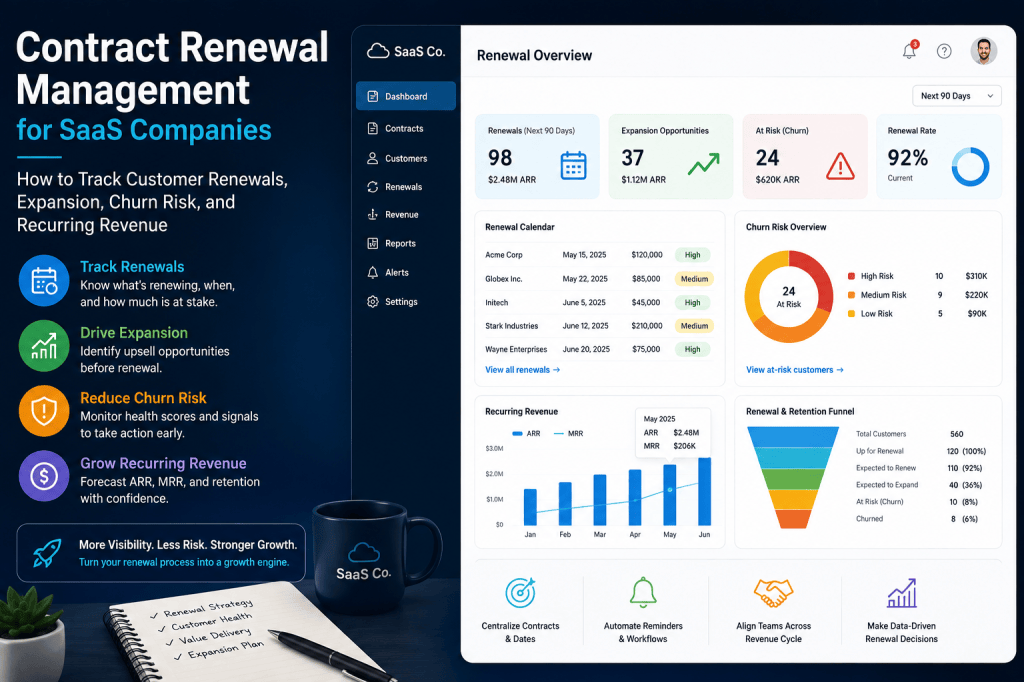
Why Customer Renewals Matter So Much in SaaS
SaaS economics depend heavily on recurring revenue.
Winning a new customer creates revenue.
Keeping that customer protects the revenue already acquired.
Expanding that customer increases it.
Losing the customer creates churn.
That means every renewal should be treated as a managed commercial process rather than a date on an account record.
The Customer Renewal Lifecycle
A structured SaaS renewal process might look like:
Active Customer Contract
↓
Renewal Window Opens
↓
Account Health Reviewed
↓
Usage Reviewed
↓
Churn Risk Assessed
↓
Expansion Opportunity Assessed
↓
Renewal Strategy
↓
Customer Engagement
↓
Commercial Negotiation
↓
Approval
↓
Renewal / Expansion / Contraction / Churn
↓
Revenue Outcome Recorded
This creates a repeatable revenue-retention process.
Still Managing Customer Renewals Through CRM Notes and Calendar Reminders?
A CRM may show the account and opportunity.
But a renewal process also needs precise contract dates, notice periods, commercial terms, customer-health signals, workflow stages, and ownership.
Contract Renewal Tracker can be positioned as a dedicated customer-renewal operations layer for subscription businesses that need tighter control over recurring revenue.
Turn every customer renewal into a managed revenue event →
Customer Renewal Date
At minimum, every customer agreement should have:
- contract start;
- contract end;
- renewal date;
- notice period;
- renewal term;
- auto-renewal status.
The renewal date determines when revenue becomes vulnerable.
Notice Periods Matter on the Sell Side Too
A SaaS contract may require the customer to give:
60 or 90 days’ notice
before cancellation.
That information can influence:
- churn forecasting;
- customer-success timing;
- commercial strategy.
But the company should never rely solely on the contractual notice period to retain the customer.
A dissatisfied customer who misses the notice deadline may still create a difficult relationship.
The better approach is to address churn risk early.
Auto-Renewal vs Active Renewal
Some SaaS contracts renew automatically.
Others require:
- new order form;
- purchase order;
- signature;
- explicit customer approval.
The system should distinguish both.
Auto-Renewal Does Not Mean Guaranteed Revenue
A contract may technically auto-renew, but the customer may:
- dispute the renewal;
- negotiate;
- reduce licenses;
- request cancellation;
- stop using the product.
For forecasting, contractual rights and customer health should both be considered.
Renewal Value
For a customer renewal, the financial baseline may include:
Current ARR
For example:
€120,000.
This becomes the revenue amount at risk.
ARR at Risk
Suppose:
50 customers renew next quarter.
Combined ARR:
€4.8M
That €4.8M becomes:
Renewal ARR at Risk
It does not mean the company expects to lose it.
It means the revenue needs to pass through the renewal process.
Renewal Pipeline
A customer-renewal pipeline might include:
Upcoming
Renewal not yet active.
Health Review
Customer status evaluated.
Strategy
Renewal approach defined.
Customer Engagement
Commercial discussion started.
Negotiation
Terms under discussion.
Commit
Customer intent confirmed.
Contracting
Paperwork underway.
Renewed
Closed successfully.
Churned
Customer lost.
This gives revenue teams a clear operating model.
Build a 180-Day Customer Renewal Pipeline
For larger SaaS contracts, customer renewal work may begin months early.
For example:
180 Days
Account health review.
150 Days
Usage and value analysis.
120 Days
Executive sponsor review.
90 Days
Customer renewal discussion.
60 Days
Commercial negotiation.
30 Days
Contract completion.
This reduces last-minute surprises.
Segment Renewals by Customer Value
Not every account needs the same playbook.
A SaaS company might use:
Strategic
ARR > €250K.
Enterprise
€50K–€250K.
Growth
€10K–€50K.
SMB
<€10K.
Different segments can use different levels of automation and human engagement.
Strategic Account Renewal
A €1M ARR customer may justify:
- executive sponsorship;
- success-plan review;
- multi-threading;
- custom commercial strategy;
- early negotiation.
This may start:
6–12 months before renewal.
SMB Renewal
A €2,000 annual customer may use:
- automated reminders;
- product-led renewal;
- self-service checkout.
The workflow should remain proportional to account value.
Renewal Ownership
Customer renewals may involve several roles:
Customer Success Manager
Owns relationship and adoption.
Account Executive
Owns commercial expansion or negotiation.
Renewal Manager
Owns renewal execution.
Finance
Owns pricing controls.
Legal
Owns contract exceptions.
The system should make responsibilities explicit.
Customer Success vs Sales Ownership
One common SaaS problem is:
Who owns the renewal?
If this is unclear, work starts late.
A Contract Renewal Tracker can define:
Standard Renewal
CSM owns.
Expansion Opportunity
Sales participates.
Strategic Negotiation
Renewal manager or AE leads.
Contract Exception
Legal joins.
This reduces ambiguity.
Account Health
Customer health is one of the most important renewal inputs.
Possible signals include:
- product usage;
- support issues;
- NPS or satisfaction;
- executive engagement;
- payment behavior;
- adoption;
- outcome achievement.
These signals can feed renewal risk.
Customer Health Score
For example:
Product Usage:
82/100.
Support:
Engagement:
Business Value:
Payment:
Overall Health:
81/100
This helps prioritize attention.
Usage Is Often the Strongest Renewal Signal
Suppose:
Customer purchased:
500 seats.
Active users:
Utilization:
24%.
That is a major renewal risk.
The customer may:
- reduce licenses;
- downgrade;
- churn.
The renewal team should know this months in advance.
Usage Trend Matters
Suppose utilization was:
Q1:
80%.
Q2:
65%.
Q3:
48%.
Q4:
24%.
The trend is deteriorating.
That is more concerning than one temporary low month.
Low Usage Playbook
If usage falls below a threshold:
IF utilization < 50%AND renewal_date <= 180 daysTHEN create_adoption_recovery_plan
The renewal process begins with customer success, not discounting.
Adoption Recovery
Possible actions include:
- training;
- implementation support;
- feature enablement;
- executive review;
- success planning.
The best churn-prevention action may happen long before commercial negotiation.
Customer Value Realization
The renewal team should understand:
What value has the customer actually received?
Useful evidence includes:
- hours saved;
- revenue generated;
- cost reduced;
- workflows automated;
- users enabled.
This creates a stronger renewal conversation.
Build a Renewal Value Brief
For example:
Customer
ExampleCorp.
ARR
€180K.
Active Users
Key Outcome
Reduced processing time by 32%.
Usage Trend
Stable.
Support Satisfaction
High.
Health
86/100.
Renewal Strategy
Renew + explore expansion.
This gives the account team a clear position.
Churn Risk
A customer may be at risk because of:
- low usage;
- poor support experience;
- leadership change;
- missing executive sponsor;
- pricing pressure;
- competitive evaluation;
- unresolved product gaps.
The tracker can combine these signals.
Customer Renewal Risk Score
For example:
DataWorks
ARR:
€240K.
Renewal:
74 days.
Usage:
48%.
Support Escalations:
Executive Sponsor:
Left company.
Pricing Concern:
Yes.
Renewal Risk:
91 — Critical
Now the CSM knows where to focus.
Explainable Churn Risk
Do not simply display:
Risk: 91
Explain:
High risk because utilization declined 38%, the executive sponsor left, three critical support issues remain unresolved, and pricing concerns were recorded during the latest QBR.
This makes the score actionable.
Renewal Probability
The system may also track a forecast probability.
For example:
Renewal Probability: 65%
Weighted ARR:
€240K × 65%
=
€156K
This can support revenue forecasting.
The methodology should remain transparent.
Renewal Forecast Categories
Possible categories:
Commit
Likely
At Risk
Upside
Churn Expected
These may be easier for revenue teams than raw probabilities.
Customer Renewal Forecast
For example:
Q4 Renewal ARR
Total:
€8.2M.
Commit:
€5.7M.
Likely:
€1.4M.
At Risk:
€800K.
Expected Churn:
€300K.
This gives leadership visibility.
Gross Revenue Retention
GRR measures how much existing recurring revenue is retained before expansion.
A simplified formula is:
Starting ARR − Churn − Contraction
divided by:
Starting ARR
For example:
Starting ARR:
€10M.
Churn:
€500K.
Contraction:
€300K.
GRR:
92%
A customer-renewal system can help track the underlying events.
Net Revenue Retention
NRR also includes expansion.
Simplified:
Starting ARR − Churn − Contraction + Expansion
divided by:
Starting ARR
Example:
Starting ARR:
€10M.
Churn:
€500K.
Contraction:
€300K.
Expansion:
€1M.
NRR:
102%
This makes renewal management closely connected to SaaS growth.
Renewal Outcome Types
Every renewal should be classified.
Renewed Flat
Same ARR.
Expanded
ARR increased.
Contracted
ARR decreased.
Churned
ARR lost.
Extended
Temporary extension.
This supports retention reporting.
Expansion Opportunities
Renewal is not only about protecting revenue.
It is also a natural expansion point.
Possible expansion signals include:
- high utilization;
- increasing user count;
- new departments;
- additional products;
- premium features.
The Contract Renewal Tracker can surface these.
Expansion Signal Example
Customer purchased:
500 users.
Active:
Forecast:
Renewal:
120 days.
The system can flag:
Strong seat-expansion opportunity.
Sales can engage early.
Cross-Sell Opportunities
A customer may use:
Product A
but not:
Product B.
If account health is strong, renewal may be a good time to explore an additional product.
This creates:
Renewal + Expansion
rather than merely:
Renewal
Expansion ARR
Suppose:
Current ARR:
€180K.
Renewal ARR:
€180K.
Expansion:
€60K.
New ARR:
€240K
The renewal outcome should preserve both:
Retained ARR
and:
Expansion ARR
Contraction
Customers may renew but reduce:
- users;
- modules;
- usage;
- regions.
For example:
Current ARR:
€200K.
Renewed ARR:
€150K.
Contraction:
€50K
This is not churn, but it affects GRR and NRR.
Renewal Price Uplifts
Some SaaS contracts include planned annual increases.
For example:
Current ARR:
€100K.
Renewal uplift:
5%.
New ARR:
€105K.
The system should distinguish:
contractual price uplift
from:
expansion.
This improves revenue reporting.
Price Uplift vs Expansion
If a customer adds no new products but price increases:
€100K → €105K
that is:
Price Uplift: €5K
If they also add €20K module:
New ARR:
€125K.
Then:
Price Uplift:
€5K.
Expansion:
€20K.
This level of clarity improves SaaS metrics.
Renewal Negotiation
Customers may push back on:
- price increases;
- term;
- quantity;
- payment terms.
The Contract Renewal Tracker can record:
Current ARR
Proposed ARR
Customer Counteroffer
Target ARR
Final ARR
This creates structured renewal negotiation data.
Discount Governance
A renewal manager should not automatically grant any discount requested.
The platform can enforce thresholds.
For example:
Discount ≤5%
Renewal manager.
5–15%
Sales director.
>15%
VP / Finance approval.
This protects revenue.
Margin Considerations
For some SaaS businesses, renewal pricing may also consider:
- hosting cost;
- support cost;
- implementation burden.
A heavily discounted renewal may be unprofitable.
The system could eventually incorporate margin information where relevant.
Multi-Year Renewals
Customers may receive incentives for longer commitments.
For example:
1-year:
€200K.
3-year:
€180K/year.
Total contract value:
€540K.
The SaaS company gains:
- longer revenue visibility;
- lower churn risk.
But gives up:
- annual pricing flexibility.
The tracker should capture both ARR and total contract value.
Renewal Term Strategy
Possible options include:
12 months
24 months
36 months
The renewal team can optimize:
- retention;
- cash flow;
- discount;
- commitment.
Payment Terms
Annual upfront payment may be preferable for cash flow.
Customers may request:
- monthly;
- quarterly;
- net-60.
The renewal workflow can route non-standard terms to finance.
Customer Legal Review
Renewals may involve:
- amendments;
- new DPAs;
- liability changes;
- security terms;
- product changes.
Legal should join when needed.
But low-risk standard renewals can remain automated.
Renewal Approval Rules
For example:
IF discount > 10%THEN sales_director_approval = REQUIREDIF legal_terms_changed = TRUETHEN legal_review = REQUIREDIF contract_term > 36 monthsTHEN finance_approval = REQUIRED
This gives revenue operations control.
Renewal Playbooks by Risk
Healthy Account
Standard renewal + expansion review.
Medium Risk
CSM action plan + executive check.
High Risk
Churn-prevention plan + leadership involvement.
Critical
Executive sponsor + commercial rescue plan.
This ensures effort aligns with risk.
Healthy Customer Playbook
180 Days
Health review.
120 Days
Expansion analysis.
90 Days
Renewal outreach.
60 Days
Commercial proposal.
30 Days
Execution.
Simple and proactive.
At-Risk Customer Playbook
180 Days
Risk diagnosis.
150 Days
Adoption plan.
120 Days
Executive sponsor engagement.
90 Days
Success review.
60 Days
Commercial strategy.
30 Days
Escalation.
This focuses on retention before negotiation.
Do Not Solve Churn Only with Discounts
A customer with poor adoption may not stay because of a 10% discount.
The problem may be:
- implementation;
- product fit;
- missing functionality.
A good renewal system should identify the cause before applying commercial concessions.
Churn Reason Tracking
If a customer leaves, record why.
Possible reasons:
- budget;
- competitor;
- poor adoption;
- product gap;
- support;
- company closure;
- consolidation.
This creates learning.
Churn Analysis
For example:
40% of churn:
Low adoption.
25%:
Budget.
20%:
Competitor.
15%:
Other.
Now customer-success leadership can improve upstream processes.
Renewal Cohort Analysis
The company may analyze:
- renewal rate by customer segment;
- renewal rate by CSM;
- renewal rate by product;
- renewal rate by industry.
This can reveal patterns.
ARR Renewal Dashboard
A customer-renewal dashboard could show:
ARR Renewing Next 90 Days
€6.4M
Commit
€4.8M
At Risk
€1.1M
Expected Churn
€500K
Expansion Pipeline
€1.3M
Weighted Renewal Forecast
€5.9M
This is directly relevant to leadership.
Renewal Calendar
A calendar view might show:
September
€1.2M ARR.
October
€2.4M.
November
€1.6M.
December
€3.8M.
This helps teams plan capacity.
CSM Workload Planning
Suppose one CSM has:
€2M of ARR renewing in one month.
Another has:
€300K.
The system can identify workload imbalance.
This can help customer-success leadership reassign support.
Renewal Manager Capacity
High-volume SaaS companies may have dedicated renewal teams.
The platform can forecast:
- renewal count;
- ARR;
- complexity.
This helps resource planning.
Executive Customer Renewal Dashboard
Leadership might see:
Q4 Renewal ARR
€18M.
Forecasted Retention
€16.5M.
At-Risk ARR
€2.4M.
Expansion Opportunity
€3.1M.
GRR Forecast
93%.
NRR Forecast
107%.
This turns contract renewal data into recurring-revenue intelligence.
CRM Integration
For the sell-side use case, CRM integration becomes especially important.
CRM may already contain:
- account;
- opportunity;
- contacts;
- account owner.
Contract Renewal Tracker can add:
- precise renewal terms;
- notice periods;
- contract hierarchy;
- renewal workflow;
- risk.
The two systems can complement each other.
Renewal Opportunity Creation
A common workflow could be:
Contract enters 180-day window
↓
Create or update:
CRM Renewal Opportunity
↓
Synchronize ARR, date, account.
This avoids duplicate entry.
CRM Is Not Always Enough
Many CRMs can track renewal opportunities.
But they may not deeply understand:
- contract notice periods;
- legal renewal terms;
- document hierarchy;
- automated contract-driven dates.
A specialized renewal layer can improve accuracy.
Customer Success Platform Integration
Customer-success platforms may provide:
- health scores;
- usage;
- engagement.
Contract Renewal Tracker can combine those signals with actual contractual deadlines.
This creates a more complete renewal picture.
Billing Integration
Billing systems may provide:
- current subscription;
- MRR;
- invoices;
- payment status.
That can enrich financial forecasting.
Product Usage Integration
Product analytics can provide:
- active users;
- feature usage;
- adoption trend.
This is extremely valuable for churn prediction and expansion.
Support Integration
Support platforms can contribute:
- unresolved tickets;
- CSAT;
- escalation history.
A large number of unresolved issues close to renewal should increase risk.
AI Customer Renewal Assistant
A CSM could ask:
Which customers are most at risk this quarter?
The assistant can combine:
- renewal date;
- ARR;
- usage;
- support;
- account health;
- commercial notes.
Then prioritize accounts.
Example AI Renewal Brief
Five customers represent €1.2M of ARR at high renewal risk. The two largest accounts show declining product adoption, one has unresolved executive escalation, and two have requested pricing concessions above 15%.
This gives leadership an immediate action list.
AI Account Brief
Before a customer call:
Prepare me for the ExampleCorp renewal.
The assistant could summarize:
ARR: €240K
Renewal: 74 days
Health: 68/100
Usage: declining
Open Support Issues: 2
Price Uplift: 6%
Expansion Opportunity: analytics module
Recommended Focus
Resolve adoption issues before presenting renewal pricing.
This is highly actionable.
AI Expansion Recommendations
The assistant might identify:
Customer is at 96% license utilization and has added 80 users during the last six months. Consider seat expansion during renewal.
This can increase NRR.
AI Churn Prediction Should Be Explainable
If the system predicts:
High Churn Risk
it should explain the drivers.
Users should not rely on an opaque score.
Customer Renewal Alerts
A useful alert might say:
ExampleCorp — €240K ARR
Renewal in 90 days.
Usage down 28%.
Executive sponsor inactive.
Two high-priority support issues open.
Risk: High.
This is far better than:
Contract renews soon.
Expansion Alert
Another:
DataWorks — €180K ARR
97% license utilization.
Headcount forecast +20%.
Renewal in 120 days.
Expansion opportunity detected.
This turns renewals into growth opportunities.
Customer Renewal KPIs
Useful SaaS metrics include:
Renewal Rate
GRR
NRR
Churn ARR
Contraction ARR
Expansion ARR
Renewal Forecast Accuracy
Average Renewal Cycle
At-Risk ARR
These make the customer-renewal function measurable.
Renewal Forecast Accuracy
Suppose:
Forecasted renewal ARR:
€10M.
Actual:
€9.1M.
Forecast accuracy:
91%.
Tracking this over time can improve revenue predictability.
Early Renewal Rate
Another useful metric:
Percentage of renewals completed 30+ days before contract end.
Early completion can reduce quarter-end risk.
Auto-Renewal Rate
For auto-renewing customer contracts:
What percentage renew without manual negotiation?
This can help revenue operations understand the portfolio.
Expansion Attach Rate
Of customers renewing:
what percentage also expand?
For example:
120 renewals.
32 include expansion.
Attach rate:
26.7%
This helps measure renewal-driven growth.
Customer Renewal Forecast by Segment
Enterprise:
€8M.
Mid-Market:
€5M.
SMB:
€2M.
This helps leadership understand where retention risk sits.
Customer Renewal Tracker vs Supplier Renewal Tracker
The underlying engine can be similar.
Both need:
- contracts;
- dates;
- workflows;
- risk;
- approvals.
But the objectives differ.
Supplier Renewal
Protect spend.
Customer Renewal
Protect revenue.
That distinction matters for product positioning.
Should One Product Support Both?
Potentially yes—but only if the workflows remain clearly separated.
The data model could distinguish:
Buy-Side Contract
and:
Sell-Side Contract
Then provide different:
- dashboards;
- terminology;
- playbooks;
- financial metrics.
This could broaden the product significantly.
Risk of Product Overexpansion
There is also a strategic risk.
A focused Contract Renewal Tracker initially positioned around procurement and supplier renewals could become confusing if it tries to serve revenue teams too early.
The sell-side use case may be better as:
- a later module;
- separate product edition;
- distinct landing page.
This preserves positioning clarity.
Why the Sell-Side Use Case Is Attractive
Customer renewal software addresses a direct financial outcome:
retained ARR.
That can support strong willingness to pay.
If a platform helps protect even one €100K ARR customer, the subscription can be easy to justify.
Example Revenue ROI
Platform annual cost:
€12K.
One churn prevented:
€120K ARR.
The economic value is obvious.
Expansion may create additional upside.
Revenue Saved vs Revenue Created
The system can track:
Retained ARR
Revenue successfully renewed.
Expansion ARR
Additional recurring revenue.
Churn Prevented
Estimated or verified where methodology allows.
Care is needed not to overclaim causal impact.
Renewal Influence Attribution
Just because a customer renewed does not mean the software “saved” the revenue.
A credible system should report:
Renewal Outcome
rather than claiming:
Revenue Saved by Platform
unless there is a defensible attribution methodology.
This keeps reporting trustworthy.
Ready to Turn Customer Renewals into a Revenue Operating Process?
Customer renewals should not depend on account managers remembering dates or discovering churn risk weeks before contract end.
Contract Renewal Tracker can be extended to help SaaS businesses connect contractual renewal dates with customer health, usage, recurring revenue, commercial workflows, and expansion opportunities.
Use it to:
- track customer renewal dates;
- calculate notice windows;
- assign renewal ownership;
- build 90-, 120-, and 180-day renewal pipelines;
- monitor ARR at risk;
- connect usage and customer-health signals;
- identify churn risk;
- surface expansion opportunities;
- manage renewal negotiations;
- enforce discount approvals;
- forecast recurring revenue;
- track expansion, contraction, and churn;
- report GRR and NRR;
- use AI to prepare renewal and account briefs.
The goal is not merely to know:
When does the customer contract renew?
It is to know:
What is the probability of renewal, what needs to happen now, and how can we protect or expand the recurring revenue before the decision is made?
Start Your Contract Renewal Tracker Subscription →
Final Thoughts
The sell-side renewal problem opens a substantially different opportunity for Contract Renewal Tracker.
The workflow changes from:
Spend → Renewal → Cost Decision
to:
ARR → Renewal → Retention / Expansion Decision
But many of the underlying platform capabilities remain reusable:
Contract Data
↓
Renewal Timing
↓
Ownership
↓
Risk
↓
Workflow
↓
Approval
↓
Outcome
For a SaaS business, the outcome becomes:
Renewed
Expanded
Contracted
or:
Churned
That transforms Contract Renewal Tracker into a potential recurring-revenue operations platform.
Strategically, however, I would keep the primary product positioning focused on buy-side/supplier contract renewals first and treat customer renewals as a later extension or separate module. The supplier-renewal proposition you have built throughout this series is already clear and differentiated; the customer-renewal market introduces CRM, customer success, revenue operations, GRR, NRR, and churn-management competitors.
Next Article in the Contract Renewal Tracker Series
Article 46 — “Contract Renewal Risk Management: How to Build a Renewal Risk Register, Heatmap, and Early-Warning System”
The next article will return to the core buy-side product and go deep into a highly valuable capability: portfolio-level renewal risk management.
It will cover deadline risk, auto-renewal exposure, financial risk, owner risk, supplier dependency, legal risk, data-quality risk, workflow delays, risk scoring, heatmaps, risk appetite, exception registers, trend analysis, early-warning indicators, executive reporting, AI-assisted risk explanations, and how Contract Renewal Tracker can become the early-warning system for contracts that are most likely to create financial or operational problems.

