Mid-market companies often reach an awkward stage in contract management.
They are too large for informal renewal tracking.
But they may not yet need—or want—the complexity of a full enterprise Contract Lifecycle Management platform.
This is where contract renewal operations begin to break down.
A company may have:
- hundreds of active contracts;
- multiple departments;
- several legal entities;
- decentralized contract owners;
- growing supplier spend;
- increasing SaaS usage;
- procurement involvement;
- finance approvals;
- legal review;
- recurring executive reporting.
The spreadsheet that worked when the business had 50 contracts becomes harder to trust when there are 500.
The calendar reminders that worked when one person owned renewals become unreliable when 30 different managers are responsible.
The issue is no longer simply:
When does this contract expire?
The real question becomes:
How do we create a scalable renewal process across the organization without building a large contract-management bureaucracy?
That is where a focused Contract Renewal Tracker can fit particularly well.
It can provide the automation, workflow, visibility, accountability, and reporting that a growing company needs while keeping implementation focused on renewals.
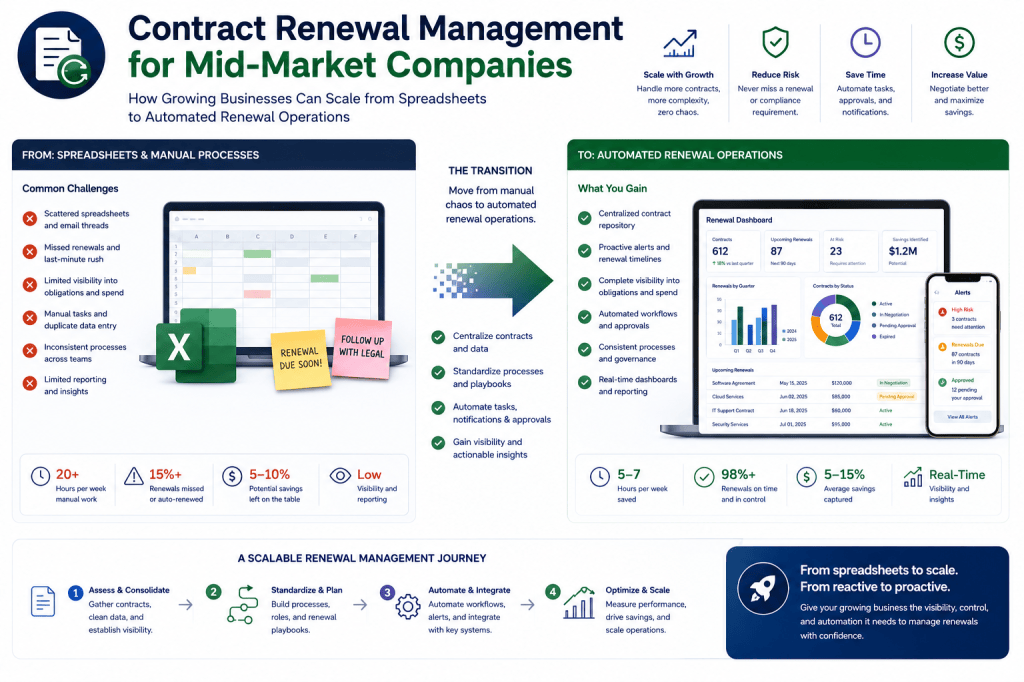
Why Mid-Market Companies Reach a Renewal Tipping Point
Growth creates complexity gradually.
A company may begin with:
50 contracts
Then:
150
Then:
400
Then:
800
At each stage, more people become involved.
There are more:
- suppliers;
- contract owners;
- departments;
- renewal dates;
- notice periods;
- approval thresholds;
- budgets.
Eventually, the renewal process becomes too important to depend primarily on spreadsheets and individual memory.
The Mid-Market Renewal Problem
A growing organization may have contracts across:
IT
Software, cloud, cybersecurity, telecom, support.
Marketing
Advertising platforms, agencies, analytics, creative software.
HR
Recruiting, payroll, benefits, learning platforms.
Finance
Accounting systems, banking services, insurance.
Operations
Facilities, maintenance, logistics, outsourced services.
Each department may maintain its own contract information.
That creates fragmentation.
Growing Beyond Spreadsheet Renewal Tracking?
When contract ownership is distributed across departments, the biggest problem is often not missing data—it is missing coordination.
Contract Renewal Tracker is designed to give growing companies one renewal operations layer across business owners, procurement, finance, legal, and management without requiring a full enterprise CLM transformation.
Scale renewal management before contract volume becomes operational chaos →
The First Tipping Point: Multiple Contract Owners
A spreadsheet works relatively well when one person maintains it.
Problems appear when:
- IT updates some rows;
- procurement updates others;
- finance has its own version;
- departments track separate contracts.
Now the organization has multiple sources of truth.
A dedicated SaaS provides a shared operational record.
The Second Tipping Point: Multiple Departments
Suppose:
Marketing manages 60 contracts.
IT manages 180.
HR manages 45.
Operations manages 90.
Finance manages 30.
Total:
405 active contracts
No single department sees the complete renewal portfolio.
Management cannot easily answer:
How much contract value renews next quarter?
Centralization solves that.
The Third Tipping Point: Growing Contract Spend
Contract count matters.
But spend often matters more.
Suppose:
Active contracts:
Annual contract spend:
€18M
Renewing within 12 months:
€9.4M
Even a small improvement in renewal outcomes can create significant financial value.
This is where renewal management becomes a finance and procurement issue—not merely an administrative task.
The Fourth Tipping Point: Auto-Renewal Exposure
As the contract portfolio grows, automatic renewals accumulate.
For example:
Auto-renewing contracts:
Annual value:
€5.6M.
Notice deadlines within 90 days:
€1.4M.
That exposure deserves structured monitoring.
The Fifth Tipping Point: Approval Complexity
Small companies may use:
Founder approves everything.
Growing companies often add thresholds.
For example:
Under €25K:
Department manager.
€25K–€100K:
Director.
€100K–€500K:
Finance.
Above €500K:
CFO.
The spreadsheet does not enforce this.
A workflow engine can.
The Sixth Tipping Point: Procurement Becomes Involved
As spend grows, procurement begins managing:
- supplier negotiation;
- sourcing;
- consolidation;
- savings.
Now renewal visibility becomes commercially important.
Procurement needs enough time to act before the notice deadline.
The Seventh Tipping Point: Legal Cannot Review Everything
Legal may initially review every renewal manually.
That becomes difficult as volume grows.
The organization needs to distinguish:
Routine Renewal
from:
Material Legal Change
A renewal platform can automatically route legal review only where required.
The Eighth Tipping Point: Management Wants Reporting
Eventually leadership asks:
What is renewing this quarter?
How much spend is at risk?
Where can we save money?
Which suppliers are increasing prices?
If answering requires several spreadsheets and days of reconciliation, the current operating model has reached its limits.
The Mid-Market Operating Model
A scalable model can be:
Business Owners
Confirm need and usage.
Procurement
Manage commercial strategy.
Finance
Approve financial commitment.
Legal
Review contractual exceptions.
Contract Operations
Maintain governance and data quality.
Executives
Handle material exceptions.
Contract Renewal Tracker can coordinate the entire model.
Central Governance, Distributed Ownership
This is often the best mid-market approach.
Not every contract needs to be owned centrally.
Instead:
Central Policy
Department Ownership
The company sets:
- reminder rules;
- workflows;
- approval policies;
- data standards.
Departments retain business responsibility.
This scales much better.
Example
Marketing owns:
Marketing Automation Platform.
IT owns:
Cloud Platform.
HR owns:
Payroll System.
Procurement owns:
Negotiation.
Finance owns:
Approval.
Everyone works in the same system.
Build a Central Renewal Register
The first objective is a single reliable portfolio.
Useful fields include:
- supplier;
- owner;
- department;
- contract value;
- end date;
- notice period;
- auto-renewal;
- status.
This creates enterprise visibility without requiring full CLM functionality.
Import Existing Spreadsheets
Most mid-market customers will already have contract lists.
Onboarding can begin with:
Excel / CSV
↓
Column Mapping
↓
Validation
↓
Import
The migration does not need to start from zero.
Merge Departmental Trackers
Suppose:
IT.xlsx
Marketing.xlsx
HR.xlsx
Procurement.xlsx
The system can consolidate them.
Then detect:
- duplicates;
- conflicting suppliers;
- missing owners;
- inconsistent dates.
This is often one of the first high-value outcomes.
Supplier Normalization
Different departments may use:
Microsoft.
Microsoft Corp.
Microsoft Ireland.
MSFT.
A centralized system can group these into one supplier relationship.
This matters for:
- spend reporting;
- negotiation;
- supplier concentration.
Ownership Reconciliation
Mid-market growth often involves organizational change.
Employees move.
Departments restructure.
Managers leave.
The tracker should identify:
Inactive Owner
and route affected contracts for reassignment.
Ownership Coverage KPI
For example:
Active contracts:
Assigned owner:
Coverage:
96.3%
Unassigned:
Of those, 6 renew within 90 days.
Those six become immediate priorities.
Build a Renewal Pipeline
Once the portfolio is centralized, move from passive dates to pipeline management.
For example:
Upcoming
Business Review
Procurement
Negotiation
Approval
Execution
Completed
This gives management visibility into where every renewal stands.
Pipeline Dashboard
Upcoming Renewals
184
Business Review
67
Procurement
42
Negotiation
28
Approval
19
Execution
12
Now the company can see bottlenecks.
Segment Contracts by Complexity
Not every contract needs the same workflow.
A mid-market company can define:
Low Value
<€10K.
Standard
€10K–€100K.
High Value
€100K–€500K.
Strategic
€500K or critical.
Different tiers get different treatment.
Low-Value Workflow
60 Days
Owner review.
30 Days
Decision.
14 Days
Execution.
Minimal overhead.
Standard Workflow
120 Days
Business review.
90 Days
Commercial review.
60 Days
Negotiation if needed.
30 Days
Approval.
This covers most contracts.
Strategic Workflow
180–365 Days
Performance review.
↓
Market analysis.
↓
Sourcing strategy.
↓
Negotiation.
↓
Legal and finance review.
↓
Executive approval.
This protects important commitments.
Automate Workflow Selection
For example:
IF annual_value < €10,000THEN use LOW_VALUE_PLAYBOOKIF annual_value >= €100,000THEN use HIGH_VALUE_PLAYBOOKIF supplier_classification = STRATEGICTHEN use STRATEGIC_PLAYBOOK
The organization does not manually configure every renewal.
Use Notice Deadlines, Not Just Expiration Dates
This becomes increasingly important as portfolio size grows.
A contract may expire:
December 31.
But require:
120 days’ notice.
The operational deadline is months earlier.
The SaaS should calculate that automatically.
Create Internal Buffers
For example:
Contractual notice deadline:
October 2.
Internal decision deadline:
September 1.
Procurement start:
July 1.
This provides enough time for the organization to act.
Automated Reminder Strategy
A mid-market organization might use:
180 Days
Strategic review.
120 Days
Business owner notification.
90 Days
Procurement check.
60 Days
Decision escalation.
30 Days
High-risk alert.
14 Days
Critical escalation.
The system handles this portfolio-wide.
Escalation Without Manual Chasing
Today, procurement may spend time writing:
Just following up on the renewal below.
A workflow engine can do this automatically.
Owner.
↓
Manager.
↓
Procurement.
↓
Director.
Humans focus on decisions instead of reminder administration.
Approval Automation
Approval rules can also scale.
For example:
IF total_commitment <= €50,000THEN department_approvalIF total_commitment > €50,000THEN add_financeIF total_commitment > €500,000THEN add_cfo
This removes uncertainty.
Conditional Legal Review
Legal does not need every contract.
For example:
IF legal_terms_changed = TRUETHEN legal_review = REQUIRED
Otherwise:
Fast-track.
This keeps legal workload manageable.
Procurement Opportunity Identification
As renewal data becomes centralized, procurement can identify:
- supplier increases;
- unused licenses;
- duplicate vendors;
- low utilization;
- consolidation opportunities.
The product now creates commercial value beyond deadline control.
Example Opportunity
Supplier:
ExampleCloud.
Contracts:
Total annual spend:
€1.1M.
Three renew within six months.
Supplier proposed increases:
8–12%.
The tracker can recommend:
Consolidate negotiations.
This is difficult to see from separate department spreadsheets.
Supplier Consolidation
Growing companies frequently discover multiple departments buying from the same supplier independently.
For example:
Marketing:
€80K.
IT:
€120K.
Sales:
€60K.
Operations:
€40K.
Total:
€300K
A consolidated negotiation may produce better terms.
SaaS Duplication
The same applies to software categories.
For example:
3 project-management tools.
4 AI tools.
2 video-conferencing platforms.
Renewal time creates a natural consolidation opportunity.
Savings Tracking
Mid-market procurement teams should measure:
Hard Savings
Cost Avoidance
Avoided Spend
License Optimization
This helps justify both procurement activity and the SaaS subscription.
Example
Annual contract:
€240K.
Supplier proposal:
€270K.
Final:
€220K.
Hard savings:
€20K
Cost avoidance:
€50K
One renewal may pay for the software several times over.
Finance Forecasting
Finance can use the same renewal dataset.
For example:
Next 12 Months
Renewing value:
€9.4M.
Supplier proposed increases:
€780K.
Potential identified savings:
€540K.
Undecided value:
€1.3M.
This improves budget planning.
Multi-Year Commitment Visibility
A contract may be:
€300K/year.
Term:
3 years.
Total commitment:
€900K.
Finance should see the total, not only annual value.
This may affect approval routing.
Legal Workload Planning
Legal can see:
Reviews expected next month:
Historical capacity:
That signals a potential bottleneck.
The company can:
- start earlier;
- triage;
- add external support.
This is a major advantage of portfolio visibility.
Procurement Capacity Planning
The same applies to sourcing.
Suppose:
40 high-value renewals are scheduled in Q4.
Procurement has:
4 category managers.
The company may need to start Q4 negotiations in Q2 or Q3.
A renewal platform makes this visible.
Mid-Market Renewal Dashboard
A useful dashboard could show:
Active Contracts
684
Annual Contract Spend
€21.8M
Renewing Next 180 Days
€8.2M
Auto-Renewal Exposure
€6.1M
High/Critical Risk
42 contracts
Active Negotiations
31
Approval Backlog
17
Savings YTD
€680K
This gives management one source of truth.
Department Dashboards
Departments can still see only their own portfolios.
For example:
Marketing
Active Contracts:
Annual Spend:
€2.4M.
Renewing Next 180 Days:
€820K.
Decisions Required:
Procurement Opportunity:
€110K.
This preserves distributed ownership.
Executive Dashboard
Executives may see:
- major upcoming commitments;
- critical contracts;
- supplier concentration;
- savings.
They do not need every task.
Executive Renewal Brief
For example:
Next 90 Days
Renewal Commitments:
€4.8M.
Executive Decisions:
Critical Renewals:
Potential Savings:
€420K.
Largest Exposure:
Cloud Infrastructure — €1.4M.
That is decision-ready.
Procurement Dashboard
Procurement might see:
Active Negotiations:
Supplier Increases >10%:
Savings Opportunity:
€620K.
Strategic Renewals:
This creates a commercial workbench.
Legal Dashboard
Legal might see:
Contract Changes:
Termination Notices:
Notice Verification:
High-Risk Legal Reviews:
This keeps legal focused.
Finance Dashboard
Finance may see:
Commitments Awaiting Approval:
€3.1M.
Over-Budget Renewals:
€420K.
Multi-Year Commitments:
€5.8M.
Savings Validated:
€510K.
Each function works from the same data.
SSO Becomes Important
As the number of users increases, separate credentials become more difficult to administer.
Mid-market companies may begin expecting:
- SSO;
- MFA;
- centralized offboarding.
These are natural growth-stage requirements.
Role-Based Access Control
A 20-person company may simply allow everyone to view contracts.
A 500-person company cannot.
The system needs:
- department access;
- contract-level restrictions;
- negotiation confidentiality.
This is where dedicated SaaS starts separating itself from shared spreadsheets.
Example Permissions
Marketing owner:
Marketing contracts.
Procurement:
Commercial portfolio.
Finance:
Financial fields.
Legal:
Contract documents and legal workflow.
Executives:
Enterprise overview.
This supports controlled collaboration.
Auditability
As the organization grows, management increasingly needs to know:
- who changed deadlines;
- who approved commitments;
- which version was signed.
A structured audit trail provides this automatically.
Data Quality Becomes a Process
With hundreds of contracts, data problems are inevitable.
Examples:
- missing owner;
- unverified notice period;
- duplicate supplier;
- missing contract value.
The system should create a data-quality backlog.
Data Quality Dashboard
For example:
Owner Coverage:
97%.
Verified Notice Terms:
91%.
Supplier Normalization:
94%.
Critical Data Issues:
This helps contract operations improve reliability over time.
Mid-Market Integrations
This is also the stage where integrations become valuable.
Useful examples include:
- Microsoft 365;
- Google Workspace;
- Teams;
- Slack;
- ERP/accounting;
- identity;
- document storage.
The company may not need dozens of integrations yet.
A few high-value connections can remove significant manual work.
HR / Identity Integration
If a contract owner leaves:
User deactivated.
↓
Contracts identified.
↓
Manager notified.
↓
Ownership reassigned.
This is an especially valuable mid-market automation.
Finance Integration
Actual spend can be compared with contract value.
For example:
Contract:
€120K.
Actual spend:
€165K.
The system flags the discrepancy before renewal.
Document Integration
Many mid-market organizations already use:
SharePoint.
Google Drive.
OneDrive.
The tracker can link to existing files rather than creating another uncontrolled repository.
Avoid Overbuilding the First Implementation
The biggest implementation mistake is trying to configure enterprise-level complexity immediately.
Start with:
- contract import;
- notice deadlines;
- owners;
- reminders;
- basic workflows.
Then add:
- approvals;
- integrations;
- risk scoring;
- analytics.
This accelerates time-to-value.
Phase 1 — Control the Deadlines
Goal:
No important renewal should be invisible.
Capabilities:
- import;
- date tracking;
- notice deadlines;
- reminders.
This creates immediate control.
Phase 2 — Create Accountability
Add:
- owners;
- tasks;
- escalations;
- renewal decisions.
The organization now has a repeatable process.
Phase 3 — Add Governance
Add:
- approvals;
- legal review;
- RBAC;
- audit trail.
This supports organizational scale.
Phase 4 — Add Commercial Intelligence
Add:
- negotiations;
- supplier aggregation;
- savings;
- usage optimization.
Now procurement creates additional value.
Phase 5 — Add AI and Advanced Analytics
Finally:
- AI extraction;
- portfolio prioritization;
- predictive timing;
- executive narratives.
The platform grows with operational maturity.
Move Beyond Spreadsheets Without Starting a Massive CLM Project
Mid-market organizations often sit between two extremes.
Their renewal process has become too complex for spreadsheets, but replacing the entire contract lifecycle may be unnecessary.
Contract Renewal Tracker is designed to occupy that middle ground—giving growing companies the workflow, automation, governance, and portfolio intelligence needed to manage renewals professionally.
Scale renewal operations without overcomplicating contract management →
The Cost of Staying with Spreadsheets
The spreadsheet itself may cost nothing extra.
The manual process does.
Suppose:
600 renewals annually.
Average manual coordination:
45 minutes.
Total:
450 hours.
At:
€50/hour
administrative value:
€22,500
Then add potential:
- missed renewals;
- supplier increases;
- unused software.
The economic cost rises quickly.
Cost of One Missed Renewal
Suppose:
€80K/year software contract.
Auto-renews for 12 months.
The business intended to terminate it.
Potential unnecessary spend:
€80K
That single event can outweigh the annual cost of dedicated renewal software.
Mid-Market ROI Example
Suppose:
Annual contract spend:
€15M.
Recoverable improvement:
0.5%.
Potential financial value:
€75K
Add administrative savings:
€20K.
Potential total:
€95K
The exact outcome will vary, but the SaaS only needs to improve a small fraction of the managed spend to create a strong business case.
The Mid-Market Buyer Personas
A focused product can appeal to several stakeholders.
Head of Procurement
Wants negotiation pipeline and savings.
CFO
Wants recurring-spend visibility.
General Counsel / Legal Ops
Wants notice and legal-risk control.
CIO
Wants technology-renewal visibility.
COO
Wants operational accountability.
This is a strong multi-stakeholder SaaS proposition.
The Mid-Market Product Position
A useful positioning statement is:
Contract Renewal Tracker helps growing organizations replace spreadsheet-driven renewal management with automated workflows, controlled approvals, supplier intelligence, and portfolio reporting—without requiring a full enterprise CLM implementation.
That message directly addresses the segment’s likely problem.
When Should a Mid-Market Company Consider Dedicated Renewal Software?
Strong signals include:
- 100+ active contracts;
- multiple departments;
- multiple contract owners;
- meaningful auto-renewal exposure;
- procurement involvement;
- manual approval chasing;
- recurring-spend growth;
- executive reporting needs.
There is no exact contract count where software becomes mandatory.
Complexity is the more important factor.
The Best Indicator: The Process Depends on Individuals
Ask:
What happens if the person maintaining the renewal spreadsheet leaves tomorrow?
If the answer is:
We would have a problem.
then the organization has a process-control issue.
A SaaS platform can reduce that dependency.
Another Indicator: Suppliers Know Before You Do
If suppliers routinely contact the organization about renewal before internal teams are prepared, the workflow is too reactive.
The customer should control the timeline.
Another Indicator: Management Cannot See Upcoming Spend
If the CFO cannot quickly answer:
What supplier spend becomes renewable in the next six months?
centralization can create significant value.
Another Indicator: Procurement Starts Late
If procurement repeatedly receives renewals:
30 days before deadline
when it needs:
120 days
the company has an upstream workflow problem.
A renewal tracker can solve this.
Ready to Scale Your Contract Renewal Process?
Growing companies should not need to choose between uncontrolled spreadsheets and a large enterprise contract transformation.
Contract Renewal Tracker is designed to provide a focused path between those extremes.
Use Contract Renewal Tracker to:
- consolidate departmental contract spreadsheets;
- centralize renewal dates and notice periods;
- assign accountable owners;
- automate reminder sequences;
- create renewal pipelines;
- apply different workflows by contract value and risk;
- route procurement, finance, and legal approvals;
- identify supplier consolidation opportunities;
- forecast upcoming renewal spend;
- monitor portfolio risk;
- manage access with SSO and RBAC;
- preserve audit history;
- track savings and cost avoidance;
- expand automation as the organization grows.
The result is not merely a better contract list.
It is a scalable renewal operating model.
Start Your Contract Renewal Tracker Subscription →
Final Thoughts
Mid-market organizations are an especially strong fit for focused contract-renewal software because they have reached a point where:
the financial exposure is meaningful,
the contract portfolio is complex,
multiple stakeholders are involved,
but:
full enterprise CLM may still be more transformation than they need.
The progression often looks like:
Spreadsheet
↓
Central Renewal Register
↓
Automated Reminders
↓
Ownership
↓
Workflow
↓
Approvals
↓
Supplier Intelligence
↓
Portfolio Analytics
That is exactly the maturity path a focused Contract Renewal Tracker can support.
For a growing company, the key objective is to build the process before scale makes the manual model fail.
Because once hundreds of contracts are renewing across dozens of owners and departments, the cost of fixing a missed renewal can be much greater than the cost of preventing it.
Next Article in the Contract Renewal Tracker Series
Article 40 — “Contract Renewal Management for Enterprises: How to Govern Thousands of Contracts Across Global Business Units, Legal Entities, and Regions”
The next article will move further upmarket and target large enterprises with complex contract portfolios. It will cover global contract hierarchies, regional ownership, legal entities, multi-currency reporting, centralized versus federated governance, enterprise SSO and SCIM, segregation of duties, global approval policies, data residency, renewal waves, strategic-supplier concentration, enterprise integrations, portfolio-scale automation, auditability, and executive renewal governance.
It will position Contract Renewal Tracker as a scalable renewal-operations layer for organizations that need enterprise control without losing local ownership.

