Contract renewals are financial events.
They create future commitments.
They influence budgets.
They affect cash flow.
They can increase recurring spend.
They can lock the organization into multi-year obligations.
And when renewal decisions happen too late, finance may discover the impact only after the commercial options have already narrowed.
For CFOs, finance directors, FP&A teams, controllers, and budget owners, the key question is not simply:
When does this contract expire?
It is:
What financial commitment is approaching, when will it hit the budget, how much control do we still have, and what should we do before the renewal becomes unavoidable?
A dedicated Contract Renewal Tracker can help finance teams turn contract renewals into a forward-looking spend-management process rather than a series of last-minute surprises.
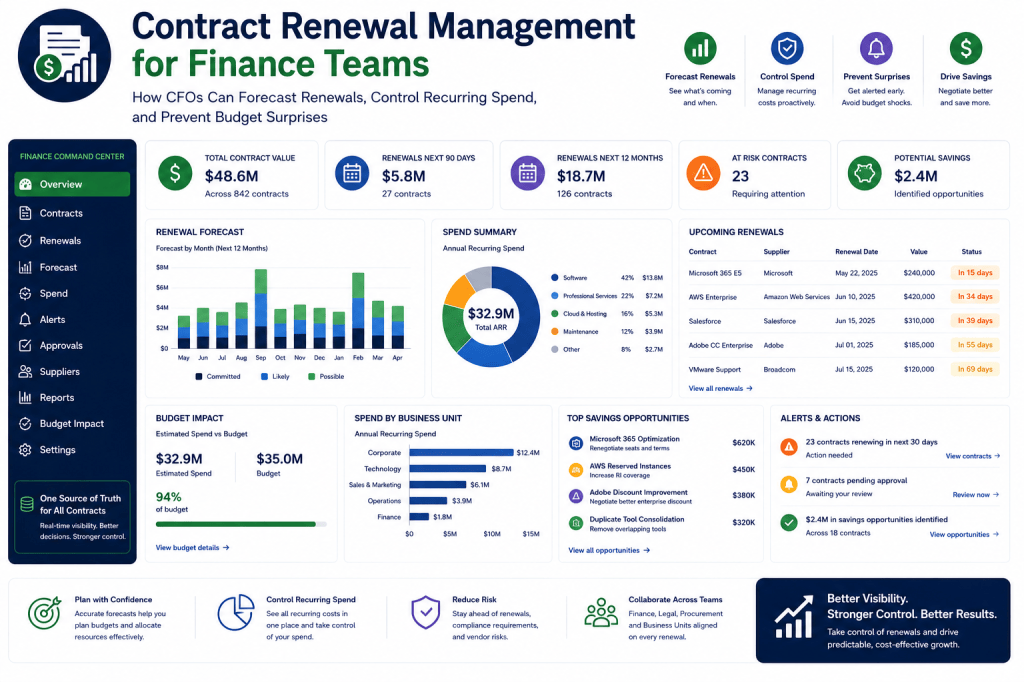
Why Contract Renewal Management Matters to Finance
Finance teams already track:
- budgets;
- forecasts;
- actual spend;
- purchase commitments;
- recurring costs;
- vendor payments.
But renewal dates often live somewhere else.
They may sit in:
- procurement spreadsheets;
- contract repositories;
- calendar reminders;
- department files;
- supplier emails.
That separation creates a blind spot.
The financial system may show what the organization is paying today.
It may not show:
Which contracts will create new commitments next quarter?
That is where renewal management becomes strategically important.
Want Better Visibility into Upcoming Contract Spend?
Finance should not need to wait for a purchase request or supplier invoice to discover that a major renewal is approaching.
Contract Renewal Tracker is designed to give finance teams forward-looking visibility into contract commitments, supplier increases, approval requirements, renewal scenarios, and upcoming budget exposure.
See recurring contract spend before it becomes committed →
The Finance Renewal Lifecycle
A finance-oriented renewal process might look like:
Upcoming Contract
↓
Renewal Exposure Identified
↓
Budget Impact Assessed
↓
Commercial Scenario Reviewed
↓
Finance Approval
↓
Commitment Authorized
↓
Renewal Executed
↓
Forecast Updated
↓
Actual Spend Monitored
This creates a direct connection between contract operations and financial planning.
Renewal Spend Is Different from Current Spend
Suppose a supplier contract costs:
€500,000 per year
That is current spend.
But the upcoming renewal might be:
€550,000 per year for three years
Now the organization is considering:
€1.65 million of future commitment
That is the number finance needs to understand.
Annual Value vs Total Commitment
A strong renewal system should show both.
For example:
Annual Contract Value: €550K
Term: 36 months
Total Commitment: €1.65M
This avoids understating long-term exposure.
Total Commitment Formula
A simplified formula is:
Annual Value × Contract Term
So:
€550,000 × 3
=
€1,650,000
For more complex agreements, the system may also include:
- implementation fees;
- scheduled price increases;
- minimum usage charges;
- one-time costs.
Committed Spend vs Discretionary Spend
One useful finance distinction is:
Committed Spend
The organization is already contractually obligated.
Discretionary Renewal Spend
The organization still has the option to renew, renegotiate, reduce, or terminate.
This matters because discretionary renewal spend represents an opportunity for cost control.
Example Spend Classification
Suppose next year’s recurring supplier spend is projected at:
€40M
Of that:
Already committed:
€28M.
Up for renewal:
€12M.
That €12M deserves special attention because it may still be influenced.
Renewal Spend at Risk of Becoming Committed
Now suppose:
Of the €12M up for renewal:
€4.2M has notice deadlines within 60 days.
€1.1M remains undecided.
That €1.1M is financially significant.
The system can flag:
€1.1M of contract spend may become committed without a completed renewal decision.
That is a finance issue, not merely a contract-management issue.
Renewal Forecasting
Finance should be able to forecast future contract spend by horizon.
For example:
Next 30 Days
€1.8M
Next 90 Days
€6.4M
Next 180 Days
€13.2M
Next 12 Months
€31.8M
This provides forward-looking visibility.
Forecast by Business Unit
For example:
IT:
€12.4M.
Marketing:
€4.2M.
Operations:
€6.8M.
HR:
€2.1M.
Finance:
€1.6M.
Other:
€4.7M.
This helps budget owners understand where renewal exposure is concentrated.
Forecast by Supplier
A supplier-level view might show:
ExampleCloud:
€4.8M renewing.
Global Telecom:
€2.9M.
DataWorks:
€1.6M.
This helps finance understand concentration and cash-flow impact.
Forecast by Month
For example:
January:
€1.2M.
February:
€2.4M.
March:
€5.7M.
April:
€1.8M.
May:
€3.9M.
June:
€6.1M.
This can support cash planning and approval workload.
Budget Surprise Prevention
One of the strongest use cases is preventing unexpected increases.
Suppose:
Current budget:
€900K.
Supplier renewal proposal:
€1.05M.
Budget variance:
+€150K
If finance learns this two weeks before signature, options may be limited.
If it learns 120 days earlier, the organization can:
- challenge pricing;
- reduce scope;
- adjust quantities;
- seek alternatives;
- reallocate budget.
That is much more valuable.
Price Increase Visibility
A finance dashboard could show:
Proposed Supplier Increases
Average:
7.8%
Contracts above 10%:
18
Potential annual increase:
€1.4M
That allows finance to focus attention where budget pressure is highest.
Price Increase by Category
For example:
Cloud:
+9%.
Cybersecurity:
+11%.
Professional Services:
+6%.
Telecom:
+4%.
Marketing Software:
+13%.
This can reveal inflation hotspots.
Separate Quantity Growth from Price Inflation
Suppose software spend rises:
€500K → €620K.
That may look like:
24% increase.
But if users grew from:
1,000 → 1,300
the unit economics may have improved.
The system should distinguish:
Volume Increase
from:
Unit Price Increase
Finance needs both.
Budget Baseline vs Supplier Proposal
A useful renewal record could show:
Budget: €540K
Current Spend: €500K
Supplier Proposal: €575K
Procurement Target: €520K
This creates a common financial view across teams.
Scenario Planning
Finance should be able to compare possible renewal outcomes.
For example:
Scenario A — Renew as Proposed
€575K
Scenario B — Negotiated Target
€520K
Scenario C — Reduce Scope
€470K
Scenario D — Replace Supplier
€440K + €150K migration
This supports better decisions.
Multi-Year Scenario Comparison
Suppose:
Current supplier:
€520K/year.
Alternative:
€450K/year.
Migration:
€180K.
Three-year view:
Current Supplier
€1.56M
Alternative
€1.35M + €180K
=
€1.53M
The difference is only:
€30K over three years
Switching may not be worth the operational disruption.
This is why finance should look at TCO, not only annual price.
Total Cost of Ownership
Finance may want to include:
Subscription
Implementation
Migration
Support
Training
Internal Effort
This creates a more realistic renewal decision.
Finance Approval Controls
High-value renewals should route through defined financial authority.
For example:
Under €50K:
Business owner.
€50K–€250K:
Department budget owner.
€250K–€1M:
Finance director.
Above €1M:
CFO.
The Contract Renewal Tracker can enforce these thresholds automatically.
Multi-Year Approval Thresholds
A common mistake is approving based on annual value only.
Suppose:
Annual spend:
€450K.
Term:
4 years.
Total commitment:
€1.8M.
Even if annual value is below the CFO threshold, total commitment may not be.
The approval engine should evaluate both.
Approval Brief for Finance
A finance approver could receive:
Renewal Request
Current Spend:
€500K.
Supplier Proposal:
€575K.
Final Negotiated Price:
€520K.
Budget:
€540K.
Variance:
−€20K.
Term:
24 months.
Total Commitment:
€1.04M.
Cost Avoidance:
€55K/year.
Risk:
Medium.
This makes the decision much faster.
Finance Should Not Approve Blindly
The approval package should include:
- business need;
- current spend;
- proposed spend;
- negotiated spend;
- budget;
- contract term;
- total commitment;
- savings;
- supplier risk.
Finance should not need to reconstruct the business case manually.
Prevent Reapproval Errors
Suppose finance approves:
€520K.
Then procurement changes the final deal to:
€560K.
The original approval should no longer remain valid.
The system should automatically trigger reapproval.
Material Change Rule
For example:
IF final_commitment > approved_commitmentTHEN finance_reapproval = REQUIRED
This helps maintain financial control.
Recurring Spend Management
Many organizations struggle with recurring supplier spend because it renews incrementally.
The renewal portfolio gives finance a way to separate:
Recurring Spend We Must Pay
from:
Recurring Spend We Can Still Influence
That is an important distinction.
SaaS Spend Control
For software contracts, finance can review:
- unused licenses;
- inactive users;
- duplicate tools;
- tier usage.
This can reduce recurring cost.
Example SaaS Savings
Current spend:
€300K.
Unused licenses:
€60K.
Supplier increase:
€20K.
Final renewal after optimization:
€250K.
Hard savings:
€50K.
Cost avoidance:
€70K.
This has a direct budget impact.
Cloud Commitment Control
Cloud agreements may create large future commitments.
Finance should understand:
- committed spend;
- actual consumption;
- forecast consumption.
If a customer is using only 75% of its commitment, renewal may be an opportunity to reduce it.
Telecom Spend Control
Telecom renewals can also reveal:
- inactive mobile subscriptions;
- unused circuits;
- closed locations.
These are recurring-cost opportunities.
Professional Services Renewals
Finance may ask:
Is the current scope still needed?
A consulting retainer that began at:
€300K/year
may no longer reflect current demand.
Renewal should force a fresh justification.
Avoiding Automatic Budget Inflation
If every supplier increases prices 5–10% and every contract renews automatically, recurring spend can increase materially without explicit strategic decisions.
A Contract Renewal Tracker can expose these increases before they become part of the baseline.
The Compounding Effect of Renewal Increases
Suppose:
Year 1:
€1M.
Annual increase:
7%.
Year 2:
€1.07M.
Year 3:
€1.145M.
Year 4:
€1.225M.
Small recurring increases become large over time.
Finance should track cumulative impact.
Control the Next Budget Before It Becomes the New Baseline
Recurring supplier spend can grow quietly when each renewal is treated as a local operational decision.
Contract Renewal Tracker can help finance teams identify proposed increases, compare them with budget and actual usage, and intervene before new pricing becomes embedded in the next financial year.
Turn upcoming renewals into active budget decisions →
Renewal Spend Forecast vs Budget
A finance dashboard could show:
Budget:
€35M.
Expected Renewal Spend:
€36.8M.
Variance:
+€1.8M.
Potential Optimization:
€1.4M.
Target Outcome:
€35.4M.
This connects procurement action directly to budget management.
Forecast Confidence
Not every renewal outcome is known.
The system can distinguish:
Approved
Likely
Negotiating
Undecided
This creates a weighted forecast.
Example Weighted Forecast
Approved:
€12M at 100%.
Likely:
€8M at 90%.
Negotiating:
€6M at 75%.
Undecided:
€4M at 50%.
Finance can use weighted assumptions to estimate future exposure.
Renewal Scenario Forecasting
A stronger model could compare:
Baseline
Renew as proposed.
€39M.
Expected
Current negotiation assumptions.
€36.5M.
Optimized
Apply identified savings opportunities.
€34.8M.
This gives leadership a range.
Forecasting by Quarter
Q1:
€8.1M.
Q2:
€6.7M.
Q3:
€9.4M.
Q4:
€12.6M.
This helps FP&A understand when renewal pressure is highest.
Contract Accrual Considerations
Some renewals may affect accruals or expense recognition.
The tracker does not need to become the accounting ledger.
But it can provide finance with:
- expected start date;
- total commitment;
- invoice schedule;
- payment terms.
That information can support planning.
Payment Terms
Renewal negotiation may affect cash flow even when total price stays constant.
For example:
Current:
Annual upfront.
Renewed:
Quarterly.
Or:
Net 30 → Net 60.
Finance may value these changes.
Cash-Flow Impact
Suppose:
€1.2M contract.
Annual upfront:
€1.2M January cash outflow.
Quarterly:
€300K every quarter.
The economics are similar, but cash-flow timing changes significantly.
Finance should see that.
Multi-Year Payment Structure
A three-year contract might have:
Year 1:
€500K.
Year 2:
€525K.
Year 3:
€550K.
The platform should not simplify this to:
€500K × 3.
Scheduled increases matter.
Finance Renewal Dashboard
A dedicated finance dashboard could show:
Upcoming 12-Month Renewals
€31.8M
Total Commitment Under Review
€46.2M
Budget Variance
+€1.6M
Proposed Supplier Increases
€2.2M
Savings Identified
€1.4M
Finance Approvals Pending
18
Multi-Year Commitments
€11.7M
This is directly relevant to CFO planning.
Finance Approval Queue
For example:
ExampleCloud
Total Commitment:
€2.4M.
Budget Variance:
−€100K.
Savings:
€180K.
Decision:
Approve.
CyberSecure
Commitment:
€1.1M.
Budget Variance:
+€120K.
Supplier Increase:
14%.
Decision:
Review.
This makes approvals decision-ready.
Finance Exception Reporting
Finance does not need to review every renewal.
It may focus on:
- budget variance >5%;
- commitment >€500K;
- supplier increase >10%;
- multi-year contract;
- high-risk supplier;
- exception to policy.
The system can automatically surface these.
Avoid Approval Overload
Low-value renewals should not flood finance.
For example:
IF total_commitment < €50,000AND budget_variance <= 0AND risk = LOWTHEN finance_approval = NOT_REQUIRED
This keeps finance focused on material events.
Cost Avoidance Reporting
Finance should clearly distinguish cost avoidance from hard savings.
Example:
Current spend:
€1M.
Supplier proposal:
€1.1M.
Final renewal:
€1.02M.
Hard savings:
None.
Cost avoidance:
€80K
The organization still spends more than last year, but less than it would have under the original proposal.
Avoided Spend
Suppose a contract costing:
€180K/year
is terminated.
That becomes:
Avoided Future Spend: €180K/year
This is different again.
The system should keep the categories distinct.
Finance-Validated Savings
A useful workflow is:
Procurement Records Value
↓
Finance Reviews
↓
Finance Validates
↓
Included in Official Reporting
This improves confidence in ROI reporting.
Savings Audit Trail
Finance should be able to ask:
How was this €90K saving calculated?
The system shows:
Previous spend.
Supplier proposal.
Final price.
Scope changes.
Quantity changes.
This makes the figure defensible.
Cost of Inaction
CFOs may also want to understand the financial cost of weak renewal management.
Possible sources include:
- unwanted auto-renewals;
- unchallenged increases;
- unused software;
- duplicate vendors;
- emergency procurement.
These can become part of the business case for Contract Renewal Tracker.
Example Cost-of-Inaction Model
Annual managed spend:
€20M.
Potential leakage:
Unwanted renewals:
€120K.
Unchallenged increases:
€180K.
Unused licenses:
€220K.
Administrative inefficiency:
€40K.
Total:
€560K
Even recovering a portion creates a strong SaaS ROI case.
One Missed Renewal Can Be a Material Financial Event
Suppose:
Annual contract:
€400K.
Auto-renewal term:
24 months.
Potential commitment:
€800K
A missed notice window can have a larger financial impact than many ordinary operating expenses.
That makes renewal governance a legitimate finance-control issue.
Finance and Procurement Collaboration
Procurement asks:
Can we get a better deal?
Finance asks:
Can we afford the commitment?
The Contract Renewal Tracker should give both teams the same facts.
Shared Commercial View
For example:
Current Spend:
€500K.
Supplier Proposal:
€575K.
Procurement Target:
€520K.
Budget:
€540K.
Final Outcome:
€515K.
Both teams see the same record.
That reduces reconciliation work.
Finance and Business Owners
Business owners answer:
Do we still need this?
Finance answers:
Can we justify and fund it?
These decisions should be connected.
Finance and Legal
Legal may change contract terms that affect financial exposure.
Examples include:
- termination fees;
- minimum commitments;
- escalation clauses.
Finance should see material changes before approval.
AI for Finance Renewal Management
The AI Contract Renewal Assistant could help CFO teams ask:
What are our largest upcoming commitments?
Which renewals are over budget?
Which supplier increases are driving the forecast?
Where can we reduce recurring spend?
The assistant can summarize the renewal portfolio in financial terms.
Example AI Finance Brief
€18.2M of contract value is scheduled for renewal during the next six months. Current supplier proposals would increase annual spend by approximately €1.1M. Procurement has identified €720K of active optimization opportunities, leaving a net projected increase of roughly €380K if current negotiations succeed.
This is executive-ready.
AI Scenario Analysis
A CFO could ask:
What happens if we accept all current supplier proposals?
The system might answer:
Projected annual spend:
€38.1M.
Current budget:
€36.4M.
Variance:
+€1.7M
Then:
What if procurement achieves its targets?
Projected spend:
€36.7M.
Variance:
+€300K
This makes the renewal portfolio much easier to understand.
AI Should Use Verified Financial Data
Financial analysis should clearly identify sources.
For example:
Current Spend: ERP
Supplier Proposal: Renewal workspace
Budget: Finance system
Contract Terms: Contract Renewal Tracker
This improves trust.
Renewal ROI Dashboard for the CFO
A CFO-facing ROI view might show:
Annual SaaS Cost
€15K
Hard Savings
€420K
Cost Avoidance
€610K
Avoided Spend
€280K
Productivity Value
€45K
Finance-Validated Value
€1.31M
This can make the software’s own renewal easier to justify.
Finance KPI Examples
Useful metrics include:
Upcoming Renewal Value
Total Commitment Under Review
Budget Variance
Average Supplier Increase
Multi-Year Commitment Exposure
Finance Approval Cycle Time
Validated Savings
Avoided Spend
Undecided Renewal Value
These make renewal management measurable from a finance perspective.
Undecided Value Is a Powerful Metric
Suppose:
€7M renews in 90 days.
€5.8M has decisions.
€1.2M is still undecided.
That €1.2M represents uncertainty in the financial forecast.
Reducing it improves planning.
Finance Approval SLA
For example:
Target:
3 business days.
Actual:
5.4.
Overdue:
11 approvals.
This may create renewal risk.
The Contract Renewal Tracker can highlight the bottleneck.
Recurring Spend Governance
Finance may establish policies such as:
Contracts Above €100K
Budget validation required.
Price Increase Above 8%
Finance director review.
Multi-Year Commitment
CFO approval.
Unbudgeted Renewal
Exception workflow.
The SaaS can enforce these rules automatically.
Unbudgeted Renewal Workflow
For example:
IF renewal_budget_status = UNBUDGETEDTHEN create_finance_exceptionAND require_budget_owner_justification
This prevents accidental commitments.
Renewal Budget Owner
Every material contract can have:
Business Owner
and:
Budget Owner
These may be different people.
The system should support both.
Finance Portfolio Reporting
Reports can include:
- commitments by month;
- spend by business unit;
- supplier increases;
- savings;
- multi-year contracts;
- approvals.
This reduces repeated spreadsheet preparation.
Scheduled CFO Brief
A weekly summary could say:
Contract Renewal Finance Brief
Upcoming 90-Day Commitments:
€8.6M.
Over-Budget Proposals:
€740K.
Finance Approvals Pending:
Validated Savings YTD:
€1.2M.
Highest-Risk Commitment:
ExampleCloud — €2.4M.
This gives finance a concise operating view.
Contract Renewal Tracker as a Financial-Control Platform
This is an important positioning opportunity.
The product does not need to become an ERP.
Its role is different.
The ERP answers:
What did we spend?
Contract Renewal Tracker can answer:
What are we about to commit to, and do we still have time to change it?
That is a highly valuable financial-control capability.
From Historical Spend to Forward-Looking Control
Traditional finance reporting is often backward-looking.
It explains what happened.
Renewal intelligence is forward-looking.
It asks:
What is coming?
What is still negotiable?
What could increase?
What can be reduced?
What requires approval?
That can make contract renewal management highly relevant to CFO organizations.
Ready to Bring Contract Renewals into Financial Planning?
Contract renewals should not arrive in finance as last-minute purchase requests.
Contract Renewal Tracker is designed to give CFOs and finance teams earlier visibility into recurring contract spend and future commitments.
Use Contract Renewal Tracker to:
- forecast upcoming renewal spend;
- distinguish annual value from total commitment;
- identify contracts above budget;
- track supplier price increases;
- model renewal scenarios;
- control multi-year commitments;
- route finance approvals;
- validate savings;
- monitor avoided spend;
- forecast recurring-cost changes;
- identify undecided financial exposure;
- create CFO renewal dashboards;
- measure the ROI of better renewal management.
The objective is to move from:
Reactive Approval
to:
Forward-Looking Financial Control
See the commitment before you approve it. Influence the spend before it renews.
Start Your Contract Renewal Tracker Subscription →
Final Thoughts
Contract renewal management is naturally a finance problem because every renewal has an economic consequence.
The decision can:
Increase Spend
Maintain Spend
Reduce Spend
Create Multi-Year Commitment
or:
Eliminate Spend
Finance should therefore have visibility before the decision is finalized.
A strong renewal process connects:
Contract
↓
Upcoming Commitment
↓
Budget
↓
Commercial Scenario
↓
Approval
↓
Forecast
↓
Actual Outcome
That gives CFOs more control over recurring supplier spend.
The most important financial question is not:
How much are we paying today?
It is:
How much are we about to commit to tomorrow—and can we still change it?
That is where Contract Renewal Tracker can create value for finance teams.
Next Article in the Contract Renewal Tracker Series
Article 35 — “Contract Renewal Management for Legal Teams: How to Control Notice Periods, Termination Rights, Amendments, and Renewal Risk”
The next article will target General Counsel, Legal Operations, commercial lawyers, contract managers, and legal teams. It will cover notice-clause verification, termination methods, document hierarchy, conflicting amendments, renewal-risk review, legal approval workflows, contract versioning, notice evidence, legal workload prioritization, AI clause extraction, grounded legal Q&A, and how Contract Renewal Tracker can help legal teams focus on the renewals where contractual risk actually requires attention.

