Enterprise contract renewal management is fundamentally different from managing a few hundred agreements.
At enterprise scale, the challenge is not merely volume.
It is complexity.
A global organization may manage contracts across:
- dozens of countries;
- multiple legal entities;
- hundreds of business units;
- regional procurement teams;
- shared-service centers;
- centralized legal functions;
- local finance organizations;
- thousands of contract owners;
- multiple currencies;
- different approval structures;
- different regulatory environments.
The organization may have tens of thousands of active agreements, each with its own:
- expiration date;
- notice period;
- renewal mechanism;
- owner;
- supplier;
- contractual value;
- renewal workflow;
- approval requirements.
At that scale, renewal management becomes an enterprise operating model.
The question is no longer:
Which contracts expire next month?
It becomes:
How do we govern thousands of renewal decisions consistently across the enterprise while preserving local responsibility, regional differences, security boundaries, and management visibility?
A dedicated Contract Renewal Tracker can provide the renewal operations layer required to coordinate that complexity.
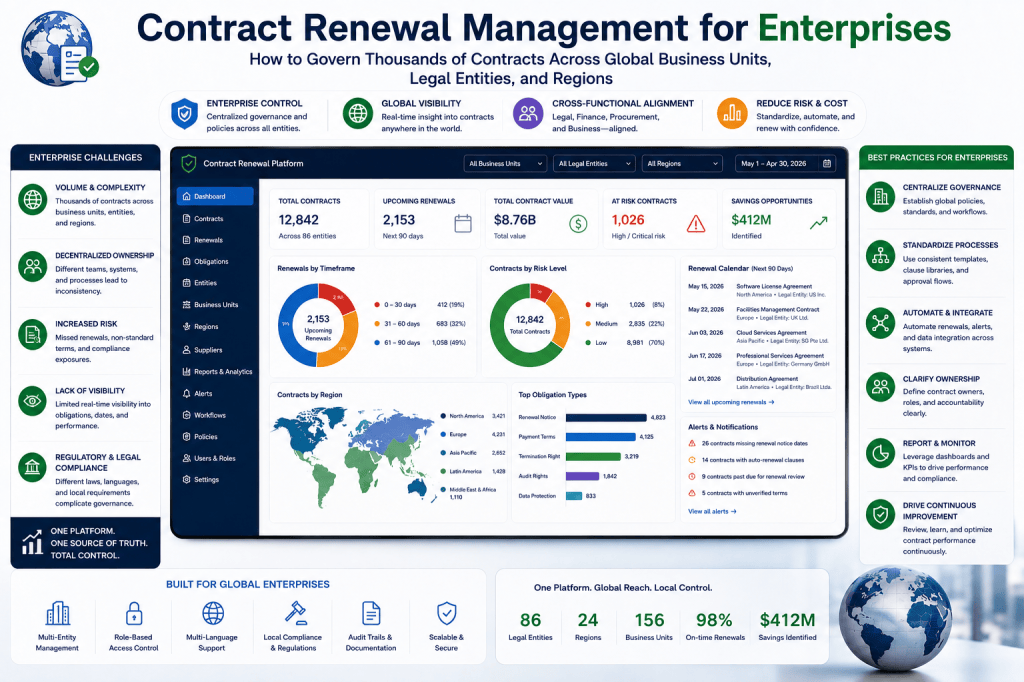
Why Enterprise Renewal Management Is Different
Enterprise organizations rarely have one simple contract process.
Instead, they often operate several models simultaneously.
For example:
Europe may use centralized procurement.
North America may use decentralized category teams.
APAC may require local legal review.
Some subsidiaries may have independent financial authority.
Strategic suppliers may be governed globally.
Smaller suppliers may be managed locally.
A scalable renewal platform therefore needs both:
central governance
and:
local flexibility.
Managing Thousands of Renewals Across Multiple Systems?
When contract data is spread across regions, subsidiaries, procurement systems, shared drives, CLM platforms, ERP applications, and local spreadsheets, enterprise leadership can lose visibility into the total renewal exposure.
Contract Renewal Tracker is designed to create a common renewal operating layer across entities and regions while preserving local ownership, permissions, workflows, and approval authority.
Create enterprise-wide renewal control without centralizing every decision →
The Enterprise Renewal Hierarchy
A global contract portfolio may need a hierarchy such as:
Enterprise
↓
Region
↓
Country
↓
Legal Entity
↓
Business Unit
↓
Department
↓
Supplier
↓
Contract
This enables both centralized and local views.
Enterprise-Level View
Corporate leadership may want to see:
Global Contract Portfolio
Active Contracts:
24,800
Annual Contract Value:
€1.7B
Renewing Next 12 Months:
€740M
High/Critical Renewal Risk:
€118M
Auto-Renewal Exposure:
€260M
Strategic Suppliers:
142
This provides a global picture.
Regional View
Europe might show:
Contracts:
7,200.
Annual Value:
€510M.
Renewing Next 12 Months:
€220M.
Critical Renewals:
APAC can see its own portfolio.
North America can see its own.
The global dataset remains connected.
Legal Entity View
A multinational group may contain dozens or hundreds of contracting entities.
For example:
Parent Company.
Netherlands BV.
Germany GmbH.
France SAS.
UK Ltd.
US Inc.
Singapore Pte Ltd.
Each entity may have:
- different contracts;
- different approvers;
- different currencies;
- different local governance.
The system should preserve these distinctions.
Enterprise vs Local Ownership
A contract may belong legally to:
ExampleCorp Netherlands BV
but operationally serve:
Global IT
This means the tracker may need several ownership dimensions:
Legal Entity
Business Owner
Commercial Owner
Technical Owner
Regional Owner
This gives a more accurate enterprise model.
Centralized Governance
Global organizations may establish corporate renewal policies.
For example:
All strategic contracts must:
- start renewal review 270 days before notice deadline;
- receive procurement review;
- receive finance approval above €1M;
- receive legal review when terms change.
These rules can be centrally managed.
Local Flexibility
Regions may still need their own rules.
For example:
Europe:
Legal review above €250K.
US:
Legal review above $500K.
Japan:
Local signatory approval.
The platform should support policy inheritance plus regional override where authorized.
Policy Hierarchy
A possible model is:
Global Policy
↓
Regional Policy
↓
Legal Entity Policy
↓
Contract-Specific Exception
This provides structure without forcing every contract into one rigid process.
Example Policy Inheritance
Global rule:
Strategic contracts start 180 days before notice deadline.
European rule:
Strategic contracts start 240 days before notice deadline.
Contract-specific exception:
Critical outsourcing agreement starts 365 days before deadline.
The most specific valid rule applies.
Federated Renewal Governance
Many large organizations benefit from a federated model.
Central teams define:
- standards;
- controls;
- reporting;
- risk thresholds.
Regional and local teams execute:
- business reviews;
- negotiations;
- approvals.
The Contract Renewal Tracker becomes the coordination layer.
Central vs Federated Model
Fully Centralized
Global contract team manages most renewals.
Advantages:
- consistency;
- consolidated leverage.
Challenges:
- scalability;
- local context.
Fully Decentralized
Regions manage independently.
Advantages:
- local speed;
- local knowledge.
Challenges:
- inconsistent controls;
- weak global visibility.
Federated
Central policy + local execution.
For many enterprises, this is the most practical model.
Global Contract Ownership
Ownership complexity increases dramatically at enterprise scale.
A strategic software contract may have:
Global Business Owner
CIO.
Technical Owner
Enterprise Architecture.
Regional Owners
Europe, Americas, APAC.
Procurement Owner
Global Category Lead.
Legal Owner
Commercial Legal.
The system should support multiple roles.
Ownership Inheritance
A subsidiary may inherit ownership from a regional team unless a local owner is assigned.
For example:
Regional Procurement Lead:
Europe.
Local contract:
Belgium.
No local procurement owner.
System defaults to:
Europe Procurement Lead.
This reduces unassigned contracts.
Owner Reconciliation at Scale
When employees move or leave, hundreds of contracts may be affected.
Suppose a regional IT director leaves and owns:
142 contracts.
The platform can automatically identify them.
Then:
Ownership Exception Created
↓
Regional Manager Notified
↓
Contracts Reassigned in Bulk
This prevents large ownership gaps.
Enterprise SSO
At enterprise scale, SSO becomes almost essential.
Users should authenticate through the corporate identity provider.
Benefits include:
- centralized authentication;
- MFA enforcement;
- easier onboarding;
- immediate offboarding.
The SaaS should not require thousands of independent passwords.
SCIM Provisioning
Automated provisioning becomes valuable when user populations are large.
For example:
Employee joins:
Global-Procurement-Europe
The user automatically receives:
Procurement Role
Europe Scope
When removed from the group:
access changes automatically.
This reduces administrative work.
Role-Based Access Control
Enterprise RBAC may include roles such as:
- Contract Owner;
- Regional Procurement;
- Global Procurement;
- Legal Reviewer;
- Finance Approver;
- Executive;
- Audit Viewer;
- Administrator.
Roles determine capabilities.
Scope determines which data is visible.
Attribute-Based Access
Large enterprises may eventually require controls beyond basic roles.
For example:
User may see contract if:
Region = Europe
AND
Business Unit = IT
AND
Contract Category = Software
This is closer to attribute-based access control.
It can support complex organizations.
Restricted Contracts
Certain agreements may require additional protection.
Examples include:
- M&A;
- executive compensation;
- litigation;
- strategic transactions;
- board-level agreements.
These can be explicitly restricted regardless of broad organizational roles.
Field-Level Confidentiality
A global contract record may be broadly visible while certain fields remain restricted.
For example:
General users can see:
- supplier;
- deadline;
- owner.
Only procurement can see:
- target price;
- benchmark;
- walk-away threshold.
Only legal can see:
- privileged legal commentary.
This protects sensitive information.
Segregation of Duties
Enterprise governance often requires separation between:
Requester
Negotiator
Approver
Signatory
A Contract Renewal Tracker can enforce this.
For example:
IF negotiation_owner = finance_approverAND commitment_value > €1,000,000THEN approval_route = alternate_authorized_approver
This supports stronger internal control.
Global Approval Policies
Approval authority may vary by:
- contract value;
- legal entity;
- currency;
- category;
- region.
The approval engine should calculate the correct route.
Example Global Approval Matrix
Under €100K Equivalent
Local budget owner.
€100K–€500K
Regional finance.
€500K–€2M
Regional CFO.
€2M–€10M
Group CFO.
>€10M
Executive Committee.
Thresholds would be configured by the customer.
Currency Conversion for Approval
A contract may be denominated in:
USD.
Approval policy may be defined in:
EUR.
The system can calculate an approval-equivalent value according to the organization’s FX policy.
For example:
Contract:
$2.8M.
Policy Equivalent:
€2.45M.
Required approval:
Group CFO.
The original currency remains preserved.
Multi-Currency Reporting
Global portfolios require normalization.
A dashboard should support:
Original Contract Currency
and:
Reporting Currency
For example:
USD:
$320M.
EUR:
€410M.
GBP:
£85M.
Consolidated enterprise equivalent:
€740M.
This makes financial exposure comparable.
Exchange-Rate Policy
Organizations should define whether portfolio reporting uses:
- current FX;
- budget FX;
- contract-date FX;
- monthly average.
Consistency is more important than choosing one universal methodology.
The system should record the method used.
Enterprise Renewal Waves
Large organizations can have massive renewal concentrations.
For example:
Q1:
2,800 renewals.
Q2:
4,200.
Q3:
3,100.
Q4:
5,900.
This is not only a contract-management problem.
It is a capacity-planning problem.
Renewal Value by Quarter
Count may tell one story.
Value may tell another.
| Quarter | Renewals | Value |
|---|---|---|
| Q1 | 2,800 | €140M |
| Q2 | 4,200 | €185M |
| Q3 | 3,100 | €105M |
| Q4 | 5,900 | €310M |
Q4 is clearly the major commercial period.
Enterprise Capacity Planning
The tracker can forecast workload for:
- procurement;
- legal;
- finance;
- contract operations;
- executive approvals.
Suppose Q4 contains:
180 strategic supplier renewals.
Historical procurement capacity:
The system can flag:
Strategic renewal workload is projected to exceed current capacity by 50%.
Now management can act months earlier.
Global Legal Capacity
Legal may face:
240 contract reviews in October.
Regional capacity:
The company can:
- start reviews earlier;
- shift work;
- engage outside counsel;
- fast-track unchanged agreements.
This is a major enterprise planning benefit.
Global Approval Workload
Suppose:
€180M of commitments require Group CFO approval during Q4.
The system can identify the queue in advance.
This prevents end-of-quarter bottlenecks.
Enterprise Supplier Concentration
Global organizations often have strategic suppliers with dozens or hundreds of agreements.
For example:
ExampleCloud
Contracts:
186
Countries:
32
Annual Spend:
€84M
Renewing Next 12 Months:
€52M
Business Units:
18
Supplier Dependency:
Critical
This is not a normal renewal.
It is a strategic supplier event.
Global Supplier Aggregation
The platform should group related supplier entities.
For example:
ExampleCloud Inc.
ExampleCloud Europe BV.
ExampleCloud Japan KK.
ExampleCloud UK Ltd.
These may remain legally distinct but belong to:
ExampleCloud Group
This enables global spend and renewal analysis.
Supplier Family Hierarchy
A supplier structure might be:
Parent Supplier
↓
Regional Entity
↓
Local Contract
This is essential for multinational procurement.
Global Negotiation Opportunities
Suppose:
20 regional contracts renew separately.
Total value:
€40M.
A global category manager may decide to:
consolidate negotiation
and establish:
global framework agreement.
The renewal platform helps identify that opportunity.
Co-Termination Across Regions
Contracts with the same supplier may renew in:
March.
June.
September.
December.
The organization may gradually align them to one strategic renewal date.
This can improve:
- negotiation leverage;
- administration;
- forecasting.
Global Supplier Strategy
The enterprise may classify the supplier relationship as:
Grow
Maintain
Consolidate
Diversify
Exit
Individual contract renewals should ideally align with this global strategy.
Strategic Supplier Governance
For critical suppliers, the renewal workflow may require:
Global Category Review
↓
Vendor Management Review
↓
Regional Input
↓
Risk Review
↓
Executive Strategy
↓
Negotiation
↓
Approval
This is much more sophisticated than a simple reminder.
Enterprise Contract Categories
Different categories may have global playbooks.
Examples:
- software;
- cloud;
- telecom;
- logistics;
- facilities;
- professional services;
- insurance;
- outsourcing.
Each may have different lead times and review requirements.
Global Playbook, Local Execution
For example:
Global Software Renewal Playbook:
180 Days
Usage review.
150 Days
Business need.
120 Days
Procurement assessment.
90 Days
Negotiation.
45 Days
Approvals.
Every region follows the core structure.
Local rules can add additional steps.
Regional Compliance Steps
A region may add:
Data Privacy Review
or:
Local Legal Approval
without changing the global playbook.
This supports regulatory variation.
Portfolio Automation at Scale
At enterprise scale, automation becomes essential.
Suppose overnight the system evaluates:
24,800 contracts.
It identifies:
213 entering a renewal window.
17 becoming high risk.
6 with inactive owners.
4 with new critical data-quality issues.
The system can automatically create the appropriate work.
Humans focus on exceptions.
Exception-Based Enterprise Operations
The organization should not expect administrators to review all 24,800 contracts manually.
Instead:
Today
Critical Renewals:
Missing Owners:
Late Approvals:
Conflicting Notice Terms:
Strategic Negotiations Behind Schedule:
This makes the portfolio manageable.
Global Risk Model
Enterprise renewal risk can combine:
Deadline Urgency
Financial Value
Auto-Renewal Exposure
Supplier Criticality
Country Risk
Data Quality
Workflow Status
Approval Status
The result is a portfolio-wide priority system.
Global Risk Example
Global Outsourcing Agreement
Value:
€28M.
Countries:
Notice Deadline:
74 days.
Supplier Dependency:
Critical.
Negotiation:
Behind Schedule.
Legal Review:
Incomplete.
Renewal Risk:
97 — Critical
This should appear at senior-management level.
Regional Risk Thresholds
Not every region may use the same financial thresholds.
But the risk engine can still normalize outcomes into:
Low
Medium
High
Critical
This allows global reporting.
Enterprise Data Quality
Large portfolios inevitably contain:
- duplicate suppliers;
- conflicting dates;
- missing owners;
- old amendments;
- missing values.
A global data-quality program is necessary.
Data Quality by Region
For example:
Europe:
96%.
North America:
93%.
APAC:
88%.
LATAM:
84%.
This helps central operations target remediation.
Critical Data Coverage
Global management may care especially about:
Verified Notice Periods
Verified Auto-Renewal Status
Active Ownership
Contract Value Coverage
These metrics indicate how trustworthy renewal forecasts are.
Data Stewardship Model
Enterprise organizations can assign responsibility.
Local Business
Business need.
Procurement
Commercial data.
Legal
Contract terms.
Finance
Financial values.
Contract Operations
Data governance.
This distributes responsibility while maintaining central standards.
Enterprise Integrations
A global deployment may need connections to:
- ERP;
- CLM;
- procurement;
- HR;
- identity;
- e-signature;
- data warehouse;
- ITSM;
- supplier-risk systems.
The Contract Renewal Tracker can operate as a specialized renewal layer.
CLM Integration
If the enterprise already uses CLM:
CLM
remains the contract repository.
Contract Renewal Tracker receives:
- active contract metadata;
- renewal terms;
- documents.
Then it manages:
- renewal workflows;
- negotiation;
- risk;
- portfolio reporting.
This reduces duplication.
ERP Integration
ERP provides:
- actual spend;
- vendor master;
- purchase orders;
- cost centers.
The renewal tracker adds:
- future renewal exposure;
- decisions;
- workflows.
Together they provide a stronger financial picture.
HR Integration
HR can keep:
- employee status;
- organizational hierarchy;
- managers.
This helps with:
- owner reassignment;
- escalation;
- access.
At enterprise scale, this automation is essential.
Data Warehouse Integration
Large organizations may want renewal data in their analytics environment.
The system can expose:
- renewal pipeline;
- risk;
- commitments;
- savings;
- supplier exposure.
This allows enterprise-wide reporting.
API-First Enterprise Architecture
Enterprise customers may require:
- REST APIs;
- webhooks;
- event feeds;
- bulk data exports.
This allows the platform to integrate with custom internal systems.
Integration Governance
Not every regional administrator should be able to connect enterprise systems.
Integration permissions may be restricted to:
Global Administrators
or:
Security-approved Integration Managers
This is part of enterprise governance.
Data Residency
Multinational customers may have requirements around where data is stored or processed.
A mature SaaS roadmap may need to consider:
- regional hosting;
- data residency;
- cross-border transfer controls.
These requirements vary by customer and jurisdiction.
Data Retention by Region
Some customers may require different retention policies for different contract populations.
The system should eventually support appropriate governance where required.
Enterprise Auditability
Large organizations need to reconstruct:
- approval;
- ownership;
- document version;
- deadline change;
- policy exception.
The audit history should operate across the entire portfolio.
Global Audit Query
For example:
Show all contracts above €5M where notice deadlines were manually overridden during the last year.
Or:
Show renewals completed without required legal approval.
These queries support internal audit and compliance.
Policy Exceptions
Enterprise processes need controlled exceptions.
For example:
A critical supplier requires:
60-month term
when policy allows:
36 months.
The system can create:
Policy Exception
↓
Business Justification
↓
Legal Review
↓
Executive Approval
The exception remains visible.
Exception Analytics
Management may discover:
62% of contract-term exceptions occur in cloud infrastructure agreements.
That may indicate the policy needs review.
This is how portfolio data improves governance.
Enterprise Reporting
Different audiences require different levels.
Board / Executive
Financial exposure and strategic risk.
Group Procurement
Supplier and negotiation portfolio.
Regional Leadership
Regional commitments and exceptions.
Legal
Notice and contract-risk portfolio.
Contract Operations
Workflow and data quality.
All reports derive from the same system.
Executive Enterprise Dashboard
For example:
Global Renewal Exposure
Next 12 Months:
€740M.
High/Critical Risk
€118M.
Strategic Supplier Renewals
€240M.
Executive Decisions Required
€96M.
Identified Savings Opportunity
€38M.
This is enterprise renewal intelligence.
Region Drill-Down
Click:
Europe — €220M
Then:
Germany.
Then:
IT.
Then:
Supplier.
Then:
Contract.
The platform should support this progression.
Enterprise Procurement Dashboard
Global procurement may see:
Active Strategic Negotiations:
Supplier Increases >10%:
Consolidation Opportunities:
Potential Savings:
€38M.
This becomes a global commercial command center.
Global Finance Dashboard
Finance may see:
Renewal Commitments:
€740M.
Multi-Year Commitments Pending:
€310M.
Budget Variance:
+€24M.
Savings Forecast:
€18M.
Undecided Exposure:
€72M.
This supports planning.
Enterprise Legal Dashboard
Legal may see:
Notice Deadlines <30 Days:
Material Contract Changes:
Termination Notices Pending:
Unverified Critical Clauses:
This provides portfolio-scale workload visibility.
Enterprise Renewal Governance Meetings
The platform can support recurring operating rhythms.
Weekly
Critical exception review.
Monthly
Regional renewal review.
Quarterly
Strategic supplier review.
Annual
Enterprise renewal-planning cycle.
This embeds renewal management into governance.
Global Renewal Council
A large organization may establish a cross-functional renewal council for:
- strategic contracts;
- high-value commitments;
- critical suppliers.
The dashboard becomes the agenda.
AI at Enterprise Scale
AI can help management navigate enormous renewal portfolios.
For example:
What changed in our renewal risk this week?
The assistant might respond:
Global high-risk renewal exposure increased by €18.4M because six strategic supplier contracts entered their final 90-day notice windows and two major finance approvals became overdue.
That is much easier than manually analyzing thousands of records.
AI Regional Comparison
A leader could ask:
Why is APAC renewal risk higher than Europe?
The assistant might identify:
- more unverified notice terms;
- lower owner coverage;
- higher concentration of auto-renewing contracts.
This converts portfolio data into insight.
AI Strategic Supplier Brief
For a global supplier:
Summarize our ExampleCloud relationship.
The assistant could provide:
Annual Spend: €84M
Contracts: 186
Countries: 32
Upcoming Renewals: €52M
Supplier Performance: 79/100
Critical Issues: 6
Negotiation Status: Global strategy pending
This is executive-level supplier intelligence.
AI Must Respect Enterprise Permissions
A regional user must not receive global confidential data simply because they ask the AI.
The assistant must respect:
- tenant;
- region;
- entity;
- role;
- contract;
- field-level permissions.
AI security must use the same authorization model as the application.
AI and Data Residency
Enterprises may also require clear controls over:
- what data is sent to AI services;
- where processing occurs;
- retention;
- model training policies.
These become important enterprise sales questions.
Enterprise Availability and Resilience
Large organizations may expect stronger operational capabilities, including:
- backups;
- disaster recovery;
- monitoring;
- incident response;
- service availability targets.
These become part of enterprise trust.
Implementation at Enterprise Scale
An enterprise rollout should not attempt to migrate every contract at once unless there is a strong reason.
A phased model is often more manageable.
Phase 1 — Strategic Portfolio
Start with:
- top suppliers;
- high-value contracts;
- contracts renewing within 12 months.
This delivers immediate value.
Phase 2 — Regional Expansion
Add:
Europe.
North America.
APAC.
LATAM.
Regional teams validate data and ownership.
Phase 3 — Full Portfolio
Expand into:
- lower-value contracts;
- long-term future agreements;
- local supplier populations.
The system gradually becomes comprehensive.
Phase 4 — Integrations
Add:
ERP.
CLM.
HR.
SSO.
Supplier-risk systems.
This reduces ongoing manual maintenance.
Phase 5 — Optimization and AI
Once data quality is mature:
- predictive renewal timing;
- supplier consolidation;
- AI portfolio prioritization;
- savings intelligence.
The platform becomes increasingly strategic.
Enterprise Adoption Strategy
User training should be role-based.
Contract Owners
Simple renewal decision.
Procurement
Negotiation and savings.
Legal
Clause and notice review.
Finance
Commitment approval.
Executives
Exception-based decisions.
This prevents unnecessary complexity.
Regional Champions
Large rollouts may benefit from:
Regional Renewal Champions
They can help:
- validate ownership;
- monitor adoption;
- resolve data issues;
- support local teams.
This makes federated governance practical.
Enterprise Readiness Dashboard
A rollout dashboard might show:
Contracts Imported
18,400 / 24,800
Strategic Contracts Verified
100%
Owner Coverage
94%
Notice-Term Verification
91%
Regions Live
3 / 5
SSO Adoption
98%
This gives program leadership clear visibility.
Enterprise ROI
At large portfolio sizes, extremely small improvements can generate large financial value.
Suppose:
Annual contract spend:
€1B.
Renewing annually:
€450M.
A:
0.25%
improvement on renewing spend equals:
€1.125M
At:
1%
it becomes:
€4.5M
The software does not need to transform every contract to create significant value.
Administrative Scale
Suppose:
10,000 renewals annually.
Manual coordination:
30 minutes per renewal.
Total:
5,000 hours.
Automation that reduces this by 50% saves:
2,500 hours.
That can be substantial even before commercial savings are considered.
The Bigger Enterprise Value Is Control
The strongest enterprise business case is likely a combination of:
Risk Reduction
Commercial Savings
Financial Visibility
Operational Efficiency
Governance
No single metric captures the full value.
Contract Renewal Tracker as an Enterprise Renewal Operations Layer
The product’s enterprise position should remain clear.
It does not necessarily need to replace:
- ERP;
- CLM;
- procurement;
- HR;
- document management.
Instead, it can connect them around one specific problem:
Managing renewal decisions across the enterprise.
That focus can be a strength.
Why a Specialized Enterprise Layer Can Work
An enterprise may already have systems for:
Contracts
Spend
Users
Suppliers
But still lack a strong system for:
Renewal Action
Contract Renewal Tracker can fill that gap.
Move from Local Renewal Tracking to Enterprise Renewal Governance
Large organizations should not need to choose between complete centralization and uncontrolled local processes.
Contract Renewal Tracker is designed to support a federated model where global policies, regional execution, local ownership, supplier strategy, approvals, and portfolio reporting operate from the same renewal framework.
Use Contract Renewal Tracker to:
- manage thousands of contracts;
- model regions, entities, and business units;
- support global and local policies;
- enforce approval hierarchies;
- provide SSO and SCIM;
- apply role- and scope-based access;
- manage multiple currencies;
- consolidate strategic suppliers;
- forecast renewal waves;
- automate workflows at portfolio scale;
- monitor data quality;
- integrate with enterprise systems;
- maintain global audit trails;
- provide executive renewal intelligence;
- use AI to prioritize enterprise-level risk and opportunity.
The goal is not to centralize every decision.
It is to create consistent enterprise control around every decision.
Start Your Contract Renewal Tracker Subscription →
Final Thoughts
Enterprise renewal management requires a balance.
Too much decentralization creates:
- inconsistent processes;
- weak visibility;
- uncontrolled risk.
Too much centralization creates:
- bottlenecks;
- slow decisions;
- loss of local context.
A strong operating model combines:
Global Governance
Regional Policy
Local Ownership
Enterprise Visibility
Contract Renewal Tracker can provide the technical layer connecting those four elements.
The enterprise architecture becomes:
Global Portfolio
↓
Regional / Entity Scope
↓
Local Renewal Workflow
↓
Cross-Functional Review
↓
Approval
↓
Execution
↓
Global Reporting
That turns thousands of disconnected contract dates into a coherent renewal operating system.
For enterprise prospects, the value proposition is therefore not merely:
Never miss a renewal.
It is much broader:
Know what is renewing across the enterprise, know where the exposure sits, know which decisions require attention, and apply the right governance before hundreds of millions in future commitments become unavoidable.
Next Article in the Contract Renewal Tracker Series
Article 41 — “Contract Renewal Management for Multi-Entity and International Companies: How to Handle Currencies, Local Owners, Regional Policies, and Cross-Border Contract Portfolios”
The next article will go deeper into a specific enterprise pain point: international and multi-entity renewal operations. It will cover legal-entity ownership, regional autonomy, local currencies, FX normalization, local languages, timezone-aware reminders, jurisdiction-specific workflows, shared global suppliers, cross-border approvals, regional procurement, local legal review, intercompany visibility, and consolidated reporting.
This creates another strong prospect-focused article for international companies that have outgrown country-by-country contract spreadsheets.

