Cost-reduction programs often begin with a broad objective:
Reduce operating expenses by 5%.
The difficult part is turning that objective into specific, executable actions.
Where should the savings come from?
Which contracts can be changed?
Which suppliers should be renegotiated?
Which subscriptions can be reduced?
Which services can be terminated?
Which commitments are already fixed?
And, most importantly:
When do we still have enough time to act?
Contract renewals provide a natural answer.
Every renewal creates a temporary window in which the organization may be able to:
- reduce scope;
- challenge pricing;
- remove unused services;
- consolidate suppliers;
- rebid the contract;
- renegotiate terms;
- terminate the agreement;
- avoid a proposed increase.
That makes upcoming renewals one of the most practical foundations for a CFO- and procurement-led cost-reduction program.
A dedicated Contract Renewal Tracker can turn those renewal opportunities into a measurable savings pipeline.
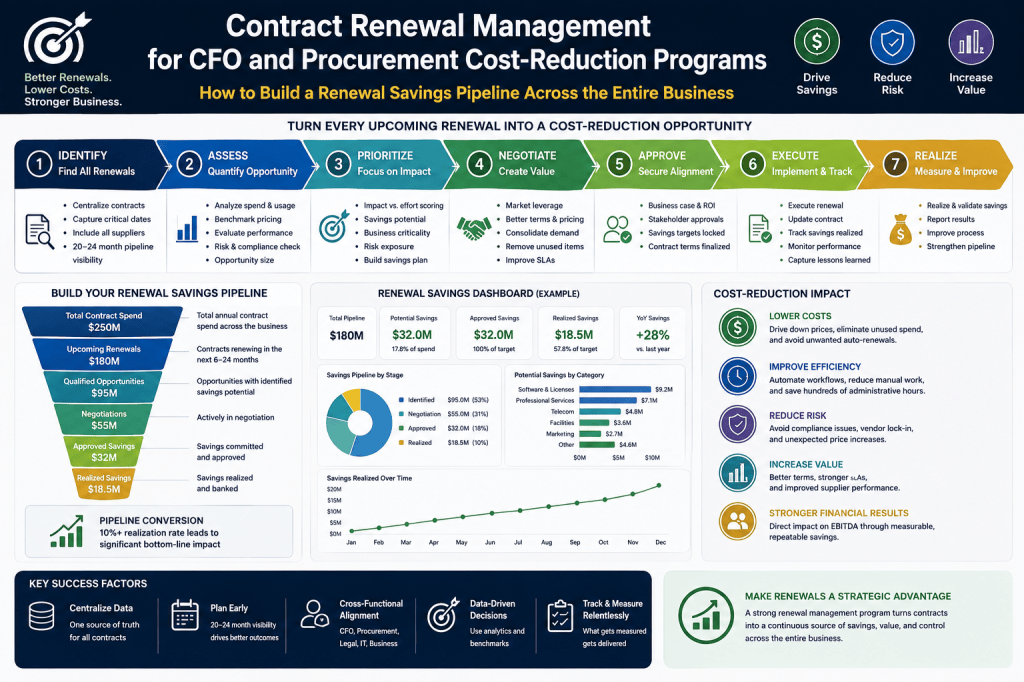
Why Renewal Dates Matter to Cost Reduction
Not all company spend can be changed immediately.
Some costs are already contractually committed.
Others remain negotiable.
This creates an important distinction:
Committed Spend
versus:
Addressable Spend
For a cost-reduction program, the second category matters most.
A €2 million agreement that cannot be changed for another three years may offer little immediate opportunity.
A €500,000 agreement reaching its renewal window next quarter may be highly actionable.
The renewal calendar therefore becomes a map of when spend becomes addressable.
Looking for Recurring Costs You Can Actually Reduce?
Broad cost-cutting targets are difficult to execute when nobody knows which supplier commitments can still be changed.
Contract Renewal Tracker is designed to help finance and procurement identify upcoming renewal spend, rank savings opportunities, assign actions, manage negotiations, and track the financial outcomes.
Turn your renewal calendar into a cost-reduction pipeline →
From Contract Portfolio to Savings Pipeline
A traditional contract register tells you:
What contracts exist.
A savings-oriented renewal platform should answer:
Which contracts can create financial value?
The progression becomes:
Contract Portfolio
↓
Upcoming Renewals
↓
Addressable Spend
↓
Savings Opportunities
↓
Negotiation / Reduction / Termination
↓
Validated Financial Outcomes
This is a fundamentally more commercial way to use contract data.
Step 1: Define the Cost-Reduction Target
Suppose leadership establishes:
Annual Cost Reduction Target: €5 million
The next question is:
Where can that €5 million realistically come from?
The Contract Renewal Tracker can identify the contract portfolio becoming negotiable during the target period.
Example Cost-Reduction Program
Total third-party annual spend:
€120M
Contracts renewing within 12 months:
€48M
Addressable renewal spend:
€38M
Cost-reduction target:
€4M
Required improvement on addressable spend:
approximately:
10.5%
Now the program becomes measurable.
Addressable Spend Is More Useful Than Total Spend
If the organization has:
€200M total supplier spend
but only:
€40M can realistically be renegotiated this year,
a €10M savings target represents:
25% of addressable spend
not:
5% of total spend.
That changes the feasibility analysis.
Step 2: Identify Which Renewals Are Actually Actionable
Not every upcoming renewal offers the same opportunity.
A contract may be:
- business critical;
- difficult to replace;
- already competitively priced;
- subject to a long-term commitment.
Another may have:
- poor utilization;
- supplier price increases;
- duplicate services;
- low business value.
The second contract is much more promising.
Build a Savings Opportunity Score
A Contract Renewal Tracker could calculate a score using:
Contract Value
Price Increase
Low Utilization
Supplier Overlap
Benchmark Gap
Business Value
Replacement Feasibility
This helps prioritize effort.
Example Opportunity Score
Analytics Platform
Annual Spend:
€600K
Supplier Increase:
11%
Utilization:
58%
Business Value:
Medium
Alternative Supplier:
Available
Opportunity Score:
94/100
This should rank very high in the savings pipeline.
Another Example
Payroll Platform
Annual Spend:
€180K
Supplier Increase:
2%
Utilization:
98%
Business Criticality:
High
Replacement Complexity:
Very High
Opportunity Score:
27/100
This may not deserve intensive negotiation effort.
Step 3: Segment the Savings Opportunities
Useful categories include:
Price Negotiation
Supplier pricing can be challenged.
Quantity Reduction
Reduce licenses, users, sites, units, or consumption.
Scope Reduction
Remove unnecessary services.
Supplier Consolidation
Combine several agreements or vendors.
Competitive Sourcing
Run an RFP or benchmark exercise.
Termination
Remove the contract entirely.
Renewal-Term Optimization
Avoid unnecessary long-term commitments.
This gives the savings pipeline structure.
Savings Lever 1: Challenge Supplier Price Increases
Suppose:
Current contract:
€1M.
Supplier proposal:
€1.12M.
Increase:
12%
If procurement negotiates:
€1.04M,
then:
Cost Avoidance
€80K.
The system should record this explicitly.
Savings Lever 2: Reduce Quantities
For SaaS:
Current licenses:
2,000.
Required next year:
1,500.
Unit price:
€200.
Potential gross reduction:
€100,000
The renewal becomes a demand-management opportunity.
Savings Lever 3: Remove Unused Services
A managed-services contract may include:
- weekend support;
- onsite engineering;
- legacy system coverage.
If those are no longer required, remove them before renewal.
Savings do not always require changing supplier.
Savings Lever 4: Terminate the Contract
This is often the largest opportunity.
Suppose:
Annual subscription:
€120K.
Business owner confirms:
No longer required.
Avoided future spend:
€120K
The best supplier negotiation is sometimes no renewal at all.
Savings Lever 5: Consolidate Suppliers
Suppose the company uses:
Vendor A:
€300K.
Vendor B:
€180K.
Vendor C:
€140K.
All provide overlapping services.
Total:
€620K
Consolidating to one or two suppliers may create both:
- lower pricing;
- lower administrative cost.
Renewal timing reveals when consolidation becomes possible.
Savings Lever 6: Consolidate Contracts with the Same Supplier
A supplier may hold several separate agreements.
For example:
€400K.
€250K.
€180K.
€120K.
Total:
€950K
Negotiating them together may create more leverage than treating each as an isolated renewal.
Savings Lever 7: Rebid the Contract
Some renewals justify competitive sourcing.
A rebid may be particularly attractive when:
- supplier performance is weak;
- pricing has drifted upward;
- alternatives have improved;
- requirements have changed.
But sourcing takes time.
The Contract Renewal Tracker must identify these candidates early enough.
Savings Lever 8: Renegotiate Contract Duration
Suppliers often offer discounts for multi-year commitments.
For example:
1 year:
€500K.
3 years:
€450K/year.
Potential annual reduction:
€50K.
But the total commitment becomes:
€1.35M
The decision should balance savings against lock-in.
Savings Lever 9: Negotiate Renewal Caps
The current price may be acceptable.
The future escalation may not be.
For example:
Supplier proposes:
8% annual increase.
Procurement negotiates:
3% cap.
That creates value over future years.
The savings model should capture the expected impact transparently.
Step 4: Build the Renewal Savings Pipeline
The pipeline might use stages such as:
Identified
↓
Validated
↓
Strategy Defined
↓
Supplier Engagement
↓
Negotiating
↓
Agreement Reached
↓
Contracted
↓
Finance Validated
↓
Realized
This separates ideas from actual results.
Identified Opportunity
Example:
Potential license reduction:
€80K.
This is not yet savings.
It is:
Identified Opportunity
Validated Opportunity
Business owner confirms:
licenses can be reduced.
Now:
Validated Opportunity: €80K
This has higher confidence.
Negotiating
Procurement begins supplier discussions.
Potential result:
€60K.
The expected outcome may be updated as information improves.
Contracted Savings
Final contract confirms:
€55K annual reduction.
Now the amount is much more reliable.
Finance Validated
Finance verifies:
- baseline;
- calculation;
- effective date.
The amount can enter official savings reporting.
This process helps prevent exaggerated savings claims.
Hard Savings vs Cost Avoidance
A cost-reduction program should separate these carefully.
Suppose:
Current spend:
€500K.
Supplier proposal:
€580K.
Final renewal:
€470K.
Hard Savings
€30K.
Cost Avoidance
€110K.
If management’s objective is reducing the existing cost base, hard savings matter most.
If the objective is preventing budget growth, cost avoidance is also highly relevant.
Avoided Spend
Another category is:
Avoided Spend
Example:
A €200K contract is terminated.
That may represent:
€200K of future spend avoided.
Again, the methodology should be explicit.
Demand Reduction
Suppose:
Current software spend:
€400K.
License reduction creates:
€75K saving.
This may be classified separately as:
Demand Reduction
because the price did not change; the quantity did.
This can help management understand where savings came from.
Cost-Reduction Taxonomy
A useful reporting model could include:
Hard Savings
Cost Avoidance
Demand Reduction
Avoided Spend
Supplier Consolidation
Process Productivity
This provides greater clarity than one generic “Savings” number.
Avoid Double Counting
Suppose a SaaS contract falls from:
€500K
to:
€400K
because 20% of licenses were removed.
Do not count:
€100K License Savings
and:
€100K Hard Savings
as:
€200K total.
They are two descriptions of the same financial outcome.
Savings attribution rules should prevent this.
Step 5: Set Savings Targets by Portfolio
The global target can be divided into practical sub-targets.
For example:
IT
€1.5M.
Marketing
€500K.
Operations
€900K.
HR
€300K.
Corporate Services
€800K.
This creates distributed accountability.
Target by Procurement Category
Alternatively:
Software:
€1.2M.
Cloud:
€800K.
Professional Services:
€900K.
Telecom:
€400K.
Facilities:
€700K.
This may align better with category-management structures.
Target vs Pipeline Coverage
Suppose:
Savings target:
€5M.
Current validated opportunity pipeline:
€7M.
Pipeline coverage:
1.4×
That may not be sufficient because not every opportunity will convert.
The organization might target:
2× or 3× coverage
depending on confidence.
Pipeline Coverage Formula
Opportunity Pipeline ÷ Savings Target
For example:
€10M opportunities
÷
€5M target
=
2.0×
This is a useful program-management KPI.
Confidence-Weighted Savings Pipeline
Not all opportunities have the same probability.
For example:
Identified
25% confidence.
Validated
50%.
Negotiating
70%.
Agreement Reached
90%.
Contracted
100%.
The system can calculate weighted expected savings.
Example Weighted Pipeline
Identified:
€2M × 25% = €500K.
Validated:
€1.5M × 50% = €750K.
Negotiating:
€1M × 70% = €700K.
Contracted:
€800K × 100% = €800K.
Expected total:
€2.75M
This is more realistic than simply adding all opportunities.
Step 6: Prioritize by Deadline
A €1M opportunity is useless if the contractual deadline already passed.
The pipeline should therefore combine:
Savings Potential
and:
Time Remaining
For example:
High opportunity + 180 days:
Strategic.
High opportunity + 14 days:
Critical.
The second one needs immediate action.
Savings Urgency Matrix
| Low Savings Potential | High Savings Potential | |
|---|---|---|
| Long Runway | Monitor | Plan |
| Short Runway | Simplify | Immediate Action |
This helps procurement allocate resources.
Step 7: Prioritize by Ease of Execution
Not every saving requires the same effort.
A useful categorization is:
Quick Win
Low effort, high confidence.
Negotiation Opportunity
Medium effort.
Strategic Initiative
High effort, potentially high value.
For example:
Removing inactive licenses may be a quick win.
Replacing a core ERP supplier is strategic.
Quick-Win Renewal Portfolio
The tracker could identify:
- inactive SaaS licenses;
- duplicate low-value tools;
- unused telecom lines;
- unnecessary support agreements.
These can create fast savings while larger negotiations progress.
Strategic Savings Portfolio
Examples include:
- cloud consolidation;
- major outsourcing rebid;
- global telecom sourcing;
- enterprise software renegotiation.
These may require many months.
The renewal system provides the runway.
Step 8: Assign Savings Owners
Each opportunity needs accountability.
For example:
Business Owner
Validates demand reduction.
Procurement Owner
Negotiates.
Finance Owner
Validates savings.
Executive Sponsor
Supports strategic action.
Without ownership, the pipeline becomes a list of ideas.
Savings Opportunity Record
A record might contain:
Contract
ExampleCloud.
Opportunity
Reduce commitment.
Baseline
€2.4M.
Target
€2.0M.
Potential Savings
€400K.
Procurement Owner
Sarah.
Business Owner
CIO.
Deadline
128 days.
Confidence
70%.
Status
Negotiating.
This is far more actionable than a spreadsheet note.
Step 9: Connect Savings to Renewal Workflow
Savings work should not exist separately from the actual contract renewal.
The process should connect:
Opportunity
↓
Business Validation
↓
Negotiation
↓
Approval
↓
Final Contract
↓
Savings Result
This creates traceability.
Step 10: Validate with Finance
Procurement and finance should agree on:
- baseline;
- calculation method;
- period;
- categorization.
This is essential for credibility.
Finance Validation Workflow
For example:
Procurement submits:
Hard Savings:
€80K.
Finance reviews:
- previous contract;
- new contract;
- quantities.
Decision:
Validated
or:
Adjusted
The audit trail records the outcome.
Step 11: Track Realized Savings
Contracted savings are not always realized.
Suppose a license reduction is agreed, but usage later causes the company to purchase additional licenses.
The actual benefit may be lower.
A mature system can distinguish:
Contracted Savings
from:
Realized Savings
This makes reporting stronger.
Step 12: Report Savings by Source
A CFO dashboard might show:
Hard Savings
€1.8M.
Cost Avoidance
€2.4M.
Avoided Spend
€1.1M.
Demand Reduction
€900K.
Finance-Validated Total
€6.2M.
This clearly shows how the program is performing.
Savings by Business Unit
IT:
€2.1M.
Marketing:
€620K.
Operations:
€1.4M.
HR:
€310K.
Corporate:
€1.77M.
This helps identify where value is being created.
Savings by Supplier
ExampleCloud:
€680K.
Global Telecom:
€420K.
DataPlatform:
€310K.
Consulting Group:
€290K.
This reveals important supplier outcomes.
Savings by Strategy
Termination:
€1.4M.
Price Negotiation:
€1.2M.
License Reduction:
€980K.
Supplier Consolidation:
€850K.
Scope Reduction:
€620K.
This helps management understand which levers work best.
Savings by Procurement Category
Software.
Cloud.
Professional services.
Marketing.
Facilities.
Telecom.
This helps category leaders manage their pipelines.
CFO Savings Dashboard
A strong executive dashboard might show:
Annual Cost-Reduction Target
€5M
Finance-Validated Savings
€3.4M
Remaining Gap
€1.6M
Weighted Pipeline
€2.2M
Pipeline Coverage
1.38×
Renewal Spend Remaining
€14M
High-Value Opportunities Not Started
12
This creates a clear management view.
Procurement Savings Dashboard
Procurement may need more detail:
Identified Opportunities
€9.2M.
Validated
€5.8M.
Negotiating
€3.4M.
Contracted
€2.9M.
Average Cycle Time
74 days.
Critical Opportunities
This becomes an operating dashboard.
The Gap-to-Target View
One especially useful metric is:
How much savings are still required?
For example:
Target:
€5M.
Validated result:
€3.4M.
Gap:
€1.6M
The system can then ask:
Which upcoming renewals can realistically close the gap?
This turns renewal data into strategic planning.
AI Cost-Reduction Assistant
A CFO could ask:
Where can we find the remaining €1.6M?
The AI assistant could analyze:
- upcoming renewals;
- contract values;
- usage;
- supplier increases;
- duplicate services;
- current savings pipeline.
Then return prioritized opportunities.
Example AI Savings Brief
Twelve upcoming renewals represent approximately €2.4M of additional validated opportunity. The largest sources are €620K of low-utilization software spend, €480K across three supplier consolidation opportunities, and €390K associated with proposed supplier increases above 10%.
This is much more useful than manually filtering contracts.
AI Should Separate Opportunity from Forecast
The AI may identify:
Potential Opportunity: €2.4M
That is not the same as:
Expected Savings: €2.4M
The system should apply confidence and clearly label estimates.
AI Can Recommend Next-Best Actions
For example:
Contract
AnalyticsPro.
Opportunity
€140K.
Recommended Next Action
Validate license requirement with business owner.
Why:
61% utilization and 83 days until notice deadline.
This makes the cost-reduction program operational.
AI Can Find Supplier Consolidation Opportunities
For example:
Four business units have contracts with Supplier X totaling €1.8M, and three renew within 120 days. Consider a coordinated negotiation.
This is exactly the kind of opportunity fragmented spreadsheets can hide.
AI Can Detect Low-Value Contracts
Another query:
Which contracts are high cost but low business value?
The system can combine:
Annual Spend
with:
Business Value Score
to identify termination candidates.
Cost Reduction Should Not Damage the Business
Savings are not the only objective.
Aggressive cost reduction can create:
- service failures;
- security risk;
- operational disruption;
- employee productivity problems.
The renewal decision must balance:
Savings
with:
Business Value and Risk
Savings vs Business Criticality
Consider:
Contract A:
€500K.
Potential saving:
€100K.
Business criticality:
Low.
Excellent opportunity.
Contract B:
€3M.
Potential saving:
€150K.
Business criticality:
Critical.
Replacement risk:
Very High.
Different strategies are required.
Avoid Across-the-Board Cuts
A blanket rule such as:
Cut every supplier by 10%.
may be unrealistic.
A better approach is:
data-driven opportunity identification.
Some contracts can produce:
30% savings.
Others should perhaps increase because the business needs more capacity.
Renewal Decisions Are Better Than Generic Cost Cutting
The renewal framework naturally asks:
What should this contract cost next year?
That is more precise than:
Reduce department budget by 5%.
This is why renewals can provide a practical execution engine for a cost-reduction program.
Turn Cost Reduction into a Repeatable Process
One-off cost-cutting programs often fade after the immediate target is reached.
A renewal tracker can institutionalize the discipline.
Every renewal automatically asks:
- Do we still need this?
- Is usage appropriate?
- Is the price competitive?
- Can suppliers be consolidated?
- What alternatives exist?
The cost-control process repeats every year.
Continuous Savings Pipeline
The pipeline never needs to be empty.
As one renewal closes:
another enters the:
180-day window.
This creates continuous cost optimization rather than periodic cost-cutting campaigns.
CFO + Procurement Operating Rhythm
A recurring meeting could review:
Monthly
Savings target.
Pipeline coverage.
Critical opportunities.
Upcoming high-value renewals.
Quarterly
Supplier consolidation.
Category performance.
Realized savings.
The Contract Renewal Tracker supplies the agenda.
Savings Governance
Organizations should define:
- savings categories;
- baseline rules;
- validation responsibility;
- reporting periods;
- currency treatment.
Without common rules, different teams may calculate savings differently.
Savings Policy Example
Hard Savings
Reduction from prior comparable cost.
Cost Avoidance
Reduction from documented supplier proposal.
Avoided Spend
Future contractual spend eliminated.
Finance Validation Required
For official reporting.
This makes the program credible.
Multi-Year Savings Governance
Suppose:
Annual saving:
€100K.
Term:
3 years.
The dashboard can show:
Annualized Savings: €100K
Contract-Term Impact: €300K
Do not present the €300K as annual savings.
Transparency matters.
FX Treatment
For international portfolios, savings should be recorded in:
contract currency
and:
reporting currency
using a defined finance methodology.
This prevents currency movement from distorting performance.
Cost-Reduction Program Audit Trail
Management should be able to ask:
How did we achieve this €240K saving?
The record should show:
- old price;
- supplier proposal;
- scope;
- quantity;
- final agreement;
- approval;
- finance validation.
This makes savings defensible.
Link Savings to Contract Documents
The final renewal document provides evidence.
For example:
Previous:
€600K.
Final:
€520K.
The Contract Renewal Tracker can connect the financial outcome directly to the signed renewal.
Cost Reduction and Supplier Relationships
Procurement should also avoid damaging strategic relationships through poorly coordinated negotiations.
A supplier may have:
10 contracts.
If different departments independently demand different reductions, the relationship can become fragmented.
A supplier-level renewal view enables a coordinated strategy.
Executive Sponsorship
Large strategic savings opportunities may require executive support.
For example:
Global outsourcing supplier.
Annual spend:
€18M.
Target:
€2M reduction.
This may require:
- scope changes;
- operating-model changes;
- supplier executive negotiations.
The tracker can classify this as a strategic initiative.
Savings Program Workflow
A major opportunity may move through:
Opportunity Identified
↓
Executive Sponsor Assigned
↓
Business Case
↓
Supplier Strategy
↓
Negotiation
↓
Implementation
↓
Savings Realization
This is more sophisticated than ordinary renewal processing.
Quick Wins and Strategic Savings Together
A balanced program should include:
Quick Wins
Immediate savings.
Medium-Term Negotiations
Quarterly impact.
Strategic Initiatives
Larger future value.
Contract Renewal Tracker can manage all three through renewal timing.
The Cost of Missing the Savings Window
Suppose:
Contract:
€800K.
Optimization opportunity:
€120K.
Notice deadline:
September 1.
The organization identifies the opportunity:
September 15.
The contract already renewed.
Potential opportunity lost:
€120K
This is why renewal automation is central to cost-reduction execution.
Cost Reduction Requires Time
The earlier the organization identifies the renewal:
the more options it has.
180 days
Benchmark.
Source alternatives.
Validate demand.
90 days
Negotiate.
30 days
Mostly execute.
Time is a commercial asset.
Build Savings Runway into the Workflow
For contracts above a threshold, the system could start earlier.
For example:
IF estimated_savings_opportunity > €100,000THEN start_procurement_review = 180_days_before_notice_deadline
This protects high-value opportunities.
Program-Level Alert
The system could warn:
€1.4M of identified savings opportunity is attached to contracts with notice deadlines inside 45 days.
That is a management issue requiring immediate action.
Pipeline Leakage
A useful metric is:
Opportunities Lost Due to Late Action
For example:
This year:
€420K.
Management can then address the upstream process.
Why Contract Renewal Tracker Fits Cost-Reduction Programs
A generic cost-reduction spreadsheet can track savings initiatives.
But it may not know:
- contractual notice periods;
- auto-renewal mechanisms;
- contract owners;
- current documents;
- supplier relationships.
Contract Renewal Tracker combines the financial initiative with the contractual execution window.
That is the key differentiator.
It Is Not a Spend-Analytics Replacement
A spend-analytics platform can tell you:
Where did we spend money?
Contract Renewal Tracker answers:
When can we change that spend?
The two can work together.
It Is Not an ERP Replacement
ERP records transactions and commitments.
Contract Renewal Tracker focuses on the decision window before the next commitment.
This gives it a distinct role in the financial architecture.
Cost-Reduction Program ROI
Suppose:
Annual software subscription:
€20K.
Finance-validated cost reduction:
€1M.
Value-to-cost ratio:
50:1
Even a much smaller savings result can justify the product.
Break-Even Example
Annual SaaS cost:
€12K.
Managed renewal spend:
€20M.
Break-even improvement:
€12K ÷ €20M
=
0.06%
The platform only needs to help improve a tiny fraction of managed spend to cover its own cost.
One Termination Could Pay for the Platform
Example:
Unused service:
€75K/year.
Contract Renewal Tracker identifies it before auto-renewal.
Final decision:
Terminate.
Avoided spend:
€75K.
If the annual platform subscription is substantially below that amount, the economic case becomes straightforward.
Ready to Build a Renewal-Based Savings Program?
CFO and procurement cost-reduction targets should not remain abstract percentages in a presentation.
Contract Renewal Tracker is designed to turn upcoming supplier commitments into a structured pipeline of measurable savings actions.
Use Contract Renewal Tracker to:
- identify addressable renewal spend;
- rank savings opportunities;
- challenge supplier price increases;
- reduce unused licenses and quantities;
- remove unnecessary services;
- consolidate suppliers;
- identify termination candidates;
- manage sourcing and negotiations;
- assign savings owners;
- track pipeline stages;
- calculate confidence-weighted savings;
- distinguish hard savings from cost avoidance;
- validate outcomes with finance;
- report progress against target;
- use AI to find the next best cost-reduction opportunities.
The objective is to transform:
Upcoming Renewals
into:
Measurable Financial Opportunities
Find the spend. Create the runway. Capture the savings.
Start Your Contract Renewal Tracker Subscription →
Final Thoughts
Renewals create something cost-reduction programs desperately need:
a natural execution point.
The company may want to reduce supplier spend all year.
But the renewal window is when many of those costs become genuinely negotiable.
That creates a repeatable cycle:
Renewal Identified
↓
Opportunity Assessed
↓
Business Need Challenged
↓
Commercial Strategy
↓
Negotiation
↓
Contract Changed
↓
Savings Validated
Over time, that transforms contract renewal management into a recurring financial-control process.
For CFOs, the result is better visibility into where cost reductions can actually happen.
For procurement, it creates a prioritized commercial pipeline.
For business owners, it forces recurring costs to justify themselves.
And for Contract Renewal Tracker, it creates one of the strongest SaaS positioning opportunities in the entire series:
The platform does not merely help organizations avoid missing renewals. It helps them use renewals as recurring opportunities to reduce their cost base.
Next Article in the Contract Renewal Tracker Series
Article 43 — “Contract Renewal Management During Mergers and Acquisitions: How to Find Duplicate Suppliers, Consolidate Contracts, and Capture Post-Merger Savings”
The next article will target another high-value business event: M&A integration. It will cover combining contract inventories, discovering duplicate vendors and overlapping SaaS, identifying near-term renewal windows, comparing pricing across acquired entities, supplier consolidation, termination opportunities, inherited auto-renewals, ownership reassignment, legal-entity changes, synergy tracking, transition-service dependencies, and using Contract Renewal Tracker as a post-merger contract rationalization and savings platform.

