For many contracts, the most important renewal question is not legal, financial, or technical.
It is much simpler:
Do we still need this contract?
That decision usually belongs to the business.
A department manager may know whether a software platform is still useful.
An application owner may know whether the team actually uses all purchased licenses.
An operations manager may know whether the supplier is delivering acceptable service.
A budget owner may know whether the expense still fits next year’s priorities.
Procurement, legal, and finance can support the renewal process, but they cannot always answer those fundamental business questions.
This makes business owners one of the most important user groups in a Contract Renewal Tracker.
The challenge is that they are usually not contract-management specialists.
They do not want to learn a complex CLM system.
They need a simple workflow that tells them:
What contract is this?
What are we paying?
When must we decide?
How well is it being used?
How is the supplier performing?
What do I need to do next?
A good Contract Renewal Tracker should make that process fast and intuitive.
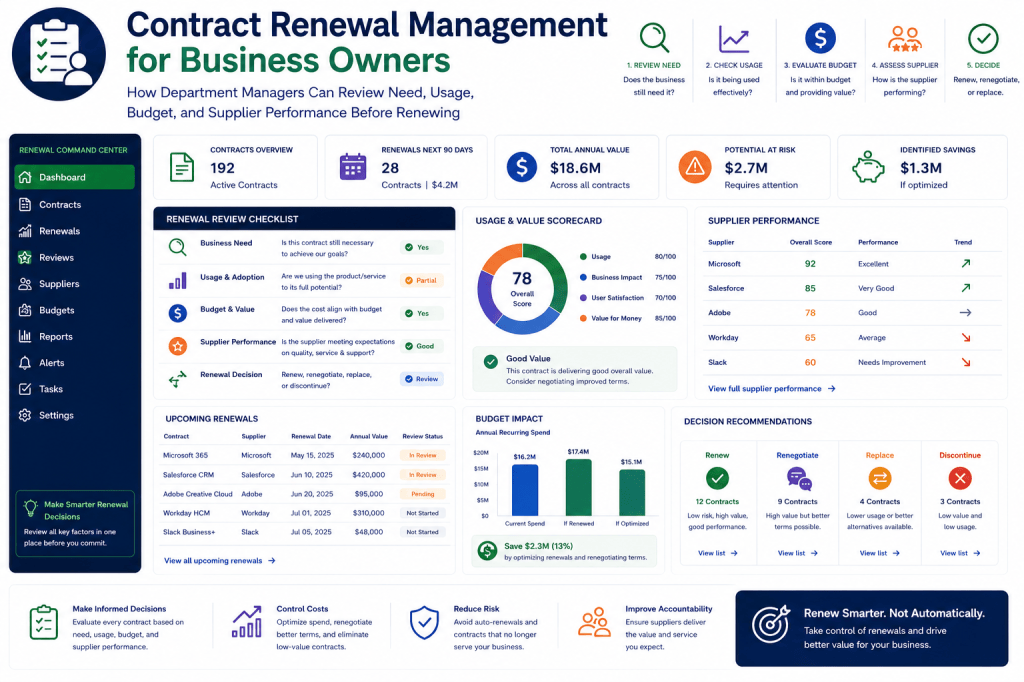
Why Business Owners Matter in Renewal Management
A contract can be commercially attractive and legally sound—but still be unnecessary.
Suppose procurement negotiates a supplier down from:
€120,000
to:
€100,000
That appears to create:
€20,000 savings.
But if the department no longer needs the service, the best renewal outcome may actually be:
Terminate and save €120,000.
That is why business validation should happen before procurement spends significant time negotiating.
Still Asking Business Owners About Renewals by Email?
A typical renewal process often looks like:
“Hi, this software is renewing soon. Do you still need it?”
Then:
no response.
Another email follows.
Then a Teams message.
Then procurement asks again.
Meanwhile, the contractual notice deadline gets closer.
Contract Renewal Tracker is designed to give business owners a simple renewal task with the relevant contract, spend, usage, deadline, and supplier information already attached.
Turn renewal decisions into clear, accountable business tasks →
The Business Owner’s Role
The business owner does not necessarily manage the entire contract.
Their responsibilities may be limited to questions such as:
- Is the product or service still required?
- Is it delivering business value?
- Is usage appropriate?
- Has demand changed?
- Is supplier performance acceptable?
- Should scope increase or decrease?
- Is the budget still justified?
- Are there better alternatives?
Their answer becomes an important input into the broader renewal workflow.
Business Owner vs Contract Owner
These roles may be different.
Contract Owner
Responsible for maintaining the contract record and coordinating the process.
Business Owner
Responsible for the underlying business requirement.
For a SaaS contract:
Contract Owner: Procurement Manager
Business Owner: Head of Marketing
Technical Owner: IT Application Manager
All three may have different responsibilities.
Budget Owner
There may also be a separate:
Budget Owner
For example:
Business owner:
Marketing Operations Director.
Budget owner:
CMO.
Contract owner:
Procurement.
The Contract Renewal Tracker should support these separate roles rather than forcing one person to own everything.
The Business Renewal Review
A business review can be structured around six questions:
- Do we still need the product or service?
- How much are we using?
- Is performance acceptable?
- Has the business requirement changed?
- Is the cost still justified?
- What should happen at renewal?
This creates a repeatable process.
Question 1: Do We Still Need It?
This is the most basic renewal question.
Possible answers:
Yes — Essential
Yes — Useful
Yes — But Reduced Scope
Maybe
No
The answer should affect the next workflow stage.
Business Criticality
The owner could also classify the contract:
Critical
Business cannot operate without it.
Important
Material impact if unavailable.
Standard
Useful but replaceable.
Low
Limited operational impact.
This can influence risk scoring and escalation.
Example
Contract:
Design Collaboration Platform.
Annual Spend:
€72,000.
Business owner response:
Useful, but team has migrated most workflows to another platform.
Recommendation:
Terminate or consolidate.
That information is extremely valuable to procurement.
Question 2: How Much Are We Actually Using?
Usage is one of the strongest renewal signals.
For software:
Purchased licenses:
Active users:
Utilization:
56%
The business owner should see this before selecting:
Renew As-Is.
Usage Context
Depending on the contract, usage might mean:
- active software users;
- cloud consumption;
- telecom lines;
- service hours;
- support tickets;
- consulting days;
- storage volume.
The platform should present the metric appropriate to the contract type.
Low-Usage Alert
A renewal task might say:
Current utilization is 56%. Renewing the existing quantity would leave approximately 220 unused licenses.
Then ask:
Recommended Quantity
[280]
[300]
[400]
[500]
[Other]
This turns renewal into an optimization exercise.
Usage Trend
Current usage alone may be misleading.
For example:
January:
220 users.
April:
July:
September:
Growth may justify keeping capacity.
The business owner should be able to see the trend.
Forecast Requirement
A good renewal questionnaire can ask:
How many users do you expect to need next year?
For example:
Current active:
Forecast:
Now procurement negotiates for the expected requirement rather than last year’s quantity.
Question 3: Is the Supplier Performing?
Business users often experience supplier quality directly.
They may know:
- support is slow;
- product quality has declined;
- account management is poor;
- implementation support is strong.
That information should feed into renewal strategy.
Simple Supplier Rating
Business owner might score:
Product / Service Quality
4/5.
Support
2/5.
Reliability
3/5.
Overall Satisfaction
3/5.
Then add comments.
This gives procurement useful negotiation context.
Supplier Performance Comment
For example:
Support response times deteriorated considerably during the last six months, and three major incidents affected operations.
That may influence:
Renegotiate
rather than:
Renew As-Is.
Performance vs Contractual SLA
The system may also show objective data.
For example:
SLA Target:
99.9%.
Actual:
99.4%.
The business owner can combine experience with measured performance.
Question 4: Has the Business Requirement Changed?
Many contracts are renewed based on last year’s scope.
But businesses change.
Examples include:
- headcount decreases;
- business unit closes;
- new product launches;
- acquisition;
- digital transformation;
- application consolidation.
The renewal should reflect the future requirement.
Example Requirement Change
Current contract:
1,200 users.
Business restructuring:
Expected workforce:
Recommended renewal:
950 licenses.
That creates an immediate reduction opportunity.
Growth Scenario
The opposite may happen.
Current:
500 users.
Forecast:
The renewal should perhaps include:
- better volume discount;
- tier pricing;
- flexible growth terms.
Business input allows procurement to negotiate proactively.
Question 5: Is the Cost Still Justified?
Business owners do not always need to determine whether the supplier’s pricing is competitive.
That may be procurement’s job.
But they can answer:
Is this service worth the money to the business?
For example:
Annual spend:
€180K.
Business value rating:
Low
That should trigger additional scrutiny.
Business Value Rating
A simple scale might be:
Very High
High
Medium
Low
No Longer Needed
Combine this with cost to create a value signal.
Cost vs Value Matrix
| Low Cost | High Cost | |
|---|---|---|
| High Value | Keep | Protect / Optimize |
| Low Value | Review | Major Opportunity |
A high-cost, low-value contract should receive immediate attention.
Renewal Value Score
For example:
Business Value:
38/100.
Utilization:
52%.
Annual Cost:
€240K.
Supplier Performance:
61/100.
The system could flag:
Renewal Review Priority: Very High
This gives procurement a clear signal.
Question 6: What Should Happen?
Business owners should not be limited to:
Yes / No
Possible recommendations include:
Renew As-Is
No major changes required.
Renew with Reduced Scope
Keep supplier, reduce quantity.
Renegotiate
Keep service but improve commercial terms.
Expand
Increase scope.
Replace
Use another supplier.
Consolidate
Move to another existing internal platform.
Terminate
Service no longer required.
Undecided
More analysis required.
This provides richer decision data.
The Business Owner Does Not Make Every Decision
The owner may recommend:
Replace
But procurement may need to:
- evaluate alternatives;
- run sourcing process.
Legal may review termination rights.
Finance may approve migration cost.
The Contract Renewal Tracker converts the business recommendation into the next workflow.
Example Workflow
Business Owner:
Recommendation = Renegotiate
↓
Procurement:
Negotiation task created.
↓
Supplier proposal reviewed.
↓
Finance approval.
↓
Renewal completed.
The business owner does not need to coordinate the rest manually.
Business Review Should Happen Early
A common failure is asking the business whether it wants to renew only a few weeks before the deadline.
Instead, the review could start:
Strategic Contract
180 days before notice deadline.
Standard Contract
90 days.
Low-Value Contract
30–60 days.
This gives other teams time to act.
Business Decision Deadline
The tracker should create an internal decision deadline before the contractual deadline.
For example:
Notice deadline:
October 2.
Business decision required:
August 20.
This gives procurement six weeks to negotiate.
Late Business Decisions Reduce Procurement Leverage
Suppose the business owner waits until:
September 25
to say:
We want to renegotiate.
But notice deadline:
October 2.
Procurement now has only seven days.
That is why business-owner responsiveness has commercial consequences.
Escalate Overdue Business Reviews
A workflow might use:
Initial Request
Owner.
5 Days Before Due Date
Reminder.
Due Date
Urgent.
3 Days Overdue
Manager escalation.
Critical Deadline Approaching
Procurement escalation.
The owner does not need to be manually chased through email.
Keep Business-Owner Tasks Simple
This is crucial for adoption.
A department manager should not need to navigate a complex contract-management interface.
The review page might simply show:
Adobe Enterprise Agreement
Annual Cost:
€160K.
Notice Deadline:
87 days.
Usage:
73%.
Supplier Performance:
Good.
Do You Still Need This Service?
[Yes]
[Yes, but reduce]
[Renegotiate]
[Replace]
[Terminate]
Then:
Submit Review
That is enough for many users.
Occasional Users Need a Different UX
Procurement may use Contract Renewal Tracker every day.
A department head may use it only four times per year.
The software should recognize this difference.
For occasional users:
- minimal navigation;
- clear language;
- direct actions;
- contextual explanations.
This can substantially improve adoption.
Email-to-Action
A business owner might receive:
Renewal Review Required
AnalyticsPro
Annual Spend: €180K
Notice Deadline: 76 days
Utilization: 61%[Review Renewal]
One click opens the relevant decision page.
This is much better than:
Please log into the contract system and find the renewal.
Teams and Slack Tasks
The same review could be surfaced in:
- Microsoft Teams;
- Slack.
For example:
Your Marketing Automation renewal requires review. Current license utilization is 58%.
Button:
Review Contract
This reduces friction.
Business-Owner Dashboard
A lightweight dashboard might show:
My Renewals
Upcoming:
Action Required:
Overdue:
High Risk:
This gives the user a manageable queue.
My Contract Portfolio
Business owners may also want visibility into:
- all contracts they own;
- annual spend;
- next renewal;
- supplier.
For example:
Marketing Contracts
Active Contracts:
Annual Spend:
€1.8M.
Renewing Next 180 Days:
€640K.
This improves cost awareness.
Budget Ownership
If the business owner also owns budget, renewal decisions become even more valuable.
For example:
Current departmental software spend:
€1.8M.
Renewing:
€620K.
Potential reduction:
€95K.
The manager can make tradeoffs before the annual budget is fixed.
Business Unit Renewal Forecast
A department report could show:
Q1
€120K.
Q2
€240K.
Q3
€180K.
Q4
€460K.
This helps managers anticipate recurring spend.
Budget Pressure
Suppose the department needs to cut:
€200K.
The Contract Renewal Tracker can show:
€520K of contracts become negotiable during the next six months.
Now the manager knows where cost reduction may be possible.
Make Renewal Reviews Part of Budget Planning
Renewal decisions should not happen independently from departmental planning.
Contract Renewal Tracker can give budget owners early visibility into which recurring costs become adjustable during the next planning period—creating a practical link between contract renewals and cost management.
See which departmental costs can still be changed before they renew →
Contract Owner Departures
Business ownership changes frequently.
Employees:
- leave;
- change roles;
- change departments.
The system should detect inactive owners.
Owner Reassignment
When an owner leaves:
Contract Owner Inactive
↓
Manager notified.
↓
Replacement owner assigned.
↓
Outstanding renewal tasks reassigned.
This keeps the process alive.
Delegated Ownership
The business owner may also delegate a specific review.
For example:
Department head assigns:
Application Manager
to complete the usage review.
But the final business recommendation may still require the department head.
This supports realistic organizational workflows.
Shared Ownership
Some contracts serve several departments.
For example:
Enterprise collaboration platform.
Business owners:
IT.
HR.
Sales.
Marketing.
The renewal may require input from several stakeholder groups.
Multi-Stakeholder Review
The system can ask:
IT:
Technical fit.
Business Units:
Usage.
Procurement:
Commercial.
Finance:
Budget.
This creates a consolidated recommendation.
Business Owner Questionnaire
A standardized questionnaire could include:
Business Need
Is the service still required?
Usage
Is current quantity appropriate?
Performance
Is supplier performance acceptable?
Future Demand
Do you expect demand to grow or decline?
Alternatives
Is another internal tool available?
Recommendation
What should happen?
This makes the process repeatable.
Different Questionnaires by Contract Type
A SaaS review might ask:
How many users are needed?
A professional-services renewal might ask:
What project demand is expected?
A telecom contract might ask:
Are all locations still active?
The questionnaire should adapt.
SaaS Business Review
Possible questions:
- How many licenses are needed?
- Which features are required?
- Is another internal application overlapping?
- Is the platform business-critical?
This supports optimization.
Professional Services Business Review
Questions may include:
- Is the service still required?
- Are the current rates justified?
- Does the scope need to change?
- Could work be brought in-house?
This informs procurement strategy.
Facilities Business Review
For cleaning, maintenance, security, or property contracts:
- are locations unchanged?
- is service quality acceptable?
- are service levels appropriate?
- is scope changing?
Again, the business owns key context.
Supplier Satisfaction
Business users can provide recurring supplier feedback.
Over time:
2026:
4.3/5.
2027:
3.8/5.
2028:
3.1/5.
A declining trend can influence negotiation.
Business Owner Comments Become Institutional Knowledge
Suppose a manager writes:
Supplier implementation support was excellent, but support after launch has been poor.
Two years later, a new manager can see that history.
This prevents organizational memory loss.
Business Value History
The system can track how the value assessment changes over time.
For example:
2026:
Critical.
2027:
Important.
2028:
Low.
That trend may indicate a contract approaching obsolescence.
Repeated “Replace” Decisions
Suppose the business has selected:
Replace
for three consecutive renewals.
Yet the contract keeps being renewed.
The platform can flag:
Replacement strategy has been deferred for three renewal cycles.
That is a management issue.
Temporary Extensions
Sometimes the business needs more time.
Recommendation:
Replace
but migration requires six additional months.
The correct outcome may be:
Temporary Extension
rather than full renewal.
The system should support this.
Business Owner Risk Signals
Business-owner behavior can affect renewal risk.
Examples:
- review overdue;
- requirement unknown;
- owner inactive;
- recommendation conflicting with procurement;
- no replacement plan.
These can increase the risk score.
Example Business Risk
Contract:
€600K.
Notice deadline:
28 days.
Business recommendation:
Undecided.
Owner task:
12 days overdue.
Risk:
Critical
Reason:
Business decision is blocking procurement action.
This creates clear accountability.
Business Owner Escalation
For critical contracts:
Business owner.
↓
Department manager.
↓
Executive sponsor.
The escalation path can be configured.
Do Not Overwhelm Business Users with Contract Language
The system should translate legal terms into operational meaning.
Instead of:
Section 13.4 requires 120-day prior written notice.
Show:
Decision needed by August 20. If no action is taken, this contract may renew automatically.
The underlying clause remains available when needed.
Explain Why the Review Is Urgent
A user may ask:
Why do I need to decide now if the contract does not expire until December?
The system can answer:
The contract requires 90 days’ notice to prevent automatic renewal, and procurement needs an additional 30 days to negotiate or prepare termination.
This improves compliance.
AI Assistant for Business Owners
The AI assistant could simplify the process further.
The user could ask:
Summarize this renewal for me.
The assistant might respond:
AnalyticsPro
Annual Spend:
€180K.
Usage:
61%.
Supplier Performance:
Good.
Supplier Proposal:
+8%.
Notice Deadline:
82 days.
Current Issue
License utilization is low and supplier pricing is increasing.
Suggested Review
Confirm whether the department needs all 500 licenses next year.
This gives the owner what they need.
Ask Simple Business Questions
Business users might ask:
Are we using this enough?
What did we pay last year?
Is another department using a similar product?
What happens if we cancel?
When do I need to decide?
This is where conversational AI can significantly reduce software complexity.
AI Should Not Make the Business Decision Automatically
AI can recommend:
Reduce licenses.
But the owner must decide whether the business requirement supports that recommendation.
The AI may not know about:
- upcoming hiring;
- new project;
- strategic initiative.
Human context remains important.
Business Decision + AI Explanation
For example:
AI:
Recommendation: Reduce
Reason:
Current utilization 56%.
Business Owner:
Override: Renew As-Is
Reason:
Expected 40% team expansion next quarter.
Both should be recorded.
This creates explainable decision history.
Business Owner Reporting
Useful reports include:
My Contracts
My Upcoming Renewals
My Annual Contract Spend
My Overdue Reviews
My Savings Opportunities
These can be delivered periodically.
Department Manager Report
For example:
Marketing Renewal Portfolio
Active Contracts:
Annual Spend:
€2.8M.
Renewing Next 12 Months:
€1.6M.
Potential Optimization:
€180K.
Decisions Required This Month:
This gives managers real financial visibility.
Business Unit Comparison
Executive management might see:
| Business Unit | Spend | Renewing | Optimization |
|---|---|---|---|
| IT | €18M | €7M | €1.1M |
| Marketing | €3M | €1.6M | €180K |
| HR | €2M | €900K | €90K |
This can support cost-control programs.
Business Owner KPIs
Useful metrics include:
Review Completion Rate
Average Decision Time
Overdue Reviews
Renewals Reduced
Contracts Terminated
Owner Coverage
These should support process improvement rather than simplistic performance rankings.
Business Decision Turnaround
For example:
Target:
7 days.
Average:
9.4 days.
On-Time Rate:
72%.
If late decisions are harming procurement, the organization can improve the workflow.
Contract Renewal Tracker as a Business Decision Platform
For business owners, the product should not feel like legal software.
It should feel like:
a simple decision system for recurring supplier spend.
The user sees:
What do we have?
What does it cost?
Are we using it?
Do we still need it?
When must we decide?
That is a highly approachable product experience.
Why This Matters for SaaS Adoption
One of the biggest challenges in enterprise software is getting occasional users to participate.
If Contract Renewal Tracker requires every department manager to become a contract expert, adoption will suffer.
The interface should instead reduce the renewal to the business questions that only that manager can answer.
That is a powerful design principle.
Business Owners Create the First Decision Signal
The end-to-end renewal process can become:
System Detects Renewal
↓
Business Owner Confirms Requirement
↓
Procurement Develops Commercial Strategy
↓
Legal Reviews Terms
↓
Finance Approves Commitment
↓
Executive Approves if Required
↓
Contract Executed
The business review is often the first meaningful human decision.
Cost Optimization Starts with Business Need
There is an important commercial principle:
The best negotiated contract is not always the best savings outcome.
If something is no longer needed, the best price is:
€0.
That is why business-owner engagement is essential to procurement optimization.
Example
Supplier proposal:
€140K.
Procurement target:
€120K.
Potential negotiated saving:
€20K.
Business owner review:
Service no longer required.
Final decision:
Terminate.
Avoided spend:
€140K.
The business decision created far more value than negotiation alone.
Ready to Make Business Owners Part of the Renewal Process?
Business owners should not discover contract renewals through last-minute procurement emails.
Contract Renewal Tracker is designed to give department managers a simple, structured way to review the contracts they actually use and influence what happens next.
Use Contract Renewal Tracker to:
- assign business owners;
- request renewal reviews automatically;
- show contract cost and deadline context;
- display usage information;
- capture supplier feedback;
- forecast future requirements;
- record renew / reduce / renegotiate / replace / terminate recommendations;
- escalate overdue decisions;
- reassign contracts when employees leave;
- coordinate procurement, legal, and finance after the business decision;
- provide department-level renewal reporting;
- use AI to summarize complex renewals for occasional users.
The question every business owner should be able to answer is:
Do we still need this contract, and if so, what should change before we renew it?
Start Your Contract Renewal Tracker Subscription →
Final Thoughts
Business owners play a critical role because they provide something contract systems cannot derive entirely from documents:
business context.
The contract can tell you:
When it renews.
Finance can tell you:
What it costs.
Usage data can tell you:
How much it is used.
Procurement can tell you:
Whether the price is competitive.
But the business owner answers:
Do we still need it?
A strong renewal process combines all of these perspectives:
Business Need
Usage
Supplier Performance
Budget
Contract Terms
↓
Renewal Recommendation
That recommendation then drives:
Negotiation → Approval → Execution
For Contract Renewal Tracker, simplifying this interaction is important because business owners may represent the largest group of occasional users in the system.
If their experience is clear and easy, the entire renewal process becomes more reliable.
Next Article in the Contract Renewal Tracker Series
Article 37 — “Contract Renewal Management for Vendor Managers: How to Track Supplier Performance, Relationship Risk, SLAs, and Upcoming Renewals”
The next article will target vendor managers, supplier relationship managers, IT vendor-management offices, procurement operations, and strategic-supplier teams.
It will go deeper into supplier scorecards, SLA trends, relationship health, supplier dependency, contract concentration, QBRs, performance incidents, strategic-supplier classifications, renewal preparation, escalation management, vendor-risk signals, and AI-generated supplier briefs.
This continues building a strong persona-specific acquisition cluster around Contract Renewal Tracker, giving each potential stakeholder a clear reason to adopt and subscribe to the SaaS.

