Mergers and acquisitions create an immediate contract-management problem.
Two organizations become one, but their contracts do not automatically become one portfolio.
The acquiring company may already have:
- cloud providers;
- CRM platforms;
- cybersecurity tools;
- telecom contracts;
- consultants;
- marketing agencies;
- payroll systems;
- software subscriptions.
The acquired company may have many of the same categories—and sometimes the same suppliers—under completely different commercial terms.
That creates duplication, fragmented supplier leverage, overlapping software, conflicting renewal dates, and potentially large amounts of avoidable recurring spend.
A post-merger integration team therefore needs to answer:
What contracts did we inherit, which suppliers overlap, what renews soon, and where can we consolidate before another unnecessary commitment is created?
A dedicated Contract Renewal Tracker can turn the inherited contract estate into a structured M&A integration and savings pipeline.
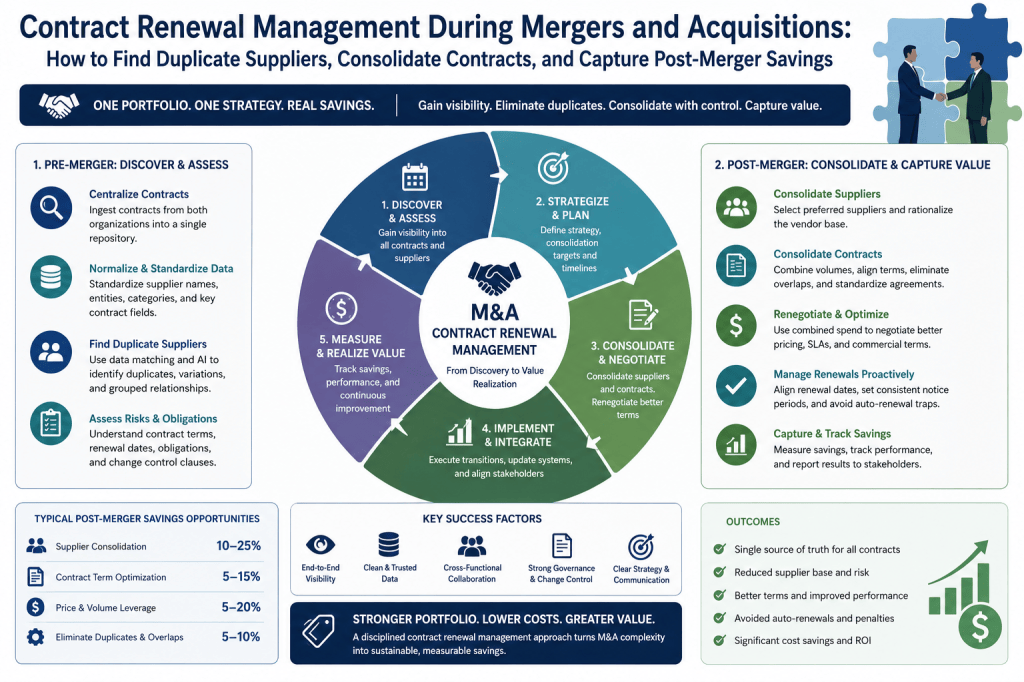
Why Contract Renewals Matter During M&A
Contract rationalization is often discussed as part of post-merger synergy.
But timing is critical.
Suppose the acquiring company discovers that both businesses use separate CRM platforms.
The long-term decision may be:
Standardize on one platform.
But if the acquired company’s CRM automatically renews for another 24 months in 30 days, the company may lose the opportunity to consolidate quickly.
That means:
Synergy Opportunity
is not enough.
You also need:
Renewal Timing
Acquired a Company? Start with the Contract Renewal Calendar
Post-merger savings can disappear quickly when inherited contracts auto-renew before integration teams have reviewed them.
Contract Renewal Tracker is designed to help M&A, procurement, finance, IT, and legal teams identify inherited contracts, prioritize upcoming notice deadlines, detect supplier overlap, and convert consolidation opportunities into actionable renewal decisions.
Find the contracts that need attention before they renew →
The M&A Contract Problem
Imagine:
Acquiring Company
Active Contracts:
1,600
Annual Supplier Spend:
€48M
Acquired Company
Active Contracts:
700
Annual Supplier Spend:
€19M
Combined:
2,300 contracts
€67M annual spend
But simply adding the portfolios together is not the goal.
The organization needs to identify:
- duplicate suppliers;
- duplicate products;
- overlapping services;
- pricing differences;
- termination opportunities;
- future consolidation opportunities.
Phase 1: Build the Combined Contract Inventory
The first post-merger objective is visibility.
Collect contract data from both organizations.
Possible sources include:
- spreadsheets;
- CLM systems;
- procurement platforms;
- shared drives;
- ERP;
- legal repositories.
Then load them into one structured portfolio.
Preserve the Original Entity
During integration, each contract should retain:
Original Legal Entity
Original Business Unit
Original Owner
Original Supplier
This prevents loss of legal context.
For example:
Contract:
Analytics Platform.
Original Entity:
AcquiredCompany GmbH.
That information may matter until novation or termination.
Add M&A Classification
Useful fields might include:
Legacy Company A
Legacy Company B
Integration Status
Consolidation Candidate
Strategic Dependency
This makes post-merger analysis easier.
Phase 2: Prioritize Upcoming Renewal Deadlines
Do not start by cleaning every historical contract.
Start with the contracts where options may disappear soon.
For example:
Critical
Notice deadline within 30 days.
High
Within 90 days.
Medium
Within 180 days.
Long-Term
Beyond 180 days.
This creates an immediate integration work queue.
Example M&A Renewal Queue
Next 30 Days
18 contracts
€2.4M annual value
Next 90 Days
72 contracts
€8.1M
Next 180 Days
164 contracts
€16.7M
The first 18 deserve immediate attention.
Auto-Renewals Are Especially Dangerous After an Acquisition
Inherited auto-renewals may continue because:
- the original owner left;
- integration teams do not know the contract exists;
- supplier correspondence still goes to an old email address;
- responsibility is unclear.
That makes auto-renewal detection one of the first M&A controls to establish.
Example
Acquired company has:
Cybersecurity Platform B.
Annual Cost:
€380K.
Acquirer already uses:
Cybersecurity Platform A.
Decision:
Consolidate onto A.
But B automatically renews for another year in 42 days.
If the notice deadline is missed:
Potential avoidable commitment:
€380K
The integration team needs to know immediately.
Phase 3: Normalize Suppliers
The same supplier may appear differently across the two companies.
For example:
Microsoft Corp.
Microsoft Ireland Operations Ltd.
Microsoft.
MSFT.
Without normalization, the platform may fail to recognize the combined relationship.
Supplier Family Mapping
A useful structure is:
Supplier Group
Microsoft.
Then:
Legal Entity
Microsoft Ireland Operations Ltd.
This allows procurement to see total supplier exposure while preserving legal precision.
Duplicate Supplier Detection
The Contract Renewal Tracker can flag:
Supplier appears in both legacy organizations.
Then show:
Legacy A Spend:
€1.2M.
Legacy B Spend:
€740K.
Combined:
€1.94M
This may create negotiation leverage.
Phase 4: Find Duplicate Products and Services
Supplier overlap is useful.
But product overlap may matter even more.
For example:
Legacy A uses:
CRM A.
Legacy B uses:
CRM B.
Different suppliers, same business need.
This is a consolidation candidate.
SaaS Overlap
Common post-merger overlap categories include:
- CRM;
- collaboration;
- analytics;
- HR;
- project management;
- security;
- design;
- AI tools.
The system can classify contracts by category to make duplication visible.
Example Software Rationalization
CRM A:
€420K.
CRM B:
€310K.
Combined:
€730K.
Future strategy:
Standardize on CRM A.
CRM B renewal:
in 120 days.
Potential future avoided spend:
€310K
subject to migration cost and timing.
Duplicate Services Beyond SaaS
Overlap may also exist in:
- MSP contracts;
- telecom;
- agencies;
- consultants;
- logistics;
- facilities.
M&A contract rationalization should not be limited to software.
Phase 5: Compare Supplier Pricing
One of the most valuable M&A insights is discovering that the two companies pay different prices to the same supplier.
For example:
Legacy A
800 licenses
€180 per user
Legacy B
500 licenses
€240 per user
Same product.
Same supplier.
Difference:
€60 per user
That creates immediate commercial leverage.
Benchmark Internally Before Going to Market
The combined company now has its own pricing benchmark.
Procurement can ask:
Why is one entity paying 33% more for the same product?
That can strengthen renegotiation even before external benchmarking begins.
Volume Consolidation
Combined volume may also qualify the new company for better pricing.
For example:
Legacy A:
800 users.
Legacy B:
Combined:
1,300.
The supplier may offer a better tier at:
1,000+ users.
This creates synergy.
Phase 6: Identify Contract Consolidation Opportunities
Several separate contracts with the same supplier can potentially become:
One Master Agreement
Consolidated Order Forms
Benefits may include:
- lower pricing;
- fewer renewal dates;
- stronger governance;
- simpler administration.
Contract Consolidation Example
Supplier:
CloudWorks.
Legacy A Contracts:
Legacy B Contracts:
Combined Annual Spend:
€3.8M.
Renewal Dates:
January, March, July, October.
Strategy:
Move toward one global commercial anniversary date.
This can improve future negotiating leverage.
Co-Termination Strategy
The organization may not be able to consolidate immediately.
Instead, use short extensions to gradually align contracts.
For example:
Contract A:
renew for 6 months.
Contract B:
renew for 3 months.
Then both expire:
December 31.
Future negotiations become easier.
Phase 7: Find Contracts That Can Be Terminated
Some inherited contracts may no longer make sense.
Examples include:
- duplicate applications;
- discontinued services;
- redundant consulting;
- duplicate insurance;
- separate data providers;
- unnecessary office services.
The merger creates a natural reason to reassess them.
Termination Opportunity
Annual Cost:
€95K.
Business Need:
Duplicate.
Migration:
None.
Notice Deadline:
63 days.
Recommendation:
Terminate
Potential annual avoided spend:
€95K
This is a high-confidence synergy.
Phase 8: Distinguish Easy Synergies from Complex Synergies
Not every duplicate contract can be eliminated immediately.
A useful classification is:
Quick Win
Easy termination or reduction.
Medium Complexity
Requires migration or supplier renegotiation.
Strategic Integration
Major technology or operating-model change.
This prevents unrealistic savings assumptions.
Quick-Win Example
Two identical marketing tools.
One barely used.
Cancellation straightforward.
Potential saving:
€24K.
Strategic Example
Two ERP platforms.
Combined cost:
€4M.
Long-term consolidation opportunity:
€1M/year.
Migration:
3 years.
This should not be treated as immediate year-one savings.
Build a M&A Contract Synergy Pipeline
A structured pipeline can use:
Identified
↓
Validated
↓
Integration Plan
↓
Notice Preserved
↓
Negotiation / Termination
↓
Contracted
↓
Realized
This allows management to track contract-related synergies over time.
Example Synergy Record
Contract
CRM B.
Legacy Company
Acquired Company.
Annual Cost
€310K.
Synergy Type
Application Consolidation.
Target Platform
CRM A.
Notice Deadline
October 1.
Migration Readiness
70%.
Expected Annual Savings
€250K.
Status
Validated.
This is far more useful than a line in an M&A spreadsheet.
Preserve the Notice Window First
This is a critical principle.
A consolidation project may not be fully approved yet.
But if a contract’s notice deadline is approaching, the organization may still need to preserve its options.
Possible action:
Send Non-Renewal Notice
or:
Negotiate Short Extension
This can avoid locking the business into another long term.
Option Preservation
A renewal workflow can explicitly ask:
Do we need to preserve the right not to renew while integration analysis continues?
This is an important M&A use case.
Short-Term Bridge Agreements
Sometimes the business cannot terminate immediately.
A bridge arrangement may be better.
For example:
Original renewal:
12 months.
Integration needs:
4 months.
Negotiate:
6-month extension.
This gives the integration team time while reducing unnecessary commitment.
Transition Services Agreements
M&A transactions may also involve Transition Services Agreements, or TSAs.
These can cover:
- IT;
- payroll;
- finance;
- infrastructure;
- HR;
- shared services.
TSAs themselves may have:
- expiration dates;
- extension mechanisms;
- termination terms.
They should be managed carefully.
TSA Dependency Tracking
For example:
TSA Service:
Identity Management.
Expiry:
June 30.
Replacement Platform:
Not Ready.
Extension Notice:
90 days.
The tracker can flag:
Replacement readiness is behind schedule and TSA extension decision is approaching.
This can prevent operational disruption.
Phase 9: Reassign Contract Ownership
Acquisitions disrupt organizational ownership.
Original contract owners may:
- leave;
- change roles;
- move into integration teams.
The combined company needs clear responsibility.
Ownership Transition
For example:
Old Owner:
Head of IT, Acquired Company.
New Owner:
Regional IT Director.
Procurement Owner:
Global Software Category Lead.
The tracker records the transfer.
Bulk Reassignment
If an acquired executive owns 80 contracts, administrators should be able to reassign them in bulk.
The audit history preserves:
- previous owner;
- new owner;
- effective date.
Phase 10: Review Approval Authority
The acquired company may have different financial thresholds.
After close, the new parent organization’s approval matrix may apply.
The platform should identify:
Legacy Approval Policy
vs:
Post-Merger Policy
This helps avoid unauthorized commitments.
Example
Acquired company previously allowed:
VP approval to €1M.
Parent policy:
CFO approval above €500K.
Upcoming €750K renewal:
must follow:
new approval matrix
The workflow should route correctly.
Phase 11: Review Legal Entity Changes
Some contracts may remain with the acquired entity.
Others may need:
- assignment;
- novation;
- consent.
This should be tracked separately from renewal.
Change-of-Control Clauses
Some contracts contain provisions triggered by acquisition.
The legal team may need to review:
- change-of-control rights;
- consent requirements;
- termination rights.
These issues can affect renewal strategy.
Renewal + Novation
A contract may be renewed while also being moved to a new legal entity.
The workflow could include:
Renewal
Novation
This creates additional legal complexity.
Phase 12: Review Supplier Concentration After the Merger
Combining two companies can create large supplier dependencies.
For example:
Before acquisition:
Supplier share:
8% of IT spend.
After acquisition:
17%.
The merged organization may decide to:
- diversify;
- renegotiate;
- reduce concentration.
The renewal portfolio helps identify when that can happen.
Strategic Supplier Exposure
For example:
Supplier Group:
ExampleCloud.
Combined Spend:
€18M.
Contracts:
Countries:
Renewing Next 12 Months:
€12M.
This becomes a strategic integration issue.
Phase 13: Track Synergy Targets
M&A transactions often include expected cost synergies.
For example:
Technology:
€4M.
Procurement:
€3M.
Facilities:
€1M.
Contract Renewal Tracker can help connect those targets to specific contracts.
Synergy Target Dashboard
M&A Contract Synergy Target
€8M.
Identified
€10.4M.
Validated
€7.1M.
Contracted
€4.8M.
Realized
€3.9M.
This gives integration leadership a clear view.
Confidence-Weighted Synergies
As with ordinary savings pipelines, different stages have different certainty.
For example:
Identified:
25%.
Validated:
50%.
Negotiating:
75%.
Contracted:
100%.
The system can calculate a weighted synergy forecast.
Avoid Double Counting Synergies
Suppose:
Software consolidation creates:
€200K annual savings.
Do not also count:
€200K supplier consolidation
unless it represents a separate effect.
Clear attribution is essential for M&A reporting.
Finance Validation
Finance should validate:
- baseline spend;
- savings;
- timing;
- one-time migration costs.
The net synergy may differ from gross savings.
Gross vs Net Synergies
For example:
Annual contract saving:
€500K.
One-time migration cost:
€700K.
Year 1 net impact:
−€200K
Year 2:
+€500K
This matters for transaction economics.
Multi-Year Synergy View
A contract optimization may produce:
Year 1:
€100K.
Year 2:
€500K.
Year 3:
€500K.
The system can show ramp-up rather than pretending the full savings exist immediately.
Integration Costs
Potential costs include:
- migration;
- implementation;
- termination fees;
- parallel running;
- consulting.
These should be connected to the synergy business case.
Example Replacement Decision
Duplicate HR platform.
Annual saving:
€300K.
Migration cost:
€450K.
Parallel-run cost:
€100K.
Payback:
approximately:
1.8 years.
This helps determine whether consolidation is worthwhile.
M&A Renewal Dashboard
A dedicated dashboard could show:
Inherited Contracts
712
Annual Spend
€19.2M
Notice Deadlines <90 Days
74
Duplicate Suppliers
58
Overlapping Services
41
Validated Synergy Opportunities
€4.8M
Ownership Exceptions
33
Critical Auto-Renewals
8
This immediately focuses the integration team.
M&A Contract Heatmap
A useful matrix could combine:
Synergy Potential
with:
Renewal Urgency
High opportunity + short deadline:
Immediate Integration Priority
This helps allocate resources.
Example
CRM B:
Opportunity:
High.
Notice deadline:
45 days.
Priority:
Critical.
ERP B:
Opportunity:
Very High.
Deadline:
18 months.
Priority:
Strategic.
Different actions are required.
Department-Level Integration
The combined portfolio can be segmented by:
- IT;
- HR;
- Finance;
- Marketing;
- Operations.
Each functional integration team can work its own queue.
IT M&A Renewal Review
IT may focus on:
- duplicate SaaS;
- cloud;
- cybersecurity;
- telecom;
- support.
Technology portfolios often contain some of the largest consolidation opportunities.
Procurement M&A Review
Procurement focuses on:
- duplicate suppliers;
- pricing differences;
- global leverage;
- consolidation.
Finance M&A Review
Finance focuses on:
- recurring commitments;
- synergy validation;
- termination costs;
- forecast impact.
Legal M&A Review
Legal focuses on:
- change of control;
- assignment;
- novation;
- notice rights;
- termination.
Business Owner Review
Business teams confirm:
Is this service still needed in the combined company?
That decision is critical.
AI for M&A Contract Rationalization
AI can dramatically accelerate analysis.
A user could ask:
Which suppliers appear in both companies?
Or:
Which software categories are duplicated?
Or:
What contracts must we act on in the next 60 days?
This turns a large acquired contract portfolio into a manageable decision set.
Example AI M&A Brief
The acquired company has 74 contracts with notice deadlines inside 90 days. Twelve overlap with suppliers already used by the parent company, and seven software agreements appear functionally duplicative. Combined annual spend associated with those opportunities is approximately €2.6M.
This gives integration leadership immediate direction.
AI Pricing Comparison
The assistant could identify:
Legacy Company B pays 22% more per license for Supplier X than Legacy Company A.
This is an obvious renegotiation opportunity.
AI Duplicate Tool Detection
The system could group:
Tool A:
Project management.
Tool B:
Project management.
Tool C:
Project management.
Then ask:
Should these be reviewed for consolidation?
Human validation remains important.
AI Contract Similarity
Contract text analysis can also identify:
- similar supplier agreements;
- duplicate contracts;
- overlapping scopes.
This reduces manual review.
AI Should Not Assume Every Duplicate Is Redundant
Two similar tools may serve different business needs.
The system should say:
Potential overlap
not:
Terminate one.
Business and technical owners still validate the recommendation.
M&A Integration Alerts
Useful alerts include:
High-value inherited contract reaches notice deadline in 14 days.
Duplicate supplier contract identified.
Acquired contract owner no longer active.
Legacy agreement contains change-of-control clause.
Synergy opportunity at risk due to approaching auto-renewal.
These are highly actionable.
Synergy-at-Risk Alert
For example:
€180K annual consolidation opportunity may be lost if the contract auto-renews in 21 days.
This links financial value directly to deadline urgency.
Integration Wave Planning
Large acquisitions may contain thousands of agreements.
A phased approach can be:
Wave 1
90-day deadlines.
Wave 2
High-value / strategic.
Wave 3
Duplicate suppliers.
Wave 4
Long-tail contracts.
This prevents the integration team from becoming overwhelmed.
Day 1 Is Not the Time to Perfect Every Contract Record
The immediate priority is:
preserve options.
Focus first on:
- critical notice dates;
- auto-renewals;
- high-value duplicates;
- ownership gaps.
Data normalization can continue later.
First 30 Days
Key objectives:
- Ingest contract inventories.
- Identify deadlines <90 days.
- Identify auto-renewals.
- Assign integration owners.
- Flag major overlaps.
This creates basic control.
First 90 Days
Then:
- validate suppliers;
- analyze overlaps;
- begin consolidation;
- confirm legal entities;
- start negotiations.
This converts visibility into action.
First 12 Months
Over the first year:
- align renewal dates;
- rationalize suppliers;
- consolidate software;
- standardize governance;
- track realized synergies.
The renewal calendar becomes an integration roadmap.
Contract Renewal Tracker as an M&A Integration Tool
The product should not pretend to replace:
- M&A project-management software;
- ERP;
- CLM;
- financial modeling.
Its specialized role is:
Identify when inherited contractual commitments can be changed and make sure integration opportunities are acted on before the renewal window closes.
That is a distinct and valuable role.
Why Renewals Are Natural M&A Integration Milestones
A merger creates a long list of decisions.
Renewal dates create forced prioritization.
If Contract A renews next month and Contract B renews in 18 months, Contract A deserves earlier attention.
That naturally sequences the integration workload.
M&A Savings Program Example
Acquisition contract spend:
€20M.
Identified overlap:
€5M.
Validated addressable overlap:
€3M.
Expected savings:
15%.
Potential annual synergy:
€450K
Additional supplier-price harmonization:
€220K.
Total potential:
€670K annually
This can become a measurable integration workstream.
One Duplicate Contract Can Justify Fast Action
Suppose:
Parent company already has enterprise access to a software platform.
Acquired company separately pays:
€90K/year.
Renewal deadline:
30 days.
If the subscription can be terminated safely:
avoided spend:
€90K
That is a straightforward integration win.
Contract Renewal Tracker ROI During M&A
The platform’s value can come from:
- avoided duplicate renewals;
- supplier consolidation;
- price harmonization;
- license reduction;
- administrative efficiency;
- reduced legal risk.
An acquisition can therefore create an unusually strong use case for renewal software.
Turn Contract Renewals into Post-Merger Synergies
M&A integration teams should not wait until every system, supplier, and business process has been fully harmonized before reviewing contracts.
Renewal deadlines keep moving during the integration.
Contract Renewal Tracker is designed to help teams identify the inherited commitments that matter first and convert contract overlap into measurable integration opportunities.
Use Contract Renewal Tracker to:
- combine acquired contract inventories;
- preserve legacy legal-entity information;
- identify critical notice deadlines;
- detect auto-renewal exposure;
- normalize suppliers;
- find duplicate suppliers;
- identify overlapping software and services;
- compare supplier pricing;
- consolidate contracts;
- co-terminate renewal dates;
- manage short bridge extensions;
- track TSA deadlines;
- reassign contract owners;
- monitor change-of-control and novation requirements;
- build a synergy pipeline;
- validate savings with finance;
- use AI to prioritize post-merger contract rationalization.
The objective is simple:
Do not let inherited contracts renew before the combined company has decided whether it still needs them.
Start Your Contract Renewal Tracker Subscription →
Final Thoughts
Mergers create duplication almost by definition.
Two companies bring:
two supplier portfolios,
two technology stacks,
two sets of contracts,
and:
two sets of renewal dates.
The value comes from deciding what the combined organization should keep.
That process can be structured as:
Acquire Contract Portfolio
↓
Identify Upcoming Renewal Windows
↓
Find Overlap
↓
Validate Business Need
↓
Consolidate / Renegotiate / Terminate
↓
Track Synergy
The contract renewal date becomes an integration milestone.
That is the strategic opportunity for Contract Renewal Tracker.
It can make sure M&A teams do not merely identify theoretical synergies—they actually act on the contractual windows required to realize them.
Next Article in the Contract Renewal Tracker Series
Article 44 — “Contract Renewal Management for Private Equity Portfolio Companies: How PE Operating Teams Can Control Recurring Spend and Track Savings Across Multiple Businesses”
The next article will target private equity firms, operating partners, portfolio CFOs, procurement transformation teams, and PE-backed businesses. It will cover portfolio-company contract inventories, recurring-cost visibility, cross-company supplier leverage, software rationalization, 100-day plans, EBITDA improvement, savings pipelines, procurement synergies, contract-renewal calendars, KPI standardization, centralized versus portfolio-company ownership, and how Contract Renewal Tracker can provide a repeatable renewal and cost-optimization framework across an entire investment portfolio.

