A renewal calendar tells you what is coming.
A renewal forecast tells you what those upcoming contracts are likely to mean.
For finance, procurement, legal, and business leadership, that difference matters.
Knowing that €12 million of contracts renew in the next six months is useful.
Knowing that:
- €7 million is likely to renew;
- €2 million is likely to be renegotiated;
- €1.2 million may be terminated;
- €900,000 is currently at high risk;
- €650,000 of savings is already identified;
is much more valuable.
That is the purpose of contract renewal forecasting.
A dedicated Contract Renewal Tracker can move beyond static deadline reporting and help organizations estimate future commitments, financial exposure, workload, and likely renewal outcomes before those outcomes are final.
The objective is not to predict the future with certainty.
It is to give decision-makers a better forward-looking view of:
What is likely to happen, how confident are we, and where should we intervene before the forecast becomes reality?
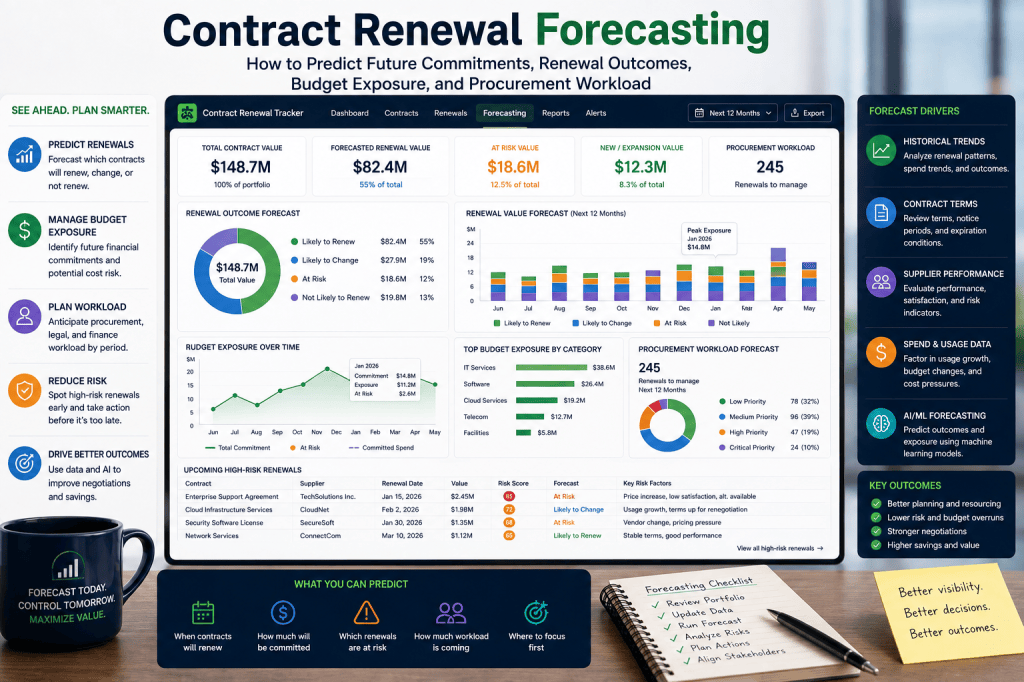
What Is Contract Renewal Forecasting?
Contract renewal forecasting is the process of estimating the likely future outcome of upcoming contract renewals.
It can answer questions such as:
- How much contract spend is likely to renew next quarter?
- How much is still undecided?
- Which contracts are likely to terminate?
- What supplier increases are expected?
- How much savings may procurement capture?
- How much legal and procurement workload is coming?
- Which renewals are likely to require executive approval?
A forecast turns the renewal portfolio into a planning tool.
A Calendar Shows Dates. A Forecast Shows Consequences.
A standard renewal calendar might say:
Next 180 Days
Contracts:
240
Annual Value:
€18.6M
Useful—but incomplete.
A forecast could say:
Next 180 Days
Likely Renewal:
€11.2M
Renegotiation:
€4.1M
Likely Termination:
€1.3M
Undecided:
€2.0M
Expected Supplier Increase:
€640K
Expected Savings:
€520K
Now management can plan.
Need to Know What Upcoming Renewals Mean for Next Year’s Budget?
Contract Renewal Tracker is designed to turn future renewal dates into forward-looking forecasts of commitments, savings opportunities, workload, and decision risk.
See the likely financial impact before contracts actually renew →
Forecasting Horizon
Different teams need different time horizons.
Useful views include:
30 Days
Immediate execution.
90 Days
Operational planning.
180 Days
Procurement and finance planning.
365 Days
Budget and strategic planning.
The system should support all four.
30-Day Forecast
This horizon answers:
What will close soon?
Useful metrics include:
- commitments awaiting signature;
- terminations pending;
- approvals outstanding;
- likely spend change.
This is an execution forecast.
90-Day Forecast
This is particularly valuable for procurement.
It can answer:
Which negotiations need to complete this quarter?
For example:
Renewing value:
€8.2M.
Active negotiations:
€4.6M.
Expected savings:
€320K.
At-risk commitments:
€1.1M.
This gives the procurement team a clear operating picture.
180-Day Forecast
The six-month horizon is useful for:
- strategic renewals;
- workload planning;
- budget revisions.
This is where organizations still have time to:
- benchmark;
- source alternatives;
- reduce quantities;
- negotiate.
365-Day Forecast
A 12-month view becomes important for:
- annual budgeting;
- category planning;
- supplier strategy;
- resource planning.
For example:
Annual renewing spend:
€42M.
Strategic contracts:
€18M.
Expected cost increase:
€1.6M.
Savings pipeline:
€1.2M.
This is leadership-level planning data.
Forecast Outcome Categories
A simple model might classify each contract as:
Renew As-Is
Renegotiate
Reduce
Replace
Terminate
Temporary Extension
Undecided
These categories can then be aggregated.
Example Portfolio Forecast
Renewal Outcome Forecast
Renew As-Is:
€14.2M.
Renegotiate:
€8.4M.
Reduce:
€3.1M.
Terminate:
€2.2M.
Temporary Extension:
€900K.
Undecided:
€4.8M.
Total:
€33.6M
This gives management a clear view of likely outcomes.
Undecided Spend Is Important
One of the most useful metrics is:
Undecided Renewal Value
Suppose:
€20M renews next quarter.
€17M has a defined strategy.
€3M is still undecided.
That €3M represents uncertainty.
Management can focus on reducing it.
Decision Coverage
Formula:
Renewals with Defined Strategy ÷ Total Upcoming Renewals
For example:
170 of 200 contracts.
Decision Coverage:
85%
The organization may target:
95% by 90 days before notice deadlines.
Commitment Forecast
Finance may want to know:
How much spend is likely to continue?
A simple forecast can calculate:
Expected Renewal Commitment
For example:
Current renewing portfolio:
€40M.
Likely renewal:
€32M.
Likely termination:
€4M.
Uncertain:
€4M.
This improves budget accuracy.
Expected Renewal Spend
For contracts with defined scenarios:
Current spend:
€500K.
Expected renewal:
€520K.
Forecast increase:
€20K.
Do this across the portfolio and finance gets:
Expected Renewal Spend Change
Supplier Increase Forecast
Suppose suppliers are proposing:
Cloud:
+8%.
Software:
+10%.
Telecom:
+4%.
Professional Services:
+6%.
Weighted portfolio expected increase:
6.8%
This can be compared against budget assumptions.
Proposed vs Expected Increase
Procurement may expect to negotiate suppliers down.
For example:
Supplier Proposal:
+10%.
Procurement Forecast:
+4%.
The tracker can preserve both.
This gives finance a more realistic budget forecast.
Forecast Scenario Layers
A strong system can support:
Supplier Proposal Scenario
What if we accept every current proposal?
Expected Scenario
What procurement expects to achieve.
Target Scenario
What the organization wants to achieve.
Downside Scenario
What happens if negotiations fail.
This allows scenario planning.
Example Scenario
Current renewing spend:
€10M.
Supplier proposals:
€10.9M.
Procurement expected:
€10.4M.
Target:
€10.1M.
Now leadership understands the range.
Budget Exposure
Finance may define:
Budget for renewing contracts:
€10.2M.
Expected scenario:
€10.4M.
Forecast variance:
+€200K
That gives finance time to intervene.
Budget Exposure Dashboard
Renewal Budget
€28M.
Expected Renewal Spend
€29.4M.
Variance
+€1.4M.
Procurement Savings Pipeline
€950K.
Remaining Forecast Gap
€450K.
This creates a direct link between renewals and budget planning.
Forecast by Department
IT:
+€700K.
Marketing:
−€120K.
Operations:
+€250K.
HR:
−€80K.
The company can see where recurring costs are likely to grow.
Forecast by Category
Cloud:
+9%.
Cybersecurity:
+11%.
SaaS:
+4%.
Telecom:
−3%.
Professional Services:
+2%.
This helps category managers focus their strategy.
Forecast by Supplier
For strategic suppliers:
Supplier A:
Current €4.2M.
Expected €4.5M.
Supplier B:
Current €2.8M.
Expected €2.5M.
This shows where spend is shifting.
Probability-Weighted Forecasting
When outcomes are uncertain, assign probabilities.
For example:
Renew As-Is:
70%.
Renegotiate Down:
20%.
Terminate:
10%.
Each scenario has a value.
The system can calculate expected financial value.
Example Weighted Forecast
Scenario A:
Renew at €500K.
Probability:
60%.
Scenario B:
Reduce to €420K.
Probability:
30%.
Scenario C:
Terminate.
Probability:
10%.
Expected spend:
0.60 × €500K
0.30 × €420K
0.10 × €0
=
€426K
This gives finance a probabilistic forecast.
Keep Probability Transparent
The user should know whether probability came from:
- owner judgment;
- workflow stage;
- AI model;
- historical data.
Forecasts should not appear more certain than they are.
Confidence Levels
A useful system might show:
High Confidence
Signed or approved.
Medium Confidence
Negotiation advanced.
Low Confidence
Decision unresolved.
This helps users interpret the forecast.
Forecast Confidence Score
For example:
Approved renewal:
95%.
Active negotiation:
70%.
Business review only:
40%.
Unknown:
20%.
The exact rules can be configured.
Do Not Confuse Confidence with Probability
These are related but different.
Probability asks:
How likely is the outcome?
Confidence asks:
How much do we trust our estimate?
A 50% probability can still have high confidence.
That distinction can improve forecasting maturity.
Procurement Workload Forecasting
Contract renewals also create work.
A forecast can answer:
How many negotiations are coming?
For example:
Q1:
Q2:
Q3:
Q4:
Q4 clearly requires more procurement capacity.
Workload by Complexity
Count alone is not enough.
One strategic cloud negotiation may require more effort than 20 small subscriptions.
The tracker can assign effort points.
For example:
Low:
1 point.
Standard:
High:
Strategic:
Then calculate workload.
Example Workload Forecast
Q4 renewals:
Workload points:
Procurement capacity:
Projected deficit:
80 points
Management can:
- start work earlier;
- add resources;
- simplify low-value renewals.
Category Manager Capacity
Software category manager:
28 high-value renewals.
Telecom manager:
This may indicate workload imbalance.
The system can help redistribute work.
Legal Capacity Forecasting
Legal can forecast upcoming reviews.
For example:
Next month:
42 legal reviews.
Capacity:
Projected overload:
This allows:
- early triage;
- external counsel;
- workflow adjustment.
Finance Approval Workload
Finance can also forecast:
CFO approvals next quarter:
Total commitment:
€42M.
This avoids last-minute approval spikes.
Executive Decision Forecast
For example:
Executive Committee renewals:
€78M.
Decision dates:
12 next quarter.
This becomes a governance calendar.
Renewal Volume Forecast
Operations teams may want:
Contracts Entering Renewal Window
Next 30 days:
Next 90 days:
This helps plan onboarding and support capacity.
Forecast Savings
Procurement can forecast expected savings from upcoming renewals.
For example:
Identified opportunity:
€2M.
Weighted expected:
€1.2M.
Contracted:
€600K.
This helps leadership estimate cost-reduction outcomes.
Savings Forecast by Stage
Identified:
25% confidence.
Validated:
50%.
Negotiating:
75%.
Contracted:
100%.
Weighted savings creates a realistic view.
Example
Identified:
€800K × 25% = €200K.
Validated:
€600K × 50% = €300K.
Negotiating:
€500K × 75% = €375K.
Contracted:
€300K.
Expected:
€1.175M
This supports CFO planning.
Forecast Savings vs Target
Target:
€2M.
Expected:
€1.175M.
Gap:
€825K
The system can identify additional renewals to investigate.
Forecast Supplier Consolidation
A future model could estimate when supplier consolidation becomes possible.
For example:
5 contracts with same supplier.
4 renew within 12 months.
Combined spend:
€3.2M.
The system can flag:
Potential consolidation window opening in Q3.
This creates strategic sourcing insight.
Forecast Terminations
Business owners may already indicate:
Likely Terminate
The system can aggregate expected avoided spend.
For example:
Likely terminations:
€1.8M annual value.
Finance can adjust future budgets cautiously.
Contract Exit Forecast
If termination requires:
migration.
The system should also consider:
- transition cost;
- bridge extensions.
Expected savings may not begin immediately.
Forecast Timing of Savings
Suppose:
Contract ends June.
Annual saving:
€120K.
Only six months remain in the financial year.
Year-one impact:
€60K
Full-year annualized saving:
€120K.
Both should be reported.
Effective Date Matters
Savings beginning:
January 1.
have different annual impact from savings beginning:
October 1.
Finance needs the actual timing.
Cash-Flow Forecast
Renewals can also affect payment timing.
For example:
Annual upfront payment:
€1M in January.
Quarterly:
€250K per quarter.
Contract Renewal Tracker can pass this schedule into financial planning.
Forecast Multi-Year Commitments
Suppose:
€8M of upcoming renewals are likely to become 3-year agreements.
Total commitment forecast:
€24M
This is important even if annual P&L spend remains €8M.
Total Contract Value Forecast
The system can report:
Annual Spend Renewing
€32M.
Expected Total Contract Value
€68M.
This shows the full commitment being created.
Forecast Auto-Renewal Exposure
A useful forward-looking metric:
How much spend may auto-renew if nothing changes?
For example:
Next 90 days:
€2.4M.
Next 180 days:
€6.2M.
This gives management a clear risk forecast.
Forecast Notice-Deadline Exposure
Similarly:
Notice Deadlines Next 30 Days
€4.8M.
Next 90 Days
€12.6M.
This may be more operationally useful than expiration-date forecasting.
Forecast Risk
The current risk score tells you:
What is risky now?
Forecast risk can ask:
Which contracts are likely to become critical if nothing changes?
This is more powerful.
Example Predictive Risk
Contract currently:
Medium.
But:
- decision still missing;
- workflow already 20 days behind;
- notice deadline in 75 days.
The system could predict:
Likely Critical within 30 days if no action occurs.
That is an early-warning forecast.
Risk Trajectory
A contract can show:
Current Risk:
Projected in 30 days:
Projected at notice deadline:
Now management sees the trajectory.
Forecast Bottlenecks
The system can also predict where workflow congestion may occur.
For example:
42 renewals are expected to enter legal review in the first two weeks of October, exceeding normal capacity by 35%.
This allows proactive resource planning.
Forecast by Owner
One owner may have:
12 renewals in Q2.
Another:
The platform can identify overloaded teams or individuals.
Forecast by Region
International companies can see:
Europe:
€22M.
North America:
€18M.
APAC:
€11M.
This helps regional planning.
Forecast by Legal Entity
Finance can see expected commitments by entity.
This supports local budget control.
Forecast by Currency
For global portfolios:
USD:
$42M.
EUR:
€38M.
GBP:
£12M.
Then consolidated reporting using corporate FX methodology.
Forecast Supplier Price Inflation
Over time, the system may learn:
Software suppliers average:
6%.
Cybersecurity:
8%.
Telecom:
2%.
This historical data can inform early budget assumptions.
Historical Forecasting
Past renewals provide useful information.
For example:
Supplier typically proposes:
10%.
Final negotiated average:
4%.
Future forecasts can use this history.
Human review should remain possible.
Forecast Model Inputs
Possible inputs include:
- supplier history;
- category inflation;
- current proposal;
- contract terms;
- negotiation status;
- procurement target.
This can improve accuracy.
AI-Assisted Renewal Forecasting
AI can help convert portfolio complexity into understandable scenarios.
A CFO might ask:
What is our expected renewal spend next quarter?
The assistant can summarize:
- likely renewals;
- supplier increases;
- savings;
- uncertainty.
Example AI CFO Forecast
€18.4M of annual contract value reaches renewal during Q4. Based on current renewal strategies and negotiations, expected renewed annual spend is approximately €18.9M. Supplier proposals would otherwise increase spend to €19.7M, while active procurement initiatives are expected to offset roughly €800K of that increase.
That is much easier to consume than a large spreadsheet.
AI Procurement Forecast
A procurement leader could ask:
Where will the team be overloaded next quarter?
The assistant might answer:
November contains 31 high-complexity negotiations, approximately 40% above normal monthly capacity. Software and professional services account for most of the workload.
This creates actionable capacity planning.
AI Legal Forecast
Which month has the most legal renewal work?
The system can estimate the expected review queue from workflow rules.
AI Scenario Analysis
Management could ask:
What happens if supplier increases average 8% instead of 5%?
The system can recalculate:
Expected annual cost.
Budget variance.
Savings gap.
This enables interactive planning.
Scenario Example
Base expected spend:
€50M.
At 5% supplier inflation:
€52.5M.
At 8%:
€54M.
Difference:
€1.5M
Now procurement knows how much additional mitigation may be required.
What If Savings Underperform?
Another question:
What happens if only 50% of the savings pipeline converts?
The system can recalculate budget exposure.
This is valuable for CFO planning.
Best-Case / Expected / Worst-Case
A common executive view could show:
Best Case
€47.8M.
Expected
€49.4M.
Worst Case
€52.1M.
This presents uncertainty clearly.
Forecast Accuracy
A forecasting system should measure itself.
For example:
Forecast:
€10M renewed spend.
Actual:
€10.6M.
Variance:
6%.
Over time, the organization can improve assumptions.
Forecast Accuracy by Category
Software:
92%.
Cloud:
86%.
Professional Services:
78%.
The lower category may need better inputs.
Forecast Bias
Does the organization consistently underestimate supplier increases?
Or overestimate savings?
The tracker can identify bias.
For example:
Procurement savings forecasts averaged 14% above realized savings during the last four quarters.
This helps improve planning.
Forecast Versioning
Forecasts change over time.
A company should preserve:
January Forecast
March Forecast
June Forecast
This allows management to see how the outlook evolved.
Forecast Movement
For example:
Q4 expected spend:
January:
€42M.
April:
€43.2M.
July:
€44.1M.
Now leadership can ask:
Why has the forecast increased?
The system can explain.
Forecast Change Drivers
Possible drivers:
- supplier price increases;
- expansion of scope;
- delayed terminations;
- savings underperformance;
- new contracts.
This improves management reporting.
Forecast Confidence Dashboard
For example:
High-confidence spend:
€24M.
Medium:
€12M.
Low:
€6M.
The company knows how much of the forecast is still uncertain.
Undecided Exposure Should Decline Over Time
A healthy process might show:
180 days before renewal:
40% undecided.
90 days:
15%.
30 days:
3%.
This can become an operational KPI.
Forecast Readiness KPI
For strategic contracts:
Percentage with defined outcome by 120 days.
Target:
95%.
This reduces uncertainty.
Procurement Forecast KPI
Expected savings accuracy.
Target:
within ±10%.
This improves credibility.
Finance Forecast KPI
Expected renewal spend accuracy.
Target:
within ±5%.
This makes renewal forecasting part of financial planning.
Workload Forecast KPI
Projected vs actual review volumes.
This helps staffing decisions.
Forecasting Should Drive Action
A forecast is only valuable if it changes behavior.
If the system predicts:
Procurement capacity will be exceeded in Q4,
management should:
- start renewals earlier;
- reassign work;
- automate low-value renewals.
Forecasting should lead to intervention.
Forecast-Triggered Automation
For example:
IF projected_procurement_capacity > 120%THEN accelerate_low_complexity_renewals
Or:
IF forecast_budget_variance > 5%THEN create_cost_mitigation_review
This turns forecasting into operations.
Forecast-Triggered Executive Review
For example:
Projected annual renewal spend exceeds budget by €2.4M.
Automatically add to:
CFO Renewal Review
This keeps leadership informed.
Forecast-Triggered Supplier Strategy
If:
supplier renewals cluster in same quarter,
the system can recommend:
Consolidated Negotiation
This converts forecasting into commercial strategy.
Contract Renewal Tracker as a Forward-Looking Platform
A basic system tells you:
What is due.
A more advanced system tells you:
What is likely to happen.
A mature renewal intelligence system tells you:
What should we do now to change the likely outcome?
That is the strategic progression.
From Calendar to Forecast to Intervention
The architecture becomes:
Contract Data
↓
Renewal Calendar
↓
Workflow Status
↓
Outcome Probability
↓
Financial Forecast
↓
Workload Forecast
↓
Scenario Analysis
↓
Recommended Action
This is much more valuable than simple deadline tracking.
Ready to See What Your Renewal Portfolio Is Likely to Become?
Upcoming contracts should not remain an unknown future liability until suppliers send their final invoices.
Contract Renewal Tracker can help organizations build a forward-looking view of future commitments, savings, risks, and workload.
Use Contract Renewal Tracker to:
- forecast 30-, 90-, 180-, and 365-day renewals;
- estimate likely renewal outcomes;
- track undecided spend;
- forecast supplier increases;
- compare supplier, expected, and target scenarios;
- calculate probability-weighted commitments;
- forecast savings;
- model multi-year exposure;
- predict procurement workload;
- forecast legal and finance capacity;
- monitor risk trajectories;
- run best-, expected-, and worst-case scenarios;
- measure forecast accuracy;
- use AI to explain forecast changes and suggest interventions.
The goal is not simply:
What renews next?
It is:
What is likely to happen next—and what can we still do to improve the outcome?
Start Your Contract Renewal Tracker Subscription →
Final Thoughts
Renewal management naturally becomes more valuable as it moves from:
history
to:
current status
to:
future outlook.
A spreadsheet may tell you:
the contract ends December 31.
A renewal workflow tells you:
negotiation is underway.
A forecast tells you:
the contract is likely to renew at €520K, €20K over budget, with 70% confidence.
And an intelligent renewal system can go one step further:
Start escalation now because the current forecast will miss the annual cost-reduction target.
That is a substantially stronger product proposition.
Contract Renewal Tracker can evolve from a reminder application into a forward-looking renewal planning and decision platform for procurement, finance, legal, and leadership.
Next Article in the Contract Renewal Tracker Series
Article 48 — “Contract Renewal KPIs and Executive Dashboards: The Metrics CFOs, Procurement Leaders, Legal Teams, and Executives Should Track”
The next article will bring many parts of the series together into a measurement and management layer. It will cover renewal coverage, notice-deadline compliance, undecided spend, auto-renewal exposure, savings, cost avoidance, cycle time, owner responsiveness, approval delays, legal review SLA, high-risk contract value, forecast accuracy, supplier performance, workload, portfolio health, executive scorecards, and how Contract Renewal Tracker can turn renewal operations into a measurable business discipline rather than a collection of reminders.

