A contract renewal should not become binding simply because the person managing it clicked Renew.
For material agreements, the renewal decision can create:
- new financial commitments;
- multi-year obligations;
- supplier concentration;
- legal exposure;
- budget variance;
- operational dependency.
That means approval governance matters.
The question is not only:
Should this contract renew?
It is also:
Who is authorized to approve the commitment, what information should they see, and what happens if the commercial terms change after approval?
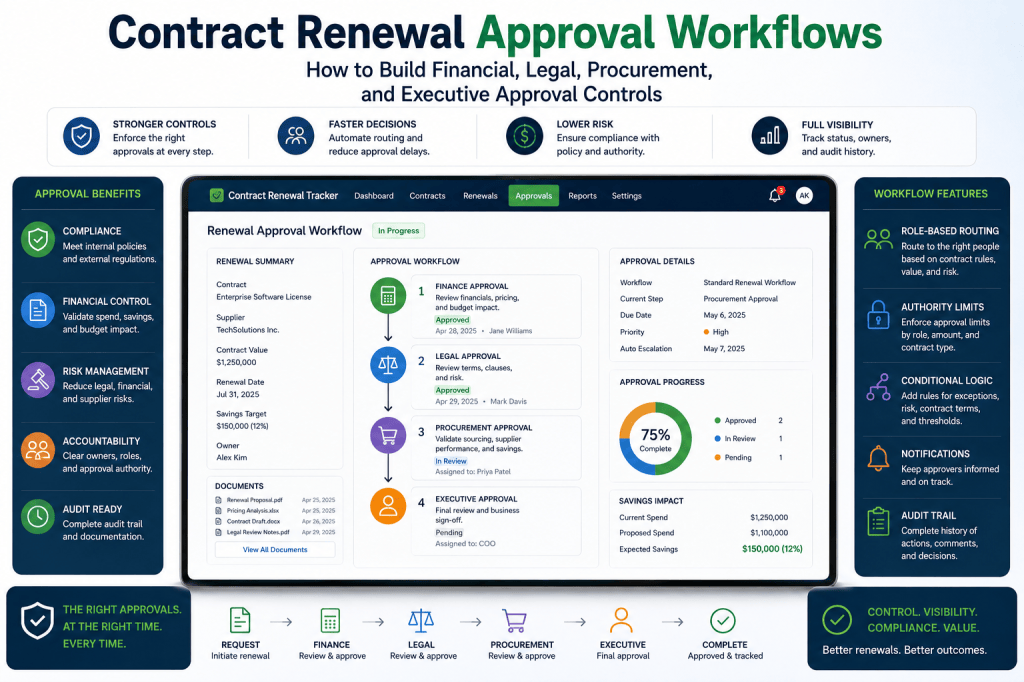
A dedicated Contract Renewal Tracker can automate approval routing so each renewal receives the appropriate financial, legal, procurement, and executive authorization before execution.
The objective is to create enough governance to protect the organization without turning every routine renewal into bureaucracy.
Why Renewal Approvals Matter
Consider a software contract with:
Current annual spend:
€400,000
Supplier proposal:
€460,000
Term:
3 years
The annual increase is important.
But the larger issue is the total commitment:
€1.38 million
A department manager may be authorized to manage the service.
That does not necessarily mean they are authorized to commit the organization to €1.38 million.
Renewal approval workflows solve that distinction.
Are Large Renewals Still Being Approved Through Email?
Email approvals are easy to request.
They are harder to govern.
Questions quickly arise:
- Was the approver authorized?
- Which contract version did they approve?
- Was the final price the same?
- Did legal review the changed terms?
- Was the commitment within budget?
- When was approval granted?
Contract Renewal Tracker is designed to route renewal decisions through structured approval policies and preserve the evidence behind every authorization.
Turn renewal approvals into controlled, auditable decisions →
Approval Should Follow Risk and Materiality
Not every renewal requires the same approval path.
A €500 productivity subscription should not require:
CFO
General Counsel
Procurement Director.
A €10 million outsourcing renewal probably should not be approved by one department manager.
The workflow should scale according to factors such as:
- annual value;
- total commitment;
- price increase;
- contract term;
- legal changes;
- risk;
- budget status;
- supplier criticality.
Build an Approval Matrix
A simple financial approval matrix might look like:
Up to €10,000
Business owner.
€10,001–€50,000
Department manager.
€50,001–€250,000
Director.
€250,001–€1 million
Finance director.
Above €1 million
CFO.
Actual thresholds should reflect the organization’s delegation-of-authority policy.
Annual Value Is Not Enough
Suppose:
Annual value:
€300K.
Term:
5 years.
Total commitment:
€1.5M
If approval rules look only at annual value, the contract might route to a finance director.
But organizational policy may require CFO authorization because the total commitment exceeds €1 million.
The platform should evaluate both.
Annual Contract Value vs Total Contract Value
A renewal record should clearly distinguish:
Annual Contract Value
€300K.
Renewal Term
60 months.
Total Contract Value
€1.5M.
Approval routing can then use the appropriate measure.
Scheduled Price Increases Matter Too
A three-year contract might be:
Year 1:
€300K.
Year 2:
€315K.
Year 3:
€330K.
Total commitment:
€945K
The system should calculate the actual scheduled commitment rather than simply:
€300K × 3.
This improves approval accuracy.
One-Time Charges
Renewals can also include:
- implementation fees;
- migration costs;
- support fees;
- onboarding;
- equipment.
These may need to be included in approval value.
For example:
Subscription:
€400K.
Implementation:
€150K.
Total Year-One Commitment:
€550K
The approver should see the full picture.
Approval Dimension 1: Financial Value
The most obvious approval driver is:
How much are we committing?
Possible rule:
IF total_commitment > 1,000,000THEN CFO_APPROVAL_REQUIRED
This provides deterministic governance.
Approval Dimension 2: Budget Status
A contract can be within authority but outside budget.
Example:
Final price:
€240K.
Budget:
€200K.
Variance:
+€40K
This should trigger a finance exception even if €240K normally falls within the department’s approval threshold.
Budget Exception Rule
For example:
IF renewal_value > approved_budgetTHEN FINANCE_EXCEPTION_APPROVAL = REQUIRED
This prevents renewals from quietly exceeding plan.
Budget Variance Threshold
Some organizations may allow minor variance.
For example:
≤3%
Normal approval.
3–10%
Finance review.
>10%
Finance director or CFO review.
This can be configured.
Approval Dimension 3: Supplier Price Increase
A large supplier increase may require procurement oversight.
For example:
Current spend:
€500K.
Supplier proposal:
€575K.
Increase:
15%.
Even if the business can afford it, procurement may need to challenge the commercial terms.
Price Increase Rule
IF supplier_price_increase > 8%THEN PROCUREMENT_APPROVAL_REQUIRED
This makes commercial review automatic.
Procurement Approval Is Not the Same as Finance Approval
Procurement asks:
Are these terms commercially appropriate?
Finance asks:
Is this commitment financially authorized?
Both can be required.
This is why approval workflows often involve multiple functions.
Approval Dimension 4: Legal Changes
A renewal can preserve the same price but introduce significant legal changes.
For example:
- liability cap removed;
- termination rights changed;
- governing law changed;
- DPA revised.
That should trigger legal review regardless of financial value.
Legal Approval Rule
IF legal_terms_changed = TRUETHEN LEGAL_APPROVAL_REQUIRED
This keeps legal review focused on meaningful changes.
Material vs Non-Material Legal Changes
Not every change deserves legal escalation.
For example:
Supplier contact address updated.
That may be administrative.
But:
Liability cap changed.
That is material.
The platform can support:
Administrative
Commercial
Material Legal
classification.
Approval Dimension 5: Contract Term
A long-term commitment reduces flexibility.
For example:
Annual value:
€100K.
Term:
7 years.
Total:
€700K.
The value may be moderate, but the duration is unusual.
A policy could require executive approval above:
36 months.
Term Rule
IF renewal_term_months > 36THEN EXECUTIVE_APPROVAL_REQUIRED
This protects against excessive lock-in.
Approval Dimension 6: Supplier Criticality
A critical supplier may deserve additional review regardless of contract value.
Examples:
- payroll;
- cloud infrastructure;
- cybersecurity;
- manufacturing dependency.
The renewal could require:
- vendor management;
- risk;
- executive sponsor.
Strategic Supplier Rule
IF supplier_classification = STRATEGICTHEN VENDOR_MANAGER_REVIEW_REQUIRED
This ensures relationship context enters the decision.
Approval Dimension 7: Renewal Risk
A Critical-risk renewal may require higher-level attention.
For example:
IF renewal_risk = CRITICALTHEN FUNCTIONAL_EXECUTIVE_REVIEW = REQUIRED
The executive is not approving routine paperwork.
They are addressing a material exception.
Approval Dimension 8: Termination Decision
Termination can also require approval.
For example:
Cancelling a critical IT supplier may affect operations.
A termination workflow could require:
Business Owner
↓
IT / Operations
↓
Legal
↓
Executive Sponsor
before notice is issued.
Approval Dimension 9: Replacement Decision
Replacing a supplier may create:
- migration costs;
- operational risk;
- new implementation.
The approval should cover the total transition decision, not only the old contract termination.
Approval Dimension 10: Data and Security Risk
Contracts involving sensitive data or critical systems may require:
Security
Privacy
approval.
For example:
IF personal_data = TRUEAND DPA_changed = TRUETHEN PRIVACY_REVIEW_REQUIRED
This turns renewal into a governance checkpoint.
Sequential Approvals
Some decisions need to occur in order.
For example:
Business Owner
↓
Procurement
↓
Legal
↓
Finance
↓
CFO
Each approver sees the result of earlier work.
This is useful when the later decision depends on final commercial terms.
Parallel Approvals
Other reviews can happen simultaneously.
For example:
After negotiation:
Legal Review
and:
Security Review
run in parallel.
Once both complete:
Finance Approval
begins.
This reduces cycle time.
Example Parallel Approval Model
COMMERCIAL TERMS FINAL ↓ ┌─────┴─────┐LEGAL SECURITY └─────┬─────┘ ↓ FINANCE
This is common for technology agreements.
Hybrid Approval Workflow
Most sophisticated renewals use a combination.
For example:
Business Approval.
↓
Procurement Negotiation.
↓
Legal + Security in parallel.
↓
Finance.
↓
CFO.
This balances control and speed.
Approval Dependencies
Finance should not approve a preliminary supplier proposal if procurement is still negotiating.
The workflow can enforce:
Finance approval only after Final Commercial Terms = Complete.
This reduces rework.
Approval Readiness
Before routing an approval, the system can validate:
- business decision complete;
- final price entered;
- term known;
- documents uploaded;
- required reviews complete.
If something is missing, approval does not start.
Approval Package
Approvers should receive a concise decision brief.
For example:
Contract
ExampleCloud Enterprise Agreement.
Current Annual Spend
€800K.
Supplier Proposal
€920K.
Final Negotiated Value
€840K.
Budget
€850K.
Renewal Term
36 months.
Total Commitment
€2.52M.
Savings vs Proposal
€80K/year.
Supplier Risk
Medium.
Legal Review
Approved.
Decision
Approve / Reject / Request Changes.
This is much better than:
Please approve attached contract.
AI-Generated Approval Briefs
Contract Renewal Tracker can use AI to summarize the key decision context.
For example:
The proposed renewal commits €2.52M over three years, remains €30K below approved annual budget, avoids €240K of the supplier’s proposed three-year increase, and includes no material legal deviations from the approved position.
The approver can still inspect the underlying data and documents.
Finance Approval Brief
Finance may care most about:
- budget;
- annual value;
- total commitment;
- savings;
- payment schedule.
The system should tailor the summary accordingly.
Legal Approval Brief
Legal may see:
- changed clauses;
- notice terms;
- liability;
- termination;
- document version.
Same renewal, different approval context.
Procurement Approval Brief
Procurement may see:
- supplier proposal;
- benchmark;
- negotiation target;
- concessions;
- savings.
This avoids information overload.
Executive Approval Brief
Executives need the shortest version.
For example:
Decision: Approve €8.2M strategic cloud renewal.
Why: Business critical; market review completed; €700K negotiated cost avoidance.
Risk: High supplier dependency.
Alternative: Migration estimated 18–24 months.
Recommendation: Approve 24-month term while diversification plan proceeds.
That is decision-ready.
Approve, Reject, or Request Changes
Approval outcomes should not be limited to:
Yes / No
Useful statuses include:
Approved
Rejected
Approved with Conditions
Changes Requested
This supports real workflows.
Approved with Conditions
Example:
Approved provided annual price escalation remains capped at 3%.
The condition should remain attached to the renewal.
If the final contract violates it:
reapproval is required.
Conditional Approval Enforcement
For example:
IF final_price_cap > approved_price_capTHEN APPROVAL_INVALIDATED = TRUE
This makes conditional approvals meaningful.
Approval Comments
Approvers should be able to explain their decision.
For example:
Approved for 12 months only. Do not accept supplier’s proposed 36-month term.
This becomes part of the audit trail.
Approval Evidence
The system should preserve:
- approver;
- role;
- decision;
- date;
- approved value;
- approved term;
- document version;
- comments.
This creates defensible authorization evidence.
Document Version Matters
Legal approves:
Renewal Agreement v7
Supplier later sends:
v8
with changed language.
The approval should not automatically apply.
The system must know which version was approved.
Document-Approval Binding
For example:
Approved Document Hash / Version
is tied to:
Legal Approval.
If the document changes:
status becomes:
Reapproval Required
This is essential for reliable governance.
Material Change Detection
Not every document change needs full reapproval.
A future system could compare versions and classify:
Non-Material Formatting
vs:
Material Commercial Change
vs:
Material Legal Change
Then route accordingly.
Reapproval After Price Change
Suppose finance approves:
€500K.
Final supplier value:
€530K.
Policy:
Tolerance up to 2%.
Actual increase:
6%.
Result:
Finance Reapproval Required
Reapproval Tolerance
A rule might allow:
IF final_value <= approved_value * 1.02THEN PRIOR_APPROVAL_REMAINS_VALIDELSE REAPPROVAL_REQUIRED
This reduces unnecessary approval loops while preserving control.
Reapproval After Term Change
Finance approved:
24 months.
Final:
36 months.
Even if annual price is unchanged, the total commitment changed materially.
Reapproval should be triggered.
Reapproval After Scope Change
If:
license quantity increases
or:
additional services are added,
approval may need to restart.
The system should compare the final agreement with the approved baseline.
Delegated Authority
Executives often delegate authority.
For example:
CFO delegates approvals up to:
€2M
to:
Deputy CFO
for a two-week period.
The system should support formal delegation.
Delegation Record
Store:
Delegator
Delegate
Authority Scope
Start Date
End Date
This prevents informal “please approve for me” workflows.
Temporary Delegation
Useful for:
- holidays;
- leave;
- travel;
- reorganizations.
Expired delegation should automatically stop.
Authority Limits
Delegation should not exceed the delegator’s own authority.
For example:
Director authority:
€500K.
They cannot delegate:
€2M.
The system should enforce this.
Approval Groups
Some organizations approve through committees.
For example:
Investment Committee.
Executive Committee.
Technology Review Board.
The system may need:
group approval
rather than individual approval.
Approval Quorum
Possible rule:
3 of 5 committee members must approve.
Or:
All named approvers required.
This should be configurable.
Majority vs Unanimous Approval
A high-risk decision may require unanimous approval.
A routine committee decision may require majority.
The workflow engine should understand the difference.
Sequential Committee Approval
Some governance processes require:
Regional Committee
then:
Group Committee.
The system can route accordingly.
Approval SLA
Approvals themselves can become bottlenecks.
For example:
Finance SLA:
3 business days.
Legal:
Executive:
The tracker should measure whether approvals are completed on time.
Approval Reminder
At:
80% of SLA elapsed,
send warning.
At:
100%,
mark overdue.
Then escalate based on policy.
Approval Escalation
Example:
Finance approval overdue.
↓
Finance manager.
↓
Finance director.
↓
CFO if critical.
This prevents important renewals from stalling unnoticed.
Approval Bottleneck Dashboard
For example:
Pending Approvals
42
Overdue
11
Associated Commitment
€18.4M
Oldest
13 days
This gives management a clear view.
Approval Aging
Useful buckets:
0–2 days.
3–5.
6–10.
10+.
This helps identify process problems.
Approval Cycle Time
Measure:
Request Created → Final Decision
For example:
Finance:
3.4 days.
Legal:
6.8.
Executive:
4.2.
This becomes a KPI.
Rejection Rate
If finance rejects:
25% of renewal requests,
something may be wrong upstream.
Possible causes:
- budget not validated;
- commercial terms incomplete;
- insufficient justification.
The workflow can improve based on this data.
Rejection Reasons
Require structured reasons such as:
Over Budget
Insufficient Business Case
Legal Issue
Commercial Terms Unacceptable
Missing Information
This supports analytics.
Approval Rework
A request may move:
Finance
↓
Rejected
↓
Procurement
↓
Resubmitted
This increases cycle time.
The system can measure rework rate.
Approval Guardrails
The system should block invalid approval scenarios.
For example:
- approver approves own unauthorized request;
- expired delegate approves;
- threshold exceeded;
- missing legal review.
This is where deterministic rules are crucial.
Segregation of Duties
A person may be allowed to negotiate but not approve the final commitment.
For example:
IF procurement_owner = final_finance_approverAND commitment > thresholdTHEN REQUIRE_ALTERNATE_APPROVER
This strengthens control.
Self-Approval Restrictions
A contract owner may not be allowed to approve their own high-value renewal.
The workflow can enforce:
Requester ≠ Final Approver
where required.
Conflict-of-Interest Controls
Some suppliers may involve employee relationships or other conflicts.
A compliance review can be triggered.
This may be especially relevant in regulated environments.
Emergency Approval
Occasionally a critical contract needs urgent authorization.
A structured emergency process is better than bypassing governance entirely.
Emergency Approval Workflow
For example:
- Emergency reason recorded.
- Minimum required approvers identified.
- Executive approval obtained.
- Renewal executed.
- Post-event review scheduled.
This maintains accountability.
Emergency Does Not Mean Uncontrolled
The system should preserve:
- reason;
- deadline;
- approvers;
- exception.
Then management can investigate why emergency approval was necessary.
Emergency Approval KPI
Measure:
Percentage of renewals requiring emergency approval.
If this rises:
the renewal process may be starting too late.
This is a valuable maturity metric.
Approval Policy Exceptions
Sometimes policy itself must be overridden.
For example:
Standard maximum term:
36 months.
Supplier requires:
48 months.
The system should create:
Policy Exception
rather than silently allow it.
Policy Exception Workflow
Exception Requested
↓
Business Justification
↓
Procurement Review
↓
Finance / Legal Review
↓
Authorized Approval
This creates a formal record.
Policy Versioning
Approval policies change.
For example:
2027:
CFO threshold €1M.
2028:
€1.5M.
Historical renewals should preserve which policy applied at the time.
This matters for audit.
Global Approval Policies
International organizations may need different approval paths by:
- region;
- legal entity;
- currency.
For example:
US:
$1M threshold.
Europe:
€1M.
UK:
£800K.
The system should evaluate the correct local policy.
Multi-Currency Approval
If group policy is expressed in EUR, a USD contract may need conversion.
The system can use the approved corporate FX rate.
For example:
$2M.
Group equivalent:
€1.72M.
Required:
Group CFO.
The methodology should be visible.
Approval Across Legal Entities
A regional master agreement may involve several legal entities.
The workflow may require:
- local authority;
- regional approval;
- global approval.
The platform should support multi-entity approvals without losing accountability.
Local + Global Approval Example
Germany:
Local budget owner.
↓
EMEA procurement.
↓
Group finance.
↓
Global signatory.
This is common in multinational environments.
Approval and Signature Are Different
Approval authorizes the decision.
Signature legally executes the agreement.
A person may be authorized to approve but not sign.
The system should distinguish:
Approver
from:
Authorized Signatory
Signature Authority
For example:
CFO approves.
Legal Entity Director signs.
This should be modeled separately.
E-Signature Handoff
After all approvals:
Ready for Signature
↓
Send to e-signature platform.
↓
Signed.
↓
Document returned.
↓
Renewal completed.
This creates a clean execution chain.
Do Not Send to Signature Before Approval Is Complete
This should be a hard workflow guardrail.
For example:
IF required_approvals != COMPLETETHEN SIGNATURE_REQUEST = BLOCKED
This reduces governance risk.
Post-Signature Validation
After execution, the platform can verify:
- signed value;
- term;
- notice period.
If the signed contract differs from the approved terms:
flag exception.
This creates another important control.
Approval Audit Trail
A complete record might show:
July 3
Business Owner approved.
July 11
Procurement approved final commercial terms.
July 14
Legal approved document v8.
July 16
Finance approved €1.42M commitment.
July 18
CFO approved.
July 19
Authorized signatory executed agreement.
This provides complete traceability.
Approval Dashboard for Finance
Finance might see:
Pending
Overdue
Commitment Pending
€7.4M.
Over Budget
Multi-Year
This is a focused work queue.
Approval Dashboard for Legal
Legal may see:
Pending Legal Approvals
Material Changes
Termination Notices
High Risk
Again, role-specific.
Executive Approval Queue
Executives should see only material decisions.
For example:
Approval Required
Cloud Contract
€8.2M total commitment.
Outsourcing Renewal
€4.8M.
Global Telecom
€3.1M.
Each with a concise recommendation.
Approval Analytics
Useful metrics include:
Average Approval Time
Approval SLA Compliance
Rejection Rate
Reapproval Rate
Emergency Approval Rate
Policy Exception Rate
These help governance teams improve the process.
Reapproval Rate as a Quality Signal
If:
30% of renewals need reapproval,
the initial approvals may be occurring too early.
This suggests workflow redesign.
Approval SLA Compliance
For example:
Finance:
92%.
Legal:
88%.
Executive:
96%.
This identifies bottlenecks.
Policy Exception Rate
If:
40% of strategic contracts require exceptions,
the policy itself may no longer reflect commercial reality.
Analytics can support policy redesign.
AI Approval Assistant
An approver could ask:
What am I actually approving?
The AI assistant could answer:
You are approving a 36-month commitment of €2.52M for ExampleCloud. The final price is €80K per year below the supplier’s proposal and €10K below annual budget. Legal has approved the final document, but supplier dependency remains High.
This reduces review time.
Ask AI: What Changed Since Last Approval?
If reapproval is required:
The annual value increased from €800K to €840K and the term changed from 24 to 36 months, increasing total commitment from €1.6M to €2.52M.
This explains exactly why the approval came back.
Ask AI: What Are the Main Risks?
The assistant might answer:
- 36-month lock-in;
- supplier dependency;
- limited replacement alternatives.
This makes executive review faster.
AI Should Not Grant Approval
AI can:
- summarize;
- explain;
- compare.
It should not replace authorized human approval where policy requires a person.
Deterministic authorization rules remain authoritative.
AI Can Detect Missing Information
Before approval:
Supplier proposal is attached, but final payment schedule is missing.
The system can prevent incomplete requests from entering the queue.
This reduces approval rework.
AI Can Compare Approved vs Final Terms
For example:
Final document differs from the approved commercial position in two material areas: annual price increased €25K and auto-renewal term changed from 12 to 24 months.
This can trigger reapproval.
Approval Automation ROI
Approval automation creates value through:
- less email coordination;
- faster decisions;
- fewer unauthorized commitments;
- stronger auditability;
- less rework.
But the largest value may be preventing one material renewal from being executed without proper scrutiny.
Example Approval Failure
Supplier renewal:
€1.5M annually.
Department manager approves by email.
Contract term:
3 years.
Total commitment:
€4.5M.
CFO never sees it.
A structured approval engine prevents this scenario.
Productivity Example
Suppose:
500 material renewals/year.
Manual approval coordination:
30 minutes each.
Automated workflow saves:
20 minutes.
Time saved:
167 hours.
At:
€60/hour
administrative value:
approximately:
€10,000/year
The governance value comes on top.
Start Simple
Organizations do not need to implement a highly complex approval matrix on day one.
Start with:
Low Value
Business owner.
Medium
Manager + finance.
High
Procurement + finance.
Strategic
Legal + finance + executive.
Then mature the rules.
Phase 1 — Basic Thresholds
Route by:
value.
This creates immediate control.
Phase 2 — Add Conditional Reviews
Add:
- legal change;
- price increase;
- over-budget.
This increases precision.
Phase 3 — Add Delegation and SoD
Introduce:
- delegated authority;
- self-approval controls;
- segregation of duties.
This supports stronger governance.
Phase 4 — Add Enterprise Complexity
Add:
- multi-entity;
- currencies;
- committees;
- policy inheritance.
This supports global organizations.
Phase 5 — Add AI Decision Support
Add:
- approval briefs;
- change summaries;
- risk explanations.
This improves decision speed without weakening human control.
Contract Renewal Tracker as an Approval Governance Platform
This is another important product evolution.
The product no longer merely answers:
When does the contract renew?
It answers:
Who has the authority to approve the next commitment, what evidence do they need, and did the final agreement stay within what was approved?
That is a significantly stronger enterprise capability.
Ready to Put Real Controls Around Renewal Commitments?
A contract renewal can create years of financial and operational obligations.
The approval process should therefore be more reliable than:
“Approved” in an email thread.
Contract Renewal Tracker is designed to give organizations a structured approval framework that scales from simple departmental renewals to complex enterprise commitments.
Use Contract Renewal Tracker to:
- build approval matrices;
- route by annual and total contract value;
- trigger budget exceptions;
- escalate supplier price increases;
- require legal approval for material changes;
- control long-term commitments;
- route strategic supplier reviews;
- run sequential and parallel approvals;
- support delegated authority;
- enforce segregation of duties;
- trigger reapproval after material changes;
- bind approvals to document versions;
- manage emergency approvals;
- preserve complete audit evidence;
- use AI to create concise approval briefs.
The goal is not to add bureaucracy.
It is to make sure:
the right people approve the right commitment based on the right information before the organization becomes bound.
Start Your Contract Renewal Tracker Subscription →
Final Thoughts
Renewal approval governance works best when it is:
Proportional
Routine contracts remain simple.
Deterministic
Policies decide who must approve.
Contextual
Approvers see the information relevant to their role.
Auditable
Every authorization is preserved.
Adaptive
Material changes automatically trigger reapproval.
The process becomes:
Renewal Decision
↓
Commercial Terms
↓
Policy Evaluation
↓
Required Approvals
↓
Authorized Decision
↓
Signature
↓
Post-Execution Verification
That is the control layer between:
We want to renew this contract
and:
The organization is now legally and financially committed.
For Contract Renewal Tracker, this capability strengthens the product considerably because it moves the platform deeper into financial governance, legal control, procurement policy, and enterprise auditability.
Next Article in the Contract Renewal Tracker Series
Article 52 — “Contract Renewal Negotiation Management: How to Track Supplier Offers, Counteroffers, Targets, Savings, and Final Commercial Outcomes”
The next article will focus on the commercial heart of many renewals: negotiation. It will cover current baseline pricing, supplier proposals, negotiation targets, walk-away positions, offer history, quantity and scope changes, concessions, contract-term tradeoffs, benchmark comparisons, hard savings, cost avoidance, approval handoffs, negotiation timelines, supplier leverage, and AI-generated negotiation briefs.
This will further position Contract Renewal Tracker as a procurement and commercial-optimization platform, not merely a contract-management tool.

