Automatic renewal clauses are convenient when a business wants a contract to continue without interruption.
They are much less convenient when nobody realizes the renewal deadline has already passed.
A software subscription, maintenance agreement, telecommunications contract, consulting arrangement, managed service agreement, lease, insurance policy, or supplier contract may automatically renew for another month, year, or multi-year term unless the customer provides notice within a specified period.
The financial consequences can be substantial.
A company may believe it has another three months to decide whether to continue a contract, while the agreement actually requires cancellation notice 90 or 120 days before expiration.
By the time the contract reaches the expiration date, the renewal may already be legally committed.
This is why a Contract Renewal Tracker should treat auto-renewal clauses as a separate risk category rather than merely another contract attribute.
The system needs to identify the clause, extract the relevant terms, calculate the real decision deadline, notify the correct people, and escalate the renewal if no action is taken.
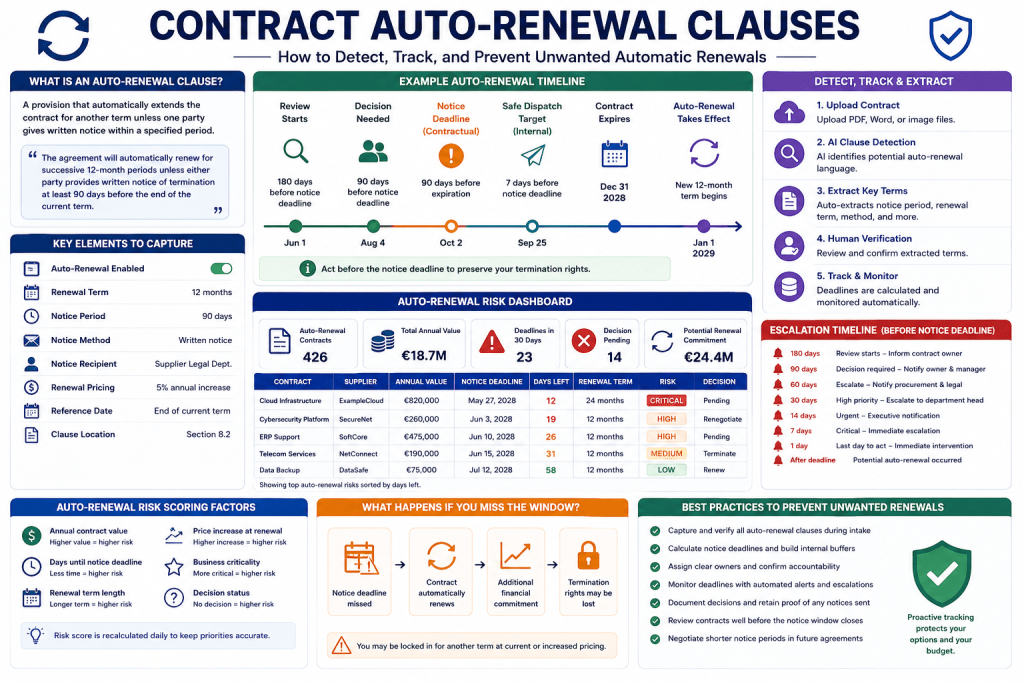
What Is an Auto-Renewal Clause?
An auto-renewal clause is a contractual provision that extends an agreement automatically unless one of the parties takes a specified action before a defined deadline.
A typical clause might say:
The agreement will automatically renew for successive twelve-month periods unless either party provides written notice of termination at least 90 days before the end of the current term.
The exact wording varies considerably, but the underlying structure usually contains several elements:
- current contract term;
- renewal period;
- automatic renewal mechanism;
- notice period;
- termination method;
- notice recipient;
- deadline for giving notice.
A renewal tracker needs to capture these elements individually.
Simply recording:
Auto-Renewal: Yes
is not enough.
Why Auto-Renewal Clauses Create Risk
The main risk is not automatic renewal itself.
The risk is loss of decision flexibility.
Suppose a company signs a software contract worth €240,000 per year.
The agreement expires December 31.
The contract contains a 120-day cancellation notice requirement.
That means the real decision deadline occurs around the beginning of September.
If the organization begins its review in November, it may already be too late.
The supplier can potentially say:
The cancellation window has passed. The agreement has renewed for another twelve months.
The organization may then be committed to another €240,000 of spending despite wanting to:
- negotiate a lower price;
- reduce license quantities;
- migrate to another supplier;
- consolidate software;
- terminate the service;
- renegotiate unfavorable terms.
The failure was not necessarily a procurement failure.
It was often a deadline visibility failure.
Expiration Date Is Not the Same as Cancellation Deadline
This distinction should be central to the design of any Contract Renewal Tracker.
Consider:
Contract expiration: December 31
Termination notice: 90 days
Auto-renewal: 12 months
A simple contract database may show:
138 days until expiration.
That sounds comfortable.
But if the notice deadline is only 48 days away, the meaningful number is:
48 days until cancellation rights may be lost.
An intelligent tracker should therefore prioritize the notice deadline over the expiration date.
The Anatomy of an Auto-Renewal Clause
A Contract Renewal Tracker should attempt to extract at least the following fields.
Auto-Renewal Enabled
Possible values:
- Yes
- No
- Conditional
- Unknown
Renewal Period
Examples:
- one month;
- three months;
- twelve months;
- twenty-four months;
- same length as original term.
Notice Period
Examples:
- 30 days;
- 60 days;
- 90 days;
- 120 days;
- six months.
Notice Method
Examples:
- written notice;
- registered mail;
- email;
- customer portal;
- formal letter;
- notice to designated legal address.
Notice Recipient
For example:
Supplier Legal Department
or:
Account Manager and Contract Administration
Renewal Pricing
The clause may also contain commercial provisions.
For example:
- current pricing continues;
- pricing increases by 5%;
- pricing increases according to CPI;
- renewal is subject to supplier’s then-current pricing;
- negotiated pricing expires at renewal.
These terms can materially affect renewal strategy.
Evergreen Contracts
Some auto-renewing contracts are sometimes described as evergreen agreements.
Instead of ending permanently after the initial term, they continue renewing until one party terminates them.
For example:
Initial term:
24 months
Thereafter:
Automatic 12-month renewal periods
This structure can continue indefinitely.
Evergreen agreements are not inherently problematic, but they require ongoing visibility.
A company may have used the same supplier for eight years while the contract automatically renewed every twelve months.
Without structured renewal management, the organization may never have performed a proper market review.
Auto-Renewal Detection During Contract Upload
A modern Contract Renewal Tracker should attempt to identify auto-renewal clauses when a contract enters the system.
The process might look like this:
Contract Uploaded
↓
Text Extracted
↓
Relevant Clauses Identified
↓
Renewal Language Analyzed
↓
Structured Renewal Terms Generated
For example:
Extracted Renewal Information
Auto-Renewal: Yes
Initial Term: 36 months
Renewal Term: 12 months
Termination Notice: 90 days
Notice Type: Written notice
Renewal Pricing: Supplier’s current list price
Confidence: 94%
A human contract administrator can then verify the extracted information.
Why Human Verification Is Important
Contract language can be complicated.
Consider wording such as:
Unless terminated pursuant to Section 14.3, the Services shall continue for successive Renewal Terms equivalent to the Initial Term, provided that Customer may elect not to renew by giving Supplier written notice not less than ninety days prior to the commencement of the next Renewal Term.
The meaning may be understandable to an experienced reviewer, but automated extraction still needs verification.
Contracts may also contain:
- conflicting clauses;
- amendments;
- schedules;
- special terms;
- regional variations;
- superseding provisions.
The system should therefore distinguish between:
AI-Extracted
and:
Human-Verified
renewal data.
Contract Amendments Can Change Renewal Terms
Another important challenge is that the original contract may no longer contain the current renewal rules.
Suppose the original agreement states:
Notice period: 60 days
Two years later, an amendment changes it to:
Notice period: 120 days
If the Contract Renewal Tracker analyzes only the original agreement, it may calculate the wrong deadline.
The system therefore needs to understand the contract document hierarchy.
For example:
Master Services Agreement
↓
Amendment 1
↓
Amendment 2
↓
Current Renewal Terms
The latest controlling provision should drive renewal calculations.
Calculate the Auto-Renewal Deadline Automatically
Once the relevant terms are verified, the system can calculate the key date.
A simplified calculation is:
Auto-Renewal Decision Deadline = Contract End Date − Notice Period
Example:
Contract end:
December 31, 2028
Notice requirement:
90 days
Decision deadline:
approximately October 2, 2028
But the organization should normally act earlier.
It might define:
Internal Decision Deadline = Contractual Deadline − 30 days
That creates a buffer.
The tracker might therefore display:
Contract Expiration: December 31
Contractual Notice Deadline: October 2
Internal Decision Deadline: September 2
Renewal Review Start: June 1
Now the organization has an operational timeline rather than a single date.
Auto-Renewal Risk Scoring
Not all auto-renewal clauses represent the same level of risk.
A €300 annual subscription renewing automatically is different from a €2 million outsourcing contract.
The Contract Renewal Tracker can calculate an Auto-Renewal Risk Score.
Possible factors include:
- annual contract value;
- days until notice deadline;
- length of renewal period;
- business criticality;
- cancellation complexity;
- supplier dependency;
- renewal price increase;
- contract owner status;
- decision status;
- historical renewal behavior.
For example:
Contract A
Annual value: €2,400
Notice deadline: 60 days
Renewal period: 1 month
Business criticality: Low
Risk:
Low
Contract B
Annual value: €850,000
Notice deadline: 37 days
Renewal period: 24 months
Business criticality: High
Decision recorded: No
Risk:
Critical
The dashboard should make Contract B impossible to overlook.
Renewal Period Length Matters
Organizations often focus on annual contract value but overlook the length of the renewal commitment.
Consider:
Annual contract value:
€400,000
Automatic renewal period:
3 years
Potential committed value:
€1.2 million
Missing the renewal window could therefore create a much larger financial exposure than the annual amount suggests.
A useful metric is:
Renewal Commitment Exposure = Annualized Contract Value × Renewal Term
For multi-year renewals, this can dramatically change the risk assessment.
Renewal Price Increases Matter Too
Some contracts automatically increase pricing at renewal.
For example:
Fees will increase annually by the greater of 5% or CPI.
Another contract might say:
Renewal pricing will be based on Supplier’s then-current standard rates.
These clauses can create significant cost increases.
A Contract Renewal Tracker could flag:
Commercial Renewal Risk
Current annual cost:
€200,000
Expected increase:
7%
Projected renewed cost:
€214,000
Additional annual spend:
€14,000
This gives procurement a concrete reason to begin negotiations.
Notice Method Can Be as Important as Notice Date
A company may correctly identify the cancellation deadline and still fail to terminate the contract properly.
Why?
Because the agreement may specify how notice must be given.
For example:
Notice must be sent by registered mail to Supplier’s legal address.
Sending an email to the account manager may not satisfy the contract.
The renewal tracker should therefore capture:
Notice Deadline
and:
Notice Procedure
For example:
Termination Requirements
Deadline:
October 2
Method:
Registered mail
Recipient:
Supplier Legal Department
Address:
Contractual notice address
Additional requirement:
Copy to account representative
This turns contract data into actionable instructions.
Auto-Renewal Watchlist
A dedicated Auto-Renewal Watchlist can help organizations focus on contracts with the highest renewal risk.
Example dashboard:
Critical Auto-Renewals
| Contract | Value | Deadline | Decision | Risk |
|---|---|---|---|---|
| Cloud Infrastructure | €820K | 12 days | Pending | Critical |
| Cybersecurity Platform | €260K | 19 days | Renegotiate | High |
| ERP Support | €475K | 26 days | Pending | High |
| Telecom Services | €190K | 31 days | Terminate | High |
The dashboard can also include:
Total Auto-Renewal Exposure: €4.8M
Decision Pending: €1.7M
Deadlines Within 30 Days: 14
Critical Renewals: 4
That gives management immediate visibility.
Auto-Renewal Alerts Should Escalate Aggressively
Because missing the deadline may result in a contractual commitment, escalation rules should be stronger than ordinary expiration reminders.
A possible workflow:
180 Days Before Deadline
Notify contract owner.
120 Days
Create renewal review task.
90 Days
Notify contract owner and procurement.
60 Days
Require renewal decision.
30 Days
Escalate to manager.
14 Days
High-priority alert.
7 Days
Escalate to department leadership.
3 Days
Critical alert to procurement/legal administrator.
1 Day
Immediate escalation.
If the deadline passes without a recorded decision, the system should flag:
POTENTIAL AUTO-RENEWAL OCCURRED
This should trigger follow-up verification.
Decision States for Auto-Renewal Contracts
Every important auto-renewing contract should eventually receive a clear decision.
Useful states include:
- Review Pending
- Renew
- Renegotiate
- Terminate
- Replace Supplier
- Consolidate
- Temporary Extension
- Legal Review Required
- Decision Deferred
- Notice Submitted
- Renewal Confirmed
- Auto-Renewed
- Missed Deadline
The system should never treat:
No decision recorded
as equivalent to:
Renew
Those are fundamentally different situations.
Silence Should Not Be a Renewal Decision
This is one of the most important principles in renewal management.
In many organizations, the default operational behavior is:
Nobody complained, so the contract renewed.
That is risky.
The system should instead treat silence as an exception.
For example:
Auto-renewal deadline in 21 days. No explicit renewal decision recorded.
The contract remains escalated until someone actively records an outcome.
This shifts the organization from passive renewal to explicit renewal governance.
Require Approval for High-Value Auto-Renewals
Organizations can establish policy thresholds.
For example:
Contracts below €10,000:
Contract owner approval.
Contracts between €10,000 and €100,000:
Manager approval.
Contracts between €100,000 and €500,000:
Procurement and finance approval.
Contracts above €500,000:
Executive approval.
An auto-renewing €900,000 agreement should not continue merely because nobody noticed the cancellation deadline.
The renewal tracker can enforce governance rules before the deadline arrives.
AI Can Explain Why an Auto-Renewal Is Dangerous
A useful AI capability is not merely identifying the clause but explaining the business consequence.
For example:
AI Renewal Analysis
Risk: Critical
This contract automatically renews for an additional 24 months unless written notice is delivered within 45 days.
Current annual value is €480,000.
If renewed at current pricing, the organization may become committed to approximately €960,000 over the next renewal term.
No renewal decision has been recorded.
Pricing is scheduled to increase by 6% at renewal.
Recommended Action:
Begin immediate commercial and legal review.
This is much more useful than:
Contract expires soon.
Detecting Duplicate and Overlapping Auto-Renewals
A renewal intelligence system can also compare contracts.
Suppose an organization has:
- three project management tools;
- four file-sharing platforms;
- two cybersecurity monitoring systems;
- multiple overlapping consulting retainers.
All automatically renew.
The system could identify:
Three contracts in the Collaboration Software category renew within 90 days.
Combined annual value:
€310,000
This creates an opportunity for consolidation.
Auto-renewal monitoring can therefore support cost reduction as well as risk avoidance.
Auto-Renewal and License Utilization
Software contracts are particularly suitable for intelligent renewal analysis.
Imagine:
Purchased licenses:
1,000
Active users:
612
Annual cost:
€360,000
Auto-renewal deadline:
73 days
The Contract Renewal Tracker could flag:
Current license utilization is approximately 61%. Review quantity before renewal.
A procurement team now has time to renegotiate from 1,000 licenses to perhaps 700 or 750.
Without early visibility, the organization might automatically renew all 1,000.
Auto-Renewal and Supplier Performance
Supplier performance can also influence renewal recommendations.
Suppose a supplier has repeatedly missed service-level targets.
The system could combine:
- contract terms;
- renewal deadline;
- SLA performance;
- incident history;
- user feedback.
The renewal alert might say:
Supplier has failed to meet SLA targets in four of the previous six months. Contract automatically renews in 82 days unless notice is submitted within 22 days.
That is highly actionable information.
Renewal History Should Be Preserved
Each renewal cycle should create historical data.
For example:
2025 Renewal
Decision:
Renew
Original price:
€160,000
Renewed price:
€150,000
Savings:
€10,000
2026 Renewal
Decision:
Renegotiate
Original proposal:
€165,000
Final price:
€154,000
Savings:
€11,000
2027 Renewal
Decision:
Under Review
This history helps future negotiations.
The organization can see how pricing and terms have evolved.
Missed Auto-Renewals Should Become Learning Events
If a deadline is missed, the Contract Renewal Tracker should capture why.
Possible causes:
- no contract owner;
- wrong renewal date;
- notice period not captured;
- contract amendment overlooked;
- notification ignored;
- owner left company;
- approval delayed;
- workflow failed;
- notification system failed.
Instead of treating the event as an isolated mistake, the organization can improve its renewal controls.
For example:
Contracts without active owners will now escalate to procurement 120 days before the renewal deadline.
This creates continuous process improvement.
The Auto-Renewal Control Center
A mature Contract Renewal Tracker could provide a dedicated control center containing:
Portfolio Metrics
Active auto-renewing contracts:
426
Total annual value:
€18.7M
Potential renewal commitment:
€24.4M
Upcoming Risk
Deadlines within 30 days:
23
Value exposed:
€2.8M
No decision recorded:
9
Commercial Opportunities
Contracts marked renegotiate:
37
Potential price increases:
€610K
Low-utilization contracts:
18
Supplier consolidation candidates:
11
Governance
Contracts without owner:
7
Contracts requiring executive approval:
14
Notice verification pending:
12
This moves auto-renewal management from scattered reminders to structured governance.
Recommended Auto-Renewal Workflow
A practical workflow might look like this:
1. Contract Uploaded
↓
2. Renewal Clause Detected
↓
3. Auto-Renewal Terms Extracted
↓
4. Human Verification
↓
5. Notice Deadline Calculated
↓
6. Risk Score Assigned
↓
7. Renewal Workflow Created
↓
8. Owner Assigned
↓
9. Review and Negotiation
↓
10. Renewal Decision Recorded
↓
11. Required Approval Obtained
↓
12. Notice or Renewal Executed
↓
13. Outcome Verified
↓
14. Renewal History Stored
Every important step becomes traceable.
Auto-Renewal Policies
Organizations should be able to configure rules.
For example:
Policy: High-Value Auto-Renewal
Condition:
Annual value > €250,000
AND
Auto-renewal = Yes
Actions:
- start renewal review 180 days before notice deadline;
- assign procurement;
- require finance approval;
- escalate unresolved decision at 60 days;
- require executive approval before renewal.
Policy: Long-Term Renewal Commitment
Condition:
Renewal period >= 24 months
Actions:
- increase risk score;
- begin review 270 days before deadline;
- require legal review;
- calculate total commitment exposure.
Policy: Price Increase
Condition:
Renewal price increase > 5%
Actions:
- flag commercial review;
- request supplier proposal;
- compare current market alternatives.
This is where the Contract Renewal Tracker evolves into a rules-driven renewal platform.
Preventing Unwanted Renewals Is Only the Beginning
Once the organization reliably controls auto-renewal deadlines, additional capabilities become possible.
The system can begin optimizing:
- supplier negotiations;
- contract consolidation;
- software utilization;
- procurement planning;
- renewal timing;
- spend forecasts;
- contract standardization.
The original objective may have been simple:
Don’t miss a cancellation deadline.
But structured renewal data creates a much broader opportunity.
It becomes possible to ask:
Which auto-renewing contracts should we challenge?
Which suppliers have the largest automatic renewal exposure?
How much spending could be renegotiated during the next quarter?
Which contracts have unfavorable notice periods?
Which agreements repeatedly renew without competitive review?
Where should procurement focus first?
These are strategic contract-management questions.
Final Thoughts
Auto-renewal clauses are not necessarily bad.
In many cases they provide operational continuity and reduce administrative work.
The problem arises when automatic renewal becomes unintentional renewal.
A strong Contract Renewal Tracker should therefore ensure that every material auto-renewing contract has:
a verified clause, a calculated deadline, an assigned owner, a renewal workflow, an explicit decision, and an audit trail.
The goal is not to prevent contracts from renewing automatically.
The goal is to ensure they renew automatically only when the organization deliberately chooses that outcome.
The progression is:
Contract → Auto-Renewal Clause → Notice Deadline → Risk Assessment → Review → Decision → Approval → Action → Verification
When this process is automated and visible, unwanted renewals become much less likely.
Next Article in the Contract Renewal Tracker Series
Article 8 — “Contract Renewal Notice Periods: How to Calculate Deadlines, Build Buffers, and Avoid Missing Termination Windows”
The next article will go deeper into one of the most important mechanics behind contract renewals: notice periods. It will cover 30-, 60-, 90-, 120-, and 180-day notice requirements, internal decision buffers, business-day calculations, amendments, notice delivery requirements, deadline confidence, escalation rules, and how a Contract Renewal Tracker can calculate the real last day to act.

