Contract renewal management produces a surprising amount of information.
A single renewal may involve:
- the original contract;
- amendments;
- order forms;
- renewal clauses;
- notice requirements;
- pricing schedules;
- supplier correspondence;
- usage data;
- negotiation history;
- approval records;
- risk scores;
- workflow tasks.
Traditional contract systems make users navigate through all of this information manually.
A contract manager may need to open several documents simply to answer:
When do we need to decide whether to renew this contract?
A procurement manager may ask:
Why is this renewal classified as high risk?
A CFO may want to know:
How much contract value becomes committed if we miss notice deadlines this month?
An AI Contract Renewal Assistant changes the interaction model.
Instead of forcing users to search through contracts, dashboards, documents, and workflow screens, they can ask questions in natural language.
For example:
What contracts require my attention today?
Which auto-renewals above €100,000 have notice deadlines during the next 60 days?
Explain the termination requirements for the ExampleCloud agreement.
Why is the cybersecurity contract rated Critical?
What should we do next?
Prepare me for the supplier negotiation.
The AI assistant becomes a conversational layer over the Contract Renewal Tracker.
But to be useful in contract management, it must do more than generate plausible answers.
It needs to be grounded in actual contract evidence, explain its reasoning, respect permissions, distinguish facts from recommendations, and keep humans responsible for consequential decisions.
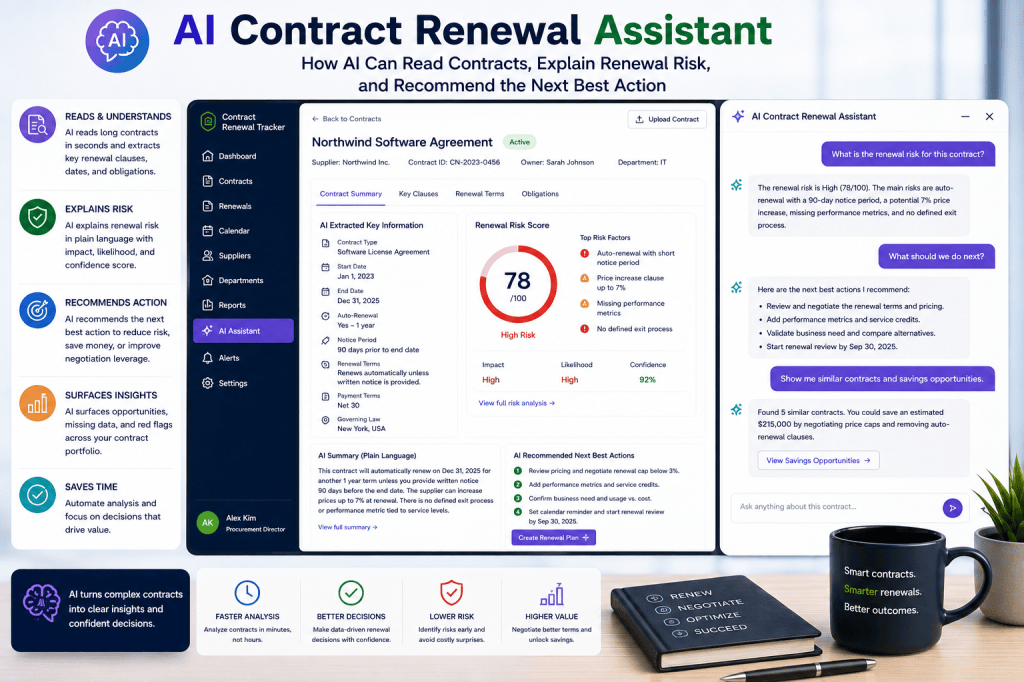
What Is an AI Contract Renewal Assistant?
An AI Contract Renewal Assistant is an intelligent interface that combines information from:
Contract Documents
Structured Contract Data
Renewal Clauses
Deadlines
Workflow Status
Risk Scores
Financial Information
Supplier History
↓
AI Reasoning Layer
↓
Answers, Explanations, Summaries, and Recommended Actions
The assistant should not operate as a generic chatbot.
It should understand the organization’s contract-renewal context.
The Difference Between Search and an AI Assistant
Traditional contract search answers:
Where is the contract?
An AI renewal assistant should answer:
What does the contract mean for the renewal decision?
For example, traditional search might locate:
Section 12.3 — Term and Renewal
The AI assistant might explain:
The agreement automatically renews for successive 12-month periods unless either party provides written notice at least 90 days before the end of the current term.
Then add:
The current term ends December 31. Based on the extracted clause, the notice deadline is October 2.
And finally:
The contract is currently marked for renegotiation, but supplier discussions have not started. Beginning negotiation now is recommended.
That is a very different level of functionality.
The Assistant Needs Multiple Sources of Context
A reliable renewal answer rarely comes from one database field.
Suppose the user asks:
Should we renew the analytics platform?
The assistant may need:
Contract Information
Annual value.
Renewal term.
Notice deadline.
Termination rights.
Usage Information
Purchased licenses.
Active users.
Feature utilization.
Supplier Performance
SLA results.
Incidents.
Support performance.
Commercial Information
Current price.
Proposed price.
Historical increases.
Benchmark pricing.
Workflow Information
Current decision.
Negotiation status.
Approvals.
Risk Information
Renewal risk score.
Contributing factors.
The assistant should combine these sources before generating its response.
Step 1: Contract Document Ingestion
The AI capability starts when contract documents enter the system.
Possible document types include:
- PDF;
- DOCX;
- scanned PDF;
- order form;
- amendment;
- statement of work;
- renewal letter;
- pricing schedule.
The system extracts the text while preserving useful metadata such as:
- document name;
- page number;
- section;
- paragraph;
- document version.
That metadata later becomes important for citations.
Step 2: Contract Classification
Before extracting renewal information, the system should identify the document type.
For example:
Master Services Agreement
Order Form
Amendment
Data Processing Agreement
Statement of Work
Renewal Notice
This matters because documents can conflict.
An amendment may override the original agreement.
The AI system needs to understand document relationships.
Step 3: Renewal Clause Detection
The system searches for clauses associated with:
- term;
- renewal;
- automatic renewal;
- expiration;
- termination;
- notice;
- cancellation;
- price adjustment.
For example, it may identify:
The agreement shall automatically renew for additional periods of twelve months unless either party provides written notice at least ninety days prior to expiration.
The system then extracts structured fields.
Structured Renewal Data
From that clause, the AI could derive:
Auto-Renewal: Yes
Renewal Period: 12 months
Notice Period: 90 days
Notice Type: Written notice
Renewal Mechanism: Automatic
Confidence: High
Source: Section 11.2, page 18
This converts contract language into operational data.
Step 4: Deadline Calculation
The system combines the extracted notice period with the contract end date.
For example:
Contract expiration:
December 31, 2027
Notice requirement:
90 days
Calculated deadline:
October 2, 2027
But the AI should not simply present the date.
It should explain it.
For example:
The contract expires December 31, 2027 and requires at least 90 days’ written notice. The calculated termination-notice deadline is October 2, 2027.
This makes the result understandable and auditable.
Contract Questions in Natural Language
Once documents are indexed, users can ask questions such as:
Does this contract automatically renew?
How much notice do we need to give?
How long is the next renewal period?
Can we terminate for convenience?
Does the supplier have the right to increase prices?
Where must termination notice be sent?
What happens if we miss the deadline?
The assistant retrieves the relevant contract evidence and answers the question.
Grounded Contract Q&A
Contract Q&A should use retrieval-grounded generation.
The simplified flow is:
User Question
↓
Search Contract Knowledge
↓
Retrieve Relevant Clauses
↓
Provide Evidence to AI
↓
Generate Answer
↓
Attach Sources
The AI should answer from retrieved contract evidence rather than relying on general knowledge.
Citations Are Essential
Suppose the assistant says:
The contract requires 120 days’ notice.
The user should be able to verify that statement.
The answer could display:
Source
Master Services Agreement
Section 14.2 — Termination
Page 27
The user can click the citation and inspect the actual clause.
This is particularly important when AI is being used around legal and financial decisions.
Distinguish Extracted Fact from AI Interpretation
The system should clearly distinguish between:
Contract Fact
The agreement requires 90 days’ written notice.
and:
AI Interpretation
Because the contract is high-value and requires several approvals, starting the renewal process at least 180 days before the notice deadline would provide a safer operating buffer.
The first statement comes from the contract.
The second is a recommendation.
They should not be presented as equivalent.
Confidence Scores
Some clauses are easy to interpret.
Others are ambiguous.
The assistant can expose confidence.
For example:
Auto-Renewal: Yes
Confidence:
98%
But another contract might show:
Notice Deadline: October 2
Confidence:
68%
Reason:
The master agreement requires 90 days’ notice, but Amendment 3 contains language that may modify the termination provisions.
Recommended action:
Legal verification required.
This is far safer than pretending certainty.
AI Renewal Summary
One of the assistant’s most useful functions is generating a concise renewal summary.
For example:
Enterprise Analytics Platform
Supplier: DataInsight
Annual Cost: €580,000
Expiration: December 31
Notice Deadline: September 30
Auto-Renewal: Yes
Renewal Period: 24 months
Current Decision: Renegotiate
Risk: High — 78/100
Proposed Increase: 9%
License Utilization: 63%
Negotiation Status: Not started
AI Summary
The agreement automatically renews for two years unless notice is submitted by September 30. Current utilization suggests potential license reduction, while the supplier’s proposed renewal represents a 9% price increase.
Because negotiation has not yet started and the notice deadline is approaching, procurement should begin discussions while preserving the option to terminate.
A manager can understand the situation without reading every underlying record.
Explain My Risk Score
If the tracker uses renewal risk scoring, users should be able to ask:
Why is this contract High Risk?
The assistant might answer:
Risk Score: 78/100 — High
Primary contributors:
Deadline urgency: +22
Notice deadline is 27 days away.
Auto-renewal exposure: +15
The contract automatically renews for 24 months.
Financial exposure: +14
Total renewal commitment is approximately €1.16M.
Commercial risk: +11
Supplier proposes a 9% increase.
Workflow delay: +10
Negotiation has not started.
Utilization concern: +6
Only 63% of purchased licenses are active.
This makes the scoring model explainable.
What Should I Do Next?
Perhaps the most valuable question is:
What should I do next?
The assistant should analyze the current renewal state.
For example:
Current Situation
Notice deadline:
27 days.
Decision:
Renegotiate.
Supplier proposal:
+9%.
Utilization:
63%.
Negotiation:
Not started.
Legal review:
Not required yet.
Recommended Next Actions
- Confirm target license quantity with the business owner.
- Establish negotiation target based on reduced utilization.
- Contact supplier within two business days.
- Prepare non-renewal notice as a contingency.
- Schedule finance approval before the internal decision deadline.
This transforms information into workflow guidance.
Next-Best-Action Engine
Recommendations can be generated using a combination of:
Rules
Workflow State
Risk Score
AI Reasoning
For example:
IF:
Auto-renewal = Yes
AND:
Notice deadline < 30 days
AND:
Decision = Undecided
THEN:
Priority action:
Escalate renewal decision.
AI can then explain why the action matters.
Rules vs AI Recommendations
Not every action should be generated by an LLM.
Deterministic rules are better for certain situations.
For example:
Notice deadline is within seven days and no decision exists.
This should trigger a predefined escalation.
AI is more useful for interpreting complex context.
For example:
Given supplier performance, license utilization, pricing history, and switching difficulty, what negotiation strategy appears most appropriate?
A strong architecture combines deterministic controls with AI assistance.
AI Negotiation Preparation
Before speaking with a supplier, procurement could ask:
Prepare me for the renewal negotiation.
The assistant might generate:
Negotiation Brief
Current Position
Annual spend:
€620,000.
Supplier proposal:
€675,800.
Increase:
9%.
Utilization
Purchased licenses:
1,400.
Active users:
Utilization:
70%.
Supplier Performance
SLA compliance:
99.6%.
Target:
99.9%.
Three severity-one incidents during the last year.
Pricing History
Previous renewal increase:
4%.
Previous negotiated reduction from initial proposal:
6%.
Negotiation Opportunities
- reduce unused licenses;
- challenge 9% increase;
- request multi-product discount;
- negotiate stronger SLA credits;
- preserve 12-month renewal option.
Suggested Opening Position
Target annual spend:
€570K–€590K.
The assistant is now functioning as procurement decision support.
Supplier History
The AI can search previous renewal events.
For example:
What happened the last time we negotiated with this supplier?
Response:
During the 2026 renewal, the supplier initially requested an 8% increase. Procurement negotiated the increase down to 2% after reducing license quantities by 11%. The negotiation took 19 days and required two commercial proposals.
Historical intelligence can improve future negotiations.
Compare Contracts
Users might ask:
Compare our three cybersecurity platform contracts.
The assistant could summarize:
| Supplier | Annual Cost | Users | Cost/User | Renewal |
|---|---|---|---|---|
| Supplier A | €420K | 1,200 | €350 | 74 days |
| Supplier B | €280K | 640 | €438 | 122 days |
| Supplier C | €190K | 700 | €271 | 93 days |
Then explain:
Supplier B has the highest cost per user, while Supplier C has the lowest. Supplier A and Supplier C renew within the same quarter, creating a possible consolidation review window.
This moves the assistant beyond single-contract analysis.
Portfolio Questions
Executives can ask broader questions.
For example:
How much contract value renews next quarter?
Which five renewals represent the highest risk?
Which suppliers are proposing price increases above 10%?
How much auto-renewal exposure do we have this month?
Which SaaS contracts have utilization below 60%?
Which contracts are awaiting my approval?
Where could we save the most money this quarter?
These questions should be answered from structured portfolio data.
Example Executive Question
User:
What should I worry about this week?
The assistant might respond:
Highest-Priority Renewal Issues
1. Cloud Infrastructure — Critical
€2.1M potential commitment.
Notice deadline:
8 days.
Executive approval pending.
2. Cybersecurity Platform — Critical
€780K annual spend.
Supplier proposes 14% increase.
Negotiation unresolved.
3. Marketing Platform — High
€240K annual spend.
No active contract owner.
Auto-renews in 23 days.
4. SaaS Optimization Opportunity
17 upcoming renewals have utilization below 60%.
Potential annual optimization opportunity:
approximately €410K.
This is much more useful than requiring an executive to inspect several dashboards.
Conversational Filtering
The assistant can also help users explore data interactively.
User:
Show high-risk renewals.
Assistant:
There are 37 High, Very High, or Critical renewals.
User:
Only software.
Assistant:
21 remain.
User:
Above €100,000.
Assistant:
12 remain.
User:
Which ones have no decision yet?
Assistant:
Five contracts meet all of those conditions.
The conversational context allows progressively refined analysis.
AI Workflow Assistant
The assistant can help users understand workflow state.
For example:
Why is this renewal blocked?
Response:
The renewal cannot proceed to final approval because legal review remains incomplete. Legal requested updated liability language from the supplier four days ago. The supplier has not yet provided Amendment v5.
Then:
Who owns that action?
Procurement Manager — Sarah Williams.
Then:
When is it due?
Tomorrow at 17:00.
This reduces workflow navigation.
AI Approval Assistant
Approvers could receive a concise briefing.
For example:
Summarize what I’m approving.
Response:
Approval Request
Supplier:
ExampleCloud.
Total commitment:
€1.8M.
Term:
36 months.
Previous annual spend:
€620K.
New annual spend:
€600K.
Hard savings:
€20K/year.
Procurement:
Approved.
Legal:
Approved.
Security:
Approved.
Primary risk:
Three-year commitment limits flexibility.
Recommendation from business owner:
Renew.
The approver still makes the decision.
AI reduces the effort required to understand it.
AI Should Not Silently Approve Contracts
There is an important boundary.
The AI assistant may:
- summarize;
- explain;
- recommend;
- compare;
- identify risk;
- prepare actions.
But consequential actions should remain governed.
For example:
Approve this €5 million renewal.
The system should require the authorized human approval process rather than allowing conversational AI to bypass governance.
Human-in-the-Loop Actions
AI can prepare an action.
Humans authorize it.
For example:
User:
Prepare the termination notice.
AI:
Generates draft.
User reviews.
User:
Send for legal approval.
Workflow starts.
Legal approves.
Authorized signatory signs.
Notice is submitted.
This is a safer operating model.
Read Actions vs Write Actions
The assistant architecture should distinguish:
Read Actions
Search contracts.
Explain clauses.
Summarize renewals.
Calculate exposure.
Analyze suppliers.
Low-Risk Write Actions
Add note.
Create task.
Change internal priority.
Controlled Write Actions
Change renewal decision.
Submit approval request.
High-Impact Actions
Approve financial commitment.
Execute contract.
Send termination notice.
High-impact actions require stronger authorization and confirmation.
Permission-Aware AI
The assistant should respect the same permissions as the underlying Contract Renewal Tracker.
A procurement analyst might see:
- supplier pricing;
- contract terms;
- negotiation history.
A department user may see only:
- contracts they own;
- relevant tasks;
- approved financial information.
The AI must never expose information the user could not access through the normal application.
Tenant Isolation
For a multi-tenant SaaS product, tenant isolation is critical.
The AI retrieval system must ensure:
Organization A’s contract data can never appear in Organization B’s AI responses.
This applies to:
- embeddings;
- vector search;
- structured queries;
- cached answers;
- conversation history.
Tenant context must be enforced throughout the entire AI pipeline.
AI Hallucination Risk
LLMs can generate confident-sounding incorrect statements.
That is especially dangerous in contract management.
The system should therefore avoid answering unsupported questions as facts.
For example:
Does this contract allow termination for convenience?
If no relevant clause can be found, the assistant should say:
I could not find sufficient contract evidence to confirm a termination-for-convenience right. Legal review is recommended.
That is better than guessing.
Evidence Thresholds
The system can require minimum evidence before answering certain questions.
For example:
High Confidence
Clear clause found in governing contract.
Medium Confidence
Relevant clause found, but amendment relationship uncertain.
Low Confidence
Possible language found, but interpretation ambiguous.
Insufficient Evidence
No reliable supporting clause found.
The user can then decide when human review is necessary.
Conflicting Documents
Contracts often contain multiple amendments.
Suppose:
Master Agreement:
90-day notice.
Amendment 2:
60-day notice.
Amendment 4:
“All other terms remain unchanged.”
Which notice period applies?
The assistant should not simply retrieve the first clause.
It needs document hierarchy and effective-date awareness.
If uncertainty remains, it should flag the conflict.
Contract Version Awareness
The system should know:
Master Agreement v1
↓
Amendment 1
↓
Amendment 2
↓
Renewal Order Form
The assistant should prioritize the currently governing terms.
This is one of the harder technical problems in contract AI.
AI Contract Timeline
The assistant can reconstruct contract history.
For example:
Give me the history of this contract.
Response:
2024
Original agreement signed.
Annual value:
€420K.
2025
Amendment increased licenses from 800 to 1,100.
Annual value:
€510K.
2026
Renewal negotiated.
Supplier proposed +8%.
Final increase:
+2%.
2027
Current renewal approaching.
Supplier proposal:
€580K.
This provides valuable commercial context.
Renewal Decision Memory
The system should preserve previous decisions and their rationale.
For example:
Why did we renew this supplier last year?
The assistant could retrieve:
The 2026 renewal was approved because switching was estimated to require nine months, supplier SLA performance was strong, and procurement negotiated the proposed 8% increase down to 2%.
That historical memory prevents teams from repeating previous analysis.
AI Can Identify Missing Information
The assistant should not only answer questions.
It can detect gaps.
For example:
I cannot calculate a reliable renewal deadline because the contract end date is missing.
or:
Auto-renewal language has been identified, but the required notice delivery method has not been verified.
or:
The contract owner listed in the system is no longer active.
These become actionable data-quality tasks.
AI Data Quality Assistant
The system could continuously review contracts for:
- missing dates;
- inconsistent dates;
- missing owners;
- conflicting values;
- unverified clauses;
- missing amendments;
- incomplete supplier information.
For example:
14 high-value contracts have unverified notice periods.
This improves the reliability of the entire renewal operation.
AI Opportunity Detection
The assistant can also identify cost optimization opportunities.
For example:
Which upcoming renewals could save us money?
It might identify:
Collaboration Platform
Potential opportunity:
€140K.
Reason:
31% unused licenses.
Analytics Platform
Potential opportunity:
€90K.
Reason:
Supplier price 12% above internal benchmark.
Project Management Tools
Potential opportunity:
€180K.
Reason:
Three overlapping platforms.
This connects AI directly to procurement value.
AI Renewal Watchlist
Users could ask the assistant to create a watchlist.
For example:
Show me contracts that are high risk and above €250K.
The assistant identifies the contracts.
The user can then create a saved portfolio view.
This becomes a dynamic management queue.
Daily Renewal Briefing
The assistant could generate a daily briefing such as:
Renewal Brief — Monday
3 critical renewals require attention.
€2.8M of potential commitment reaches notice deadlines during the next 14 days.
2 approvals are overdue.
1 supplier proposal increased by more than 10%.
4 new optimization opportunities were detected.
Highest Priority
Cloud Infrastructure — Executive approval required today.
This creates a proactive renewal operating model.
Weekly Executive Briefing
Executives may prefer a weekly summary.
For example:
Weekly Contract Renewal Intelligence
Renewal value next 90 days:
€8.7M
High/Critical risk:
€3.1M
Decisions pending:
€1.4M
Savings realized this week:
€120K
New optimization opportunities:
€340K
Primary issue:
Three strategic supplier negotiations are behind schedule.
Recommended focus:
Resolve cloud infrastructure renewal and cybersecurity pricing before Friday.
The assistant becomes an executive intelligence layer.
AI Actions Need Audit Trails
Every AI-generated or AI-assisted action should be recorded.
For example:
August 14 — 10:42
User requested renewal summary.
August 14 — 10:44
AI recommended preparing termination contingency.
August 14 — 10:48
User created termination preparation task.
This provides transparency.
Store AI Recommendations Separately from Decisions
A recommendation should not overwrite the official renewal decision.
For example:
AI Recommendation: Renegotiate.
Business Decision: Renew.
Both should be preserved.
This allows organizations to compare recommendations with actual outcomes later.
AI Evaluation
A production AI renewal assistant should be evaluated continuously.
Possible metrics include:
Clause Extraction Accuracy
Did the system correctly identify renewal clauses?
Deadline Accuracy
Were calculated deadlines correct?
Citation Accuracy
Did citations support the generated statements?
Recommendation Relevance
Were suggested actions useful?
Hallucination Rate
How often did the assistant generate unsupported claims?
User Acceptance
How frequently were recommendations accepted?
This creates a measurable AI quality program.
High-Risk AI Evaluation Cases
Special test cases should include:
- multiple amendments;
- contradictory clauses;
- unusual date language;
- rolling renewals;
- month-end calculations;
- business-day notice requirements;
- different governing documents;
- scanned contracts;
- incomplete contracts.
These are precisely the situations where errors matter most.
Guardrails
A Contract Renewal AI Assistant should have explicit guardrails.
For example:
Never invent contract terms.
Always provide evidence for contract-specific claims.
Distinguish fact from recommendation.
Expose uncertainty.
Respect tenant and user permissions.
Require confirmation for write operations.
Never bypass approval authority.
Preserve audit history.
These principles should be part of the architecture rather than merely instructions in a prompt.
Suggested Assistant Interface
A contract workspace could include a conversational panel.
For example:
Ask Renewal Assistant
Suggested Questions
- What are the renewal terms?
- When is the notice deadline?
- Explain the risk score.
- Summarize this contract.
- What changed since last renewal?
- What should we negotiate?
- What should I do next?
Below the response:
Sources
Confidence
Recommended Actions
This makes AI part of the normal contract workflow.
Portfolio-Level AI Interface
The main dashboard could provide another assistant:
Ask About Your Renewal Portfolio
Examples:
Which contracts need attention today?
Where is our biggest auto-renewal exposure?
Show me savings opportunities above €50K.
Which suppliers have multiple renewals next quarter?
Why did portfolio risk increase this week?
What should procurement prioritize?
This creates conversational analytics.
AI Assistant Architecture
A simplified technical architecture could look like:
User
↓
Chat Interface
↓
Authentication + Tenant Context
↓
AI Orchestrator
↓
Intent Detection
↓
Tool Selection
↓
Structured Contract Queries
Vector Retrieval
Workflow API
Risk Engine
Analytics Engine
↓
Evidence Assembly
↓
LLM Reasoning
↓
Grounded Response
↓
Citations + Confidence + Actions
This is significantly more robust than sending contract text directly to an LLM.
Tool-Based AI Architecture
The assistant should use specialized tools.
For example:
get_contract
get_renewal_terms
calculate_notice_deadline
get_supplier_history
get_usage_metrics
get_risk_score
explain_risk
get_workflow_status
search_contract_clauses
get_renewal_portfolio
calculate_savings_opportunity
The LLM orchestrates these tools.
Business logic remains in deterministic services where appropriate.
Why This Matters for the Contract Renewal Tracker Product
This capability changes the product’s positioning.
Without AI, the product is primarily:
A system for tracking contract renewals.
With grounded conversational intelligence, it becomes:
An intelligent renewal operations platform that understands contracts, identifies risk, finds opportunities, and helps users decide what to do next.
That is a substantially stronger product proposition.
The user no longer needs to understand every screen, filter, or report.
They can simply ask:
What needs my attention?
And the system can answer.
From Tracking to Reasoning
The evolution of the product can now be seen clearly.
Stage 1
Store contracts.
Stage 2
Track renewal dates.
Stage 3
Calculate notice deadlines.
Stage 4
Automate reminders.
Stage 5
Manage renewal workflows.
Stage 6
Route approvals.
Stage 7
Score renewal risk.
Stage 8
Identify cost optimization opportunities.
Stage 9
Provide portfolio analytics.
Stage 10
Reason across the entire renewal context.
This is where the AI Contract Renewal Assistant fits.
Final Thoughts
The most useful AI capability in contract renewal management is not simply:
Summarize this PDF.
The real opportunity is connecting the contract to everything surrounding the renewal.
The assistant needs to understand:
What the contract says.
When action is required.
How much money is involved.
What the organization currently intends to do.
What work remains unfinished.
What happened during previous renewals.
What risks are increasing.
Where savings may exist.
And ultimately:
What should happen next?
That requires a combination of document intelligence, structured data, deterministic business rules, retrieval, workflow state, risk models, analytics, and LLM reasoning.
Implemented correctly, the AI assistant does not replace contract owners, procurement professionals, lawyers, finance teams, or executives.
It gives them a much better interface to the information they need.
The product progression becomes:
Contract → Clause → Deadline → Workflow → Risk → Opportunity → Evidence → Recommendation → Human Decision
At that point, the Contract Renewal Tracker is no longer merely keeping track of renewals.
It is helping the organization reason about them.
Next Article in the Contract Renewal Tracker Series
Article 15 — “Contract Renewal Supplier Management: How to Track Vendor Performance, Spend, Risk, Negotiations, and Renewal History”
The next article will move from individual contracts to the supplier relationship. It will cover supplier profiles, total supplier spend, multiple contracts per vendor, performance and SLA history, renewal concentration, price-increase history, negotiation outcomes, supplier dependency, concentration risk, consolidation opportunities, supplier scorecards, strategic suppliers, alternative vendors, and AI-generated supplier intelligence.

