Most businesses know exactly when an employee needs to be paid, when a tax return needs to be filed, and when an important customer invoice becomes overdue.
Contract renewal deadlines often receive far less attention.
A software agreement may renew automatically for another year. A supplier contract may require 90 days’ notice before termination. A maintenance agreement may contain a price increase at renewal. A cloud subscription may continue even though half of its licenses are no longer being used.
The organization may have all of these contracts stored somewhere.
The problem is knowing:
Which contracts are approaching renewal?
When is the real deadline for taking action?
Who owns the renewal decision?
How much money is involved?
Should the contract be renewed, renegotiated, replaced, or terminated?
That is why businesses increasingly need a structured Contract Renewal Tracking System.
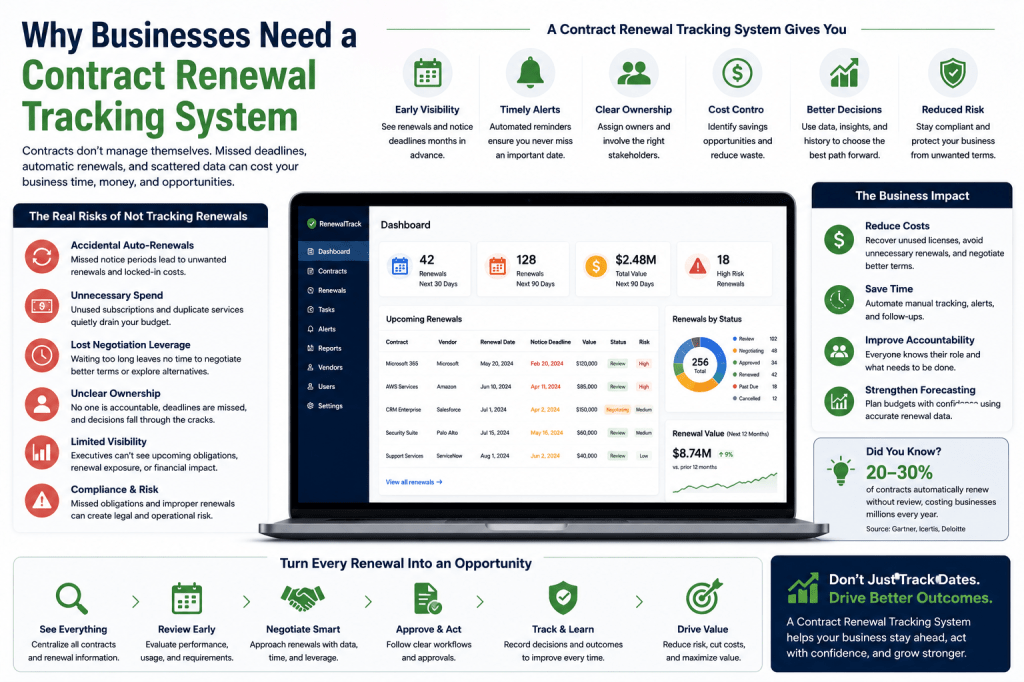
A renewal tracking system does much more than remind employees that a contract is about to expire. It creates visibility across the contract portfolio and gives the organization enough time to make deliberate commercial decisions before contractual deadlines remove its options.
The Real Problem Is Not Contract Storage
Many organizations already have somewhere to store contracts.
Contracts may be located in:
- SharePoint;
- Google Drive;
- OneDrive;
- Dropbox;
- document management systems;
- procurement applications;
- CRM systems;
- finance systems;
- email inboxes;
- shared network folders; or
- dedicated contract repositories.
Storage solves one problem:
Where is the contract?
It doesn’t necessarily solve another:
What do we need to do about this contract?
That distinction is critical.
A perfectly organized PDF stored in SharePoint can still automatically renew because nobody noticed its 90-day termination notice requirement.
Contract renewal management therefore requires an operational layer above document storage.
The Hidden Contract Portfolio
Ask a growing company how many active contracts it has and the answer may be surprisingly difficult to obtain.
Different departments often manage different agreements.
IT manages:
- Microsoft subscriptions;
- cloud services;
- cybersecurity tools;
- hosting;
- telecommunications;
- software licenses;
- managed services.
Marketing manages:
- advertising platforms;
- agencies;
- analytics tools;
- content services;
- marketing software.
Finance manages:
- banking;
- insurance;
- accounting services;
- payment providers.
Operations manages:
- facilities;
- maintenance;
- logistics;
- equipment;
- suppliers.
HR manages:
- recruitment services;
- payroll systems;
- HR platforms;
- training providers.
Sales manages:
- customer agreements;
- channel agreements;
- partnerships.
Legal may have copies of some contracts.
Procurement may have others.
Finance sees invoices but may not have the agreement.
The result is a distributed contract portfolio.
And distributed contracts create distributed renewal risk.
Problem 1: Accidental Auto-Renewals
Automatic renewal is one of the strongest reasons to implement contract renewal tracking.
Consider a business that signs a three-year software agreement.
The contract states:
The agreement automatically renews for successive twelve-month periods unless either party provides written notice at least 90 days before the end of the current term.
Three years later, nobody remembers the clause.
The company begins reviewing the software 45 days before expiration.
At that point, the contractual notice deadline may already have passed.
The organization may therefore discover that the agreement has automatically renewed for another year.
The problem isn’t necessarily the auto-renewal clause.
The problem is that nobody acted before the decision window closed.
A Contract Renewal Tracking System makes the notice deadline visible months earlier.
Expiration Date vs Action Deadline
This distinction deserves particular attention.
Suppose:
Contract expiration: December 31
Notice requirement: 90 days
The business shouldn’t begin thinking about the contract on December 1.
The relevant contractual deadline is approximately three months earlier.
And the organization’s internal review should probably begin earlier than that.
A better timeline might be:
180 days before notice deadline
Early review.
120 days
Assess supplier and business requirement.
90 days
Begin formal renewal process.
60 days
Complete commercial analysis.
30 days
Finalize decision.
Notice deadline
Required action completed.
The expiration date becomes almost the final event in the process rather than the beginning.
Problem 2: Unnecessary SaaS Renewals
Software subscriptions have dramatically increased the number of recurring contracts businesses manage.
A company may subscribe to:
- CRM software;
- project management;
- collaboration tools;
- cybersecurity;
- analytics;
- cloud infrastructure;
- design software;
- accounting systems;
- AI services;
- marketing automation;
- HR software;
- backup services;
- developer tools;
- communication platforms.
Each service may appear affordable individually.
Across an organization, however, SaaS expenditure can become substantial.
The renewal problem becomes especially important when usage changes.
Imagine:
Contracted licenses: 200
Active users: 126
Annual contract value: €72,000
Automatic renewal: Yes
If nobody reviews utilization before renewal, the company may purchase another year of 200 licenses even though 74 are unnecessary.
Renewal tracking therefore creates an opportunity for spend optimization.
Every Renewal Is a Commercial Checkpoint
Instead of treating renewal as an administrative event, businesses can treat it as a commercial checkpoint.
Before renewal, ask:
Do we still need this contract?
Are we using what we’re paying for?
Has the supplier performed well?
Has the price increased?
Have our requirements changed?
Are better alternatives available?
Can we negotiate better terms?
Should the contract be consolidated with another agreement?
Should we reduce quantities or licenses?
The renewal date creates leverage.
Once the contract automatically renews, much of that leverage may disappear.
Problem 3: Missed Negotiation Opportunities
Imagine a supplier proposes a 12% increase at renewal.
If the organization begins reviewing the agreement two weeks before the deadline, it has limited time to:
- challenge the increase;
- benchmark competitors;
- request alternative proposals;
- negotiate;
- obtain internal approval;
- plan migration;
- switch suppliers.
Starting six months earlier creates a very different negotiating position.
Time creates options.
A Contract Renewal Tracking System therefore doesn’t merely prevent missed deadlines.
It protects negotiating leverage.
Problem 4: Nobody Owns the Contract
Another common problem is unclear ownership.
A contract may originally have been signed by an employee who has since:
- changed departments;
- been promoted;
- left the organization;
- changed responsibilities.
The supplier continues sending invoices.
Finance continues paying them.
But nobody is actively responsible for reviewing the agreement.
This creates what could be called an orphan contract.
A renewal system should identify contracts without active owners.
For example:
Contract Owner: Unassigned
Annual Value: €48,000
Notice Deadline: 67 days
Status: Ownership Required
This transforms an invisible governance problem into an actionable task.
Contract Ownership Should Be Explicit
Every significant contract should have at least one accountable business owner.
Depending on the organization, additional stakeholders may include:
Business Owner
Responsible for determining whether the product or service is still required.
Procurement
Responsible for supplier and commercial negotiations.
Finance
Responsible for financial approval and budgeting.
Legal
Responsible for contractual terms where legal review is required.
IT/Security
Responsible for technical or security review.
The renewal tracker connects these stakeholders to the contract.
Problem 5: Renewal Information Is Buried Inside PDFs
Another difficulty is that contract renewal information often isn’t available as structured data.
It is buried inside documents.
A contract may contain 80 pages.
The relevant renewal provision may be in:
Section 14.3 — Term and Termination
or:
Schedule 4 — Commercial Terms
or even an amendment signed several years later.
The organization may know the expiration date but not:
- whether renewal is automatic;
- how long the renewal term lasts;
- how much notice is required;
- what form the notice must take;
- whether pricing changes;
- whether termination rights differ at renewal.
A Contract Renewal Tracking System converts these provisions into structured information.
From Contract Language to Renewal Data
Suppose a contract says:
This Agreement shall automatically renew for successive periods of twelve months unless either party provides written notice no later than sixty days before the expiration of the then-current term.
The tracker should capture:
Auto-renewal: Yes
Renewal period: 12 months
Notice period: 60 days
Notice method: Written
The system can then calculate the relevant deadline automatically.
This is especially powerful when AI assists with extracting the information.
Problem 6: Spreadsheet Tracking Doesn’t Scale Well
Many businesses begin with Excel.
That is perfectly reasonable.
A simple renewal spreadsheet may contain:
| Contract | Supplier | Renewal Date | Notice | Value | Owner |
|---|---|---|---|---|---|
| CRM | Supplier A | Dec 31 | 90 days | €35,000 | Sales |
| Cloud | Supplier B | Mar 1 | 60 days | €80,000 | IT |
| Support | Supplier C | Jun 30 | 30 days | €25,000 | Operations |
For 20 contracts, this may be sufficient.
For 200 contracts across ten departments, things become harder.
For 2,000 contracts, manual administration can become a significant operational problem.
The Spreadsheet Dependency Problem
A spreadsheet is only as reliable as the process around it.
Someone must remember to:
- add new contracts;
- remove terminated contracts;
- update amendments;
- calculate notice deadlines;
- change contract owners;
- update pricing;
- create reminders;
- monitor deadlines;
- chase decisions;
- record approvals;
- update renewal status.
If the person responsible for maintaining the spreadsheet leaves, the process may deteriorate quickly.
A dedicated system makes renewal monitoring process-driven rather than person-dependent.
Problem 7: Finance Cannot See Future Renewal Exposure
Contract renewals aren’t merely legal or procurement events.
They represent future financial commitments.
Suppose management asks:
How much contractual spend is coming up for renewal during the next six months?
Without structured contract information, answering that question may require contacting multiple departments and combining several spreadsheets.
A renewal tracker can provide the answer immediately.
For example:
Renewals next 30 days: €85,000
Next 90 days: €420,000
Next 180 days: €1.35 million
Next 12 months: €4.8 million
That information can improve financial planning.
Auto-Renewal Exposure
An even more useful metric is:
Value of contracts that will automatically renew unless action is taken.
Imagine a dashboard showing:
Auto-Renewal Exposure — Next 90 Days
14 contracts
€685,000 annual value
That is actionable management information.
It tells leadership exactly how much expenditure could become committed if no action is taken.
Problem 8: High-Value Contracts Receive the Same Attention as Small Ones
Not all contracts deserve equal effort.
Consider:
Contract A
Value: €600
Notice deadline: 30 days
Contract B
Value: €850,000
Notice deadline: 180 days
If the organization simply sorts contracts by the closest expiration date, Contract A may appear more urgent.
But Contract B may require:
- six months of negotiation;
- security review;
- executive approval;
- migration planning;
- competitive tender;
- legal review.
The business impact is far greater.
This is why sophisticated renewal tracking needs priority, not merely chronology.
Renewal Priority
A renewal priority model might consider:
Urgency
How soon must action occur?
Value
How much money is involved?
Risk
What happens if the contract renews automatically?
Strategic Importance
How critical is the supplier?
Complexity
How difficult would replacement be?
Performance
Is the current supplier meeting expectations?
A system can combine these factors into a priority score.
For example:
Renewal Priority: 91/100 — CRITICAL
Now management knows where to focus attention.
Problem 9: Contract Decisions Aren’t Documented
Suppose a contract is renewed.
Six months later someone asks:
Why did we renew this supplier despite the price increase?
Without a structured process, the answer may exist only in email conversations.
A renewal tracker can record:
Decision: Renew
Date: October 14
Decision owner: IT Director
Reason: Migration risk exceeds short-term savings.
Approved by: CFO
New value: €210,000
Next renewal: December 31, 2027
This creates institutional memory.
Auditability Matters
A proper audit trail can record:
- who changed contract data;
- who reviewed the renewal;
- who approved the decision;
- what recommendation was made;
- when reminders were sent;
- when tasks were completed;
- what documents were uploaded;
- what action was taken.
This becomes valuable for governance, internal control, compliance, and future decision-making.
Problem 10: Contract Knowledge Leaves With Employees
Employee turnover creates another renewal risk.
Imagine the employee who negotiated an important supplier contract leaves the company.
They understood:
- why the supplier was selected;
- which concessions were negotiated;
- which clauses mattered;
- what pricing discussions occurred;
- what problems existed;
- what should happen at the next renewal.
If this context exists only in the employee’s memory and email inbox, much of it disappears.
A structured renewal system preserves more of this knowledge.
The Business Case for Contract Renewal Tracking
The business value of renewal tracking can be grouped into several areas.
1. Prevent Unwanted Renewals
Avoid contracts continuing because deadlines were missed.
2. Reduce Costs
Identify unused services, excessive licenses, duplicate suppliers, and unnecessary agreements.
3. Improve Negotiations
Begin renewal discussions while enough time remains to create alternatives.
4. Improve Forecasting
Understand future contractual commitments.
5. Reduce Risk
Identify approaching notice deadlines and problematic contract terms.
6. Improve Accountability
Assign owners and track responsibilities.
7. Improve Governance
Create consistent renewal and approval processes.
8. Preserve Knowledge
Maintain decision history and contractual context.
A Simple ROI Example
Consider a company with:
250 active contracts
Annual contracted spend: €5 million
Suppose better renewal management produces only a modest:
2% reduction in unnecessary renewal expenditure
That represents:
€100,000 per year
The savings could come from:
- unused licenses;
- terminated services;
- reduced quantities;
- negotiated pricing;
- consolidated suppliers;
- prevented auto-renewals.
And this calculation doesn’t include the value of reduced risk, better forecasting, or improved employee productivity.
At larger contract volumes, even small improvements can become financially significant.
Renewal Tracking and Procurement
Procurement teams benefit particularly from early visibility.
Instead of discovering a contract shortly before renewal, Procurement can see the future pipeline.
For example:
Q1
18 contracts — €420,000
Q2
31 contracts — €1.1 million
Q3
24 contracts — €780,000
Q4
42 contracts — €1.6 million
This allows procurement teams to plan:
- negotiations;
- supplier reviews;
- competitive tenders;
- consolidation;
- resource requirements.
Renewal tracking becomes a procurement planning tool.
Renewal Tracking and Finance
Finance gains visibility into recurring contractual commitments.
Questions become easier to answer:
Which large contracts renew next quarter?
What price increases are expected?
Which contracts are being renegotiated?
Which subscriptions could potentially be eliminated?
How much spend is automatically renewing?
This connects contract management with budgeting and forecasting.
Renewal Tracking and Legal
Legal teams don’t necessarily need to manage every renewal.
Instead, the system can route contracts to Legal only when necessary.
For example:
IF contract terms changed
THEN Legal review required.
Or:
IF termination dispute exists
THEN Legal review required.
Or:
IF non-standard renewal clause detected
THEN Legal review required.
This helps Legal focus on higher-risk situations.
Renewal Tracking and IT
IT departments frequently manage large numbers of recurring agreements.
Examples include:
- SaaS;
- cloud infrastructure;
- support;
- hardware maintenance;
- cybersecurity;
- telecommunications;
- managed services;
- data platforms;
- developer tools;
- software licensing.
These contracts often represent substantial recurring expenditure.
A renewal system allows IT to combine:
contract terms + cost + utilization + performance + risk
before making the renewal decision.
Renewal Tracking and Management
Executives generally don’t need to inspect individual renewal clauses.
They need portfolio-level information.
For example:
Contract value renewing this year
€8.2 million
High-risk renewals
17
Automatic renewal exposure
€1.4 million
Potential savings identified
€320,000
Decisions overdue
8
Contracts without owners
11
That turns renewal management into an executive control mechanism.
Why Alerts Alone Aren’t Enough
Some organizations attempt to solve renewal management using calendar reminders.
For example:
Outlook reminder — Software contract expires in 90 days.
This is better than nothing.
But it still leaves unanswered:
Who is responsible?
What is the notice deadline?
What is the annual value?
Is the contract auto-renewing?
What review is required?
Has the supplier performed well?
What decision has been made?
Does Finance need to approve it?
Has Procurement started negotiation?
The problem isn’t merely notification.
It is workflow coordination.
From Reminder to Workflow
A modern renewal process might work like this:
Review window opens
↓
System creates renewal assessment
↓
Contract owner is notified
↓
Usage and performance are reviewed
↓
Risk and priority are calculated
↓
Recommendation is prepared
↓
Procurement negotiates
↓
Finance approves
↓
Legal reviews if required
↓
Decision is executed
↓
Outcome is recorded
The system manages the process rather than simply announcing a date.
AI Changes the Economics of Contract Review
Historically, extracting information from large contract portfolios required substantial manual effort.
AI can reduce that burden.
A modern system can assist with:
- document classification;
- contract text extraction;
- renewal-clause retrieval;
- date extraction;
- notice-period extraction;
- auto-renewal detection;
- pricing-term extraction;
- obligation identification;
- contract summaries;
- risk identification.
The extracted information should still be verifiable against the source document, particularly when it affects legal or financial decisions.
But AI can dramatically accelerate the first-pass analysis.
AI Can Also Prioritize Renewals
Once contracts are structured, AI and deterministic scoring can help identify which renewals require attention.
For example:
Contract: Enterprise Cloud Agreement
Annual Value: €450,000
Notice Deadline: 74 days
Auto-Renewal: Yes
Renewal Period: 24 months
Price Increase: 15%
Supplier Performance: Medium
The system could identify this as a high-priority renewal and explain why.
This helps teams focus limited time on the contracts with the greatest potential impact.
From Reactive to Proactive Contract Management
Without renewal tracking, the process often looks like this:
Supplier sends renewal invoice
↓
Business realizes contract renewed
↓
Someone searches for agreement
↓
Notice deadline has passed
↓
Business accepts renewal
That is reactive contract management.
A better model is:
System detects upcoming renewal
↓
Review begins months earlier
↓
Business need is evaluated
↓
Usage and supplier performance are reviewed
↓
Alternatives are considered
↓
Negotiation begins
↓
Decision is approved
↓
Renewal or termination is executed before deadline
That is proactive renewal management.
When Does a Business Need a Contract Renewal Tracking System?
There isn’t a universal number of contracts.
However, several warning signs indicate that manual tracking is becoming inadequate.
A business should consider a dedicated system when:
- contract renewals are being missed;
- spreadsheets are becoming difficult to maintain;
- multiple departments manage contracts;
- automatic renewals are common;
- SaaS spending is increasing;
- nobody has a complete contract inventory;
- contract ownership is unclear;
- renewal negotiations start too late;
- management cannot see upcoming renewal exposure;
- approval processes are inconsistent;
- employees spend significant time chasing renewal information;
- high-value contracts lack structured review;
- contract knowledge disappears when employees leave.
The more of these conditions that apply, the stronger the case becomes.
A Contract Renewal Tracking Maturity Model
Organizations can progress gradually.
Stage 1 — Reactive
Contracts are stored in folders and employees remember renewals.
Risk: Very High
Stage 2 — Spreadsheet
Important contracts and dates are manually tracked.
Risk: High to Medium
Stage 3 — Centralized Tracking
Contracts, renewal dates, notice periods, and owners are centralized.
Risk: Medium
Stage 4 — Workflow Management
Alerts, tasks, approvals, escalations, and dashboards are automated.
Risk: Lower
Stage 5 — Renewal Intelligence
AI extraction, risk scoring, priority scoring, recommendations, and portfolio analytics are introduced.
Capability: Proactive
Stage 6 — Renewal Automation
Policies automatically coordinate low-risk actions while important decisions remain under human control.
Capability: Intelligent and scalable
This maturity path allows organizations to improve incrementally rather than attempting to automate everything immediately.
The Bigger Opportunity: Renewal Intelligence
The strongest business case isn’t simply:
We need software that reminds us about contracts.
It is:
We need visibility and control over recurring contractual commitments.
Once the system understands contracts, suppliers, dates, notice periods, values, usage, performance, risks, and decisions, it can answer increasingly valuable questions.
For example:
Which contracts represent the greatest renewal risk?
How much spend automatically renews during the next quarter?
Which subscriptions are underutilized?
Which suppliers should be renegotiated?
Which renewals are overdue for a decision?
Which contracts could potentially be consolidated?
Where are prices increasing fastest?
Which departments have the highest renewal exposure?
Which renewal decisions generated savings last year?
These are management questions, not calendar questions.
That is why the natural evolution of a Contract Renewal Tracker is toward a Contract Renewal Intelligence Platform.
Final Thoughts
Businesses don’t usually lose control of contract renewals because contracts are inherently impossible to manage.
They lose control because contract information is fragmented.
The document is in one system.
The invoice is in another.
The owner is in another department.
The deadline is in someone’s calendar.
The supplier history is in email.
The pricing information is in Finance.
The performance information is in IT.
And the renewal clause is buried on page 47 of a PDF.
A Contract Renewal Tracking System brings those pieces together.
It gives businesses enough time to evaluate their options before renewal becomes unavoidable.
The value therefore goes far beyond reminders.
A well-designed system can help an organization:
prevent accidental renewals;
reduce unnecessary expenditure;
protect negotiating leverage;
improve financial forecasting;
identify renewal risks;
assign accountability;
standardize decision-making;
and ultimately:
turn every important contract renewal into a deliberate business decision.
Next in the Contract Renewal Tracker Series
Article 4 — How to Track Contract Renewal Dates Without Spreadsheets
The next article examines practical alternatives to Excel and Google Sheets, including centralized renewal databases, contract repositories, automated deadline calculation, configurable alerts, dashboards, workflows, integrations, and AI-assisted contract intake. It will also explain how an organization can migrate an existing contract-renewal spreadsheet into a structured tracking system without losing its current contract data.

